Showing posts with label Austria. Show all posts

Saturday, November 23, 2013

Lega Nord, Flemish Separatists, Others at Secret Vienna Summit Plot Far-Right Slate for Strasbourg


On November 15th, in Vienna, Austria, history of a sort was made as seven far-right parties from across Europe met in secret to form the beginnings of a coherent voting bloc that could try to push their shared decentralist, anti-Brussels, anti-immigrant agenda in the May 2014 European Parliament elections.

Flemish nationalism and religious bigotry on display at a Vlaams Belang rally
The parties involved were: Belgium’s ethnic-separatist Flemish Interest (Vlaams Belang, or V.B.) party, France’s notorious but influential National Front (Front national, or F.N.), the NetherlandsParty for Freedom (Partij voor de Vrijheid, or P.V.V.), the neo-Nazi-tinged Freedom Party of Austria (Freiheitliche Partei Österreichs, or F.P.Ö.), the Swedish Democrats (Sverigedemokraterna, or S.D.), the Slovak National Party (Slovenská národná strana, or S.N.S.), and Italy’s Northern League (Lega Nord), which seeks a separate republic called Padania.   Two other parties which planned to attend cancelled at the last minute: the United Kingdom Independence Party (UKIP), which wants the U.K. to leave the European Union (E.U.), and Alternative for Germany (Alternative für Deutschland, or AfD), a rather ideologically mild party by this summit’s standards, which wants Germany to abandon the euro but not the E.U.  The Netherlands’ Party for Freedom (Partij voor de Vrijheid, or P.V.V.) was also not at the summit, but its membership in the new alliance is assumed; two days earlier, its founder, Geert Wilders, had met with the F.N.’s leader, Marine Le Pen, to declare a new working relationship.  (Wilders, whose party is unlike the F.N. not anti-gay or anti-Semitic—they prefer to focus their energies on hating just Muslims—had earlier been wary of associating too closely with the F.N. and even forbade P.V.V. members of European Parliament (M.E.P.s) from sitting next to F.N. ones.)

The Dutch ultranationalist GeertWilders
Not all of these movements believe in the same kind of decentralism.  Vlaams Belang would like to see the Kingdom of Belgium dissolved and replaced by the separate independent states of Flanders, Wallonia, and maybe even Brussels and the German-Speaking Communities (an autonomous sliver of Wallonia along the German border).  And Lega Nord would like to see a Federal Republic of Padania with significant self-rule for regions such as Lombardy, Liguria, and Venetia, as well as enhanced linguistic rights for German-speakers in the South Tyrol, speakers of Arpitan/Savoyard French and Walserdeutsch in Val d’Aosta, and speakers of Friulian and Ladin near the borders with Switzerland and Austria.

Umberto Bossi, founder of Italy’s Northern League
The Swedish Democrats, on the other hand, want the trans-national and ultimately toothless Sami Parliament, which represents indigenous northern (Lappish) people in Norway, Sweden, and Finland, shut down, while the Slovak National Party pounces on any attempts by the Hungarian-speaking minority in the Slovak Republic to secure more linguistic or cultural rights—fearing the kind of Magyar irredentism that haunts autonomy movements in Serbia’s Vojvodina province (see my recent article) and Romania’s Transylvania region (see my article on this).  And, even though the National Front’s founder, Jean-Marie Le Pen, was born in a village in a Brittany, his party recently called any government efforts to preserve minority languages like Breton, Occitan, Basque, Catalan, and Alsatian German “pure madness” (ironically, since France already has the nastiest policies in western Europe when it comes to linguistic rights).

The National Front’s Marine Le Pen, as portrayed at a controversial Madonna concert
But one thing all parties can agree is an opposition to European integration and hostility toward immigrants, especially Muslim ones.  The F.P.Ö. leader, Heinz-Christian Strache, said, in announcing the meeting after the fact, “There are many important patriotic parties in Europe that have recognised problems and are prepared to work together,” adding that there is now “a real chance that with the partnership that we’re working on we can have a strong parliamentary group.”


Make no mistake, this is not a move of desperation by these disparate groups but an attempt to capitalize on existing momentum.  The F.P.Ö. currently has only two seats in the European Parliament in Strasbourg, won with 12.7% of the Austrian vote in 2009 elections, but earlier this year it took more than a fifth of the popular vote in national parliamentary elections and is considered to be on a roll.  The F.N. is also expected to enlarge its current three-seat delegation.  The Slovak nationalists have one of Slovakia’s 13 European seats, but none in the national body.  Many expect UKIP to dislodge the U.K.’s ruling-coalition junior partner, the Liberal Democratic Party, as the country’s number-three party, at least in Strasbourg.  Vlaams Belang is also optimistic: the more moderate separatist party, the New Flemish Alliance (Nieuw-Vlaamse Alliantie, or N.-V.A.), is expected to become the ruling party in Belgium in next year’s national elections, which will only raise V.B.’s profile and influence.  The euro crisis has obviously played a large role in all of this.

One of Vlaams Belang’s more controversial ad campaigns
But in order to form a functioning, recognized slate in the European Parliament, a coalition needs seven parties from seven different E.U. member states and 25 seated parliamentarians.  To fill this out, they have had not much luck in reaching toward the more moderate end of the Europhobic spectrum.  The Danish People’s Party (Dansk Folkeparti, or D.F.), which controls 13.8% of Denmark’s parliament, turned down an offer to join the group, citing mainly fear of association with the Le Pens and their anti-Semitism.  That might leave the extremist F.P.Ö., which is spearheading the slate, to reach out to the farther right fringe for new allies, such as Hungary’s Jobbik: Movement for a New Hungary (Jobbik Magyarországért Mozgalom), the neo-Fascist Tricolor Flame Social Movement (Movimento Sociale Fiamma Tricolore, or M.S.–F.T.) in Italy, Spain’s Phalangists, Romania’s New Right (Noua Dreaptă), or the openly neo-Nazi paramilitary movement in Greece, Golden Dawn (Laïkós Sýndesmos–Chryssí Avgí), which has benefited from anti-northern, anti-Brussels feeling in the recent currency crisis but has recently been all but shut down by the Greek government.

Members of Greece’s Golden Dawn party.  That kind of angled curly thing in the middle of their flag?
Um, that’s, um, that’s supposed to represent Theseus and the Minotaur in the Labyrinth.  Yeah, that’s it.
(It would be less politic perhaps for the alliance to reach out to the neo-Fascist British National Party (B.N.P.) or Anglo-separatist English Democrats—largely in some ways an outgrowth of the B.N.P.—for fear of alienating the more moderate and successful UKIP.  (See a recent article on the English Democrats from this blog—which even features its founder, Robin Tilbrook, chiming in critically on the comment thread!).)

Robin Tilbrook of the English Democrats
This right-wing fringe constitutes more natural allies for the extremist F.P.Ö.  The party rose to prominence under the leadership of Jörg Haider, a confidante of Saddam Hussein and Moammar al-Qaddafi who once called the Waffen-S.S. “decent men of good character” and referred to Nazi death camps as merely “punishment camps.”

The late Austrian neo-fascist leader Jörg Haider.
Most Europeans’ complete and utter lack of any kind of gaydar whatsoever
(I mean, come on, people—right?) preserved his reputation until his death.
(Haider, who was married and loudly homophobic, died in a car crash in 2008—on his way, as it was revealed posthumously, to his grandmother’s 90th-birthday party from a gay bar in Klagenfurt, where he had had a lover’s spat with his “LebensmenschStefan Petzner.  As further evidence that there is an element of self-loathing in all bigotry, the head of Hungary’s virulently anti-Semitic Jobbik movement, Csanád Szegedi, was revealed last year—as reported at the time in this blog—to be Jewish himself.  He has since experienced a personal political transformation and has embraced his Judaism.  There is little of such wisdom or courage—belated though it was—among most of Europe’s far-right fringe.)

Csanad Szégedi’s new look.
Which way the new far-right alliance will swing as it seeks sufficient breadth to secure a place at the table in Strasbourg will depend on the volatility of European politics in this time of financial crisis—and ultimately it will determine the success of the movement, and its effect on European policy, as well.

Strasbourg or bust?  The Slovak National Party on parade


[You can read more about many of these and other separatist and new-nation movements, both famous and obscure, in my new book, a sort of encyclopedic atlas just published by Litwin Books under the title Let’s Split! A Complete Guide to Separatist Movements and Aspirant Nations, from Abkhazia to Zanzibar.  The book, which contains 46 maps and 554 flags (or, more accurately, 554 flag images), is available for order now on Amazon.  Meanwhile, please “like” the book (even if you haven’t read it yet) on Facebook and see this special announcement for more information on the book.]


Monday, September 9, 2013

Croatia Honors ’70s Terrorist Hijacker with Hero’s Funeral


Leading Croatian politicians joined nationalists and others in the downtown of Zagreb, Croatia’s capital, on September 4th to give a hero’s funeral to Zvonko Bušić, who in 1976, in the years of Yugoslavia’s Communist dictatorship, hijacked an American jetliner in a series of horrific events that ended in the death of a New York policeman.  For the political mainstream in a western nation—the European Union’s newest member—to so honor a killer who threatened the lives of hundreds of civilians for a political cause (that’s the definition of terrorism, by the way) is part of the topsy-turvy world of post-Yugoslav symbolic politics in the new Europe, where everything Croats do is forgiven and Serbs can do nothing right.

The hijackers’ perp walk
Bušić—who was born in 1946 in Gorica (now in Bosnia and Herzegovina, on the Croatian border) and immigrated to the United States—hijacked a Trans-World Airlines (T.W.A.) flight from New York to Chicago in 1976 in league with his wife (a nurse from Oregon) and three other Croatian-Americans.  The five threatened to blow up the plane and detonate another device in a locker in New York City’s Grand Central Station unless a Croatian declaration of independence were printed in leading newspapers and leafleted over five major world cities.  Those demands were met, but it turned out the “bomb” on the plane was a fake prop, while the Grand Central Station bomb was real—but was not intended to go off (so Bušić later said).  The idea was that police, after being given directions to the rail-station locker by the hijackers, would find the real bomb and falsely believe that the one on the plane was also real.  While none of the 80-plus airline passengers was harmed, a New York City police officer died trying to disable the Grand Central bomb when it exploded.  Another policeman was blinded and two others wounded.  The plane was diverted to Paris, and French police, showing more interventionist gumption than the Americans—or, if you prefer, more recklessness, tempered with luck—shot out the wheels and forced the hijackers to surrender.

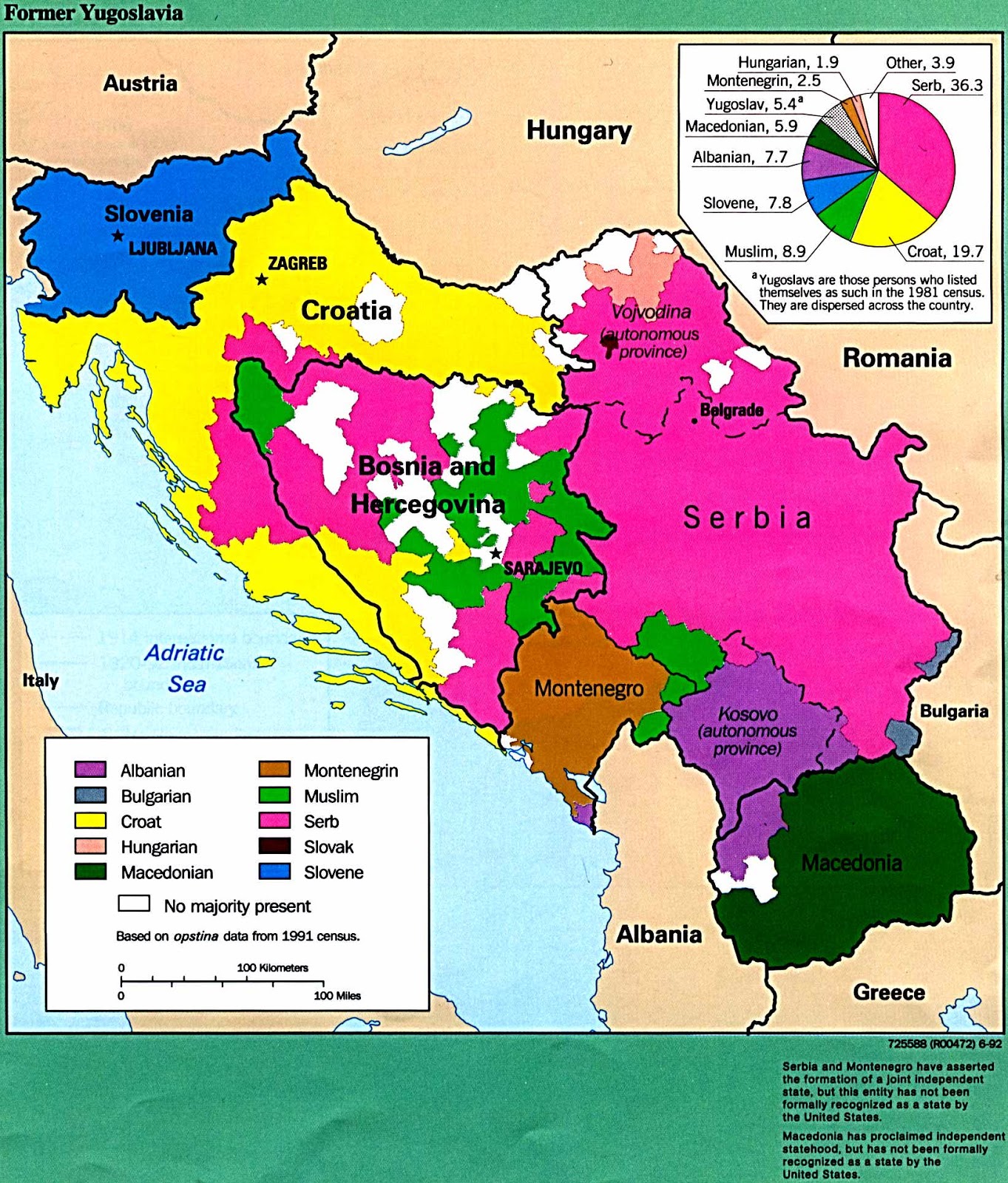
An only slightly outdated map of the former Yugoslavia
In 1977, Bušić and his wife, Julienne Eden Bušić, received life sentences for air piracy in an American court.  In 1987, Bušić escaped from prison in New York state but was apprehended on the run in Pennsylvania shortly after.  Two years later, Mrs. Bušić was released.  In 2008, seventeen years after the Republic of Croatia regained its independence amid the rubble of Leninism, Bušić was paroled on good behavior (a move decried by New York police and others) on condition that he leave the U.S. for good.  He returned to his native Croatia and was active in nationalist politics.  On September 1st, at their home near Zadar, on the Dalmatian coast, Julienne found her husband’s body beside a suicide note, a bullet in his head.

Black banners and the glorification of violence—old habits die hard.
(A scene from Bušić’s funeral.)
Bušić had in later life said of his crimes, “If I had ever imagined that anyone could have been hurt, I would never, even if it had cost me anonymous death at Yugoslav hands, embarked on that flight.”  But in his defense he also called the hijacking “the scream of a disenfranchised and persecuted man.”  By most accounts, the T.W.A. passengers were not mistreated.  One later said, “They had nothing against us, but wanted only to get a story across.  They were concerned for our welfare, and we were treated well during most of it.”  The cop who found Bušić after his prison bust said of him, “He seemed very intelligent and articulate, basically a very gentle man.  He was just worn out.”

Julienne and Zvonko Bušić in later life
Nonetheless, he was a terrorist, and it seems odd that the Croatian political mainstream would celebrate their integration into “civilized” Europe—they joined the E.U. the month before last—by putting on a pedestal a man who caused such suffering while also not advancing the Croatian nationalist cause an inch.  (He may even have harmed it.)  But Croatian nationalists can perhaps be forgiven for such illogicality.  The West—and especially the United NationsInternational Criminal Tribunal for the Former Yugoslavia (I.C.T.Y.) in the Hague, in the Netherlands—seems determined to read the Wars of Yugoslav Succession in the 1990s as simply a war of nasty, dirty Serbs against everyone else.

Croatia (in purple) within the European Union (blue and purple)
Croatian nationalism as it emerged after the fall of the Berlin Wall in 1989 was largely built upon the ashes of the Nazi puppet state known as the Independent State of Croatia, which existed briefly during the Second World War.  The stormtroopers of Croatia’s dreaded fascist terrorist militia of that era, the Ustaša, were never discredited and scorned in the post-war era in the way that their counterpart in Germany—the Schutzstaffel (S.S.)—was.  Unlike Germany, Italy, and Japan, Croatia never undertook the earnest, apologetic soul-searching after the war to atone for their role in the rise of fascism.  Like France and Austria, Croatian nationalists disingenuously managed to persuade themselves and most of the world that they had been only the victims of fascism, never perpetrators.  (Ironically, Kurt Waldheim, the former United Nations secretary general who was elected to Austria’s presidency in 1986 even after it was revealed that he was complicit in Nazi war crimes, served as a Wehrmacht officer in a fascist-Croatian-occupied area of what is now northwestern Bosnia, for which he was awarded the Nazi puppet state’s Medal of the Crown of King Zvonimir.)  The newly revived independent Croatia after 1991 shamelessly resurrected the symbols and banners of the Ustaša.  Nor was that empty romanticism: in the wars that followed, Croatian nationalists tried to purge Serbs from Croatia—and from Bosnia and Herzegovina—nearly as ruthlessly as Serbs tried to purge Croats and Bosniaks from Serb-controlled terrorities.  Though it was Serbia that brought the practice of ethnic cleansing to the most horrific levels, the term was in fact first coined to describe what Croats were doing to Bosniaks in the early 1990s.

Kurt Waldheim (middle)
The West, during the Yugoslav Wars of Succession, needed a Hitler-like enemy, and the Serbs (nasty as Serbian nationalist violence actually was, mind you) fit the bill nicely.  Unfortunately, this also meant overlooking the atrocities of the Serbs’ enemies.  The fact that the Serbian capital, Belgrade, had also been the capital of Communist Yugoslavia, and that Serbs politically dominated the federation, was doubtless part of it.  But there was also a xenophobic subtext: Croatians are Catholic and use the Roman alphabet and have long-standing cultural ties with neighboring states like Italy and Austria; Serbs, meanwhile, are Cyrillic-alphabet-using Eastern Orthodox Christians—practically Saracens in the eyes of many ordinary Western Europeans.  They were easy to demonize.  Their concentration camps and the thunderous rhetoric of their nationalists made it easy too, as did the fact that Russia, then as now, tends to side with the Serbs.  Never mind that both Serbia’s president, Slobodan Milošević, and Croatia’s, Franjo Tuđman, had both allegedly conspired, in the early stages of the wars, to carve up Bosnia and Herzegovina to add to their own mini-empires.

Franjo and Slobo occasionally found things to agree on.
The international community’s double standard was most evident late last year, when (as reported at the time in this blog), two Croatian war criminals and one from the Kosovo Liberation Army (K.L.A.) were cleared by the I.C.T.Y. of all charges, including charges of torturing and killing defenseless Serbs, Roma (“Gypsies”), and collaborationist ethnic-Albanians in prison camps.  Sickeningly, the three were treated in their communities as returning heroes, and Serbs and Russians were suitably appalled.  The I.C.T.Y. has yet to fully demonstrate that they believe the lives of Serbian civilians are worth as much as those of Croats, Bosniaks, and Kosovars.

Croatian nationalists celebrating the acquittal of Croatian mass murderers last year
Serbian war criminals, make no mistake, have been among the nastiest of all the world’s nasties.  Bušić’s nemesis, the part-Croatian, part-Slovenian dictator Josip Broz Tito was another one (and a worse one than Bušić).  But the world is full of nasties, some of them even ending up on the winning side of wars.  None of them should be given heroes’ funerals.

[Also, for those who are wondering, yes, this blog is tied in with a forthcoming book, a sort of encyclopedic atlas to be published by Auslander and Fox under the title Let’s Split! A Complete Guide to Separatist Movements, Independence Struggles, Breakaway Republics, Rebel Provinces, Pseudostates, Puppet States, Tribal Fiefdoms, Micronations, and Do-It-Yourself Countries, from Chiapas to Chechnya and Tibet to Texas.  Look for it some time in 2013.  I will be keeping readers posted of further publication news.]

Saturday, December 15, 2012

Sandy Island May Not Exist, but Now It Has a King


Last month, media attention was drawn to Sandy Island (a.k.a. Île du Sable), in the Coral Sea between Australia and New Caledonia when a University of Sydney plate-tectonics surveying ship headed to the island to investigate discrepancies in their charts and found out there was nothing there but open sea.  They had seen the island on Google Maps and Google Earth—shown as being in the territorial waters of New Caledonia and, thus, of the French Republic—but it has also appeared in numerous atlases and other sources.  Nor is this a mere location error.  Sandy Island doesn’t exist and has never existed.  Its posited existence and position were traced first to a 1908 map and then to one by the legendary British explorer Capt. James Cook from 1774.  The island’s non-existence was not very loudly suspected, if at all, but was unconfirmed for centuries.


Now, a German man calling himself King Marduk I has laid claim, on behalf of the State Kingdom of Marduk, to Sandy Island, which he claims does indeed exist and which he names after himself, i.e. King Marduk Island.  The self-styled king, who is named for a Babylonian god (or possibly for the eponymous alleged tenth planet of our solar system “discovered” by the crackpot archaeo-astronomer Zechariah Sitchin), several years ago tried to claim the Principality of Sealand, the disused World War II derrick off the coast of Essex, England, which is one of the modern world’s best known and most successful “micronations.”

His Majesty, King Marduk I
Marduk declared this week on his website (in language that suggests he relies as heavily on Google Translate to render his German into  Englissh as he does on Google Maps to tell him which islands exist or don’t exist): “H. M. KING MARDUK I DECLARE THAT THE SINCE DECADES OF STATE FREE ISLAND TERRITORY UNDER THE NAME CALLED ‘SANDY ICELAND’ [sicTHE PACIFIC LOCATEDALWAYS NO STATE EITHER COUNTRY COURSE LISTENING BETWEEN AUSTRALIA AND EAST OF WHICH LOCATED COLONIAL COUNTRY NEW CALEDONIATHE SANDY ISLAND LOCATEDTHOSE LEGAL UNVERWERFLICH NO PHANTOMS ISLANDBUT ACTUALLY EXIST IN POSITION [WGS84] 19°13'6.43"S, 159°55'23:42"E – 19.218451°, 159.923172 ° [UTM] 57K 597040 7874744 INTERNATIONAL REGISTERED LOCATEDFROM A STATE SURVIVE FREE TERRITORY ISWHERE THIS ISLAND SINCE 1922 ON CARD DOCUMENTEDRECENTLY THE UNITED NATIONS IN 2002 TO YOUR DECREE CONFIRMED THIS ISLAND.”

An image from the Kingdom of Marduk website
Other territories Marduk claims for his kingdom (called, in some reference, New Germania) include: much of the eastern Alps, including the Austria’s Vorarlberg state, the Italian region of South Tyrol, Liechtenstein, and parts of Switzerland and Bavaria around, and including, Lake Constance (Bodensee); various localities in the Swiss cantons of Schaffhausen and the cities of Basel and Bern; the entire former Kingdom of Württemberg; the Dogger Bank, the German island of Heligoland, and the artificial island Langlütjen, all in the North Sea; Hamburg and, by extension, the Baltic Sea; the island of Rockall, between Scotland and Iceland (and itself once the location of a publicity-stunt micronation called Waveland); Vatican City; the micronation of Seborga, on the border between Italy and France; parts of Ticino, in southern Switzerland; Jerusalem; and—why aim low, right?—all of outer space.

The former micronation of Waveland, in the North Atlantic
—claimed also by the Kingdom of Marduk.
Little is known about King Marduk himself, but a Swiss journalist who reported recently on Marduk’s royal territorial claims on the town of Büsingen, Schaffhausen, quoted the kingdom’s secretary of state, one Thomas Vogel, as saying—with a kind of wild inconsistency—that his monarch “shuns publicity and does not want to be recognized.  He lives in Tübingen in a stately residence, not a castle.  He has a huge royal fleet with twelve cars for state visits such as Jaguars and Mercedes.  Apart from a Rolex, he has not a lot of wealth.  The king is wise as a professor and lives rather modestly.”  The reporter, Hermann-Luc Hardmeier, who interviewed the bling-laden “Vogel” in Büsingen after his arrival in a limousine, seemed sure that “Vogel” was merely “Marduk” in disguise, but photographs of the monarch do not much resemble the man Hardmeier interviewed.

The Kingdom of Marduk’s secretary of state, Thomas Vogel,
arriving for an important press conference with a reporter from the Schaffhauser Nachrichten
Going back to Sandy Island—the French government has not yet responded to Marduk’s claims on its territory, but then again Paris has also reacted not at all to the fact that an island which it thought it owned now does not exist and what the implications are for its maritime boundaries.  Nor have their been responses from the separatist movement in New Caledonia or from an unrecognized nation which claims waters (which the world grants to Australia) just to the west of “Sandy Island”: the Gay and Lesbian Kingdom of the Coral Sea Islands.  Theoretically, this could get ugly.

Postage stamps produced by the Gay and Lesbian Kingdom of the Coral Sea Islands.
It’s nice to finally see the “bear” subculture honored with a stamp.
Here at “Springtime of Nations,” we will keep you posted on any further developments regarding non-existent islands.

[For those who are wondering, yes, this blog is tied in with my new book, a sort of encyclopedic atlas just published by Litwin Books under the title Let’s Split! A Complete Guide to Separatist Movements and Aspirant Nations, from Abkhazia to Zanzibar.  (That is shorter than the previous working title.)  The book, which contains 46 maps and 554 flags (or, more accurately, 554 flag images), is available for order now on Amazon.  Meanwhile, please “like” the book (even if you haven’t read it yet) on Facebook and see this special announcement for more information on the book.]


Saturday, November 17, 2012

Kosovo Recognized by Timor-Leste, K.L.A. War-Crimes Arrests, an E.U. Ultimatum, and Hashim Thaçi’s Underground Sex Slaves: Kosovo Update, 11-17 November 2012


European Parliament Says Serbia Cannot Join without Recognizing Kosovo.  The European Parliament’s rapporteur for Kosovo, Ulrike Lunacek, said this week that the Republic of Serbia will not be allowed to join the European Union (E.U.) unless it grants diplomatic recognition to the Republic of Kosovo, the de facto independent state which most E.U. member states recognize but which Serbia still regards as part of its territory.  She did not express the ultimatum as a punishment for Serbia, saying, “The E.U. will not allow another Cyprus in the E.U.  The E.U. will not accept any country without defined borders.”  Lunacek, who represents Austria in the E.P. for the Green Party, also ruled out any partition of Kosovo.

Timor-Leste Becomes 94th Nation to Recognize Kosovo.  The partially recognized Republic of Kosovo received notice this week from one of the world’s youngest United Nations (U.N.) member states, the Democratic Republic of Timor-Leste, that it will be extending diplomatic recognition to Kosovo.  Timor-Leste (also known as East Timor), which became independent in 2002 after a U.N.-sponsored plebiscite end military occupation by Indonesia, is, at my count, the 94th nation, out of about 193 recognized sovereign states, to recognize Kosovo, following Papua New Guinea and the Republic of Burundi in October (as reported last month in this blog, at which point I also discussed some discrepancies over how to count Kosovo’s diplomatic partners).

Timor-Leste, a.k.a. East Timor, is Kosovo’s newest diplomatic partner.
E.U. Arrests 3 Former Kosovo Rebels on War-Crimes Charges.  Three former members of the Kosovo Liberation Army (K.L.A.), two of them currently serving in the North Atlantic Treaty Organization’s Kosovo Security Force (K.S.F.), were arrested this week by European Union (E.U.) police on war-crimes charges.  Reports indicate that the murder of two ethnic-Albanian supporters of the moderate politician Ibrahim Rugova in 1999.  The arrests were made by the E.U. Rule of Law Mission in Kosovo (Eulex).

E.U. Lays Corruption Charges against 7 Kosovars, Including Former Transport Minister.  The European Union Rule of Law Mission in Kosovo (Eulex) announced November 16th it had charged the Republic of Kosovo’s former minister of transport and communications and six other Kosovar Albanians with corruption.  The former minister, Fatmir Limaj, is the second-in-command in the Democratic Party (P.D.K.), Kosovo’s ruling party.  Charges against the seven include “manipulating tender procedures, giving and receiving bribes, and obstructing evidence.”

Fatmir Limaj
Slav Media Run Lurid Tales of Kosovo Prime Minister’s Underground Harem.  The organ-harvesting allegations (a hospital in the Netherlands was tapped by Interpol this week to investigate accusations of organ-trafficking by Kosovo rebels in the 1990s) don’t seem to be enough.  Several newspapers in the Balkans this week are running reports on interviews with a woman from Ukraine identified only as “N.M.” who describes escaping from what she calls an underground “hell hole” in which the prime minister of the Republic of KosovoHashim Thaçi, operates a “harem” with 52 sex slaves.  “None of the girls were from Kosovo,” N.M. said; “there were few from the Balkans, about ten from Russia, one from Cameroon, two Chinese women, etc.”  Many of the men who visit the harem for “orgies” “are foreign diplomats,” she said, “including officers from Eulex and KFOR.  The girls are not allowed to say, ‘No.’  One of the girls called Dolores from Colombia protested the conditions during our lunch time in the cafeteria.  She was shot dead by Thaci’s bodyguards.”  N.M. says she escaped with the assistance of a bodyguard from Chechnya, whom she had to bribe with sexual favors.  That’s all pretty good, but the lack of any reference to the ceremonial drinking of the blood of Serbian babies represents a disappointing decline in the literary quality of Serbian propaganda.


2 Serbs Ambushed in Kosovo; Grenade Attack on Serb Apartment Building.  Two Serbs were ambushed in their car in a village in western Kosovo’s Istok municipality on November 10th by an unknown gunman in a balaclava.  One of the two men, Momir Pantić, a former local police chief, was wounded in the arm and face.  Pantić owns land on Osojane, a Serb enclave in Istok, which is outside the Serb-governed North Kosovo territory along the republic’s border with the Republic of Serbia.  He said he had been followed all that day by unknown persons.  The mayor of Kosovoska Mitrovica, North Kosovo’s de facto capital, called Pantić an internally displaced person and said that the ambush was evidence that Serbs are not safe in Kosovo.  In the evening of the next day, November 11th, a hand grenade went off in front of a Serb-populated apartment building in Kosovska Mitrovica, which caused damage to the building and nearby vehicles but no injuries.


[Also, for those who are wondering, yes, this blog is tied in with a forthcoming book, a sort of encyclopedic atlas to be published by Auslander and Fox under the title Let’s Split! A Complete Guide to Separatist Movements, Independence Struggles, Breakaway Republics, Rebel Provinces, Pseudostates, Puppet States, Tribal Fiefdoms, Micronations, and Do-It-Yourself Countries, from Chiapas to Chechnya and Tibet to Texas.  Look for it in spring 2013.  I will be keeping readers posted of further publication news.]

Thursday, November 1, 2012

The Islamic Republic of Belgium?

Belgian Muslim women protesting a head-scarf ban
If you thought the ascendancy of Flemish secessionists in Antwerp’s municipal election on October 14th (reported at the time in this blog) was a worrying challenge to Belgium’s identity, you may be even more alarmed by the statements being made by two Belgian Muslims who won local town-council seats in Brussels.


Redouane Ahrouch (left) and Lhoucine Aït Jeddig (right)
The two, Lhoucine Aït Jeddig and Redouane Ahrouch, now hold seats representing districts in Brussels, Belgium’s cosmopolitan, multicultural capital, and say that they seek, in the long run, to establish a Belgian Islamic state ruled by shari’a (Islamic law).  Members of the tiny Islam Party, the two told a press conference on October 25th, “Islam is compatible with the laws of the Belgian people.  As elected Muslims, we embrace the Qur’an.  We consider Islam a universal religion.”  They pointed out that Islamic culture made European civilization possible (an arguable point, since Europe was lifted out of the Dark Ages partly by returning Crusaders importing products of Arab civilization such as mathematics, chemistry, astronomy, and the university system), and they say their short-term goals are limited to bringing halal meals to cafeterias, recognizing Muslim holidays, and allowing the hijab to be worn in public.


Map showing density of Muslim population in different European countries.
If Catalonia were independent, it would be colored dark green, like France and Belgium.
Wait a minute—yes, American readers, you read correctly: Belgium has laws dictating which religious clothing people are allowed to wear?  Yeeup: as in other “civilized” countries, such as the NetherlandsGermanyFranceSwitzerland, etc., Belgium has laws restricting all sorts of peaceful forms of religious expression, dictating how religious minorities are allowed to dress or what their houses of worship are allowed to look like.  If Catholic-dominated governments in Europe imposed restrictions like that on Protestants or vice versa, there would be civil war.  But anti-Muslim legislation is socially acceptable in modern Europe.  And Islamophobia is largely responsible for radical fascist political movements like France’s National Front surging into mainstream politics for the first time since the Second World War.  (Some of that has been discussed in this blog, such as new legal restrictions on infant circumcision in Germany, Switzerland, and Austria—an initiative which also tucks anti-Semitist agendas inside a more-acceptable Islamophobia.)  It is mainly because of the National Front, for example, that France’s former president, Nicolas Sarkozy, was elected on campaign promises to “powerhose the scum out of the ghettoes”—and why he led an intolerant campaign against halal butcheries (halal is the Muslim equivalent of Jewish kosher dietary rules) when his popularity faltered earlier this year (as discussed in this blog at the time).  Maybe, after all, Europe is still in need of a bit of enlightenment from the Muslim world.  One wonders how western Europeans that favor such persecution of religious minorities think themselves superior to societies where, say, people are required to dress modestly, rather than, as in much of Europe, being forbidden to.  (And, mind you, European laws, like laws everywhere, also require women, and men, to dress modestly; they just define that differently.)


Members of the far-right Flemish-separatist political party Vlaams Belang holding an anti-Mulsim rally
Let’s not take these points too far, though: Ahrouch’s other envisioned improvements to Belgian society have included executions, child marriage, restrictions on divorce, and the segregation of the sexes in all public places.  Medieval Arabs may have (by being invaded) delivered some forms of civilization to Europe, but some (not all) Muslim immigrants in Europe are bringing poisonous ideas and customs with them.  (Do I need to mention female circumcision?)


A Belgian cartoonist’s paranoid view of history.
(By the way, shouldn’t it show an American kicking the Nazi out of Belgium?)
Brussels’ two new councilmen have not a shred of hope of introducing any aspects of shari’a in Belgium, a country which has, you know, a constitution and stuff like that.  Muslims—most of them with ancestry in Morocco, Algeria, or Turkey—make up 30-35% of Brussels’ population, but only 6-9% of Belgium as a whole.

Maybe, however, their illiberal proposals can provoke a discussion that will bring both cultures toward a more moderate middle ground.

Probably not, actually, but it’s a nice thought.

[For those who are wondering, yes, this blog is tied in with my forthcoming book, a sort of encyclopedic atlas to be published by Litwin Books under the title Let’s Split! A Complete Guide to Separatist Movements and Aspirant Nations, from Abkhazia to Zanzibar.  (That is shorter than the previous working title.)  The book, which contains 46 maps and 554 flags (or, more accurately, 554 flag images), will be on shelves and available on Amazon on March 1, 2015.  I will be keeping readers posted of further publication news.  Meanwhile, please “like” the book (even though you haven’t read it yet) on Facebook and see this special announcement for more information on the book.]


Subscribe Now: Feed Icon