Showing posts with label Communism. Show all posts

Thursday, January 23, 2014

Will Ukraine Crisis Become Second Crimean War? Tatars and Russian Nationalists Take Sides

RT photo

The Crimean War of the 1850s is a murky phrase for most in the West.  Something to do with Florence Nightingale and the Charge of the Light Brigade, right?  But for Russian nationalists, it is a stinging memory.  As the larger geopolitical goals of the United States and western Europe in the early 21st century seem to be focused on containing Russia, the grievance-nursing, revanchist followers of the Russian president, Vladimir Putin, are having flashbacks to this pivotal mid-19th-century war, when Czarist Russia, already finding the Ottoman Empire blocking its expansion southward, also found that western European powers such as Britain and France were willing to block turn back its expansion toward Central Europe as well.  Then, as now, attention zeroed in on Ukraine, and in particular the Crimean Peninsula, as a place where Russia feels asked to take a stand.  This time, unlike the humiliations of the Treaty of Paris, the Russian nationalists hope to win.


As we all know, Ukraine has been torn by a street-politics movement over the past several weeks.  In November 2013, Ukraine’s president, Viktor Yanukovych, reneged on a promise to sign a largely symbolic “association agreement” with the European Union (E.U.).  This infuriated Ukrainians who saw Yanukovych’s betrayal as a capitulation to Putin, who has long said that Ukraine is where he draws a line in the sand; he will not allow it to be swallowed up by “the West.”  Already, since the implosion of the Soviet Union in 1991, the three Baltic State of Latvia, Lithuania, and Estonia have joined the E.U. and the North Atlantic Treaty Organization (NATO), Georgia and Moldova have been increasingly embraced by the United States and western Europe as allies, and even far-off Uzbekistan has hosted U.S. and NATO militaries during the Afghanistan War.  Putin had been trying to woo Ukraine into eschewing E.U. aspirations in favor of a nascent customs union with Russia, Belarus, Kazakhstan, and maybe Armenia.

Yulia Tymoshenko
Opinion on this issue tends to be split between the ethnic-Ukrainian majority and the 30% or so of the country who are culturally and linguistically Russian, especially in the east and south of the country and in and around Odessa and the capital, Kiev.  It is these ethnic Russians who are the main supporters of Yanukovych, who is himself not ethnically Ukrainian but of mixed Russian, Polish, and Belarussian ancestry.  Under the Party of Regions banner, Yanukovych came out ahead with a mere third or so of the national vote in the first round of the 2010 elections and in the runoff still fell short of a majority but squeaked past the pro-Western, pro-democracy opposition leader Yulia Tymoshenko with a three-point margin to become president.  Fearing her resurgence, Yanukovych then had Tymoshenko arrested on a variety of charges, including corruption and murder—charges which most of the international community, including the Council of Europe, regards as trumped up and politically motivated.  She remains in prison and may even have been tortured.


Last month, I listed Ukraine’s ethnolinguistic fault lines as one of “Ten Separatist Movements to Watch in 2014.”  Although there is nothing like a formal secession movement yet on the part of the eastern Donbas and Novorossiya (“New Russia”) regions that produced Yanukovych and most of his followers, there are other fault lines likely to emerge.  Primary among these is Crimea.


In much of Ukraine, the linguistic, cultural, ethnic, and historical boundaries between Russians and Ukrainians have been blurry.  Both nations claim as their patrimony the ancient monarchy of Kievan Rus’, with its capital at Kiev (Kyiv).  This is why Russian nationalists regard Ukraine as part of their heartland, and this is why Ukrainians chafe at Russians who regard their nation as the mere borderlands (that is what the term Ukraine literally means) of a Russian empire.  When Josef Stalin declared the Ukrainian Soviet Socialist Republic to be nominally sovereign, it was a mere accounting trick to secure him an extra seat at the United Nations; in reality, the Ukraine was under the thumb of the party dictatorship in Moscow, like every other part of the Soviet Union.  But in 1991, its status as a republic made it automatically a truly independent state.  With it was Crimea, but after Stalin’s death in 1953, his successor Khrushchev transfer that territory from the Russian Soviet Federative Socialist Republic (R.S.F.S.R.) to Ukraine the following year.  This meant that many residents of the Crimea, who are about 58% self-identified ethnic Russians, now feel that they have landed on the wrong side of an international border when the dust settled from the end of Communism.  Only about 24% of Crimean citizens are ethnically and linguistically Ukrainian.


A further 12% are Crimean Tatars, members of a Turkic-speaking, predominantly-Muslim ethnic group.  (They are only tangentially related to the Tatars of Russia’s distant landlocked Republic of Tatarstan; in traditional usage, Russians called any Muslims, especially any Turkic-speaking ones, Tatars.)  Crimean Tatars, who ruled the peninsula and much of today’s southern Ukraine in a medieval khanate, still dominated the peninsula demographically after absorption by the Czars, until two disasters: first, the Crimean War sent many Tatars fleeing to parts of the Ottoman Empire such as Anatolia (modern Turkey).  Second, Crimea was a battleground in the Second World War, and after the war—and after the map-redrawing victors’ summit at Yalta, on the Crimean peninsula—Stalin deported thousands of Tatars to Central Asia, mostly Kazakhstan and Uzbekistan, as punishment for supposed collaboration with Nazi Germany.  In the 1950s, when Stalin’s successor, Nikita Khrushchev, allowed many deported peoples from that era to return to their homelands, the looked-down-upon Tatars were left off the resettlement list.  Their slow return to Crimea since the fall of Communism has been difficult and only partial.

Modern Crimean Tatars with their flag (photo: Andriy Ignatov)
The newly independent Ukraine in 1991 made Crimea an autonomous republic within Ukraine, the only such example.  This happened only after Crimea held an unofficial referendum on independence in 1991, with 54% wanting full independence for the peninsula.  Russian-speaking Crimeans assembled their own government in 1992 and agreed to “rejoin” Ukraine only with the promise of their own autonomous republic.  A further agreement between Moscow and Kiev made sure that Russia’s—formerly the Soviet Union’s—Black Sea Fleet could stay in Sevastopol harbor at least into the 2040s.

The Black Sea Fleet, in Crimea
But in a sense Crimea is two autonomous republics: first, there is the Autonomous Republic of Crimea itself, which, because it is democratic, is politically dominated by the ethnic-Russian majority.  Second, there is the Mejlis of the Crimean Tatar nation, a talking club which serves as the official voice of the Crimean Tatar people.  As Maidan Square in Kiev has become the scene of larger and ever tenser demonstrations—in recent days turning lethal see photo at the top of this article)—and as Yanukovych’s pro-Russian, anti-Western police forces are using more and more violent tactics to suppress dissent, the Mejlis has come out in favor of the pro-European demonstrators.  For Russians in Crimea, it is another story.


Very worrying has been the confrontational language used by Russian nationalists in the autonomous republic.  Crimea’s Supreme Council, its parliament, is dominated by Yanukovych’s Party of Regions, which has 80 out of 100 seats in the body.  (The second most powerful party is the Communist Party of Ukraine, with five seats.  Tymoshenko’s pro-Western, pro-democratic Fatherland (Batkivshchyna) party got less than 3% in the last elections in Crimea and and holds no parliamentary seats.)  In a resolution adopted on January 22nd in Simferopol, the Crimean capital, the Council said that the protesters in Kiev were trying to “deprive the Autonomous Republic of Crimea of its future”—planning to strip it of its autonomy and “force Crimeans to forget the Russian language.”  “We will not give Crimea to the extremists and neo-Nazis,” the statement said.  Some of the strongest language came from the extremist-right-wing Union Party (Partia Soyuz), which warned even the blustery, pro-Yanukovych Party of the Regions against complacency and compromise, saying Crimeans (i.e. ethnic Russians in Crimea) need to be “ready for anything.”

A Partia Soyuz banner
One Soyuz deputy, Svetlana Savchenko, said, “If the national extremists [i.e., the pro-Western protest movement] seizes power, we reserve the right to decide on the determination of the Autonomous Republic of Crimea.  We will have nothing to do with these guys in the same country, so let them go and join Europe.”  Vladimir Klychnykov, of the Party of Regions, spoke, demanding a fully federal system for Ukraine, devolving powers from Kiev to the regions.  Refat Chubarov, leader of the Mejlis and one of 14 Crimean Tatar deputies in the Supreme Council, representing the tiny minority party People’s Movement of Ukraine (Narodnyi Rukh Ukrayiny), which has only five seats, accused the majority of separatism and stormed out of the chamber.

Refat Chubarov, leader of the Crimean Tatar Mejlis
In a sense, we have been here before.  In 2008, nearly simultaneous with Russia’s invasion of the Republic of Georgia, meant to “liberate” the secessionist Georgian regions of Abkhazia and South Ossetia, there was a suspiciously groundless sudden declaration of independence by the small community of Transcarpathian Ruthenians in far-western Ukraine.  At the time, Tymoshenko was prime minister and her government decried the Ruthenians’ declaration of independence a Kremlin plot—probably correctly, since it quickly evaporated.  Putin’s moles were probably just testing the waters.

The political divide in Ukraine in 2009.  Transcarpathian Ruthenia (Zakarpattia) is shown in orange.
But it is not merely more autonomy for itself that Crimea is worried about.  It is also worried that the rest of Ukraine is too autonomous.  In a bizarre turn of events on the occasion of the 350th anniversary, on January 18th, of a territorial accord between Czarist Russia and the Cossacks of Zaporizhia, the Crimean parliament invoked Medieval law to claim that the independence Ukraine achieved in 1991 is somehow artificial and illegal.  This agreement, the 1654 Treaty of Pereyeslav, guaranteed the territorial integrity of the Zaporizhian Hetmanate (Host) of Cossacks, a quasi-state loyal to Czar Alexey I and covering roughly contemporary Ukraine—minus Crimea.  The Council’s resolution proclaimed, “Reunification with Russia protected Ukraine from the national, economic, and spiritual oppression of the Catholic Polish–Lithuanian Commonwealth and other seekers of Ukrainian lands.  That kind of ‘Europeanization’ would have meant enslavement and loss of the Orthodox faith and cultural identity to our people.  Unfortunately, political gamblers who are holding forth today on the civilizational choice of Ukraine forget that such a choice has already been taken, that it was made by our ancestors many centuries ago and is based on the perennial desire of the eastern Slavonic peoples, which have the same roots, close historical ties, similar cultures and spiritual values, for unification.  This choice is not revisable! We Crimeans are fully aware of the momentous significance of the Council of Pereyaslav, an event that should set an example to our contemporaries and our descendants for all time.  May the day of January 18 become a symbol of peace and inseparable friendship between the brother peoples of Ukraine and Russia!”
The Zaporizhian Hetmanate of Cossacks in 1654
Vladimir Konstantinov, speaker of the Crimean Supreme Council, added: “Attempts are being made now to make us choose our vector of integration though such a choice was taken once and for all as far back as 360 years ago at the Council of Pereyaslav.  Attempts are being made today to force an artificial civilizational choice on us.  Such a choice has already been taken!  We are part of the Russian world.  ...  We—Ukraine and the Russian Federation—are parts of the same cultural and economic space.  ...  And no matter how hard they try to pull us apart and drag us into various ‘unions’ and ‘spaces,’ we will keep being drawn toward each other and support each other in difficult moments.  If we are together we will overcome anything.”

Vladimir Konstantinov, speaker of the Crimean parliament
The long arc of history is probably in favor of those in Maidan Square demanding democracy and integration with the open societies of western Europe.  But with every gain they make, the pro-Moscow jingoists in Simferopol will dig in their heels and delivery more and more fiery, Medieval-tinged demands for a restoration of the Czarist subjugation of Ukrainian people and the splitting of their peninsula from the Ukrainian republic.  Eventually, it seems, something will have to give.  Ukraine may yet fracture, and the battle to sort out the border between West and East may once again, 150 years later, be waged in Crimea.


[For those who are wondering, yes, this blog is tied in with a forthcoming book, a sort of encyclopedic atlas to be published by Auslander and Fox under the title Let’s Split! A Complete Guide to Separatist Movements, Independence Struggles, Breakaway Republics, Rebel Provinces, Pseudostates, Puppet States, Tribal Fiefdoms, Micronations, and Do-It-Yourself Countries, from Chiapas to Chechnya and Tibet to Texas.  Look for it some time in 2014.  I will be keeping readers posted of further publication news.]

Saturday, January 11, 2014

Venezuela’s President Maduro Urges Puerto Rico to Declare Independence, Join Latin American Bloc


Nicolás Maduro Moros, the president of Venezuela, used the occasion of the 55th anniversary of Cuba’s Communist revolution on January 9th to call on Puerto Rico to secede from the United States, so that it can join the community of Latin American nations, and in particular the 33-member Community of Latin American and Caribbean States (Comunidad de Estados Latinoamericanos y Caribeños, or CELAC).


Venezuela will be hosting the annual CELAC summit later this month, and with that mind, Maduro said, “I have asked Foreign Minister Elías Jaua Milano to prepare a document to propose, in the name of Venezuela, the incorporation of Puerto Rico to CELAC.  May Puerto Rico take the path of Latin America.  ...  One day we will see the birthing of a Republic of Puerto Rico and we will go together to consolidate its independence.  It would be our greatest homage to the giants: to Bolívar, Martí, and to Chávez. ...  If we really consider ourselves sons of Bolívar, sons of Chávez, let us never let go from our hearts the cause of Puerto Rico’s independence.”

Maduro used Venezuelan and Cuban flags as a backdrop to make his point.
The new statements are the latest volley in a rhetorical and diplomatic war between Venezuela and the United States that continues the clash between the two countries’ former leaders, Hugo Chávez and George W. Bush, respectively, in the 2000s.  Last year, Maduro succeeded the wildly popular Chávez, who in his 14 years in office took inspiration from Cuba’s 1959 revolution and from its hero, Fidel Castro, in blazing a path toward redistributionist economic policy and charismatic left-wing populism.  He also leaned slightly in Castro’s direction when it came to his relationship to democracy—using his popular mandate to grab more power for the presidency and to jail political opponents.  Genuinely committed to economic inequality, he redistributed wealth and responded to food shortages through price ceilings and the nationalization of large sectors of the economy—which only worsened his country’s economic crisis, in a kind of parody of the carefully managed command economy in Cuba, which for all its faults is at least stable.  But it was Chávez’s nationalization of the oil industry that threw the U.S. into a complete tizzy.  Venezuela is the world’s fifth-largest oil producer, and its untapped reserves are now thought to be the world’s largest, exceeding Saudi Arabia’s.

Me and Mini-Me: Maduro (right) rode to power on Chávez’s coattails.
For Maduro, who was Chávez’s vice-president and has modeled his presidency on Chávez’s, the idea of advocating separatism within the U.S. is not a strategy that comes out of the blue.  Chávez had also called for Puerto Ricans to free themselves from “U.S. imperialism,” as had Fidel Castro and as does Castro’s brother and successor as Cuban president, Raúl Castro.  In fact, in 2011 the Italian-American, Puerto Rican writer Giannina Braschi published The United States of Banana, which depicted Chávez, Castro, and three other populist left-wing Latin American leaders—Bolivia’s Evo Morales, Brazil’s Luiz Inácio Lula da Silva, and Argentina’s Cristina Fernández de Kirchner—leading a campaign to “liberate” Puerto Rico.  For Latin Americans bristling at two centuries of the U.S. “Monroe Doctrine,” Puerto Rico is Exhibit A.

Hugo Chávez, Fidel Castro, and Evo Morales in 2011
More to the point, Chávez and Maduro had long accused the United States of pursuing its own economic goals in Venezuela by fomenting separatism in the country’s westernmost state, Zulia.  Known as “the Texas of Venezuela,” Zulia has 40% of the country’s oil.  It has always been the least “Venezuelan” part of Venezuela and for much of the 19th century had a sort of semi-autonomous status—an independent streak which the discovery of oil only widened.  In 1925, an American oil speculator from the Texas of the United States—you know, Texas—named William F. Buckley, Sr. (yes, he was the father of that William F. Buckley, Jr.), tried to stir up a separatist rebellion in Zulia as part of his attempt to corner the market on Venezuelan oil.  He had bought up valuable tracts of land in Zulia and was also trying to convince the government in Caracas to develop a port on the Paraguaná Peninsula, in Falcón state just to Zulia’s east, in order to make it the country’s one transshipment point—convenient for whoever controlled Zulia’s oil reserves.  But Buckley was elbowed aside by other competitors, like Gulf Oil.

Today in Zulia, a political movement called Our Way (Rumbo Propio) is pushing for a devolved parliamentary government for the state along the lines of Catalonia’s within Spain and Scotland’s within the United Kingdom.  But during the 2000s Chávez accused Bush outright of covertly supporting alleged Zulian separatist militants.  This was never substantiated, and in fact full-on Zulian separatism seems to barely exist.  But it did not help when a joint NATO military exercise in the Caribbean in 2001 called Plan Balboa simulated an invasion of Venezuela and the “liberation” of Zulia—or when Bush’s ambassador to Venezuela in 2005 referred to the province as “the independent western Republic of Zulia”—or when, that same year, the right-wing extremist American evangelist Pat Robertson, a confidante of Bush’s, called for Chávez’s assassination.  Bush’s military probably did have an “if we ‘have to’ invade Venezuela” plan on the shelf, but the idea that he would further stretch the U.S. military at a time of war in Iraq and Afghanistan by “liberating” Zulia, and thus diplomatically alienating every single other country in the hemisphere, is ludicrous even by Bush standards.  But Chávez, in his increasingly bombastic and paranoid later years, was convinced.  Even in the Barack Obama era, Maduro might still be convinced that such an invasion is imminent.

Zulia, Venezuela’s westernmost state
But back to Puerto Rico.  Unfortunately for Maduro, a referendum in Puerto Rico in 2012 came out with only 5.5% supporting independence for the territory (a referendum discussed extensively at the time in this blog).  The great majority of Puerto Rican voters—61.13%—wanted to become the 51st U.S. state.  Almost no one there is happy with the status quo: though it has had its own Olympic team since 1948, Puerto Rico is firmly under U.S. jurisdiction, but Puerto Ricans are represented in Washington only by one non-voting observer member of the U.S. House of Representatives and have to move to the mainland if they want to vote for president.  During the 2012 presidential campaign, with its crucial Hispanic vote, every candidate seemed to like the idea of Puerto Rican statehood, but the reality is that the U.S. Congress would need to approve any additions to the Union—and, in a tradition dating at least as far back as the Missouri Compromise of 1820, it is really only politically feasible to admit two states in tandem, one in the column of each of the two major political parties.  And that is a low priority nowadays on Capitol Hill, where Republicans and Democrats can barely agree on emergency budget measures to keep the government functioning.  There’s the added problem of whether Puerto Rico would be a blue state or a red state.  It is traditionally Republican but, like most of the U.S. Hispanic population, went heavily for Obama in 2008 and 2012, in what may or may not be a permanent shift.  A surer bet would be the simultaneous admission of the hardcore-Democratic District of Columbia alongside one of the many Republican 51st-state proposals going right now, in places like northern Colorado, western Maryland, and northern California.


A rare pro-independence voter in the 2012 Puerto Rico referendum
The cause of Puerto Rican independence has become much more marginal since its heyday in the 1960s and early 1970s, when it was energized by the popular revolution in neighboring Cuba and inspired by the Civil Rights movement and by the Black Power and Red Power movements in the mainland U.S.  Puerto Rican separatism has always had a left-wing flavor, its infiltration and near “neutralization” by the Federal Bureau of Investigation (F.B.I.) at the time, plus, more recently, the end of the Cold War and a general American political shift rightward in the 1980s and ’90s, have left the movement rather moribund.

Puerto Rican independence activists in the 1960s
However, an even third of voters opted for a “free association” status, similar to that enjoyed by three former U.S. colonies in the Pacific: the Federated States of Micronesia, the Republic of the Marshall Islands, and the Republic of Palau.  Those three nations have something significantly more than quasi-independence; they are members of the United Nations General Assembly.  (Other examples of “free association” states are the New Zealand territories of Niue and the Cook Islands and the United Kingdom satellite states the Isle of Man, Jersey, and Guernsey—none of those five being U.N. member states, however.)  Perhaps once Puerto Ricans realize there is a third way—with some of the advantages of statehood, nearly all the advantages of independence, and none of the diplomatic isolation that has plagued Cuba—then that current 49% approval of either independence or “free association” status could coalesce into a serious movement.  Perhaps.  But if so, it will have to come from below, and it won’t be because Maduro and Castro’s thundering paranoid rhetoric convinces them of what they are supposed to want.

This is actually the flag of the Venezuelan state of Zulia ...
... which is allegedly not inspired by the American superhero the Flash.
[You can read more about Zulia, Puerto Rico, and other separatist movements both famous and obscure in my new book, a sort of encyclopedic atlas just published by Litwin Books under the title Let’s Split! A Complete Guide to Separatist Movements and Aspirant Nations, from Abkhazia to Zanzibar.  The book, which contains 46 maps and 554 flags (or, more accurately, 554 flag images), is available for order now on Amazon.  Meanwhile, please “like” the book (even if you haven’t read it yet) on Facebook and see this special announcement for more information on the book.]


Monday, September 9, 2013

Croatia Honors ’70s Terrorist Hijacker with Hero’s Funeral


Leading Croatian politicians joined nationalists and others in the downtown of Zagreb, Croatia’s capital, on September 4th to give a hero’s funeral to Zvonko Bušić, who in 1976, in the years of Yugoslavia’s Communist dictatorship, hijacked an American jetliner in a series of horrific events that ended in the death of a New York policeman.  For the political mainstream in a western nation—the European Union’s newest member—to so honor a killer who threatened the lives of hundreds of civilians for a political cause (that’s the definition of terrorism, by the way) is part of the topsy-turvy world of post-Yugoslav symbolic politics in the new Europe, where everything Croats do is forgiven and Serbs can do nothing right.

The hijackers’ perp walk
Bušić—who was born in 1946 in Gorica (now in Bosnia and Herzegovina, on the Croatian border) and immigrated to the United States—hijacked a Trans-World Airlines (T.W.A.) flight from New York to Chicago in 1976 in league with his wife (a nurse from Oregon) and three other Croatian-Americans.  The five threatened to blow up the plane and detonate another device in a locker in New York City’s Grand Central Station unless a Croatian declaration of independence were printed in leading newspapers and leafleted over five major world cities.  Those demands were met, but it turned out the “bomb” on the plane was a fake prop, while the Grand Central Station bomb was real—but was not intended to go off (so Bušić later said).  The idea was that police, after being given directions to the rail-station locker by the hijackers, would find the real bomb and falsely believe that the one on the plane was also real.  While none of the 80-plus airline passengers was harmed, a New York City police officer died trying to disable the Grand Central bomb when it exploded.  Another policeman was blinded and two others wounded.  The plane was diverted to Paris, and French police, showing more interventionist gumption than the Americans—or, if you prefer, more recklessness, tempered with luck—shot out the wheels and forced the hijackers to surrender.

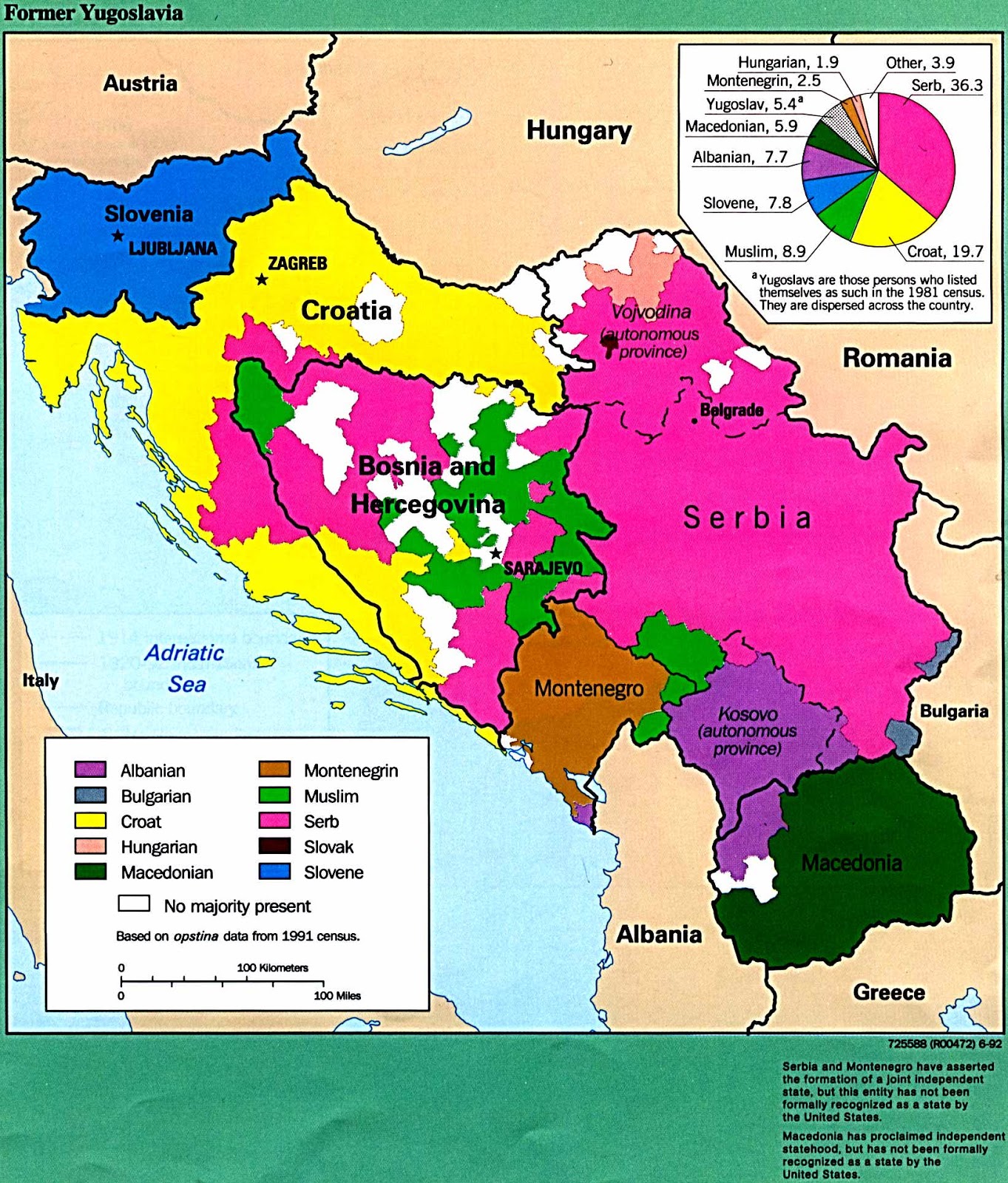
An only slightly outdated map of the former Yugoslavia
In 1977, Bušić and his wife, Julienne Eden Bušić, received life sentences for air piracy in an American court.  In 1987, Bušić escaped from prison in New York state but was apprehended on the run in Pennsylvania shortly after.  Two years later, Mrs. Bušić was released.  In 2008, seventeen years after the Republic of Croatia regained its independence amid the rubble of Leninism, Bušić was paroled on good behavior (a move decried by New York police and others) on condition that he leave the U.S. for good.  He returned to his native Croatia and was active in nationalist politics.  On September 1st, at their home near Zadar, on the Dalmatian coast, Julienne found her husband’s body beside a suicide note, a bullet in his head.

Black banners and the glorification of violence—old habits die hard.
(A scene from Bušić’s funeral.)
Bušić had in later life said of his crimes, “If I had ever imagined that anyone could have been hurt, I would never, even if it had cost me anonymous death at Yugoslav hands, embarked on that flight.”  But in his defense he also called the hijacking “the scream of a disenfranchised and persecuted man.”  By most accounts, the T.W.A. passengers were not mistreated.  One later said, “They had nothing against us, but wanted only to get a story across.  They were concerned for our welfare, and we were treated well during most of it.”  The cop who found Bušić after his prison bust said of him, “He seemed very intelligent and articulate, basically a very gentle man.  He was just worn out.”

Julienne and Zvonko Bušić in later life
Nonetheless, he was a terrorist, and it seems odd that the Croatian political mainstream would celebrate their integration into “civilized” Europe—they joined the E.U. the month before last—by putting on a pedestal a man who caused such suffering while also not advancing the Croatian nationalist cause an inch.  (He may even have harmed it.)  But Croatian nationalists can perhaps be forgiven for such illogicality.  The West—and especially the United NationsInternational Criminal Tribunal for the Former Yugoslavia (I.C.T.Y.) in the Hague, in the Netherlands—seems determined to read the Wars of Yugoslav Succession in the 1990s as simply a war of nasty, dirty Serbs against everyone else.

Croatia (in purple) within the European Union (blue and purple)
Croatian nationalism as it emerged after the fall of the Berlin Wall in 1989 was largely built upon the ashes of the Nazi puppet state known as the Independent State of Croatia, which existed briefly during the Second World War.  The stormtroopers of Croatia’s dreaded fascist terrorist militia of that era, the Ustaša, were never discredited and scorned in the post-war era in the way that their counterpart in Germany—the Schutzstaffel (S.S.)—was.  Unlike Germany, Italy, and Japan, Croatia never undertook the earnest, apologetic soul-searching after the war to atone for their role in the rise of fascism.  Like France and Austria, Croatian nationalists disingenuously managed to persuade themselves and most of the world that they had been only the victims of fascism, never perpetrators.  (Ironically, Kurt Waldheim, the former United Nations secretary general who was elected to Austria’s presidency in 1986 even after it was revealed that he was complicit in Nazi war crimes, served as a Wehrmacht officer in a fascist-Croatian-occupied area of what is now northwestern Bosnia, for which he was awarded the Nazi puppet state’s Medal of the Crown of King Zvonimir.)  The newly revived independent Croatia after 1991 shamelessly resurrected the symbols and banners of the Ustaša.  Nor was that empty romanticism: in the wars that followed, Croatian nationalists tried to purge Serbs from Croatia—and from Bosnia and Herzegovina—nearly as ruthlessly as Serbs tried to purge Croats and Bosniaks from Serb-controlled terrorities.  Though it was Serbia that brought the practice of ethnic cleansing to the most horrific levels, the term was in fact first coined to describe what Croats were doing to Bosniaks in the early 1990s.

Kurt Waldheim (middle)
The West, during the Yugoslav Wars of Succession, needed a Hitler-like enemy, and the Serbs (nasty as Serbian nationalist violence actually was, mind you) fit the bill nicely.  Unfortunately, this also meant overlooking the atrocities of the Serbs’ enemies.  The fact that the Serbian capital, Belgrade, had also been the capital of Communist Yugoslavia, and that Serbs politically dominated the federation, was doubtless part of it.  But there was also a xenophobic subtext: Croatians are Catholic and use the Roman alphabet and have long-standing cultural ties with neighboring states like Italy and Austria; Serbs, meanwhile, are Cyrillic-alphabet-using Eastern Orthodox Christians—practically Saracens in the eyes of many ordinary Western Europeans.  They were easy to demonize.  Their concentration camps and the thunderous rhetoric of their nationalists made it easy too, as did the fact that Russia, then as now, tends to side with the Serbs.  Never mind that both Serbia’s president, Slobodan Milošević, and Croatia’s, Franjo Tuđman, had both allegedly conspired, in the early stages of the wars, to carve up Bosnia and Herzegovina to add to their own mini-empires.

Franjo and Slobo occasionally found things to agree on.
The international community’s double standard was most evident late last year, when (as reported at the time in this blog), two Croatian war criminals and one from the Kosovo Liberation Army (K.L.A.) were cleared by the I.C.T.Y. of all charges, including charges of torturing and killing defenseless Serbs, Roma (“Gypsies”), and collaborationist ethnic-Albanians in prison camps.  Sickeningly, the three were treated in their communities as returning heroes, and Serbs and Russians were suitably appalled.  The I.C.T.Y. has yet to fully demonstrate that they believe the lives of Serbian civilians are worth as much as those of Croats, Bosniaks, and Kosovars.

Croatian nationalists celebrating the acquittal of Croatian mass murderers last year
Serbian war criminals, make no mistake, have been among the nastiest of all the world’s nasties.  Bušić’s nemesis, the part-Croatian, part-Slovenian dictator Josip Broz Tito was another one (and a worse one than Bušić).  But the world is full of nasties, some of them even ending up on the winning side of wars.  None of them should be given heroes’ funerals.

[Also, for those who are wondering, yes, this blog is tied in with a forthcoming book, a sort of encyclopedic atlas to be published by Auslander and Fox under the title Let’s Split! A Complete Guide to Separatist Movements, Independence Struggles, Breakaway Republics, Rebel Provinces, Pseudostates, Puppet States, Tribal Fiefdoms, Micronations, and Do-It-Yourself Countries, from Chiapas to Chechnya and Tibet to Texas.  Look for it some time in 2013.  I will be keeping readers posted of further publication news.]

Saturday, October 20, 2012

Catalans Must Decide: EU or Not EU? Unilateral or Negotiated? Include Valencia and Balearics?


As Catalan leaders plan a referendum in 2014 on independence from Spain, they are debating questions such as whether they ought to make a unilateral declaration of independence “à la Kosovo” and whether this would prevent Catalonia from seamlessly remaining in the European Union (E.U.) after a split.  The E.U.’s 2007 Lisbon Treaty clearly says it would, but it’s not clear that the Catalan president Arturo Mas’s plan for a referendum question asking, “Do you wish for Catalonia to become a new state of the European Union?” will get around that if Madrid refuses to play ball.  (See my blog article analyzing this question in detail with respect to Scotland.)

Moreover, media are reporting that some (perhaps most?) Catalonian separatists also envision the Autonomous Community of Valencia, the region to Catalonia’s south, as well as the Balearic Islands off the coast, as part of a “Greater Catalonia.”

The flag of Valencia
Valencia, the Balearics, and Aragon are three regions headed by Prime Minister Mariano Rajoy Brey’s People’s Party (P.P.) which have begun rebelling against austerity measures in the P.P.’s 2013 budget.  Valencia and Catalonia are Spain’s two most indebted regions, and prosperous, productive regions feeling that poorer, less productive Spanish regions are pushing them into indebtedness is the main economic factor fueling the secessionist crises in Spain.

Valencia, the Balearics, and Catalonia—along with AragonAndalusia, the Basque Country, the Canary Islands, and Galicia—are all constitutionally recognized as distinct “nationalities” within Spain, and Valencia and the Balearics are among those with their own devolved parliaments, like Catalonia’s.


There are differences of opinion as to whether Valencia and the Balearics are culturally and linguistically part of Catalonia: the Balearics use Catalan as an official language alongside Spanish, but the Valencians call their local official language Valencian, not Catalan, though the two are mutually intelligible.

The flag of the Balearic Islands
Separatist sentiment in Valencia, which was its own kingdom until 1707, has never been as strong as in Catalonia, the Basque Country, or Galicia, but Communists in the Balearics briefly agitated for independence in 1978 in the political disorganization following the dictator Francisco Franco’s death.

The flag of Galicia
Expect the exact boundaries of an independent Catalonia to be the source of conflict in the months ahead.  (At least Scotland has Hadrian’s Wall to keep things simple, eh?)


Basque graffiti.  (Boy, they sure make Catalonia look small in this map, don’t they?)

[For those who are wondering, yes, this blog is tied in with my forthcoming book, a sort of encyclopedic atlas to be published by Litwin Books under the title Let’s Split! A Complete Guide to Separatist Movements and Aspirant Nations, from Abkhazia to Zanzibar.  (That is shorter than the previous working title.)  The book, which contains 46 maps and 554 flags (or, more accurately, 554 flag images), will be on shelves and available on Amazon on March 1, 2015.  I will be keeping readers posted of further publication news.  Meanwhile, please “like” the book (even though you haven’t read it yet) on Facebook and see this special announcement for more information on the book.]


Thursday, September 27, 2012

Pavel Grachev, Russian Commander in First Chechen War, Dies at 64, Sparking Poisoning Rumors


The Russian Federation’s former minister of defense, Gen. Pavel Sergeyevich Grachevdied near Moscow on September 23rd at the age of 64.


Shouldn’t take more than an afternoon, eh?
A veteran of the disastrous Soviet war in Afghanistan, Grachev had been deputy minister of defense under Mikhail Gorbachev in the waning months of the Union of Soviet Socialist Republics (U.S.S.R.), then the Russian Federation’s first minister of defense under President Boris Yeltsin, whom he backed during two failed coups d’état against him—one by pro-Soviet forces in 1991 and the second by the Russian parliament in 1993.


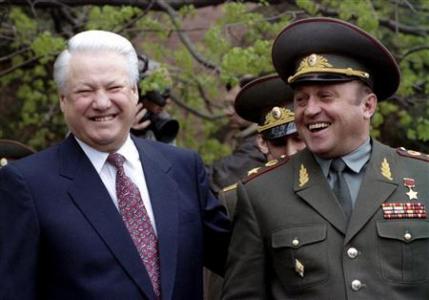
Pavel Grachev (1948-2012) (right) in (can you guess?) ... 1993, actually.
(Communist iconography dies hard.)
Most famously, Grachev was ridiculed for having claimed that the Russian military could reclaim the secessionist Chechen Republic of Ichkeria within a few hours.  The First Chechen War, which Grachev mostly commanded, ended up instead lasting nearly two years (1994-1996), costing tens of thousands of lives, and resulting in the de facto independence of Chechnya (which was brutally reclaimed in 2000 at the conclusion of the Second Chechen War, under Vladimir Putin).


“Okay, guys, off you go.  See you back here in a couple hours.”
Just for fun, we will note that the website of the radical Islamist separatist Caucasus Emirate movement, Kavkaz Center, has gleefully picked up on unfounded media speculation that Grachev was killed by poisonous mushrooms, eaten at a birthday party.  The official cause of death is acute meningoencephalitis, which can indeed be caused by some poisons.  The Emirate website theorizes that the ’shrooms were fed to him as part of a hit by Putin’s minions.  The website calls Grachev “a new victim in a long list of top Russian army generals, colonels and G.R.U. [Russian military intelligence] staff whom Putin suspected of plotting against his K.G.B. rule and preparing a military coup.”

Pavel and Boris share a tender moment.  Don’t make fun.
It’s a male Russian thing.  You might not understand.
Grachev was himself actually once involved in an assassination scandal, in 1994, when a journalist, Dmitry Kholodov, who had accused Grachev of corruption in connection with the Soviet military withdrawal from the German Democratic Republic (G.D.R.) was killed by an exploding briefcase.


I include this photo of Pavel Grachev because I have no idea what that flag in the background is.
Does anyone know?
[Also, for those who are wondering, yes, this blog is tied in with a forthcoming book, a sort of encyclopedic atlas to be published by Auslander and Fox under the title Let’s Split! A Complete Guide to Separatist Movements, Independence Struggles, Breakaway Republics, Rebel Provinces, Pseudostates, Puppet States, Tribal Fiefdoms, Micronations, and Do-It-Yourself Countries, from Chiapas to Chechnya and Tibet to Texas.  Look for it in spring 2013.  I will be keeping readers posted of further publication news.]

Subscribe Now: Feed Icon