Showing posts with label Germany. Show all posts

Saturday, October 5, 2013

Quebec Free-Love Saucer Cult Joins Muslim-Headscarf Debate, Suggests Censoring Religious Texts


A discordant note has just been added to the passionate debate in Quebec, Canada, over the ruling separatist party’s reprehensible initiative to restrict the display of religious symbols and attire, in a thinly veiled attempt to target the province’s Muslim minority (reported in detail last month in this blog).  The latest condemnations of the Parti Québécois’s policy comes from a global but Quebec-based flying-saucer cult called the International Raëlian Movement.


Raëlian bishops have publicly announced that religious symbols should not be banned but that all religious texts should be censored in order to remove references to male dominance, intolerance of homosexuality, or the elevation of the superiority of any particular religion.  Raëlism considers itself in some ways a science rather than a religion and it voices respect for all faiths.  It also promulgates a free-love doctrine and freedom for all sexual orientations.

Raël himself
Founded by a French race-car driver turned U.F.O.-contactee named Claude Vorilhon, who goes by the name Raël, the group claims that human life on earth was seeded by extraterrestrials.  Raëlians have had their own controversies over religious symbology.  Their original logo was a swastika set inside of a Star of David (below, left) but a tide of complaints over the juxtaposition—especially when they tried to open an intergalactic “embassy” in Israel, where displays of swastikas are banned—led to its replacement by a more stylized version (below, right):


This has not mollified everyone—despite the Raëlians’ designation of July 20th earlier this year as “Swastika Rehabilitation Day.”  Raël points out (correctly) that, before its use by the Nazis in the 1930s, swastikas were primarily a religious symbol of good luck and harmony and other positive virtues, found around the world in traditional Native American, Egyptian, Buddhist, and many other cultures.  He also points out (far more debatably) that he saw such a symbol on the spaceships of the “Elohim” who contacted him and took him to their planet.  Adolf Hitler’s occultic religion of Ariosophy replaced a common Aryan (i.e., north Indian) counter-clockwise swastika with a clockwise one.  Some scholars believe that some swastikas were originally counter-clockwise because they indicated the direction of the rotating earth (as seen from above).


Other controversies in which the Raëlians have been embroiled have included nude parishioners distributing condoms in front of Catholic churches and, in 2002, a fraudulent but widely publicized claim by Raëlian geneticists that they had performed the first human cloning.

Raëlians celebrating August 25, 2013, as “Go Topless Day”
This week, Raëlians are offering to be the first religious group to submit their texts to a proposed international board of censors for the deletion of any homophobic, sexist, or religious-chauvinist passages—of which they say there are none in their 1975 founding holy writ, Vorilhon’s Space Aliens Took Me to Their Planet.


To many Americans, there is something off-kilter about the entire debate.  As in Europe, Canadian legal institutions and mainstream civil society seem to take it for granted that some forms of expression should be suppressed.  In Canada and much of Europe, it is illegal to deny the Holocaust or to “incite hatred” against minorities, however that might be defined.  As a result, Nazi sympathizers in those countries are emboldened by what they see as an official attempt to suppress the truth, and their logic is understandable: if Holocaust-denial literature is blatant nonsense, they reason, why are the authorities so desperate to prevent people from reading it?  Publishing Mein Kampf and displaying swastikas is illegal in Germany; consequently, Nazi symbology has acquired a rebellious mystique, and the sight of a swastika has a taboo allure about it in Europe which it does not in places like the United States, where it is commonly seen in historical references (and when fringe neo-Nazis make the news).  The U.S. has neo-fascists, but they are the fringe of the fringe.  And the U.S. has many forms of epidemic violence, but large gangs of neo-Nazi skinheads setting fire to immigrant and minority neighborhoods is not a recurring scourge the way it is in central and eastern Europe.  The global center of Holocaust-denial research, not coincidentally, is Canada.  And the suppression of some ideas naturally leads bigots like those in charge of the Parti Québécois to put forth a “Charter of Quebec Values” that sees implicit support for terrorism in the display of Muslim symbols—since where does one draw the line? isn’t jihadist terrorism as bad as neo-Nazi violence? and don’t many suicide bombers wear burqas? etc. etc. ... and then we’re right back where we started.

A German neo-Nazi.  Censorship won’t make this problem go away.
It’s not clear if the Raëlians are serious about their proposal to censor religious texts, just as it’s never clear if they’re serious about anything.  Mostly, I think they just like getting on the news.  But if they prod Canadians and Québécois to contemplate the absurdity of religious censorship, and to question the originally-well-meaning but deeply-illiberal approach to “bad ideas” and “bad symbols” prevalent in Canada and Europe, then they will be making a contribution.


[You can read more about Quebec and other separatist movements, both famous and obscure, in my new book, a sort of encyclopedic atlas just published by Litwin Books under the title Let’s Split! A Complete Guide to Separatist Movements and Aspirant Nations, from Abkhazia to Zanzibar.  The book, which contains 46 maps and 554 flags (or, more accurately, 554 flag images), is available for order now on Amazon.  Meanwhile, please “like” the book (even if you haven’t read it yet) on Facebook and see this special announcement for more information on the book.]


Monday, September 9, 2013

Croatia Honors ’70s Terrorist Hijacker with Hero’s Funeral


Leading Croatian politicians joined nationalists and others in the downtown of Zagreb, Croatia’s capital, on September 4th to give a hero’s funeral to Zvonko Bušić, who in 1976, in the years of Yugoslavia’s Communist dictatorship, hijacked an American jetliner in a series of horrific events that ended in the death of a New York policeman.  For the political mainstream in a western nation—the European Union’s newest member—to so honor a killer who threatened the lives of hundreds of civilians for a political cause (that’s the definition of terrorism, by the way) is part of the topsy-turvy world of post-Yugoslav symbolic politics in the new Europe, where everything Croats do is forgiven and Serbs can do nothing right.

The hijackers’ perp walk
Bušić—who was born in 1946 in Gorica (now in Bosnia and Herzegovina, on the Croatian border) and immigrated to the United States—hijacked a Trans-World Airlines (T.W.A.) flight from New York to Chicago in 1976 in league with his wife (a nurse from Oregon) and three other Croatian-Americans.  The five threatened to blow up the plane and detonate another device in a locker in New York City’s Grand Central Station unless a Croatian declaration of independence were printed in leading newspapers and leafleted over five major world cities.  Those demands were met, but it turned out the “bomb” on the plane was a fake prop, while the Grand Central Station bomb was real—but was not intended to go off (so Bušić later said).  The idea was that police, after being given directions to the rail-station locker by the hijackers, would find the real bomb and falsely believe that the one on the plane was also real.  While none of the 80-plus airline passengers was harmed, a New York City police officer died trying to disable the Grand Central bomb when it exploded.  Another policeman was blinded and two others wounded.  The plane was diverted to Paris, and French police, showing more interventionist gumption than the Americans—or, if you prefer, more recklessness, tempered with luck—shot out the wheels and forced the hijackers to surrender.

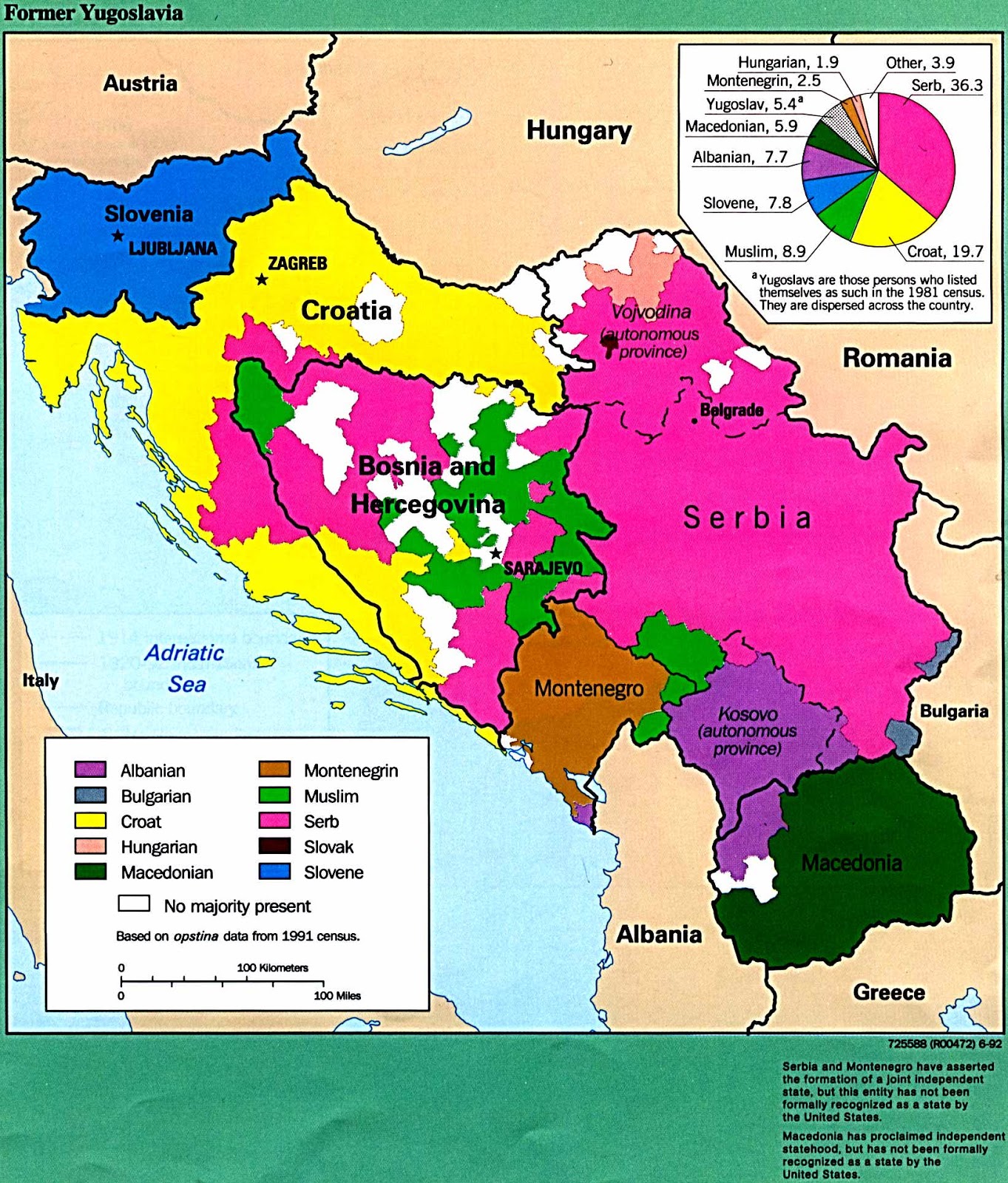
An only slightly outdated map of the former Yugoslavia
In 1977, Bušić and his wife, Julienne Eden Bušić, received life sentences for air piracy in an American court.  In 1987, Bušić escaped from prison in New York state but was apprehended on the run in Pennsylvania shortly after.  Two years later, Mrs. Bušić was released.  In 2008, seventeen years after the Republic of Croatia regained its independence amid the rubble of Leninism, Bušić was paroled on good behavior (a move decried by New York police and others) on condition that he leave the U.S. for good.  He returned to his native Croatia and was active in nationalist politics.  On September 1st, at their home near Zadar, on the Dalmatian coast, Julienne found her husband’s body beside a suicide note, a bullet in his head.

Black banners and the glorification of violence—old habits die hard.
(A scene from Bušić’s funeral.)
Bušić had in later life said of his crimes, “If I had ever imagined that anyone could have been hurt, I would never, even if it had cost me anonymous death at Yugoslav hands, embarked on that flight.”  But in his defense he also called the hijacking “the scream of a disenfranchised and persecuted man.”  By most accounts, the T.W.A. passengers were not mistreated.  One later said, “They had nothing against us, but wanted only to get a story across.  They were concerned for our welfare, and we were treated well during most of it.”  The cop who found Bušić after his prison bust said of him, “He seemed very intelligent and articulate, basically a very gentle man.  He was just worn out.”

Julienne and Zvonko Bušić in later life
Nonetheless, he was a terrorist, and it seems odd that the Croatian political mainstream would celebrate their integration into “civilized” Europe—they joined the E.U. the month before last—by putting on a pedestal a man who caused such suffering while also not advancing the Croatian nationalist cause an inch.  (He may even have harmed it.)  But Croatian nationalists can perhaps be forgiven for such illogicality.  The West—and especially the United NationsInternational Criminal Tribunal for the Former Yugoslavia (I.C.T.Y.) in the Hague, in the Netherlands—seems determined to read the Wars of Yugoslav Succession in the 1990s as simply a war of nasty, dirty Serbs against everyone else.

Croatia (in purple) within the European Union (blue and purple)
Croatian nationalism as it emerged after the fall of the Berlin Wall in 1989 was largely built upon the ashes of the Nazi puppet state known as the Independent State of Croatia, which existed briefly during the Second World War.  The stormtroopers of Croatia’s dreaded fascist terrorist militia of that era, the Ustaša, were never discredited and scorned in the post-war era in the way that their counterpart in Germany—the Schutzstaffel (S.S.)—was.  Unlike Germany, Italy, and Japan, Croatia never undertook the earnest, apologetic soul-searching after the war to atone for their role in the rise of fascism.  Like France and Austria, Croatian nationalists disingenuously managed to persuade themselves and most of the world that they had been only the victims of fascism, never perpetrators.  (Ironically, Kurt Waldheim, the former United Nations secretary general who was elected to Austria’s presidency in 1986 even after it was revealed that he was complicit in Nazi war crimes, served as a Wehrmacht officer in a fascist-Croatian-occupied area of what is now northwestern Bosnia, for which he was awarded the Nazi puppet state’s Medal of the Crown of King Zvonimir.)  The newly revived independent Croatia after 1991 shamelessly resurrected the symbols and banners of the Ustaša.  Nor was that empty romanticism: in the wars that followed, Croatian nationalists tried to purge Serbs from Croatia—and from Bosnia and Herzegovina—nearly as ruthlessly as Serbs tried to purge Croats and Bosniaks from Serb-controlled terrorities.  Though it was Serbia that brought the practice of ethnic cleansing to the most horrific levels, the term was in fact first coined to describe what Croats were doing to Bosniaks in the early 1990s.

Kurt Waldheim (middle)
The West, during the Yugoslav Wars of Succession, needed a Hitler-like enemy, and the Serbs (nasty as Serbian nationalist violence actually was, mind you) fit the bill nicely.  Unfortunately, this also meant overlooking the atrocities of the Serbs’ enemies.  The fact that the Serbian capital, Belgrade, had also been the capital of Communist Yugoslavia, and that Serbs politically dominated the federation, was doubtless part of it.  But there was also a xenophobic subtext: Croatians are Catholic and use the Roman alphabet and have long-standing cultural ties with neighboring states like Italy and Austria; Serbs, meanwhile, are Cyrillic-alphabet-using Eastern Orthodox Christians—practically Saracens in the eyes of many ordinary Western Europeans.  They were easy to demonize.  Their concentration camps and the thunderous rhetoric of their nationalists made it easy too, as did the fact that Russia, then as now, tends to side with the Serbs.  Never mind that both Serbia’s president, Slobodan Milošević, and Croatia’s, Franjo Tuđman, had both allegedly conspired, in the early stages of the wars, to carve up Bosnia and Herzegovina to add to their own mini-empires.

Franjo and Slobo occasionally found things to agree on.
The international community’s double standard was most evident late last year, when (as reported at the time in this blog), two Croatian war criminals and one from the Kosovo Liberation Army (K.L.A.) were cleared by the I.C.T.Y. of all charges, including charges of torturing and killing defenseless Serbs, Roma (“Gypsies”), and collaborationist ethnic-Albanians in prison camps.  Sickeningly, the three were treated in their communities as returning heroes, and Serbs and Russians were suitably appalled.  The I.C.T.Y. has yet to fully demonstrate that they believe the lives of Serbian civilians are worth as much as those of Croats, Bosniaks, and Kosovars.

Croatian nationalists celebrating the acquittal of Croatian mass murderers last year
Serbian war criminals, make no mistake, have been among the nastiest of all the world’s nasties.  Bušić’s nemesis, the part-Croatian, part-Slovenian dictator Josip Broz Tito was another one (and a worse one than Bušić).  But the world is full of nasties, some of them even ending up on the winning side of wars.  None of them should be given heroes’ funerals.

[Also, for those who are wondering, yes, this blog is tied in with a forthcoming book, a sort of encyclopedic atlas to be published by Auslander and Fox under the title Let’s Split! A Complete Guide to Separatist Movements, Independence Struggles, Breakaway Republics, Rebel Provinces, Pseudostates, Puppet States, Tribal Fiefdoms, Micronations, and Do-It-Yourself Countries, from Chiapas to Chechnya and Tibet to Texas.  Look for it some time in 2013.  I will be keeping readers posted of further publication news.]

Friday, August 23, 2013

Cameroon Takes Over Bakassi, Dashing Ambazonian and Efik Nationalist Hopes

Up went the Cameroonian flag over the Bakassi Peninsula on Wednesday, to the dismay of separatists and irredentists.
After decades of controversy and conflict, the Republic of Cameroon on August 21st formally took control of the disputed Bakassi Peninsula on its border with the Federal Republic of Nigeria.  This closes the door on the hopes of Nigerian nationalist irredentists, separatists in the peninsula and in the wider “Southern Cameroons” region, and members of the Efik ethnic group whose communities are riven by the international border.


Nigeria had been administering the peninsula since independence when, in 2002, the United NationsInternational Court of Justice (I.C.J.) ruled that the territory would belong to Cameroon.  Both sides had agreed to abide by the I.C.J. decision, whatever it might be, and in 2006 Nigeria ceded the peninsula, angering nationalists.  The issue lay dormant until last year, when a 10-year period during which Nigeria could contest the decision came was nearing its close (developments which were covered extensively in this blog).  Nationalist critics of Nigeria’s president, Goodluck Jonathan, cried “capitulation,” members of the Efik ethnic group, which straddles the border, demanded that displaced Efiks in Nigeria be allowed to resettle in the peninsula, and Efik nationalists on both sides of the border called for an independent state which would revive the Efiks’ precolonial Calabar Kingdom.

The Calabar Kingdom is still a functioning ceremonial monarchy,
though the Nigerian–Cameroonian border bisects its traditional lands
On the Cameroonian side, this southwestern region of the country had for decades been home to a separatist movement in formerly British-ruled areas.  The original German colony of Kamerun had been divided between the United Kingdom and France after Germany lost the First World War.  At the time of decolonization, the southern part of the British chunk (“Southern Cameroons”) voted to join the newly independent French portion as the Republic of Cameroon, while the predominantly-Muslim chunk of the British sliver voted to join Nigeria.  But Southern Cameroonians, culturally distinct and used to using English rather than French as their lingua franca, chafed under a new 1972 constitution under which the Cameroonian dictatorship erased all regional autonomy.  Separatists declared an independent Republic of Ambazonia in the former Southern Cameroons in 1999 and in 2006 declared a Republic of Ambazania (note slight difference in spelling) which was to include the Bakassi Peninsula as well.  This declaration had the support of displaced Efik and other Bakassians on the Nigerian side, but it had little effect on the ground.  (To complicate matters, the areas on the Nigerian side of the border are part of a possibly future independent state envisioned by Igbo separatists—whose disastrously brief-lived Republic of Biafra in the 1960s included a restive Efik minority.)


But a 2012 declaration of independence by the Republic of Bakassi, though it involved only a radio-station tower on a tiny island off the peninsula’s coast, invited brutal reprisals by the Cameroonian military—not only against the Bakassian separatists but against Ambazonian/Ambazanian separatists more generally.

Separatists in Cameroon wave the flag of Ambazonia
But, declarations of independence aside, this is a time of reckoning for the estimated 90% of the peninsula’s 40,000-some residents who hold only Nigerian passports.  Instead of offering dual citizenship, as Bakassians demand, they are being told they must apply for foreign-resident permits, as though they were immigrants.  This is hardly a sporting attitude on the part of the Cameroonian victors in the dispute, and it is likely to inflame tensions.  While the rest of Nigeria is riven by separatism as well, many fear that the transition to Cameroonian rule might be the beginning, rather than the end, of the dispute over the Bakassi Peninsula.

[You can read more about Bakassi, Ambazonia, and many other separatist and new-nation movements, both famous and obscure, in my new book, a sort of encyclopedic atlas just published by Litwin Books under the title Let’s Split! A Complete Guide to Separatist Movements and Aspirant Nations, from Abkhazia to Zanzibar.  The book, which contains 46 maps and 554 flags (or, more accurately, 554 flag images), is available for order now on Amazon.  Meanwhile, please “like” the book (even if you haven’t read it yet) on Facebook and see this interview for more information on the book.]


Tuesday, August 13, 2013

“Caprivi Strip” No More—but Does the De-Germanization of Namibia’s Map Have an Intertribal Agenda?


The international press is unanimous this week that the Republic of Namibia’s decision to rename the Caprivi Strip “the Zambezi Region” is a triumph of indigenous culture over colonialism.  A European name is erased from the map and replaced with the quintessentially African name Zambezi, for the noted river.  But the political subtext here is more complex, and it involves interethnic troubles in the strife-torn Caprivi region and in Namibia at large.

First, some history.

Count Leo von Caprivi
Though it sounds Italian, the name Caprivi is a legacy of colonialism by Germany, which ran Namibia (then known as South-West Africa) from 1890 until it lost it to the British as war booty after losing the First World War.  The Strip was named for Georg Leo Graf von Caprivi de Caprera de Montecuccoli, a Prussian count who succeeded Otto von Bismarck as German chancellor and whose curiously Italianate name derives from his father’s landed titles reaching back to the Italian-Slovenian borderlands on the Adriatic Sea.


When the Kaiser lost the Great War, he lost Namibia too.
The shard of land named for Count Caprivi is Namibia’s “panhandle,” as it would be called if it were an American state: jutting eastward from Namibia’s northeastern corner between Zambia, Angola, and Botswana.  It was originally part of the United Kingdom’s Bechuanaland Protectorate (i.e., Botswana).  However, in 1890, the year Caprivi succeeded Bismarck, the Crown traded it, along with the North Sea island of Heligoland, to the German Empire in exchange for Zanzibar.  The Germans wanted the strip to fill in a supply route between South-West Africa and German East Africa—i.e., Tanganyika, the mainland that later joined with Zanzibar to form today’s Tanzania.  This treaty was known as the Heligoland Treaty, indicating that its European border swaps were what were considered important about it in Berlin and London.  Later, it became notorious in the annals of the scramble for Africa because it also squiggled a small dogleg into the Kenya–Tanganyika border in order to put Mt. Kilamanjaro in German hands.   You see, Queen Victoria’s grandson Wilhelm II had been pouting because he didn’t own as many African mountains as his English cousins.


In any case, after the defeated empires of the Central Powers were hacked back by the League of Nations at the close of the First World War, the emasculated German Reich was stripped of its overseas colonies.  The newly independent Union of South Africa, then still a dominion of the British Crown, was put in charge of South-West Africa, including Caprivi.  By the 1970s, South Africa, still stewing under apartheid after nearly the whole rest of the continent had been liberated, was again using the Caprivi Strip as a supply route—this time to run guns to white Rhodesian militants in what is now Zimbabwe.  Some Caprivi natives also helped UNITA, the Angolan army backed by South Africa.  (The underground African National Congress also smuggled arms to leftist militias backed by Cuba in Angola’s civil war during the same period.)

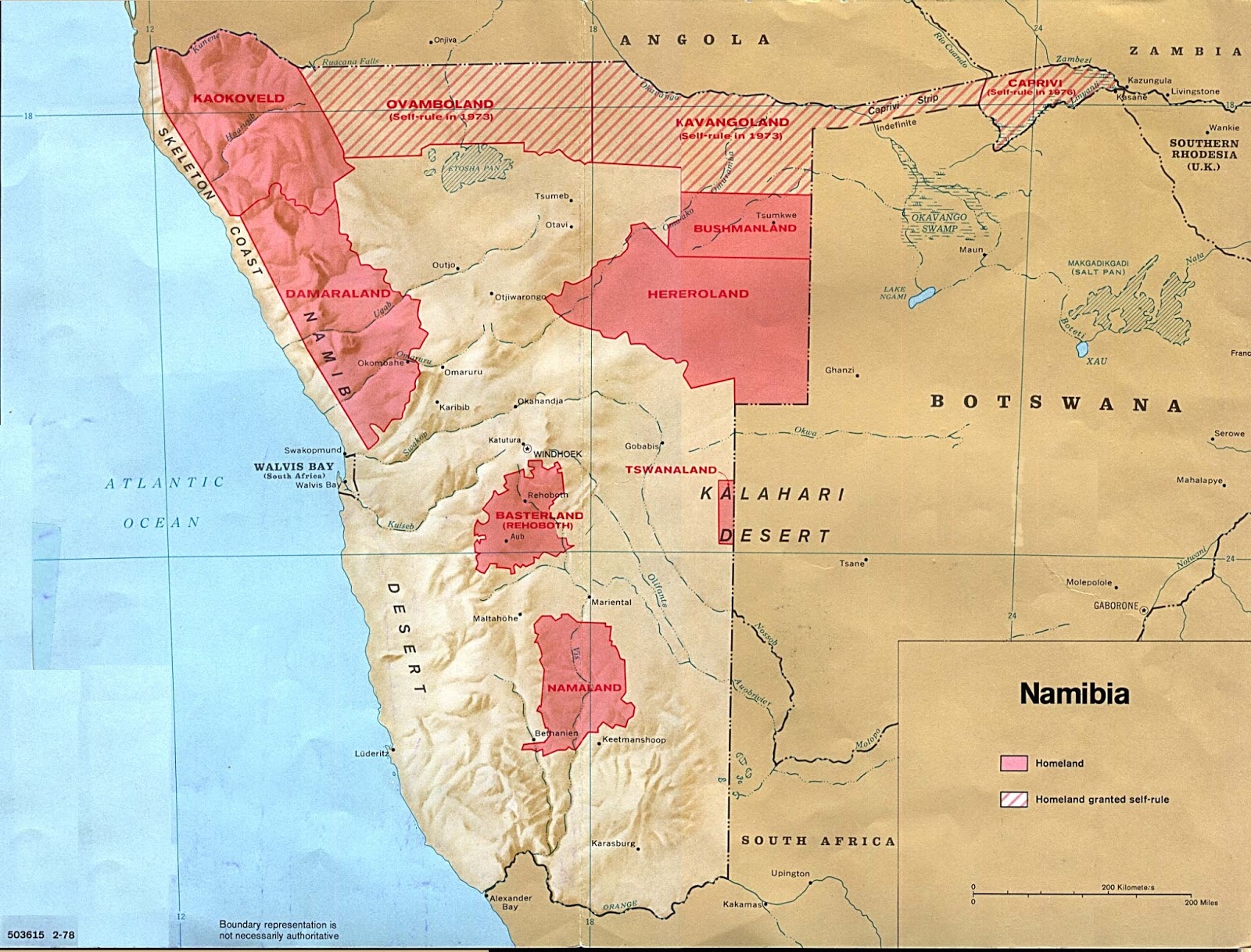
Namibia’s homelands during the apartheid era
By the time those conflicts had settled down, in the 1980s, Caprivi had become something else again: a “homeland.”  These glorified reservations, also called “Bantustans,” which the South African government tried to sell to the world as generous experiments in indigenous sovereignty, were scattered throughout South Africa and South-West Africa.  Bophuthatswana, in northern South Africa, site of the famous Sun City entertainment resort, was the most famous.  Most were barren patches of land onto which apartheid’s architects tried to expel Africans, hoping they would take the demographic and political “problems” they represented out of the South African body politic.  In South-West Africa, there was even a homeland called Rehoboth or Basterland, for the Baster people, a mix of Dutch and native Khoisian (“Bushman”) ancestry—the name baster being the Afrikaans equivalent of the English word bastard.  In some ways, these homelands had genuine autonomy, and the Lozi people of the Caprivi Strip were given their small degree of self-rule largely, many felt, as the apartheid regime’s reward for facilitating the white-supremacist gun-running during the Rhodesian business.  Whether that is a fair characterization or not, when South-West Africa finally did become independent, as the Republic of Namibia, in 1990, the homelands were abolished, and Caprivi Lozis found themselves feeling in some ways less autonomous than they did under apartheid.

The most excellent flag of the Caprivi separatists
In 1994, Lozis formed the Caprivi Liberation Army (C.L.A.), aiming to make the Strip a sovereign nation.  In 1999, a series of attacks on police stations and other targets prompted a government crackdown.  C.L.A. leaders were sent into exile, mostly to Denmark but also to Botswana, which was in the midst of a territorial dispute with Namibia.  In 2002, the C.L.A. unilaterally declared the independence of the Free State of Caprivi Strip/Itenge, but no state recognized it.

Zimbabwe’s Victoria Falls, just east of Caprivi
Today, the Strip is mostly calm, and it has natural wonders that Namibia would like tourists to flock to, being just upriver from the Zambezi River’s spectacular Victoria Falls, in Zimbabwe.  So the new name Zambezi Region is partly a rebranding, ditching a name that is mostly associated with civil war.  But why not rename the region Okavango, which some people have called it at times, after the river that runs through the western part of the Strip? or Itenge, a name preferred by Caprivian separatists? or Lozi, which was its name in the late pre-independence period?  After all, the Lozi are the people that live here.

Some nationalists’ vision of a “Greater Barotseland.”
No wonder Namibia is nervous.
Ah, but that is the rub.  The Lozi, also known as Barotse (it is the same name; ba- is a prefix in Bantu ethnonyms, and r and l are sometimes interchangeable), live not only in Caprivi but in a large area to the north called Barotseland, where a quiet revolt has been roiling for several years over the Barotse kingdom’s involuntary absorption into the Republic of Zambia at independence in 1964—a story this blog has been covering for quite a while.  (For example, I listed Barotseland as one of “10 Separatist Movements to Watch in 2013.”)   The last thing the Namibian government—run by the largest ethnic group, the Ovambo—wants is for a Barotse civil war to spill over into their territory.  So far, there has never been much coordination between Barotse/Lozi activists in Zambia and those in Namibia; Zambian Barotse are more focused on shoring up their constitutional monarchy and on challenging the legal basis of the Zambian state.  But that could change once the Barotse monarchy and its army begin to make strides and foment true unrest, as may happen any week now.  And the conservative monarchists on the Zambian side of the border are in no way natural allies of Namibia’s ruling party, the Southwest African People’s Organisation (SWAPO), a former leftist rebel army much in the A.N.C. mold.

The flag of the Barotse monarchy in Zambia
The town of Schuckmannsburg in the Caprivi Strip is also being renamed.  It is now Lohonono.  And Lüderitz, a harbor town at the other end of Namibia, in the southwest, has become !Nami=Nüs.  (Those punctuation marks represent clicks and other sounds unique to the Khoisian languages of the Kalahari Desert, which are perhaps the oldest languages in the world.)  But the renaming of the Caprivi Strip is not really about the European colonialism.  Germans have already been scrubbed from the Namibian political landscape—a neutered and cowed minority.  And the German government in 2004 made a formal apology to Namibia for massacres and concentration camps by which German soldiers killed tens of thousands of Hereros and other indigenous people in the colonial period.  If anything, the residual German-speaking population and their settlements are a tourist draw; one example is scenic Swapokmund, which played the part of the mysterious Brigadoon-like “Village” in the 2009 remake of the television series The Prisoner.  (Fun fact: Swapokmund is a linguistic blend of a name, which literally means Asshole-Mouth.  Mund is German for mouth, and the town is at the mouth of the Swapok River, derived from the indigenous Nama word tsoakhaub, which means anus—a reference to the large volumes of carcasses and reeking waste that wash out through the estuary during flood season.  You’d think that if the Namibian tourist board wanted to do some name changes to give tourism a bump, Asshole-Mouth should be top of the list.)

The Namibian flag flies over Swapokmund,
the colonial-German resort town where the remake of The Prisoner was filmed.
Rather, this rewriting of the map—which in itself is something very right and proper which nearly every formerly colonial state has undertaken—is designed to downplay the interethnic tensions within Namibia.  The Ovambo, whose territory in the north (a former homeland as well, Ovamboland) is only 6% of the country, are nearly half the population and by far the dominant group.  Many minority groups claim that Ovambos are forcing themselves on the rest of the population as the élite and are settling in areas formerly dominated by smaller groups, especially the hunter–gatherer tribes.  So the ruling Ovambos do not want names like Lozi showing up too prominently on maps.  They are trying to forestall the day when their hegemony is seriously challenged—which, to judge from events in Zambia, may happen first in the Caprivi Strip.


[You can read more about Caprivi/Itenge, Barotseland, and many other separatist and new-nation movements, both famous and obscure, in my new book, a sort of encyclopedic atlas just published by Litwin Books under the title Let’s Split! A Complete Guide to Separatist Movements and Aspirant Nations, from Abkhazia to Zanzibar.  The book, which contains 46 maps and 554 flags (or, more accurately, 554 flag images), is available for order now on Amazon.  Meanwhile, please “like” the book (even if you haven’t read it yet) on Facebook and see this interview for more information on the book.]

Saturday, December 15, 2012

Sandy Island May Not Exist, but Now It Has a King


Last month, media attention was drawn to Sandy Island (a.k.a. Île du Sable), in the Coral Sea between Australia and New Caledonia when a University of Sydney plate-tectonics surveying ship headed to the island to investigate discrepancies in their charts and found out there was nothing there but open sea.  They had seen the island on Google Maps and Google Earth—shown as being in the territorial waters of New Caledonia and, thus, of the French Republic—but it has also appeared in numerous atlases and other sources.  Nor is this a mere location error.  Sandy Island doesn’t exist and has never existed.  Its posited existence and position were traced first to a 1908 map and then to one by the legendary British explorer Capt. James Cook from 1774.  The island’s non-existence was not very loudly suspected, if at all, but was unconfirmed for centuries.


Now, a German man calling himself King Marduk I has laid claim, on behalf of the State Kingdom of Marduk, to Sandy Island, which he claims does indeed exist and which he names after himself, i.e. King Marduk Island.  The self-styled king, who is named for a Babylonian god (or possibly for the eponymous alleged tenth planet of our solar system “discovered” by the crackpot archaeo-astronomer Zechariah Sitchin), several years ago tried to claim the Principality of Sealand, the disused World War II derrick off the coast of Essex, England, which is one of the modern world’s best known and most successful “micronations.”

His Majesty, King Marduk I
Marduk declared this week on his website (in language that suggests he relies as heavily on Google Translate to render his German into  Englissh as he does on Google Maps to tell him which islands exist or don’t exist): “H. M. KING MARDUK I DECLARE THAT THE SINCE DECADES OF STATE FREE ISLAND TERRITORY UNDER THE NAME CALLED ‘SANDY ICELAND’ [sicTHE PACIFIC LOCATEDALWAYS NO STATE EITHER COUNTRY COURSE LISTENING BETWEEN AUSTRALIA AND EAST OF WHICH LOCATED COLONIAL COUNTRY NEW CALEDONIATHE SANDY ISLAND LOCATEDTHOSE LEGAL UNVERWERFLICH NO PHANTOMS ISLANDBUT ACTUALLY EXIST IN POSITION [WGS84] 19°13'6.43"S, 159°55'23:42"E – 19.218451°, 159.923172 ° [UTM] 57K 597040 7874744 INTERNATIONAL REGISTERED LOCATEDFROM A STATE SURVIVE FREE TERRITORY ISWHERE THIS ISLAND SINCE 1922 ON CARD DOCUMENTEDRECENTLY THE UNITED NATIONS IN 2002 TO YOUR DECREE CONFIRMED THIS ISLAND.”

An image from the Kingdom of Marduk website
Other territories Marduk claims for his kingdom (called, in some reference, New Germania) include: much of the eastern Alps, including the Austria’s Vorarlberg state, the Italian region of South Tyrol, Liechtenstein, and parts of Switzerland and Bavaria around, and including, Lake Constance (Bodensee); various localities in the Swiss cantons of Schaffhausen and the cities of Basel and Bern; the entire former Kingdom of Württemberg; the Dogger Bank, the German island of Heligoland, and the artificial island Langlütjen, all in the North Sea; Hamburg and, by extension, the Baltic Sea; the island of Rockall, between Scotland and Iceland (and itself once the location of a publicity-stunt micronation called Waveland); Vatican City; the micronation of Seborga, on the border between Italy and France; parts of Ticino, in southern Switzerland; Jerusalem; and—why aim low, right?—all of outer space.

The former micronation of Waveland, in the North Atlantic
—claimed also by the Kingdom of Marduk.
Little is known about King Marduk himself, but a Swiss journalist who reported recently on Marduk’s royal territorial claims on the town of Büsingen, Schaffhausen, quoted the kingdom’s secretary of state, one Thomas Vogel, as saying—with a kind of wild inconsistency—that his monarch “shuns publicity and does not want to be recognized.  He lives in Tübingen in a stately residence, not a castle.  He has a huge royal fleet with twelve cars for state visits such as Jaguars and Mercedes.  Apart from a Rolex, he has not a lot of wealth.  The king is wise as a professor and lives rather modestly.”  The reporter, Hermann-Luc Hardmeier, who interviewed the bling-laden “Vogel” in Büsingen after his arrival in a limousine, seemed sure that “Vogel” was merely “Marduk” in disguise, but photographs of the monarch do not much resemble the man Hardmeier interviewed.

The Kingdom of Marduk’s secretary of state, Thomas Vogel,
arriving for an important press conference with a reporter from the Schaffhauser Nachrichten
Going back to Sandy Island—the French government has not yet responded to Marduk’s claims on its territory, but then again Paris has also reacted not at all to the fact that an island which it thought it owned now does not exist and what the implications are for its maritime boundaries.  Nor have their been responses from the separatist movement in New Caledonia or from an unrecognized nation which claims waters (which the world grants to Australia) just to the west of “Sandy Island”: the Gay and Lesbian Kingdom of the Coral Sea Islands.  Theoretically, this could get ugly.

Postage stamps produced by the Gay and Lesbian Kingdom of the Coral Sea Islands.
It’s nice to finally see the “bear” subculture honored with a stamp.
Here at “Springtime of Nations,” we will keep you posted on any further developments regarding non-existent islands.

[For those who are wondering, yes, this blog is tied in with my new book, a sort of encyclopedic atlas just published by Litwin Books under the title Let’s Split! A Complete Guide to Separatist Movements and Aspirant Nations, from Abkhazia to Zanzibar.  (That is shorter than the previous working title.)  The book, which contains 46 maps and 554 flags (or, more accurately, 554 flag images), is available for order now on Amazon.  Meanwhile, please “like” the book (even if you haven’t read it yet) on Facebook and see this special announcement for more information on the book.]


Thursday, October 11, 2012

His Royal Highness Roy Bates, Prince of Sealand (1921-2012), Father of Micronation and Seasteading Movements


Maj. Paddy Roy Bates, an English former pirate radio broadcaster in the North Sea who turned a crumbling Second World War derrick off the East Anglian coast into a self-proclaimed principality called Sealand, died in a nursing home in Leigh-on-Sea, Essex, England, on October 9th at the age of 91.  He is indisputably the father of the modern “micronations” movement and of the futuristic concept of “seasteading” which utopians from across the political spectrum are eyeing as a way to remake society in the 21st century.  As Prince Roy, he handed the reigns of his monarchy to his son, Prince Michael as “Prince Regent as Sovereign pro tempore” in 1999.
Prince Roy and Princess Joan
Despite its name, Sealand, though it is in the sea, has no land, and thus falls between the cracks of the understanding of what “territory” is in international law (an ambiguity which seasteading aims to exploit).  It is a 550-square-meter (5,920-square-foot) floating pontoon originally called the H. M. Fort Roughs, ten kilometers off the coast of Suffolk, in southeastern England.  In the 1960s, Bates, a former fisherman and World War II veteran, with several others started up a pirate radio station on the structure, but a dispute between factions in the tiny, cramped community required the intervention of the Royal Marines in 1967.  To Bates’s surprise, a British court the following year found him immune to prosecution because the Fort Roughs was on the high seas, was disused (not “flagged”), and thus outside all legal jurisdictions.  This got him thinking, and soon he named himself Prince Roy and named the derrick the Principality of Sealand.

The flag of Sealand
While generally hosting only a skeleton crew of residents, thousands worldwide have Sealandic passports, and the nation produces currency and stamps.  No nations other than similarly unrecognized micronations grant it diplomatic recognition.


Sealand’s coat-of-arms
However, the United Kingdom has made a tacit policy of not interfering with its sovereignty, such as it is.  And Prince Roy regarded the outcome of a messy coup d’état in 1978 as a kind of de facto recognition by foreign powers.  In that series of events, the Sealandic prime minister, A. G. Achenbach, briefly took power while Prince Roy was away on the British mainland.  Achenbach and a gang of German and Dutch soldiers of fortune took Prince Michael hostage before Roy mustered a rescue squad of speedboats and helicopters (including one chopper, the rumor goes, piloted by a former James Bond body double).  Roy had Achenbach and his conspirators tried for treason on Sealand.  The Federal Republic of Germany (then merely West Germany) and the Kingdom of the Netherlands sent diplomats to London to negotiate their citizens’ release, but the Crown wanted nothing to do with it: Sealand wasn’t in the U.K.  So Bonn and Amsterdam had to negotiate directly with Prince Roy—a fact which he regarded as his own coup of sorts.

The royal couple
Furthermore, in 1987 the U.K. extended its territorial waters from 3 miles offshore to 10 miles offshore, putting Sealand technically within its territorial waters.  The fact that the U.K. still does not press a claim on Sealand is another kind of de facto recognition.


Sealand has come on the radar of this blog in the past, most notably in February of this year when it was reported that Julian Assange was thinking of relocating WikiLeaks servers there.  (See the article “WikiLeaks Mulls Moving Its Servers to Sealand to Dodge National Laws,” from this blog.)  That did not end up happening—possibly because Roy realized this might prompt the U.K. to finally make moves against Sealand.  Also, legal experts say that prosecutions under laws forbidding activities such as Assange’s leaks of information and violations of privacy can’t be dodged simply by virtue of where one’s servers are located.  (Currently, Assange is holed up in another not-quite-British scrap of British territory, the Republic of Ecuador’s embassy in London.)

A coin of the realm
This blog has also reported on Sealand’s exhibition football (soccer) matches against teams from the Chagos Islands’ diaspora community and against Alderney (an island in the U.K.’s autonomous Bailiwick of Guernsey, just around the bend in the English Channel).  The Sealandic team typically features the television comedian Ralf Little, an avocational footballer and a passport-holding Sealander.
Prince Michael commented to the media this week about his father, “He was an extremely intelligent and active man and he developed Alzheimer’s, which he would have absolutely hated, and he barely recognized his family over the last few years.  My father will always be remembered for shaking up the establishment with pirate radio, declaring Sealand’s independence and confronting the Royal Navy and other foreign governments.”

His Royal Highness is survived by the Prince Regent Michael (now Prince Sovereign), his widow Princess Joan, a daughter Penny, and four grandchildren.

Prince Michael.  The prince is dead.  Long live the prince.
[You can read more about Sealand and other separatist and new-nation movements, both famous and obscure, in my new book, a sort of encyclopedic atlas just published by Litwin Books under the title Let’s Split! A Complete Guide to Separatist Movements and Aspirant Nations, from Abkhazia to Zanzibar.  The book, which contains 46 maps and 554 flags (or, more accurately, 554 flag images), is available for order now on Amazon.  Meanwhile, please “like” the book (even if you haven’t read it yet) on Facebook and see this special announcement for more information on the book.]


Subscribe Now: Feed Icon