Showing posts with label Italy. Show all posts

Tuesday, July 14, 2015

Micronations Sign “Alcatraz Accords” Environmental Treaty at Central Italy Summit

(photo by the author)
Though “Springtime of Nations” is in many ways a news blog, rarely do I present first-person reportage on these pages.  Earlier this month, however, I was an invited speaker at the 3rd PoliNation conference, at the Free Republic of Alcatraz, in the Umbrian mountains of Italy, and was able to witness the signing of a first-of-its-kind environmental treaty by heads of state and other representatives of some of the world’s most high-profile micronations.

Daily life in the Free Republic of Alcatraz, with some of its 111 inhabitants
(photo by the author)
Titled the Alcatraz Environmental Treaty of 2015, the document, signed on July 5th, charges that “the large states of the world have been ineffective and their efforts have been lacking in intention and execution concerning efforts to improve the environment, preserve existing natural resources, and reduce carbon emissions to slow the change of the climate.”  Signatories agree to set a global example through responsible ecological stewardship in their own (usually tiny) territories, especially bee populations; to urge the preservation of Antarctica as a nature preserve set aside for scientific research only, even after the expiration of the Antarctic Treaty in 2020; to create “highly localized sub-currencies that will promote the local production and consumption of goods and produce”; to support efforts “to clean the human-generated debris from the oceans and reduce the ‘garbage patches’”; and to financial restructuring to reduce poverty and inequality.

Queen Carolyn and other dignitaries work on a draft of the final environmental treaty
(photo by the author)
In addition, the treaty demands, “for every square foot of land or glacier lost to melting ice sheets and rising ocean levels, compensation from the large landed nations of one square meter of dry/non-threatened land so that we may relocate the climate refugees that will be created as a result of the rising waters.”  (See my recent article which addresses the issue of the survival of low-elevation nations in a warmer planet with higher sea levels.)  You can read the full text of the treaty here.

For the Principality of Aigues-Mortes, one of the world’s lowest-elevation nations,
rising sea levels are no small matter.
Signatories of the treaty are Queen Carolyn of Ladonia; Grand Duke Niels of Flandrensis; President Iacopo Fo of Alcatraz; the Republic of Benny André Lund; Prince Jean-Pierre IV of Aigues-Mortes; Emperor Olivier of Angyalistan; Sogoln Yg Ysca, president of the Institut Fomoire; and a delegation from the otherwise acephalous (leaderless) Bunte Republik Neustadt.  Other nations have since expressed an interest in adding their names to the treaty.

At Alcatraz
(photo by the author)
The Royal Republic of Ladonia is a 1-square-kilometer art installation of sorts on the coast of Sweden, founded by Lars Vilks, a Latvian–Swedish avant-garde artist now living an underground, Salman Rushdie–style existence due to being targeted by jihadists for his cartoons of the Prophet Muhammad.  (The apparent oxymoron in Ladonia’s full name is reconciled through their unique form of government, remony (republic + monarchy).

Ladonia is an unusual place
The Grand Duchy of Flandrensis, founded by Niels Vermeersch of Belgium, claims five islands off the coast of Antarctica, arguing that the Antarctic Treaty bars territorial claims by states but not individuals such as soi-disant heads of state.


The Republicof (sic; one word) Benny André Lund is a native of Norway, born in 1977, who has styled himself as a sovereign nation of one.  He has changed his name legally to this phrase, including the first name Republicof.

The Republic of Benny André Lund and his flag
(photo by the author)
The Principality of Aigues-Mortes is a small town on the coast of France’s Provence region, centered on a Medieval castle, which promotes tourism as well as causes such as sustainability, including through the use of its local currency, the tune, serving a function much like that outlined in the Alcatraz treaty.  One invited speaker, the Belgian journalist Julien Oeuillet, called Aigues-Mortes the world’s most successful micronation.

Vive la microfrancophonie!
(photo by the author)
The Empire of Angyalistan, founded in 1999 and active in environmental causes, is a nation whose territory is the horizon: it is always around us and can never be reached.

Emperor Olivier explains Angyalistan
(photo by the author)
The Formori Institute (Institut Fomoire), mostly found in the French-speaking world, is a landless international nation (structured much like a fraternal order) which claims for itself the heritage of the Formori (a.k.a. Fomorians or Fomoire), a legendary race of chthonic demi-gods who were defeated, according to Irish mythology, by the Tuatha Dé Danann, the pantheon of pre-Christian Celtic deities.  (The present writer had the honor of being inducted into the Formori’s House of the Yew.  Contact me privately if you are curious about my name in the (re)constructed Formoric tongue; I am still a novice in Formori protocols and confidentiality.)

A Formori induction ceremony, at the PoliNation conference
(photo by the author)
The Colorful Republic of Newtown (Bunte Republik Neustadt), in the former East Germany, is a leaderless micronation, much in the style of Copenhagen’s Christiania community, which is the focus of an annual music and cultural festival drawing more than 100,000 people to Dresden’s Neustadt neighborhood, which is where all the funky artist types were living when the Berlin Wall came down in 1989.  It sets itself against the forces of conformity, homogenization, gentrification, and the fragmentation of community in the new Germany.  (I was also made a citizen of the B.R.N., I am proud to say.)

The foreign minister of the Bunte Republik Neustadt with, to his left, the B.R.N. flag,
featuring a gleefully-pirated trademarked image in place of the old D.D.R.’s Masonic device
(photo by the author)
As for the host community of the conference, the Free Republic of Alcatraz (Libera Repubblica di Alcatraz) is an area of private land near Perugia in the stunningly beautiful hills of Italy’s central, landlocked region of Umbria.  It was founded by Jacopo Fo, son of Dario Fo, the Italian winner of the 1997 Nobel Prize for Literature, and a writer and sex guru in his own right.  The Free University of Alcatraz (Libera Università di Alcatraz) has a full calendar of dance workshops, art exhibitions, conferences, music festivals, and other events and also advocates sustainability and strong local community by example.

A map showing the territories of the Free Republic of Alcatraz, in the central Italian highlands.
(Darn!  I missed the gnome village.)
Other dignitaries at the conference include King Bruno of Noseland, a patch of land surrounded by northern Switzerland’s Canton of Argovia (Aargau), which has its own currency.  Its king is also producer of a documentary about micronations.  One of the conference’s organizers, Emperor George II of Atlantium (a territory surrounded by New South Wales, Australia), was unable to attend, due to illness—to my disappointment, since he has been a supporter of my book Let’s Split! and is helpful to my work in other ways.

Bruno, king of Noseland
(photo by the author)
Other highlights of the conference included a talk by the Austrian anthropologist Irina Ulrika Andel on the micronation phenomenon; a presentation on the Principality of Outer Baldonia by the Canadian historian Lachlan MacKinnon; presentations by nearly all of the micronations listed above (the playing of the Noselandic national anthem, “sung” through the nose, was a highlight); and an official statement by Queen Carolyn to announce that, contrary to what some sources on the World Wide Web still state, Ladonia is no longer in a state of war with Sweden or any other nation.  (In further state business, Her Majesty sealed a mutual-recognition accord with the Empire of Austenasia at a hastily arranged meeting at Heathrow airport en route back to her home in the United States.)

Jacopo Fo, circulating at the conference
(photo by the author)
As Oeuillet, the Belgian journalist (and author of a new book on impostor noblemen), put it at the conference, today’s micronations are conducting private activity using the language and symbols of public institutions, and the best of them are doing things that the recognized public institutions should be doing but aren’t.  When it comes to climate change, maybe these “silly” and “self-styled” monarchs and heads of state can nonetheless help prod the real powers that be to move in the right direction.

A group photo of the participants in the PoliNation conference, swiped from the ArciPerugia website.
I am at the lower right.
In fact, during my stay in Alcatraz, the news came in over the radio that voters in Greece had thumbed their nose at the European Union (E.U.) in general and at Germany’s chancellor, Angela Merkel, in particular by rejecting the austerity measures proposed to help keep Greece in the euro zone.  In jubilant celebration, Alcatraz’s queen, Eleonora Albanese, passed out grappa for everyone.  Not, of course, because a “Grexit” would necessarily be the best thing or because anyone knows which course might be best for the people of Greece and the rest of southern Europe—but most of all, I gather, because, in geopolitics, Going Big isn’t working, and something has to give.

Eleonora Albanese, Queen of Alcatraz
(photo by the author)
[You can read more about Atlantium, Ladonia, and many other separatist and new-nation movements, both famous and obscure, in my new book, a sort of encyclopedic atlas just published by Litwin Books under the title Let’s Split! A Complete Guide to Separatist Movements and Aspirant Nations, from Abkhazia to Zanzibar.  The book, which contains 46 maps and 554 flags (or, more accurately, 554 flag images), is available for order now on Amazon.  Meanwhile, please “like” the book (even if you haven’t read it yet) on Facebook and see this interview for more information on the book.]

Let’s Split! was on display at the PoliNation conference, but you can buy your copy here.
(photo by the author)

Monday, March 16, 2015

Seeds of Fascism: Century-Old Soiled Hanky Could Enable Cloning of Carnaro Regency’s Tin-Pot Dictator-Prince


Sometimes there’s a theme in a week’s minor news stories, and this week it seems to be: the mislaid spermatazoa of flamboyantly (even specifically upward-turning!) mustachioed Mediterranean fascist-sympathizing bohemian egomaniacs.  First, there was the news that one Pilar Abel, a 58-year-old Spaniard, was filing a paternity suit against the estate of Salvador Dalí, claiming the bombastic Catalan surrealist painter had had an affair with her mother while he was married to Gala Diakonova Éluard Dalí, his Tatarstan-born Russo-Spanish muse.  Of course, the case will get tossed right out; after all, she looks nothing like him:


And now there is the news that police in Italy have used a semen-stained handkerchief to map the genome of Gabriele d’Annunzio, an Italian poet, playwright, and ennobled prince who founded his own authoritarian micronation of sorts, the Regency of Carnaro, in 1919, and styled himself “il Duce” (“the Leader”) in anticipation of the eventual rise of Benito Mussolini.  The aristocratic snail tracks were sent, in 1916, to Countess Olga Levi Brunner, d’Annunzio’s mistress, and were preserved for most of a century in a private collection in Cagliari, Sardinia.  The hanky is now housed with other Annunziana at the Vittoriale degli Italiani (“Shrine of Italian Victories”) museum at his the prince’s former home on Lake Garda in Lombardy.


Gabriele d’Annunzio, Prince of Montenevoso
In the aftermath of the First World War, the Kingdom of Italy and the fledgling Kingdom of Yugoslavia were still squabbling over where their final border would be.  D’Annunzio, a wildly popular poet and war hero, in 1919 marched a makeshift army into Fiume—a then-Italian-populated town which today is on the Croatia side of the border and named Rijeka—and claimed it for Italy.  Italy’s King Victor Immanuel III, however, wanted no part of the plot and declined to formally reabsorb the enclave.  So d’Annunzio—an androgynous and wildly prolific bisexual erotic conqueror who followed the Italian art movement called Decadentism and whose megalomaniacal nicknames for himself included “il Magnifico” (“the Magnificent”) and “il Profeto” (“the Prophet”)—declared the town the Regency of Carnaro (Reggenza Italiana del Carnaro) and ran it as his de facto–independent personal fief for a year before the Italian navy retook the town.  Carnaro’s bizarre constitution, which was a piece of performance art in itself, declared “music” to be the founding political principle of the state, but d’Annunzio’s bombastic balcony speeches and black-shirted militias anticipated—some would say laid the groundwork for—the capital-F Fascism which later, in the 1920s, ’30s, and ’40s, swallowed up Italy and half of Europe.  (Carnaro was later known as the Free State of Fiume (Stato Libero di Fiume) and in 1924 was formally attached to Italy.  After the Second World War, despite an attempt to revive the Carnaro entity, it reverted to Yugoslavian control.)


Olga Brunner, the prince’s mistress.
She’d better wait till the maid leaves the room before opening the mail.
Two years after Mussolini came to power in Italy in 1922 and began gently bending the monarchy to his will, Victor Immanuel III ennobled d’Annunzio as “Prince of Montenevoso”—the geographical principality in question being an Alpine town and district then within Italy but now known as Snežnik, in the Republic of Slovenia.


Poor Prince Gabriele: before the age of smartphones and “sexting,”
little ... um ... presents had to be sent through the royal mails.
D’Annunzio’s semen and its DNA are being used for comparison with his great-grandson Federico d’Annunzio, the current Prince of Montenevoso (Italy, a republic, nonetheless retains a semi-official aristocracy), and all press reports indicate that it is a test run for forensic genomics that does not rely on exhumation.  Though one wonders if something else is going on.  A succession dispute or paternity case?


In the waning days of the Second World War, a second try
at an independent Carnaro also claimed some now-Croatian islands in the Adriatic.
Indeed, the chief of the museum which owns the crusty rag, Giordano Bruno Guerri, raised, in an interview, the specter of a kind of small-scale version of The Boys from Brazil, musing that theoretically the poet, whom Italians regard as ambivalent sort of national hero and who died in 1938, could now be cloned.  “Nobody wants to clone d’Annunzio,” Guerri hastily clarified, “but nobody knows what changes will take place in science and society.  It’s good the DNA has been collected.”  Hmm, hard to know where he’s going with that.  If Guerri is planning to clone and breed a Decadentist pro-Fascist aristocracy to wrest control of Italy from corrupt republican politicos and imperialist Teutonic creditors, then where will it end?  We may have to swipe Monica Lewinsky’s dress from the Department of Justice’s evidence vault and clone an army of Bill Clintons to stop him.  Who’s in?


[You can read more about the Free State of Fiume, the Regency of Carnaro, and other bizarre and obscure separatist movements in my new book, a sort of encyclopedic atlas just published by Litwin Books under the title Let’s Split! A Complete Guide to Separatist Movements and Aspirant Nations, from Abkhazia to Zanzibar.  The book, which contains 46 maps and 554 flags (or, more accurately, 554 flag images), is available for order now on Amazon.  Meanwhile, please “like” the book (even if you haven’t read it yet) on Facebook and see this special announcement for more information on the book.]


Monday, November 3, 2014

Strange Bedfellows: “Republic of Venice” Libertarians Side with Putin in Ukraine, as Europe’s Regional Parties Tilt Eastward


Strange things are happening in Europe, as the West’s political landscape shifts in the wake of the war in Ukraine.  In the latest head-scratcher, a prominent academic historian and separatist libertarian activist in northern Italy is praising the Kremlin-backed rebels in eastern Ukraine, saying the “people’s republics” of Donetsk and Luhansk are legitimate states whose election results this week ought to be respected.


Paolo Bernardini, a Genoa-born professor of history at the University of Insubrica in Como, is known in academic circles for prolific work on the history of Jewry in Europe.  In politics, he is better known as co-founder of Veneto Independence (Indipendenza Veneta), a group seeking to separate the autonomous Veneto region—including its capital, Venice—from the Italian Republic and restore the historic Most Serene Republic of Venice, as outlined in Bernardini’s 2011 book Minima Libertaria.  For centuries, the republic was the premier naval power in the Mediterranean.  Many Venetian regionalists assert its absorption into the unified Kingdom of Italy in the mid nineteenth century was illegitimate.


Speaking a few days ago to Russia’s state-controlled news agency R.I.A. Novosti, Bernardini said, “The real and effective independence of the D.P.R. [Donetsk People’s Republic] and the L.P.R. [Luhansk People’s Republic] may create a new balance of power in the former [sic] Ukraine, and peaceful relations among the various parts of the region, including the D.P.R., L.P.R., Crimea, and what will be left of Ukraine.  A number of small states in fiscal competition one with the other would re-launch a region full of economic potential.”  Of course, this view ignores the fact that President Vladimir Putin’s not-very-covert military invasion of Ukraine has destabilized the entire world order and ushered in a new Cold War, with everyone wondering how far he will go in swallowing up his neighbor, which was ruled from Moscow for centuries until it gained independence with the implosion of the Soviet Union in 1991.  The D.P.R. and L.P.R. were declared independent states this spring by shady right-wing paramilitary rebel armies financed, supplied, and even staffed by the Russian military, with the overt desire for eventual annexation to the Russian Federation, along the lines of Crimea, which Russia had brutally invaded and annexed weeks earlier.  Western European countries and the United States have offered only token resistance to Putin’s expansion.  Ukraine is not in the North Atlantic Treaty Organization (NATO), so NATO member states are not obligated to defend it.

This week’s voting in Donetsk.
The peace signs do not seem to be intended ironically.
Another Veneto Independence leader, Alessio Morosin, told R.I.A. Novosti that the European Union (E.U.) “would be foolish to impose new sanctions against Russia for the sole reason that it [Russia] officially recognizes the November 2 elections,” as E.U. leaders have promised.   “There are no precedents in international practice,” Morosin added: “the threat of using sanctions against a state to change its political course, foreign and domestic policy is unacceptable.”  Morosin was silent on the question of  whether Russia is by the same token allowed to use military force to change Ukraine’s political course.  At the time of the Soviet collapse, Ukraine surrendered to Moscow the nuclear arsenal on its territory in exchange for recognition of its borders, including Crimea and the southeast, an agreement Putin now declares invalid because Ukraine’s government is now different—a highly eccentric reading of international law (which, if applied to Russia, would require the return of Sakhalin to Japan and Tuva to China).

Venetist demonstrators fly the Catalan flag as well to show
their—at times far too indiscriminate—support for separatists abroad.
The relationship between northern Italian separatism and Putin’s neo-Soviet imperialism is not new.  A strong theme in the European Parliament elections earlier this year, in which far-right separatist and xenophobic parties in western and central Europe made an unexpectedly strong showing (see recent article from this blog), was some parties’ infatuation with Putin’s style of muscular, aggressive, unapologetic nationalism.  Putin’s annexation of Crimea won praise from groups as disparate as Belgium’s Flemish-nationalist Vlaams Belang party, France’s Nazi-sympathizing National Front (Front nationale), and, yes, Italy’s xenophobic, anti-E.U. Northern League (Lega Nord) (see a recent discussion of them in this blog).  A reporter described a recent Lega Nord rally in Milan (pictured below) as oriented less toward an independent Padania (i.e. northern Italy) and more toward backing Putin, condemning the international sanctions against Russia, and praising Putin’s denigration of “invading” Muslims, a large theme of Lega Nord’s anti-immigrant rhetoric.  This shows what a dim memory the ideological divides of the Cold War have become.  Who would imagine that western Europe’s goose-stepping fascist fringe would be standing up for “people’s republics” in the Ukrainian rust belt?  But in true fascist style, it’s not about political economy: it’s about nationalism and aggression, two things the far right respects no matter what flavor they comes in.

A separatist rally in northern Italy morphs into a saint’s procession for
beloved fellow Muslim-basher Vladimir Putin.
For the most part, non–Lega Nord separatist parties in northern Italy had once occupied another part of the political spectrum (as discussed in an article in this blog; see also this article).  Those movements based in Venice, including the ideologies of “Venetism” and “Serenissimism” (the latter referring to Republic of Venice revanchists), defined themselves in opposition to the Lega Nord founder Umberto Bossi’s intolerance and jingoism, adding their own streak of American (or, in truth, Austrian) style classical-liberal libertarianism.  To make analogies with politics in the U.S., Lega Nord was Pat Buchanan while the Venetists were Ron Paul.  But Venetists are now shifting to the right, despite the fact that Lega Nord is still trying to relegitimize itself in the wake of the Euro crisis, which ejected the party from its role as Silvio Berlusconi’s junior coalition partner and ushered in a corruption scandal, and despite the fact that informal referenda in Veneto earlier this year showed that Venetist separatism could appeal to a majority of Venetians without the appeals to xenophobia and bigotry typical of Lega Nord.

Lega Nord, Republic of Venice, and Russian flags mingle at a League rally in Milan
(along with flags of the former Duchy of Milan, also used by the “eco-nationalist” Insubria movement).
Of course, the Kremlin and its state propaganda organs have been having a field day with the support they are receiving from western European third-, fourth-, and fifth-party politics.  The independence movements in Scotland and Catalonia have been touted by Russia as Exhibit A in its case for the West’s hypocrisy concerning “separatism.”  If Scots should be allowed to choose whether or not to secede, then why not Crimea’s ethnic-Russian majority? (or so the argument goes).  And the far-right xenophobic political party in Hungary, Jobbik, has openly backed the idea that ethnic Hungarians just over the border in Ukraine’s Transcarpathia (Zakarpattia) oblast should be offered “protection” from the “oppression” of the new Ukrainian government, just as the Kremlin is supposedly “protecting” ethnic Russians in the east and Crimea (as discussed in this blog; see also an article here).

Hungary’s Jobbik political party has all the trappings.
Even more bizarrely, in September the separatist parliament of Spain’s autonomous Basque Country region announced that it was recognizing the sovereignty of the Nagorno-Karabakh Republic (N.K.R.), the unrecognized puppet state which newly independent Armenia slashed out of Azerbaijan’s soft western flank when Communism collapsed, after a pitiless campaign of ethnic cleansing of Azeris and Kurds.  Armenia, a close Russian ally, had essentially been doing the same thing for decades in Azerbaijan that Russia started doing this year in Ukraine—and few outside Russia and its puppet states (and, to their shame, many in the U.S. Armenian-American community) backs the N.K.R.  But now the Basques, despite their legacy of leftism and resistance against Francisco Franco’s fascism, are jumping on Putin’s imperialist bandwagon as well.  Strange bedfellows indeed.

The Basque parliament now recognizes the Nagorno-Karabakh Republic.
Why is all this happening now?  Well, it’s easy to blame Putin’s propaganda machine, but some blame must be shared by the western European political establishment.  Though the U.K. showed itself to be an enlightened democratic nation by allowing the people of Scotland to choose independence, it still pushed strenuously—and, in the end, successfully—to convince Scots to stay in the U.K.  Spain, on the other hand, has drawn a line in the sand forbidding Catalonia, the Basques, or any other nation within its kingdom from holding similar referenda.  Nor do Germany, with respect to Bavaria; Belgium, with respect to Flanders; or Italy, with respect to Padania or Veneto, take anything like a British approach to regionalist movements.  In fact, the E.U. and NATO establishments are quite panicked at the idea that regions within European countries might be allowed to—horrors!—choose who governs them.  Well, who does allow such a thing?  In some very blinkered views, Russia does, with its support for eastern and southern regions’ secession from Ukraine.  Never mind that elections in Donetsk, Luhansk, and Crimea are messy and crooked, without international observers; never mind that the movements were spearheaded by provocateurs from Russia and are in fact a mere step on the road to absorption into the heavily centralized Russian Federation, which grants regions far less autonomy than Ukraine does.  And never mind that in Russia even openly voicing support for any kind of autonomy or separatism is illegal, as activists in Siberia and in the Steppes just east of Ukraine have been finding out in the form of prison terms (as discussed recently in this blog).  And never mind the city of Grozny, capital of Russia’s Chechen Republic, which Putin leveled, murdering tens of thousands of civilians, in a war to prevent the Chechen majority’s desire for independence.  Indeed, never mind any of that—and western European far-right separatists are not being reminded of it, either, as they go online and read glowing reports of their own movements in Russia’s slick and deceptive English-language media.

Grozny in 1995.  This is how Putin reacts to separatists when they’re not Russians.
Because western European governments have for the most part turned their backs on the legitimate aspirations of their own ethnic minorities, those groups are now seeking validation and succor, and perhaps even funding, elsewhere—the Kremlin of Vladimir Putin, the most anti-separatist tyrant of all.  For the E.U. and the leaders of Spain, the U.K., and Italy, this should be a wake-up call.  Western European governments who want to show the world that they are more democratic than Putin’s Russia (which they are), it’s time to put your money where your mouth is on the question of ethnic autonomy.  Spain, I’m looking at you.


[You can read more about Venice, Padania, and many other separatist and new-nation movements, both famous and obscure, in my new book, a sort of encyclopedic atlas just published by Litwin Books under the title Let’s Split! A Complete Guide to Separatist Movements and Aspirant Nations, from Abkhazia to Zanzibar.  The book, which contains 46 maps and 554 flags (or, more accurately, 554 flag images), is available for order now on Amazon.  Meanwhile, please “like” the book (even if you haven’t read it yet) on Facebook and see this interview for more information on the book.]


Tuesday, April 8, 2014

Anti-Immigrant Publicity Stunt Lands Italian Xenophobe Separatists in the Drink


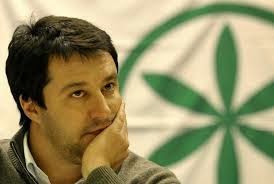
Matteo Salvini of Italy’s Northern League (Lega Nord) political party often likes to point out that Lombards like himself and the League’s founder, Umberto Bossi, are not really Mediterranean people but Anglo-SaxonNordic, even.  That may be, but last week Salvini proved to the world that he’s no Thor Heyerdahl.


According to Maltese media, seven League members, including Salvini, who is the party secretary, had to be rescued from the Mediterranean by the tiny Republic of Malta’s navy.  They were in the midst of a publicity stunt to prove how easy it was for undocumented “boat people” from Tunisia to illegally emigrate to Italy.  But their small rubber dinghy’s engine caught fire.  After the fire was put out, one of the crew fired a distress flare but held the flare gun the wrong way around and fired it into the boat instead.  The craft capsized and all seven had to be rescued by a Maltese military vessel.

Matteo Salvini, Northern League secretary, with a Padanian flag

The Northern League was founded in Lombardy in the 1980s and now has party branches throughout the northern third of Italy, pushing for greater autonomy for the regions and eventually independence from the south as a Federal Republic of Padania.  The League was an unlikely junior partner in Silvio Berlusconi’s ruling coalition, but when Berlusconi was swept out of office in 2011 in the wake of the European currency crisis, the League found itself fighting for its political life.  As a consequence, it chose to amplify the nascent xenophobia that runs through the movement.  One Northern League senator from Lombardy, Roberto Calderoli, last year infamously compared Italy’s minister for integration, Cécile Kyenge—an immigrant who was born in the Democratic Republic of the Congo—to “an orangutan.”  And Bossi has been known to refer to Africans as “bingo-bongos.”

Umberto Bossi, founder of Lega Nord
“Instead of covering themselves with glory,” a Maltese newspaper said, “they only succeeded in covering themselves with ridicule.  And they actually proved that it is easy for sea trips of this sort to end in tragedy—and in Malta, where neither they nor asylum seekers want to land.”


Perhaps the adventure will teach Salvetti and his colleagues a little more sympathy for those who risk life and limb to provide for their families by emigrating to Italy.  But probably not.

The Viking seafaring genes must have skipped the Lombards.
[For those who are wondering, yes, this blog is tied in with a forthcoming book, a sort of encyclopedic atlas to be published by Auslander and Fox under the title Let’s Split! A Complete Guide to Separatist Movements, Independence Struggles, Breakaway Republics, Rebel Provinces, Pseudostates, Puppet States, Tribal Fiefdoms, Micronations, and Do-It-Yourself Countries, from Chiapas to Chechnya and Tibet to Texas.  Look for it some time in mid 2014.  I will be keeping readers posted of further publication news.]

Saturday, April 5, 2014

Venice Cops Nab 24 “Terrorists” with Jerry-Rigged Fiat “Tank” after 89% of Venetians Vote to Secede from Italy

“Fix it again, Tony”
Police in northern Italy on April 2nd arrested 24 separatist activists on “terrorism” charges, including for the construction of what the authorities are calling a home-made tank for use in a planned mock “invasion” of St. Mark’s Plaza in Venice.  This occurred only a little more than a week after an overwhelming majority of residents of Venice and its surrounding administrative region, Veneto, voted in an unofficial online referendum to secede from Italy.  The poll—reported on at the time in this blog—was organized by a group which would like to revive the Most Serene Republic of Venice, which ruled the Mediterranean until it was dismantled by Napoleon and the Hapsburgs in the late 18th century.


Other charges levied included “fabrication of weapons of war” and “subversion of the democratic order”—this last being a rather interesting way of viewing a group that organized a referendum on something that the central government refused to put to a vote.  Those arrested included Franco Rocchetta, a former parliamentary who founded the Veneto League (Ligo Veneta, or L.V.), which in the late 1980s split away from the more geographically broad Northern League (Lega Nord) to launch the movement for a revival of the old republic, a movement called “Serenissimism.”

Franco Rocchetta (right, holding a Venetian flag) was among those arrested.
Closer inspection of the released images, including police surveillance videos, show that the vehicle, though it was nicknamed “il Tanko” and allegedly was mounted with machine-gun turreted and stocked with dynamite, was in fact a rather amateurishly slapped together conglomeration of welded panels atop an ordinary Fiat earthmover (see photo at the top of this article).

Serenissimists are shown here pulling off a similar stunt in St. Mark’s Plaza
in 1997.  There were no injuries or violence.
Police also claim that wiretapped conversations among the plotters included a statement from one that “There’ll be 800 of us.  Well equipped, with gas masks.  Some of us with machine guns and there will be people from abroad too.”  Another allegedly said, “We’re going to install a real climate of fear.  It’s going to be fun.”


After the referendum held last month, organizers announced at a rally in Padua a turnout of 2.36 million voters out of Veneto’s 5 million residents and 73% of all registered voters.  89% of these voters ticked the “yes” box for independence.  Far more concretely, the ballot elected ten “delegates” designated to begin implementing moves toward secession.  In the same ballot, Venetians opted to retain membership in the European Union (E.U.), the Euro Zone, and the North Atlantic Treaty Organization (NATO) with majorities of 55%, 51%, and 65%, respectively.


Gianluca Busato, the referendum’s organizer, was ecstatic, telling reporters, “Rome treats us as the edge of the empire, good only to pay taxes,” and already discussing details for an independent Veneto’s tax system.


Veneto region’s separatist president, Luca Zaia, celebrated the results but said that there was still “some way to go” along the road to an official referendum whose results the Italian government and the international community would accept.


The arrested of the alleged terrorists may dampen enthusiasm for the movement and test its seriousness. On the other hand, it may just make Venetians—many of whom feel that their region pays in too much to prop up the currency-crisis-ravaged Italian state—only angrier.  That seems to be the case for at least one of those arrested, Luigi Faccia, who, in his arraignment in Vicenza on April 4th, would only give his citizenship as Venetian, and told the judge, “As head of the Venetian Liberation, servant of the Most Serene Republic of Venice, I declare myself a prisoner of war.”


[For those who are wondering, yes, this blog is tied in with a forthcoming book, a sort of encyclopedic atlas to be published by Auslander and Fox under the title Let’s Split! A Complete Guide to Separatist Movements, Independence Struggles, Breakaway Republics, Rebel Provinces, Pseudostates, Puppet States, Tribal Fiefdoms, Micronations, and Do-It-Yourself Countries, from Chiapas to Chechnya and Tibet to Texas.  Look for it some time in mid 2014.  I will be keeping readers posted of further publication news.]

Subscribe Now: Feed Icon