Showing posts with label Lombardy. Show all posts

Tuesday, April 8, 2014

Anti-Immigrant Publicity Stunt Lands Italian Xenophobe Separatists in the Drink


Matteo Salvini of Italy’s Northern League (Lega Nord) political party often likes to point out that Lombards like himself and the League’s founder, Umberto Bossi, are not really Mediterranean people but Anglo-SaxonNordic, even.  That may be, but last week Salvini proved to the world that he’s no Thor Heyerdahl.


According to Maltese media, seven League members, including Salvini, who is the party secretary, had to be rescued from the Mediterranean by the tiny Republic of Malta’s navy.  They were in the midst of a publicity stunt to prove how easy it was for undocumented “boat people” from Tunisia to illegally emigrate to Italy.  But their small rubber dinghy’s engine caught fire.  After the fire was put out, one of the crew fired a distress flare but held the flare gun the wrong way around and fired it into the boat instead.  The craft capsized and all seven had to be rescued by a Maltese military vessel.

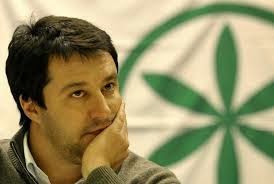
Matteo Salvini, Northern League secretary, with a Padanian flag

The Northern League was founded in Lombardy in the 1980s and now has party branches throughout the northern third of Italy, pushing for greater autonomy for the regions and eventually independence from the south as a Federal Republic of Padania.  The League was an unlikely junior partner in Silvio Berlusconi’s ruling coalition, but when Berlusconi was swept out of office in 2011 in the wake of the European currency crisis, the League found itself fighting for its political life.  As a consequence, it chose to amplify the nascent xenophobia that runs through the movement.  One Northern League senator from Lombardy, Roberto Calderoli, last year infamously compared Italy’s minister for integration, Cécile Kyenge—an immigrant who was born in the Democratic Republic of the Congo—to “an orangutan.”  And Bossi has been known to refer to Africans as “bingo-bongos.”

Umberto Bossi, founder of Lega Nord
“Instead of covering themselves with glory,” a Maltese newspaper said, “they only succeeded in covering themselves with ridicule.  And they actually proved that it is easy for sea trips of this sort to end in tragedy—and in Malta, where neither they nor asylum seekers want to land.”


Perhaps the adventure will teach Salvetti and his colleagues a little more sympathy for those who risk life and limb to provide for their families by emigrating to Italy.  But probably not.

The Viking seafaring genes must have skipped the Lombards.
[For those who are wondering, yes, this blog is tied in with a forthcoming book, a sort of encyclopedic atlas to be published by Auslander and Fox under the title Let’s Split! A Complete Guide to Separatist Movements, Independence Struggles, Breakaway Republics, Rebel Provinces, Pseudostates, Puppet States, Tribal Fiefdoms, Micronations, and Do-It-Yourself Countries, from Chiapas to Chechnya and Tibet to Texas.  Look for it some time in mid 2014.  I will be keeping readers posted of further publication news.]

Tuesday, July 24, 2012

Valtellina: A History Lesson on Europe’s Tense North–South Border

Europe’s cultural and even political boundaries have never been more fuzzy and contested.  The Euro Zone crisis is intensifying chauvinistic opinions on what it means to be Northern European and Southern European.  Padania (northern Italy), Catalonia, and even France’s region of Savoy (see a report on Savoyard separatism from this blog), are itching to secede.  Switzerland is content to be a gaping doughnut hole in the European Union (E.U.).  And an island in Greece is even trying to join the Republic of Austria (as reported last week in an article in this blog).  It’s always an exercise in perspective to take a look at central Europe’s complicated history and figure out how we got here and where we might be headed.


Valtellina

In that spirit, an academic conference held jointly in the nearby border towns of Tirano, Italy, and Poschiavo, Switzerland, on June 22-23 was the occasion for historians to mull the significance of the 500th anniversary of the annexation, in June 1512, of the Italian region of Valtellina by the Free State of the Three Leagues, which is now the Swiss canton of the Grisons (Graubünden in German, and Grigioni in Italian).  Today, Valtellina forms more or less the province of Sondrio in the Lombardy region of northern Italy, but in 1512 it was under the control of the Holy Roman Empire’s Duchy of Milan until the Three Leagues annexed it.  It remained a Three Leagues dependency without ever being asked to join the Free State’s tripartite confederation (the three leagues were the League of God’s House, the Grey LeagueGraubünden literally means “Grey League”—and the League of Ten Jurisdictions).  Thus, after conquering Switzerland and northern Italy, Napoleon Bonaparte in 1798 gave the Valetellinesi the choice of which Napoleonic puppet state to join: the Cisalpine Republic, with its capital in Milan, or the Helvetic Republic, where it would be part of the Canton of Raetia (corresponding to the ancient Roman imperial province of the same name).  It chose the Cisalpine Republic, where more fellow Italian-speakers lived.  (The Helvetic Republic was, as its successor state Switzerland is today, mostly German-speakers).  So, when the Helvetic Republic was reorganized in 1803 under Napoleon into the loosely federal Swiss Confederation we know today, it was with a truncated Grisons replacing Raetia, while Valtellina became part of Napoleon’s Kingdom of (northern) Italy, then the post-Napoleonic Kingdom of Lombardy and Venetia and, later, modern Italy.


Switzerland in the late Napoleonic period.  Valtellina is shown with diagonal grey stripes in the lower right.
Today’s Grisons (Graubünden) is “Rhätien,” in lavender, just above it.  Bellinzona and Lugano later united as Ticino.

But what if the Valtellinesi had chosen differently?  As a Grisonian “fourth league,” muses the Milan University historian Guglielmo Scaramellini, Valtellina’s inclusion might have tipped the Grisonian ethnolinguistic and political balance and dampened the Grisons’ motivation to join the Swiss Confederation after Napoleon—“so that still today,” Scaramellini speculates, “there would be a Republic of the Four Leagues, independent and sovereign.  Another miniature Switzerland—but competing with the original!”  The Grisons of today is already trilingual—with a German-speaking majority outnumbering valleys populated by speakers of Italian and Romansh (Rhaeto-Romanic) (Romansh being one of Europe’s threatened languages, related to the much healthier Friulian language spoken in northeastern Italy).  But an independent Grisons that included Valtellina would be dominated by Italian language and culture, and, says the Swiss historian Florian Hitz, “One cannot be sure if a Switzerland weighted to the southeast, with Valtellina, would have been able to withstand Italian irredentism.”


Flags of Switzerland and the Grisons

Nowhere more than on Switzerland’s borders with its neighbors, none of which corresponds to a linguistic boundary, is the arbitrariness of the lines laid down by history more obvious.  (Maybe that’s why the Swiss are so xenophobic: they are trying to change the subject so no one notices that there are no ethnolinguistic grounds for the country existing at all.)  The cultural affinities that run across the border from Valtellina to the Grisons might be something to contemplate, in light of several recent developments.


Chur, capital of the Grisons, in 1803, the year the modern Swiss Confederation was formed

Since 1995, the Council of Europe has recognized (mostly for touristic and cultural-exchange purposes) a transnational “Euroregion” called Insubria, embracing part of the Italian regions of Piedmont and Lombardy and Switzerland’s Italian-speaking canton, Ticino, to the Grisons’ west—but not, oddly enough, either Valtellina or the Italian-speaking Poschiavo valley in the Grisons.  And an Italian linguist named Lorenzo Banfi founded, in 2005, the bioregionalist nationalist political party Domà Nunch (“Only Ours,” in Lombard dialect) with the quixotic idea of one day declaring an independent Insubria.


A map of “Insubria”

More relevant here, to the east, is the Euroregion of Raetia Nova—or, if you want to get pedantic about it, Rætia Nova—which as far as I can tell seems to embrace the historically Romansh-speaking areas of: Graubünden; adjoining areas of the Austrian Alps (including Vorarlberg, which after the carnage of the First World War voted overwhelmingly in a referendum to join Switzerland, but without effect); Valtellina; and the Italian autonomous region of Trentino–Alto Adige/Südtirol, where hundreds of thousands of speakers of Friulian and Tyrolean German constitute Italy’s highest concentration of linguistic minorities.  It is hard to get reliable maps of Raetia Nova, suggesting that as a Euroregion it hasn’t really gotten up and running yet, though there was a Raetian football (soccer) team that competed in this year’s VIVA World Cup competition for unrecognized states, held June 9th in Arbil, in Iraqi Kurdistan (as reported on in this blog at the time).  (Since you ask: Zanzibar, Western Sahara, and Tamil Eelam massacred them out of the top ranks with 6-0, 4-0, and 3-0 wins, respectively.)


The flag of Raetia, as used by the region’s resolutely unofficial football team.
Note the use of grey, as in the “Grey League”—otherwise a rather unusual color in flags.

Meanwhile, northern Italy’s separatist Lega Nord (“Northern League”) has recently mooted the idea of a “Greater Padania” (see my article from this blog on that particular benchmark in Umberto Bossi’s descent into silliness) that embraces all of the Alpine region, as far as northern Bavaria.  (See an article from this blog listing Padania as one of “Ten Separatist Movements to Watch in 2012” and another profiling Bossi’s son Renzo Bossi as one of “The World’s 21 Sexiest Separatists.”)

A Lega Nord–produced map of a sort of European-mini-empires fantasy league, showing,
in dull orange in the middle of everything, “Greater Padania”

Hitz says that Valtellina would theoretically make a fine Swiss canton: “Ticino was conquered territory, too, so that would fit,” he says, adding, “The country would just have been bigger and more beautiful!”  (Ah, yes, I like my countries Rubenesque myself.)  In fact, in March of this year Switzerland’s minister of defense, Ueli Maurer (ironic onomastic synchronicity: Maurer means wall-builder, but never mind), quipped that Switzerland would be economically capable of annexing Lombardy.  He was not serious, but several tens of thousands of Lombards were when, over the next few weeks, they signed a petition supporting the idea.  Under Swiss rule, Lombards would have more autonomy, a better infrastructure, an automatic exemption from foreign military adventurism, and even lower taxes—since, in this Lega Nord way of thinking, there won’t be millions of lazy, jobless Sicilians and Neapolitans to subsidize.


Switzerland’s minister of defense, Ueli Maurer (right), posing with a compatriot

Bossi, the Lega Nord’s founder, had another idea, telling a crowd of supporters recently, “We could declare war on them” (them meaning the Swiss; Bossi is a Lombard), “and then promptly surrender.”  Somehow, I think those are the only terms of annexation the xenophobic—and in particular Italophobic—Swiss would accept.  (Lega Nord sent a delegate to the Valtellina conference to take careful notes.)


The flag of Insubria is a mighty wicked flag, in my opinion.
Yes, that’s Jonah being eaten by a (rather serpent-like) whale.  Twice.
’Cause that’s how Insubria rolls.

But all of these jokes and quips and petitions should be a wake-up call.  Many in central Europe are unhappy with the way the borders are drawn.  They don’t feel the lines and colors on the map reflect their histories, identities, and allegiances.  Sooner or later, something has to give.


[Also, for those who are wondering, yes, this blog is tied in with a forthcoming book, a sort of encyclopedic atlas to be published by Auslander and Fox under the title Let’s Split! A Complete Guide to Separatist Movements, Independence Struggles, Breakaway Republics, Rebel Provinces, Pseudostates, Puppet States, Tribal Fiefdoms, Micronations, and Do-It-Yourself Countries, from Chiapas to Chechnya and Tibet to Texas.  Look for it in spring 2013.  I will be keeping readers posted of further publication news.]

Friday, January 27, 2012

Umberto Bossi’s “Republic of Padania” Expands into Central Europe

A month ago, I listed Padania—the new state some Italians want to create in the northern third of their country—as number eight among “Ten Separatist Movements to Watch in 2012.”  The party pushing this idea, the Lega Nord per l’Indipendenza della Padania—called Lega Nord (Northern League) for short—is not just any minor separatist movement.  It is the main political party in Italy’s large Veneto region (which includes Venice) and is the second-largest in Lombardy, which contains Milan and nearly 10 million people.  Italy’s fractious coalition politics allowed the League to become a junior partner in the Milanese media mogul Silvio Berlusconi’s center-right coalition government in 2008.  The League’s flamboyant and confrontational leader, Umberto Bossi, became Prime Minister Berlusconi’s Minister for Federal Forms, pushing the agenda of, if not necessarily independence, at least a much more federal system, with much more power devolved to the regions.

The proposed borders of an independent Padania

Then, in 2011, the European debt crisis spread from Greece to Italy and brought down the Berlusconi government.  The new prime minister, Mario Monti, a shy economist and technocrat beholden to European Union institutions, left the Northern League out of his new coalition—despite the fact that Monti, like Bossi, is a Lombard.  The League saw this as a stinging betrayal.  In my earlier post, I predicted that sudden marginalization after having tasted the highest echelons of government would galvanize the Northern League’s separatist spirit.  What I didn’t predict was that this fall from power would push Bossi, a former Communist from Lombardy, over the edge.

Umberto Bossi

Bossi had long called for Italy’s more prosperous, more industrialized, and culturally less Mediterranean northern regions—Emilia-Romagna, Friuli-Venezia-Giulia, Liguria, Lombardy, Piedmont, Trentino-Alto-Adige, Val d’Aosta, Veneto—to secede as Padania.  But after being forced out of government the League now asks all party members to pledge allegiance to the cause of Padanian secession.


And now media are reporting that at a conference last month Bossi unveiled his plans for a future Padania to be the heart of a new, greater Central European state that would also include Switzerland, Austria, Bavaria, and France’s Savoy region.  Bossi unveiled a map of this new superstate, colored in by his equally flamboyant son, Renzo Bossi.  Has the Northern League gone crazy?

Imperial Lombard cartographer
and apple-fallen-not-far-from-tree Renzo Bossi

It would be one thing if Bossi saw this Greater Padania as part of an integrated Europe, but Bossi over the years has become as Euro-skeptical as Margaret Thatcher.  The League laments northern Italy’s embeddedness in a Euro zone that allows inefficient and corrupt cultures like those of Greece, southern Italy, and Portugal to drag down the industrialized north.  And, make no mistake, Bossi thinks Italy is northern Europe.  Bossi, who spent more than ten years as a Member of European Parliament, now calls the E.U. both “fascist” and “Stalinist” and would like to take Padania out of it.  Now, it seems, he would like to punch an even larger hole in the middle of Europe.

Padania’s flag

Just to take the example of Switzerland—which, unlike other parts of the Greater Padania on Bossi’s fantasy map, is not in the E.U.—the idea that German-speaking Swiss would consent to be a province within a country ruled from Venice where Italian would be the predominant language is not only highly unlikely but rolling-on-the-floor laughable.  Switzerland is not only one of the Europe’s most xenophobic countries, but most of its xenophobia is directed eastward and, especially, southward (even though Italian is one of Switzerland’s national languages, spoken in the border canton of Ticino).  The Swiss do not see much distinction between northern and southern Italy and certainly do not regard Lombards, Ligurians, and Venetians as fellow ... Aryans-or-whatever, blond though some of them may be.  Much the same could be said of Austrian attitudes toward Italy, despite the fact that there is a very large community of German-speakers in the South Tyrol region of northeastern Italy.  (That region also has a large vibrant linguistic minority of Friulians, speaking a variety of the Rhaeto-Romanic language also in use on a much smaller scale in southeastern Switzerland, where it is called Romansch.)

Do you think the folks who made this poster
would swear allegiance to an Italian-run government?

As for Savoy, there are historical resonances Bossi is building on: the medieval Duchy of Savoy had its capital in Turin and extended to the Mediterranean; then the region was made part of the Kingdom of Sicily (later Sardinia), until France absorbed it for the first time during the French Revolution.  Sardinia seized it back after Napoleon’s fall, but then Napoleon III negotiated its return to France in 1858 in a secret deal that Savoyard activists today still recall bitterly.  Culturally and historically, then, Savoy is arguably half Italian already.  But Bavaria (which has its own marginal separatist movement)—that is hard to picture.

The medieval Duchy of Savoy

Bossi’s pipe dream envisions a Lombardy that is at the heart of a new Mitteleuropa, embracing those parts of Germany that are the least Nordic—the southern, Alpine region of the Alemannic dialects.  One could be forgiven for detecting a whiff of Axis geography in all of this; after all, Adolf Hitler was from Austria, Berchtesgaden was right on the Austro-Bavarian border, and Benito Mussolini was from Emilia–Romagna and emigrated to Switzerland as a young man—etc. etc.  In fact, though, what Bossi’s map shows more than anything else is a revived (but modified) Holy Roman Empire.  And just guess who would be Emperor.


Mario Monti—and the circumstances of recent political history—had already temporarily marginalized the Northern League.  But with this kind of talk, Umberto Bossi will marginalize it permanently.


(P.S.: I have had trouble finding a clear image of Renzo Bossi’s map.  The closest I can find is the following map (see below), from an “Anthrocivitas” forum thread on the subject.  If any readers find a more reliably genuine or better-resolution image for this map, please let me know!  And please help me understand how Bossi plans to redraw these other borders.  What is that I see there?  Southeast England plus Saxony and the Low Countries??  A restored East Germany??  A Viking reannexation of the Scottish Highlands??)

Subscribe Now: Feed Icon