Showing posts with label Padania. Show all posts

Sunday, September 6, 2015

Why Does Abkhazia Get to Host the 2016 “World Cup” for Aspirant Nations?


[Special note to readers: This article elicited a strong reaction from ConIFA, which contributed a statement to the effect that it considers itself a “non-political” organization.  For that statement, please see the comments section at the end of this article.  This blog welcomes and encourages a full discussion of the political and ethical implications, if one feels there are any, to ConIFA’s relationship with Abkhazia, Transnistria, Magyar irredentists, and other entities which many see as playing a negative role, to say the least, in European politics.]

We are used to international geopolitics inserting itself into the world of association football (that’s “soccer” to Americans).  World powers sometimes use the game as a proxy war for their own tussles over what is and is not a state and where national borders lie.  Examples include the ban on holding FIFA games in Russian-occupied Crimea, Spain trying to block Gibraltar, which it still claims, from member-state status, and ongoing politically motivated fan violence in Balkan hotspots like Bosnia and Kosovo.  But now a smaller football league that was supposed to be aloof from the rougher political edges of FIFA (the French acronym for the International Federation of Association Football) is courting similar controversy.


This league, the Confederation of Independent Football Associations (ConIFA), a new organization devoted to aspirant or unrecognized states ineligible for FIFA membership, decided this summer that its 2016 football (soccer) world cup would be held in the Republic of Abkhazia, a de facto–independent Russian puppet state in what most of the world outside Russia regards as part of the Republic of Georgia.  Despite damage and economic instability resulting from a recent history of separatist war and ongoing diplomatic limbo, Abkhazia and its capital city, Sukhumi, can, ConIFA promises, offer “top-class infrastructure” for a sporting event.  But Abkhazia is bound to be a divisive choice, considering that Russian support for violent separatism in Ukraine since early last year—a political situation which closely parallels Abkhazia, which split away as the Cold War ended—has led to calls to boycott the Russian-hosted FIFA World Cup planned for 2018.


ConIFA is not the first league of its type.  A predecessor was Viva, which doesn’t stand for anything but is a play on the name FIFA, also set up for national teams of unrecognized states.  Viva’s first world cup, in 2006, was originally to be held in the Turkish Republic of Northern Cyprus, a puppet state that every country in the world other than Turkey recognizes as part of the Republic of Cyprus.  Northern Cyprus ended up ceding hosting duties to Occitania (southern France) after a brouhaha over Northern Cypriot demands to vet participating teams—probably the result of Turkish skittishness at that time about any kind of recognition of any kind of Kurdish entity, since northern Iraq’s autonomous Kurdistan Region was also a participant.  Viva has successfully kept politics out of the team-selection process in the four subsequent Viva cup finals hosted by, in turn, Sápmi (the northern Scandinavian homeland of the Sami, or Lappish, people), Padania (separatist northern Italy), Gozo (the Republic of Malta’s smaller island), and Erbil, the Iraqi Kurdish capital.

Sami (Lapp) footballers competing in Östersund
Other participating Viva teams over the years have included Monaco (not a pseudo-state, but too small for FIFA nonetheless), Provence, Zanzibar, Arameans Soryoye (the team of the Christian Syriac people), Darfur (southwestern Sudan), Raetia (the linguistically distinct Ladin, Friulian, and Romansh speakers of southeast Switzerland and northern Italy), Tamil Eelam (the Hindus of northern Sri Lanka), and Western Sahara (the Moroccan-occupied Sahrawi homeland).  Customs red tape and other logistical problems have mostly prevented Southern Cameroons, West Papua, and Tibet from participating.  But no one was deliberately excluding anyone, or being remotely provocative.  Even the Northern Cypriot team graciously conceded defeat to the Kurdish team in the 2012 Erbil games.


(Yet another organization, FIFI (Federation of International Football Independents), in 2006 held a one-off exhibition “Wild Cup” tournament in Hamburg, Germany, where Northern Cyprus triumphed over Zanzibar, Gibraltar, Greenland, Tibet, and the Republic of St. Pauli—this last being a fictive micronation (fictive even by micronational standards) consisting of Hamburg’s red-light district.)


The ConIFA European cup this June, for its part, was hosted in Hungary by Székely Land, a proposed state in western Romania’s ethnic-Magyar (Hungarian) region.  Padania (northern Italy) won that 11-match series, with the County of Nice (in southeastern France), the Isle of Man, and Felvidék (Slovakia’s “Upper Hungary” region) ranking second through fourth, in that order.  The first ConIFA world cup, in 2014 in Östersund, Sweden, hosted by Sápmi (Lappland), was won by the highly impressive Niçois team.

Magyar nationalists displaying the Székely Land flag in Transylvania
And here, with this ConIFA line-up, the observant reader who is familiar with the minor nationalisms to which this blog is devoted will have caught perhaps a clue as to why Abkhazia, of all places, was selected to host the 2016 ConIFA cup.  Start with Székely Land, an autonomist cause with nowhere near the popular momentum enjoyed by, say, Scotland, Catalonia (both of which keep a plenty high profile in FIFA football), Padania, Kurdistan, or Tibet.  In fact, the idea of giving autonomy to the Magyar-dominated parts of western Romania is mostly a pet cause of the extremist far right in Hungary and Romania (as discussed once in this blog).  Autonomy for Romania’s Szeklers (Magyars) is in particular an abiding emotional rallying point for Jobbik, the neo-fascist ultranationalist party in Hungary, which in an election last year became Hungary’s third-largest party.

Jobbik armbands on parade
Felvidék, or “Upper Hungary,” the formerly Hungarian-ruled parts of Slovakia, is an even obscurer cause.  Slovakia is a stable, increasingly western-style state, and Hungarian is an official language in areas where speakers are more than 20% of the population.  (They are 8.5% of it nationwide.)   Slovakia’s Magyars are hardly separatist, but Jobbik has not forgotten them.   The party specifically calls for the revocation of the 1920 Treaty of Trianon.  That agreement, part of the dismantling of the defeated Austro-Hungarian Empire after the First World War, whittled the newly independent Hungary down to its current size, stripping away territories that had been under the Hungarian crown within the empire: all of Slovakia, a third or so of modern Romania, the Vojvodina province of northern Serbia, Ukraine’s Transcarpathia oblast, and significant territories which are now along the edges of Austria, Slovenia, and Croatia.  Jobbik wants all these lands back.  Only small bits of them have ethnic-Hungarian majorities today, but under Habsburg rule the German-speaking Austrian and Magyar élites ruled over smaller ethnonational groups in a political structure that was almost feudal.  Hungary, when it was an Axis country during the Second World War, tried and failed to use that conflict to regain lost territories.

Light green is modern Hungary;
darker green are those areas stripped from
the Kingdom of Hungary after the First World War
The County of Nice, too, is mostly a right-wing, even neo-fascist, irredentist cause.  In the years of conflict leading up to Italian unification in the mid 19th century, this Mediterranean city and its environs were ceded by the Kingdom of Sardinia’s House of Savoy (soon to become the ruling house of unified Italy) to France in exchange for help fighting the Austrians.  This stuck in the craw of the unification hero Giuseppe Garibaldi, a Niçois native who once famously said, “If Nice is French, then I am a Tatar.”  Thus Nice shifted from a mostly Italian-speaking city to a francophone one.  A claim on Nice was revived by Benito Mussolini during the Fascist era, and it is also included by the far-right, xenophobic, anti-Brussels Lega Nord (Northern League) in northern Italy as part of its dreamed-of “Greater Padania.”  Oh, and of course Padania is prominent in ConIFA too (as it was in Viva).  A ConIFA delegation to Nice in May of this year is prominently featured on the ConIFA website.

Football fans waving the Niçois separatist flag
Abkhazia, next year’s ConIFA host, is one of two ethnically distinct parts of Georgia which split away from Georgia after the fall of Communism in the early 1990s—the other being South Ossetia, which, like Abkhazia, is also a ConIFA member “state.”  After the brief South Ossetia War in 2008, Russia’s President Vladimir Putin shored up their de facto independence and granted them diplomatic recognition, something only a handful of other tiny states have followed the Russian example in extending.  Abkhazia and South Ossetia are in fact just the longest-standing parts of an archipelago of Russian-backed puppet states in non-Russian parts of the former Union of Soviet Socialist Republics.  Others (discussed at length elsewhere in this blog, e.g. here) are Transnistria, in Moldova; the Armenian-dominated Nagorno-Karabakh Republic in Azerbaijan (the N.K.R. is also in ConIFA); the Donetsk and Luhansk “People’s Republics” established last year in eastern Ukraine; and, less concretely, possible future separatist entities in places like Transcarpathia (see discussions in this blog here and here), Ukraine’s Odessa oblast (see reports from this blog here and here), and ethnic-Russian parts of Kazakhstan, the Baltic States, and elsewhere.  Another emotional issue for Armenian nationalists and their Turkophobic puppetmasters in the Kremlin is another ConIFA “member,” Western Armenia, a proposed N.K.R.-type entity many Armenians would like to carve out of what is now eastern Turkey.  (Turkey is a member of the North Atlantic Treaty Organization (NATO) and has been a bugbear of Russian nationalists since Ottoman days.  Turkey and Azerbaijan are both allies of the U.S.)


Transnistria, it will be no surprise, is also a target of ConIFA diplomacy, in the form of an official ConIFA visit just before June’s European cup to Tiraspol, capital of this tiny, Russian-backed sliver of a pseudostate consisting of Moldova’s eastern edge abutting Ukraine.  ConIFA would like Transnistria to host a future tournament.  It also features prominently in contingent Russian plans for a takeover of more of the southern, ethnic-Russian-dominated areas of Ukraine, which mostly extend in a belt across the northern shores of the Black Sea, extending to Odessa oblast, which borders Transnistria.

Transnistrians in Bessarabian folk costume in a flag ceremony in Tiraspol
Putin’s proxy expansionism, while it exploits Soviet iconography and terms like “people’s republic,” is in fact a right-wing type of enterprise, and to this end it is not surprising that it has gained the support of far-right parties in the west that might otherwise talk a lot about “freedom”—such as (see discussion in this blog) Jobbik, Lega Nord, Flemish separatists in Belgium, libertarian-leaning separatists in Venice, the United Kingdom Independence Party (UKIP), and high-profile right-wing conspiracy-mongering nuts in the United States such as Lyndon LaRouche and Ron Paul.  Putinism shares with these far-right movements a suspicion of the European Union (E.U.), NATO, and multilateralism in general; xenophobia focusing on a nakedly bigoted Islamophobia; and an infatuation with muscular militant nationalist leadership that in fact has more in common with 1930s Fascism than with Soviet-style Communism.

Putin is a darling of xenophobic Padanist separatists like these Lega Nord activists in Milan
To be sure, leftist aspirant states are in ConIFA too, including the Aymará indigenous nation of Bolivia; the disinherited Chagos Islanders of Diego Garcia in the Indian Ocean, who live in exile in England; and Cascadia in the American and Canadian Pacific Northwest.  But even some of these are causes which appeal to Putin’s anti-Western imperialism.   The Aymará nation includes Bolivia’s left-wing president, Evo Morales, who sided with Putin’s invasion and annexation of Crimea.  Bolivia was one of only ten countries which sided with Russia in voting against a March 2014 United Nations resolution that upheld Ukraine’s right to territorial integrity following the Crimea annexation; the others—all of them (as discussed at the time in this blog) mostly profoundly undemocratic societies—were Armenia, North Korea, Zimbabwe, Cuba, Nicaragua, Venezuela, Syria, Sudan, and Belarus.  Even Iran, China, and Myanmar had the decency to at least abstain.  The Chagos Islanders’ cause, too (see discussion here and here), is one which Putin is keen to highlight because it is an example of a serious human-rights abuse which can be laid at the feet of NATO.  Along with the prominence of the above-discussed obscure neo-fascist irrendentist entities like Upper Hungary, Székely Land, and Nice, most of the teams prominent in ConIFA are ones that conform to the anti-Western, anti-NATO, anti-E.U. agenda of Putin’s new imperialism in its “near abroad.”

Aymará Indian demonstrators with their national flag
One possible result of a tournament in Abkhazia next year, and a possible later one in Transnistria, would be to spread the popularity and prestige of the Russian puppet-state model among separatist groups across the political spectrum and around the world—fitting the new pattern of parties like Lega Nord, France’s National Front, and Jobbik—even the otherwise-leftist Basque nationalists in Spain—lining up behind Putin’s imperialist agenda in Georgia, Moldova, and Ukraine.  Playing in Abkhazia is sure to be willfully misinterpreted as a de facto recognition by these aspirant nations.  It is worth asking who is running ConIFA—or, perhaps, who has taken it over or whom it serves.  While Putin plays hardball in Ukraine, the lurch to the right in separatist soccer may be playing into the hands of his stealth “soft power” offensive against the West.


[You can read more about Abkhazia, Transnistria, and many other separatist and new-nation movements, both famous and obscure, in my new book, a sort of encyclopedic atlas just published by Litwin Books under the title Let’s Split! A Complete Guide to Separatist Movements and Aspirant Nations, from Abkhazia to Zanzibar.  The book, which contains 46 maps and 554 flags (or, more accurately, 554 flag images), is available for order now on Amazon.  Meanwhile, please “like” the book (even if you haven’t read it yet) on Facebook and see this interview for more information on the book.]


Monday, November 3, 2014

Strange Bedfellows: “Republic of Venice” Libertarians Side with Putin in Ukraine, as Europe’s Regional Parties Tilt Eastward


Strange things are happening in Europe, as the West’s political landscape shifts in the wake of the war in Ukraine.  In the latest head-scratcher, a prominent academic historian and separatist libertarian activist in northern Italy is praising the Kremlin-backed rebels in eastern Ukraine, saying the “people’s republics” of Donetsk and Luhansk are legitimate states whose election results this week ought to be respected.


Paolo Bernardini, a Genoa-born professor of history at the University of Insubrica in Como, is known in academic circles for prolific work on the history of Jewry in Europe.  In politics, he is better known as co-founder of Veneto Independence (Indipendenza Veneta), a group seeking to separate the autonomous Veneto region—including its capital, Venice—from the Italian Republic and restore the historic Most Serene Republic of Venice, as outlined in Bernardini’s 2011 book Minima Libertaria.  For centuries, the republic was the premier naval power in the Mediterranean.  Many Venetian regionalists assert its absorption into the unified Kingdom of Italy in the mid nineteenth century was illegitimate.


Speaking a few days ago to Russia’s state-controlled news agency R.I.A. Novosti, Bernardini said, “The real and effective independence of the D.P.R. [Donetsk People’s Republic] and the L.P.R. [Luhansk People’s Republic] may create a new balance of power in the former [sic] Ukraine, and peaceful relations among the various parts of the region, including the D.P.R., L.P.R., Crimea, and what will be left of Ukraine.  A number of small states in fiscal competition one with the other would re-launch a region full of economic potential.”  Of course, this view ignores the fact that President Vladimir Putin’s not-very-covert military invasion of Ukraine has destabilized the entire world order and ushered in a new Cold War, with everyone wondering how far he will go in swallowing up his neighbor, which was ruled from Moscow for centuries until it gained independence with the implosion of the Soviet Union in 1991.  The D.P.R. and L.P.R. were declared independent states this spring by shady right-wing paramilitary rebel armies financed, supplied, and even staffed by the Russian military, with the overt desire for eventual annexation to the Russian Federation, along the lines of Crimea, which Russia had brutally invaded and annexed weeks earlier.  Western European countries and the United States have offered only token resistance to Putin’s expansion.  Ukraine is not in the North Atlantic Treaty Organization (NATO), so NATO member states are not obligated to defend it.

This week’s voting in Donetsk.
The peace signs do not seem to be intended ironically.
Another Veneto Independence leader, Alessio Morosin, told R.I.A. Novosti that the European Union (E.U.) “would be foolish to impose new sanctions against Russia for the sole reason that it [Russia] officially recognizes the November 2 elections,” as E.U. leaders have promised.   “There are no precedents in international practice,” Morosin added: “the threat of using sanctions against a state to change its political course, foreign and domestic policy is unacceptable.”  Morosin was silent on the question of  whether Russia is by the same token allowed to use military force to change Ukraine’s political course.  At the time of the Soviet collapse, Ukraine surrendered to Moscow the nuclear arsenal on its territory in exchange for recognition of its borders, including Crimea and the southeast, an agreement Putin now declares invalid because Ukraine’s government is now different—a highly eccentric reading of international law (which, if applied to Russia, would require the return of Sakhalin to Japan and Tuva to China).

Venetist demonstrators fly the Catalan flag as well to show
their—at times far too indiscriminate—support for separatists abroad.
The relationship between northern Italian separatism and Putin’s neo-Soviet imperialism is not new.  A strong theme in the European Parliament elections earlier this year, in which far-right separatist and xenophobic parties in western and central Europe made an unexpectedly strong showing (see recent article from this blog), was some parties’ infatuation with Putin’s style of muscular, aggressive, unapologetic nationalism.  Putin’s annexation of Crimea won praise from groups as disparate as Belgium’s Flemish-nationalist Vlaams Belang party, France’s Nazi-sympathizing National Front (Front nationale), and, yes, Italy’s xenophobic, anti-E.U. Northern League (Lega Nord) (see a recent discussion of them in this blog).  A reporter described a recent Lega Nord rally in Milan (pictured below) as oriented less toward an independent Padania (i.e. northern Italy) and more toward backing Putin, condemning the international sanctions against Russia, and praising Putin’s denigration of “invading” Muslims, a large theme of Lega Nord’s anti-immigrant rhetoric.  This shows what a dim memory the ideological divides of the Cold War have become.  Who would imagine that western Europe’s goose-stepping fascist fringe would be standing up for “people’s republics” in the Ukrainian rust belt?  But in true fascist style, it’s not about political economy: it’s about nationalism and aggression, two things the far right respects no matter what flavor they comes in.

A separatist rally in northern Italy morphs into a saint’s procession for
beloved fellow Muslim-basher Vladimir Putin.
For the most part, non–Lega Nord separatist parties in northern Italy had once occupied another part of the political spectrum (as discussed in an article in this blog; see also this article).  Those movements based in Venice, including the ideologies of “Venetism” and “Serenissimism” (the latter referring to Republic of Venice revanchists), defined themselves in opposition to the Lega Nord founder Umberto Bossi’s intolerance and jingoism, adding their own streak of American (or, in truth, Austrian) style classical-liberal libertarianism.  To make analogies with politics in the U.S., Lega Nord was Pat Buchanan while the Venetists were Ron Paul.  But Venetists are now shifting to the right, despite the fact that Lega Nord is still trying to relegitimize itself in the wake of the Euro crisis, which ejected the party from its role as Silvio Berlusconi’s junior coalition partner and ushered in a corruption scandal, and despite the fact that informal referenda in Veneto earlier this year showed that Venetist separatism could appeal to a majority of Venetians without the appeals to xenophobia and bigotry typical of Lega Nord.

Lega Nord, Republic of Venice, and Russian flags mingle at a League rally in Milan
(along with flags of the former Duchy of Milan, also used by the “eco-nationalist” Insubria movement).
Of course, the Kremlin and its state propaganda organs have been having a field day with the support they are receiving from western European third-, fourth-, and fifth-party politics.  The independence movements in Scotland and Catalonia have been touted by Russia as Exhibit A in its case for the West’s hypocrisy concerning “separatism.”  If Scots should be allowed to choose whether or not to secede, then why not Crimea’s ethnic-Russian majority? (or so the argument goes).  And the far-right xenophobic political party in Hungary, Jobbik, has openly backed the idea that ethnic Hungarians just over the border in Ukraine’s Transcarpathia (Zakarpattia) oblast should be offered “protection” from the “oppression” of the new Ukrainian government, just as the Kremlin is supposedly “protecting” ethnic Russians in the east and Crimea (as discussed in this blog; see also an article here).

Hungary’s Jobbik political party has all the trappings.
Even more bizarrely, in September the separatist parliament of Spain’s autonomous Basque Country region announced that it was recognizing the sovereignty of the Nagorno-Karabakh Republic (N.K.R.), the unrecognized puppet state which newly independent Armenia slashed out of Azerbaijan’s soft western flank when Communism collapsed, after a pitiless campaign of ethnic cleansing of Azeris and Kurds.  Armenia, a close Russian ally, had essentially been doing the same thing for decades in Azerbaijan that Russia started doing this year in Ukraine—and few outside Russia and its puppet states (and, to their shame, many in the U.S. Armenian-American community) backs the N.K.R.  But now the Basques, despite their legacy of leftism and resistance against Francisco Franco’s fascism, are jumping on Putin’s imperialist bandwagon as well.  Strange bedfellows indeed.

The Basque parliament now recognizes the Nagorno-Karabakh Republic.
Why is all this happening now?  Well, it’s easy to blame Putin’s propaganda machine, but some blame must be shared by the western European political establishment.  Though the U.K. showed itself to be an enlightened democratic nation by allowing the people of Scotland to choose independence, it still pushed strenuously—and, in the end, successfully—to convince Scots to stay in the U.K.  Spain, on the other hand, has drawn a line in the sand forbidding Catalonia, the Basques, or any other nation within its kingdom from holding similar referenda.  Nor do Germany, with respect to Bavaria; Belgium, with respect to Flanders; or Italy, with respect to Padania or Veneto, take anything like a British approach to regionalist movements.  In fact, the E.U. and NATO establishments are quite panicked at the idea that regions within European countries might be allowed to—horrors!—choose who governs them.  Well, who does allow such a thing?  In some very blinkered views, Russia does, with its support for eastern and southern regions’ secession from Ukraine.  Never mind that elections in Donetsk, Luhansk, and Crimea are messy and crooked, without international observers; never mind that the movements were spearheaded by provocateurs from Russia and are in fact a mere step on the road to absorption into the heavily centralized Russian Federation, which grants regions far less autonomy than Ukraine does.  And never mind that in Russia even openly voicing support for any kind of autonomy or separatism is illegal, as activists in Siberia and in the Steppes just east of Ukraine have been finding out in the form of prison terms (as discussed recently in this blog).  And never mind the city of Grozny, capital of Russia’s Chechen Republic, which Putin leveled, murdering tens of thousands of civilians, in a war to prevent the Chechen majority’s desire for independence.  Indeed, never mind any of that—and western European far-right separatists are not being reminded of it, either, as they go online and read glowing reports of their own movements in Russia’s slick and deceptive English-language media.

Grozny in 1995.  This is how Putin reacts to separatists when they’re not Russians.
Because western European governments have for the most part turned their backs on the legitimate aspirations of their own ethnic minorities, those groups are now seeking validation and succor, and perhaps even funding, elsewhere—the Kremlin of Vladimir Putin, the most anti-separatist tyrant of all.  For the E.U. and the leaders of Spain, the U.K., and Italy, this should be a wake-up call.  Western European governments who want to show the world that they are more democratic than Putin’s Russia (which they are), it’s time to put your money where your mouth is on the question of ethnic autonomy.  Spain, I’m looking at you.


[You can read more about Venice, Padania, and many other separatist and new-nation movements, both famous and obscure, in my new book, a sort of encyclopedic atlas just published by Litwin Books under the title Let’s Split! A Complete Guide to Separatist Movements and Aspirant Nations, from Abkhazia to Zanzibar.  The book, which contains 46 maps and 554 flags (or, more accurately, 554 flag images), is available for order now on Amazon.  Meanwhile, please “like” the book (even if you haven’t read it yet) on Facebook and see this interview for more information on the book.]


Tuesday, April 8, 2014

Anti-Immigrant Publicity Stunt Lands Italian Xenophobe Separatists in the Drink


Matteo Salvini of Italy’s Northern League (Lega Nord) political party often likes to point out that Lombards like himself and the League’s founder, Umberto Bossi, are not really Mediterranean people but Anglo-SaxonNordic, even.  That may be, but last week Salvini proved to the world that he’s no Thor Heyerdahl.


According to Maltese media, seven League members, including Salvini, who is the party secretary, had to be rescued from the Mediterranean by the tiny Republic of Malta’s navy.  They were in the midst of a publicity stunt to prove how easy it was for undocumented “boat people” from Tunisia to illegally emigrate to Italy.  But their small rubber dinghy’s engine caught fire.  After the fire was put out, one of the crew fired a distress flare but held the flare gun the wrong way around and fired it into the boat instead.  The craft capsized and all seven had to be rescued by a Maltese military vessel.

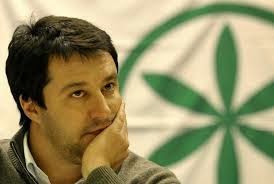
Matteo Salvini, Northern League secretary, with a Padanian flag

The Northern League was founded in Lombardy in the 1980s and now has party branches throughout the northern third of Italy, pushing for greater autonomy for the regions and eventually independence from the south as a Federal Republic of Padania.  The League was an unlikely junior partner in Silvio Berlusconi’s ruling coalition, but when Berlusconi was swept out of office in 2011 in the wake of the European currency crisis, the League found itself fighting for its political life.  As a consequence, it chose to amplify the nascent xenophobia that runs through the movement.  One Northern League senator from Lombardy, Roberto Calderoli, last year infamously compared Italy’s minister for integration, Cécile Kyenge—an immigrant who was born in the Democratic Republic of the Congo—to “an orangutan.”  And Bossi has been known to refer to Africans as “bingo-bongos.”

Umberto Bossi, founder of Lega Nord
“Instead of covering themselves with glory,” a Maltese newspaper said, “they only succeeded in covering themselves with ridicule.  And they actually proved that it is easy for sea trips of this sort to end in tragedy—and in Malta, where neither they nor asylum seekers want to land.”


Perhaps the adventure will teach Salvetti and his colleagues a little more sympathy for those who risk life and limb to provide for their families by emigrating to Italy.  But probably not.

The Viking seafaring genes must have skipped the Lombards.
[For those who are wondering, yes, this blog is tied in with a forthcoming book, a sort of encyclopedic atlas to be published by Auslander and Fox under the title Let’s Split! A Complete Guide to Separatist Movements, Independence Struggles, Breakaway Republics, Rebel Provinces, Pseudostates, Puppet States, Tribal Fiefdoms, Micronations, and Do-It-Yourself Countries, from Chiapas to Chechnya and Tibet to Texas.  Look for it some time in mid 2014.  I will be keeping readers posted of further publication news.]

Saturday, April 5, 2014

Venice Cops Nab 24 “Terrorists” with Jerry-Rigged Fiat “Tank” after 89% of Venetians Vote to Secede from Italy

“Fix it again, Tony”
Police in northern Italy on April 2nd arrested 24 separatist activists on “terrorism” charges, including for the construction of what the authorities are calling a home-made tank for use in a planned mock “invasion” of St. Mark’s Plaza in Venice.  This occurred only a little more than a week after an overwhelming majority of residents of Venice and its surrounding administrative region, Veneto, voted in an unofficial online referendum to secede from Italy.  The poll—reported on at the time in this blog—was organized by a group which would like to revive the Most Serene Republic of Venice, which ruled the Mediterranean until it was dismantled by Napoleon and the Hapsburgs in the late 18th century.


Other charges levied included “fabrication of weapons of war” and “subversion of the democratic order”—this last being a rather interesting way of viewing a group that organized a referendum on something that the central government refused to put to a vote.  Those arrested included Franco Rocchetta, a former parliamentary who founded the Veneto League (Ligo Veneta, or L.V.), which in the late 1980s split away from the more geographically broad Northern League (Lega Nord) to launch the movement for a revival of the old republic, a movement called “Serenissimism.”

Franco Rocchetta (right, holding a Venetian flag) was among those arrested.
Closer inspection of the released images, including police surveillance videos, show that the vehicle, though it was nicknamed “il Tanko” and allegedly was mounted with machine-gun turreted and stocked with dynamite, was in fact a rather amateurishly slapped together conglomeration of welded panels atop an ordinary Fiat earthmover (see photo at the top of this article).

Serenissimists are shown here pulling off a similar stunt in St. Mark’s Plaza
in 1997.  There were no injuries or violence.
Police also claim that wiretapped conversations among the plotters included a statement from one that “There’ll be 800 of us.  Well equipped, with gas masks.  Some of us with machine guns and there will be people from abroad too.”  Another allegedly said, “We’re going to install a real climate of fear.  It’s going to be fun.”


After the referendum held last month, organizers announced at a rally in Padua a turnout of 2.36 million voters out of Veneto’s 5 million residents and 73% of all registered voters.  89% of these voters ticked the “yes” box for independence.  Far more concretely, the ballot elected ten “delegates” designated to begin implementing moves toward secession.  In the same ballot, Venetians opted to retain membership in the European Union (E.U.), the Euro Zone, and the North Atlantic Treaty Organization (NATO) with majorities of 55%, 51%, and 65%, respectively.


Gianluca Busato, the referendum’s organizer, was ecstatic, telling reporters, “Rome treats us as the edge of the empire, good only to pay taxes,” and already discussing details for an independent Veneto’s tax system.


Veneto region’s separatist president, Luca Zaia, celebrated the results but said that there was still “some way to go” along the road to an official referendum whose results the Italian government and the international community would accept.


The arrested of the alleged terrorists may dampen enthusiasm for the movement and test its seriousness. On the other hand, it may just make Venetians—many of whom feel that their region pays in too much to prop up the currency-crisis-ravaged Italian state—only angrier.  That seems to be the case for at least one of those arrested, Luigi Faccia, who, in his arraignment in Vicenza on April 4th, would only give his citizenship as Venetian, and told the judge, “As head of the Venetian Liberation, servant of the Most Serene Republic of Venice, I declare myself a prisoner of war.”


[For those who are wondering, yes, this blog is tied in with a forthcoming book, a sort of encyclopedic atlas to be published by Auslander and Fox under the title Let’s Split! A Complete Guide to Separatist Movements, Independence Struggles, Breakaway Republics, Rebel Provinces, Pseudostates, Puppet States, Tribal Fiefdoms, Micronations, and Do-It-Yourself Countries, from Chiapas to Chechnya and Tibet to Texas.  Look for it some time in mid 2014.  I will be keeping readers posted of further publication news.]

Wednesday, March 19, 2014

Venice Votes on Independence from Italy This Week; Separatists Prepare Declaration, Transfer of Authority


It is a year for separatist referenda.  Scotland will hold its vote on separation from the United Kingdom on September 18th.  Catalonia, in Spain, will follow suit on December 18th—allowing the separatist government there a full three months to learn from any Scottish mistakes or successes.  Three days ago, on March 16th, the whole global order was called into question as the newly declared Republic of Crimea voted on cutting its ties to Ukraine and joining Russia.  Not to be outdone, the people of Veneto (in Italian, Veneta), the administrative region of which Venice is the capital, on the same day Crimeans went to the polls, began voting on whether to secede from the Italian Republic.

The seven provinces that form Veneto are in northeastern Italy.
An online referendum is now underway, by which Venetians can log in and answer the question, “Do you want Veneto to ­become an independent and sovereign federal republic?”  The vote is organized by Gianluca Busato, a member of the separatist party Venetian Independence (Indipendenza Veneta, or I.V.).  Busato claims that, even though it will be non-binding, it is supported by many local governments and will be “a call to arms.”  The results are to be announced on March 21st.

Gianluca Busato says, “Vote sì!
Claims of the popularity of independence in Veneto range from 65% to 80%.  Interestingly enough, the phenomenon of Venetian nationalism is distinct from the Northern League (Lega Nord) movement, which for decades has pushed vocally for all of northern Italy, including Venice, to secede as an independent country called Padania (named for the Po River).  The League’s high water mark was its junior membership in Silvio Berlusconi’s ruling coalition until the Euro Zone crisis brought down the Berlusconi and kicked the League out of government too.  In the late 1980s, members of the Veneto League (Ligo Veneta, or L.V.), a branch of Lega Nord, broke away and founded a separate movement to revive the Most Serene Republic of Venice (Serenissima Repubblica di Venezia), which for about a millennium was one of Europe’s most significant economic and naval powers and a major cultural center, until the Hapsburgs and Napoleon Bonaparte dismantled it in the late 18th century.  These L.V. members, in the jargon of Italian separatist politics, are a species of “Venetist” called “Serenissimists,” as distinct from the Northern League’s “Padanists.”  They went so far as to found a provisional Venetian government, calling into question the legality of the 1866 referendum which incorporated Veneto into the new Kingdom of Italy during the Risorgimento.  In a 1997 publicity stunt, a group of Serenissimists “invaded” the iconic St. Mark’s Plaza in Venice with an elaborately and patriotically decorated military tank.

The Northern League’s Umberto Bossi tried but failed
to coax Venetians toward Padanism.
The more serious and mainstream L.V. is much more popular and in fact is Veneto’s ruling party.  Veneto’s president, Luca Zaia, is the L.V. party leader.  Lega Nord, which is far more right-wing and has been buffeted lately by corruption scandals and outcries over racist, anti-immigrant comments by its politicians, has far fewer supporters in this part of the north; they got 10.5% of the vote in the 2013 regional elections, to L.V.’s 35%.  Ironically, it is Venice that Lega Nord envisions as the capital of a future Padania, rather than Turin or Milan, two more natural choices, which are Lega Nord strongholds.  The choice of Venice is probably a vain attempt to shore up support for Padanism in the northeast.

Veneto’s president, Luca Zaia, demonstrating what he’d like to do to Italy
However, the current referendum’s backers, I.V., are a far smaller splinter group which is very libertarian in its orientation.  I.V. got only 1.1% in the 2013 elections.  This despite the fact that they had organized a large independence rally in Venice the previous year (reported at the time in this blog), which culminated in the delivery to the regional government, by gondola, of a declaration of independence.


Fringe I.V. may be, and non-binding the referendum may be, but one I.V. spokesman, Lodovico Pizzati, sounds very serious when he discusses its implications. “If there is a majority yes vote,” he told a reporter, “we have scholars drawing up a declaration of independence and there are businesses in the region who say they will begin paying taxes to local authorities instead of to Rome.”  The new state is to be called the Republic of Veneto (Repubblica Veneta).  Pizzati is a World Bank economist who currently lives in California.  Another I.V. member, Raffaele Serafini, told media, “Venetians not only want out of Italy, but we also want out of the euro, the E.U. and NATO.”  This view is distinct from the pro-Brussels separatist sentiment found in Scotland or Catalonia, but it is not clear if most Venetans share Serafini’s views.  If so, then one of the obstacles to Scottish separatists reaching a majority—fear of ejection from the E.U.—is one which Venetists don’t need to worry about.

Lodovico Pizzati in St. Mark’s Plaza in 2012
Veneto’s nearly 5 million people are about a twelfth of Italy’s population.  Nonetheless, it constitutes about a tenth of Italy’s gross domestic product (G.D.P.), and separatists point out that a Republic of Veneto would be Europe’s seventh-strongest economy.  As in many of Italy’s administrative regions, Veneto’s dialect of Italian is increasingly referred to as a separate language.

Venetian flags mingle with Lombard and Padanian ones at a rally.
As Zaia put it, “The push for independence comes from the people.  It is a democratic request born of Rome’s indifference.  If Barcelona [i.e., Catalonia] gets independence, Veneto could adopt the same method and get it too.  We have knocked politely on the door of federalism, but it did not open.  Now we will break down the door.”


[For those who are wondering, yes, this blog is tied in with a forthcoming book, a sort of encyclopedic atlas to be published by Auslander and Fox under the title Let’s Split! A Complete Guide to Separatist Movements, Independence Struggles, Breakaway Republics, Rebel Provinces, Pseudostates, Puppet States, Tribal Fiefdoms, Micronations, and Do-It-Yourself Countries, from Chiapas to Chechnya and Tibet to Texas.  Look for it some time in mid 2014.  I will be keeping readers posted of further publication news.]


Lega Nord’s vision of the future is different from that of Venetists and Serenissimists.
Related articles from this blog:
“The World’s 21 Sexiest Separatists” (including Lega Nord’s Renzo Bossi) (April 2012)

Subscribe Now: Feed Icon