Showing posts with label fascism. Show all posts

Monday, March 16, 2015

Seeds of Fascism: Century-Old Soiled Hanky Could Enable Cloning of Carnaro Regency’s Tin-Pot Dictator-Prince


Sometimes there’s a theme in a week’s minor news stories, and this week it seems to be: the mislaid spermatazoa of flamboyantly (even specifically upward-turning!) mustachioed Mediterranean fascist-sympathizing bohemian egomaniacs.  First, there was the news that one Pilar Abel, a 58-year-old Spaniard, was filing a paternity suit against the estate of Salvador Dalí, claiming the bombastic Catalan surrealist painter had had an affair with her mother while he was married to Gala Diakonova Éluard Dalí, his Tatarstan-born Russo-Spanish muse.  Of course, the case will get tossed right out; after all, she looks nothing like him:


And now there is the news that police in Italy have used a semen-stained handkerchief to map the genome of Gabriele d’Annunzio, an Italian poet, playwright, and ennobled prince who founded his own authoritarian micronation of sorts, the Regency of Carnaro, in 1919, and styled himself “il Duce” (“the Leader”) in anticipation of the eventual rise of Benito Mussolini.  The aristocratic snail tracks were sent, in 1916, to Countess Olga Levi Brunner, d’Annunzio’s mistress, and were preserved for most of a century in a private collection in Cagliari, Sardinia.  The hanky is now housed with other Annunziana at the Vittoriale degli Italiani (“Shrine of Italian Victories”) museum at his the prince’s former home on Lake Garda in Lombardy.


Gabriele d’Annunzio, Prince of Montenevoso
In the aftermath of the First World War, the Kingdom of Italy and the fledgling Kingdom of Yugoslavia were still squabbling over where their final border would be.  D’Annunzio, a wildly popular poet and war hero, in 1919 marched a makeshift army into Fiume—a then-Italian-populated town which today is on the Croatia side of the border and named Rijeka—and claimed it for Italy.  Italy’s King Victor Immanuel III, however, wanted no part of the plot and declined to formally reabsorb the enclave.  So d’Annunzio—an androgynous and wildly prolific bisexual erotic conqueror who followed the Italian art movement called Decadentism and whose megalomaniacal nicknames for himself included “il Magnifico” (“the Magnificent”) and “il Profeto” (“the Prophet”)—declared the town the Regency of Carnaro (Reggenza Italiana del Carnaro) and ran it as his de facto–independent personal fief for a year before the Italian navy retook the town.  Carnaro’s bizarre constitution, which was a piece of performance art in itself, declared “music” to be the founding political principle of the state, but d’Annunzio’s bombastic balcony speeches and black-shirted militias anticipated—some would say laid the groundwork for—the capital-F Fascism which later, in the 1920s, ’30s, and ’40s, swallowed up Italy and half of Europe.  (Carnaro was later known as the Free State of Fiume (Stato Libero di Fiume) and in 1924 was formally attached to Italy.  After the Second World War, despite an attempt to revive the Carnaro entity, it reverted to Yugoslavian control.)


Olga Brunner, the prince’s mistress.
She’d better wait till the maid leaves the room before opening the mail.
Two years after Mussolini came to power in Italy in 1922 and began gently bending the monarchy to his will, Victor Immanuel III ennobled d’Annunzio as “Prince of Montenevoso”—the geographical principality in question being an Alpine town and district then within Italy but now known as Snežnik, in the Republic of Slovenia.


Poor Prince Gabriele: before the age of smartphones and “sexting,”
little ... um ... presents had to be sent through the royal mails.
D’Annunzio’s semen and its DNA are being used for comparison with his great-grandson Federico d’Annunzio, the current Prince of Montenevoso (Italy, a republic, nonetheless retains a semi-official aristocracy), and all press reports indicate that it is a test run for forensic genomics that does not rely on exhumation.  Though one wonders if something else is going on.  A succession dispute or paternity case?


In the waning days of the Second World War, a second try
at an independent Carnaro also claimed some now-Croatian islands in the Adriatic.
Indeed, the chief of the museum which owns the crusty rag, Giordano Bruno Guerri, raised, in an interview, the specter of a kind of small-scale version of The Boys from Brazil, musing that theoretically the poet, whom Italians regard as ambivalent sort of national hero and who died in 1938, could now be cloned.  “Nobody wants to clone d’Annunzio,” Guerri hastily clarified, “but nobody knows what changes will take place in science and society.  It’s good the DNA has been collected.”  Hmm, hard to know where he’s going with that.  If Guerri is planning to clone and breed a Decadentist pro-Fascist aristocracy to wrest control of Italy from corrupt republican politicos and imperialist Teutonic creditors, then where will it end?  We may have to swipe Monica Lewinsky’s dress from the Department of Justice’s evidence vault and clone an army of Bill Clintons to stop him.  Who’s in?


[You can read more about the Free State of Fiume, the Regency of Carnaro, and other bizarre and obscure separatist movements in my new book, a sort of encyclopedic atlas just published by Litwin Books under the title Let’s Split! A Complete Guide to Separatist Movements and Aspirant Nations, from Abkhazia to Zanzibar.  The book, which contains 46 maps and 554 flags (or, more accurately, 554 flag images), is available for order now on Amazon.  Meanwhile, please “like” the book (even if you haven’t read it yet) on Facebook and see this special announcement for more information on the book.]


Monday, December 2, 2013

North Dakota Neo-Nazi Separatist, Outed as 14% Black, Now on Hunger Strike


Let’s check in, shall we, on Paul Craig Cobb—he goes by Craig Cobb—the 62-year-old neo-Nazi white separatist from Canada who was eventually hounded by criminal charges to the minuscule hamlet of Leith, North Dakota, where, as reported in this blog a couple months ago, he intended to establish a racially pure enclave.  His idea was to make Leith into an autonomous whites-only town, and perhaps eventually to make all of North Dakota into a “white bastion” of the sort that has been dreamed of by white supremacists in places like the Pacific Northwest.  As Dr. Phil would say: how’s that been working out for you?  Not so well, as it turns out.

Craig Cobb (right)
First, Cobb made the mistake of assuming that Leith’s 24 residents were as bigoted as he was.  When he called Sherrill Harper, the wife of the town’s one African-American resident, Bobby Harper, “a filthy race-mixing white woman” and tried to intimidate Bobby into moving out, the community closed ranks against Cobb.  (The Harpers are both on the town council.)  Leith residents told Bobby Harper they “have his back” and formed a united front against Cobb, letting him know he was not welcome there.  Although Leith is isolated and in one of the most socially and politically conservative and demographically whitest parts of the country, its citizens have managed to make their town a byword for tolerance.

Location of Leith, in Grant County, North Dakota
Last year, when Cobb first moved to Leith, in southwestern North Dakota, it was via Montana from Canada, where he is wanted on charges of promoting racial hatred.  Cobb is a member of the Church of the Creator, which the Southern Poverty Law Center (S.P.L.C.), an Alabama-based organization which monitors hate groups, classifies as neo-Nazi.  But it is not a typical white-supremacist organization.  Drawing on paganism and on the occult, Theosophy-based “Ariosophy” doctrines to which Adolf Hitler and his inner circle subscribed, Creativity, as the church’s ideology is known, also uses the jargon of American self-help and New Age movements and is more interested in home-grown American notions of a coming black-vs.-white “race war” than in traditional bugaboos of the Nazis such as Jews.

A sign on Cobb’s property refers to one of the 73 “credos” (chapters)
of the Church of the Creator’s 1981 holy text, The White Man’s Bible.
He bought a dilapidated off-grid house (no running water) for a song and also started buying up 13 other houses in a town so full of ancient derelict properties that some tourist guides put it on a list of “ghost towns.”  But Muriel Ulrich, Grant County’s property-tax assessor, thought something was fishy when he started selling the properties at a loss.  He sold houses for a dollar each to Tom Metzger, head of the White Aryan Resistance (WAR), and to Alex Linder, a neo-Nazi who runs the white-supremacist Vanguard News Network (V.N.N.) website.  Cobb outright gave the cemetery next to his house to Jeff Schoep, who heads the fascist National Socialist Movement (N.S.M.).  Leith’s list of landowners was turning into a Who’s Who of modern American neo-Nazism.


Then the white-supremacist settlers started arriving, including April Gaede, a fellow “Creator” (as followers of the Church of Creator, oddly enough, call themselves) and Holocaust-denier who used to bring her pre-teen twin daughters Lynx and Lamb Gaede around to White Power rallies and music fests as a white-nationalist pop singing duo called Prussian Blue.  Gaede and her husband are vocal proponents of setting up an archipelago of all-white communes across the country under the name “Little Europe,” which quickly became a tentative name for the proposed racially-purified Leith.  (She is also a former B-movie actress who appeared in the 2003 straight-to-video horror flick Darkwalker.  Lynx and Lamb had cameos in that one, too, and are listed in the cast as playing “Creepy Twin” nos. 1 and 2.  This is where I need to interject that I am not making any of this up.  But keep reading.  It doesn’t even let up.)

Patience and Prudence they ain’t:
Lynx and Lamb Gaede of the white-supremacist pop due Prussian Blue
Leith banded together to find some way to eject him.  He was cited for the dereliction of his properties. He was fired from his construction job.  Things came to a head in mid-September when 350 people from North Dakota, Minnesota, and elsewhere held a rally in Leith to urge him to go.  Prominent among the organizers were American Indians from the Standing Rock Sioux Reservation.  Cobb and members of the N.S.M., including Schoep himself, held a counter-protest.  Cobb taunted one of the Sioux activists, James Testemary, saying, “You’re stumbling, and obviously drunk.  Have you been drinking?” and adding, “You have your sovereign land and your own nation.  Why is it wrong for us to have our sovereign land?”  A not incorrect, but irrelevant point, to be sure, but his logic broke down even further as he riffed, “How come we go all over the world with B-52s and B-1s in the name of democracy and call it world-building?  I’m doing village-building, except I’m not using violence.  Here’s this white guy trying to get 17 people together in a democracy who think like he does and they just go bananas, while there’s 50 million Mexicans running around.”  But I will spare you more of his ranting; you get the idea.

American Indians came out in force to stand up for tolerance in Leith.
Even apart from being a racist asshole, Cobb made some tactical public-relations errors.  He groundlessly accused one Leith resident of murdering his daughter; the young woman had actually been killed by her abusive husband.  That is hardly a way to make friends in a tight-knit community.  But Cobb’s biggest error was agreeing to appear on The Trisha Show, an N.B.C. talk show hosted by Trisha Goddard, a British T.V. personality of Caribbean ancestry who was raised in Tanzania.  The Harpers were brought onto the stage to confront Cobb, who referred to Bobby Harper as “her pet”; he also calls African Americans “orks” and, mysteriously, “strolling biological early warning devices.”  As part of the show’s “Race in America” segment, Cobb underwent genetic testing that revealed that he was only 86% “European” and 14% “sub-Saharan African.”  When Goddard moved in for a fist bump, saying, “You got a little black in you, bro,” he recoiled—either in fear of her cooties or because he believed Fox News (which he surely watches), which called Barack and Michelle Obama’s use of the gesture at a campaign stop in 2008 a “terrorist fist jab.”


Cobb called the test results “statistical noise” and “short science” (sic)—and is probably not likely to be convinced of it anyway, since understanding the data might involve accepting evolution ... plus the idea that all human beings are 100% African insofar as that is where humanity emerged.  Etc. etc.  But he seems to have taken the genomic results rather hard.  Though there are no legal grounds for forcing someone out of a town just because of his personal views (and nor should there be, to be sure), he and his fellow “Little Europeans” (which I’m sure is not what members of the Leith commune call themselves) were more and more isolated and more and more reviled.  On November 16th, Cobb sort of snapped.  He sent text messages to the local newspaper warning, “Because of the many violences [sic] and harassments against we [sic] and the children, we have commenced armed patrols of Leith”—and then he and a fellow white supremacist approached the home of another town councilman with rifles cocked.  911 was dialed, and the “patrolmen” were arrested and slapped with three counts, including terrorism.

This “neighborhood patrol” eventually segued into a perp walk.
The 62-year-old Cobb is now sitting in a jail cell in Stanton, in nearby Mercer County, awaiting trial on charges that could give him up to 35 years in prison.  At last report, he was refusing food.  By telephone, Cobb told an Associated Press reporter that, in A.P.’s words, “he is not on a hunger strike to protest his imprisonment—though he does feel he is wrongly accused—but is instead practicing mahasamadhi, a form of spiritual enlightenment in which the physical body is permanently left behind.  Cobb said that will happen for him at yuletide, another term for Christmas.”  The reporter may have mangled this; Creativity, which is anti-Christian, does not recognize Christmas in any form and instead celebrates “Festum Album” (not to be confused with “Festivus,” presumably), a week-long celebration of White Pride which begins December 26th.  Having stopped taking food on November 21st, he may not make it even until his preliminary hearing scheduled for December 9th.  As even Cobb’s own court-appointed attorney said, “To a certain degree, if he wants to starve himself, he can.”  I’m sure none of Leith’s long-standing residents will argue with that.

In happier times: Cobb, posing with some Estonian skinhead friends,
with the Church of the Creator flag
[You can read more about Cobbsville and many other separatist and new-nation movements, both famous and obscure, in my new book, a sort of encyclopedic atlas just published by Litwin Books under the title Let’s Split! A Complete Guide to Separatist Movements and Aspirant Nations, from Abkhazia to Zanzibar.  The book, which contains 46 maps and 554 flags (or, more accurately, 554 flag images), is available for order now on Amazon.  Meanwhile, please “like” the book (even if you haven’t read it yet) on Facebook and see this interview for more information on the book.]


Saturday, November 23, 2013

Lega Nord, Flemish Separatists, Others at Secret Vienna Summit Plot Far-Right Slate for Strasbourg


On November 15th, in Vienna, Austria, history of a sort was made as seven far-right parties from across Europe met in secret to form the beginnings of a coherent voting bloc that could try to push their shared decentralist, anti-Brussels, anti-immigrant agenda in the May 2014 European Parliament elections.

Flemish nationalism and religious bigotry on display at a Vlaams Belang rally
The parties involved were: Belgium’s ethnic-separatist Flemish Interest (Vlaams Belang, or V.B.) party, France’s notorious but influential National Front (Front national, or F.N.), the NetherlandsParty for Freedom (Partij voor de Vrijheid, or P.V.V.), the neo-Nazi-tinged Freedom Party of Austria (Freiheitliche Partei Österreichs, or F.P.Ö.), the Swedish Democrats (Sverigedemokraterna, or S.D.), the Slovak National Party (Slovenská národná strana, or S.N.S.), and Italy’s Northern League (Lega Nord), which seeks a separate republic called Padania.   Two other parties which planned to attend cancelled at the last minute: the United Kingdom Independence Party (UKIP), which wants the U.K. to leave the European Union (E.U.), and Alternative for Germany (Alternative für Deutschland, or AfD), a rather ideologically mild party by this summit’s standards, which wants Germany to abandon the euro but not the E.U.  The Netherlands’ Party for Freedom (Partij voor de Vrijheid, or P.V.V.) was also not at the summit, but its membership in the new alliance is assumed; two days earlier, its founder, Geert Wilders, had met with the F.N.’s leader, Marine Le Pen, to declare a new working relationship.  (Wilders, whose party is unlike the F.N. not anti-gay or anti-Semitic—they prefer to focus their energies on hating just Muslims—had earlier been wary of associating too closely with the F.N. and even forbade P.V.V. members of European Parliament (M.E.P.s) from sitting next to F.N. ones.)

The Dutch ultranationalist GeertWilders
Not all of these movements believe in the same kind of decentralism.  Vlaams Belang would like to see the Kingdom of Belgium dissolved and replaced by the separate independent states of Flanders, Wallonia, and maybe even Brussels and the German-Speaking Communities (an autonomous sliver of Wallonia along the German border).  And Lega Nord would like to see a Federal Republic of Padania with significant self-rule for regions such as Lombardy, Liguria, and Venetia, as well as enhanced linguistic rights for German-speakers in the South Tyrol, speakers of Arpitan/Savoyard French and Walserdeutsch in Val d’Aosta, and speakers of Friulian and Ladin near the borders with Switzerland and Austria.

Umberto Bossi, founder of Italy’s Northern League
The Swedish Democrats, on the other hand, want the trans-national and ultimately toothless Sami Parliament, which represents indigenous northern (Lappish) people in Norway, Sweden, and Finland, shut down, while the Slovak National Party pounces on any attempts by the Hungarian-speaking minority in the Slovak Republic to secure more linguistic or cultural rights—fearing the kind of Magyar irredentism that haunts autonomy movements in Serbia’s Vojvodina province (see my recent article) and Romania’s Transylvania region (see my article on this).  And, even though the National Front’s founder, Jean-Marie Le Pen, was born in a village in a Brittany, his party recently called any government efforts to preserve minority languages like Breton, Occitan, Basque, Catalan, and Alsatian German “pure madness” (ironically, since France already has the nastiest policies in western Europe when it comes to linguistic rights).

The National Front’s Marine Le Pen, as portrayed at a controversial Madonna concert
But one thing all parties can agree is an opposition to European integration and hostility toward immigrants, especially Muslim ones.  The F.P.Ö. leader, Heinz-Christian Strache, said, in announcing the meeting after the fact, “There are many important patriotic parties in Europe that have recognised problems and are prepared to work together,” adding that there is now “a real chance that with the partnership that we’re working on we can have a strong parliamentary group.”


Make no mistake, this is not a move of desperation by these disparate groups but an attempt to capitalize on existing momentum.  The F.P.Ö. currently has only two seats in the European Parliament in Strasbourg, won with 12.7% of the Austrian vote in 2009 elections, but earlier this year it took more than a fifth of the popular vote in national parliamentary elections and is considered to be on a roll.  The F.N. is also expected to enlarge its current three-seat delegation.  The Slovak nationalists have one of Slovakia’s 13 European seats, but none in the national body.  Many expect UKIP to dislodge the U.K.’s ruling-coalition junior partner, the Liberal Democratic Party, as the country’s number-three party, at least in Strasbourg.  Vlaams Belang is also optimistic: the more moderate separatist party, the New Flemish Alliance (Nieuw-Vlaamse Alliantie, or N.-V.A.), is expected to become the ruling party in Belgium in next year’s national elections, which will only raise V.B.’s profile and influence.  The euro crisis has obviously played a large role in all of this.

One of Vlaams Belang’s more controversial ad campaigns
But in order to form a functioning, recognized slate in the European Parliament, a coalition needs seven parties from seven different E.U. member states and 25 seated parliamentarians.  To fill this out, they have had not much luck in reaching toward the more moderate end of the Europhobic spectrum.  The Danish People’s Party (Dansk Folkeparti, or D.F.), which controls 13.8% of Denmark’s parliament, turned down an offer to join the group, citing mainly fear of association with the Le Pens and their anti-Semitism.  That might leave the extremist F.P.Ö., which is spearheading the slate, to reach out to the farther right fringe for new allies, such as Hungary’s Jobbik: Movement for a New Hungary (Jobbik Magyarországért Mozgalom), the neo-Fascist Tricolor Flame Social Movement (Movimento Sociale Fiamma Tricolore, or M.S.–F.T.) in Italy, Spain’s Phalangists, Romania’s New Right (Noua Dreaptă), or the openly neo-Nazi paramilitary movement in Greece, Golden Dawn (Laïkós Sýndesmos–Chryssí Avgí), which has benefited from anti-northern, anti-Brussels feeling in the recent currency crisis but has recently been all but shut down by the Greek government.

Members of Greece’s Golden Dawn party.  That kind of angled curly thing in the middle of their flag?
Um, that’s, um, that’s supposed to represent Theseus and the Minotaur in the Labyrinth.  Yeah, that’s it.
(It would be less politic perhaps for the alliance to reach out to the neo-Fascist British National Party (B.N.P.) or Anglo-separatist English Democrats—largely in some ways an outgrowth of the B.N.P.—for fear of alienating the more moderate and successful UKIP.  (See a recent article on the English Democrats from this blog—which even features its founder, Robin Tilbrook, chiming in critically on the comment thread!).)

Robin Tilbrook of the English Democrats
This right-wing fringe constitutes more natural allies for the extremist F.P.Ö.  The party rose to prominence under the leadership of Jörg Haider, a confidante of Saddam Hussein and Moammar al-Qaddafi who once called the Waffen-S.S. “decent men of good character” and referred to Nazi death camps as merely “punishment camps.”

The late Austrian neo-fascist leader Jörg Haider.
Most Europeans’ complete and utter lack of any kind of gaydar whatsoever
(I mean, come on, people—right?) preserved his reputation until his death.
(Haider, who was married and loudly homophobic, died in a car crash in 2008—on his way, as it was revealed posthumously, to his grandmother’s 90th-birthday party from a gay bar in Klagenfurt, where he had had a lover’s spat with his “LebensmenschStefan Petzner.  As further evidence that there is an element of self-loathing in all bigotry, the head of Hungary’s virulently anti-Semitic Jobbik movement, Csanád Szegedi, was revealed last year—as reported at the time in this blog—to be Jewish himself.  He has since experienced a personal political transformation and has embraced his Judaism.  There is little of such wisdom or courage—belated though it was—among most of Europe’s far-right fringe.)

Csanad Szégedi’s new look.
Which way the new far-right alliance will swing as it seeks sufficient breadth to secure a place at the table in Strasbourg will depend on the volatility of European politics in this time of financial crisis—and ultimately it will determine the success of the movement, and its effect on European policy, as well.

Strasbourg or bust?  The Slovak National Party on parade


[You can read more about many of these and other separatist and new-nation movements, both famous and obscure, in my new book, a sort of encyclopedic atlas just published by Litwin Books under the title Let’s Split! A Complete Guide to Separatist Movements and Aspirant Nations, from Abkhazia to Zanzibar.  The book, which contains 46 maps and 554 flags (or, more accurately, 554 flag images), is available for order now on Amazon.  Meanwhile, please “like” the book (even if you haven’t read it yet) on Facebook and see this special announcement for more information on the book.]


Monday, September 9, 2013

Croatia Honors ’70s Terrorist Hijacker with Hero’s Funeral


Leading Croatian politicians joined nationalists and others in the downtown of Zagreb, Croatia’s capital, on September 4th to give a hero’s funeral to Zvonko Bušić, who in 1976, in the years of Yugoslavia’s Communist dictatorship, hijacked an American jetliner in a series of horrific events that ended in the death of a New York policeman.  For the political mainstream in a western nation—the European Union’s newest member—to so honor a killer who threatened the lives of hundreds of civilians for a political cause (that’s the definition of terrorism, by the way) is part of the topsy-turvy world of post-Yugoslav symbolic politics in the new Europe, where everything Croats do is forgiven and Serbs can do nothing right.

The hijackers’ perp walk
Bušić—who was born in 1946 in Gorica (now in Bosnia and Herzegovina, on the Croatian border) and immigrated to the United States—hijacked a Trans-World Airlines (T.W.A.) flight from New York to Chicago in 1976 in league with his wife (a nurse from Oregon) and three other Croatian-Americans.  The five threatened to blow up the plane and detonate another device in a locker in New York City’s Grand Central Station unless a Croatian declaration of independence were printed in leading newspapers and leafleted over five major world cities.  Those demands were met, but it turned out the “bomb” on the plane was a fake prop, while the Grand Central Station bomb was real—but was not intended to go off (so Bušić later said).  The idea was that police, after being given directions to the rail-station locker by the hijackers, would find the real bomb and falsely believe that the one on the plane was also real.  While none of the 80-plus airline passengers was harmed, a New York City police officer died trying to disable the Grand Central bomb when it exploded.  Another policeman was blinded and two others wounded.  The plane was diverted to Paris, and French police, showing more interventionist gumption than the Americans—or, if you prefer, more recklessness, tempered with luck—shot out the wheels and forced the hijackers to surrender.

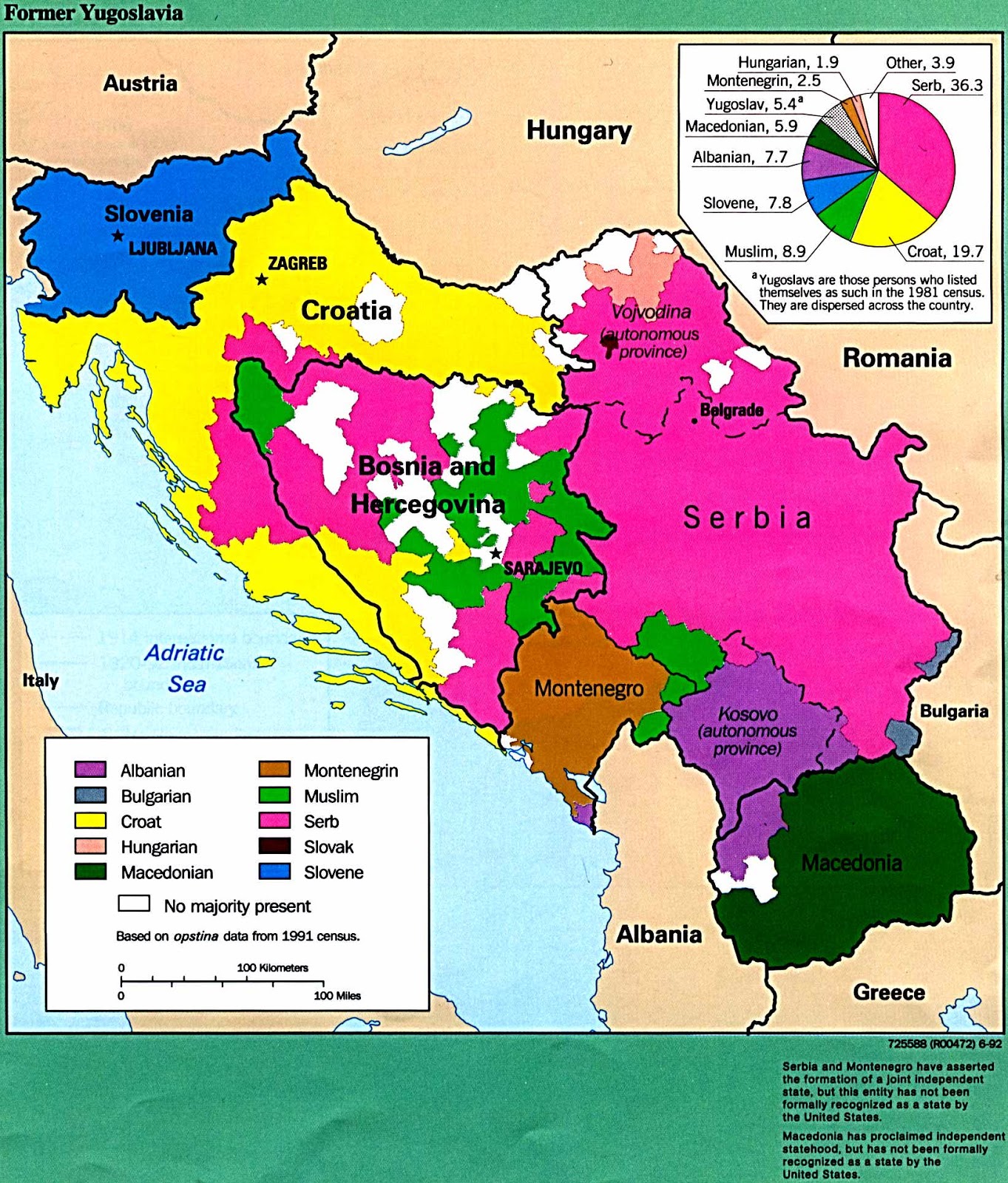
An only slightly outdated map of the former Yugoslavia
In 1977, Bušić and his wife, Julienne Eden Bušić, received life sentences for air piracy in an American court.  In 1987, Bušić escaped from prison in New York state but was apprehended on the run in Pennsylvania shortly after.  Two years later, Mrs. Bušić was released.  In 2008, seventeen years after the Republic of Croatia regained its independence amid the rubble of Leninism, Bušić was paroled on good behavior (a move decried by New York police and others) on condition that he leave the U.S. for good.  He returned to his native Croatia and was active in nationalist politics.  On September 1st, at their home near Zadar, on the Dalmatian coast, Julienne found her husband’s body beside a suicide note, a bullet in his head.

Black banners and the glorification of violence—old habits die hard.
(A scene from Bušić’s funeral.)
Bušić had in later life said of his crimes, “If I had ever imagined that anyone could have been hurt, I would never, even if it had cost me anonymous death at Yugoslav hands, embarked on that flight.”  But in his defense he also called the hijacking “the scream of a disenfranchised and persecuted man.”  By most accounts, the T.W.A. passengers were not mistreated.  One later said, “They had nothing against us, but wanted only to get a story across.  They were concerned for our welfare, and we were treated well during most of it.”  The cop who found Bušić after his prison bust said of him, “He seemed very intelligent and articulate, basically a very gentle man.  He was just worn out.”

Julienne and Zvonko Bušić in later life
Nonetheless, he was a terrorist, and it seems odd that the Croatian political mainstream would celebrate their integration into “civilized” Europe—they joined the E.U. the month before last—by putting on a pedestal a man who caused such suffering while also not advancing the Croatian nationalist cause an inch.  (He may even have harmed it.)  But Croatian nationalists can perhaps be forgiven for such illogicality.  The West—and especially the United NationsInternational Criminal Tribunal for the Former Yugoslavia (I.C.T.Y.) in the Hague, in the Netherlands—seems determined to read the Wars of Yugoslav Succession in the 1990s as simply a war of nasty, dirty Serbs against everyone else.

Croatia (in purple) within the European Union (blue and purple)
Croatian nationalism as it emerged after the fall of the Berlin Wall in 1989 was largely built upon the ashes of the Nazi puppet state known as the Independent State of Croatia, which existed briefly during the Second World War.  The stormtroopers of Croatia’s dreaded fascist terrorist militia of that era, the Ustaša, were never discredited and scorned in the post-war era in the way that their counterpart in Germany—the Schutzstaffel (S.S.)—was.  Unlike Germany, Italy, and Japan, Croatia never undertook the earnest, apologetic soul-searching after the war to atone for their role in the rise of fascism.  Like France and Austria, Croatian nationalists disingenuously managed to persuade themselves and most of the world that they had been only the victims of fascism, never perpetrators.  (Ironically, Kurt Waldheim, the former United Nations secretary general who was elected to Austria’s presidency in 1986 even after it was revealed that he was complicit in Nazi war crimes, served as a Wehrmacht officer in a fascist-Croatian-occupied area of what is now northwestern Bosnia, for which he was awarded the Nazi puppet state’s Medal of the Crown of King Zvonimir.)  The newly revived independent Croatia after 1991 shamelessly resurrected the symbols and banners of the Ustaša.  Nor was that empty romanticism: in the wars that followed, Croatian nationalists tried to purge Serbs from Croatia—and from Bosnia and Herzegovina—nearly as ruthlessly as Serbs tried to purge Croats and Bosniaks from Serb-controlled terrorities.  Though it was Serbia that brought the practice of ethnic cleansing to the most horrific levels, the term was in fact first coined to describe what Croats were doing to Bosniaks in the early 1990s.

Kurt Waldheim (middle)
The West, during the Yugoslav Wars of Succession, needed a Hitler-like enemy, and the Serbs (nasty as Serbian nationalist violence actually was, mind you) fit the bill nicely.  Unfortunately, this also meant overlooking the atrocities of the Serbs’ enemies.  The fact that the Serbian capital, Belgrade, had also been the capital of Communist Yugoslavia, and that Serbs politically dominated the federation, was doubtless part of it.  But there was also a xenophobic subtext: Croatians are Catholic and use the Roman alphabet and have long-standing cultural ties with neighboring states like Italy and Austria; Serbs, meanwhile, are Cyrillic-alphabet-using Eastern Orthodox Christians—practically Saracens in the eyes of many ordinary Western Europeans.  They were easy to demonize.  Their concentration camps and the thunderous rhetoric of their nationalists made it easy too, as did the fact that Russia, then as now, tends to side with the Serbs.  Never mind that both Serbia’s president, Slobodan Milošević, and Croatia’s, Franjo Tuđman, had both allegedly conspired, in the early stages of the wars, to carve up Bosnia and Herzegovina to add to their own mini-empires.

Franjo and Slobo occasionally found things to agree on.
The international community’s double standard was most evident late last year, when (as reported at the time in this blog), two Croatian war criminals and one from the Kosovo Liberation Army (K.L.A.) were cleared by the I.C.T.Y. of all charges, including charges of torturing and killing defenseless Serbs, Roma (“Gypsies”), and collaborationist ethnic-Albanians in prison camps.  Sickeningly, the three were treated in their communities as returning heroes, and Serbs and Russians were suitably appalled.  The I.C.T.Y. has yet to fully demonstrate that they believe the lives of Serbian civilians are worth as much as those of Croats, Bosniaks, and Kosovars.

Croatian nationalists celebrating the acquittal of Croatian mass murderers last year
Serbian war criminals, make no mistake, have been among the nastiest of all the world’s nasties.  Bušić’s nemesis, the part-Croatian, part-Slovenian dictator Josip Broz Tito was another one (and a worse one than Bušić).  But the world is full of nasties, some of them even ending up on the winning side of wars.  None of them should be given heroes’ funerals.

[Also, for those who are wondering, yes, this blog is tied in with a forthcoming book, a sort of encyclopedic atlas to be published by Auslander and Fox under the title Let’s Split! A Complete Guide to Separatist Movements, Independence Struggles, Breakaway Republics, Rebel Provinces, Pseudostates, Puppet States, Tribal Fiefdoms, Micronations, and Do-It-Yourself Countries, from Chiapas to Chechnya and Tibet to Texas.  Look for it some time in 2013.  I will be keeping readers posted of further publication news.]

Tuesday, August 14, 2012

Transylvanian Separatism Haunts Romania, This Time via YouTube


Just when the Republic of Romania is being embarrassed in front of its European Union (E.U.) pals by an impeachment scandal that doesn’t seem particulary first-world and democratic, Transylvanian separatists in the country’s west have risen from the grave to haunt Romanians and to threaten to suck the blood from its aspirations for political stability.
Within Romania, Transylvania is shown in light yellow.  Dark yellow counties are the regions of Banat, Crişana, and Maramureş—which, like Transylvania, are historically ethnic-Hungarian-dominated.
Romania’s interior minister, Mircea Duşa, was obliged to go on record to calm public concerns this week over a new video that surfaced online advocating the violent secession of Transylvania, Romania’s historically ethnic-Hungarian-dominated region.  Duşa called it a matter of concern that should be discussed at high levels, “in view of the cooperation between the Romanian and Hungarian governments and their good ties.”  In the video, a marksmanship training camp, with both adults and children, is combined with the words, “We are from the Székely-Hungarian National Guard [Székely-Magyar Nemzetőrség], designed to liberate Transylvania from Romanian occupation. If you want to join up, seek us at Borzont’s E.M.I. camp.”  (Watch the video here.)

Training to secede from Romania?
The Székely are the Magyars of Transylvania, considered a part of the Hungarian nation that got stranded by history outside the bounds of the Republic of Hungary.  E.M.I. stands for Erdélyi Magyar Ifjak, or Transylvanian Hungarian Youth, a group with autonomist and sometimes right-wing leanings.  Police have now been ordered to look into who may have uploaded it—possibly from Hungary, Romanian police offer hopefully—and the ethnic-Hungarian (a.k.a. Magyar) youth camp in question has assured the public that they are not training Magyar militias.

The Székely-Hungarian National Guard’s insignia.  That’s the old Székely Land flag on the left and the Austro-Hungarian-imperial-era Kingdom of Hungary flag on the right.
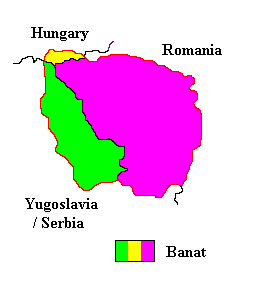
Transylvania was run by Hungarian élites during the Austro-Hungarian Empire as part of the empire’s Kingdom of Hungary, but after the First World War the region was reattached to the other two of the three traditional regions of Romania, Wallachia and Moldavia, which had broken free of the Ottoman Empire in the 1870s as the Kingdom of Romania.  At war’s end, ethnic Hungarians outside Hungary proper united as an unrecognized very-brief-lived Banat Republic in what is today Transylvania and the adjacent Vojvodina province of Serbia, to the west.  Banat’s capital was Timişoara, which is the main city in Transylvania and also, incidentally, where, later, the 1989 anti-Communist revolution in Romania was born.  Small patches of territory in eastern Transylvania, called the Székely Land, are today the heartland of what is left of Magyar Romania, where Hungarians, though they are only 6.5% of Romania as a whole, form the majority in two of Romania’s 42 counties.  These counties once formed the core of a larger, Soviet-installed Magyar Autonomous Region within Romania—until the Communist dictator Nicolae Ceauşescu, in a fit of jingoism, erased it in 1968.
Romania’s ethnic geography.  Magyars (Hungarians) are dark green, Ukrainians are light green, and shades of purple show proportions of a county’s population that is ethnically Romanian.
There has also been a resurgence of Hungarian ethnonationalism in Vojvodina, just over the border from Transylvania, since the Yugoslav Wars of Succession began in the 1990s.  Kosovo, Serbia’s other “autonomous province,” is now de facto independent and under NATO protection, so Vojvodina’s Magyars, though they have a much smaller population share than Kosovo’s Albanians, are naturally getting ideas themselves.
The flash-in-the-pan Banat Republic straddled the border between modern Romania and Vojvodina province in modern Serbia.
It is important to keep aware of who these Magyar nationalists in Romania are.  They are not an oppressed group.  They are descended from Transylvania’s former minority élites, who a century ago ruled over a Romanian majority who were treated as second-class citizens.  The Banat Republic experiment was sponsored by ultra-nationalists in Hungary, where jingoists nursed the same grievances of dismembered empire that, in Germany, eventually gave rise to Nazism.  Both Hungary and Romania were Axis power during the Second World War, but Romanians had fewer close cultural and historical ties to Austria, the birthplace of Nazi ideology, than Hungary had, so Romanians were less ardent in their capital-F Fascism.  Romania switched sides near war’s end in 1944 and turned on its former friends, Germany and Hungary.  Hungary stayed on Adolf Hitler’s sinking ship till the bitter end.  Stranded on the east side of the Iron Curtain, Hungarians did not participate in the soul-searching and contrition that came to define post-war Germany; they merely congratulated themselves that their newly imposed ideology, Communism, defeated Hitler in the “Great Patriotic War.”


Modern Transylvanian nationalists’ feelings of former empire and historical wrongedness have a whiff of Nazi-style irredentism that is far less pronounced in expressions of Romanian hypernationalism—even when it comes to Romania’s lost province, Moldova.  Sure enough, groups like E.M.I. do not look like a disenfranchised minority struggling to breathe free when they hold their marches.  They wear masks and hoods, their flags feature a swastika-like black-and-white Celtic cross, and they are openly homophobic and anti-Semitic.

These Transylvanians are scarier than Dracula.
Luckily, E.M.I. and their allies are a fringe in Romania, but they are also not as anomalously freakish on the Romanian and Hungarian political landscape as analogous swivel-eyed, foam-flecked neo-fascists and skinheads are in places like Norway or the Netherlands.  Surveys show Hungary itself to be the most intolerant of all modern industrial European democracies.  We can expect that Hungarians stranded bitterly in modern Romania probably score higher than the 63% rate of anti-Semitism that the Anti-Defamation League (A.D.L.) found in Hungary itself in a survey this year.  Romania as a whole is not much better on this score.  Romanians, too, paper over their Nazi past.  It was Romanians and Magyars, not Germans, who decimated the local Jewish population in the Holocaust.  The move to restore King Michael I to the throne after 1989 never gathered momentum, but the 90-year-old royal pretender, exiled today in Switzerland, remains disturbingly popular given that he was friendly with Hitler and Benito Mussolini and didn’t really switch sides until Soviet troops were pouring through Romania’s eastern borders in 1944.  Michael—who last year grudgingly ditched his other title, Prince of Hohenzollern—has been invited to address Romania’s parliament, and surveys show him to be Romanians’ most trusted public figure.  The current, embattled president of Romania, Traian Băsescu, has gone on record saying that he regards Michael’s abandonment of the Axis cause as treason brought about by Soviet bullying.  In 2007 he called a journalist a “dirty Gypsy.”  And none of those comments really hurt him in his current struggles to avoid impeachment (though it is slightly embarrassing that someone videotaped Băsescu at a campaign rally slapping a 10-year-old boy in the face).

King Michael I (left)
So what to make of this new E.M.I. video?  Are there really Magyar paramilitaries training to wage a war of secession against Romania?  Probably not.  The reality is likely one of the following scenarios: either some nationalists in Hungary or in the Székely Land mashed up the video to make a political point, or, perhaps more plausibly, some more progressive Romanian created the clip to embarrass E.M.I. and to alert the public to the disturbing political undertones to some of the expressions of ethnic pride like these youth camps.  We may never know, but if it makes Romania take a harder look at its right-wing Hungarian-nationalist fringe and what it represents, that may be a good thing.

[Also, for those who are wondering, yes, this blog is tied in with a forthcoming book, a sort of encyclopedic atlas to be published by Auslander and Fox under the title Let’s Split! A Complete Guide to Separatist Movements, Independence Struggles, Breakaway Republics, Rebel Provinces, Pseudostates, Puppet States, Tribal Fiefdoms, Micronations, and Do-It-Yourself Countries, from Chiapas to Chechnya and Tibet to Texas.  Look for it in spring 2013.  I will be keeping readers posted of further publication news.]

Subscribe Now: Feed Icon