Showing posts with label English Democrats. Show all posts

Tuesday, May 20, 2014

Dragons, Doubts, and Devils Dog Welsh Identity as Scottish Referendum Looms


Opinion polls predict that the September 18th referendum on Scotland’s secession from the United Kingdom will fail, with polls giving somewhere between 46% and 47% intending to vote for continued union with England (and Wales and Northern Ireland) and only about 35% to 40% intending to opt for independence.  With just about four months to go before polling day, a lot could change.  But if the outcome is not 100% assured, one thing is: the truism that in the event of a “yes” result for Scottish independence, or even, as looks likely, a relatively close (non-landslide) “no,” the other constituent parts of the U.K.—England, Northern Ireland, and Wales are going to experience something of an identity crisis.


Wales, in particular, in the event of a Scottish split, would probably be carried along to independence itself like a rudderless ship in Scotland’s wake—much in the way that in the 1990s Serbia, the Czech Republic, and Belarus became independent states not from any desire to separate themselves but because of the dissolutions of their larger federations driven by centrifugal forces generated elsewhere.  After all, the U.K. is the United Kingdom because of the early-18th-century merger of the kingdoms of England and Scotland; without that constitutional basis, a rethinking of the rest of the union is in order.


Some of this anxiety is expressed as kerfuffles over flags.  Wales, were it to be independent, would suddenly become the European country with the most striking, remarkable, and dramatic national flag, featuring a rampant red dragon on a horizontal white-and-green bicolor (see above).  That prospect has attracted the superstitious nervousness of a fringe group called the Welsh Christian Party.  (Unlike more primitive backwaters like the United States, in Britain fundamentalist Christianity is a phenomenon of the fringes, not the political mainstream.)  As the Rev. George Hargreaves, speaking for the party, put it, “We will not allow this evil symbol of the devil to reign over Wales for another moment.  Wales is the only country in history to have a red dragon on its national flag.  This is the very symbol of the devil described in the Book of Revelation 12:3.  This is nothing less than the sign of Satan, the Devil, Lucifer, that ancient serpent who deceived Adam and Eve in the Garden of Eden” (he explains helpfully in case we haven’t heard of him).  Just for the record, Revelation 12:3 tells us, “And there appeared another wonder in heaven; and behold a great red dragon, having seven heads and ten horns, and seven crowns upon his heads.”  Far be it from me to contradict a man of the cloth, but I’ve been studying that Welsh flag and I’m afraid I see only one head and no crowns at all.

Now that’s the dragon of Revelation.  See?  Lots more heads.
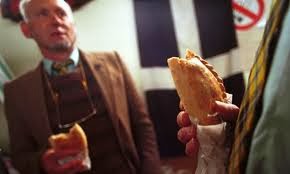
But never mind that.  Hargreaves recommends that the Welsh dragon—which is of murky origins but has been in use on the flag only since 1959—be replaced by a black-and-yellow cruciform design called the Cross of St. David, which is the emblem of the patron saint of Wales (see the flag at right in the photo at the top of this article).  This flag is often flown on March 1st, which is the feast of St. David and the Welsh national holiday.  Adopting this flag would put Wales’s flag on the same footing as those of England, Northern Ireland, Scotland, and Cornwall, which feature the traditional crosses of those countries’ patron saints—St. George (yes, of dragon fame), St. Patrick (patron saint of all Ireland, actually), St. Andrew, and St. Piran, respectively.

This vessel in Queen Elizabeth II’s Diamond Jubilee flotilla in 2012 featured, atop the cabin,
the flags of England, Scotland, London (England’s flag but with sword in upper left), Northern Ireland
(not official, but the St. Patrick’s Cross), Cornwall, and Wales,with flags for the sponsoring Motability, Inc.,
mixed in, plus, aft, the U.K. civilian ensign.
(Hargreaves, given his feelings about the Welsh dragon, will be equally vexed to learn that archaeologists have recently discovered, in the ruins of Leiston Abbey in East Anglia, the remains of a seven-foot-tall canine who some feel might have been the origin of the 16th-century legend of the “Hell Hound of Suffolk.”)


It is not just conservative Christians who are unhappy with Wales’s flag.  The radical, militant Free Wales Army (F.W.A., or Byddin Rhyddid Cymru), uses a vaguely swastika-ish black-and-white emblem as its flag.  The F.W.A. are republicans and presumably would like to eschew anything heraldic as too posh.  Among other parties, the left-wing socialist Cymru Goch (“Red Wales”) independence party, though republican, wants to keep the dragon flag—it’s red, after all!—as does the equally republican Cymru Annibynnol, the Independent Wales Party, along with the former majority party in the Welsh Assembly, Plaid Cymru (“the Party of Wales”), which has republican and pro-Commonwealth (monarchist) tensions within it.  Nor are these minor distinctions: Plaid Cymru came under fire (as reported at the time in this blog) when a party leader appeared alongside F.W.A. radicals and their flags at a rally marking the 729th anniversary of the killing by English soldiers of Llywelyn ap Gruffudd (Llywelyn the Last), the last true Prince of Wales (before it became a title affixing to any English crown prince), thus ending Welsh independence.  By contrast, the Scottish National Party has prevailed over republican Greens and socialists in its coalition and plans on keeping Scotland in the Commonwealth, with Elizabeth II as its head of state.

No one respectable wants to be seen alongside the F.W.A. banner.
(A more benign St. David’s Cross flag is at right.)
The Scottish referendum campaign has raised vexillological vexations in other parts of the kingdom as well.  Northern Ireland’s identity crisis in a post-Scottish dis-United Kingdom would be even more severe than Wales’s, since the Scottish ancestry of the Protestant Scots-Irish majority in the region is the only rationale behind it being part of the U.K., rather than the Republic of Ireland, in the first place.  Northern Ireland currently has no flag, and uses only the Union Jack, but the traditional flag of Ulster is used by the small minority (soon to be taken more seriously, perhaps) who wish Northern Ireland to be independent.  (Ulster, rather awkwardly, includes not just the Northern Ireland counties but the majority-Catholic county of Donegal within the Republic, so there might be some words over that ...)

Unionist rallies in Belfast sometimes feature the “red hand” flag of Ulster.
And what of a rump U.K. minus only Scotland?  The current Union Jack is a blending of the crosses of SS. George, Andrew, and Patrick—


—and without the Scottish St. Andrew’s Cross it would look like this:


Clearly, a lot less colorful.  Thus, some favor incorporating Wales’s green into it somehow ...


... or in some other way taking the opportunity to give Wales a piece of the flag to call its own, if only to persuade them not to secede themselves:


Okay, well, maybe not that prominently.  It isn’t all just about Wales, you know.  Others favor solving the color problem in a more grandiose way:


If Scotland’s secession is followed by those of Wales and Northern Ireland, then England would find itself independent in spite of itself.  Indeed, the St. George’s Cross flag is the one preferred by the pro-independence party English Democrats (as reported on earlier in this blog):


... though some of independence-for-England activists prefer the “three lions” flag which is a modification of the personal royal standard Richard the Lion-Hearted (and which for complicated reasons—1066 and all that—is also a flag used by regional activists in the Normandy region of France):


Presumably, some of these suggestions are ones that the Welsh Christian Party can live with.  And if it’s Satanic symbols they’re worried about, just be glad they don’t have deal with Morocco’s national flag:


Oh, no, wait, sorry, I put it upside-down.  Here, let me fix that ...


Phew!  That was a close one.

Thanks to Jen Mayfield Shafer for alerting me to the report on the Leiston Abbey discovery.

[You can read more about Wales, Scotland, and many other separatist and new-nation movements, both famous and obscure, in my new book, a sort of encyclopedic atlas just published by Litwin Books under the title Let’s Split! A Complete Guide to Separatist Movements and Aspirant Nations, from Abkhazia to Zanzibar.  The book, which contains 46 maps and 554 flags (or, more accurately, 554 flag images), is available for order now on Amazon.  Meanwhile, please “like” the book (even if you haven’t read it yet) on Facebook and see this interview for more information on the book.]


Saturday, November 23, 2013

Lega Nord, Flemish Separatists, Others at Secret Vienna Summit Plot Far-Right Slate for Strasbourg


On November 15th, in Vienna, Austria, history of a sort was made as seven far-right parties from across Europe met in secret to form the beginnings of a coherent voting bloc that could try to push their shared decentralist, anti-Brussels, anti-immigrant agenda in the May 2014 European Parliament elections.

Flemish nationalism and religious bigotry on display at a Vlaams Belang rally
The parties involved were: Belgium’s ethnic-separatist Flemish Interest (Vlaams Belang, or V.B.) party, France’s notorious but influential National Front (Front national, or F.N.), the NetherlandsParty for Freedom (Partij voor de Vrijheid, or P.V.V.), the neo-Nazi-tinged Freedom Party of Austria (Freiheitliche Partei Österreichs, or F.P.Ö.), the Swedish Democrats (Sverigedemokraterna, or S.D.), the Slovak National Party (Slovenská národná strana, or S.N.S.), and Italy’s Northern League (Lega Nord), which seeks a separate republic called Padania.   Two other parties which planned to attend cancelled at the last minute: the United Kingdom Independence Party (UKIP), which wants the U.K. to leave the European Union (E.U.), and Alternative for Germany (Alternative für Deutschland, or AfD), a rather ideologically mild party by this summit’s standards, which wants Germany to abandon the euro but not the E.U.  The Netherlands’ Party for Freedom (Partij voor de Vrijheid, or P.V.V.) was also not at the summit, but its membership in the new alliance is assumed; two days earlier, its founder, Geert Wilders, had met with the F.N.’s leader, Marine Le Pen, to declare a new working relationship.  (Wilders, whose party is unlike the F.N. not anti-gay or anti-Semitic—they prefer to focus their energies on hating just Muslims—had earlier been wary of associating too closely with the F.N. and even forbade P.V.V. members of European Parliament (M.E.P.s) from sitting next to F.N. ones.)

The Dutch ultranationalist GeertWilders
Not all of these movements believe in the same kind of decentralism.  Vlaams Belang would like to see the Kingdom of Belgium dissolved and replaced by the separate independent states of Flanders, Wallonia, and maybe even Brussels and the German-Speaking Communities (an autonomous sliver of Wallonia along the German border).  And Lega Nord would like to see a Federal Republic of Padania with significant self-rule for regions such as Lombardy, Liguria, and Venetia, as well as enhanced linguistic rights for German-speakers in the South Tyrol, speakers of Arpitan/Savoyard French and Walserdeutsch in Val d’Aosta, and speakers of Friulian and Ladin near the borders with Switzerland and Austria.

Umberto Bossi, founder of Italy’s Northern League
The Swedish Democrats, on the other hand, want the trans-national and ultimately toothless Sami Parliament, which represents indigenous northern (Lappish) people in Norway, Sweden, and Finland, shut down, while the Slovak National Party pounces on any attempts by the Hungarian-speaking minority in the Slovak Republic to secure more linguistic or cultural rights—fearing the kind of Magyar irredentism that haunts autonomy movements in Serbia’s Vojvodina province (see my recent article) and Romania’s Transylvania region (see my article on this).  And, even though the National Front’s founder, Jean-Marie Le Pen, was born in a village in a Brittany, his party recently called any government efforts to preserve minority languages like Breton, Occitan, Basque, Catalan, and Alsatian German “pure madness” (ironically, since France already has the nastiest policies in western Europe when it comes to linguistic rights).

The National Front’s Marine Le Pen, as portrayed at a controversial Madonna concert
But one thing all parties can agree is an opposition to European integration and hostility toward immigrants, especially Muslim ones.  The F.P.Ö. leader, Heinz-Christian Strache, said, in announcing the meeting after the fact, “There are many important patriotic parties in Europe that have recognised problems and are prepared to work together,” adding that there is now “a real chance that with the partnership that we’re working on we can have a strong parliamentary group.”


Make no mistake, this is not a move of desperation by these disparate groups but an attempt to capitalize on existing momentum.  The F.P.Ö. currently has only two seats in the European Parliament in Strasbourg, won with 12.7% of the Austrian vote in 2009 elections, but earlier this year it took more than a fifth of the popular vote in national parliamentary elections and is considered to be on a roll.  The F.N. is also expected to enlarge its current three-seat delegation.  The Slovak nationalists have one of Slovakia’s 13 European seats, but none in the national body.  Many expect UKIP to dislodge the U.K.’s ruling-coalition junior partner, the Liberal Democratic Party, as the country’s number-three party, at least in Strasbourg.  Vlaams Belang is also optimistic: the more moderate separatist party, the New Flemish Alliance (Nieuw-Vlaamse Alliantie, or N.-V.A.), is expected to become the ruling party in Belgium in next year’s national elections, which will only raise V.B.’s profile and influence.  The euro crisis has obviously played a large role in all of this.

One of Vlaams Belang’s more controversial ad campaigns
But in order to form a functioning, recognized slate in the European Parliament, a coalition needs seven parties from seven different E.U. member states and 25 seated parliamentarians.  To fill this out, they have had not much luck in reaching toward the more moderate end of the Europhobic spectrum.  The Danish People’s Party (Dansk Folkeparti, or D.F.), which controls 13.8% of Denmark’s parliament, turned down an offer to join the group, citing mainly fear of association with the Le Pens and their anti-Semitism.  That might leave the extremist F.P.Ö., which is spearheading the slate, to reach out to the farther right fringe for new allies, such as Hungary’s Jobbik: Movement for a New Hungary (Jobbik Magyarországért Mozgalom), the neo-Fascist Tricolor Flame Social Movement (Movimento Sociale Fiamma Tricolore, or M.S.–F.T.) in Italy, Spain’s Phalangists, Romania’s New Right (Noua Dreaptă), or the openly neo-Nazi paramilitary movement in Greece, Golden Dawn (Laïkós Sýndesmos–Chryssí Avgí), which has benefited from anti-northern, anti-Brussels feeling in the recent currency crisis but has recently been all but shut down by the Greek government.

Members of Greece’s Golden Dawn party.  That kind of angled curly thing in the middle of their flag?
Um, that’s, um, that’s supposed to represent Theseus and the Minotaur in the Labyrinth.  Yeah, that’s it.
(It would be less politic perhaps for the alliance to reach out to the neo-Fascist British National Party (B.N.P.) or Anglo-separatist English Democrats—largely in some ways an outgrowth of the B.N.P.—for fear of alienating the more moderate and successful UKIP.  (See a recent article on the English Democrats from this blog—which even features its founder, Robin Tilbrook, chiming in critically on the comment thread!).)

Robin Tilbrook of the English Democrats
This right-wing fringe constitutes more natural allies for the extremist F.P.Ö.  The party rose to prominence under the leadership of Jörg Haider, a confidante of Saddam Hussein and Moammar al-Qaddafi who once called the Waffen-S.S. “decent men of good character” and referred to Nazi death camps as merely “punishment camps.”

The late Austrian neo-fascist leader Jörg Haider.
Most Europeans’ complete and utter lack of any kind of gaydar whatsoever
(I mean, come on, people—right?) preserved his reputation until his death.
(Haider, who was married and loudly homophobic, died in a car crash in 2008—on his way, as it was revealed posthumously, to his grandmother’s 90th-birthday party from a gay bar in Klagenfurt, where he had had a lover’s spat with his “LebensmenschStefan Petzner.  As further evidence that there is an element of self-loathing in all bigotry, the head of Hungary’s virulently anti-Semitic Jobbik movement, Csanád Szegedi, was revealed last year—as reported at the time in this blog—to be Jewish himself.  He has since experienced a personal political transformation and has embraced his Judaism.  There is little of such wisdom or courage—belated though it was—among most of Europe’s far-right fringe.)

Csanad Szégedi’s new look.
Which way the new far-right alliance will swing as it seeks sufficient breadth to secure a place at the table in Strasbourg will depend on the volatility of European politics in this time of financial crisis—and ultimately it will determine the success of the movement, and its effect on European policy, as well.

Strasbourg or bust?  The Slovak National Party on parade


[You can read more about many of these and other separatist and new-nation movements, both famous and obscure, in my new book, a sort of encyclopedic atlas just published by Litwin Books under the title Let’s Split! A Complete Guide to Separatist Movements and Aspirant Nations, from Abkhazia to Zanzibar.  The book, which contains 46 maps and 554 flags (or, more accurately, 554 flag images), is available for order now on Amazon.  Meanwhile, please “like” the book (even if you haven’t read it yet) on Facebook and see this special announcement for more information on the book.]


Friday, October 11, 2013

Right-Wing English Separatists Declare “Precious” Cornish Nationalism “Dead”


The idea of a national identity for the people of Cornwall, England’s southwesternmost point and the most obscure of the Celtic nations, is “dead,” according to the chairman of the English Democrats political party.

Robin Tilbrook
The party’s chairman, Robin Tilbrook, was exulting over recently-released census data which show depressed figures for those identifying themselves as ethnically or nationally “Cornish.”  He added, “The census figures show that not many people are precious about declaring themselves as Cornish.  There’s at least five times more people for English nationalism than Cornish.”  Only 14% of Cornwall residents in the 2011 census indicated Cornish as their national identity—though that is a more impressive figure when one considers that Cornish was not one of the printed choices and that those 73,200 people Cornish nationals were all write-ins.  Moreover, Cornwall has one of the highest rates of immigration from other parts of the United Kingdom among England’s counties, and nearly 5% of the population is from immigrant ethnic groups.  Given that, the true figures for those thinking of themselves as Cornish first may give greater cause for English Democrat worries.


The English Democrats were founded in the late 1990s (as the English National Party) in response to devolution of powers to Scotland and Wales.  On the face of it, they are a devolutionist and Eurosceptical movement favoring removal of England from the European Union and of course from the U.K.  But its true motives are less savory: English Democrats regularly march in white-supremacist rallies alongside National Front neo-fascists, and the movement is part of a broader movement of Continental European right-wing extremist groups such as Serbia’s neo-Nazi Obraz movement, the affiliated Russky Obraz in Russia (which the English Democrats publicly support), the New Right (Noua Dreaptă) hate group in Romania, and even Golden Dawn, the violent, high-profile fascist party in Greece whose leaders and M.P.s have recently been rounded up by the Greek government.*

Coming to a Skinhead rally near you
The English Democrats have no seated legislators and have recently lost ground to the more centrist (but still plenty right of center) United Kingdom Independence Party (UKIP), which aims to remove the entire U.K. from the E.U. and currently seats three parliamentarians in the House of Lords and nine in the European Parliament’s U.K. delegation in Strasbourg.  So the English Democrats are floundering for an edge in the polls.  Picking on the Cornish seems especially pathetic and bullying, but that sort of image problem has never bothered them before.


Cornwall has a peculiar status within England.  The only English county known formally as the Duchy of ..., rather than County of ..., this does not actually translate to any kind of autonomy.  It is semantic merely, like Pennsylvania’s designation as a “Commonwealth” or Quebec’s parliament being called a “National,” rather than provincial, assembly.  But it is also the constituent part of England with the most recent experience with sovereignty.  King Edward III unilaterally annexed to England the previously independent Duchy of Cornwall in 1337 and designated his son Edward, the “Black Prince,” as Duke of Cornwall.  Since then, that title has been reserved for the first in line to the throne, alongside the title Prince of Wales.  Today’s Prince of Wales, Charles, is thus Duke of Cornwall as well.  His specific royal prerogatives include silly medieval stuff like the right to all shipwrecks that wash ashore on Cornwall’s beaches or any porpoises “or other royalle Fishes” caught in Cornish waters, but also more serious assets such as over 540 square kilometers of productive land in and around Cornwall, including enough lucrative farmland to support his lavish lifestyle without dipping into other royal coffers.  Cornwall is really Charles’s personal royal fief—and is one day to be Prince William’s.

The current Duke of Cornwall is ready to claw the county back if necessary.
That is, unless the nationalist Party for Cornwall (Mebyon Kernow, or M.K.) has anything to say about it.  They argue that the original ducal line, and the Cornish sovereignty it embodied, were never formally extinguished.  In 2003, a non-binding referendum showed 55% favored a devolved legislature for the duchy.  Others favor being made a full constituent “country” of the U.K., like England, Scotland, Wales, and Northern Ireland, or a quasi-independent “Crown Dependency” like Jersey, Guernsey, and the Isle of Man.  Still others, like the sometimes violent Cornish Nationalist Party, back full independence.


Cornwall is, along with Brittany across the water in France, one of the only two of the seven (as they are sometimes defined) Celtic nations to lack any home rule.  (Ireland is independent—most of it, anyway—while Scotland, Wales, Northern Ireland, the Isle of Man, and Spain’s region of Galicia all have powerful regional parliaments, and Scotland is voting on independence next year.)  The Cornish language went more or less extinct in the 19th century, by some reckonings, but recently it has been brought somewhat back to life by schooling elders who had dimly remembered passive knowledge of it up to proficiency, with the help of younger speakers of the more-healthy, mutually-intelligible Breton language in northwest France.


Cornish nationalists reacted strongly to Tilbrook’s death certificate, with one local leader, Wendron Loveday Jenkin, saying, “Most Cornish people define themselves as Cornish and British but not English, and many non-Cornish people living in Cornwall would recognise Cornwall as a land apart, a duchy and a distinct region, if not a nation.  A significant number of people have voted for Mebyon Kernow and more than 50,000 have called for Cornwall to have its own assembly to run its own affairs.”  And even this does not include the even greater popularity in the county of the Liberal Democratic Party, now the U.K.’s ruling junior coalition partner, which champions Cornish autonomy.


Indeed, the English Democrats and M.K. are a study in contrasts.  Like the separatist movements in Scotland, Wales, Brittany, and Galicia and Ireland’s Sinn Féin, Cornish nationalists are considerably left of center.  Galician separatism even includes a Communist component (though there are, to be far, smaller far-right Scottish and Welsh nationalist movements).  The English Democrats, however, have more affinity with far-right separatist groups on the Continent, nearly all of them from the more prosperous parts of their countries, like northern Italy’s Lega Nord (Northern League), Belgium’s Flemish nationalists, and the fascist-tinged Norman Movement in northeastern France.


But Lega Nord, for all its racist anti-immigrant bluster, does champion the rights of linguistic minorities such as Provençal and Swiss-German speakers in Italy’s northwestern Alpine fringes, and the Friulian, Ladin, and South Tyrolean peoples in the northeast along the border with Austria.  The English Democrats, by contrast, are as intolerant of indigenous diversity as they are of immigrants.  They hate anything that spoils the picture of an English unitary state and are even cold to movements to establish devolved parliaments for the Wessex and Yorkshire regions.


With high hopes for referenda on Scotland and Catalonia next year and rising nationalism in Wales, Cornish national identity may in fact be on the upswing.  It is the English Democrats who may be headed for the dustbin of history.  Good thing, too.

*Note: This article includes a revision of the original version, which featured a statement to the effect that the English Democrats were formally allied with the extremist groups listed in the third paragraph.  See comments below for the discussion.  Thank you to all readers who provide feedback, clarifications, and corrections.


[For those who are wondering, yes, this blog is tied in with my new book, a sort of encyclopedic atlas just published by Litwin Books under the title Let’s Split! A Complete Guide to Separatist Movements and Aspirant Nations, from Abkhazia to Zanzibar.  The book, which contains 46 maps and 554 flags (or, more accurately, 554 flag images), is available for order now on Amazon.  Meanwhile, please “like” the book (even if you haven’t read it yet) on Facebook.]


Subscribe Now: Feed Icon