Showing posts with label Banat Republic. Show all posts

Monday, September 23, 2013

Slovene E.U. Diplomat’s Words on Vojvodina’s Status Ruffle Serb Feathers

Vojvodine nationalists rallying in Novi Sad, the provincial capital
Jelko Kacin, a Slovenian diplomat who is the European Union’s “rapporteur” for the Republic of Serbia, stepped on a landmine in the European Parliament last week by calling for a clarification of the status of Vojvodina, an autonomous—but not really—province within Serbia.  Then his remarks were interpreted with great alarm, putting the Serbian foreign ministry into damage-control mode.

Jelko Kacin
While speaking on a panel on Vojvodina at the E.U. legislature in Brussels, Belgium, Kacin said, “Having in mind upcoming negotiations on Serbia’s membership in the E.U., I believe this is the right moment to raise the question of the constitutional and statutory regulation of the autonomy of Vojvodina.  The present framework for autonomy is uncertain and vague, which prevents Vojvodina, and therefore Serbia, from developing its capacities.”

Map showing Vojvodina within the former Yugoslavia (the green countries)
Vojvodina, in the north of Serbia and forming the only Serbian borders with Hungary and Croatia, is historically and potentially one of the most multi-ethnic and contentious portions of the former Yugoslavia, but it largely stayed out of the fray of the Wars of Yugoslav Secession in the early 1990s.  Vojvodina was an ethnically-Hungarian part of the Austro-Hungarian Empire, but when the empire was dismantled after losing the First World War the newly created independent Hungarian Republic set Vojvodina, including a portion of what is now western Romania, as a Hungarian-dominated Banat Republic.  Serbian and Romanian forces invaded the fledgling Banatia, as it was also known, and divvied it up: Romania got what is now its western Transylvania region, while Serbia absorbed the rest and made it the autonomous province of Danube Banovina within the Serbian part of the new Kingdom of Yugoslavia.  (For a discussion of separatism in Transylvania, see a recent article from this blog.)


During the Second World War, the Independent State of Croatia, a Nazi puppet state, and Hungary, then an Axis power, took over the province and tried to revive the Banat Republic, with ethnic Germans and Hungarians in charge.  It failed, and after the war Yugoslavia filled its vacant Nazi concentration camps with Vojvodina’s Germans, who were subsequently cleansed from the province, and Danube Banovina was renamed Vojvodina.

As the “Banat Republic,” Vojvodina (dark green, at center) almost achieved independence
in the aftermath of the First World War.
Yugoslavia’s Communist dictator, Josip Broz Tito, granted Vojvodina some genuine, but limited, autonomy in 1974, but then Vojvodina’s hopes of further loosening ties to Belgrade after the fall of the Berlin Wall were dashed when Serbia’s president, Slobodan Milošević, revoked its autonomy in 1990.  It has never been restored, so it is the Autonomous Province of Vojvodina in name only.  Ethnically, the region is two-thirds Serb, but the 13% Magyar (ethnic Hungarian) minority feels that, with the de facto independence of Kosovo—once Serbia’s other “autonomous province”—they are the last colonized people in the Serb mini-empire.  Belgrade is ever alert to the possibility of the province flaring up in rebellion.

Vojvodina’s autonomy: Tito giveth, and Slobo taketh away
In Brussels, Mr. Kacin—a former independence leader during Slovenia’s “Ten-Day War” of secession from Belgrade in 1990—was not being inflammatory.  He merely pointed out that if Serbia is to get its bureaucratic house in order in preparation for E.U. candidacy, then it must sort out Vojvodina’s financial relationship to the central government.  If it is an autonomous unit, then it is eligible for special E.U. funds after accession, but if so, the implication went, it would have to start being treated autonomously, and its role in the levying and spending of tax funds must be clarified.  Pending resolution of the conflict over Kosovo, Serbia is considered close to the front of the line for E.U. enlargement, along with Macedonia, Montenegro, and Kosovo itself.

Aleksandar Vučić
Serbia was furious at this interest in its internal structure, however, and by September 19th, Serbia’s first deputy prime minister, Aleksandar Vučić, had bullied Kacin into appearing alongside him at a special press conference, where he intoned sternly that Kacin’s statement was liable to misinterpretation, adding, “I can say this in Kacin’s presence, because I know he also believes that Vojvodina cannot be separated from Serbia.”

One wonders if Kacin, during this, thought to himself, “Where have I heard those words before?  Oh, yes—Slovenia, Croatia, Bosnia, Macedonia, Montenegro, Kosovo ...”


[You can read more about Vojvodina, Kosovo, other sovereignty and independence movements both famous and obscure in my new book, a sort of encyclopedic atlas just published by Litwin Books under the title Let’s Split! A Complete Guide to Separatist Movements and Aspirant Nations, from Abkhazia to Zanzibar.  The book, which contains 46 maps and 554 flags (or, more accurately, 554 flag images), is available for order now on Amazon.  Meanwhile, please “like” the book (even if you haven’t read it yet) on Facebook and see this interview for more information on the book.]


Saturday, November 24, 2012

Fatmir Limaj to Face War-Crimes Charges (Again); Fiji Recognizes Kosovo; Vojvodina Leader Arrested: Kosovo & Serbia Update, 18-24 November 2012

Fatmir Limaj will now have to face war-crimes charges.

Kosovo Politician Arrested on Corruption Now to Face Retrial on War Crimes.  The supreme court of the partially recognized Republic of Kosovo ordered on November 20th that a former cabinet minister who was arrested last week by NATO police on corruption charges be retried on charges of war crimes, including the murder and torture of Serbian prisoners during the war for independence from Serbia.  The minister, Fatmir Limaj, Kosovo’s former minister of transport and communications and currently a parliamentarian and the deputy chairman of the republic’s ruling Democratic Party of Kosovo (P.D.K.), was a member of the Kosovo Liberation Army (K.L.A.) during the 1998-99 Kosovo War.  Limaj was originally tried in May on the same charges but was acquitted after the former prison guard, Agim Zogaj, who was chief witness against him was found hanging dead from a tree in a park in Germany.  His written testimony was deemed inadmissible, but this week’s ruling reverses that and brings Limaj back to court.  Three other former K.L.A. rebels will be retried with Limaj.

Fiji Becomes 95th Country to Grant Kosovo Diplomatic Recognition.  The Republic of Fiji has become the 95th country to grant diplomatic recognition to the Republic of Kosovo, according to a November 20th announcement by the office of Kosovo’s prime minister, Hashim Thaçi.  This follows closely on the heels of recognition by Timor-Leste (reported on last week in this blog), Burundi, and Papua New Guinea (as reported earlier in this blog).  Now Kosovo is only three short of 98, which would make it recognized by a majority of the world’s 193 generally-recognized sovereign states.  The Republic of Serbia still claims Kosovo as its territory.
Grenade Explodes at Kosovar Administrator’s Home in Serb-Ruled North Kosovo.  Another grenade blast rocked the Serbian-administered sliver of the Republic of Kosovo called North Kosovo on November 19th, according to police.  The grenade went off in the town of Zvečan (spelled Zveçan in Albanian), the residence of Dušan Milisavljević, deputy chief of the Republic of Kosovo’s administrative office for the town.  Zvečan is a Serb-dominated town which is administered through the Republic of Serbia, though officially it is under Kosovar sovereignty.  Police were investigating.  The following day, incidents of stone-throwing between Serb and ethnic-Albanian construction workers in Kosovsko Mitrovica, North Kosovo’s de facto capital, led to gunfire, but no injuries were reported.  At issue in that incident was the controversy over construction of new homes for ethnic Albanians in North Kosovo.  Eight Serb police in North Kosovo were suspended in the wake of that incident.


Serbia’s Ex–Deputy Premier, a Vojvodina Nationalist, Nabbed on Corruption Charges.  A former deputy prime minister and nationalist politician who represents the Republic of Serbia’s ethnic Hungarians was arrested on November 20th on corruption charges.  The politician, József Kasza (that’s is Hungarian name; Serbs call him Jožef Kasa), used to head the Union of Vojvodina Hungarians and was part of the democratic reforms that swept the Serbian nationalist war criminal Slobodan Milošević out of power in 2000.  The province of Vojvodina is home to Serbia’s Hungarians and was part of the Hungarian-aligned Banat Republic after the First World War and, under the name Danube Banovina, an expanded Axis-aligned Hungary during the Second World War.  Kasza is accused of intentionally issuing bad loans while managing a state-run bank.  Critics point out that the Serbian government’s aggressive anti-corruption campaigns, which are part of its attempts to qualify for membership in the European Union (E.U.) seem to focus exclusively on opposition parties.

József Kasza
[Also, for those who are wondering, yes, this blog is tied in with a forthcoming book, a sort of encyclopedic atlas to be published by Auslander and Fox under the title Let’s Split! A Complete Guide to Separatist Movements, Independence Struggles, Breakaway Republics, Rebel Provinces, Pseudostates, Puppet States, Tribal Fiefdoms, Micronations, and Do-It-Yourself Countries, from Chiapas to Chechnya and Tibet to Texas.  Look for it in spring 2013.  I will be keeping readers posted of further publication news.]

Tuesday, August 14, 2012

Transylvanian Separatism Haunts Romania, This Time via YouTube


Just when the Republic of Romania is being embarrassed in front of its European Union (E.U.) pals by an impeachment scandal that doesn’t seem particulary first-world and democratic, Transylvanian separatists in the country’s west have risen from the grave to haunt Romanians and to threaten to suck the blood from its aspirations for political stability.
Within Romania, Transylvania is shown in light yellow.  Dark yellow counties are the regions of Banat, Crişana, and Maramureş—which, like Transylvania, are historically ethnic-Hungarian-dominated.
Romania’s interior minister, Mircea Duşa, was obliged to go on record to calm public concerns this week over a new video that surfaced online advocating the violent secession of Transylvania, Romania’s historically ethnic-Hungarian-dominated region.  Duşa called it a matter of concern that should be discussed at high levels, “in view of the cooperation between the Romanian and Hungarian governments and their good ties.”  In the video, a marksmanship training camp, with both adults and children, is combined with the words, “We are from the Székely-Hungarian National Guard [Székely-Magyar Nemzetőrség], designed to liberate Transylvania from Romanian occupation. If you want to join up, seek us at Borzont’s E.M.I. camp.”  (Watch the video here.)

Training to secede from Romania?
The Székely are the Magyars of Transylvania, considered a part of the Hungarian nation that got stranded by history outside the bounds of the Republic of Hungary.  E.M.I. stands for Erdélyi Magyar Ifjak, or Transylvanian Hungarian Youth, a group with autonomist and sometimes right-wing leanings.  Police have now been ordered to look into who may have uploaded it—possibly from Hungary, Romanian police offer hopefully—and the ethnic-Hungarian (a.k.a. Magyar) youth camp in question has assured the public that they are not training Magyar militias.

The Székely-Hungarian National Guard’s insignia.  That’s the old Székely Land flag on the left and the Austro-Hungarian-imperial-era Kingdom of Hungary flag on the right.
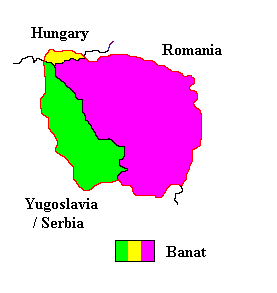
Transylvania was run by Hungarian élites during the Austro-Hungarian Empire as part of the empire’s Kingdom of Hungary, but after the First World War the region was reattached to the other two of the three traditional regions of Romania, Wallachia and Moldavia, which had broken free of the Ottoman Empire in the 1870s as the Kingdom of Romania.  At war’s end, ethnic Hungarians outside Hungary proper united as an unrecognized very-brief-lived Banat Republic in what is today Transylvania and the adjacent Vojvodina province of Serbia, to the west.  Banat’s capital was Timişoara, which is the main city in Transylvania and also, incidentally, where, later, the 1989 anti-Communist revolution in Romania was born.  Small patches of territory in eastern Transylvania, called the Székely Land, are today the heartland of what is left of Magyar Romania, where Hungarians, though they are only 6.5% of Romania as a whole, form the majority in two of Romania’s 42 counties.  These counties once formed the core of a larger, Soviet-installed Magyar Autonomous Region within Romania—until the Communist dictator Nicolae Ceauşescu, in a fit of jingoism, erased it in 1968.
Romania’s ethnic geography.  Magyars (Hungarians) are dark green, Ukrainians are light green, and shades of purple show proportions of a county’s population that is ethnically Romanian.
There has also been a resurgence of Hungarian ethnonationalism in Vojvodina, just over the border from Transylvania, since the Yugoslav Wars of Succession began in the 1990s.  Kosovo, Serbia’s other “autonomous province,” is now de facto independent and under NATO protection, so Vojvodina’s Magyars, though they have a much smaller population share than Kosovo’s Albanians, are naturally getting ideas themselves.
The flash-in-the-pan Banat Republic straddled the border between modern Romania and Vojvodina province in modern Serbia.
It is important to keep aware of who these Magyar nationalists in Romania are.  They are not an oppressed group.  They are descended from Transylvania’s former minority élites, who a century ago ruled over a Romanian majority who were treated as second-class citizens.  The Banat Republic experiment was sponsored by ultra-nationalists in Hungary, where jingoists nursed the same grievances of dismembered empire that, in Germany, eventually gave rise to Nazism.  Both Hungary and Romania were Axis power during the Second World War, but Romanians had fewer close cultural and historical ties to Austria, the birthplace of Nazi ideology, than Hungary had, so Romanians were less ardent in their capital-F Fascism.  Romania switched sides near war’s end in 1944 and turned on its former friends, Germany and Hungary.  Hungary stayed on Adolf Hitler’s sinking ship till the bitter end.  Stranded on the east side of the Iron Curtain, Hungarians did not participate in the soul-searching and contrition that came to define post-war Germany; they merely congratulated themselves that their newly imposed ideology, Communism, defeated Hitler in the “Great Patriotic War.”


Modern Transylvanian nationalists’ feelings of former empire and historical wrongedness have a whiff of Nazi-style irredentism that is far less pronounced in expressions of Romanian hypernationalism—even when it comes to Romania’s lost province, Moldova.  Sure enough, groups like E.M.I. do not look like a disenfranchised minority struggling to breathe free when they hold their marches.  They wear masks and hoods, their flags feature a swastika-like black-and-white Celtic cross, and they are openly homophobic and anti-Semitic.

These Transylvanians are scarier than Dracula.
Luckily, E.M.I. and their allies are a fringe in Romania, but they are also not as anomalously freakish on the Romanian and Hungarian political landscape as analogous swivel-eyed, foam-flecked neo-fascists and skinheads are in places like Norway or the Netherlands.  Surveys show Hungary itself to be the most intolerant of all modern industrial European democracies.  We can expect that Hungarians stranded bitterly in modern Romania probably score higher than the 63% rate of anti-Semitism that the Anti-Defamation League (A.D.L.) found in Hungary itself in a survey this year.  Romania as a whole is not much better on this score.  Romanians, too, paper over their Nazi past.  It was Romanians and Magyars, not Germans, who decimated the local Jewish population in the Holocaust.  The move to restore King Michael I to the throne after 1989 never gathered momentum, but the 90-year-old royal pretender, exiled today in Switzerland, remains disturbingly popular given that he was friendly with Hitler and Benito Mussolini and didn’t really switch sides until Soviet troops were pouring through Romania’s eastern borders in 1944.  Michael—who last year grudgingly ditched his other title, Prince of Hohenzollern—has been invited to address Romania’s parliament, and surveys show him to be Romanians’ most trusted public figure.  The current, embattled president of Romania, Traian Băsescu, has gone on record saying that he regards Michael’s abandonment of the Axis cause as treason brought about by Soviet bullying.  In 2007 he called a journalist a “dirty Gypsy.”  And none of those comments really hurt him in his current struggles to avoid impeachment (though it is slightly embarrassing that someone videotaped Băsescu at a campaign rally slapping a 10-year-old boy in the face).

King Michael I (left)
So what to make of this new E.M.I. video?  Are there really Magyar paramilitaries training to wage a war of secession against Romania?  Probably not.  The reality is likely one of the following scenarios: either some nationalists in Hungary or in the Székely Land mashed up the video to make a political point, or, perhaps more plausibly, some more progressive Romanian created the clip to embarrass E.M.I. and to alert the public to the disturbing political undertones to some of the expressions of ethnic pride like these youth camps.  We may never know, but if it makes Romania take a harder look at its right-wing Hungarian-nationalist fringe and what it represents, that may be a good thing.

[Also, for those who are wondering, yes, this blog is tied in with a forthcoming book, a sort of encyclopedic atlas to be published by Auslander and Fox under the title Let’s Split! A Complete Guide to Separatist Movements, Independence Struggles, Breakaway Republics, Rebel Provinces, Pseudostates, Puppet States, Tribal Fiefdoms, Micronations, and Do-It-Yourself Countries, from Chiapas to Chechnya and Tibet to Texas.  Look for it in spring 2013.  I will be keeping readers posted of further publication news.]

Subscribe Now: Feed Icon