AFRICA
Eastern Libyans Declare Autonomous Cyrenaica. Months after
Moammar al-Qaddafi’s death marked the end of
Libya’s civil war and its movement toward democracy, militia and tribal leaders in the eastern region where anti-Qaddafi fighters had first established a makeshift rebel capital in Benghazi last year,
have declared their region semi-autonomous. The region,
Cyrenaica, covers nearly half of the desert country, itself the sixteenth-largest country in the world, and has 80% of Libya’s oil wealth but only 20% of its population. The
Congress of the People of Cyrenaica does not seek independence but its own parliament and regional government and a return to a pre-Qaddafi federation of three regions—Cyrenaica (called
Barqah in Arabic),
Tripolitania, and
Fezzan—based on provincial divisions during the
Ottoman Empire’s rule of the area (and, before that, the Romans) until its conquest by
Benito Mussolini’s
Italy in 1934. An independent
Emirate of Cyrenaica, with a capital in Benghazi, ruled the region from 1949 to 1951, backed by the
United Kingdom, until it was folded into the
United Nations–sanctioned
Kingdom of Libya. Currently, Libya’s unelected assembly (elections and a new constitution are due in June) is weighted toward Tripolitania, though Cyrenaicans argue they made greater sacrifices to defeat Qaddafi. The newly formed
Cyrenaica Provisional Council is headed by
Ahmed Al-Zubair al-Senussi, a nearly-80-year-old great-nephew of
Sayyid Idris (Cyrenaica’s last Emir and, after that, Libya’s first and last King), who, after
Moammar al-Qaddafi’s seizure of power, led a royalist uprising against him in 1970 and spent most of his life after that as a political prisoner. Throughout Libya, most local militias that were formed to topple Qaddafi are still armed and organized. In reply, the
Transitional National Council (N.T.C.) in Tripoli blamed the declaration of autonomy on “sister Arab nations” trying to divide Libya, and its chairman,
Mustafa Abdul Jalil,
called the separatists pro-Qaddafi and vowed to keep the country united by force if necessary.

Twitter and YouTube Catapult Ugandan Rebel to World’s Most Wanted. It’s not quite as popular as “Charlie Bit My Finger,” but a viral YouTube video about the murderous, child-enslaving, and reputedly cannibalistic Ugandan rebel
Joseph Kony might be called “Joseph Ate My Finger.” Invisible Children, Inc., a
California-based nonprofit organization,
pushed the half-hour video, “Kony 2012,” via Twitter and unwittingly put it into the viral stratosphere, with nearly 50 million views by this week. The video (watch it
here) features interviews with children bearing witness to Kony’s atrocities, which involve rape as a weapon of war, recruitment of child soldiers, dismemberment and mutilation, and a deep involvement in local beliefs in sorcery. Kony’s group, the
Lord’s Resistance Army, has been operating for decades in
South Sudan,
Uganda, the
Democratic Republic of the Congo, and elsewhere. It began as an anti-government insurgency by members of Uganda’s northern
Acholi ethnic group. A Ugandan military spokesman,
Felix Kulayigye, dismissed the video as old news and Kony as himself nearly defeated, saying, “The world is just realizing the evil in this man, but these are the things we have pointed out countless times in the past. Good enough, we have decimated his capabilities now.”

Joseph Kony with some fresh recruits for the Lord’s Resistance Army, 1995
Somaliland’s Talk of Peace Followed by Massacre of Khaatumo Protesters. The president of the
de facto independent
Republic of Somaliland,
Ahmed Mohamed Silanyo,
told the B.B.C. that his country is ready to start talks with the self-proclaimed
Sool, Saanag, and Cayn (
S.S.C.)
State of Somalia, also known as
Khaatumo State. But that may not be possible after a fatal shooting in a disputed area on March 8th. In Las Anod, the capital of the S.S.C.’s Sool region, which Somaliland administers but is part of claimed S.S.C. territory, Somaliland security forces
opened fire on protesters chanting S.S.C. independence slogans, killing four. The S.S.C. has established itself in a contested border area between Somaliland and the
Puntland State of Somalia. The Puntland government and the
Transitional Federal Government (
T.F.G.) in Mogadishu have both asked Somaliland to withdraw its forces from S.S.C.-claimed territory, but it has refused. Puntland and S.S.C. regard themselves as part of Somalia and have a long-term goal of reunification, but in the absence of a functioning central government are
de facto self-governing. Somaliland claims full independence. The international community recognizes the T.F.G. as the legitimate government of all
Somalia, including Somaliland, Puntland, S.S.C., and other statelets. However, planned talks between Silanyo and the T.F.G., which got off to a start at last month’s London Somalia Conference, may proceed, but Silanyo has categorically ruled out reunification. (See
my recent blog article on the London Somalia Conference and the future of the Horn of Africa.)
Seychelles Shipping Prisoners to Somaliland; Pirates Demand Hostage Swap. The Indian Ocean archipelago of the
Republic of the Seychelles, the 15th-smallest independent state in the world, which is housing 92 captured Gulf of Aden pirates—and occasionally bringing some of them to trial—
is now scheduled to transfer nineteen of them to the
de facto independent
Republic of Somaliland. Meanwhile, pirates holding a Somaliland-bound,
Panama-flagged cargo vessel in a
Puntland harbor
have said they will only free the ship in exchange for the release of pirates imprisoned by Somaliland. Although the world recognizes Somaliland as part of the
Republic of Somalia, the
United Nations negotiated with the Somaliland government to erect a prison there for arrested pirates. And another
United States “assassination drone” aircraft
has crashed, this time while searching for kidnappers in the pirate-infested,
de facto independent
Galmudug State of Somalia, near Hobyo.

9 Die as Puntland Battles al-Shabaab; Police Storm Radio Station. Nine were killed in
fighting that raged over the night of March 2-3 after members of the
al-Shabaab militia attacked a military checkpoint near Bosasso in the
de facto independent
Puntland State of Somalia. After the raid, Puntland police
raided a privately owned radio station in Bosasso, seized equipment, shut the station down, and detained its director for airing “al-Shabaab propaganda.” The station, Radio Voice of Peace, had covered the clashes in its news program and interviewed both Puntland and al-Shabaab spokesmen to get differing accounts of the fighting. Al-Shabaab, an
al-Qaeda-affiliated Islamist militia that controls much of southern
Somalia and aims to impose
shari’a law on the entire country, has recently expanded its reach into Puntland, in the north, after its control over the south was weakened by an invasion late last year by forces from
Kenya and
Ethiopia under
African Union auspices. Al-Shabaab’s goal is to disrupt economic activity in Puntland. (See
my recent blog article on the London Somalia Conference and the future of the Horn of Africa.)
Reporter Shot Dead at Puntland–Galmudug Border. A 24-year-old reporter for Radio Galkayo in the
Puntland State of Somalia,
Ali Ahmed Abdi,
was gunned down on March 4th near the village of Gasoor near Puntland’s border with the
de facto independent
Galmudug State of Somalia, and did not survive his wounds. Police have no leads on the killer or killers. He was the fourth journalist killed in as many months in the patchwork of self-governing fiefdoms covering the territory of the
Republic of Somalia.
South Sudan Disavows Role in SPLM Strife in Darfur and Kordofan. The deputy minister of defense for the
Republic of South Sudan reiterated on March 3rd that his government has no connection with those fighting in
Darfur,
South Kordofan, and
Blue Nile under the banner of the
Sudan People’s Liberation Movement (
S.P.L.M.). When South Sudan seceded from the
Republic of Sudan, the S.P.L.M., which had been the main entity fighting for South Sudan’s independence, dissociated itself from S.P.L.M.-N., the northern branch of the group that carries on the fight against the Sudanese government in areas that remain outside South Sudan’s borders. South Kordofan and Blue Nile are two provinces claimed by both Sudans; they were promised separate referenda to determine their status, but those votes were never held. Darfur is a rebel region in northwestern Sudan whose decades-old conflict with the Sudanese government in Khartoum is largely separate from the north–south struggles. (See my recent blog article listing the South Sudan conflict among
“Ten Separatist Movements to Watch in 2012.”)

Flag of the Kordofan region
Khartoum’s Southern Refugees Won’t Meet Deadline. The
International Organization for Migration (I.O.M.) has said that
it will be impossible to meet an April 8th deadline for repatriating South Sudanese refugees in Khartoum, the capital of the
Republic of Sudan, from which the
Republic of South Sudan seceded in July 2011. According to a memorandum of understanding between the two Sudans on February 12th, the half-million or so South Sudanese in Khartoum have to decide before April 8th whether to go to the South Sudan or remain as refugees.
Jean-Philippe Chauzy, spokesman for the I.O.M., told Voice of America, “It is a logistical nightmare. It is totally impossible to organize such large returns in such a short period of time. We are, therefore, advocating with other agencies for the 8th of April deadline to be extended to allow South Sudanese who want to leave to do so safely and in dignity. Or to open up some corridors between the North and the South, which would allow for spontaneous and organized returns within an extended deadline.” In Addis Ababa,
Ethiopia, on March 6th, delegates from the two Sudans
convened a new round of talks under African Union auspices to discuss border conflicts, oil revenues, and other issues.
France Backs Western Sahara Autonomy within Morocco. The Foreign Minister of the
French Republic,
Alain Juppé,
said on March 7th that the
Kingdom of Morocco’s plan to grant the territory of
Western Sahara autonomy but not independence is the best plan on the table. But any settlement still needs to be addressed via the
United Nations. Morocco invaded the former colony known as
Spanish Sahara in 1975, making it impossible for residents to hold the referendum on independence promised by the U.N. An eastern sliver of the territory is administered outside Moroccan control as the internationally unrecognized
Sahrawi Arab Democratic Republic.
Mombasa Separatists Unslowed by Death. The chairman of the outlawed
Mombasa Republican Council (M.R.C.),
Omar Khamis,
said on March 9th that the recent death of his wife will not slow his pursuit of independence for
Kenya’s Coast province. His wife,
Mwanakombo Swaleh, who died after a short illness, was a founding figure in the M.R.C.
EUROPE
“Black Widow” Suicide Bomber Kills 5 Police in Dagestan. A female suicide bomber
killed herself and at least five policemen in the village of Karabudakhkent, in
Dagestan, a lawless republic in southern
Russia’s predominantly Muslim north Caucasus region. An Islamist website claimed that as many as ten police were killed because other insurgents executed those that had been merely injured in the blast, but that version of events has not been verified. The attack was apparently in retaliation for the police killing of the woman’s husband in early February, making this a style of revenge attack known as “black widow” bombings. Dagestan is home to a network of Salafist and Wahhabist separatists who would like to establish an independent radical-fundamentalist
Caucasus Emirate in the region.

Belgrade Mulls Holding “Local” Serbian Elections in Kosovo “Province.” The government of the
Republic of Serbia, which will hold local elections throughout the country in late April or early May,
must decide whether this will include
Kosovo, which half the world recognizes as an independent republic and the other half recognizes as a Serbian province. Last month, Serbia and Kosovo reached a compromise allowing direct relations with neither side yielding its position but with Kosovo agreeing to drop “Republic of” from its name—a compromise which allowed Serbia to become a candidate for
European Union membership (a series of events discussed at length in my recent blog article). The question of local elections raises further contradictions that will need to be resolved. In particular, thousands of minority Serbs in a sliver of land called
North Kosovo live outside the Kosovo republic’s jurisdiction and regard themselves as living in Serbia. Serbia’s Electoral Commission will hold talks with international groups in the coming week on the question. (See
my recent blog article on the Kosovo dispute.)

Basques Ready for Talks. The Basque separatist militia
Euskadi Ta Askatasuna (“Basque Homeland and Freedom”) (
E.T.A.), which officially laid down its arms in October 2011,
announced on March 9th that it is ready to hold talks with the French and Spanish governments on putting a formal end to the conflict, but it pointed out that French and Spanish authorities are continuing to round up and arrest Basque activists. E.T.A. had fought for decades to establish an independent republic in the
Basque Country of southwestern
France and northern
Spain. Just the day before, French police had
delivered two captured Basques into Spanish custody.
Salmond Plans Independence Campaign for May. The First Minister of
Scotland and head of its ruling Scottish National Party,
Alex Salmond,
has announced that his campaign to convince the Scottish public to vote to secede from the
United Kingdom will be launched in May, and he is confident of victory. The referendum is tentatively scheduled for 2014. Meanwhile, a new study (“Scottish Independence and EU Accession”; read it
here) by the think-tank
Business for New Europe (B.N.E.)
casts further doubt on an independent Scotland’s ability to make a guaranteed transition to
European Union membership (an issue discussed at length in my recent blog article). Also, an S.N.P. parliamentary staffer
has had to resign his post after opining on Twitter that there was nothing regrettable about the recent killing of four U.K. soldiers in
Afghanistan since they were “child killers.” An independent Scotland would be expected to have a less interventionist foreign policy than the U.K. and would probably refuse nuclear facilities to be stationed in its territory. (See my two recent blog articles on Scotland:
one on the question of whether an independent Scotland could remain in the E.U. and
one discussing North Sea oil claims.)
BITS OF ASIA WHICH LIKE TO PRETEND THEY’RE PART OF EUROPE
Abkhaz President, Others in “Near Abroad” Vote for Putin. Polling stations were open on March 5th in the nominally independent
Republic of South Ossetia and
Republic of Abkhazia so that Russian passport-holders (who are the majority of residents in both republics, mostly “dual citizens”) and members of the Russian military stationed there could vote in elections for the presidency of the
Russian Federation. Abkhazia’s president,
Alexandr Ankvab, was eligible and said at the polling station, “I cast my ballot for
Vladimir Vladimirovich Putin with pleasure. Abkhazia knows for whom to vote. I am sure that Abkhazia will vote for Vladimir Vladimirovich Putin. I have voted for our country’s future.” Putin won the election handily, with about 63% of the vote, but amid what international observers are calling widespread fraud and irregularities.
90.94% of voters in Abkhazia supported Putin, while in South Ossetia the figure was 92.77%. In
Chechnya, a republic which Putin virtually wiped off the face of the earth in the Second Chechen War, the official count for Putin was 99.89%. (I’ve heard of the Stockholm Syndrome, but that’s ridiculous.) There were also
thirteen polling stations in Crimea, in
Ukraine, and eight in
Belarus. At one Belarussian polling station, at the Russian embassy in Minsk, the turnout, about 5,300, exceeded the entire national turnout in the last Belarussian parliamentary elections. The
Republic of Georgia, which broke diplomatic relations with Russia in 2008 over Abkhazia and South Ossetia, did not allow Russian ballot boxes, so Russian citizens living in Georgia had to travel to Gyumri,
Armenia, to vote. (See
my recent blog article on an earlier election dispute in South Ossetia.)

An Abkhazian votes (for president of Russia).
Georgian Police Post on Abkhazia Border Attacked. The government of the Republic of Georgia
reported an attack March 4th on a Georgian police post on the border with the
de facto independent
Republic of Abkhazia, which most of the world recognizes as part of the
Republic of Georgia. Six men coming from within Abkhazia attacked the post, at the village of Ganmukhuri, with automatic weapons and rocket-propelled grenades, then retreated back into Abkhazia. No one was injured.
Syria’s Abkhazians and Circassians Barred from Return to Russia. Thousands of Syrians of Circassian and Abkhazian ancestry
remain trapped in Syria’s civil war—a disproportionate number of them serving in the military and security forces—with Syrian rebels demanding they switch sides and the Russian government barring their return to
Russia. Circassians are a widely dispersed ethnic group native to the western North Caucasus and Black Sea region, many of whom were slaughtered or exiled during the
Russian Empire’s conquest of the region from the
Ottoman Empire in the nineteenth century. The Abkhaz, who speak a language related to Circassian, established an independent
Republic of Abkhazia by seceding from the
Republic of Georgia in 2008 with the sponsorship of the Russian military. Liaisons between the vast Circassian exile community and the leadership in the three Russian republics that form a Circassian homeland—the
Republic of Adygea, the
Karachay–Cherkess Republic, and the
Kabardino–Balkar Republic—have failed to budge the Russian Federation’s government on the question. Not only are Circassians still regarded as a potential insurgent threat in Russia, but accepting refugees would amount to an official admission that Syria is victimizing Russian ethnic groups. Russia, the
People’s Republic of China, and
Iran are virtually the only remaining allies of
Bashar al-Assad’s doomed Shiite regime in Syria. (See
my blog article on ethnic dimensions of the Syrian conflict.)

A poster shows the Circassia region in southern Russia, abutting the de facto independent Abkhazia
Kurdish Rebels in Turkey Capturing Syrian Defectors at Border. Fighters from
Turkey’s banned
Kurdistan Workers’ Party (
P.K.K.)
have begun taking the unusual step of capturing Syrian military defectors trying to escape across the border into Turkey—including, on March 4th, fifteen from the rebel
Free Syrian Army, who may or may not have been turned in to Syrian authorities. Kurds, who are mostly Sunni Muslims, make up 10% of the population of
Syria, mostly in villages in the mountainous border with Turkey, abutting Turkey’s much vaster
Kurdistan region. It is suspected that the P.K.K. is cooperating directly with
Bashar al-Assad’s embattled Alawite Shiite regime in Damascus. Dr.
Othman Ali, head of the Turkish–Kurdish Studies Center in
Iraq (a country which also includes a large chunk of Kurdistan), said, “The P.K.K.’s influence in Syria is growing rapidly as the security situation deteriorates, and lately the group has given signs that it may act on behalf of the government in a way similar to the Shabiha,” referring to pro-Assad thugs in Syria. Since Syria’s civil war began last year, the Syrian government has warned the Turkish government that it was prepared to ally itself with the P.K.K. and plunge Turkey into civil war if Turkey tried to aid the Syrian rebels. Meanwhile, the Turkish government has warned Syria’s Kurds not to turn the civil strife into an ethnic separatist movement. Clearly, the deterioration in the Syrian–Turkish friendship since the Syrian uprising began has pushed Kurds into unlikely alliances. Meanwhile, the P.K.K.
is also reported to be holding captive five young relatives of an Iraqi Kurdish leader,
Massoud Barzani. The relatives were captured near the Turkish–Iraqi border. (See my recent blog article listing Kurdistan among
“Ten Separatist Movements to Watch in 2012.”) (See
my blog article on ethnic dimensions of the Syrian conflict.)
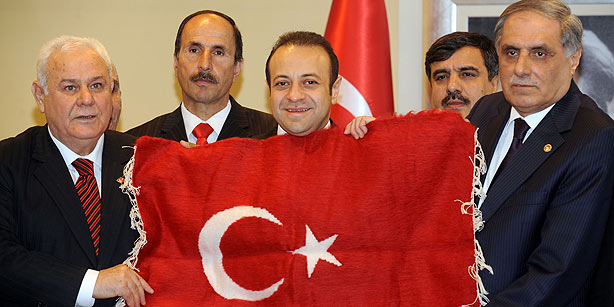
Turkey Says Annexing Northern Cyprus a Possibility. The
Republic of Turkey’s minister for
European Union affairs,
Egemen Bağış, said March 4th that
all options are on the table if negotiations fail between the
Republic of Cyprus and the
de facto independent Turkish client state established in the northern third of the island by a 1974 Turkish invasion, the
Turkish Republic of Northern Cyprus. Those options include formal annexation by Turkey. The Republic of Cyprus, internationally recognized as representing the entire island, is an E.U. member state, but the Cypriot issue remains unresolved and is a barrier to Turkey’s aspirations to become a candidate for E.U. membership. The Turks
have also said they will boycott any E.U.-related meetings during the Republic of Cyprus’s term holding the rotating presidency of the E.U. from July to December 2012. In related revelations, the hacker webiste WikiLeaks has released November 2011 emails hacked from the
Texas-based military-intelligence consulting firm Stratfor by the vigilante hacker group Anonymous, including one revealing that
Turkey’s secret plans for an all-out invasion of northern Syria include mobilizing troops currently based in Northern Cyprus.

Turkey’s minister for European Union affairs, Egemen Bağış, with flag
Mediators Tour Nagorno-Karabakh Amid Ongoing Fighting. The Russian, American, and French co-chairs of the
Organization for Security and Cooperation in Europe’s special Minsk Group task force on the
Nagorno-Karabakh conflict
toured the disputed territory over the March 3-4 weekend even as ongoing fighting killed two Azeri soldiers. They also visited Yerevan,
Armenia, and Baku,
Azerbaijan, to meet with both the Armenian and Azeri government presidents. The discussions focused on cease-fire violations and on ways to implement “understandings” between the parties at a summit in January in Sochi,
Russia (a formerly ethnically Circassian city on the Black Sea—and site of the 2014 Winter Olympics—which was emptied in the 1860s by the Russian Empire’s genocide of the
Ubykh people). Nagorno-Karabakh is a
de facto independent state in what the world recognizes as territory of the Republic of Azerbaijan. The area, which is ethnically Armenian, was separated from Azerbaijan by a war with Armenia twenty years ago after the fall of Communism.

Delegates from the O.S.C.E. “Minsk Group” visit Nagorno-Karabakh
Armenia Pulls out of Eurovision Contest, but the Udmurt Are In. Pop music fans will be
spared another Armenian entry in the Eurovision Song Contest this May. The
Republic of Armenia will be boycotting the event because it will be held in Baku, capital of
Azerbaijan, a country with which Armenia is still formally at war over the
Nagorno-Karabakh region. Despite the name
Eurovision, both Azerbaijan and Armenia are in Asia, not Europe, as are all or nearly all of the territories of three other nations which regularly compete:
Israel,
Turkey, and
Cyprus. Well within the bounds of Europe is the
Republic of Udmurtia, on the Russian Steppes, home to
the Russian Federation’s entry in this year’s Eurovision contest: the
Buranoa Grannies, a group of six
babushkas in traditional dress who sing in their native Udmurt language, a non-Indo-European language related to Finnish and Estonian.
The Buranova Grannies, Udmurtia’s new pop sensation
ASIA
Abbas Readying Ultimatum on Preconditions for Talks. On March 3rd, the foreign minister for the
Palestinian Authority,
Riad Malki, said that the President
Mahmoud Abbas will soon set out in a letter to
Benjamin Netanyahu,
Israel’s prime minister, preconditions, with a deadline, for the resumption of talks between the two entities. Abbas’s position is that talks are contingent on a freeze on Israeli settlements in the
West Bank and a recognition of pre-1967 borders as the basis for negotiations. Netanyahu has repeatedly rejected those conditions. Meanwhile, the secretary-general of the
Palestine Liberation Organization (P.L.O.),
Yasser Abed Rabbo, said on March 3rd that Israel is not really interested in negotiations, that it plans to put the
Gaza Strip under the control of
Egypt, and that it is building Jewish settlements in the West Bank “so that it could establish a state for settlers, and not for Palestinians, in the West Bank and
Jerusalem ... this,” he added, “at a time when the Palestinians are seeking a negotiated solution on the basis of international legitimacy.” He believes that a resumption of negotiations is impossible in these circumstances. (See my recent blog article listing the Palestinian conflict among
“Ten Separatist Movements to Watch in 2012.”)
Israel Air Force Attacks Gaza; Islamic Jihad Replies with Rockets. The Israeli air force
ended weeks of quiet in the on-again, off-again war between
Israel and
Palestine on March 9th, destroying a car in Gaza City from the air—killing, Israel claimed, two militants, one of whom,
Zuhair Qaisi, was secretary-general of the
Popular Resistance Committees (P.R.C.) and had been plotting an attack via Egypt. The P.R.C. are not connected with the
Gaza Strip’s
Hamas government; they are possibly
Hezbollah-funded and have ties to the former
al-Aqsa Martyr Brigades. At least eight were killed in other Israeli air strikes on Friday as well. In reply,
at least 70 rockets were fired from the Gaza Strip into civilian areas of southern Israel, wounding at least eight, one critically. Some of the rockets were intercepted by Israel’s “Iron Dome” anti-missile defense system.
Islamic Jihad and the P.R.C. claimed responsibility for the rocket attacks. (See my recent blog article listing the Palestinian conflict among
“Ten Separatist Movements to Watch in 2012.”)
Aftermath of an Israeli airstrike on Gaza City
Hamas Seems Split on Whether to Defend Iran against Israel. A spokesman for the radical Islamist organization
Hamas, which governs the
Gaza Strip,
said on March 7th that it will stay out of any possible looming conflict between
Israel and
Iran and will not retaliate against Israel. The spokesman said that Hamas’s weapons were only for defending
Palestine, though in reality Hamas has used rockets to target civilians in Israel. But the following day, an apparently higher-ranking Hamas official,
Mahmoud Zahar,
told the official Iranian news agency that that was not Hamas’s position and that “Retaliation with utmost power is the position of Hamas with regard to a Zionist war on Iran.”
Three Tibetans Immolate Themselves in China. A nineteen-year-old woman
set fire to herself in a public market in a Tibetan area of the
People’s Republic of China’s Gansu province on March 3rd. The following day, a 32-year-old widow immolated herself at the gates of the Kirti monastery in a Tibetan part of Sichuan province. Then, on March 5th, an 18-year-old man
set himself ablaze near government offices in Sichuan, after shouting slogans about the Chinese occupation of Tibet. The Chinese news agency Xinhua, in a
rare official acknowledgment that such self-immolations occur, explained the 19-year-old Gansu woman’s death by saying, “She was sent to hospital and has had occasional fainting spells. The medical treatment held up her studies and her school scores began to decline, which put a lot of pressure on her and made her lose her courage for life and study.” The incidents are part of a recent wave of self-immolations in Tibetan regions of China outside the
Tibet Autonomous Region, protesting the Chinese invasion of Tibet in 1950 and its ongoing occupation. (See
my recent blog article on Buddhism and Tibetan separatism.)

Map showing the Tibet Autonomous Region, plus other culturally Tibetan areas in China
Nepal Frees 13 Imprisoned Tibetan Students. Nepal has released thirteen Tibetan students who were arrested for holding a demonstration outside
United Nations offices in Kathmandu, the capital. The release, on March 6th, came after complaints from the U.N. itself. The students were arrested on Feb. 24th for holding a demonstration against the Chinese occupation of
Tibet.
Afghans Shut Down Baloch Terror Camp. At the request of the Pakistani government,
Afghan forces have dismantled a Baloch separatist training camp in Kandahar,
Afghanistan, according to
Pakistan’s interior minister,
Rehman Malik. Baloch training camps in Afghanistan train thousands of fighters loyal to the
Baloch Republican Party run by the separatist leader
Brahamdagh Bugti. Meanwhile, seven possible separatist fighters
were killed over a two-day period in Pakistan’s rebellious
Balochistan province in the southwest. In one incident, near Dera Bugti, a military convoy was ambushed, and four militants were killed by the soldiers. In the other incident, on March 6th, security forces killed three people and wounded nine. There is no verification that the perpetrators were Baloch separatists. A variety of violent groups operate in Pakistan, including the
Taliban and
al-Qaeda, but most violence in Balochistan is separatism-related. (See my recent blog article listing Balochistan among
“Ten Separatist Movements to Watch in 2012.”)
Sindhi Assembly Condemns Push for Separate Muhajir Province. The legislature of
Pakistan’s
Sindh province
unanimously condemned on March 9th a new, apparently grass-roots push to create a separate province for
Muhajir people in Sindhi territory.
Muhajir means, roughly, ‘immigrant’ and is the Urdu term for those Muslims (and their descendants) who migrated from what is now
India to what is now Pakistan when the two countries were created out of
British India in 1947, many of them from regions far to the east. Over a fifth of Sindh’s population is Muhajir, the highest of any of Pakistan’s eight provinces and territories, and most of the Sindhi Muhajirs, who number 12 million or so throughout the country, live in large cities like Karachi. The provincehood movement appears to be led by a previously unknown group called
Mohajir Sooba Tehreek.

Thais Ease Clampdown in Parts of Pattani Region; Attacks Escalate. The government of the
Kingdom of Thailand is loosening its state of emergency in three southern provinces where there has been recent violence involving
Pattani separatists from an ethnically-Malay Muslim minority near the border with
Malaysia. The easing was announced by the deputy prime minister,
Yutthasak Sasiprapa, on March 6th. But many areas of Pattani, Yala, and Narathiwat provinces remain under the emergency decree. Two Buddhist Thai businessmen
were ambushed and killed in Pattani province on March 5th, the following day two Thai soldiers
were wounded by an insurgent bomb in Yala, and on March 7th four Thai soldiers
were killed by a roadside bomb in Narathiwat province, followed two days later by
the wounding of twelve soldiers in a militant ambush, then
a highly organized attack on a military base by 50 militants on March 9th, in which two soldiers were killed.
Naga Separatists Lose Ground in Manipur Election. In
India’s
Manipur state, the chief minister,
Okram Ibobi Singh,
was easily reelected on March 6th, and his Congress Party slate gained seats at the expense of the Naga People’s Front, which would like to separate Naga-dominated districts from Manipur to create a
Greater Nagaland entity. Singh promised to “solve the insurgency problem through dialogue.” On Friday, in neighboring Assam state, police
arrested a militant from nearby
Meghalaya state’s
Garo National Liberation Army.
States in India’s eastern “panhandle” region
Junta Holds Peace Talks with Kachin in Burma. In Ruili,
Burma, near the border with
China, “peace negotiators” from the slowly liberalizing
junta that runs Burma under the name
Myanmar began talks with rebels from the separatist
Kachin Independence Army on March 8th. As part of a drive toward democracy and an end to its diplomatic isolation, the Myanmar
junta is closing peace deals with Burma’s sixteen ethnic militias. On March 8th, the
junta signed its twelfth cease-fire, with the
Kayah Nationalities Progressive Party. (See
my recent blog article on independence struggles within Burma.)
Gamblers Caned in Aceh. In Banda Aceh, capital of
Aceh province in far western
Indonesia, five convicted gamblers
were caned six times each in front of a crowd of hundreds of observers on March 9th. Aceh was permitted to institute Islamic
shari’a law in 2001 as part of a deal that ended a decades-long insurgency pushing for a separate Acehnese state.
OCEANIA
New Caledonian Nationalists Back Hollande for French Presidency. Pro-independence parties in the French colony of
New Caledonia, in the South Pacific island chain of Melanesia,
have come out in support of the Socialist candidate François Hollande for the presidency of the
French Republic. New Caledonians voted overwhelmingly for the current incumbent,
Nicolas Sarkozy, in the 2007 elections, despite Sarkozy’s opposition to New Caledonian independence. Hollande has not yet stated a position on New Caledonia, which is scheduled to hold a referendum on separation between 2014 and 2018, meaning it may occur during the next presidential term. Last week,
as reported in this blog, the pro-independence president of
French Polynesia,
Oscar Temaru, announced his backing for Hollande, despite Hollande’s stance against Polynesian sovereignty. Both French Polynesia and New Caledonia are technically “overseas collectivities,” with a degree of self-government and representation in the French National Assembly. Many in New Caledonia want it to be a sovereign state to be called
Kanaky.
Papuan Separatists Face Prison for Treason; Soldiers Ambushed. Five separatist leaders in
Indonesia’s
West Papua may be given five-year prison sentences for treason. They were arrested in October 2011 when delegates at a
Papuan People’s Congress in Jayapura read aloud a declaration of independence. Indonesian troops opened fire, killed three, and arrested many others. Meanwhile, one Indonesian soldier
died on March 8th after a military truck was ambushed by gunmen in Papua’s Puncak Jaya district. (See my recent blog article listing West Papua among
“Ten Separatist Movements to Watch in 2012.”)
NORTH AMERICA
Dramatic Proliferation of Violent U.S. Anti-Government Groups Documented. The Southern Poverty Law Center, an
Alabama-based nonprofit group that tracks hate groups, has issued a new report
documenting an astounding 755% increase since 2008 in the number of the anti-government brand of hate groups in the
United States.
Mark Potok, Senior Fellow at S.P.L.C. and author of the report, attributes the rise partly to the election of
Barack Obama, the first African-American president, but also a wave of anti-immigrant feeling exacerbated by the recession. Anti-immigrant ideology has mostly edged out anti-Semitism, traditional anti-black
Ku Klux Klan–type activity, and other bigotries among galvanizing issues on the militant right. The report, titled “The Year in Hate & Extremism: The Patriot Movement Explodes” (read it
here) says, “Even as most of the nation cheered the election of the first black president that November, an angry backlash developed that included several plots to murder Obama. Many Americans, infused with populist fury over bank and auto bailouts and a feeling that they had lost their country, joined Patriot groups.” It also mentions followers of the Sovereign Citizen movement, “whose ideology first developed in white supremacist groups” and who “generally do not believe they are obliged to pay federal taxes, follow most laws, or comply with requirements for driver’s licenses and vehicle registrations.” Examples cited included the violent
Alaska Peacemakers Militia and the
Hutaree Militia, whose leader,
David Stone, Sr., “planned to create his own country carved out of four
Michigan counties, then defend that country against attack by the ‘One World Order’ army. The group allegedly planned to incite that attack by making a false 911 complaint, shooting any police who responded and then attacking attendees at the funerals of those officers with improvised explosive devices.” (See
my recent blog article about separatist and ethnonationalist terrorism in the U.S.)
Members of the Michigan separatist Hutaree Militia, with their flag
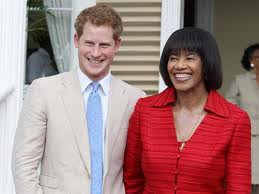
Prince Harry Cordial with Secessionist Jamaican Premier. On the eve of a visit from
Prince Harry, third in line to the
United Kingdom’s throne, on a tour of
Commonwealth nations to celebrate his grandmother
Queen Elizabeth II’s diamond-jubilee year, the prime minister of the
Commonwealth of Jamaica reiterated her intention to cut her country’s last ties with the U.K. “It’s time for us to achieve full independence,”
Portia Simpson Miller, the prime minister, said on March 6th. Currently, Jamaica is one of fifteen “Commonwealth realms”—out of 54 members of the
Commonwealth of Nations—which use the British sovereign as a head of state and are constitutionally linked to the U.K. The others are eight other Caribbean nations, four South Pacific ones (including
New Zealand),
Canada, and
Australia. The last member of the Commonwealth to renounce its membership was
Fiji, which became a republic in 1987 after a
coup d’état.
Prince Harry and Portia Simpson Miller
Church Apologizes to Family of Girl Punished for Speaking Menominee. The Catholic Diocese of Green Bay,
Wisconsin, and a Catholic school in nearby Shawano,
have formally apologized to the family of a girl punished for speaking the
Menominee language in class.
Miranda Washinawatok, age 12, was banned from a basketball game for teaching fellow students to say “hello,” “I love you,” and “thank you” in her ancestral language during homeroom. The girl’s mother,
Tanaes Washinawatok, says the teacher “slammed her hands down on the desk and stated, ‘You are not to speak like that. How do I know you’re not saying something bad? How would you like it if I spoke Polish and you didn’t understand?’” But the teacher’s letter, Mrs. Washinawatok said, was not an apology at all but only an excuse for its own actions and a reiteration of its position: “Language and behavior that creates [
sic] a possibility of elitism, or simply excludes other students, can create or increase racial and cultural tensions,” the letter said. The apology from the assistant coach, who did not know the reason for the punishment at the time, was more contrite and humble. The Menominee, or Omāēqnomenew, language, is seriously endangered. In 1997, according to the Menominee Historic Preservation Office, it had only 39 fluent native speakers, although many, like Miranda Washinawatok, are trying to learn it as a second language. Only a handful of indigenous languages in the
United States are expected to survive to the end of the century with communities of native speakers—a situation which centuries of brutal Catholic-run Indian boarding schools in the western Great Lakes region helped create.
Navajo Sue Urban Outfitters over Use of Name. The
Navajo Nation, the largest American Indian tribal group in the
United States,
is suing the clothing company Urban Outfitters for trademark infringement over its line of more than twenty products featuring the names
Navajo and
Navaho. The suit was filed Feb. 28th in U.S. District Court in
New Mexico. Earlier, the Navajo had sent Urban Outfitters a cease-and-desist letter and the company pulled the clothes from its website but continue to sell them elsewhere. The Navajo Nation first trademarked its name in 1943.
Sioux Sue Bud for Targeting Pine Ridge. The
Oglala Sioux Tribe, based on the
Pine Ridge Indian Reservation in
South Dakota—in what is sometimes called the most impoverished community in the
United States—
filed a law suit in February against the Anheuser–Busch Corporation (makers of Budweiser and Michelob) and other brewers for targeting American Indian consumers and thus being responsible for a host of social problems on the reservation. Pine Ridge is a dry community, but just across the boundary in Whiteclay,
Nebraska, a cluster of gigantic liquor stores exist mainly to provide contraband alcohol to Pine Ridge residents. Whiteclay, which has a population of twelve people, sold 4.3 million twelve-ounce servings of alcohol in 2010.
Chilling graffiti in Whiteclay, Nebraska, where the Pine Ridge Indian Reservation goes to buy booze
PRACTICALLY BLOODY ANTARCTICA
Poll Shows Most Britons Supporting Giving Falklands to Argentina. An
unscientific survey by the website of the conservative
Daily Telegraph newspaper in
England found most respondents saying the
United Kingdom should just give the
Falkland Islands to
Argentina. Of the 25,771 respondents, 58% said the Falklands should be “returned,” 28% said no, and 14% supported a referendum in the Falklands to decide the question. One unscientific aspect of the poll was its wording, since “returned” implies, misleadingly, that Argentina ever had a permanent settlement in the archipelago. (See
my recent blog article on the Falklands dispute.)
Pink Floyd Bassist Softens Falklands Position, Morrissey’s Hardens. The bassist for the English rock band Pink Floyd,
Roger Waters,
has backpedalled from his Feb. 28th statement on Chilean television (
reported in this blog last week) that the
Falkland Islands belonged to
Argentina. On
his Facebook page, Waters said he had been misquoted, adding, “ I am not a politician or a diplomat, and have no ready solution, but I am convinced it’s time to sue for peace and seek a compromise, not push for victory. At the end of the day what really matters is that not one more drop of blood is shed on the altar of the imperial aspirations of long dead kings.” Meanwhile, the English singer
Morrissey reinforced his support for Argentina’s claims on the Falklands by performing with his band before 15,000 Argentine fans while wearing t-shirts proclaiming, “
WE HATE WILLIAM AND KATE,” referring to the
Prince William, the Duke of Cambridge, and his new wife. Also, at press time, the American actor
Sean Penn is reportedly still a moron and has not yet been
fed to crocodiles.

There goes his chance at a knighthood.
Caribbeans Waffle on Falklands Question. The prime minister of
St. Vincent and the Grenadines, Dr.
Ralph Gonsalves,
faced tough questions in his country’s parliament over where he stands on conflicting British and Argentine claims on the
Falkland Islands. St. Vincent’s government joined a statement by the
Caribbean Community this year to support the
United Kingdom and the principle of self-determination for all peoples, including those of the Falklands, who overwhelmingly wish to remain in the U.K. On other hand, at last month’s summit in Caracas,
Venezuela, of the
Bolivarian Alliance for the Americas, St. Vincent agreed to support
Argentina’s agenda by banning Falklands-flagged ships from its ports. The tough questions came after Gonsalves refused to see visiting diplomats from the Falklands, supposedly for scheduling reasons. The Falklands dispute is awkward for Caribbean nations, especially former U.K. colonies like St. Vincent, caught between political and cultural loyalties to Britain and close economic ties with Latin America.