Showing posts with label Circassians. Show all posts

Sunday, May 18, 2014

Amidst Ukraine Crisis, Turkey Courts Tatars, Abkhaz, and Gagauz in Soft-Power Campaign for Black Sea Dominance


In the first Crimean War, in the 1860s, the Russian Empire, though it held onto that strategic peninsula, was stymied in its effort to seize all the areas around the Black Sea where the faltering Ottoman Empire’s grip was loosening.  But the same geopolitical tension between Constantinople and Moscow was in play over the next fifty years in the Russo-Turkish Wars, the Balkan Wars, and the First World War.  Through all of these later conflicts, Russia either extended or solidified its control of more Black Sea coastline.  With the transformation of Romania and Bulgaria into client states of the Soviet Union after the Second World War, Turkey was reduced to controlling only the very southern, though long, Anatolian coast of the Black Sea.


Then the break-up of the Soviet Union in 1991 freed Romania, Bulgaria, Moldova, Georgia, and Ukraine from Moscow’s control.  The first two in 2004 joined the North Atlantic Treaty Organization (NATO), of which Turkey was and is a member.  The last three were leaning toward the West and aspired to NATO membership but had chunks of territory invaded and established as puppet states (e.g. Transnistria, Abkhazia, South Ossetia; more on these below) by the newly expansionist Russian Federation—the most recent instance being this spring’s secession of Crimea from Ukraine, and its subsequent annexation by Russia.  But now Turkey is regrouping, in a quiet way, by trying to woo bits of the Russian-claimed and Russian-leaning territories away from Moscow.

Here is a run-down of the pincers—soft pincers, mind you—in Ankara’s new charm offensive in the northern Black Sea region.

The Crimean Mejlis in session
Crimean Tatars
Like many Muslim peoples of the former Soviet Union, Crimea’s Tatar minority speak a Turkic language, i.e. one related to Turkish.  As discussed earlier in this blog, Tatars were among the most ardent proponents of Ukraine’s ties to the European Union (E.U.) and opponents of the deposed Ukrainian president, Viktor Yanukovych, and of President Vladimir Putin’s annexation of the peninsula in March 2014.  Long ago, Tatars were the majority in Crimea and in what is now the south-central mainland of Ukraine until Czarist forces began pushing south in the 18th century.  They were were decimated by deportation to Siberia and Central Asia by Josef Stalin as punishment for supposed colllaboration with Nazi Germany in the Second World War, and when Nikita Khrushchev, Stalin’s reformist successor, allowed many deported peoples to return home in the 1950s, Crimean Tatars (along with the Meskhetian Turks of Georgia) were not on the list.  Tatars had only built their numbers up to a meagre 12% in the post-Soviet period.

Deportation by Stalin is still a stinging memory for Crimean Tatars.
The Russian annexation caused something of an exodus of Tatars to the Ukrainian mainland—reliable numbers are still hard to come by—and the news out of Crimea on treatment of Tatars has been grim.  Although Putin was shamed into “rehabilitating” the ethnic group—essentially, doing what Khrushchev had refused to do in the 1950s, making them an official nationality with minority rights—Tatars are under fire.  Crimea’s chief public prosector, Natalia Poklonskaya, has said the autonomous but mostly toothless Mejlis (Council) of the Crimean Tatar Nation was full of “extremists.”  Poklonskaya was responding to council members’ vociferous protests after Mustafa Dzhemilev (a.k.a., in Tatar, Mustafa Abdülcemil Kırımoğlu), a former Mejlis chairman and an iconic leader in the struggle for Tatar rights, was barred from reentering Crimea on his return from a visit to Kyiv, the capital of the rump Ukraine whose new government the Kremlin demonizes.


Dzhemilev is banned from Crimea.
Poklonskaya (who, in one of the weird twists of this Second Crimean War, has become an unexpected international celebrity, especially in Japan, due to her anime-style, doe-eyed, angelic looks) is threatening to “liquidate” (her word) the Mejlis outright, along with other allied organizations.  Moscow propaganda to the contrary, the corrupt and dysfunctional pre-crisis Ukraine had been doing its best to be inclusive, though many Tatar former deportees were forced into substandard squat housing.  Nonetheless, Tatars who now find themselves suddenly residents of Russia are subject to the same prejudices, whims, and pogroms as other beleaguered Muslim groups within the Russian Federation such as Chechens and Volga Tatars.  Today, May 18th, is the 70th anniversary of Stalin’s deportations of Tatars.  Most expect some kind of flare-up of ethnic tension, especially with Putin having just placed a ban on mass demonstrations in Crimea for fear of a Tatar rally against Russian rule, and as Russian secret police raided the still-exiled Dzhemilev’s home (he is banned from Russia for five years) with a full battalion on May 16th, causing his wife to be hospitalized.

Natalia Poklonskaya threatens Crimean Tatars with “liquidation,”
even as her doe-eyed innocence captures the hearts of anime fans worldwide.
But Turkey has stepped into the fray, initiating a series of high-level contacts between its foreign ministry and Dzhemilev and other representatives of the Mejlis.  In April, Dzhemilev was brought to Ankara to receive Turkey’s Order of State award—its highest honor, whose previous recipients include anti-Soviet icons like Lech Wałęsa and Václav Havel.  Turkey’s prime minister, Recep Tayyip Erdoğan, has pledged support to protect Tatar language and culture and Tatar communities from Russian repression and to support individual Tatar families in either fleeing Crimea or settling there from eastern exile, as they choose.  Within Crimea, on March 29th, the Mejlis reacted to the annexation by voting to pursue “national and territorial autonomy” within Russia.  The March 29th resolution, titled “On the Crimean Tatar People’s Right to Self-Determination on Their Historical Territory in Crimea,” reads, in part, “By adopting this document, we inform all parties of the beginning of political and legal procedures for setting up a national autonomous territory of the Crimean Tatar people on their historical territory in Crimea.”  Turkey has given tacit support, but it may not be able to do much to help in concrete ways.  After all, Turkey’s membership in NATO, with its mutual-defense pact, means that an out and out military conflict with Russia would pretty much trigger World War III, which no one wants.  The declaration is vague, in any case.  Establishing an autonomous ethnic region for Tatars on the peninsula would be resisted by the Kremlin, and in any case the bulk of the Tatar population is in the east of the peninsula, clustered around the city of Kerch at the Strait of Kerch, which is the entry point of supplies from the Russian mainland now that the Ukrainian government has shown its willingness to seal the isthmus to the Ukrainian mainland in order to stymie the Russians.

Dzhemilev accepting turkey’s Order of State Award, in front of a Turkish flag
and with a Crimean-Tatar-flag tie and a Ukrainian-flag pin.
Abkhazia
One piece of Putin’s empire which has particular cultural and historic ties with Turkey is Abkhazia, one of the two chunks of the Republic of Georgia (South Ossetia is the other) which declared themselves independent of Georgia after the fall of Communism and which have become client states, with Russia granting them diplomatic recognition after its victory over Georgia in the brief South Ossetia War in 2008.  Only a handful of countries have followed suit, namely Nicaragua, Venezuela, and the minuscule South Pacific island of Nauru.  Tuvalu (as reported at the time in this blog) withdrew its diplomatic recognition in the wake of the Crimean annexation.  The Crimean annexation made Abkhazians and South Ossetians wonder what was next for them.  Some hoped that they were next in line for formal absorption into Russia, being fed up with their current diplomatic limbo and fearful that, as Tuvalu’s defection indicated, Putin’s new aggressiveness can only further isolate the two republics.  But Russia’s foreign minister, Sergei Lavrov, dashed those hopes last month when he announced that there were no plans and no reason for Russia to annex the two republics.  (But Abkhazia and South Ossetia are tentatively slated to join Russia, Belarus, Kazakhstan, and Armenia in the new “Eurasian Union” trade bloc that Putin is establishing as a counterweight to the E.U.—the same bloc whose wooing of Ukraine caused the political crisis there to flare up late last year.)


In any case, Abkhazia has responded to this snub by attempting, on its own, to increase its relations with nations beyond Russia, and Turkey has become a natural choice.  Turkey is already one of Abkhazia’s most significant trading partners (much of it under the table), and Turkey is home to about a half-million Abkhaz who are descended from refugees from Russia’s invasions of the Caucasus in the 19th century.  Turkey is also home to perhaps as many as 2 million Circassians—the ethnic group whose traditional territory stretches along the Black Sea between Abkhazia and Crimea, including Sochi, site of this year’s Winter Olympics.  Circassian nationalism has increased recently (as discussed in this blog), and Abkhaz are sometimes considered a branch of the Circassian nation.  (Circassian is a language unrelated to either Russian or Turkish.)  During the Russo-Turkish wars in the 19th century, Abkhaz were split between Muslims who sided with the Ottomans and Eastern Orthodox Christians who sided with the Czar.  Russian victory chased most Muslim Abkhaz to Turkey.  In the Soviet period, Abkhaz were mostly Muslim but became outnumbered by ethnic Georgians in their “autonomous” republic within the Georgian Soviet Socialist Republic.  Secession from Georgia in 1992 was accompanied by ethnic cleansing of Georgians from Abkhazia.  That, and the restoration of religious freedom, helped make Muslims by now a large-ish (16%) minority in Abkhazia.  (South Ossetia, by contrast, is overwhelmingly Christian.)

The flag of Abkhazia
This in fact may be one reason behind Kremlin wariness of absorbing Abkhazia next: in addition to further antagonizing the West, Abkhazian annexation would mean bringing into the Russian empire 40,000 Muslims, with the possibility that they—and maybe even some Christian Abkhaz—may hitch their wagon to the rising nationalism among the predominantly-Muslim Circassians, who are focused on uniting their nation as a single entity within the Russian Federation.  (Currently, they are dispersed among three separate republics in the north Caucasus.)

Abkhazia’s president, Aleksandr Ankvab, hobnobs with Putin—
but isn’t getting what he wants out of the relationship.
Georgia is not happy about any Abkhaz–Turkish friendliness, and when eighty Turkish journalists formed an official delegation to Abkhazia earlier this month, the Georgian government cried foul.  Georgian law forbids entry to Abkhazia other than via Georgian territory (though it knows it can do nothing about Abkhazian–Russian border traffic), and Georgia denies entry to anyone with an Abkhazian or South Ossetian stamp in his or her passport.  That diplomatic kerfuffle between Ankara and Tbilisi took some work to smooth over.  But the reality is that Georgia is not in a position to risk what relations it does have with any NATO country, especially as a mostly symbolic protest over territories that it in its heart realizes it has lost for good.  Though Georgians will not admit this, they would rather have an Abkhazia aligned with Turkey than with Moscow.

By some reckonings, the Circassian nation, which abuts Crimea
and has a large diaspora in Turkey, includes Abkhazia.
Gagauzia
At the other end of the Black Sea is another cluster of Turkic ethnicity in a sea of Slavic and Romanian peoples, the 160,000 or so Gagauz, who speak a Turkic language but are mostly Eastern Orthodox Christian.  Gagauz Yeri, or the Autonomous Territorial Unit of Gagauzia, as their homeland is called, is an autonomous region within the Republic of Moldova, the former Moldavian S.S.R., which is mostly ethnically Moldavian (i.e. Romanian).  The Moldovan government has gone into crisis mode this year over the Russian annexation of Crimea.  Its own eastern region of Transnistria (a.k.a. Transdniestria, a.k.a. Pridnestrovia) is a de facto independent puppet state of Russia, and many fear that Russia will try to annex Transnistria next.  (Ethnically, it is about a third Moldovan (i.e. Romanian), a third Russian, and a third Ukrainian.)  The tiny unrecognized republic’s government has already formally requested admission to the Russian Federation, though Putin may be wondering if he should wait first until more or all of Ukraine’s Black Sea coast comes under Russian or pro-Russian control—in the way that Donetsk and Luhansk oblasts in the east now have—so that Transnistria can be connected to Russia proper by a land-bridge.  Transnistria abuts Ukraine’s mostly-Russian-speaking Odessa oblast, whose capital was built by Catherine the Great and which many Russians feel should not be part of Ukraine.


Though the Gagauz people have a generous autonomous region in southern Moldova, they do lean toward Moscow.  In February of this year (as reported at the time in this blog), Gagauzia held a local referendum in its 700 square miles of territory.  In that vote, 98.9% said that Gagauzia should declare independence in case Romania and Moldova attempt reunification.  (Moldavia is one of the traditional three constituent lands of Romania, along with Wallachia and Transylvania.)  Also, 98.4% of voters preferred membership in Putin’s new “Eurasian Union” trade bloc to membership in the E.U., of which Romania is part.  Perhaps Gagauz fear that Romanian nationalists would erase their autonomous region in case of reunification, just as the Szekler (i.e. Hungarian) minority lost their autonomous region farther west in Romania, in the Transylvania region.  Romania and Bulgaria are also both seeing rising discontent with Muslim refugees from the civil war in Syria and intolerance of Muslims in general.  Though Gagauz are not Muslim, they are Turkic and are eastern in their culture and might face persecution.  Or so they fear: in reality, indigenous minorities are well protected in the E.U., but Gagauz are wary of ethnic Romanians after a history of persecution.

Welcome to Gagauzia
Here is where Turkey may step into the breach.  The Turkish Cooperation and Development Agency (analogous to the United States Agency for International Development, or USAID) has been offering economic and educational support to Gagauzia, and last week the speaker of Turkey’s parliament, Cemil Çiçek, made a formal visit to Gagauzia to offer whatever support it could. Ankara may be hoping that they can peel away some Gagauz support for Moscow in the wake of the new Russian expansionism, especially after Gagauz have had the chance to see the fate (see above) of their fellow Turcomans, the Tatars, in annexed Crimea.  Gagauzia abuts the portion of Ukraine’s Odessa oblast which is nearly separated from the rest by the narrow point where Transnistria almost meets the Black Sea.  All this area is served by the navigable estuary of the Dniester River and counts, strategically and economically speaking, as Black Sea coast.  If Russia were to annex Transnistria, it would put Moldova in the position, like the current rump Ukraine, of having to retreat into neutrality in order to save what is left of its territory.  That strategic and territorial loss to the West could be counteracted by a Gagauzia that, whatever its status, is oriented to warm relations with a NATO country.  And if, as seems likely, there is a ground war for control of Odessa oblast as there already is for Donetsk and Luhansk farther east, having Gagauzia as a friendly territory will be an asset to either side.

Cemil Çiçek in Gagauzia
Sometimes NATO wonders whether it is worth having Turkey in its ranks.  Since the end of the Cold War and the beginning of the “War on Terror” in the Middle East, Turkey has been a more awkward fit with the predominantly-European and predominantly-Christian alliance.  And Turkey’s chances for joining the E.U. look as poor as ever.  But if Turkey can help contain Russia by preventing Putin’s tentacles from swarming around all sides of the Black Sea, NATO will be grateful.


Related articles from this blog:
“Abkhazia & South Ossetia Won’t Compete in Sochi Olympics, I.O.C. Declares” (Oct. 2013)
“She Recognizes Me, She Recognizes Me Not: Fickle Vanuatu Dumps Abkhazia for Georgia” (March 2013)
“Gagauzia Threatens to Secede from Moldova If Nationalists Push Reunification with Romania” (Sept. 2012)
“Transnistria’s Limbo to Continue Indefinitely” (Nov. 2011)


[For those who are wondering, yes, this blog is tied in with my forthcoming book, a sort of encyclopedic atlas to be published by Auslander and Fox under the title Let’s Split! A Complete Guide to Separatist Movements, Independence Struggles, Breakaway Republics, Rebel Provinces, Pseudostates, Puppet States, Tribal Fiefdoms, Micronations, and Do-It-Yourself Countries, from Chiapas to Chechnya and Tibet to Texas.  The book is now in the layout phase and should be on shelves, and available on Amazon, by early fall 2014.  I will be keeping readers posted of further publication news.  Meanwhile, please “like” the book (even though you haven’t read it yet) on Facebook.]

Tuesday, February 18, 2014

The KGB Olympics: Russians Arrest 2 Pussy Rioters, Circassian Leader; Terrorist “Emir” Killed in Dagestan


FSB Arrest, Interrogate 2 Pussy Rioters in Sochi
In the latest dispatch from Sochi, Russia, site of the Winter Olympics, two members of the persecuted punk-rock protest band Pussy Riot were arrested today (February 18th) in downtown Sochi on supposed suspicion of theft at their hotel.  (Pussy Riot was listed in this blog as no. 6 among “10 Political Causes Sure to Disrupt the Sochi Games.”)  News of the arrest came first via Twitter from Nadezhda Tolokonnikova.  She was arrested along with her bandmate Maria Alyokhina and six others, including Semyon Simonov of the group Memorial, which provides legal aid to immigrant workers on Olympic construction projects.  Tolokonnikova later told media that she and Alyokhina had been arrested the previous day as well as the day before.  On those occasions they had been detained by the F.S.B., the dreaded successor to the Soviet-era K.G.B. secret police force, and interrogated for many hours.  As Tolokonnikova tweeted, “We are in Sochi to hold a Pussy Riot action.  The song is called ‘Putin Will Teach You to Love the Motherland””—and was meant to call attention to abuses that include last week’s arbitrary arrest of an environmental critic named Yevgeny Vitishko.

Tolokonnikova and Alyokhina with Madonna at an Amnesty International
event in New York last week
I.O.C. Turns Blind Eye to Environmentalist’s Labor-Camp Sentence

Meanwhile, the International Olympic Committee (I.O.C.) has responded to requests to look into Vitishko’s arrest (as reported earlier in this blog).  The I.O.C. has decided that the labor-camp term for Yevgeny Vitishko, a critic of the Sochi games’ environmental impact, “is, and we think remains, a non-Olympic case,” in the words of the I.O.C.’s spokesman, Mark Adams.  Makes sense: he was arrested for protesting the environmental impacts of Olympic construction; what could that possibly have to do with the Olympics?  Oh, no, wait, he was technically arrested for “public profanity.”  Well, that gives the I.O.C. an out; now they don’t have to offend their gracious hosts.  Vitishko has been sentenced to three years in a labor camp.

Police look on as a protestor in Moscow demands
freedom for Yevgeny Vitishko.
Italian Transgender Politician Arrested at Sochi Park
But it’s not just Pussy Riot.  On February 16th, police in Sochi arrested Vladimir Luxuria, a 48-year-old transgender television host and former member of Italy’s parliament, for unveiling a banner in a park reading, “Gay is okay,” in Russian.  After being held overnight, she was released and then again arrested the next day entering the Olympic hockey arena wearing the gay-pride rainbow colors.  Olympic officials denied the arrest.  Luxuria was in Sochi to work on a television documentary on gay life in Russia.  (The gay-rights issue in Russia was listed in this blog as no. 3 among “10 Political Causes Sure to Disrupt the Sochi Games.”)

Vladimir Luxuria tweets from Sochi.
Russian Cops Nab Circassian Activist for “Hooliganism”

Arrests motivated by the more familiar ethnic politics of the North Caucasus and Black Sea region continue apace as well.  A leading Circassian activist was arrested on the evening of February 14th in a move that is already being criticized internationally.  The activist, Asker Sokht, who is considered a moderate, was last reported to be still in detention.  He was arrested in Krasnodar Krai, the province which includes Sochi.  His activities involved helping Circassian families fleeing Syria’s civil war resettle in Russia.  He has been sentenced to eight days in jail for “hooliganism and disobeying police.”

Asker Sokht with the Circassian flag
Circassians lived for centuries in the Black Sea coastal area around Sochi until the mid 19th century, when the Russian Empire massacred and scattered most of them in what many call a genocide.  Not quite a million Circassians remain in the Russian Federation today, while more live in a diaspora in Turkey, Syria, and elsewhere.  For the most part, Circassian activists are non-violent, unlike radical Islamists such as the Caucasus Emirate movement, who often invoke the Circassians’ plight.  Sokht is often seen, even, as a Kremlin ally.  (The Circassians were listed in this blog as no. 2 among “10 Political Causes Sure to Disrupt the Sochi Games.”)


Another Circassian activist, Adam Bogus, said from Maykop, capital of the Adyghe (i.e. Circassian Republic), a sliver of land surrounded by Krasnodar Krai where Circassians are a minority, “This is deeply sad for Circassians,” adding, “ This has led a great number of people to conclude that anybody who deals with the Circassian question—even the most loyal—will now be under pressure.”  Sokht criticized last week’s Olympic opening ceremonies for not including any references to Circassians in the wide-ranging, pageant-like depiction of Russian history and culture.  An open letter to Sokht’s captors from a Circassian activist group states, “It is clear that behind the alleged hooliganism or disobeying charge against him are his critical statements about the Olympics in Sochi.”  On the day of the Sochi opening ceremonies, 37 Circassian demonstrators were arrested in Nalchik, capital of another nominally Circassian republic, the Kabardino-Balkar Republic, to the east (as reported at the time in this blog).

Twin solitudes: Olympic and Circassian emblems on display in Sochi
Russians Kill Chechen “Emir” at Dagestan Rail Station
Meanwhile, to the east in the Republic of Dagestan in the predominantly-Muslim eastern North Caucasus, a rebel fighter who called himself the “Emir of Gudermes,” was shot and killed in a shootout with police at a railway station in Sobachy, in the Khasavyurt district, it was reported on February 13th.  Authorities described him as Sheykhakhmed Baysuyev, a 41-year-old originally from Chechnya also nicknamed “Foton” who was a member of the Aukhovskaya or the Khasavyurtovskaya rebel group.  He has been on a Russian wanted list since 2005.  Gudermes is a town in central Chechnya.  It was not immediately clear if his use of an Ottoman-style title indicated that he was a member of the Caucasus Emirate movement. A previous “Emir of Gudermes,” Salman Temirbulatov, was a close associate of Aslan Maskhadov, who was rebel president of the Chechen Republic of Ichkeria during its period of de facto independence in the late 1990s, and later in exile.  A later “Emir of Gudermes,” Said-Emin Hezriev, was killed in a shootout with police in Grozny, the Chechen capital, in 2009.  That emir was associated with the Caucasus Emirate, as was another, Aslambek Vadalov.  (The Caucasus Emirate was listed in this blog as no. 1 among “10 Political Causes Sure to Disrupt the Sochi Games.”)

This is how Islamists view the area that includes Sochi.
Also over the weekend, according to the Caucasus Emirate’s own (often unreliable) Kavkaz Center website, fighting near Bamut, Yandi, and Sunzha in western Chechnya killed five members of the insurgent “Sever/North” gang and injured another 15, while two Russian soldiers were killed and a Russian military helicopter damaged.


[For those who are wondering, yes, this blog is tied in with my forthcoming book, a sort of encyclopedic atlas to be published by Auslander and Fox under the title Let’s Split! A Complete Guide to Separatist Movements, Independence Struggles, Breakaway Republics, Rebel Provinces, Pseudostates, Puppet States, Tribal Fiefdoms, Micronations, and Do-It-Yourself Countries, from Chiapas to Chechnya and Tibet to Texas.  The book, which contains dozens of maps and over 500 flags, is now in the layout phase and should be on shelves, and available on Amazon, by early fall 2014.  I will be keeping readers posted of further publication news.  Meanwhile, please “like” the book (even though you haven’t read it yet) on Facebook.]

Related articles from this blog:

Saturday, February 8, 2014

Games Begin! Ukrainian Hijacking, Putin Rounds Up Dissidents


The Olympics are a symbol of peace and harmony among peoples.  So how does Vladimir Putin prepare for Russia’s hosting of the 2014 Winter games?  Why, by rounding up dissidents and ethnic minorities, of course.

(AP photo)

Circassian, gay-rights protestors rounded up
On the day of the opening ceremony in Sochi, on the Black Sea, at least 61 citizens were arrested in different parts of the Russian Federation for exercising free speech.  Among these were 19 gay-rights activists were arrested in Moscow and four in St. Petersburg.  The four in St. Petersburg did nothing more than unfurl a banner quoting the non-discrimination clause in the Olympic Charter, to which the Russian Federation is a signator.  Russia has come under harsh international criticism for recent legislation which makes any speech in favor of homosexuality of any kind punishable by law.  (The LGBT issue was listed as no. 3 in this blog’s recent article “Yet Another Genocide Olympics: 10 Political Causes Sure to Disrupt the Sochi Games.”)

Yevgeny Vitishko was arrested in Sochi on the very serious charge of “swearing in public.”
By complete and utter coincidence, he is also an environmental activist
who has criticized the government.
Also, a human-rights activist was arrested as he tried to board a plane in Kazan, capital of the sometimes-secessionist Republic of Tatarstan, in central Russia.  Environmentalist activists in Sochi have also been arbitrarily arrested.

The scene in Nalchik yesterday as Circassian protestors were arrested
In particular, near Sochi in the western part of the predominantly-Muslim North Caucasus region, 37 Circassians were arrested in Nalchik, capital of the Kabardino-Balkar Republic, for demonstrating to call attention to the Russian genocide of tens of thousands of Circassians right in the vicinity of Sochi exactly 150 years ago.  The republic is shared by two nationalities: the Kabardin branch of the Circassian nation and the Turkic-speaking Balkar people.  (The Circassian issue was listed as no. 2 in this blog’s recent article “Yet Another Genocide Olympics: 10 Political Causes Sure to Disrupt the Sochi Games.”)


Meanwhile, NoSochi2014.com, a website run by Circassian activists which encourages protests and boycotts of the Games, was hacked by unknown forces the day before the opening ceremonies and infected with malware.

Sochi is directly in the traditional region of Circassia.
Olympic-rings snafu
Snafus plagued the Olympic open ceremonies themselves.  As most people have now heard, one of the five rings that was supposed to blossom from a snowflake into a ring and erupt in fireworks failed to do so, leaving it as the anomalous shrunken snowflake next to four fully lit rings.  Naturally, this was doctored in the footage shown on Russian television, so it looked as though there had been no problem.  Was this sabotage as well?  If so, the ring selected was the one in the upper right, which is colored red on the Olympic flag and, according to some traditions meant to represent America (i.e., both North and South America, in the five-continent scheme used by much of the world (Antarctica omitted)).  Perhaps it was a jab at the United States?  Probably not.

Уууууууууууупс
Racist torch-bearer
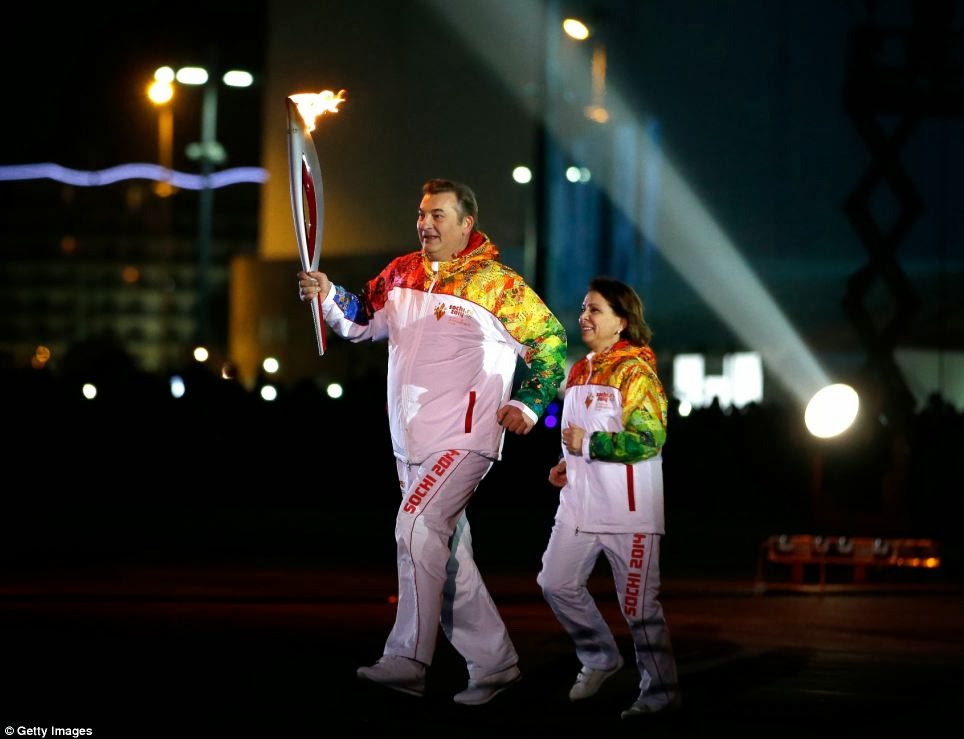
Other moments of uneasiness were perhaps less unintentional.  Eyebrows were raised when the Russian figure-skater Irina Rodnina accompanied the ceremony’s official torch-bearer.  Rodnina, who is also a member of Russia’s parliament in Putin’s ruling United Russia party, was at the center of a storm of controversy in September for posting a Photoshopped image on Twitter showing Barack Obama sitting next to Michelle with his mouth full while a banana is waved in front of him.  Initially, she cited free speech by refusing to take the image down.  The United States ambassador to Russia even called the tweet “outrageous behaviour” which “only brings shame to her parliament and country.”  Throwing bananas onto the field when foreign black athletes appear is a common form of hooliganism in European sporting events, and Russia, where anti-African racism is rampant and mostly unquestioned, this is especially the case.

The racist tweet defiantly posted in September
by one of the opening ceremonies’ final torchbearing athlete/politicians.
Putin’s secret lover among torch-bearers?
Another of the torchbearers was Alina Kabaeva, an Olympic gymnast who is an intimate of Putin’s and rumored to be his lover.  Media reported in 2008 a planned marriage between the two, but they were quashed.  More recently there have been rumors that they did marry secretly and are merely waiting for an official announcement.  Putin and his wife, Lyudmila Putina, divorced in June 2013 after 30 years of marriage.

Celebrity tabloids think Putin is romantically linked to a gymnast who carried
the torch at the opening ceremonies; they may even be secretly married.
(Or maybe they were lovers, but she still carries a torch for him?  Okay, sorry, sorry, I couldn’t resist.)

Putin’s torch-bearer and alleged mistress Alina Kabaeva.
As Lyudmila Putina put it, “Who is this bimbo, and what can she do that I can’t? Okay, never mind.”
Apologist for Syrian war crimes given key position in opening ceremony
A little more seriously, the Olympic flag was carried at the opening ceremony by a troupe of famous Russians, including a cosmonaut but also an obscurer but more controversial figure: the journalist Anastasia Popova.  A stooge of the Putin regime, Popova has appalled the international journalistic and human-rights communities by unapologetically cheerleading the embattled regime of Syria’s dictator, Bashar al-Assad. She visited Syria a few months after the civil war there began in 2011, writing, “Despite all our attempts, we didn’t manage to find the thousands-strong demonstrations against the government so often talked about by the Western media.”  More recently, she has claimed, without evidence, that it is Syrian rebels, rather than the government, that used chemical weapons against civilians.  A few days ago in an article in this blog I listed the Syrian issue as one of “10 Political Causes Sure to Disrupt the Sochi Games.”  But I didn’t think that it would be the Russian authorities themselves that would decide to flaunt their shameful support of the mass-murderer Assad and rub the international community’s nose in it.

Anastasia Popova, third from left, is Putin’s Syrian-war-crimes denier in chief.
Volgograd bombers neutralized just in time?
But security, of course, has been the biggest story of these Games, which, against all reason, decency, and common sense are being held just a few miles from the most active conflict zone in Europe, the insurgency-convulsed North Caucasus region.  Russian officials claim that on February 5th Russian police shot and killed one Zhamaldin Mirzayev, a 30-year-old alleged to be a mastermind of the recent lethal bus bombings in nearby Volgograd.  Responsibility for the attacks was claimed by a group called Vilayat Dagestan, which is not a “previously unknown group,” as the New York Times called it, but in fact a regional branch of an Islamist terrorist group called the Caucasus Emirate, which aims to break off the whole North Caucasus region (including Sochi) as an Islamic state independent of Russia.  The shootout occurred in Izberbash, in the Republic of Dagestan, a veritable war zone in the eastern North Caucasus which is so ethnically diverse that it has 30 official languages.  After the Volgograd attack, Vilayat Dagestan promised Putin they would send him “a present” for the Olympics.  Does this mean that that threat is now neutralized?  Who the hell knows.  The Kremlin controls all information about counterinsurgency operations, and Putin is highly motivated to make the Sochi Olympics seem safer than they actually are.  (The Caucasus Emirate was listed as no. 1 in this blog’s recent article “Yet Another Genocide Olympics: 10 Political Causes Sure to Disrupt the Sochi Games.”  I also listed the group as one of “10 Separatist Movements to Watch in 2014.”)

The Republic of Dagestan is “Vilayat Dagestan” in the Caucasus Emirate view of the world.
Sochi, meanwhile, is in “Vilayat Cherkessia” (Circassia).
Foiled Ukrainian hijacking
Some of the biggest headlines in the first 48 hours of these Olympics have come from the dramatic near-hijacking of a plane flying from Kharkov, in Ukraine, to Istanbul, Turkey, on February 7th, the day of the opening ceremonies.  The would-be hijacker, who was heavily intoxicated, said that a bomb was on the plane and demanded the plane, which was a Pegasus Airlines passenger jet, be taken to Sochi, for some unstated purpose.  The crew collaborated in deceiving him—and all the passengers—into thinking the plane was headed to Sochi.  But when it landed, “Sochi” was Istanbul, and the man was arrested.  Turkish police have released few details other than to say that he was a 45-year-old Ukrainian and that he was not cooperative.  It remains possible that he, like 30% of Ukrainian citizens, is ethnically Russian.  The point of origin of the flight, Kharkov, in northeastern Ukraine, is (as discussed recently in this blog) the proposed capital of a separate nation called Malorossiya or Malorussia (i.e., “Little Russia”) in the ethnic-Russian-dominated east of Ukraine.  (The Ukrainian crisis was listed as no. 4 in this blog’s recent article “Yet Another Genocide Olympics: 10 Political Causes Sure to Disrupt the Sochi Games.”)

An alleged image of the Ukrainian hijacker,
about whom as yet little is known
Watch this space for more updates on the attempted hijacking in particular, and, more generally, continuing updates on the geopolitics of the Sochi Olympics.

The defiantly racist Irina Rodnina (right)

[You can read more about Circassia, Dagestan, Tatarstan, and many other sovereignty and independence movements both famous and obscure in my new book, a sort of encyclopedic atlas just published by Litwin Books under the title Let’s Split! A Complete Guide to Separatist Movements and Aspirant Nations, from Abkhazia to Zanzibar.  The book, which contains 46 maps and 554 flags (or, more accurately, 554 flag images), is available for order now on Amazon.  Meanwhile, please “like” the book (even if you haven’t read it yet) on Facebook and see this interview for more information on the book.]


The British Virgin Islands team enters the arena

Related articles from this blog:

Subscribe Now: Feed Icon