Showing posts with label Australia. Show all posts

Thursday, September 10, 2015

Fiji Junta Rounds Up Islamophobes Bent on Separate Christian State on Viti Levu


The military strongman who runs the Republic of Fiji is continuing to crack down this month on what his government and military call a separatist insurrection on Viti Levu, the Pacific nation’s largest and most populous island.

The self-declared Christian republics are in Ra and Nadroga-Navosa provinces.
The crisis came to international attention last month, when over 50 people were arrested in Viti Levu’s Ra province, on the northeast coast, on suspicion of connection with a training camp allegedly run by a former British military officer.  Authorities said the camp was training forces to help establish two separate “Christian states” declared late last year.   The Nadroga-Navosa Sovereign Christian State, on the southwestern end of the island, in Nadroga-Navosa province, and the Ra Sovereign Christian State, in Ra, were declared in October and November 2014, reportedly with the approval and participation of some (supporters say all) local traditional chiefs.  Five people were arrested and charged with sedition at the time in connection with those declarations.  The presidents ceremonially installed for the two would-be states—Nadroga-Navosa’s Ratu Osea Turaga Gavidi and Ra’s Ratu Meli Bolobolo—have since died.

The Nadroga-Navosa Sovereign Christian State flag flying over Cuvu village last month
It is not entirely clear who runs the provisional governments now, but supporters in Sydney, Australia, some calling themselves the Fiji Democracy Movement, speak for the entities and have commissioned flags.  Their views are disseminated to the public by a Fijian, now banned from re-entering the country, named Oni Kirwin, who calls herself “attorney general” of the Ra and Nadroga Christian State (which makes it sound like one entity, instead of two) and talks brashly of bringing her case to the International Criminal Court in the Hague and to Queen Elizabeth II.  (Fiji was a United Kingdom colony until 1970, then a Commonwealth realm until a coup d’état in 1987.)

Oni Kirwin
Most of those arrested last month, plus others later, have been charged with sedition.  In a statement, Prime Minister Josaia Voreque “Frank” Bainimarama, the former naval commander who heads the country’s ruling junta, said, “There will be no so-called independent states established in Fiji.  Anyone who swears an illegal oath will face the full force of the law.  Anyone who encourages political violence will face the full force of the law.  We will not and should not tolerate the kind of instability certain people are currently trying to provoke.  Put simply, any insurrection will be crushed.”

Frank Bainimarama
Bainimarama, who was elected prime minister last year in a shady and dirty election process, had served as president (and later as acting prime minister) in an unelected capacity since he took the reins of the 2000 coup d’état that unseated the elected prime minister, Mahendra Chaudhry.  Chaudhry is from the large Indo-Fijian (i.e., South Asian) community—descendants of indentured laborers imported from India by British colonists who have become so numerous that indigenous Fijians like Bainimarama are only about 53-57% of the population.  Indo-Fijians are 38%, but used to have a larger share before the coup and a wave of emigration.  Reliable numbers are hard to come by, since demographics has become such an explosive source of political tension in this tiny nation of around 900,000 that census-taking has been nearly abandoned.  Bainimarama builds his support on Indo-Fijians as much as on indigenous Fijians.

The collective flag for the Ra and Nadroga-Navosa Sovereign Christian States
Christians (mostly Methodists) make up 58% of the Fijian population, including 6% of Indo-Fijians but over 90% of the remaining population, which includes indigenous Fijians and those with origins in China, Europe, or elsewhere in Oceania.  Indigenous Fijians have only recently regained their slim majority, and the phrase “Christian state” as it is used in the latest unrest is used by indigenous Fijians resentful of the Indo-Fijian role in politics, which is still considerable.  One member of parliament, Mosese Bulitavoare, of the Social Democratic Liberal Party (Sodelpa), was charged with sedition recently for whipping up anti-Indian bigotry.  Sodelpa has found itself in the position of denying publicly any role in the current separatist movements.

Some neighborhoods in Fiji’s capital, Suva, feel like India.
Fijian Christian activists’ concerns are less focused on Hinduism, practiced by 77% of Indo-Fijians (a third of the national population), than on Islam, even though it is practiced by only 16% of Indo-Fijians and a mere 7% of Fiji’s total population.  As the soi-disant “attorney general” Kirwin, in Australia, puts it, “I’m not frightened or scared at all.  There is a takeover in Fiji and it is not a good one.  We’re concerned by Muslims.  Their influence is very, very high.” She explicitly opposes constitutional guarantees of equal rights for all Fijians, regardless of ethnic background or faith.  Fiji’s attorney general, Aiyaz Sayed-Khaiyum, has in particular been subjected to considerable vilification for his faith by some indigenous Christians.

Attorney General Khaiyum has been the focus of much indigenist Christian vilification
Details on last month’s arrests are hard to come by, and are usually filtered through the government’s interpretation of events.  Late last month, Bainimarama blamed “high-profile figures” in Australia for abetting the uprising, which he blamed on “enemies of modern Fiji.”  This may be a reference to one of the Fijian Christian states’ loudest supporters, the Rev. Fred Nile, a New South Wales state legislator who heads the Christian Democratic Party (C.D.P.) and is a perpetual target of ridicule in Australian politics.  Each year Nile publicly prays for Sydney’s annual gay-pride parade to be rained on, and he has pushed for laws banning Muslim immigration, the wearing of Muslim religious dress, and not just same-sex weddings but also pagan and Wiccan ones.

A defaced Fred Nile billboard in Australia
Fiji is no stranger to ethnic and sectarian unrest.  In addition to several coups d’état and the tensions between indigenous and South Asian Fijians, there is recurring separatist activity on an outer Fijian island called Rotuma (1.2% of Fiji’s population), which shares more with the Polynesian culture of Samoa and Tonga than with Fiji’s Melanesian one.  And on Fiji’s Rabi Island an elders’ council of expatriates from the Republic of Kiribati’s Banaba Island, which is more Fijian than Kiribatian culturally, acts as a sort of provisional government for Banaba, where there is ongoing advocacy of either seceding as an independent state or transferring Banaba to Fiji.

Sometimes politics in Fiji gets racial, in an ugly way.
Seventy alleged “Christian state” activists await trial for sedition.  Sixteen have pleaded not guilty and are due back in court on September 22nd.  Due to the repressive political atmosphere in Fiji and constraints on the press, it is not clear how true any of the allegations are.  One defense lawyer for the defendants, Aman Ravindra-Singh, has said, “We have been kept in the dark as counsel for these persons and we have yet to see any shred of evidence with regards the allegations of guns and firearms being involved in military-style training.”  Nor can we rely on any kind of pressure for due process from neighbors like Australia and New Zealand, who regard Bainimarama’s Fiji as a crucial link in the geopolitical containment of China’s naval ambitions.

Fiji’s flag
The proposed Christian states on Viti Levu are dangerously intolerant and undemocratic.  The attitudes and prejudices underlying them have no place in a modern democratic nation.  But neither do the military-style policing and disregard for civil rights with which Bainimarama is trying to keep the uprising down.  Fiji’s junta may find that it is feeding the nation’s cycle of coups and counter-coups rather than stabilizing the country.

One of many proposed redesigns of the Fijian national flag
[Thanks to Olivier Touzeau for a correction on identification of flags in this article.]

[You can read more about many other separatist and new-nation movements, both famous and obscure, in my new book, a sort of encyclopedic atlas just published by Litwin Books under the title Let’s Split! A Complete Guide to Separatist Movements and Aspirant Nations, from Abkhazia to Zanzibar.  The book, which contains 46 maps and 554 flags (or, more accurately, 554 flag images), is available for order now on Amazon.  Meanwhile, please “like” the book (even if you haven’t read it yet) on Facebook and see this interview for more information on the book.]


Friday, July 25, 2014

Tazzies in a Tizzy over Missing Island on Commonwealth-Games Speedos, Reviving Independence Talk


Tasmanians have always been separated from the other Australian states by the waters of Bass Strait, but now a wider gulf has been opened by Australia’s new Commonwealth Games uniforms, which depict a map of the continent-nation without Tasmania.  The state’s premier is furious, and some regionalist activists are even saying the time has come for independence.


Speedo International, Ltd.—the New South Wales–based swimwear company synonymous with minuscule, painfully tight swimsuit bottoms that leave nothing to the imagination of appalled, eye-averting beach-goers worldwide—recently unveiled the design for the athletic swimwear to be worn by Team Australia at the 2018 games in Gold Coast Beach, Queensland.  The suits sport a jaunty tessellation of galloping kangaroos and emus alternating with Australia’s distinctive outline.  But missing is the large island of Tasmania just south of the mainland’s southeastern corner.  (That’s the uniform above, modelled by the Australian swimmer Kotuku Ngawati, displaying her hyper-mobile elbows.)

The flag of Tasmania (the real one; see below)
Nor is this the first such snub.  When the Commonwealth Games were held in Brisbane, Queensland, in 1982, opening-ceremony dancers formed a Busby Berkeley–style map of Australia, and Australia’s smallest state was missing there too.  Thus, Andrew Nikolic, a member of Australia’s parliament representing Bass, Tasmania, calls the new Speedos a “repetitive insult” and has written in pique to the federal minister of sport, Peter Dutton.  Nikolic says Commonwealth Games authorities “should have a good, hard look at themselves.”  Another Tasmanian legislator, Jacqui Lambie, is demanding compensation in the form of an extra $5 million (Australian) in tourism funding.

Brisbane in 1982.  Hmmm ... I don’t see the Cocos Islands either ...
The outspoken Tasmanian avocational historian Reg Watson* calls the latest omission “absolutely appalling,” adding, “This is typical of how mainlanders treat Tasmania and this is why I believe in secession for Tasmania.”   But Watson’s is not usually a voice of reason: the founder of Australia’s annual Anglo–Boer War Commemorative Day, Watson is also a ufologist, a Jack the Ripper aficionado, and an angry advocate of celebrating Tasmania’s British heritage, which he complains has been shouted down by “political correctness” and the rush to please racial minorities, a conspiracy of silence he compares to Nazism and Stalinism.  Watson is even part of a movement by amateur historians to downplay or outright deny the 1804 massacre of indigenous Tasmanians at Risdon Cove.  The last full-blooded Tasmanian Aboriginal died in the late 19th century after a campaign of extermination that was one of the most thorough and pitiless genocides in modern history.


Tasmania’s premier, Will Hodgman, is more sanguine: he calls the new uniforms “utterly un-Australian” and a “disgrace” and demands an apology, but he has also said, “I’m seriously annoyed, but this doesn’t mean we’ll move to secede.”

Tazzies, take heart!  Nothing could ever be worse than
Team Scotland’s uniforms at the 2014 Commonwealth Games in Glasgow.
Aside from genocide, Tasmania is known in the northern hemisphere mainly as the birthplace of the swashbuckling film star and libertine Errol Flynn and of another Hollywood celebrity with ravenous appetites, Warner Brothers cartoons’ “Tasmanian Devil,” who looks nothing like the ratlike, garbage-scavenging Sarcophilus harrisii found throughout the island.  But, within Australia, Tasmanians have a unique identity and have mulled a split before.  Though Tasmanians voted with the largest majority of any state, to join the Commonwealth of Australia in 1901, the Great Depression of the 1930s brought a surge of separatist anger by Tazzies (as islanders tend to be known) who blamed their economic woes on mainlanders.  Tasmanian secessionism has mostly been kept in check by a realization that Tasmania gets much more from the central government in the form of programs and services than it pays in.


Perhaps Speedo-gate will fan the faint coals of Tasmanian separatism again.  If so, those who take the idea seriously will have to wade through a barrage of inevitable randy jokes: because of the island’s vaguely triangular shape, the term map of Tasmania is a slang term for a woman’s pubic hair.  After all, isn’t that supposed to be invisible on a swimsuit?

Maybe this design would mollify would-be separatists:
you can see a little bit o’ map-o’-Tazzie on this one.
* Not to be confused with the other Australian writer named Reg Watson, creator and screenwriter of the squalid 1970s lesbians-behind-bars soap-opera Prisoner, who appears to be some sort of national treasure.
“Queen Bea” and Lizzie Birdsworth stare down
“Old Vinegar-Tits” in an episode of Prisoner

[For those who are wondering, yes, this blog is tied in with my forthcoming book, a sort of encyclopedic atlas to be published by Litwin Books under the title Let’s Split! A Complete Guide to Separatist Movements and Aspirant Nations, from Abkhazia to Zanzibar.  (That is shorter than the previous working title.)  The book, which contains 46 maps and 554 flags (or, more accurately, 554 flag images), will be on shelves and available on Amazon on March 1, 2015.  I will be keeping readers posted of further publication news.  Meanwhile, please “like” the book (even though you haven’t read it yet) on Facebook and see this special announcement for more information on the book.]


[Hear the author of this blog discuss the Cascadia independence movement in OregonWashington, and British Columbia in a recent interview for Seattle’s National Public Radio affiliate station KUOW-FM.  Click here to listen.]

Related articles from this blog:

“Wiradjuri Activists Raise Flag, Proclaim Newest Aboriginal Republic in Australia” (Jan. 2014)
“Lamb Island, off Australian Coast, to Vote on Becoming Republic of Nguduroodistan” (Oct. 2013)
“Hutt River’s Princess Shirley Had Irish Noble Blood, Mourners Learn” (Aug. 2013)
“Housing Estate Splits from New South Wales, Joins ‘Free State of Australia’” (July 2012)
“Founding of ‘Free State of Australia’ in New South Wales Stems from Zoning Dispute” (Nov. 2011)

[Special thanks are due to Alice Crawford and to Seaman Hornblower (not the one portrayed in film by Errol Flynn) for my education in Australian slang.]

Tuesday, January 28, 2014

Wiradjuri Activists Raise Flag, Proclaim Newest Aboriginal Republic in Australia


Australia is known as the continent and country with the highest concentration of micronations, those obscure whimsical independence projects enacted by eccentrics of which the government in Canberra is surprisingly tolerant.  Some have been covered in this blog, such as the Principality of Hutt River (among the most serious of them) to the Free State of Australia (see also follow-up article here) to the recent attempt by a resort island near Brisbane, Queensland, to declare itself the Independent Republic of Nguduroodistan.  Others include the Principality of Snake Hill, the Empire of Atlantium, the Principality of Dubeldeka, and, in the Great Barrier Reef, the Gay and Lesbian Kingdom of the Coral Sea Islands.  Some are no larger than the homes or properties of their self-styled princes and queens.

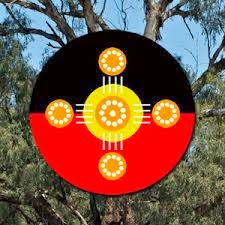
Symbol of the Australian Aboriginal
“Sovereign Union” movement
But over the past year the micronation craze has taken a more serious turn, as Australia’s Aboriginal people are using this template as a way to assert indigenous claims of sovereignty.  Partly it is a combination of the new, much more rightward-leaning government of Prime Minister Tony Abbott taking office in September with the occasion of Australia Day, the January 26th “celebration” of the 1788 British landing on the continent which Aboriginal people mourn as “Invasion Day.”

Australian Aboriginal and other indigenous activists showing solidarity
with the West Papua independence movement in neighboring Indonesia
So on January 22nd, a group of Aboriginal people in Wellington, New South Wales, raised the flag of what they are calling the Wiradjuri Central West Republic, named for the Wiradjuri ethnic group of central N.S.W.  (See photo at the top of this article, which shows the elders Dot Stewart and Nelson Smith at the flag-raising.  See a video of the flag-raising here.)

The proclaimed territory of the Murrawarri Republic is about the size of Austria.
The Wiradjuri move, as it turns out, is only the latest of four recent declarations of independence on the continent.  The others are: the Murrawarri Republic (declared on March 30, 2013, along the Queensland–N.S.W. border), the Euahlayi Peoples Republic (declared on August 3, 2013, in Dirranbandi, Queensland), and the Republic of Mbarbaram (in an inland far-northern Queensland’s Cape York Peninsula).

The Euahlayi Peoples Republic also straddles the Queensland–New South Wales border,
just east of the Murrawarri Republic.
These declarations have been made under the rubric of an organization called the Sovereign Union of First Nations and Peoples in Australia, which was founded in 1999 and later, in 2012, reformulated itself as the Sovereign Union–Interim Unity Government at the Kuradji Tent Embassy, near Wollongong, N.S.W.  “Aboriginal Tent Embassies” are a movement which began in 1972 with a protest encampment outside Parliament House in Canberra and spawned a network of Aboriginal encampments around the country as a site of Aboriginal sovereigntist activism.


What is new about these Aboriginal declarations is that they are being made in the name of individual Aboriginal nations, as opposed to previous movements to, for example, plans by the Aboriginal Provisional Government in the 1990s to declare a vast, landlocked Aboriginal State.  Of the four above-listed nations, the Republic of Mbarbaram and the Wiradjuri Central West Republic have not, to my knowledge, revealed their precise territories, though the Wiradjuri republic’s flag features the outline of the territory, which seems to be—and this is supported by the republic’s full name—a subset of the vast homeland of the Wiradjuri people, which is the largest in Australia and includes up to a third of N.S.W., including the city of Wagga Wagga.  One news report said the republic’s territory “would cover the areas around Goolma, Wellington, Parkes, Forbes and Orange.”

Map showing Wiradjuri territory (in New South Wales)
among other Aboriginal homelands in Australia.

Indeed, all of these new states, but the Wiradjuri republic especially, are claiming territories that also include large numbers, even majorities, of non-Aboriginals.  But Aboriginal activists insist this is not a problem, that the new states will be cooperative and inclusive.  It’s not clear if local whites necessarily share that optimism.

Flag of the Euahlayi Peoples Republic
The Murrawarri Republic’s declaration of independence last year took the form of a letter to Queen Elizabeth II (who holds suzerainty over Australia as a Dominion Realm).  The letter requested documents within 21 days demonstrating any kind of formal cession of Murrawarri territory.  The letter stated that if no such documentation was forthcoming, then the Republic would consider itself a continuing independent state and would apply for a seat at the United Nations General Assembly.

Flag of the Murrawarri Republic
In one sense, it is hard to see these moves as more than publicity stunts.  No one is setting up any customs booths or interfering with the exercise of Australian jurisdiction in any concrete way.  But many serious independence movements began as “publicity stunts.”  The Aboriginal activists behind these new declarations seem serious.  It is likely that more Aboriginal nations will follow suit, and that activists will take the quest for statehood to the next level.  What that next level will look is anyone’s guess.  This is a path that has not yet been blazed.


[For those who are wondering, yes, this blog is tied in with my forthcoming book, a sort of encyclopedic atlas to be published by Auslander and Fox under the title Let’s Split! A Complete Guide to Separatist Movements, Independence Struggles, Breakaway Republics, Rebel Provinces, Pseudostates, Puppet States, Tribal Fiefdoms, Micronations, and Do-It-Yourself Countries, from Chiapas to Chechnya and Tibet to Texas.  The book, which contains dozens of maps and over 500 flags, is now in the layout phase and should be on shelves, and available on Amazon, by early fall 2014.  I will be keeping readers posted of further publication news.  Meanwhile, please “like” the book (even though you haven’t read it yet) on Facebook.]

Friday, October 4, 2013

Lamb Island, off Australian Coast, to Vote on Becoming Republic of Nguduroodistan


Australia is home to the wildest profusion of micronations in the world—from one of its oldest, the Principality of Hutt River, in the western outback (reported on recently in this blog), to the Sovereign State of Aeterna Lucina (which traces its legitimacy to Afghanistan’s royal family), to wild experiments like the Gay and Lesbian Kingdom of the Coral Sea Islands, where you can sail on a ship called the Gayflower to have same-sex weddings Australia still does not permit on the mainland.  One of our first blog posts reported on the Free State of Australia, an anti-money, “technocratic” commune near the QueenslandNew South Wales border.  To this we may soon have to add the Independent Republic of Nguduroodistan.


Based on the Aboriginal name for Lamb Island, plus the suffix -stan, Nguduroodistan is not an Aboriginal movement but a new push by residents of a tiny islet in southern Moreton Bay, on the southeastern outskirts of Brisbane, Queensland, to go it alone.


(This Lamb Island is not to be confused with Lamb Island in Scotland, a volcanic outcropping which was purchased in 2009 by the Israeli psychic Uri Geller because of a fancied resemblance to an Egyptian pyramid.)

The Principality of Hutt River, in Western Australia, is an inspiration.
Tony Gilson, a shopkeeper on the sleepy resort island, says he reckons about 90% of Lamb’s 450 or so residents (427 in the 2011 census) support secession, most of them feeling that the local, state, and federal governments have failed to provide them with essential services at an affordable cost.  He has already drafted a 35-page constitution, which includes a royal family, a prime minister, and 21 cabinet ministers, some of whom have already been informally appointed.  He plans to consult with Hutt River’s Prince Leonard on legal aspects of secession.

An enthusiast displays a Hutt River flag.
Nor is it all talk: a referendum is being scheduled for October 19th.  Presumably it will be non-binding—at least in the eyes of the state and federal governments.

Some postage stamps issued by the Gay and Lesbian Kingdom of the Coral Sea Islands
At 1.39 square kilometers, Nguduroodistan would be the world’s second-smallest independent state: more than three times the size of Vatican City but still just shy of the Principality of Monaco’s 2.02 square kilometers.  (Hutt River, by contrast, is 75 square kilometers.)  It would quite handily take the title of least-populous country in the world (the Vatican, with 800, is the current champ), though Lamb’s population dwarfs that of the United Kingdom’s self-governing colony of Pitcairn Island in the South Pacific, which has 66 people.

It remains to be seen if the Hutt River royal family will welcome the competition.
No word yet from the Australian or Queensland governments on Nguduroodistan’s prospects.  Nor is there, as yet, a flag.  But we will of course keep readers posted on any developments.


[You can read more about Nguduroodistan and many other separatist and new-nation movements, both famous and obscure, in my new book, a sort of encyclopedic atlas just published by Litwin Books under the title Let’s Split! A Complete Guide to Separatist Movements and Aspirant Nations, from Abkhazia to Zanzibar.  The book, which contains 46 maps and 554 flags (or, more accurately, 554 flag images), is available for order now on Amazon.  Meanwhile, please “like” the book (even if you haven’t read it yet) on Facebook and see this interview for more information on the book.]


Monday, August 19, 2013

Hutt River’s Princess Shirley Had Irish Noble Blood, Mourners Learn


Her Royal Highness Princess Shirley of Hutt, who passed away at the age of 84 on July 7th, may not have enjoyed international recognition as consort to the monarch of a 75-square-mile independent state in the Western Australia outback, but residents of Kilkenny, in the Republic of Ireland, have identified her as one of their own and as a descendant of the Earls of Ormonde.

The Prince and (late) Princess of Hutt
The late princess, who was born in Fremantle, near Perth, and whose commoner name had been Shirley Casley, even had the maiden name Butler.  Avocational genealogists in Kilkenny, who spotted her obituary in an Australian newspaper, are linking her to James Butler, 1st Earl of Ormonde, who died in County Kilkenny in 1338—shortly after an invasion of Ireland by Scotland’s Edward of Bruce and an ensuing famine, and 10 years before the arrival of the “Black Death” (bubonic plague) to the Emerald Isle.

The 1st Earl of Ormonde
The Principality of Hutt River formally seceded from Australia in 1970, as a glorified wheat farm with the name Province of Hutt River.  Its founder, Leonard Casley, eventually styled himself Prince Leonard I and pledged loyalty to Queen Elizabeth II, invoking Australian legislation which puts sovereigns beyond the reach of the law.  The government in Canberra has never acknowledged Hutt River’s sovereignty but has never contested it either.  The approximately 220 residents—almost all of them, other than the Casley family, Aboriginal people of the Noongar ethnic group—are allowed to avoid taxes, exempt themselves from Australian laws, and issue their own postage stamps and currency.


In addition to Princess of Hutt, the late Shirley also held the titles Dame of the Rose of Sharon, Patron and Chair of the Red Cross of Hutt, and Colonel-in-Chief of the Royal Hutt River Legion.  The prince and princess’s nine children include Crown Prince Ian (who is also Prime Minister); Wayne, 1st Duke of Nain; Richard, 1st Duke of Carmel; and Graeme, Duke of Gilboa.

No Hapsburg nose is visible on hubby, however ...

[For those who are wondering, yes, this blog is tied in with my forthcoming book, a sort of encyclopedic atlas to be published by Auslander and Fox under the title Let’s Split! A Complete Guide to Separatist Movements, Independence Struggles, Breakaway Republics, Rebel Provinces, Pseudostates, Puppet States, Tribal Fiefdoms, Micronations, and Do-It-Yourself Countries, from Chiapas to Chechnya and Tibet to Texas.  The book, which contains dozens of maps and over 500 flags, is now in the layout phase and should be on shelves, and available on Amazon, by early fall 2014.  I will be keeping readers posted of further publication news.  Meanwhile, please “like” the book (even though you haven’t read it yet) on Facebook.]

Saturday, December 15, 2012

Sandy Island May Not Exist, but Now It Has a King


Last month, media attention was drawn to Sandy Island (a.k.a. Île du Sable), in the Coral Sea between Australia and New Caledonia when a University of Sydney plate-tectonics surveying ship headed to the island to investigate discrepancies in their charts and found out there was nothing there but open sea.  They had seen the island on Google Maps and Google Earth—shown as being in the territorial waters of New Caledonia and, thus, of the French Republic—but it has also appeared in numerous atlases and other sources.  Nor is this a mere location error.  Sandy Island doesn’t exist and has never existed.  Its posited existence and position were traced first to a 1908 map and then to one by the legendary British explorer Capt. James Cook from 1774.  The island’s non-existence was not very loudly suspected, if at all, but was unconfirmed for centuries.


Now, a German man calling himself King Marduk I has laid claim, on behalf of the State Kingdom of Marduk, to Sandy Island, which he claims does indeed exist and which he names after himself, i.e. King Marduk Island.  The self-styled king, who is named for a Babylonian god (or possibly for the eponymous alleged tenth planet of our solar system “discovered” by the crackpot archaeo-astronomer Zechariah Sitchin), several years ago tried to claim the Principality of Sealand, the disused World War II derrick off the coast of Essex, England, which is one of the modern world’s best known and most successful “micronations.”

His Majesty, King Marduk I
Marduk declared this week on his website (in language that suggests he relies as heavily on Google Translate to render his German into  Englissh as he does on Google Maps to tell him which islands exist or don’t exist): “H. M. KING MARDUK I DECLARE THAT THE SINCE DECADES OF STATE FREE ISLAND TERRITORY UNDER THE NAME CALLED ‘SANDY ICELAND’ [sicTHE PACIFIC LOCATEDALWAYS NO STATE EITHER COUNTRY COURSE LISTENING BETWEEN AUSTRALIA AND EAST OF WHICH LOCATED COLONIAL COUNTRY NEW CALEDONIATHE SANDY ISLAND LOCATEDTHOSE LEGAL UNVERWERFLICH NO PHANTOMS ISLANDBUT ACTUALLY EXIST IN POSITION [WGS84] 19°13'6.43"S, 159°55'23:42"E – 19.218451°, 159.923172 ° [UTM] 57K 597040 7874744 INTERNATIONAL REGISTERED LOCATEDFROM A STATE SURVIVE FREE TERRITORY ISWHERE THIS ISLAND SINCE 1922 ON CARD DOCUMENTEDRECENTLY THE UNITED NATIONS IN 2002 TO YOUR DECREE CONFIRMED THIS ISLAND.”

An image from the Kingdom of Marduk website
Other territories Marduk claims for his kingdom (called, in some reference, New Germania) include: much of the eastern Alps, including the Austria’s Vorarlberg state, the Italian region of South Tyrol, Liechtenstein, and parts of Switzerland and Bavaria around, and including, Lake Constance (Bodensee); various localities in the Swiss cantons of Schaffhausen and the cities of Basel and Bern; the entire former Kingdom of Württemberg; the Dogger Bank, the German island of Heligoland, and the artificial island Langlütjen, all in the North Sea; Hamburg and, by extension, the Baltic Sea; the island of Rockall, between Scotland and Iceland (and itself once the location of a publicity-stunt micronation called Waveland); Vatican City; the micronation of Seborga, on the border between Italy and France; parts of Ticino, in southern Switzerland; Jerusalem; and—why aim low, right?—all of outer space.

The former micronation of Waveland, in the North Atlantic
—claimed also by the Kingdom of Marduk.
Little is known about King Marduk himself, but a Swiss journalist who reported recently on Marduk’s royal territorial claims on the town of Büsingen, Schaffhausen, quoted the kingdom’s secretary of state, one Thomas Vogel, as saying—with a kind of wild inconsistency—that his monarch “shuns publicity and does not want to be recognized.  He lives in Tübingen in a stately residence, not a castle.  He has a huge royal fleet with twelve cars for state visits such as Jaguars and Mercedes.  Apart from a Rolex, he has not a lot of wealth.  The king is wise as a professor and lives rather modestly.”  The reporter, Hermann-Luc Hardmeier, who interviewed the bling-laden “Vogel” in Büsingen after his arrival in a limousine, seemed sure that “Vogel” was merely “Marduk” in disguise, but photographs of the monarch do not much resemble the man Hardmeier interviewed.

The Kingdom of Marduk’s secretary of state, Thomas Vogel,
arriving for an important press conference with a reporter from the Schaffhauser Nachrichten
Going back to Sandy Island—the French government has not yet responded to Marduk’s claims on its territory, but then again Paris has also reacted not at all to the fact that an island which it thought it owned now does not exist and what the implications are for its maritime boundaries.  Nor have their been responses from the separatist movement in New Caledonia or from an unrecognized nation which claims waters (which the world grants to Australia) just to the west of “Sandy Island”: the Gay and Lesbian Kingdom of the Coral Sea Islands.  Theoretically, this could get ugly.

Postage stamps produced by the Gay and Lesbian Kingdom of the Coral Sea Islands.
It’s nice to finally see the “bear” subculture honored with a stamp.
Here at “Springtime of Nations,” we will keep you posted on any further developments regarding non-existent islands.

[For those who are wondering, yes, this blog is tied in with my new book, a sort of encyclopedic atlas just published by Litwin Books under the title Let’s Split! A Complete Guide to Separatist Movements and Aspirant Nations, from Abkhazia to Zanzibar.  (That is shorter than the previous working title.)  The book, which contains 46 maps and 554 flags (or, more accurately, 554 flag images), is available for order now on Amazon.  Meanwhile, please “like” the book (even if you haven’t read it yet) on Facebook and see this special announcement for more information on the book.]


Subscribe Now: Feed Icon