Showing posts with label Aborigines. Show all posts

Friday, July 25, 2014

Tazzies in a Tizzy over Missing Island on Commonwealth-Games Speedos, Reviving Independence Talk


Tasmanians have always been separated from the other Australian states by the waters of Bass Strait, but now a wider gulf has been opened by Australia’s new Commonwealth Games uniforms, which depict a map of the continent-nation without Tasmania.  The state’s premier is furious, and some regionalist activists are even saying the time has come for independence.


Speedo International, Ltd.—the New South Wales–based swimwear company synonymous with minuscule, painfully tight swimsuit bottoms that leave nothing to the imagination of appalled, eye-averting beach-goers worldwide—recently unveiled the design for the athletic swimwear to be worn by Team Australia at the 2018 games in Gold Coast Beach, Queensland.  The suits sport a jaunty tessellation of galloping kangaroos and emus alternating with Australia’s distinctive outline.  But missing is the large island of Tasmania just south of the mainland’s southeastern corner.  (That’s the uniform above, modelled by the Australian swimmer Kotuku Ngawati, displaying her hyper-mobile elbows.)

The flag of Tasmania (the real one; see below)
Nor is this the first such snub.  When the Commonwealth Games were held in Brisbane, Queensland, in 1982, opening-ceremony dancers formed a Busby Berkeley–style map of Australia, and Australia’s smallest state was missing there too.  Thus, Andrew Nikolic, a member of Australia’s parliament representing Bass, Tasmania, calls the new Speedos a “repetitive insult” and has written in pique to the federal minister of sport, Peter Dutton.  Nikolic says Commonwealth Games authorities “should have a good, hard look at themselves.”  Another Tasmanian legislator, Jacqui Lambie, is demanding compensation in the form of an extra $5 million (Australian) in tourism funding.

Brisbane in 1982.  Hmmm ... I don’t see the Cocos Islands either ...
The outspoken Tasmanian avocational historian Reg Watson* calls the latest omission “absolutely appalling,” adding, “This is typical of how mainlanders treat Tasmania and this is why I believe in secession for Tasmania.”   But Watson’s is not usually a voice of reason: the founder of Australia’s annual Anglo–Boer War Commemorative Day, Watson is also a ufologist, a Jack the Ripper aficionado, and an angry advocate of celebrating Tasmania’s British heritage, which he complains has been shouted down by “political correctness” and the rush to please racial minorities, a conspiracy of silence he compares to Nazism and Stalinism.  Watson is even part of a movement by amateur historians to downplay or outright deny the 1804 massacre of indigenous Tasmanians at Risdon Cove.  The last full-blooded Tasmanian Aboriginal died in the late 19th century after a campaign of extermination that was one of the most thorough and pitiless genocides in modern history.


Tasmania’s premier, Will Hodgman, is more sanguine: he calls the new uniforms “utterly un-Australian” and a “disgrace” and demands an apology, but he has also said, “I’m seriously annoyed, but this doesn’t mean we’ll move to secede.”

Tazzies, take heart!  Nothing could ever be worse than
Team Scotland’s uniforms at the 2014 Commonwealth Games in Glasgow.
Aside from genocide, Tasmania is known in the northern hemisphere mainly as the birthplace of the swashbuckling film star and libertine Errol Flynn and of another Hollywood celebrity with ravenous appetites, Warner Brothers cartoons’ “Tasmanian Devil,” who looks nothing like the ratlike, garbage-scavenging Sarcophilus harrisii found throughout the island.  But, within Australia, Tasmanians have a unique identity and have mulled a split before.  Though Tasmanians voted with the largest majority of any state, to join the Commonwealth of Australia in 1901, the Great Depression of the 1930s brought a surge of separatist anger by Tazzies (as islanders tend to be known) who blamed their economic woes on mainlanders.  Tasmanian secessionism has mostly been kept in check by a realization that Tasmania gets much more from the central government in the form of programs and services than it pays in.


Perhaps Speedo-gate will fan the faint coals of Tasmanian separatism again.  If so, those who take the idea seriously will have to wade through a barrage of inevitable randy jokes: because of the island’s vaguely triangular shape, the term map of Tasmania is a slang term for a woman’s pubic hair.  After all, isn’t that supposed to be invisible on a swimsuit?

Maybe this design would mollify would-be separatists:
you can see a little bit o’ map-o’-Tazzie on this one.
* Not to be confused with the other Australian writer named Reg Watson, creator and screenwriter of the squalid 1970s lesbians-behind-bars soap-opera Prisoner, who appears to be some sort of national treasure.
“Queen Bea” and Lizzie Birdsworth stare down
“Old Vinegar-Tits” in an episode of Prisoner

[For those who are wondering, yes, this blog is tied in with my forthcoming book, a sort of encyclopedic atlas to be published by Litwin Books under the title Let’s Split! A Complete Guide to Separatist Movements and Aspirant Nations, from Abkhazia to Zanzibar.  (That is shorter than the previous working title.)  The book, which contains 46 maps and 554 flags (or, more accurately, 554 flag images), will be on shelves and available on Amazon on March 1, 2015.  I will be keeping readers posted of further publication news.  Meanwhile, please “like” the book (even though you haven’t read it yet) on Facebook and see this special announcement for more information on the book.]


[Hear the author of this blog discuss the Cascadia independence movement in OregonWashington, and British Columbia in a recent interview for Seattle’s National Public Radio affiliate station KUOW-FM.  Click here to listen.]

Related articles from this blog:

“Wiradjuri Activists Raise Flag, Proclaim Newest Aboriginal Republic in Australia” (Jan. 2014)
“Lamb Island, off Australian Coast, to Vote on Becoming Republic of Nguduroodistan” (Oct. 2013)
“Hutt River’s Princess Shirley Had Irish Noble Blood, Mourners Learn” (Aug. 2013)
“Housing Estate Splits from New South Wales, Joins ‘Free State of Australia’” (July 2012)
“Founding of ‘Free State of Australia’ in New South Wales Stems from Zoning Dispute” (Nov. 2011)

[Special thanks are due to Alice Crawford and to Seaman Hornblower (not the one portrayed in film by Errol Flynn) for my education in Australian slang.]

Tuesday, January 28, 2014

Wiradjuri Activists Raise Flag, Proclaim Newest Aboriginal Republic in Australia


Australia is known as the continent and country with the highest concentration of micronations, those obscure whimsical independence projects enacted by eccentrics of which the government in Canberra is surprisingly tolerant.  Some have been covered in this blog, such as the Principality of Hutt River (among the most serious of them) to the Free State of Australia (see also follow-up article here) to the recent attempt by a resort island near Brisbane, Queensland, to declare itself the Independent Republic of Nguduroodistan.  Others include the Principality of Snake Hill, the Empire of Atlantium, the Principality of Dubeldeka, and, in the Great Barrier Reef, the Gay and Lesbian Kingdom of the Coral Sea Islands.  Some are no larger than the homes or properties of their self-styled princes and queens.

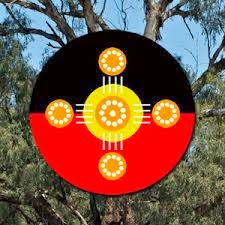
Symbol of the Australian Aboriginal
“Sovereign Union” movement
But over the past year the micronation craze has taken a more serious turn, as Australia’s Aboriginal people are using this template as a way to assert indigenous claims of sovereignty.  Partly it is a combination of the new, much more rightward-leaning government of Prime Minister Tony Abbott taking office in September with the occasion of Australia Day, the January 26th “celebration” of the 1788 British landing on the continent which Aboriginal people mourn as “Invasion Day.”

Australian Aboriginal and other indigenous activists showing solidarity
with the West Papua independence movement in neighboring Indonesia
So on January 22nd, a group of Aboriginal people in Wellington, New South Wales, raised the flag of what they are calling the Wiradjuri Central West Republic, named for the Wiradjuri ethnic group of central N.S.W.  (See photo at the top of this article, which shows the elders Dot Stewart and Nelson Smith at the flag-raising.  See a video of the flag-raising here.)

The proclaimed territory of the Murrawarri Republic is about the size of Austria.
The Wiradjuri move, as it turns out, is only the latest of four recent declarations of independence on the continent.  The others are: the Murrawarri Republic (declared on March 30, 2013, along the Queensland–N.S.W. border), the Euahlayi Peoples Republic (declared on August 3, 2013, in Dirranbandi, Queensland), and the Republic of Mbarbaram (in an inland far-northern Queensland’s Cape York Peninsula).

The Euahlayi Peoples Republic also straddles the Queensland–New South Wales border,
just east of the Murrawarri Republic.
These declarations have been made under the rubric of an organization called the Sovereign Union of First Nations and Peoples in Australia, which was founded in 1999 and later, in 2012, reformulated itself as the Sovereign Union–Interim Unity Government at the Kuradji Tent Embassy, near Wollongong, N.S.W.  “Aboriginal Tent Embassies” are a movement which began in 1972 with a protest encampment outside Parliament House in Canberra and spawned a network of Aboriginal encampments around the country as a site of Aboriginal sovereigntist activism.


What is new about these Aboriginal declarations is that they are being made in the name of individual Aboriginal nations, as opposed to previous movements to, for example, plans by the Aboriginal Provisional Government in the 1990s to declare a vast, landlocked Aboriginal State.  Of the four above-listed nations, the Republic of Mbarbaram and the Wiradjuri Central West Republic have not, to my knowledge, revealed their precise territories, though the Wiradjuri republic’s flag features the outline of the territory, which seems to be—and this is supported by the republic’s full name—a subset of the vast homeland of the Wiradjuri people, which is the largest in Australia and includes up to a third of N.S.W., including the city of Wagga Wagga.  One news report said the republic’s territory “would cover the areas around Goolma, Wellington, Parkes, Forbes and Orange.”

Map showing Wiradjuri territory (in New South Wales)
among other Aboriginal homelands in Australia.

Indeed, all of these new states, but the Wiradjuri republic especially, are claiming territories that also include large numbers, even majorities, of non-Aboriginals.  But Aboriginal activists insist this is not a problem, that the new states will be cooperative and inclusive.  It’s not clear if local whites necessarily share that optimism.

Flag of the Euahlayi Peoples Republic
The Murrawarri Republic’s declaration of independence last year took the form of a letter to Queen Elizabeth II (who holds suzerainty over Australia as a Dominion Realm).  The letter requested documents within 21 days demonstrating any kind of formal cession of Murrawarri territory.  The letter stated that if no such documentation was forthcoming, then the Republic would consider itself a continuing independent state and would apply for a seat at the United Nations General Assembly.

Flag of the Murrawarri Republic
In one sense, it is hard to see these moves as more than publicity stunts.  No one is setting up any customs booths or interfering with the exercise of Australian jurisdiction in any concrete way.  But many serious independence movements began as “publicity stunts.”  The Aboriginal activists behind these new declarations seem serious.  It is likely that more Aboriginal nations will follow suit, and that activists will take the quest for statehood to the next level.  What that next level will look is anyone’s guess.  This is a path that has not yet been blazed.


[For those who are wondering, yes, this blog is tied in with my forthcoming book, a sort of encyclopedic atlas to be published by Auslander and Fox under the title Let’s Split! A Complete Guide to Separatist Movements, Independence Struggles, Breakaway Republics, Rebel Provinces, Pseudostates, Puppet States, Tribal Fiefdoms, Micronations, and Do-It-Yourself Countries, from Chiapas to Chechnya and Tibet to Texas.  The book, which contains dozens of maps and over 500 flags, is now in the layout phase and should be on shelves, and available on Amazon, by early fall 2014.  I will be keeping readers posted of further publication news.  Meanwhile, please “like” the book (even though you haven’t read it yet) on Facebook.]

Friday, October 4, 2013

Lamb Island, off Australian Coast, to Vote on Becoming Republic of Nguduroodistan


Australia is home to the wildest profusion of micronations in the world—from one of its oldest, the Principality of Hutt River, in the western outback (reported on recently in this blog), to the Sovereign State of Aeterna Lucina (which traces its legitimacy to Afghanistan’s royal family), to wild experiments like the Gay and Lesbian Kingdom of the Coral Sea Islands, where you can sail on a ship called the Gayflower to have same-sex weddings Australia still does not permit on the mainland.  One of our first blog posts reported on the Free State of Australia, an anti-money, “technocratic” commune near the QueenslandNew South Wales border.  To this we may soon have to add the Independent Republic of Nguduroodistan.


Based on the Aboriginal name for Lamb Island, plus the suffix -stan, Nguduroodistan is not an Aboriginal movement but a new push by residents of a tiny islet in southern Moreton Bay, on the southeastern outskirts of Brisbane, Queensland, to go it alone.


(This Lamb Island is not to be confused with Lamb Island in Scotland, a volcanic outcropping which was purchased in 2009 by the Israeli psychic Uri Geller because of a fancied resemblance to an Egyptian pyramid.)

The Principality of Hutt River, in Western Australia, is an inspiration.
Tony Gilson, a shopkeeper on the sleepy resort island, says he reckons about 90% of Lamb’s 450 or so residents (427 in the 2011 census) support secession, most of them feeling that the local, state, and federal governments have failed to provide them with essential services at an affordable cost.  He has already drafted a 35-page constitution, which includes a royal family, a prime minister, and 21 cabinet ministers, some of whom have already been informally appointed.  He plans to consult with Hutt River’s Prince Leonard on legal aspects of secession.

An enthusiast displays a Hutt River flag.
Nor is it all talk: a referendum is being scheduled for October 19th.  Presumably it will be non-binding—at least in the eyes of the state and federal governments.

Some postage stamps issued by the Gay and Lesbian Kingdom of the Coral Sea Islands
At 1.39 square kilometers, Nguduroodistan would be the world’s second-smallest independent state: more than three times the size of Vatican City but still just shy of the Principality of Monaco’s 2.02 square kilometers.  (Hutt River, by contrast, is 75 square kilometers.)  It would quite handily take the title of least-populous country in the world (the Vatican, with 800, is the current champ), though Lamb’s population dwarfs that of the United Kingdom’s self-governing colony of Pitcairn Island in the South Pacific, which has 66 people.

It remains to be seen if the Hutt River royal family will welcome the competition.
No word yet from the Australian or Queensland governments on Nguduroodistan’s prospects.  Nor is there, as yet, a flag.  But we will of course keep readers posted on any developments.


[You can read more about Nguduroodistan and many other separatist and new-nation movements, both famous and obscure, in my new book, a sort of encyclopedic atlas just published by Litwin Books under the title Let’s Split! A Complete Guide to Separatist Movements and Aspirant Nations, from Abkhazia to Zanzibar.  The book, which contains 46 maps and 554 flags (or, more accurately, 554 flag images), is available for order now on Amazon.  Meanwhile, please “like” the book (even if you haven’t read it yet) on Facebook and see this interview for more information on the book.]


Monday, August 19, 2013

Hutt River’s Princess Shirley Had Irish Noble Blood, Mourners Learn


Her Royal Highness Princess Shirley of Hutt, who passed away at the age of 84 on July 7th, may not have enjoyed international recognition as consort to the monarch of a 75-square-mile independent state in the Western Australia outback, but residents of Kilkenny, in the Republic of Ireland, have identified her as one of their own and as a descendant of the Earls of Ormonde.

The Prince and (late) Princess of Hutt
The late princess, who was born in Fremantle, near Perth, and whose commoner name had been Shirley Casley, even had the maiden name Butler.  Avocational genealogists in Kilkenny, who spotted her obituary in an Australian newspaper, are linking her to James Butler, 1st Earl of Ormonde, who died in County Kilkenny in 1338—shortly after an invasion of Ireland by Scotland’s Edward of Bruce and an ensuing famine, and 10 years before the arrival of the “Black Death” (bubonic plague) to the Emerald Isle.

The 1st Earl of Ormonde
The Principality of Hutt River formally seceded from Australia in 1970, as a glorified wheat farm with the name Province of Hutt River.  Its founder, Leonard Casley, eventually styled himself Prince Leonard I and pledged loyalty to Queen Elizabeth II, invoking Australian legislation which puts sovereigns beyond the reach of the law.  The government in Canberra has never acknowledged Hutt River’s sovereignty but has never contested it either.  The approximately 220 residents—almost all of them, other than the Casley family, Aboriginal people of the Noongar ethnic group—are allowed to avoid taxes, exempt themselves from Australian laws, and issue their own postage stamps and currency.


In addition to Princess of Hutt, the late Shirley also held the titles Dame of the Rose of Sharon, Patron and Chair of the Red Cross of Hutt, and Colonel-in-Chief of the Royal Hutt River Legion.  The prince and princess’s nine children include Crown Prince Ian (who is also Prime Minister); Wayne, 1st Duke of Nain; Richard, 1st Duke of Carmel; and Graeme, Duke of Gilboa.

No Hapsburg nose is visible on hubby, however ...

[For those who are wondering, yes, this blog is tied in with my forthcoming book, a sort of encyclopedic atlas to be published by Auslander and Fox under the title Let’s Split! A Complete Guide to Separatist Movements, Independence Struggles, Breakaway Republics, Rebel Provinces, Pseudostates, Puppet States, Tribal Fiefdoms, Micronations, and Do-It-Yourself Countries, from Chiapas to Chechnya and Tibet to Texas.  The book, which contains dozens of maps and over 500 flags, is now in the layout phase and should be on shelves, and available on Amazon, by early fall 2014.  I will be keeping readers posted of further publication news.  Meanwhile, please “like” the book (even though you haven’t read it yet) on Facebook.]

Tuesday, July 31, 2012

Celts, Cypriots, Aborigines Raise Stink at Olympics: Ethnonationalist Protest Update


Just days ago, I published an article in this space with predictions for “10 Ethnonationalist Causes That Might Disrupt the Olympics,” but I have already been proven partly not-so-prescient on a couple points.  I correctly predicted that Circassians angry about the upcoming 2014 Winter Olympics in Sochi, Russia, at the site of a Czarist imperial massacre of the Turkic-speaking Muslim minority in 1862, would elicit an outcry (see below for details), but Gibraltar, Hong Kong, Western Sahara, and Syria, which were on my list, have not, as far as I know, been the focus of any fusses raised (there’s still time).  Some of my predicted disruptions—such as over organizers’ mis-listing of South Ossetia, Abkhazia, and other territories as part of “Russia,” and Argentina’s President Cristina Fernández de Kirchner’s boycott of the Games over the Falkland Islands—were already underway and discussed in the article and in last week’s “The Week in Separatist News” and so don’t count as augury.  But egg is on my face for not having foreseen that Scotland—safely on its way to independence in the eyes of many Scottish nationalists—would be the focus of controversy, nor that Wales would be part of the hullabaloo as well.


Here are the details on that, followed by updates on Cypriot, Circassian, and Australian Aboriginal protests:

Scots, Welsh Footballers’ Silence during “God Save the Queen” Challenged.  On July 26th, before the London Olympics had formally begun, two members of the British women’s football (soccer) team refused to sing along with “God Save the Queen” before their first match, against New Zealand, on the grounds they were Scottish.  One of the abstainers was Kim Little of the Arsenal Ladies, who was born in Aberdeen, but the other was Ifeoma Dieke, who was born in Massachusetts, in the United States, to immigrants from Nigeria, and plays for the Vittsjö football team in Sweden, though she has lived in Scotland since the age of three.  (Tragically, Dieke had to end her participation in these Olympics after being taken off the field in a stretcher two days later in a match against Cameroon after damaging a knee ligament.) 

Ifeoma Dieke—American-born, Nigerian by blood, Scottish to the bone.

The same day, three Welsh members of the Team Great Britain (Olympics-ese for “United Kingdom”) football team also refused to sing the anthem before their opening match against Senegal.  Their silence was repeated in a July 29th game against the United Arab Emirates (U.A.E.), prompting an outcry that led one of the Welsh footballers, Ryan Giggs, a player for Manchester United who is also the Olympic football team’s captain, to reassure the public that there was no disunity on the team.  Giggs said, “It’s difficult but it’s not an issue for us.  It might be for other people, but, once the game starts, we’re all pulling in the main direction, and I think that’s the main thing.”  (The other Welsh players who kept mum during the anthem are Joe Allen and Craig Bellamy.)  But he expressed worries about an upcoming August 1st match against Uruguay, to be held in Giggs’s own native Cardiff: “The national anthem may not be so warmly received in the Welsh capital.  I hope it won’t get booed and I hope the fans will get behind us.”

Ryan Griggs, not singing the national anthem

Perhaps, in future, Scottish players can be reassured that there won’t be time to get around to the fifth verse of “God Save the Queen,” which goes:

     Lord, grant that Marshal Wade
     May by thy mighty aid,
     Victory bring!
     May he sedition hush,
     And like a torrent rush,
     Rebellious Scots to crush,
     God save the Queen!

(Lordy, that’s almost as embarrasing as the Kentucky state song, which until the wording was changed in 1986, included as its very second line, “’Tis summer, the darkies are gay.”)

The 1725 Malt Tax Riots in Glasgow, suppressed—as the U.K. national anthem celebrates—
by Field Marshal George Wade, Commander in Chief of His Majesty’s Forces, North Britain.
The English didn’t realize that there’s only one kind of tax you can’t impose on the Scots without expecting trouble.


Australian Boxer Warned after Wearing Aboriginal Flag in Arena.  An Olympic boxer from Australia who has Aboriginal ancestry was given a warning by his team’s officials about rules on wearing the team uniform at all times after he appeared July 30th in an arena at the London Olympics wearing a t-shirt showing the Australian Aboriginal flag.  Nonetheless, the boxer, Damien Hooper, who is from Toowoomba, Queensland, went on to beat Marcus Browne of the United States in a light-heavyweight match.  An official warned he could still face disciplinary action, but Hooper said, “I’m not saying that I don’t care, I’m just saying I’m very proud of what I did.”  However, Hooper later avoided censure by apologizing to his team and saying it would not be repeated.

Oh, shit, I put on the wrong shirt.  Now I’m in trouble.

In the Summer Olympics in Sydney, New South Wales, in 2000, the Australian sprinter Cathy Freeman, who is also Aboriginal and from Queensland, waved both Australian and Aboriginal flags during a victory lap and did not face any disciplinary action.  In fact, four years later Freeman carried the Olympic flag at the head of all of the Oceania teams at the opening ceremonies in Salt Lake City, Utah.

Cathy Freeman got away with it in Sydney, though.

Circassians Invoke Genocide in Angry Anti-Russian Rally at London Olympics.  Protesters on July 29th filled an exhibition area in London’s Olympic Park designated to promote the 2014 Winter Olympics in Sochi, in southwestern Russia near the North Caucasus region.  The protests were led by a group called NoSochi, which objects to the timing and placement of the 2014 games, which will be on the 150th anniversary of, and at the same location as, a czarist Russian campaign of massacres against the Circassian people.  “Sochi is a land of genocide,” shouted a protester.  “You can take your games and get lost.”  In addition to papering over crimes against humanity perpetrated against the Circassian people, the Sochi exhibition area also commits a crime against proper punctuation by being called, officially, Sochi.Park (sic), as well as crimes against children by enlisting terrifying kabuki mascots to intimidate young visitors.

It’s only 1 p.m., and already the Russian Winter Olympics mascot needs help walking.
Well, when you come from a country with eleven time zones, it’s almost always five o’clock somewhere, right?

Another group protesting these Olympics is Embargoed, an ad hoc group calling attention to the ban on athletes from the Republic of Turkey’s unrecognized puppet state on the northern third of Cyprus, the Cyprus Turkish Republic—known, until its renaming this year (as reported in this blog), as the Turkish Republic of Northern Cyprus or, still, colloquially, as Northern Cyprus.  Embargoed has been holding a long-term sit-in outside the hotel where many International Olympic Committee (I.O.C.) officials are staying.  Coordinated with the British Turkish Cypriot Association, the 12 Embargoed protesters’ actions include wearing handcuffs and balls-and-chains to symbolize their plight.  The athletes in question are Ziya Gokbilen and Pinar Akarpinar, both of them world taekwondo champions who are barred from competing because the I.O.C. will not deal with their pseudostate.


The I.O.C. has not extended to Gokbilen and Akarpinar the option of participating as “independents,” under an Olympic flag, which other athletes in similar predicaments have been offered.  Examples include athletes from:


• the war-torn dissolving Yugoslavia in the 1992 Barcelona games and


• the Democratic Republic of Timor-Leste (a.k.a. East Timor) in the 2000 Sydney games during their country’s transition to independence from Indonesia; as well as, this year, athletes from:


• the Republic of Kosovo (de facto independent but not in the United Nations General Assembly) (though the one Kosovar athlete this year, Majlinda Kelmendi, accepted Albanian citizenship so she wouldn’t have to compete under the same neutral banner as the hated Serbs in 1992) (her case was discussed earlier in this blog),


• the Republic of South Sudan (a fledgling nation and U.N. member-state which nonetheless is too wracked by poverty and war to have its own Olympic committee),


• the Netherlands Antilles (a Caribbean quasi-colony and quasi-nationality in transition since its dissolution 2010, at which time three islands became dependent, non-autonomous municipalities within the Kingdom of the Netherlands while Curaçao and Sint Maarten became constituent “countries” of the kingdom; Aruba separated in 1986 and has its own Olympic team, but not this time around), and 


• Kuwait (whose national Olympic committee had been suspended over corruption concerns, but whose athletes’ participation under their own flag was allowed under a last-minute agreement on July 14th).

Athletes from the Netherlands Antilles, using the Olympic flag
while they are in the midst of sorting out the precise degree of Dutchness of each particular island.
That could take a while.

Watch this space.  I will be keeping you posted on further Olympic ethnonationalist kerfuffles.

[Also, for those who are wondering, yes, this blog is tied in with a forthcoming book, a sort of encyclopedic atlas to be published by Auslander and Fox under the title Let’s Split! A Complete Guide to Separatist Movements, Independence Struggles, Breakaway Republics, Rebel Provinces, Pseudostates, Puppet States, Tribal Fiefdoms, Micronations, and Do-It-Yourself Countries, from Chiapas to Chechnya and Tibet to Texas.  Look for it in spring 2013.  I will be keeping readers posted of further publication news.]

Subscribe Now: Feed Icon