Showing posts with label New South Wales. Show all posts

Tuesday, January 28, 2014

Wiradjuri Activists Raise Flag, Proclaim Newest Aboriginal Republic in Australia


Australia is known as the continent and country with the highest concentration of micronations, those obscure whimsical independence projects enacted by eccentrics of which the government in Canberra is surprisingly tolerant.  Some have been covered in this blog, such as the Principality of Hutt River (among the most serious of them) to the Free State of Australia (see also follow-up article here) to the recent attempt by a resort island near Brisbane, Queensland, to declare itself the Independent Republic of Nguduroodistan.  Others include the Principality of Snake Hill, the Empire of Atlantium, the Principality of Dubeldeka, and, in the Great Barrier Reef, the Gay and Lesbian Kingdom of the Coral Sea Islands.  Some are no larger than the homes or properties of their self-styled princes and queens.

Symbol of the Australian Aboriginal
“Sovereign Union” movement
But over the past year the micronation craze has taken a more serious turn, as Australia’s Aboriginal people are using this template as a way to assert indigenous claims of sovereignty.  Partly it is a combination of the new, much more rightward-leaning government of Prime Minister Tony Abbott taking office in September with the occasion of Australia Day, the January 26th “celebration” of the 1788 British landing on the continent which Aboriginal people mourn as “Invasion Day.”

Australian Aboriginal and other indigenous activists showing solidarity
with the West Papua independence movement in neighboring Indonesia
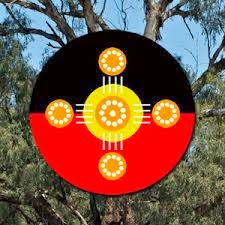
So on January 22nd, a group of Aboriginal people in Wellington, New South Wales, raised the flag of what they are calling the Wiradjuri Central West Republic, named for the Wiradjuri ethnic group of central N.S.W.  (See photo at the top of this article, which shows the elders Dot Stewart and Nelson Smith at the flag-raising.  See a video of the flag-raising here.)

The proclaimed territory of the Murrawarri Republic is about the size of Austria.
The Wiradjuri move, as it turns out, is only the latest of four recent declarations of independence on the continent.  The others are: the Murrawarri Republic (declared on March 30, 2013, along the Queensland–N.S.W. border), the Euahlayi Peoples Republic (declared on August 3, 2013, in Dirranbandi, Queensland), and the Republic of Mbarbaram (in an inland far-northern Queensland’s Cape York Peninsula).

The Euahlayi Peoples Republic also straddles the Queensland–New South Wales border,
just east of the Murrawarri Republic.
These declarations have been made under the rubric of an organization called the Sovereign Union of First Nations and Peoples in Australia, which was founded in 1999 and later, in 2012, reformulated itself as the Sovereign Union–Interim Unity Government at the Kuradji Tent Embassy, near Wollongong, N.S.W.  “Aboriginal Tent Embassies” are a movement which began in 1972 with a protest encampment outside Parliament House in Canberra and spawned a network of Aboriginal encampments around the country as a site of Aboriginal sovereigntist activism.


What is new about these Aboriginal declarations is that they are being made in the name of individual Aboriginal nations, as opposed to previous movements to, for example, plans by the Aboriginal Provisional Government in the 1990s to declare a vast, landlocked Aboriginal State.  Of the four above-listed nations, the Republic of Mbarbaram and the Wiradjuri Central West Republic have not, to my knowledge, revealed their precise territories, though the Wiradjuri republic’s flag features the outline of the territory, which seems to be—and this is supported by the republic’s full name—a subset of the vast homeland of the Wiradjuri people, which is the largest in Australia and includes up to a third of N.S.W., including the city of Wagga Wagga.  One news report said the republic’s territory “would cover the areas around Goolma, Wellington, Parkes, Forbes and Orange.”

Map showing Wiradjuri territory (in New South Wales)
among other Aboriginal homelands in Australia.

Indeed, all of these new states, but the Wiradjuri republic especially, are claiming territories that also include large numbers, even majorities, of non-Aboriginals.  But Aboriginal activists insist this is not a problem, that the new states will be cooperative and inclusive.  It’s not clear if local whites necessarily share that optimism.

Flag of the Euahlayi Peoples Republic
The Murrawarri Republic’s declaration of independence last year took the form of a letter to Queen Elizabeth II (who holds suzerainty over Australia as a Dominion Realm).  The letter requested documents within 21 days demonstrating any kind of formal cession of Murrawarri territory.  The letter stated that if no such documentation was forthcoming, then the Republic would consider itself a continuing independent state and would apply for a seat at the United Nations General Assembly.

Flag of the Murrawarri Republic
In one sense, it is hard to see these moves as more than publicity stunts.  No one is setting up any customs booths or interfering with the exercise of Australian jurisdiction in any concrete way.  But many serious independence movements began as “publicity stunts.”  The Aboriginal activists behind these new declarations seem serious.  It is likely that more Aboriginal nations will follow suit, and that activists will take the quest for statehood to the next level.  What that next level will look is anyone’s guess.  This is a path that has not yet been blazed.


[For those who are wondering, yes, this blog is tied in with my forthcoming book, a sort of encyclopedic atlas to be published by Auslander and Fox under the title Let’s Split! A Complete Guide to Separatist Movements, Independence Struggles, Breakaway Republics, Rebel Provinces, Pseudostates, Puppet States, Tribal Fiefdoms, Micronations, and Do-It-Yourself Countries, from Chiapas to Chechnya and Tibet to Texas.  The book, which contains dozens of maps and over 500 flags, is now in the layout phase and should be on shelves, and available on Amazon, by early fall 2014.  I will be keeping readers posted of further publication news.  Meanwhile, please “like” the book (even though you haven’t read it yet) on Facebook.]

Saturday, October 27, 2012

Uruguay, New South Wales on Recognizing Nagorno-Karabakh; Tacky Azeri Statue in Mexico City; Suicide Car Bomb on Ingush-Ossetian Border: Caucasus Update, 21-27 October 2012

Aftermath of this week’s suicide car-bombing at the Ingush–North Ossetian border.
NORTH CAUCASUS (DAGESTAN, CHECHNYA, INGUSHETIA, CIRCASSIA)


1 Policeman Killed, 3 Injured in Suicide Car-Bombing at Ingush Border Checkpoint.  Authorities and rebel sources in southwestern Russia’s North Caucasus region reported this week that one policeman was killed on October 23rd in a suicide car-bombing of a border checkpoint in the tiny Republic of Ingushetia.  The driver and bomber was also killed.  Three other police were injured in the blast, one very seriously.  The checkpoint was on the border between Ingushetia and the Republic of North Ossetia–Alania, which, like Ingushetia, is part of the Russian Federation.  The Ingush president, Yunus-Bek Yevkurov, said afterward that terrorists are trying to aggravate tensions because the bombing came near the 20th anniversary of a border conflict between North Ossetia and Ingushetia shortly after the fall of Communism, which was the occasion for the post-Soviet Chechen-Ingush Republic dividing into separate Chechen and Ingush republics.  Ingushetia also has an ongoing border dispute with Chechnya.


Police Kill Militant in Dagestan.  A rebel was shot and killed in the Republic of Dagestan on October 20th when he opened fire on security officers who asked for his identification.  There were no other injuries.

SOUTH CAUCASUS (GEORGIA, ARMENIA, AZERBAIJAN)

South Ossetia Offers Georgia Olive Branch, but Only in Exchange for Recognition.  The president of the mostly unrecognized Republic of South OssetiaLeonid Tibilov, told media on October 19th that his nation was ready to build a relationship with the Republic of Georgia but only the condition of a mutual non-aggression pact and Georgian diplomatic recognition of the statelet.  South Ossetia, which established its independence in 2008 after a war between Georgia and Russia, is still regarded by most of the world as Georgian territory.  Georgia has a new president elect, Bidzina Ivanishvili, who (as reported earlier in this blog) seems poised to take a more conciliatory stance toward South Ossetia and another former part of Georgia with a similar status, Abkhazia.

36 More Syrian Refugees Settle in Abkhazia.  Thirty-six more refugees from Syria’s civil war arrived in the de facto independent Republic of Abkhazia this week and will be held in “quarantine” in the Hotel Aytar in Sukhumi, the Abkhaz capital.  This brings the total to 96.  The Russian Federation, which helped establish Abkhazia’s independence from the Republic of Georgia, erects barriers to settling Abkhaz and the related Circassian people—who form a restive minority in the North Caucasus region—from settling in Russia itself as they flee the Syrian civil war.  [See an earlier report in this blog.]


Hundreds of Refugees from Abkhazia, South Ossetia Take Over Georgian Public Buildings.  Scores of families of refugees from the breakaway regions of Abkhazia and South Ossetia occupied the offices of the mayor of Tbilisi and about 30 other buildings in the Republic of Georgia’s capital.  Tax offices, science centers, and other facilities were targeted.  The Georgian minister for refugees and settlements, David Darakhvelidze, blamed the social-protection services and the municipal government.  The refugees are ethnic Georgians who were displaced by ethnic cleansing when Abkhazia and South Ossetia seceded from Georgia after the fall of Communism.

Armenian Foreign Minister Dismayed by Azerbaijani Statuary in Mexico City.  The foreign minister of the Republic of ArmeniaEdward Nalbandian, was in Mexico City this week and registered his “bewilderment” at public monuments he interprets as Mexico’s siding with Azerbaijan in the two countries’ dispute over a border region where Armenia set up a puppet regime called the Nagorno-Karabakh Republic (N.K.R.) more than 20 years ago.  One monument commemorates the few hundred victims of the 1992 Khojaly massacre during the Nagorno-Karabakh War, which Turkey and Azerbaijan (which is ethnically close to Turkey) regard as one of the worst things that ever happened in world history to anybody absolutely ever, while also pretending that the Turkish genocides of millions of Armenian and Kurdish civilians in the 20th century were invented by anti-Turkish propagandists.  Another monument shows Azerbaijan’s authoritarian president and former Soviet Communist strongman, Heydar Aliyev, along a park prospect that also features monuments to Abraham Lincoln and Mahatma Gandhi.  The inscription on the monument calls him “a brilliant example of infinite devotion to the motherland, loyal to the universal ideals of world peace.”  The Azerbaijani government pumps millions of dollars (in U.S.) into the upkeep of the monument, ostensibly because Mexico was one of the first countries to recognize Azerbaijan’s independence from the Soviet Union in 1991.  Nalbandian suggested an Armenian embassy in Mexico to try to correct the imbalance.  [See my article from this blog about the symbolic politics of the Nagorno-Karabakh dispute and a more recent article about N.K.R. politics in California.]

The Heydar Aliyev monument in Mexico City.
New South Wales Grants Diplomatic Recognition to Nagorno-Karabakh; No One Notices.  In Sydney, the upper house of the legislature of New South Wales (N.S.W.), Australia’s most populous state, unanimously voted October 25th to recognize the independence of the Nagorno-Karabakh Republic (N.K.R.), an Armenian puppet state which Armenian and Russian troops carved out of the western flank of the Republic of Azerbaijan shortly after the fall of communism, and which declared independence in 1992.  The vote came after a months-long campaign by an Armenian pressure group, the Armenian National Committee of Australia.  Most of Australia’s 50,000 or so ethnic Armenians live in Sydney, the N.S.W. capital.  [See an article from this blog about other separatist issues with respect to New South Wales.]

The flag of New South Wales
Rumors Fly of Uruguayan Recognition of N.K.R.  Armenian media are reporting this week that the Oriental Republic of Uruguay (that’s the full name of the South American country; don’t ask) is gearing up to grant diplomatic recognition to the Nagorno-Karabakh Republic within the next few weeks.  The speaker of the Uruguayan parliament will visit Armenia and the N.K.R. in late November.  Currently only three countries—which are themselves unrecognized puppet states—grant formal diplomatic recognition to the N.K.R.: AbkhaziaSouth Ossetia, and Transnistria.  However, several non-sovereign bodies have made symbolic resolutions of recognition similar to New South Wales’s (see article above), including, recently, Rhode Island and Massachusetts in the United States (as reported in this blog).  Uruguay would be the first fully recognized state to do so.

The flag of Uruguay
[Also, for those who are wondering, yes, this blog is tied in with a forthcoming book, a sort of encyclopedic atlas to be published by Auslander and Fox under the title Let’s Split! A Complete Guide to Separatist Movements, Independence Struggles, Breakaway Republics, Rebel Provinces, Pseudostates, Puppet States, Tribal Fiefdoms, Micronations, and Do-It-Yourself Countries, from Chiapas to Chechnya and Tibet to Texas.  Look for it in spring 2013.  I will be keeping readers posted of further publication news.]

Monday, July 16, 2012

Housing Estate Splits from New South Wales, Joins “Free State of Australia”

Members of an illegal housing complex in the municipality of Shoalhaven, on the southeastern coast of Australia, have responded to an order for their eviction by declaring secession from the state of New South Wales.  Residents of the community, called the Jerberra Estate, were told by the Shoalhaven Council that they needed to vacate, because the homes were built without the proper zoning permits.  So now the inhabitants of the development claim that they have split with New South Wales and have joined the Free State of Australia (F.S.A.), a micronation founded as a 100-person commune far to the north, in the rural Shire (municipality) of Kyogle, in northeastern New South Wales, near the Queensland border.  (See my full article on the F.S.A. from last year in this blog.)

Location of Shoalhaven in New South Wales, Australia.

The F.S.A.’s founder is a former Protestant minister who goes by the single name “John” or “Jonathan” (though he spells it with a lower-case j, which I refuse to indulge) and operates his 22-home intentional community in loose association with something called the Zeitgeist Movement, an anarchist, technocratic ideology which the New York Times, in 2009, described as “a wholesale reimagining of civilization, as if Karl Marx and Carl Sagan had hired John Lennon from his ‘Imagine’ days to do no less than redesign the underlying structure of planetary life.”  (Zeitgeist can also claim as a sort-of adherent Robin van Helsum, the Dutch, not-a-quite-a-feral-child “Forest Boy” that made a media splash in Germany last month—discussed in this blog at the time.)

Elder “Jonathan” with some of his followers at the Free State of Australia

It is not known what Jonathan and the original F.S.A. community thinks of the Jerberra Estates declaration.  When F.S.A. first declared independence, it sounded like they were declaring independence from Australia as a whole—like the Principality of Hutt River, near Perth, Western Australia.  But Jerberra Estate seems to be hoping for an arrangement by which the F.S.A. is a loose archipelago of scraps of land across Australia which form their own, dispersed constituent state of the dominion.  Think of it, perhaps, as a federation of unaffiliated territories.  Needless to say, Australia’s federal government is probably not that keen on the idea (if they notice this development at all)—though Australia is famously tolerant of small micronation movements.  Hutt River, for example, has operated its nice chunk of ranchland unmolested for decades.

The flag of the Principality of Hutt River

Interestingly enough, just to the south of Jerberra and Shoalhaven is a coastal wedge of land called the Jervis Bay Territory, which itself has an odd relationship to the Australian federation.  Maps will sometimes show it as part of New South Wales, but in fact in 1915 the state ceded it to the Australian Capital Territory (A.C.T.)—the inland district which surrounds the national capital, Canberra, as its own separate sort-of state (much like the District of Columbia (D.C.) in the United States).  The idea was that the A.C.T. should have “access to the sea”—even though the A.C.T. and Jervis Bay are separated by quite a bit of land.  A.C.T. administers Jervis Bay, but technically it is its own constituent part of the Commonwealth.  I wonder, though, why it matters whether the A.C.T. needs access to the sea in the first place?  No one worries that D.C. does not have a warm-water port, and no one frets that the Distrito Federal which surrounds Mexico’s capital is dangerously landlocked.  Perhaps it was feared that, during some future break-up of the Australian federation, New South Wales would try to go all Biafra War on the A.C.T. and blockade it into starvation.  But, in such a Mad Max scenario, it does seem that an aggressive New South Wales would be smart enough to pick off tiny Jervis Bay first.  What resistance could they put up?  Clearly Canberra needs a whole defensible corridor to the sea.  After all, you can’t be too careful.  Those New South Welsh can get kind of wacko.

Locations of the Australian Capital Territory (A.C.T.), Jervis Bay Territory, and surrounding New South Wales

Back to Jerberra Estates, however: Shoalhaven Council, for its part, claims to be unable to comment on the case since it is before the Land and Environment Court.

Flag of the Australian Capital Territory.  Jervis Bay has no flag.

The most distressing part of all this is that the Free State of Australia still, as far as I can tell, has no flag.  I know they’re against the money system, but they can’t be against flags, can they?  If anyone knows what an F.S.A. flag looks like, please let me know.


[For those who are wondering, yes, this blog is tied in with my forthcoming book, a sort of encyclopedic atlas to be published by Auslander and Fox under the title Let’s Split! A Complete Guide to Separatist Movements, Independence Struggles, Breakaway Republics, Rebel Provinces, Pseudostates, Puppet States, Tribal Fiefdoms, Micronations, and Do-It-Yourself Countries, from Chiapas to Chechnya and Tibet to Texas.  The book, which contains dozens of maps and over 500 flags, is now in the layout phase and should be on shelves, and available on Amazon, by early fall 2014.  I will be keeping readers posted of further publication news.  Meanwhile, please “like” the book (even though you haven’t read it yet) on Facebook.]

Wednesday, January 25, 2012

Succession or Accession: Could Scotland Leave Britain but Stay in Europe?

[Please see these related articles from this blog: “Orkney—the Next Dubai? Further Reflections on Scottish Independence,” “The World’s 21 Sexiest Separatists” (featuring Sean Connery), and “What Is a Colony? The United Nations’ Definition Needs an Overhaul,” “Happy Dependence Day, Hong Kong! 400,000 Protest Chinese Rule—but Secession Is Not on the Table,” “Celts, Cypriots, Aborigines Raise Stink at Olympics: Ethnonationalist Protest Update.”]

The United Kingdom of Great Britain and Northern Ireland now faces the inevitability of a referendum on Scotland’s independence.  Alex Salmond, who became Scotland’s First Minister when the Scottish National Party (SNP) took charge of the 14-years-young devolved Scottish parliament last year, announced the referendum plans this month and thus embarked upon a war of words with anti-independence parties in the U.K. (that is, all the rest of them).  This scrapping over legal and political details may well drag on until the vote itself, which Scottish nationalists would like to hold in late 2014, on the 700th anniversary of the Scottish victory over the English at the Battle of Bannockburn in 1314.

What the Union Jack would look like
without the St. Andrew’s Cross that represents Scotland

And speaking of battles, just this week, Philip Hammond, the Defense Secretary in David Cameron’s U.K. government, responded to Salmond’s assumption that an independent Scotland could be defended by the U.K.’s current Scottish regiments by saying that “The idea that you can sort of break off a little bit [of the British Army], like a square on a chocolate bar and that would be the bit that went north of the Border, is frankly laughable.”  And he warned that the U.K. might not want to foot the bill for the expulsion of nuclear submarines from its waters that an independent Scotland would demand—since Scotland would probably stay out of the North Atlantic Treaty Organization (NATO).  Clearly, defense is one of many areas where innumerable details would still need to be worked out if Scotland seceded.  The SNP is being reminded that their parent country will have a say in what the new state would end up with.

Anti-nuclear protesters at a NATO base in Scotland

And now the question of whether Scotland could stay in the European Union after independence has been called into question from an unexpected quarter: Spain.  The Spanish government has said this week that if Scotland applies for membership in the E.U., it will veto the move.  Under E.U. rules, any new members must be approved unanimously by all existing member states.  Spain has separatist movements of its own—in Catalonia, the Basque Country, and Galicia, specifically—that it would not like to encourage.  So the government in Madrid was alarmed to hear Artur Mas, Catalonia’s premier, point to Scotland’s referendum as a positive example of peaceful secession.  Madrid fears that a successful Scottish referendum would encourage Catalans and other nationalists to break up Spain.  Thus their threat to block Scotland’s E.U. status.


In fact, continuing E.U. membership is a crucial talking point when separatists in western Europe make their case, reassuring the public that secession would not be politically or economically disruptive, and may in fact change little.  I made such an argument in this blog discussing the prospects of a Belgian partition, and it was implicit in my more recent discussion of the movement for northern Italy secede as “Padania.”

The SNP responded to the Spanish announcement by calling Madrid’s interpretation of E.U. rules “preposterous,” adding, “Scotland has been an integral part of the E.U. for almost forty years.  An independent Scotland would be a succession state, not an accession state, and there is no provision for citizens of the E.U. to be expelled.”

Scotland’s First Minister, Alex Salmond

The SNP is probably right on the last point, but that doesn’t mean a mechanism couldn’t be found.  More important, from a legal perspective, is his point about succession and accession.

The European Common Market (later renamed the European Economic Community, the European Community, then the European Union) was founded in 1957 by six states: Belgium, France, the Federal Republic of Germany (west), Italy, Luxembourg, and the Netherlands.  The twenty-one subsequent member-states—including the U.K. and Ireland, which both joined in 1973—became members through accession—a fancy word for “joining.”  No member-state has yet joined by the mechanism of succession, which would mean, for example, that a member-state dissolved and was automatically replaced by two or more newly formed states.


So where should we look for possible precedents to the situation the E.U. would face if Scotland seceded?  Let’s look at three examples with respect to United Nations membership: the Union of Soviet Socialist Republics (U.S.S.R.), the United Arab RepublicCzechoslovakia, and Yugoslavia.

U.S.S.R.  When the U.N. was founded in 1945, the U.S.S.R. was a founding member.  Plus, Josef Stalin succeeded in getting two more member-state votes for himself by rather disingenuously sliding in the Ukrainian Soviet Socialist Republic and the Byelorussian Soviet Socialist Republic as members alongside the U.S.S.R., though they were clearly governed by the party dictatorship in Moscow.  As for other S.S.R.s, the U.N. never recognized the Soviet annexation of the Baltic states of Estonia, Latvia, and Lithuania at the close of the Second World War but did not want to antagonize Stalin by seating delegations from Baltic governments-in-exile in the General Assembly, so those three states were in actuality treated by the U.N. as part of the U.S.S.R.  In late 1991, after the collapse of Soviet Communism, Russia’s president, Boris Yeltsin, requested and got recognition of the Russian Federation as successor to the U.S.S.R.’s seat both in the General Assembly and on the Security Council.  The Ukrainian and Byelorussian S.S.R.s kept their seats as the renamed Ukraine and Belarus, respectively, but for the first time their legal status as sovereign states was not fictional.  Nevertheless, the other nine members of the so-called Commonwealth of Independent StatesMoldova, the southern Caucasus republics, and the Central Asian “-stans,” as well as the Baltic States, who refused membership in the Commonwealth—had to apply separately to the U.N. as new members.  So, although all these are now considered “Soviet Successor States,” only Russia, Ukraine, and Belarus were members by succession; the rest acceded to the U.N.

Some Soviet successor states had to reapply for U.N. membership, but some didn’t

The United Arab Republic (U.A.R.) was a short-lived merger between Egypt and Syria in the early Cold War period.  Both were founding U.N. members, and they merged their seat in 1957 as the U.A.R.  When the union dissolved in 1961, Syria resumed its former membership seamlessly, and Egypt, which retained the name United Arab Republic itself for a few more years, was the successor state to the formerly unified U.A.R.

Czechoslovakia was a founding U.N. member-state but with the fall of Communism changed its name in 1990 to the Czech and Slovak Federative Republic, to reflect the loosening of central government control over its two constituent countries.  In late 1992, it dissolved in the so-called Velvet Divorce and was succeeded by the Czech Republic and the Slovak Republic.  Both were recognized by the U.N. as successor states, and neither had to apply for admission.

Neither the Czechs nor the Slovaks had to reapply to the U.N. when Czechoslovakia dissolved

The Socialist Federal Republic of Yugoslavia had also been a founding U.N. member-state, but after the fall of Communism its constituent republics began declaring independence one by one, beginning in the north.  The northern republics of Slovenia, Croatia, and Bosnia and Herzegovina applied for admission to the U.N. and were admitted together in May 1992 as three new states, although in the case of Croatia and especially Bosnia, their wars of secession were ongoing, with Serbian regions of those two states fighting vainly to be recognized by anyone other than the Yugoslavian central government and each other as independent states themselves.  Later, in 1993, Macedonia applied for admission and was admitted.  The two remaining republics, Serbia and Montenegro, calling themselves the Federal Republic of Yugoslavia, petitioned to be recognized as a successor state to the old Socialist Federal Republic of Yugoslavia, but the U.N. General Assembly erased Yugoslavia’s membership and told the government in Belgrade that it had to reapply.  They did, and the U.N. promptly refused, citing the barbaric behavior of Serbian forces in still-ongoing Yugoslav Wars of Succession.  Yugoslavia was not admitted until 2000, after Slobodan Milošević was removed from power.  In 2003, the state changed its name to the State Union of Serbia and Montenegro.  In 2006, Montenegro seceded peacefully and quickly was admitted as a new U.N. member-state, while Serbia succeeded the former State Union as the Republic of Serbia.  So here was an odd situation where Serbia, the core republic (analogous to Russia in the U.S.S.R.), seen by the other republics as a kind of colonizer, not only was denied the right of automatic succession but was nearly the last to join the U.N. again by accession.


Serbia, the country the others seceded from, ironically had
the least luck in getting treated as a Yugoslav successor state

(The Organization for Security and Cooperation in Europe and other similar organizations for the most part followed the U.N.’s lead in the sequence and mechanisms for seating these new delegations.)

So, back to Scotland: is the U.K. more like the U.S.S.R. and Yugoslavia or more like Czechoslovakia and the U.A.R.?  The pivotal questions seem to be whether Scotland is a dependent territory of the central government in London, in a way that England perhaps is not, or whether it is a co-partner with England (and perhaps with Wales and Northern Ireland) in a union, like Czechoslovakia.  (Serbia-and-Montenegro, if the wars had gone differently, would probably have been allowed to join through succession rather than accession.)  Surely, other constituent parts of the U.K. that were unambiguously dependent territories—such as the former colonies in Africa, Asia, and elsewhere—joined the U.N. by accession, not succession, but Scotland hardly has the dependent legal status of Zambia, despite what some Scottish nationalists would have us think.

Scotland’s former royal coat-of-arms

For one thing, one might argue, unlike the two constituent countries of Czechoslovakia, it would be possible for England, Wales, and Northern Ireland to retain their designation as the United Kingdom (though they probably would have to change something about its full name, the United Kingdom of Great Britain and Northern Ireland, since Scotland is a major chunk of the geographic island of Great Britain).  Or could it even do that?

The Kingdom of England and the Kingdom of Scotland were separate, sovereign states until 1706 and 1707 when the English and Scottish parliaments, respectively, passed the Acts of Union, dissolving the Scottish crown and creating the Kingdom of Great Britain, also called the United Kingdom of Great Britain.  Similar Acts of Union in 1800 incorporated the Kingdom of Ireland into what then became the United Kingdom of Great Britain and Ireland—which later, when most of the island of Ireland gained independence in 1922, inserted the word Northern before the word Ireland.  The whole idea, then, of a United Kingdom is predicated on the idea that England, Scotland, and (now just a bit of) Ireland were equal constituent parts of a kingdom.  (Wales today also has equal status with Scotland, England, and Northern Ireland, but historically it had been ruled directly from London for centuries by the time of English–Scottish union.)  A Scottish secession would mean legally undoing the Acts of Union of 1706 and 1707.  Whether this would automatically restore the House of Stuart to the throne is something legal scholars will need to tackle.  Likewise for the question of whether the incorporation of Ireland, and now Northern Ireland, in the Union would hold after Scotland’s departure—since Scotland, at least on paper, was an equal partner on the Great Britain side of the Acts of Union of 1801.

The Parliamentary Union of England and Scotland, 1707,
as painted by Walter Thomas Monnington

All of these are questions for jurists, legislators, and diplomats not just in London and Edinburgh but in Brussels and Strasbourg as well.  To claim that an independent Scotland has left the E.U. but that England has not might not withstand the legal conceit that the Crown which ceded some powers to Brussels in 1973 implicitly included the sovereignty of Scotland as well.  After all, Jersey, Guernsey, and the Isle of Man chose to stay out of the E.U. in 1973 and are still out of it, pursuing a special legal status which Scotland never insisted on and would have rejected if there had been an attempt to impose it.


How legal scholars and politicians end up defining the matter may well decide whether Salmond can galvanize enough of the two-thirds of Scots who oppose secession today to change their minds between now and 2014.  Independence will look a lot less attractive if it means that Scotland would no longer be in the E.U.

Or will it?  Despite the fact that Croatia has just voted to join, the E.U., with its currency and debt crisis, is increasingly looking like more trouble than it’s worth.  And, after all, Scotland’s neighbors across the water, Norway and Iceland, are, along with Switzerland, major western European states that never joined the E.U., though they enjoy many of its free-trade benefits under separate arrangements.  (The Swiss are not really joiners.  Not only is Switzerland, unlike Norway and Iceland, outside NATO, but it didn’t even join the U.N. until 2002.)  Switzerland’s mammoth financial sector has always made it feel as though it needed no help from a customs union.  The same goes for Iceland, in its case because of vast fishing territories that it is permitted in a singular exception to ordinary law on marine boundaries.  And Norway, of course, has all that North Sea oil.  But, wait, isn’t the U.K., when you look at a map, just as well positioned as Norway to enjoy the largesse of all that oil? ...


Oh, no, wait, I guess that’s mostly just Scotland.  You know, maybe they won’t need the European Union after all.


[For those who are wondering, yes, this blog is tied in with my new book, a sort of encyclopedic atlas just published by Litwin Books under the title Let’s Split! A Complete Guide to Separatist Movements and Aspirant Nations, from Abkhazia to Zanzibar.  The book, which contains 46 maps and 554 flags (or, more accurately, 554 flag images), is available for order now on Amazon.  Meanwhile, please “like” the book (even if you haven’t read it yet) on Facebook.]


Wednesday, November 30, 2011

Founding of “Free State of Australia” in New South Wales Stems from Zoning Dispute

[The following article is from November 2011.  See my more recent, July 2012 article on the F.S.A., covering new developments.]

News has just reached us of a new micronation in Australia.  The new country is known as the Free State of Australia and was apparently (though media reports differ) founded within the past week by a resident of the shire of Kyogle, in northeastern New South Wales, on the rural property of a commune leader named simply “Jonathan,” with, by his insistence, a lower-case j.  (News reports do not tell us what his name was before a recent name change.  In accordance with this blog’s house style, attempts to adopt initial-lower-case names are not indulged.  (Sorry, Bell Hooks.))


Jonathan, a 65-year-old minister in the Uniting Church (which in Australia means Methodists, Congregationalists, and Presbyterians), had long threatened to secede—in a blog entry of his dated November 4, 2011, he seemed on the brink of taking the step—and now it seems he has done it, though the F.S.A. is also reported to have been founded in August.  (This probably refers to his secession from the Shire of Kyogle, not the later total secession from Australia.)  The whole chain of events goes back to Jonathan’s anger at a local shire council, which, citing “old-growth forest and fire management issues,” refused him a building permit for a 22-home intentional community on his plot of land in rural Eden Creek in Kyogle Shire.  He appealed the decision to the state level but then halted the appeal proceedings in favor of secession.


Jonathan’s commune is apparently part of the Zeitgeist Movement, a new communalist movement which seems to mix elements of anarchism, libertarianism, and technocracy.  The movement, which has made appearances at Occupy Wall Street and related events, seeks an end to the money system but not to private property, as well as a society based on reason, consensus, and something called “social cybernation,” in which work and decision-making are eventually delegated to artificial intelligence.  The Zeitgeist Movement, in alliance with something called the Venus Project, has been energized in recent months by the OWS protests and the European currency crisis, which they see as vindicating their vision of a utopian moneyless future.  The New York Times, reporting on a Zeitgeist event in 2009, called it “a wholesale reimagination of civilization, as if Karl Marx and Carl Sagan had hired John Lennon from his ‘Imagine’ days to do no less than redesign the underlying structure of planetary life.


For the time being, the Kyogle Shire Council refuses to recognize the secession and claims its permit regulations apply fully to Jonathan’s property.  Jonathan says the Free State of Australia will be run by a council of elders and that it will continue to use Australian currency and stamps, though its 100 or so citizens will be issued new F.S.A. drivers’ licenses.  We will keep you posted.


Oh, and since I promised at least one map and at least one flag in each blog post—and since there is as yet no Free State of Australia flag that I know of—here is the flag of New South Wales, which in my opinion is rather nice.  Still, I’m still looking forward to seeing what Jonathan or his council of elders comes up with in the flag department.


[For those who are wondering, yes, this blog is tied in with my forthcoming book, a sort of encyclopedic atlas to be published by Auslander and Fox under the title Let’s Split! A Complete Guide to Separatist Movements, Independence Struggles, Breakaway Republics, Rebel Provinces, Pseudostates, Puppet States, Tribal Fiefdoms, Micronations, and Do-It-Yourself Countries, from Chiapas to Chechnya and Tibet to Texas.  The book, which contains dozens of maps and over 500 flags, is now in the layout phase and should be on shelves, and available on Amazon, by early fall 2014.  I will be keeping readers posted of further publication news.  Meanwhile, please “like” the book (even though you haven’t read it yet) on Facebook.]
Subscribe Now: Feed Icon