Showing posts with label South Africa. Show all posts

Wednesday, July 23, 2014

Ndebele Rebels to Present Zimbabwe with “Divorce Papers” within Months


The leader of one of several separatist Ndebele organizations in southern Zimbabwe declared on July 19th that his group was gearing up to declare independence from President Robert Mugabe’s brutal dictatorship by year’s end.  The leader, Fidelis Ncube, who heads the Mthwakazi Liberation Front (M.L.F.), made the announcement to a crowd of supporters in Hillbrow, a suburb of Johannesburg, in neighboring South Africa.

Fidelis Ncube of the M.L.F.
“Now is the time,” Ncube said, to pursue “the total liberation of Mthwakazi.  We are a peaceful organisation but will use other methods which were used by other people to liberate themselves.  We are prepared to lay down our lives for the liberation of Mthwakazi from Zimbabwe.  Before December we will send a delegation to present our secession letter with our demands.  It’s time to serve divorce papers.”  He referred to one of the searing traumas in the history of the Ndebele (also known as the Matabele)—the extermination of many thousands of political opponents, mostly Ndebele, in the 1980s by Mugabe’s North-Korean-trained shock troops.  Ncube said it was in Mugabe’s “best interest to allow us to part ways ... and gone are the days when we could fold our hands when our people were being killed.  We will not allow another 20,000 to be killed.”

Some maps present a future independent Matabeleland
as about half of current Zimbabwe.
The previous week, in Bulawayo, the chief city in the Matabeleland region, two other separatist groups,  the Mthwakazi National Party (M.N.P.) and the newly formed Mthwakazi Republic Party (M.R.P.), held a joint meeting but failed to agree on forming a coalition.  The M.N.P. regards the M.R.P., who have announced plans to declare independence within two years, as dangerous radicals.  The M.L.F. had originally set 2018 as a year for declaring independence, but the rise of the M.R.P. this year has probably been a factor in the acceleration of the M.L.F. timetable.

M.L.F. activists burning the flag of Zimbabwe
The Ndebele had an independent kingdom called Mthwakazi until the United Kingdom consolidated rule in the 1890s, and Ndebele were at the forefront of resistance to British colonialism in that period.  During the struggle in the 1970s and 1980s against apartheid in what was then Rhodesia, the Ndebele, who are the country’s largest minority at 20%, were represented by armed rebels of the Zimbabwe African People’s Union (ZAPU), which found itself in a three-way war with British settlers and with the Zimbabwe African National Union (ZANU), representing the Shona ethnic group that forms 70% of the population.  ZANU-P.F. (the P.F. stands for Patriotic Front) has been the ruling party in Zimbabwe since independence in 1980, and Mugabe, who is Shona, has proven himself to be one of the most repressive tyrants in Africa or indeed the world.  He has been accused of genocide, and his corrupt, kleptocratic style of rule has left Zimbabwe in dire poverty, with an economy that barely functions.  Through all of this, the Ndebele regions have borne the brunt of this poverty, as a result of deliberate governmental neglect.

President Robert Mugabe
In addition to republican groups such as the M.L.F. and M.R.P., the Matabeleland Freedom Party (M.F.P.) remains loyal to the current Mthwakazi king, in exile in South Africa.  (The Ndebele, who are related to the Zulu people, include 700,000 or so people in northern South Africa, who under apartheid had a nominally autonomous “homeland” called KwaNdebele.)  Other Ndebele separatist groups include the Matabeleland Liberation Organisation (M.L.O.), the Patriotic Union of Matabeleland (P.U.M.), and a self-styled provisional government called the Mthwakazi Free State (M.F.S.).


The brutalized victims of a dictatorship in a failed state, the Ndebele deserve the chance to govern themselves.  The M.L.F. may well declare independence this year.  But it is unclear if they will make any concrete gains amid the din of competing voices for Ndebele self-rule.

[For those who are wondering, yes, this blog is tied in with my forthcoming book, a sort of encyclopedic atlas to be published by Auslander and Fox under the title Let’s Split! A Complete Guide to Separatist Movements, Independence Struggles, Breakaway Republics, Rebel Provinces, Pseudostates, Puppet States, Tribal Fiefdoms, Micronations, and Do-It-Yourself Countries, from Chiapas to Chechnya and Tibet to Texas.  The book, which contains dozens of maps and over 500 flags, is now in the layout phase and should be on shelves, and available on Amazon, by early fall 2014.  I will be keeping readers posted of further publication news.  Meanwhile, please “like” the book (even though you haven’t read it yet) on Facebook.]

Tuesday, August 13, 2013

“Caprivi Strip” No More—but Does the De-Germanization of Namibia’s Map Have an Intertribal Agenda?


The international press is unanimous this week that the Republic of Namibia’s decision to rename the Caprivi Strip “the Zambezi Region” is a triumph of indigenous culture over colonialism.  A European name is erased from the map and replaced with the quintessentially African name Zambezi, for the noted river.  But the political subtext here is more complex, and it involves interethnic troubles in the strife-torn Caprivi region and in Namibia at large.

First, some history.

Count Leo von Caprivi
Though it sounds Italian, the name Caprivi is a legacy of colonialism by Germany, which ran Namibia (then known as South-West Africa) from 1890 until it lost it to the British as war booty after losing the First World War.  The Strip was named for Georg Leo Graf von Caprivi de Caprera de Montecuccoli, a Prussian count who succeeded Otto von Bismarck as German chancellor and whose curiously Italianate name derives from his father’s landed titles reaching back to the Italian-Slovenian borderlands on the Adriatic Sea.


When the Kaiser lost the Great War, he lost Namibia too.
The shard of land named for Count Caprivi is Namibia’s “panhandle,” as it would be called if it were an American state: jutting eastward from Namibia’s northeastern corner between Zambia, Angola, and Botswana.  It was originally part of the United Kingdom’s Bechuanaland Protectorate (i.e., Botswana).  However, in 1890, the year Caprivi succeeded Bismarck, the Crown traded it, along with the North Sea island of Heligoland, to the German Empire in exchange for Zanzibar.  The Germans wanted the strip to fill in a supply route between South-West Africa and German East Africa—i.e., Tanganyika, the mainland that later joined with Zanzibar to form today’s Tanzania.  This treaty was known as the Heligoland Treaty, indicating that its European border swaps were what were considered important about it in Berlin and London.  Later, it became notorious in the annals of the scramble for Africa because it also squiggled a small dogleg into the Kenya–Tanganyika border in order to put Mt. Kilamanjaro in German hands.   You see, Queen Victoria’s grandson Wilhelm II had been pouting because he didn’t own as many African mountains as his English cousins.


In any case, after the defeated empires of the Central Powers were hacked back by the League of Nations at the close of the First World War, the emasculated German Reich was stripped of its overseas colonies.  The newly independent Union of South Africa, then still a dominion of the British Crown, was put in charge of South-West Africa, including Caprivi.  By the 1970s, South Africa, still stewing under apartheid after nearly the whole rest of the continent had been liberated, was again using the Caprivi Strip as a supply route—this time to run guns to white Rhodesian militants in what is now Zimbabwe.  Some Caprivi natives also helped UNITA, the Angolan army backed by South Africa.  (The underground African National Congress also smuggled arms to leftist militias backed by Cuba in Angola’s civil war during the same period.)

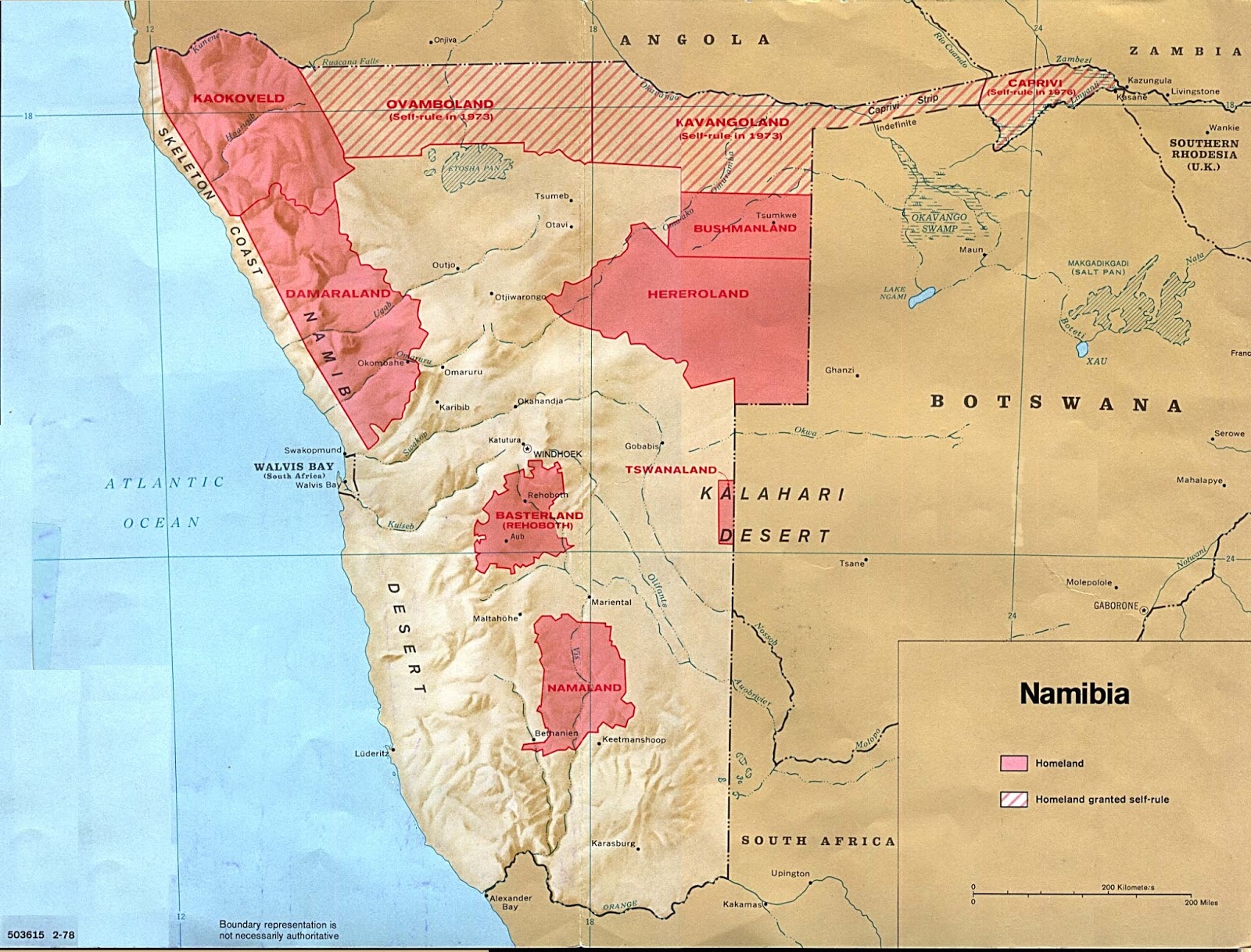
Namibia’s homelands during the apartheid era
By the time those conflicts had settled down, in the 1980s, Caprivi had become something else again: a “homeland.”  These glorified reservations, also called “Bantustans,” which the South African government tried to sell to the world as generous experiments in indigenous sovereignty, were scattered throughout South Africa and South-West Africa.  Bophuthatswana, in northern South Africa, site of the famous Sun City entertainment resort, was the most famous.  Most were barren patches of land onto which apartheid’s architects tried to expel Africans, hoping they would take the demographic and political “problems” they represented out of the South African body politic.  In South-West Africa, there was even a homeland called Rehoboth or Basterland, for the Baster people, a mix of Dutch and native Khoisian (“Bushman”) ancestry—the name baster being the Afrikaans equivalent of the English word bastard.  In some ways, these homelands had genuine autonomy, and the Lozi people of the Caprivi Strip were given their small degree of self-rule largely, many felt, as the apartheid regime’s reward for facilitating the white-supremacist gun-running during the Rhodesian business.  Whether that is a fair characterization or not, when South-West Africa finally did become independent, as the Republic of Namibia, in 1990, the homelands were abolished, and Caprivi Lozis found themselves feeling in some ways less autonomous than they did under apartheid.

The most excellent flag of the Caprivi separatists
In 1994, Lozis formed the Caprivi Liberation Army (C.L.A.), aiming to make the Strip a sovereign nation.  In 1999, a series of attacks on police stations and other targets prompted a government crackdown.  C.L.A. leaders were sent into exile, mostly to Denmark but also to Botswana, which was in the midst of a territorial dispute with Namibia.  In 2002, the C.L.A. unilaterally declared the independence of the Free State of Caprivi Strip/Itenge, but no state recognized it.

Zimbabwe’s Victoria Falls, just east of Caprivi
Today, the Strip is mostly calm, and it has natural wonders that Namibia would like tourists to flock to, being just upriver from the Zambezi River’s spectacular Victoria Falls, in Zimbabwe.  So the new name Zambezi Region is partly a rebranding, ditching a name that is mostly associated with civil war.  But why not rename the region Okavango, which some people have called it at times, after the river that runs through the western part of the Strip? or Itenge, a name preferred by Caprivian separatists? or Lozi, which was its name in the late pre-independence period?  After all, the Lozi are the people that live here.

Some nationalists’ vision of a “Greater Barotseland.”
No wonder Namibia is nervous.
Ah, but that is the rub.  The Lozi, also known as Barotse (it is the same name; ba- is a prefix in Bantu ethnonyms, and r and l are sometimes interchangeable), live not only in Caprivi but in a large area to the north called Barotseland, where a quiet revolt has been roiling for several years over the Barotse kingdom’s involuntary absorption into the Republic of Zambia at independence in 1964—a story this blog has been covering for quite a while.  (For example, I listed Barotseland as one of “10 Separatist Movements to Watch in 2013.”)   The last thing the Namibian government—run by the largest ethnic group, the Ovambo—wants is for a Barotse civil war to spill over into their territory.  So far, there has never been much coordination between Barotse/Lozi activists in Zambia and those in Namibia; Zambian Barotse are more focused on shoring up their constitutional monarchy and on challenging the legal basis of the Zambian state.  But that could change once the Barotse monarchy and its army begin to make strides and foment true unrest, as may happen any week now.  And the conservative monarchists on the Zambian side of the border are in no way natural allies of Namibia’s ruling party, the Southwest African People’s Organisation (SWAPO), a former leftist rebel army much in the A.N.C. mold.

The flag of the Barotse monarchy in Zambia
The town of Schuckmannsburg in the Caprivi Strip is also being renamed.  It is now Lohonono.  And Lüderitz, a harbor town at the other end of Namibia, in the southwest, has become !Nami=Nüs.  (Those punctuation marks represent clicks and other sounds unique to the Khoisian languages of the Kalahari Desert, which are perhaps the oldest languages in the world.)  But the renaming of the Caprivi Strip is not really about the European colonialism.  Germans have already been scrubbed from the Namibian political landscape—a neutered and cowed minority.  And the German government in 2004 made a formal apology to Namibia for massacres and concentration camps by which German soldiers killed tens of thousands of Hereros and other indigenous people in the colonial period.  If anything, the residual German-speaking population and their settlements are a tourist draw; one example is scenic Swapokmund, which played the part of the mysterious Brigadoon-like “Village” in the 2009 remake of the television series The Prisoner.  (Fun fact: Swapokmund is a linguistic blend of a name, which literally means Asshole-Mouth.  Mund is German for mouth, and the town is at the mouth of the Swapok River, derived from the indigenous Nama word tsoakhaub, which means anus—a reference to the large volumes of carcasses and reeking waste that wash out through the estuary during flood season.  You’d think that if the Namibian tourist board wanted to do some name changes to give tourism a bump, Asshole-Mouth should be top of the list.)

The Namibian flag flies over Swapokmund,
the colonial-German resort town where the remake of The Prisoner was filmed.
Rather, this rewriting of the map—which in itself is something very right and proper which nearly every formerly colonial state has undertaken—is designed to downplay the interethnic tensions within Namibia.  The Ovambo, whose territory in the north (a former homeland as well, Ovamboland) is only 6% of the country, are nearly half the population and by far the dominant group.  Many minority groups claim that Ovambos are forcing themselves on the rest of the population as the élite and are settling in areas formerly dominated by smaller groups, especially the hunter–gatherer tribes.  So the ruling Ovambos do not want names like Lozi showing up too prominently on maps.  They are trying to forestall the day when their hegemony is seriously challenged—which, to judge from events in Zambia, may happen first in the Caprivi Strip.


[You can read more about Caprivi/Itenge, Barotseland, and many other separatist and new-nation movements, both famous and obscure, in my new book, a sort of encyclopedic atlas just published by Litwin Books under the title Let’s Split! A Complete Guide to Separatist Movements and Aspirant Nations, from Abkhazia to Zanzibar.  The book, which contains 46 maps and 554 flags (or, more accurately, 554 flag images), is available for order now on Amazon.  Meanwhile, please “like” the book (even if you haven’t read it yet) on Facebook and see this interview for more information on the book.]

Saturday, October 13, 2012

Jonathan Lets Bakassi Appeal Window Close; Efik King Joins Cause with Ambazonian Separatists: Nigeria Update, 7-13 October 2012


Secession of the Bakassi Peninsula is in the air again as the deadline for appealing its cession to Cameroon is allowed to pass, and the Efik king and other leaders begin envisioning a Bakassi Republic carved out of pieces of both Nigeria and Cameroon.  Read on ...

Appeal Window Closes, Angering Efik and Others in Nigeria.  Despite a last-minute lawsuit by Bakassian activists, Nigeria’s president, Goodluck Jonathanallowed an October 10th deadline to pass, thus closing the window of opportunity for appealing a 2002 ruling by the International Court of Justice (I.C.J.) ceding the Bakassi Peninsula to the Republic of Cameroon.  Nine Bakassians in Cross River State in southeastern Nigeria had filed a lawsuit this week against the federal government over the question of sovereignty over the disputed peninsula.  The plaintiffs, a group called the Free Bakassi Association, asked the court to void the Green Tree Agreement of 2006, in which Nigeria acquiesced to the I.C.J. decision, and to order the Nigerian government to retake the disputed area by any means necessary.  But on October 8th, Mohammed Bello Adoke, the Nigerian minister of justice, announced that the deadline would be allowed to pass without appeal.  But Adoke promised to press Cameroon on the rights of Bakassians and other Nigerians living in Cameroonian territory.


Betrayed Bakassians Mull an Efik Republic to Straddle Nigerian-Cameroonian Border.  As the Nigerian government allowed the window on appealing the Bakassi cession to close on October 10th, furious Bakassians on both sides of the (now utterly officially demarcated) Nigerian–Cameroonian border took to the streets to protest.  Liyel Imoke, governor of Nigeria’s Cross River State—where many of the Efik ethnic minority live, including those displaced from Bakassi years ago when the territory was first transferred—pleaded for calm.  More pointedly, supporters of the once-sovereign Efik kingdom marched on the governor’s office, and Ekpo Abasi Otu, the obong of Calabar—the current hereditary ruler of the Efik-dominated Calabar Kingdom—said on the 10th, according to media, “that the Efik were considering the invitation by the people of Southern Cameroon to form a republic as the Federal Government [of Nigeria] had sold their ancestral land to Cameroon.  The coordinator of the Save Bakassi GroupMaurice Ekong, said that this was “the beginning of a long struggle for sovereignty.”  Also in Cross River, Cletus Obun, who heads the Cameroon Border Communities Association (C.B.C.A.), said this week that his group will petition the United Nations for a plebiscite and “will embark on serious mobilisation across local government areas bordering Cameroon in collaboration with the Efiks in Bakassi and the Southern Cameroon for an independent state of Abazonia.”  Efik and other ethnic groups in southwestern Cameroon, including many in the Bakassi Peninsula and many in the areas that used to be the British-ruled Southern Cameroons colony before a merger with Cameroon, newly independent from France, have been pushing for decades for a separate nation, to be called either Ambazonia or Ambazania (as opposed to Obun’s “Abazonia” (a new spelling, or a typo?) above).  Efik activists in August declared an island off the coast of the Bakassi Peninsula the “Republic of Bakassi.”

The obong of Calabar

Meanwhile, sources are reporting that the Cameroonian government’s security forces are cracking down in Bakassi and Efik in Nigeria have been unable to contact relatives on the Cameroonian side of the border.

Jonathan Offered Okah Amnesty for Blaming Bombs on Political Enemies, Court Hears.  In the trial of the accused Ogoni separatist bomber Henry Okah, which began last week in Johannesburg, South Africa (as reported at the time in this blog), the court screened a 2009 interview with the Qatar-based Al Jazeera news network, shot after he’d been granted amnesty by the Nigerian government, in which he said, “There are still thousands and thousands and thousands who are prepared to fight and continue fighting,” adding, “I don’t look like I am contributing to violence; I am participating in fighting for my rights.”  When asked if he was repentant for past violence, he said, “I’m not.  Why should I be?  What we want is our land.  ...  I think in a few months, if government doesn’t address the real demands ... very soon, there will be a resumption of violence.”  Okah, alleged leader of the Movement for the Emancipation of the Niger Delta (MEND), is being accused of masterminding a wave of car-bombings in Nigeria in the year following that interview.  In another interview heard by the court, Okah claimed that after the 2010 car bombings a representative of Nigeria’s president, Goodluck Jonathan, phoned him in South Africa and asked him to get MEND to retract its claim of responsibility so that Jonathan could “blame the attacks on northerners who are trying to fight against him to come back as president, and if this was done, I was not going to have any problems with the South African government.”  Okah refused the offer, he said in the interview, and a few hours later was arrested.

The Ogoni flag
New Igbo Youth Movement Says It Lured 1,000 Away from MASSOB.  The head of publicity for a new Igbo group in southeastern Nigeria, the Association of Igbo Youths (AIYO), registered in 2007, said on October 5th that at least 1,000 members have fled a longer established groupMASSOB, to join AIYO, citing as a cause that MASSOB does not look at those that have been imprisoned, widowed, or orphaned as the result of MASSOB violence.  MASSOB stands for Movement for the Actualization of the Sovereign State of Biafra.  AIYO, by contrast, according to the publicity head, Charles Chikeli, is a “youth vanguard” which promotes “peace, love, and oneness of the Igbo in accordance with the laws of the country.”

AS MANY AS 98 DEAD IN NORTH NIGERIA INCLUDE 30 SHOT BY “BERSERK” SOLDIERS.

On October 6th, battles raged for half an hour in Damaturu, capital of Yobe State in northern Nigeria, between the Islamist insurgency group Boko Haram and the federal government’s anti-terrorist Joint Task Force (J.T.F.), but there were no reports of casualties.  Six Boko Haram fighters were captured and arrested, some with the help of the citizenry.

Around the same time, two people in the village of Dogon Kuka, in northern Yobe, were killed when unknown gunmen opened fire on them.

A bomb blast near a television studio in Jalingo, capital of Taraba State in Nigeria’s mixed-Christian-and-Muslim east-central Middle Belt region, injured eight people on the night of October 6-7, including a woman and five children.  Boko Haram is suspected.

On October 7th, also in northern Yobe State, Nigerian troops killed approximately 30 suspected Boko Haram fighters in a battle that lasted several hours.  Among the dead, according to an army spokesman, was “the notorious, one-eyed Bakaka, the field commander of Boko Haram in Damaturu and a close associate of Abubakar Shekau,” the apparent leader of the terror network.  Hospitals also reported five uniformed men among the dead, presumably government soldiers.  Ten insurgents were arrested, and a gigantic cache of weapons and other equipment was recovered.

The “one-eyed” warlord Bakaka, recently neutralized—
though he seems to have full stereoscopic vision in this photo
On October 8th, in Maiduguri, capital of Borno State, an afternoon bombing of a military convoy killed 20 civilians and burned 50 homes.  An army lieutenant and six other military personnel were also apparently killed in the explosion, which prompted Nigerian troops in the area to “go berserk” in an impoverished neighborhood, opening fire, according to witnesses, and mowing down and killing 30 people that included civilians as well as those later identified as Boko Haram fighters.  They also set over 100 buildings, including houses and shops, and 35 vehicles ablaze.  Since military sources would not confirm any details of the alleged rampage—and claim no one other than two soldiers were injured in the initial blast—it is possible that there was only one wave of fires, attributed by different sources to either soldiers or the terrorist bomb.  One resident said, “The atrocities going on in Maiduguri is worse than what obtains in Somalia.  People are being killed and their wealth destroyed by the soldiers.”  In Kano, in north-central Nigeria, two police officers were shot and killed by gunmen on motorcycles on October 9th while protecting medical workers administering polio vaccine door to door.  Police have arrested eight suspected Islamist militants in connection with that incident.

Two days later, also in Kano, two officers with the Nigerian Federal Road Safety Commission (F.R.S.C.were shot and killed by unknown gunmen, presumed to be Boko Haram.  An additional officer was injured.

[Also, for those who are wondering, yes, this blog is tied in with a forthcoming book, a sort of encyclopedic atlas to be published by Auslander and Fox under the title Let’s Split! A Complete Guide to Separatist Movements, Independence Struggles, Breakaway Republics, Rebel Provinces, Pseudostates, Puppet States, Tribal Fiefdoms, Micronations, and Do-It-Yourself Countries, from Chiapas to Chechnya and Tibet to Texas.  Look for it in spring 2013.  I will be keeping readers posted of further publication news.]

Sunday, June 3, 2012

Maybe They Could Call Themselves Jutes—Oh, Wait, That Name’s Already Taken

Geneticists from Israel’s Sheba Medical Center have found a genetic marker associated with the well-mapped Ashkenazic—or Eastern European Jewish—genetic profile in a population of a Colorado Indian tribe.

The tribe was not specified, but Colorado has only two federally recognized indigenous communities: the Southern Ute Tribe, and the Ute Mountain Tribe.  The Utes migrated to what is now Colorado from Mexico before statehood but after European settlement of North America began.

The marker is a “harmful modification in the BRCA1 gene,” linked to a higher risk of breast and ovarian cancer.  The shared ancestry is likely to be linked to Spanish colonialism in Mexico—Spain being a country which had a large Jewish population until the expulsions of 1492 (the same year Christopher Columbus sailed—and, heck, some people think he may have been part Jewish), but where much Jewish genetic residue presumably remained.  Historians are only just beginning to appreciate how many Jewish families maintained their traditions and identity discreetly or secretly in the Wild West and under Spanish colonialism.


However, crackpot anthropological theories, such as that put forth in the Book of Mormon (which also claims that God punished some human populations for their laziness by making them dark-skinned, and that Jesus Christ visited the cities of Mesoamerica), are likely to seize on the study as evidence for the supposed origins of Native Americans in the Lost Tribes of Israel.  Many Native Americans find these Mormon theories deeply offensive—not out of anti-Semitism, but in reaction to the implication that anything culturally sophisticated or commendable among indigenous people needs to be explained through some Old World connection, which is a common thread in crackpot theories of the peopling of the Americas.  (I could do a search for Mormon websites responding to the news, but I don’t really have the patience for it right now.)  Meanwhile, on this side of the sanity–insanity divide, there may also be attempts to identify the Utes as a genuinely remnant genetically-and-culturally Jewish population, like the Lemba of Zimbabwe and South Africa, who abstain from pork, circumcise, use the Star of David, and maintained Old Testament stories in their oral traditions long before they learned, in the modern period, that there were other populations that shared those traits.

Members of the Lemba ethnic group in Zimbabwe—almost certain descendants of emigrants from the Holy Land

Many early anthropologists, missionaries, and settlers noted similarities between some indigenous North American cultural practices and beliefs and those found readily in the Old Testament and in Jewish tradition.  Examples include occasional arguable monotheism, the levirate (the practice of a man, for example, marrying his deceased brother’s wife), organization into tribes and clans, matrilineal descent (a post-diaspora adaptation in Jewish kinship, still persistent), animal sacrifice, food taboos, oral traditions of a Great Flood, even very sparsely distributed instances of circumcision.  But these, it is now clear, are more attributable to the global widespread nature of some cultural traits—traits which many European settlers of the era likely had not known of at all except through reading the Bible.

The flag of the Southern Ute Tribe.  As flag designs go, it’s a bit ... busy, isn’t it?

If nothing else, these new genetic discoveries may explain some unusual moments from the history of the Wild West.


[Also, for those who are wondering, yes, this blog is tied in with a forthcoming book, a sort of encyclopedic atlas to be published by Auslander and Fox under the title Let’s Split! A Complete Guide to Separatist Movements, Independence Struggles, Breakaway Republics, Rebel Provinces, Pseudostates, Puppet States, Tribal Fiefdoms, Micronations, and Do-It-Yourself Countries, from Chiapas to Chechnya and Tibet to Texas.  Look for it in spring 2013.  I will be keeping readers posted of further publication news.]

Subscribe Now: Feed Icon