Showing posts with label Goodluck Jonathan. Show all posts

Thursday, August 28, 2014

Boko Haram, Inspired by Rise of ISIS, Declares Caliphate in Captured Nigerian Towns


Almost certainly inspired by the success of the Islamic State (I.S., also known as ISIS or ISIL) in capturing and holding a huge swathe of Iraq and Syria and declaring it the kernel of an eventual global caliphate, the Nigerian Islamist terrorist group Boko Haram has shifted from hit-and-run mass killings and is now concentrating on holding territory and declaring an Islamic state.  This is a game-changer for Nigeria, Africa’s most populous and most combustively ethnically diverse country, and ushers in a new phase of what is clearly now a full-on sectarian civil war.

Boko Haram’s dune-buggy battalion
In a nearly hour-long video made available on August 24th (see image at the top of this article), Boko Haram’s apparent leader, Abubakar Shekau, speaking both Arabic and Hausa, declared that the recently captured town of Gwoza was now “made ... part of the Islamic caliphate.”  Last month, in a similar communiqué, Shekau had openly supported the I.S., whose leader, Abu Bakr al-Baghdadi, had declared himself “caliph” and “leader of Muslims everywhere.”  But the new video did not explicitly call Gwoza part of a caliphate based in Mesopotamia.

Towns in Nigeria recently captured by Boko Haram are shown in red.
An unknown portion of rural areas between them is controlled by Boko Haram as well.
In addition to Gwoza, which is in the southern part of Borno State, in Nigeria’s predominantly-Muslim northern half, Boko Haram is also believed to hold territory elsewhere in Borno including the large town of Damboa; parts of Yobe State that include Buni Yadi; and, most recently captured, in the Madagali district of Adamawa State.  But getting accurate information is difficult; there had long been areas so consistently terrorized by Boko Haram that the Nigerian military had no effective presence there.

Abubakar Shekau
The 52-minute video also shows footage of the capture of a Nigerian military base, the seizure of a tank, and the mass execution of what appear to be about twenty civilians.

Nigeria’s president, Goodluck Jonathan: helpless
The following day, Boko Haram recaptured Gamboru–Ngala, a village cluster in Borno on the border with Cameroon—reportedly sending the local Nigerian military fleeing into Cameroon without even trying to put up a resistance—and within the past 24 hours (on August 27th), according to reports, the group was closing in on Gulak, the Madagali district capital, in the far north of Adamawa.  They are gradually building a cohesive territory, and the Nigerian state seems to lack either the resources or the political will to stop them.


Setting up an Islamic state has been tried before.  The Taliban called Afghanistan the Islamic Emirate of Afghanistan during the years it ruled there, a name still used in pockets of territory it controls.  The Islamic Emirate of Somalia and the Islamic Emirate of Waziristan, in Pakistan, are names designating areas of those countries controlled by, respectively, al-Shabaab and various al-Qaeda and Taliban groups.  An “Emirate of Waqar,” declared by al-Qaeda in a town in Yemen, was recaptured by the Yemeni government in 2012.  The terrorist group Caucasus Emirate claims a state consisting of the Muslim areas in and near Russia’s North Caucasus mountains, but it does not administer any territory.


Closer to Nigeria, the al-Qaeda-linked groups Ansar al-Dine and MUJAO (Movement for Unity and Jihad in West Africa) controlled the northern two-thirds of Mali as an Islamic Republic of Azawad for about a year ending in early 2013 (see map above), when it was ousted by troops from France, Chad, and other countries.  It still controls small territories, and, although it piggy-backed its agenda onto the back of a separatist uprising by the Tuareg minority, its avowed aim was to turn all of Mali into an Islamic state.  Turning all of Nigeria into an Islamic emirate had been Boko Haram’s aim as well, and it had seemed absurd, since the country, which is about evenly divided between Christians and Muslims, is nearly entirely Christian in its southern half.  But the new territorial claims are more pragmatic and are clearly inspired by I.S., which began by capturing towns in the west and north of Syria, expanded into Fallujah, Iraq, earlier this year, and has recently spread its territory northward up against the autonomous Kurdistan Region.  I.S. never aimed to take all of Syria or Iraq; they are just taking as much as they can and running it like a state, and that seems to be Boko Haram’s plan as well.


Already a coalition and an international consensus is building to stop I.S. in its tracks, with even deadly enemies like the United States and Iran finding common cause on the issue.  Syria and Iraq, of course, are a vitally strategic area, both geopolitically and economically.  This is less true of the arid north of Nigeria.  So who will stop Boko Haram?
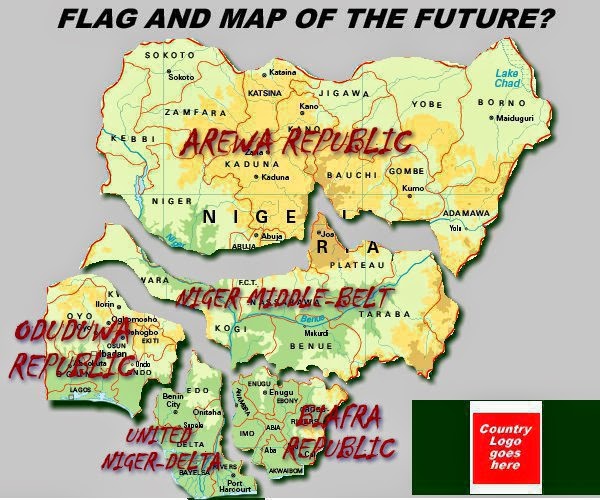
Worst-case scenario?
[You can read more about Boko Haram, Islamic State, and many other separatist and new-nation movements, both famous and obscure, in my new book, a sort of encyclopedic atlas just published by Litwin Books under the title Let’s Split! A Complete Guide to Separatist Movements and Aspirant Nations, from Abkhazia to Zanzibar.  The book, which contains 46 maps and 554 flags (or, more accurately, 554 flag images), is available for order now on Amazon.  Meanwhile, please “like” the book (even if you haven’t read it yet) on Facebook and see this interview for more information on the book.]


Saturday, November 24, 2012

Bakassian Border Survey Team Scatters; More Boko Haram Carnage: Nigeria Update, 18-24 November 2012


Lawmaker, Pastor, Police Inspector Gunned Down in Wave of Boko Haram Hits.  Police in Nigeria reported on November 18th the assassination of Ibrahim Abba Garko, a legislator in the Kano State assembly, who was gunned down in a motorcycle drive-by shooting in the city of Kano.  He died on the spot, and two companions were wounded.  He was a member of the country’s ruling party, the People’s Democratic Party (P.D.P.).  The following day, a 70-year-old Christian pastor was shot and killed in front of his family by suspected Boko Haram members in Maiduguri, capital of Borno State in the northeast.  The minister, the Rev. Ilaisha (other reports say Elisha) Kabura, was on his way to conduct a service for a Church of Christ in Nations congregation.  He had received Boko Haram death threats before.  The same day, a police inspector, Babangida Danbabowas shot and killed on his way home from prayers at a mosque in Bauchi, in Bauchi State.


Rioting between Christians, Muslims in Nigerian Middle Belt Kills 4.  Four people were killed in street warfare between Christians and Muslims in east-central Nigeria on November 18th after a Muslim in the town of Ibi, in Taraba State, refused to submit to a checkpoint set up by a Christian vigilante group.  The checkpoint was one of many set up in the town as a way of keeping Muslims from approaching churches, in the wake of a barrage of church bombings by the Islamist terrorist group Boko Haram in recent months.  Both churches and mosques were burned down in the rioting that ensued, and the military was sent into the town to keep order.  Taraba State is in the east of the region known as the Middle Belt, where Muslims and Christians live side by side.  Also, in the central Middle Belt state of Nasarawa, seven people, including a seven-year-old boy were killed on November 21st in rioting between the Koro and Eggon ethnic groups in the town of Agyaragu.  At least 10 people were injured and 15 houses burned down.

Rioting in Ibi
Military Operation in Northeast Nigeria Kills Boko Haram Commander, Others.  A joint military and police operation in Nigeria, including the anti-terrorist Joint Task Force (J.T.F.), state security forces, and even the air force, launched a major offensive on November 21st against the Islamist terrorist group Boko Haram in Maiduguri, the capital of Borno State in northeastern Nigeria, resulting in the death of a Boko Haram commander, Ibn Saleh Ibrahim.  Several other Boko Haram fighters were also killed, according to the military.  The following day in Maiduguri, Boko Haram members killed three children—ages 5, 7, and 12—in their mother’s presence, amid a total of five similar murders that day.  The children’s father was Aduju Zubairu, a member of Nigeria’s federal State Security Service (S.S.S.).

Reportedly Escaped Boko Haram Prisoner Turns Out to Be in Hospital.  In Nigeria, media reported this week that the country’s inspector general of police, Mohammed Abubakar, had informed President Goodluck Jonathan that the media reports of the escape from police custody of the Boko Haram commander Sani Mohammed (a.k.a. Mohammed Sani) on November 8th (as reported earlier in this blogwere a false story and that in fact the suspect was sick and in a hospital.  He had been arrested in January 2012 along with another suspect, Bakir Sokoto.

Bakassians Disrupt Nigerian-Cameroonian Border Survey Team, Protesting Cession.  Demonstrators from the Bakassi Peninsula disrupted the activities of a surveying team marking the newly negotiated boundary between Nigeria and Cameroon on November 21st and 22nd, over what they call a betrayal by the Nigerian government, which last month intentionally let pass a last opportunity to contest an International Court of Justice (I.C.J.) ruling ceding Bakassi to Cameroon.  The Joint Technical Team was made up of United Nations, Nigerian, and Cameroonian officials.  The demonstrators carried placards and prevented the team from reaching the site.  After the disruptions, the U.N. temporarily suspended the surveying project.  See a recent article in this blog detailing the Bakassi dispute.


[For those who are wondering, yes, this blog is tied in with my forthcoming book, a sort of encyclopedic atlas to be published by Auslander and Fox under the title Let’s Split! A Complete Guide to Separatist Movements, Independence Struggles, Breakaway Republics, Rebel Provinces, Pseudostates, Puppet States, Tribal Fiefdoms, Micronations, and Do-It-Yourself Countries, from Chiapas to Chechnya and Tibet to Texas.  The book, which contains dozens of maps and over 500 flags, is now in the layout phase and should be on shelves, and available on Amazon, by early fall 2014.  I will be keeping readers posted of further publication news.  Meanwhile, please “like” the book (even though you haven’t read it yet) on Facebook.]

Saturday, November 3, 2012

Nigerian Troops Massacre Civilians, Boko Haram Church Suicide Bombing, Kalabari-Bayelsa Border Row, Biafra Abductions: Nigeria Separatism Update, 28 October - 3 November 2012

The aftermath of an attack in Kaduna
TOP STORY:
NIGERIAN MILITARY MURDERS SCORES OF YOUNG MEN IN MAIDUGURI,
BRINGING CIVIL WAR WITH BOKO HARAM TO HIGHER LEVEL

Numerous witnesses in the northeastern Nigerian city of Maiduguri, in Borno State, say that federal troops murdered dozens of young men over the night of October 31st–November 1st in a series of house raids and in a chillingly described summary execution in a field.  Many of the men—at least 39 of them, according to a local morgue, and perhaps as many as 70—were killed in front of their parents.  The men, aged 18 to 25, were apparently accused or suspected of membership in Boko Haram, the Islamist insurgency in northern Nigeria.  The Nigerian military says it knows nothing about it, but a new report by Amnesty International, coincidentally released the morning after the killings, takes the Nigerian government to task for its heavy-handedness, concluding, “We found that the very grave human rights abuses by the armed group Boko Haram are being met with serious human rights violations by security forces in their response to Boko Haram.”  The report mentions not just killings or disappearances but detention without trial, torture, and military retaliation against entire neighborhoods, including bulldozing of homes.

A retired general was assassinated at his home in Maiduguri on November 2nd, according to the military, in what may have been retaliations for the military massacres.

Boko Haram Spokesman Offers Nigeria Peace Talks, with Conditions.  Journalists in Maiduguri, in Borno State, held a conference call November 1st with a man claiming to be a Boko Haram leader named Abu Mohammed Ibn Abdulaziz, who offered Nigeria’s government the chance to engage them in peace talks, but on strict conditions.  The conditions were that the talks must take place in Saudi Arabia and must involve Muhammadu Buhari, Nigeria’s former military ruler, who is a Muslim from the northern Fulani ethnic group.  Abdulaziz claimed to be speaking on behalf of Boko Haram’s leader, Abubakar Shekau.  Nigeria’s federal anti-terrorist Joint Task Force (J.T.F.) has rejected the conditions.

Abubakar Shekau
Jeep-Bombing of Northern Nigerian Church Kills 10; Christian Mob Kills 3 Muslims.  At least 10 people were killed in a suicide car-bombing of a Roman Catholic church in Kaduna, in north-central Nigeria, on October 28th, and over 140 were injured.  The bomber used a jeep to ram the church before detonating himself and much of the building.  No one has claimed responsibility, but Boko Haram is suspected.  In reprisal, a mob of young Christians with sticks and machetes rampaged in the city, beating three Muslims to death.  Kaduna is in the Middle Belt region where Christians and Muslims live side by side.

Boko Haram Arsonists Attack 2 Schools, Police Station in Remote Village.  Gunmen suspected of being members of the Islamist militia Boko Haram set a police station, two schools, and a telecommunications tower on fire in Chibok, in northeastern Nigeria’s Borno State, on October 30th.  Witnesses said they arrived in Volkswagens and threw Molotov cocktails while shouting, “God is great!”  Youths with bows and arrows chased the terrorists out of town.  There were no injuries, but the fires raged uncontrolled, since the village has no fire department.

Kalabari Kingdom Accuses Bayelsa of Altering Maps to Grab Resources.  A leading chief from the Kalabari Kingdom (a.k.a. Calabar) in southeastern Nigeria’s Rivers State, in the Niger Delta region, said at a news conference in Abuja, the Nigerian capital, on October 29th that he opposed plans by Bayelsa State, which borders Rivers to the west, to annex part of its traditionally Kalabari-ruled territory.  The chief, Emmanuel Awoyesuku, chairman of Akulga Local Government Area, blamed the effort—first introduced without comment via an altered map, he said—on Bayelsa leaders’ attempt “to exert economic control over the oil and gas rich communities within Kalabari territory.”  Bayelsa is the home state of Nigeria’s president, Goodluck Jonathan, an Ijaw, who has been accused of supporting Bayelsan separatism (as reported in this blog).  The Bayelsa State government denies the charges and also says Jonathan does not support annexation either.  The five communities Awoyesuku accuses Bayelsans of coveting are Ijaw, which is the dominant ethnic group in Bayelsa but not in Rivers or in the Kalabari Kingdom.  Meanwhile, the Kalabari Kingdom is also involved in a territorial dispute on its eastern flank, where the Bakassi Peninsula has been ceded, against residents’ will (as discussed in detail in this blog), to the Republic of Cameroon.

Kalabari activists in Abuja
Human-Rights Group Sues Nigerian Government over Denial of Biafran Independence.  Trial began in Owerri, Nigeria, in a lawsuit brought by a human-rights group against the federal government for the suffering and death caused to the indigenous Igbo people of southeastern Nigeria during the Biafra War of 1967-70.  The plaintiff, listed as Bilie Human Rights Initiative, is asking for nothing less than a court order for the government to implement “the self-actualisation and self-determination of the People of Biafra.”  The attorney general and president of Nigeria are listed as the defendants.

Biafra “Zionists” Claim Leader, 3 Others Abducted by Rival Igbo Separatist Group.  Just a few days before its planned declaration of independence from Nigeria (as discussed earlier in this blog), the leader of a fringe Igbo separatist group, the Biafra Zionist Movement (B.Z.M.), was abducted by members of the more mainstream separatist groupMASSOB.  The leader, Benjamin Onwuka, a lawyer, was one of four members kidnapped, according to Cornelius Anyanwu, the B.Z.M.’s “director of mobilisation.”  The other three were the organization’s national chairman, Samuel Edeson; its national secretary, Nweke Nweke; and another member named Chukwuma Orienta.  For its part, MASSOB—or, in full, the Movement for the Actualisation of the Sovereign State of Biafra—claims that it was not an abduction but an “invitation” to a meeting about the planned declaration.  One of the abducted men called Anyanwu to tell him they had been snatched from their homes and were being driven to Imo State, where MASSOB’s leader, Ralph Uwazulike, lives.  But B.Z.M. spokesmen said the declaration of independence would occur on the 5th as scheduled, in Enugu.

Members of the Biafra Zionist Movement

[For those who are wondering, yes, this blog is tied in with my forthcoming book, a sort of encyclopedic atlas to be published by Auslander and Fox under the title Let’s Split! A Complete Guide to Separatist Movements, Independence Struggles, Breakaway Republics, Rebel Provinces, Pseudostates, Puppet States, Tribal Fiefdoms, Micronations, and Do-It-Yourself Countries, from Chiapas to Chechnya and Tibet to Texas.  The book, which contains dozens of maps and over 500 flags, is now in the layout phase and should be on shelves, and available on Amazon, by early fall 2014.  I will be keeping readers posted of further publication news.  Meanwhile, please “like” the book (even though you haven’t read it yet) on Facebook.]

Saturday, October 13, 2012

Jonathan Lets Bakassi Appeal Window Close; Efik King Joins Cause with Ambazonian Separatists: Nigeria Update, 7-13 October 2012


Secession of the Bakassi Peninsula is in the air again as the deadline for appealing its cession to Cameroon is allowed to pass, and the Efik king and other leaders begin envisioning a Bakassi Republic carved out of pieces of both Nigeria and Cameroon.  Read on ...

Appeal Window Closes, Angering Efik and Others in Nigeria.  Despite a last-minute lawsuit by Bakassian activists, Nigeria’s president, Goodluck Jonathanallowed an October 10th deadline to pass, thus closing the window of opportunity for appealing a 2002 ruling by the International Court of Justice (I.C.J.) ceding the Bakassi Peninsula to the Republic of Cameroon.  Nine Bakassians in Cross River State in southeastern Nigeria had filed a lawsuit this week against the federal government over the question of sovereignty over the disputed peninsula.  The plaintiffs, a group called the Free Bakassi Association, asked the court to void the Green Tree Agreement of 2006, in which Nigeria acquiesced to the I.C.J. decision, and to order the Nigerian government to retake the disputed area by any means necessary.  But on October 8th, Mohammed Bello Adoke, the Nigerian minister of justice, announced that the deadline would be allowed to pass without appeal.  But Adoke promised to press Cameroon on the rights of Bakassians and other Nigerians living in Cameroonian territory.


Betrayed Bakassians Mull an Efik Republic to Straddle Nigerian-Cameroonian Border.  As the Nigerian government allowed the window on appealing the Bakassi cession to close on October 10th, furious Bakassians on both sides of the (now utterly officially demarcated) Nigerian–Cameroonian border took to the streets to protest.  Liyel Imoke, governor of Nigeria’s Cross River State—where many of the Efik ethnic minority live, including those displaced from Bakassi years ago when the territory was first transferred—pleaded for calm.  More pointedly, supporters of the once-sovereign Efik kingdom marched on the governor’s office, and Ekpo Abasi Otu, the obong of Calabar—the current hereditary ruler of the Efik-dominated Calabar Kingdom—said on the 10th, according to media, “that the Efik were considering the invitation by the people of Southern Cameroon to form a republic as the Federal Government [of Nigeria] had sold their ancestral land to Cameroon.  The coordinator of the Save Bakassi GroupMaurice Ekong, said that this was “the beginning of a long struggle for sovereignty.”  Also in Cross River, Cletus Obun, who heads the Cameroon Border Communities Association (C.B.C.A.), said this week that his group will petition the United Nations for a plebiscite and “will embark on serious mobilisation across local government areas bordering Cameroon in collaboration with the Efiks in Bakassi and the Southern Cameroon for an independent state of Abazonia.”  Efik and other ethnic groups in southwestern Cameroon, including many in the Bakassi Peninsula and many in the areas that used to be the British-ruled Southern Cameroons colony before a merger with Cameroon, newly independent from France, have been pushing for decades for a separate nation, to be called either Ambazonia or Ambazania (as opposed to Obun’s “Abazonia” (a new spelling, or a typo?) above).  Efik activists in August declared an island off the coast of the Bakassi Peninsula the “Republic of Bakassi.”

The obong of Calabar

Meanwhile, sources are reporting that the Cameroonian government’s security forces are cracking down in Bakassi and Efik in Nigeria have been unable to contact relatives on the Cameroonian side of the border.

Jonathan Offered Okah Amnesty for Blaming Bombs on Political Enemies, Court Hears.  In the trial of the accused Ogoni separatist bomber Henry Okah, which began last week in Johannesburg, South Africa (as reported at the time in this blog), the court screened a 2009 interview with the Qatar-based Al Jazeera news network, shot after he’d been granted amnesty by the Nigerian government, in which he said, “There are still thousands and thousands and thousands who are prepared to fight and continue fighting,” adding, “I don’t look like I am contributing to violence; I am participating in fighting for my rights.”  When asked if he was repentant for past violence, he said, “I’m not.  Why should I be?  What we want is our land.  ...  I think in a few months, if government doesn’t address the real demands ... very soon, there will be a resumption of violence.”  Okah, alleged leader of the Movement for the Emancipation of the Niger Delta (MEND), is being accused of masterminding a wave of car-bombings in Nigeria in the year following that interview.  In another interview heard by the court, Okah claimed that after the 2010 car bombings a representative of Nigeria’s president, Goodluck Jonathan, phoned him in South Africa and asked him to get MEND to retract its claim of responsibility so that Jonathan could “blame the attacks on northerners who are trying to fight against him to come back as president, and if this was done, I was not going to have any problems with the South African government.”  Okah refused the offer, he said in the interview, and a few hours later was arrested.

The Ogoni flag
New Igbo Youth Movement Says It Lured 1,000 Away from MASSOB.  The head of publicity for a new Igbo group in southeastern Nigeria, the Association of Igbo Youths (AIYO), registered in 2007, said on October 5th that at least 1,000 members have fled a longer established groupMASSOB, to join AIYO, citing as a cause that MASSOB does not look at those that have been imprisoned, widowed, or orphaned as the result of MASSOB violence.  MASSOB stands for Movement for the Actualization of the Sovereign State of Biafra.  AIYO, by contrast, according to the publicity head, Charles Chikeli, is a “youth vanguard” which promotes “peace, love, and oneness of the Igbo in accordance with the laws of the country.”

AS MANY AS 98 DEAD IN NORTH NIGERIA INCLUDE 30 SHOT BY “BERSERK” SOLDIERS.

On October 6th, battles raged for half an hour in Damaturu, capital of Yobe State in northern Nigeria, between the Islamist insurgency group Boko Haram and the federal government’s anti-terrorist Joint Task Force (J.T.F.), but there were no reports of casualties.  Six Boko Haram fighters were captured and arrested, some with the help of the citizenry.

Around the same time, two people in the village of Dogon Kuka, in northern Yobe, were killed when unknown gunmen opened fire on them.

A bomb blast near a television studio in Jalingo, capital of Taraba State in Nigeria’s mixed-Christian-and-Muslim east-central Middle Belt region, injured eight people on the night of October 6-7, including a woman and five children.  Boko Haram is suspected.

On October 7th, also in northern Yobe State, Nigerian troops killed approximately 30 suspected Boko Haram fighters in a battle that lasted several hours.  Among the dead, according to an army spokesman, was “the notorious, one-eyed Bakaka, the field commander of Boko Haram in Damaturu and a close associate of Abubakar Shekau,” the apparent leader of the terror network.  Hospitals also reported five uniformed men among the dead, presumably government soldiers.  Ten insurgents were arrested, and a gigantic cache of weapons and other equipment was recovered.

The “one-eyed” warlord Bakaka, recently neutralized—
though he seems to have full stereoscopic vision in this photo
On October 8th, in Maiduguri, capital of Borno State, an afternoon bombing of a military convoy killed 20 civilians and burned 50 homes.  An army lieutenant and six other military personnel were also apparently killed in the explosion, which prompted Nigerian troops in the area to “go berserk” in an impoverished neighborhood, opening fire, according to witnesses, and mowing down and killing 30 people that included civilians as well as those later identified as Boko Haram fighters.  They also set over 100 buildings, including houses and shops, and 35 vehicles ablaze.  Since military sources would not confirm any details of the alleged rampage—and claim no one other than two soldiers were injured in the initial blast—it is possible that there was only one wave of fires, attributed by different sources to either soldiers or the terrorist bomb.  One resident said, “The atrocities going on in Maiduguri is worse than what obtains in Somalia.  People are being killed and their wealth destroyed by the soldiers.”  In Kano, in north-central Nigeria, two police officers were shot and killed by gunmen on motorcycles on October 9th while protecting medical workers administering polio vaccine door to door.  Police have arrested eight suspected Islamist militants in connection with that incident.

Two days later, also in Kano, two officers with the Nigerian Federal Road Safety Commission (F.R.S.C.were shot and killed by unknown gunmen, presumed to be Boko Haram.  An additional officer was injured.

[Also, for those who are wondering, yes, this blog is tied in with a forthcoming book, a sort of encyclopedic atlas to be published by Auslander and Fox under the title Let’s Split! A Complete Guide to Separatist Movements, Independence Struggles, Breakaway Republics, Rebel Provinces, Pseudostates, Puppet States, Tribal Fiefdoms, Micronations, and Do-It-Yourself Countries, from Chiapas to Chechnya and Tibet to Texas.  Look for it in spring 2013.  I will be keeping readers posted of further publication news.]

Subscribe Now: Feed Icon