Showing posts with label Shekau. Show all posts

Thursday, August 28, 2014

Boko Haram, Inspired by Rise of ISIS, Declares Caliphate in Captured Nigerian Towns


Almost certainly inspired by the success of the Islamic State (I.S., also known as ISIS or ISIL) in capturing and holding a huge swathe of Iraq and Syria and declaring it the kernel of an eventual global caliphate, the Nigerian Islamist terrorist group Boko Haram has shifted from hit-and-run mass killings and is now concentrating on holding territory and declaring an Islamic state.  This is a game-changer for Nigeria, Africa’s most populous and most combustively ethnically diverse country, and ushers in a new phase of what is clearly now a full-on sectarian civil war.

Boko Haram’s dune-buggy battalion
In a nearly hour-long video made available on August 24th (see image at the top of this article), Boko Haram’s apparent leader, Abubakar Shekau, speaking both Arabic and Hausa, declared that the recently captured town of Gwoza was now “made ... part of the Islamic caliphate.”  Last month, in a similar communiqué, Shekau had openly supported the I.S., whose leader, Abu Bakr al-Baghdadi, had declared himself “caliph” and “leader of Muslims everywhere.”  But the new video did not explicitly call Gwoza part of a caliphate based in Mesopotamia.

Towns in Nigeria recently captured by Boko Haram are shown in red.
An unknown portion of rural areas between them is controlled by Boko Haram as well.
In addition to Gwoza, which is in the southern part of Borno State, in Nigeria’s predominantly-Muslim northern half, Boko Haram is also believed to hold territory elsewhere in Borno including the large town of Damboa; parts of Yobe State that include Buni Yadi; and, most recently captured, in the Madagali district of Adamawa State.  But getting accurate information is difficult; there had long been areas so consistently terrorized by Boko Haram that the Nigerian military had no effective presence there.

Abubakar Shekau
The 52-minute video also shows footage of the capture of a Nigerian military base, the seizure of a tank, and the mass execution of what appear to be about twenty civilians.

Nigeria’s president, Goodluck Jonathan: helpless
The following day, Boko Haram recaptured Gamboru–Ngala, a village cluster in Borno on the border with Cameroon—reportedly sending the local Nigerian military fleeing into Cameroon without even trying to put up a resistance—and within the past 24 hours (on August 27th), according to reports, the group was closing in on Gulak, the Madagali district capital, in the far north of Adamawa.  They are gradually building a cohesive territory, and the Nigerian state seems to lack either the resources or the political will to stop them.


Setting up an Islamic state has been tried before.  The Taliban called Afghanistan the Islamic Emirate of Afghanistan during the years it ruled there, a name still used in pockets of territory it controls.  The Islamic Emirate of Somalia and the Islamic Emirate of Waziristan, in Pakistan, are names designating areas of those countries controlled by, respectively, al-Shabaab and various al-Qaeda and Taliban groups.  An “Emirate of Waqar,” declared by al-Qaeda in a town in Yemen, was recaptured by the Yemeni government in 2012.  The terrorist group Caucasus Emirate claims a state consisting of the Muslim areas in and near Russia’s North Caucasus mountains, but it does not administer any territory.


Closer to Nigeria, the al-Qaeda-linked groups Ansar al-Dine and MUJAO (Movement for Unity and Jihad in West Africa) controlled the northern two-thirds of Mali as an Islamic Republic of Azawad for about a year ending in early 2013 (see map above), when it was ousted by troops from France, Chad, and other countries.  It still controls small territories, and, although it piggy-backed its agenda onto the back of a separatist uprising by the Tuareg minority, its avowed aim was to turn all of Mali into an Islamic state.  Turning all of Nigeria into an Islamic emirate had been Boko Haram’s aim as well, and it had seemed absurd, since the country, which is about evenly divided between Christians and Muslims, is nearly entirely Christian in its southern half.  But the new territorial claims are more pragmatic and are clearly inspired by I.S., which began by capturing towns in the west and north of Syria, expanded into Fallujah, Iraq, earlier this year, and has recently spread its territory northward up against the autonomous Kurdistan Region.  I.S. never aimed to take all of Syria or Iraq; they are just taking as much as they can and running it like a state, and that seems to be Boko Haram’s plan as well.


Already a coalition and an international consensus is building to stop I.S. in its tracks, with even deadly enemies like the United States and Iran finding common cause on the issue.  Syria and Iraq, of course, are a vitally strategic area, both geopolitically and economically.  This is less true of the arid north of Nigeria.  So who will stop Boko Haram?
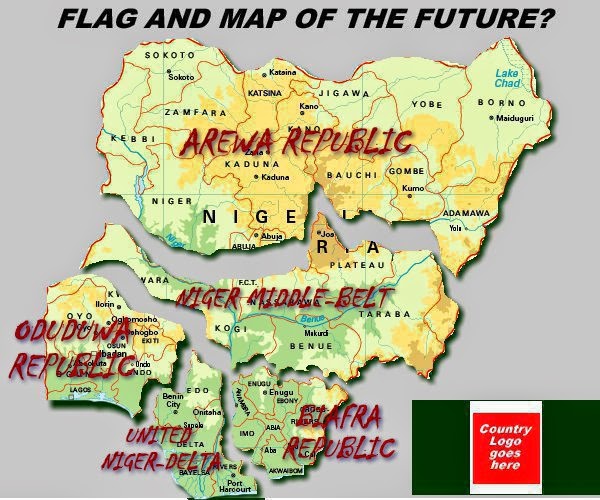
Worst-case scenario?
[You can read more about Boko Haram, Islamic State, and many other separatist and new-nation movements, both famous and obscure, in my new book, a sort of encyclopedic atlas just published by Litwin Books under the title Let’s Split! A Complete Guide to Separatist Movements and Aspirant Nations, from Abkhazia to Zanzibar.  The book, which contains 46 maps and 554 flags (or, more accurately, 554 flag images), is available for order now on Amazon.  Meanwhile, please “like” the book (even if you haven’t read it yet) on Facebook and see this interview for more information on the book.]


Wednesday, August 21, 2013

Nigeria’s Boko Haram Warlord Abubakar Shekau Reported Dead from Gun Battle


The shadowy leader of what is perhaps the world’s busiest and deadliest terrorist army was reported killed this week.  Abubakar Shekau was—or, possibly, still is, since his death is not confirmed—the founder as well as the tactical and spiritual leader of Boko Haram, the Islamist terrorist group which has killed many hundreds of civilians, mostly Christians, in a reign of terror in northern Nigeria over the past few years.

A spokesman for the Nigerian military’s anti-terrorist Joint Task Force (J.T.F.) said August 19th that Shekau—whose full name is Imam Abu Muhammad Ibn Muhammad Abubakar Ash Shekawi—was wounded in a battle with soldiers on June 30th in the Sambisa Forest.  This area is in the Boko Haram stronghold of Nigeria’s arid northeast near where Lake Chad forms the point at which Cameroon, Chad, Nigeria, and Niger border one another.  According to the J.T.F. statement, he was spirited across the border into the Muslim-dominated far north of the otherwise-predominantly-Christian Republic of Cameroon, where he was given medical treatment but died of his wounds probably between July 25th and August 3rd.  None of this could be confirmed.


Boko Haram is a phrase in northern Nigeria’s Hausa language meaning “Western education is sinful”—it could even be translated as “literacy is sinful.”  The name reflects the fervent fundamentalist anti-intellectual Islamism of the group, which not only rejects the doctrine of evolution but also condemns “theories” such as rainfall being the result of clouds formed from evaporating water, since this contradicts wording in the Qur’an.  (This puts Boko Haram on the same level, intellectually, as most Republican lawmakers in the southern United States.)  The group’s full name is Jamā’a Ahl al-Sunnah li-Da’wa wa al-Jihād, which means, in Arabic, “Congregation and People of Tradition for Proselytism and Jihad.”  From their founding in 2001, but mostly over the years since 2009, they are responsible for the deaths of perhaps as many as 10,000 civilians.  Most have been Christians, with methods including truck-bombings of churches and government buildings and organized massacres of schoolchildren.  Recently moderate Muslims have been targeted as well.


Boko Haram’s ostensible aim is the imposition of shari’a (Islamic law) over all of Nigeria.  (It is already in force in Nigeria’s northern states, as the map above shows.)  Since Nigeria’s population is about evenly divided between a Christian south and a Muslim north, this is in terms of practical politics virtually impossible.  Some argue that Boko Haram’s real goal—or at least their most likely effect—is the partition of the country.  Ethnolinguistic and sectarian tensions have plagued Nigeria since its independence from the United Kingdom in 1960.  The departing British placed a northern, Muslim leader in charge of the new nation, which set off a tit-for-tat of coups d’état and counter-coups between Muslims and Christians, setting the stage for the devastating Biafra War of 1967-1970, in which more than a million died.  Southeastern Nigeria’s Igbos, whose nationalist ambitions were the immediate cause of that war, claim today that their people are still bearing the brunt of Muslim pogroms, especially in the religiously mixed “Middle Belt” region which Boko Haram finds so rich in targets.


Little is known about Shekau.  He may be in his thirties or forties.  He may be a native of Niger or of northeastern Nigeria, though he seems to be of the Kanuri ethnic group.  (The Kanuri declared an independent republic of Greater Kanowra on the site of the precolonial Bornu Kingdom in the four-way border region of the Lake Chad basin, but that movement was largely secular in orientation.)  He reportedly had, or has, a photographic memory.


Equally unclear is whether he is still alive.  If he is, then his quasi-supernatural talent for survival will increase his prestige among Boko Haram’s rank and file.  If he is not, then the movement now has a martyr.  There seems to be no good path forward, no best-case scenario.  The future looks bleak for Nigerians, and for Nigeria.

Expect many, many more scenes like this one.
[For those who are wondering, yes, this blog is tied in with my new book, a sort of encyclopedic atlas just published by Litwin Books under the title Let’s Split! A Complete Guide to Separatist Movements and Aspirant Nations, from Abkhazia to Zanzibar.  The book, which contains 46 maps and 554 flags (or, more accurately, 554 flag images), is available for order now on Amazon.  Meanwhile, please “like” the book (even if you haven’t read it yet) on Facebook.]


Saturday, November 3, 2012

Nigerian Troops Massacre Civilians, Boko Haram Church Suicide Bombing, Kalabari-Bayelsa Border Row, Biafra Abductions: Nigeria Separatism Update, 28 October - 3 November 2012

The aftermath of an attack in Kaduna
TOP STORY:
NIGERIAN MILITARY MURDERS SCORES OF YOUNG MEN IN MAIDUGURI,
BRINGING CIVIL WAR WITH BOKO HARAM TO HIGHER LEVEL

Numerous witnesses in the northeastern Nigerian city of Maiduguri, in Borno State, say that federal troops murdered dozens of young men over the night of October 31st–November 1st in a series of house raids and in a chillingly described summary execution in a field.  Many of the men—at least 39 of them, according to a local morgue, and perhaps as many as 70—were killed in front of their parents.  The men, aged 18 to 25, were apparently accused or suspected of membership in Boko Haram, the Islamist insurgency in northern Nigeria.  The Nigerian military says it knows nothing about it, but a new report by Amnesty International, coincidentally released the morning after the killings, takes the Nigerian government to task for its heavy-handedness, concluding, “We found that the very grave human rights abuses by the armed group Boko Haram are being met with serious human rights violations by security forces in their response to Boko Haram.”  The report mentions not just killings or disappearances but detention without trial, torture, and military retaliation against entire neighborhoods, including bulldozing of homes.

A retired general was assassinated at his home in Maiduguri on November 2nd, according to the military, in what may have been retaliations for the military massacres.

Boko Haram Spokesman Offers Nigeria Peace Talks, with Conditions.  Journalists in Maiduguri, in Borno State, held a conference call November 1st with a man claiming to be a Boko Haram leader named Abu Mohammed Ibn Abdulaziz, who offered Nigeria’s government the chance to engage them in peace talks, but on strict conditions.  The conditions were that the talks must take place in Saudi Arabia and must involve Muhammadu Buhari, Nigeria’s former military ruler, who is a Muslim from the northern Fulani ethnic group.  Abdulaziz claimed to be speaking on behalf of Boko Haram’s leader, Abubakar Shekau.  Nigeria’s federal anti-terrorist Joint Task Force (J.T.F.) has rejected the conditions.

Abubakar Shekau
Jeep-Bombing of Northern Nigerian Church Kills 10; Christian Mob Kills 3 Muslims.  At least 10 people were killed in a suicide car-bombing of a Roman Catholic church in Kaduna, in north-central Nigeria, on October 28th, and over 140 were injured.  The bomber used a jeep to ram the church before detonating himself and much of the building.  No one has claimed responsibility, but Boko Haram is suspected.  In reprisal, a mob of young Christians with sticks and machetes rampaged in the city, beating three Muslims to death.  Kaduna is in the Middle Belt region where Christians and Muslims live side by side.

Boko Haram Arsonists Attack 2 Schools, Police Station in Remote Village.  Gunmen suspected of being members of the Islamist militia Boko Haram set a police station, two schools, and a telecommunications tower on fire in Chibok, in northeastern Nigeria’s Borno State, on October 30th.  Witnesses said they arrived in Volkswagens and threw Molotov cocktails while shouting, “God is great!”  Youths with bows and arrows chased the terrorists out of town.  There were no injuries, but the fires raged uncontrolled, since the village has no fire department.

Kalabari Kingdom Accuses Bayelsa of Altering Maps to Grab Resources.  A leading chief from the Kalabari Kingdom (a.k.a. Calabar) in southeastern Nigeria’s Rivers State, in the Niger Delta region, said at a news conference in Abuja, the Nigerian capital, on October 29th that he opposed plans by Bayelsa State, which borders Rivers to the west, to annex part of its traditionally Kalabari-ruled territory.  The chief, Emmanuel Awoyesuku, chairman of Akulga Local Government Area, blamed the effort—first introduced without comment via an altered map, he said—on Bayelsa leaders’ attempt “to exert economic control over the oil and gas rich communities within Kalabari territory.”  Bayelsa is the home state of Nigeria’s president, Goodluck Jonathan, an Ijaw, who has been accused of supporting Bayelsan separatism (as reported in this blog).  The Bayelsa State government denies the charges and also says Jonathan does not support annexation either.  The five communities Awoyesuku accuses Bayelsans of coveting are Ijaw, which is the dominant ethnic group in Bayelsa but not in Rivers or in the Kalabari Kingdom.  Meanwhile, the Kalabari Kingdom is also involved in a territorial dispute on its eastern flank, where the Bakassi Peninsula has been ceded, against residents’ will (as discussed in detail in this blog), to the Republic of Cameroon.

Kalabari activists in Abuja
Human-Rights Group Sues Nigerian Government over Denial of Biafran Independence.  Trial began in Owerri, Nigeria, in a lawsuit brought by a human-rights group against the federal government for the suffering and death caused to the indigenous Igbo people of southeastern Nigeria during the Biafra War of 1967-70.  The plaintiff, listed as Bilie Human Rights Initiative, is asking for nothing less than a court order for the government to implement “the self-actualisation and self-determination of the People of Biafra.”  The attorney general and president of Nigeria are listed as the defendants.

Biafra “Zionists” Claim Leader, 3 Others Abducted by Rival Igbo Separatist Group.  Just a few days before its planned declaration of independence from Nigeria (as discussed earlier in this blog), the leader of a fringe Igbo separatist group, the Biafra Zionist Movement (B.Z.M.), was abducted by members of the more mainstream separatist group, MASSOB.  The leader, Benjamin Onwuka, a lawyer, was one of four members kidnapped, according to Cornelius Anyanwu, the B.Z.M.’s “director of mobilisation.”  The other three were the organization’s national chairman, Samuel Edeson; its national secretary, Nweke Nweke; and another member named Chukwuma Orienta.  For its part, MASSOB—or, in full, the Movement for the Actualisation of the Sovereign State of Biafra—claims that it was not an abduction but an “invitation” to a meeting about the planned declaration.  One of the abducted men called Anyanwu to tell him they had been snatched from their homes and were being driven to Imo State, where MASSOB’s leader, Ralph Uwazulike, lives.  But B.Z.M. spokesmen said the declaration of independence would occur on the 5th as scheduled, in Enugu.

Members of the Biafra Zionist Movement

[For those who are wondering, yes, this blog is tied in with my forthcoming book, a sort of encyclopedic atlas to be published by Auslander and Fox under the title Let’s Split! A Complete Guide to Separatist Movements, Independence Struggles, Breakaway Republics, Rebel Provinces, Pseudostates, Puppet States, Tribal Fiefdoms, Micronations, and Do-It-Yourself Countries, from Chiapas to Chechnya and Tibet to Texas.  The book, which contains dozens of maps and over 500 flags, is now in the layout phase and should be on shelves, and available on Amazon, by early fall 2014.  I will be keeping readers posted of further publication news.  Meanwhile, please “like” the book (even though you haven’t read it yet) on Facebook.]

Subscribe Now: Feed Icon