[More recent related articles:
“A New Country in Africa: Islamic Republic of Azawad” (April 2012),
“Why It Matters What You Call Your Country: Cyprus vs. Northern Cyprus, Azawad vs. the Azawad” (April 2012),
“Dream of a Tuareg State Fizzles: Is This the End of Azawad?” (July 2012), as well as
“Remembering Odumegwu Ojukwu: On Biafra and on an African Continent Riven by European Borders” (Nov. 2011).]
At the end of last year, I posted on this blog about “
Ten Separatist Movements to Watch in 2012,” which included
Boko Haram’s Islamist rebellion in northern Nigeria and the ongoing border warfare between the
Republic of Sudan and the fledgling
Republic of South Sudan. Both conflicts lie more or less along the
Sahel region that spans Africa west to east, dividing Saharan from sub-Saharan Africa, and, like other flashpoints along the Sahel, they are splitting Africa’s traditional states along north–south lines.
Typically, a conflict along the Sahel is between a Muslim northern region and a non-Muslim southern region or an Arab north and non-Arab south; the strip approximates the boundary between Christian- and Muslim-dominated regions of the continent.
African national borders, which were drawn by European colonial powers, are quite famously contested (see
my blog post from November on this topic), usually following ethnic distribution on the ground either imperfectly or not at all. South Sudan is no exception. In July 2011 it became the first new nation in post-colonial Africa which does not correspond to European colonial boundaries, freeing, after decades of separatist struggle, the non-Muslim tribal groups of the southern third of the old Sudan from a repressive and increasingly Islamist Arab government to the north in Khartoum that has a history of harboring al-Qaeda terrorists. Although the idea was to partition Sudan to respect ethnic and religious differences, the contested border has been a war zone since it was drawn. Despite the fact that partition hardly solved Sudan’s problems, still, from
Senegal to
Chad, many Africans in the Sahel seem to feel that it may now be time to partition their countries as well. And now
Mali has joined the trend, with a fresh
Tuareg rebellion in the northern
Azawad region.
The Tuareg—also called the Tamashek—are a 1-million-strong ethnic group whose territory includes much of Mali’s northern desert, western
Niger, small parts of
Libya and
Burkina Faso and a large chunk of
Algeria. Tuaregs are Muslim but speak a language related to
Berber but quite distinct from Arabic. In appearance, they are darker-skinned, more sub-Saharan than many North Africans. They are mostly nomadic, and their traditional culture—like that of the nomadic Plains Indians in North America—is heavily oriented toward warfare.
The Tuareg region in north Africa
There is a history of Tuareg rebellions in Mali and Niger. A revolt against
France’s
colonial rule in 1916-17 resulted in thousands of deaths. After Niger and the
Federation of Mali (a brief-lived union of what are now Senegal and Mali) broke free from France in 1960, Tuaregs fought to establish a state for themselves in northern Mali, but the newly established Malian military responded with savage finality, creating a refugee crisis in neighboring Algeria and a resentment of the central government that would burn in the Azawad region for decades. In the early 1990s, Tuaregs who had been devastated by the famine that had raged across the Sahel in the 1980s (most famously in
Ethiopia and
Somalia) agitated again for a separate state. Some of these separatists operated from bases in
Moammar al-Qaddafi’s Libya to the north. A smaller rebellion occurred in 2007-09 when Tuaregs who had dispersed to other countries in the 1990s rebellion returned and ended up in conflict with other groups.
The timing of the latest troubles is fairly directly a result of the 2011 civil war in Libya. In that conflict, Tuareg fighters that the Qaddafi regime had long employed as mercenaries—including many from neighboring countries—were loyal to the dictator in his doomed battle against democratic forces. One of the dirty secrets of the
United States’ covert operations in Africa during the
George W. Bush and
Barack Obama administrations is that the
Central Intelligence Agency had made use of Qaddafi’s Tuareg thugs when it was useful. Remember that Qaddafi had halted his nuclear program in a panic after seeing the U.S. topple
Saddam Hussein in
Iraq in 2003 over ostensive nuclear ambitions, and he began renouncing terrorism and trying to make amends for the Lockerbie airline bombing of 1988. Qaddafi’s Libya was on its way to international normalization—one of “our S.O.B.s,” in C.I.A. terms—when the Arab Spring gradually made the U.S. and Europe realize that the tide was turning against Qaddafi Tuaregs surely experienced this as a betrayal. In addition, as victory neared, Libyan Arabs opposed to Qaddafi retaliated against the visibly darker-skinned Tuareg minority, taking them all for Qaddafi loyalists.
Tuareg mercenaries in Libya
As a result, Tuaregs have been moving into Mali—not just refugees from earlier Malian rebellions and their descendants, but Libyan Tuaregs fleeing the civil war and its aftermath. It is these disaffected fighters who seem to be behind this latest rebellion. There are historical analogies for this. Chechen conscripts trained and hardened by the
Soviet Union’s war in
Afghanistan became the leaders of the uprising in
Chechnya in the 1990s. Farther back, the violence and lawlessness of the U.S.’s Wild West can be traced to unhinged Confederate veterans of the Civil War bereft of their homeland and their
raison d’être. In the same way, we now see Tuareg fighters who not only nurse grievances against outsiders but bear the formative influence of Qaddafi’s pitiless approach to politics-by-force.
Moammar al-Qaddafi in some of his many moods ...
This latest Fifth Tuareg Rebellion began with unprovoked attacks on northern Malian towns—including, most newsworthily, Niafunké, where the world-famous (non-Tuareg)
griot guitarist and singer
Ali Farka Touré was raised. The Malian military seems hardly prepared for these new, violent demands for a separate state. Surely the Tuareg separatists’ newly formed
National Movement for the Liberation of Azawad (M.N.L.A.) operates under the assumption that, unlike previous rebellions, this one will build on the international community’s sudden readiness—witness South Sudan—to entertain the idea of partitioning long-standing African states. That is probably a gross miscalculation, but Azawadi secessionism has a couple things in favor of it that it did not in previous Tuareg rebellions. For one thing, oil has recently been discovered in the Azawad, which suddenly makes the idea of an Azawad republic more viable. Secondly, and surely relatedly, many differences among groups in the Azawad region have been patched up. There are now Arabs and members of a culturally Berberized “black” African group called the
Haratins, as well as other ethnicities, allied with Tuaregs within the M.N.L.A. If some reports are to be believed, this is hardly just a Tuareg rebellion.
Northern Malian griot Ali Farka Touré
Other countries in Africa are experiencing similar divisions lately, inspired both by the Arab Spring and by South Sudan:
•
Côte d’Ivoire (a.k.a.
Ivory Coast), for much of its civil war in 2011, was divided between areas loyal to the embattled president,
Laurent Gbagbo, and areas in rebellion. Before France intervened to support the rebels, a partition seemed an outside possibility, and it would have divided the more arid Muslim north from the more cosmopolitan and Christian south where the authority of Gbagbo, a Roman Catholic from the
Bété ethnic group of the southwest, held sway.
Côte d’Ivoire’s political territories at the height of its civil war in 2011
•
Senegal, traditionally one of Africa’s most prosperous and stable states, has seen its long low-simmering separatist rebellion in its southern
Casamance region revved up this winter, testing the unifying message of its newly elected president,
Abdoulaye Wade, a northern Senegalese Muslim. Senegal is about 90% Muslim, but Casamance is comparatively recently Islamized, with fewer ties to Arab cultures to the north.
The Republic of Senegal, with the rebellious Casamance region shown in red
•
Nigeria, which experienced a devastating and unsuccessful civil war by separatist
Igbos in
Biafra in the 1960s, has always been fractious, but past months have seen a dramatic rise in random terrorist attacks by a radical, fundamentalist, violently anti-Christian Islamist sect called Boko Haram in the northern, drier half of the country dominated by the
Hausa people. Boko Haram has not yet declared a separate state—it is hard to determine what exactly it is that they want, since after all their fellow Islamists have already managed to institute
shari’a law in the northern provinces—but, if they continue to escalate their terrorist campaign, the Muslim north will become ungovernable.
•
Ghana has not experienced the kind of sectarian conflict that plagues its less prosperous neighbors. But here, too, we find a divide between a Christian-dominated southern region and a less developed, more arid, Muslim-dominated north. In the mid-1990s, a minor civil war broke out among different northern Ghanaian kingdoms, which revealed just how poor and disorganized the region is. The economic ingredients of rebellion are in place. A political crisis or the importation of Islamist ideology, or both, could light the powderkeg.
A moderate Muslim event in southern Ghana; let’s hope this approach prevails
•
Chad has many of the same geographical and demographic divides as the old Sudan: Muslim Arabs in the north and tribal and Christian groups in the south. But, unlike Khartoum, Chad’s capital, N’Djamena, in the sub-Saharan south. After independence from France in 1960, a succession of dictatorships based in the south led to northerners feeling disenfranchised. In the late 1970s, a northern-based Islamist insurgency made the country ungovernable. International negotiations installed a northern-led
Transitional Government of National Unity (GUNT) which retook the capital only with the help of Qaddafi’s Libyan military. Qaddafi took advantage of this opportunity to annex the northern
Aouzou Strip and partially occupy northern Chad for several years—part of his megalomaniacal plans to expand his influence southward as the self-styled “King of Africa.” It was the intervention of the French military and Qaddafi’s defeat in the Aouzou war that bruised his twisted ego and turned him toward anti-European terrorism like the Lockerbie bombing. The scars of this civil war run deep and still divide Chadian society between north and south. It remains to be seen if disaffected northerners demoralized by the defeat of their former Libyan sponsors resort to more desperate means. All the ingredients are in place.
Map of Chad showing Libyan-occupied areas (1976-87) in dark green and,
in light green, areas run by the Qaddafi-backed transitional government
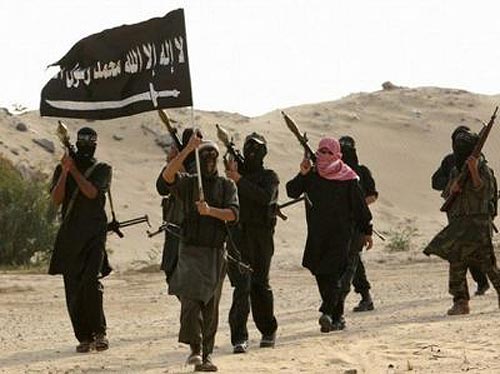
Two factors are likely to worsen the trend of latitudinal Balkanization in the Sahel. One is the greater influence of Al-Qaeda in this region, in particular the Al-Qaeda Organization in the Islamic Maghreb. Not overtly affiliated with the Osama bin Laden branch, and originally founded as the Salafist Group for Preaching and Combat (GSPC) by Hassan Hattab, a commander in the Armed Islamic Group that had plunged Algeria into civil war in the 1980s, it affiliated with Al-Qaeda only later and now wages a low-level insurgency campaign throughout west Africa against European and non-Islamic targets—including in places like Mauritania, Burkina Faso, and Western Sahara that have not even been discussed in this article. Mali’s NLMA renounces Al-Qaeda and their tactics, but Al-Qaeda are presumed to be at least sympathetic to the rise of Boko Haram in Nigeria, and surely the closing off of areas of possible operation in Sudan, Somalia, and Libya, and the emergence of a suddenly unmoored military class with groups like the Tuareg veterans of the Libyan civil war will give them plenty of scope to incite insurgency in the near future.

Hassan Hattab, founder of the precursor to Al-Qaeda in the Islamic Maghreb
More broadly and less visibly,
desertification has been a powerful ingredient in political destabilization in the Sahel. The Sahara is creeping southward, making many areas less productive and forcing migrations that lead to territorial scraps and conflict. As catastrophic climate change begins to chart its unknown course, one thing is sure: water will become scarcer in Africa’s future, and areas that are only marginally agriculturally productive, or only marginally capable of sustaining a nomadic lifestyle, may abruptly tip in the direction of becoming wasteland.
One proposed flag for an Azawad Republic
Sometimes, as in the case of Sudan, the West supported the secession because it reduced the size and influence (and natural resource base) of an Islamic state. But many of the new states that would be formed by the partitioning of Sahelian nations—in Nigeria, Chad, Mali, and elsewhere—would create radical Islamic governments. It would create a corridor of desperately poor, radicalized nations where Al-Qaeda might be welcome to operate. So if these separatists think the international community will tolerate their ambitions—or even, as it did with South Sudan, abet them—they may be sorely disappointed.