Showing posts with label Moors. Show all posts

Tuesday, June 9, 2015

Philadelphia Apartment Building Claimed as Sovereign “Moorish” Territory on 30th Anniversary of MOVE Bombing

A new Black nationalist micronation in Philadelphia?
The city of Philadelphia, Pennsylvania, has never healed from the horrific events of May 1985, when police helicopters bombed an urban compound rented by the radical Black nationalist organization MOVE and the mayor ordered firefighters to stand aside while 65 homes burned to the ground, after a siege followed police attempts to evict the group.  MOVE, a (heavily armed) communitarian, back-to-nature movement, had been branded a terrorist organization linked to the killing of a police officer seven years earlier, though in the 1985 eviction case had done little more than torment neighbors with political diatribes delivered through bullhorns.  Last month, media and activists revisited the MOVE siege on its thirtieth anniversary, which came amid a new civil-rights movement across the United States focusing on police brutality against African-Americans.

How Philadelphia police handled an eviction complaint in 1985.
It was in this climate that four African-American activists facing eviction from another Philadelphia apartment building invoked Black nationalism last week and tried to turn a minor court hearing into an international incident.  They say the entire building is a sovereign territory, not part of the United States.

A tenant in the latest dispute being arrested last month
At the June 2nd hearing addressing defiance of an eviction order by the landlord, Francine Beyer, the four tenants of the apartment at 13th and Hamilton identified themselves as “Aboriginal Indigenous Moorish Americans,” refusing to recognize the court’s right to call them or its authority over the building, which they regard as “theirs by birthright,” according to the Philadelphia Daily News, and not subject to U.S., state, or municipal law.

Location of the apartment building on 13th and Hamilton in Philadelphia being claimed as a separate nation.
“Are you aware that the people who you have falsely called defendants,” one defendant, Nanye Amil El (a.k.a. 45-year-old Dante Morris), wearing a maroon fez cap, asked Judge David C. Shuter, “are actually heirs to this land?”  Another defendant, 65-year-old Delilah Passe, waved what the press described as a Moorish flag but was asked to put it away lest it be used as a weapon.  (If a reader can tell me which flag was used, I would be grateful.)

This (in center) may or may not be an example of the type of Moorish flag
displayed by defendants in court last week in Philadelphia.
At this point, students of the history of Black nationalism and readers of this blog will recognize the names and terminology of the tenants as indications that they are part of the Moorish Science Temple movement.  This precursor to modern Black nationalism emerged in the ferment of religious and political ideas in 1920s and ’30s Detroit, Michigan, where Islam, Freemasonry, offbeat anthropological theorizing, and an infatuation with all things Egyptian and occultic gave rise to Marcus Garvey as well as the Nation of Islam’s founder, Elijah Muhammad, among others.  Many Moorish activists claim that African-Americans are actually African-featured “Israelites.”  This is known as the “Paleo-Negroid” hypothesis, which holds, against all evidence, that the Americas were peopled by ancient Africans who are responsible for the monumental architecture of the Midwestern mound-building cultures and others.

Historic photo of Moorish Science Temple of America members
Other offshoots of the group that have been reported on in this blog include the Washitaw Nation in Oklahoma and elsewhere (see an article from this blog) (whose crown is currently claimed by a Trenton, New Jersey, eccentric calling himself “Crown Prince Emperor El Bey Bigbay Bagby-Badger” (see article), the Nuwaubian Nation of Moors (whose 500-acre compound Tama-Re, in Georgia, was demolished by authorities in 2005), and a new splinter group called the United Nuwaupian Nation (see article). Yet another group, the Moorish Divine and National Movement of the World, includes among its followers Pilar Sanders, the estranged wife of the retired football star Deion Sanders, who in court last month tried to void a prenuptial agreement which would cost her millions by saying that she now calls herself Pilar Biggers Sanders Love El-Dey and answers only to the laws of the “Moroccan Empire.”

Moorish Science follower Pilar Sanders as depicted in a graphic by the celebrity gossip website TMZ
One reporter contacted Brother A. Kinard-Bey, of the largest and oldest Moorish group, the Moorish Science Temple of America, Inc., in Washington, D.C., who called the four Philadelphia tenants “impostors” and said his group is the only real Moorish Temple in the U.S.  He added, “We’re seeing a number of people claiming to be of our temple who want to know how to naturalize or how to gain to their sovereignty.  Those are not lessons that the Moorish Science Temple of America teaches.”


Noble Drew Ali, founder of the Moorish Science Temple movement
Indeed, while Moorish Science traditionally is communal and leftish in its orientation, new offshoots like the Washitaw Nation are borrowing concepts and legal strategies from the “individual sovereignty” movement more popular among alienated right-wing white American males.  One of the tenant activists in Philadelphia this month, 38-year-old Rebecca Lyn Harmon, who asked to be referred to as R. Lynn Hatshepsut Ma’atKare El, is also an attorney (under yet a third name, Rhashea Lynn Harmon), who has talked of running for mayor of Philadelphia on the Republican Party ticket.

R. Lynn Hatshepsut Ma’atKare El (a.k.a. Rebecca Harmon),
a defendant in the current eviction case
A formal arraignment will be held for the four tenants on June 23rd.

American and Moroccan flags on display at a charity event hosted by a separate Moorish group in Philadelphia recently.  Note the 48-star flag.
[You can read more about many of these and other separatist and new-nation movements, both famous and obscure, in my new book, a sort of encyclopedic atlas just published by Litwin Books under the title Let’s Split! A Complete Guide to Separatist Movements and Aspirant Nations, from Abkhazia to Zanzibar.  The book, which contains 46 maps and 554 flags (or, more accurately, 554 flag images), is available for order now on Amazon.  Meanwhile, please “like” the book (even if you haven’t read it yet) on Facebook and see this special announcement for more information on the book.]


Friday, September 13, 2013

Mali Civil War May Be Reigniting; Tuaregs Suddenly No Longer Satisfied with Autonomy


Last month, I reported in this space that the Tuareg rebels of the northern Mali were prepared to set aside their demands for full independence (as some sort of “Republic of Azawad) but promised that violence could be renewed if the incoming Malian president denied the region its autonomy.


But no sooner did a former prime minister, Ibrahim Boubacar Keïta, take office, with barely any time to articulate an Azawad policy, than violence has erupted again.  The main Tuareg rebel group, the National Movement for the Liberation of Azawad (M.N.L.A.), was calling, on September 4th, for pro-independence protests protests to coincide with the inauguration of “I.B.K.,” as Malians call their new leader.  He had promised to open negotiations with the M.N.L.A. within 60 days of taking office.

“I.B.K.”

On September 11th, it was reported that M.N.L.A. rebels clashed with Malian government soldiers near Léré, in the Niafunké district of Timbuktu province, near the border with Mauritania but also right near the former border between the three provinces that make up “Azawad” and the Mopti province that forms a buffer between Tuareg and non-Tuareg parts of Mali.  Each side blames the other for starting the violence, which violates a cease-fire agreed to in June.  Three Malian troops were injured.

Where Tuaregs live.
It is unclear what position the two other main rebel groups in the north—the generally more moderate High Unity Council of Azawad and the ethnic-“Moor”-dominated Arab Movement of the Azawad (M.A.A.)—are taking on the question of peace with the central government.  Nor is it clear how unified the M.N.L.A. is on the question, or whether the renewed fighting was an intentional restarting of hostilities—and, if so, by which side.

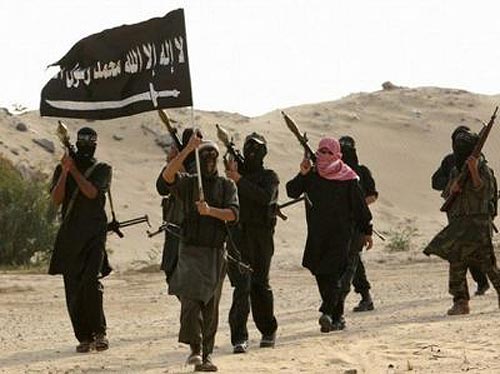
Ansar al-Dine on parade
The current troubles—which this blog has been reporting on in detail all along—began last year when displaced pro-regime Tuareg militias from the civil war in Libya fled, bristling with Moammar al-Qaddafi’s weapons, into northern Mali and reignited the latest in a series of Tuareg uprisings which date back to the early periods of colonial rule by France.  Tuaregs made a fatal alliance with Islamists affiliated with al-Qaeda and with radicals in Algeria, notably the Movement for Unity and Jihad in West Africa (MUJAO) and Ansar al-Dine.  Discontent in Mali’s capital, Bamako, over the government’s response to the Tuareg crisis sparked a coup d’état, which in turn created the power vacuum necessary for the M.N.L.A., MUJAO, and Ansar al-Dine to take over the northern two-thirds of the country with little opposition and declare an “Islamic Republic of Azawad.”  When, earlier this year, they attempted to spread their area of control into Mopti, with the avowed goal of placing all of Mali under shari’a (Islamic law), troops from France, Chad, and other countries intervened and put the north back into government control.  At least the cities.  Most of the hinterlands are still in rebel hands, though the Islamists have mostly melted away into the desert.

What happens next is anyone’s guess.  This, the Fifth Tuareg Rebellion (by many historians’ count), may not be over yet.  Or we may be ready for a sixth.  Without the Islamist factor, it remains to be seen how much the outside world will care this time.


[Also, for those who are wondering, yes, this blog is tied in with a forthcoming book, a sort of encyclopedic atlas to be published by Auslander and Fox under the title Let’s Split! A Complete Guide to Separatist Movements, Independence Struggles, Breakaway Republics, Rebel Provinces, Pseudostates, Puppet States, Tribal Fiefdoms, Micronations, and Do-It-Yourself Countries, from Chiapas to Chechnya and Tibet to Texas.  Look for it some time in 2013.  I will be keeping readers posted of further publication news.]

Monday, August 12, 2013

On Election Eve, Mali’s Tuaregs Vow: Autonomy or War

Not a single hanging chad in sight
Votes are still being counted from the Republic of Mali’s runoff election yesterday, with huge implications for the unity of the country.  Tuareg rebels, in league for a while with Islamists affiliated with al-Qaeda, controlled the northern three-fifths or so of the country for about a year until February of this year, when invading French troops put the Malian government in control of the region’s cities.  But the Tuareg-led National Movement for the Liberation of Azawad (known by its acronym in French, M.N.L.A.) says it will restart the war if any new government does not respect the autonomy of the large, sparsely-populated northern desert region called Azawad.

Map of Mali, showing the formerly de facto independent republic of Azawad in purple
The M.N.L.A. raised the stakes after the July 28th Malian elections it grudgingly recognized and yesterday’s runoff, the results from which are still inconclusive.  The group’s main European spokesman, Moussa Ag Assarid, said August 4th at a conference in Corsica organized by the local separatist Corsa Libera party that the Tuareg rebel group would take up arms against any new government in Bamako that did not guarantee autonomy to Azawad.  A peace deal reached in June stipulates that Bamako will open negotiations with the M.N.L.A. within 60 days of forming a cabinet following these elections.

Moussa Ag Assarid (right) speaking alongside a Berber separatist at a rally in Paris. 
If things do come to that, the M.N.L.A. may not be alone.  On August 9th, in neighboring Mauritania, the M.N.L.A. announced that they had patched things up with two rival Azawadi militias: the High Unity Council of Azawad and the anti-Islamist Arab Movement of the Azawad (M.A.A., formerly known as the National Liberation Front of Azawad, or F.L.N.A.).  This buries the hatchet following remote desert clashes between the groups in April.  Although French and Malian troops control Azawad’s cities, rebels still control areas of northern Mali’s vast deserts—it is not clear entirely how much.  Azawad’s “Arabs”—actually ethnic Berbers who have been speaking Arabic for centuries—are often also called “Moors”—in French Maures, hence the name Mauritania, where they are the largest ethnic group.  These Moors are the main inhabitants of most of Azawad’s territory but are only a small part of the population (perhaps 10-15%, though figures are unreliable), with little presence in the Tuareg-dominated cities of Timbuktu, Kidal, and Gao.  (The Tuareg language is somewhat close to Berber but only very distantly related to Arabic.)


Facing off for the presidency are the Rally for Mali party’s Ibrahim Boubacar Keïta, a former prime minister of Mali (1994-2000), who got 40% of the vote in the July 28th round, and a former finance minister, Soumaïla “Sumy” Cissé, current president of the West African Monetary Union, who got 20%.  Cissé, who faces an uphill battle, is a native of Niafunké, the town in the far south of Azawad’s Timbuktu province, which is also the home town of possibly the world’s most famous Malian, the late musician Ali Farka Touré.  Both Keïta and Cissé have campaigned on vows to end the Azawad conflict without partitioning the country.  If they are not prepared to allow the 10% of the Malian population who are Tuareg and Moor a quasi-state in the north, that may be an impossible promise to keep.

If Keïta wins, he will have the perhaps impossible task of keeping Mali together.
[Also, for those who are wondering, yes, this blog is tied in with a forthcoming book, a sort of encyclopedic atlas to be published by Auslander and Fox under the title Let’s Split! A Complete Guide to Separatist Movements, Independence Struggles, Breakaway Republics, Rebel Provinces, Pseudostates, Puppet States, Tribal Fiefdoms, Micronations, and Do-It-Yourself Countries, from Chiapas to Chechnya and Tibet to Texas.  Look for it some time in 2013.  I will be keeping readers posted of further publication news.]

Saturday, July 21, 2012

Dream of a Tuareg State Fizzles: Is This the End of Azawad? (Mali Update)


The flag of the Independent State of Azawad.  Is it time to fold it up?


Secular Tuaregs Drop Separatist Agenda, Just Want Islamists Ejected.  The secular Tuareg separatist army called the National Movement for the Liberation of Azawad (M.N.L.A.) announced July 15th that it was dropping its goal of secession from the Republic of Mali.  The group declared independence in early April for the Tuareg-dominated northern two-thirds of Mali, which then became the unrecognized Independent State of Azawad.  But gradually Ansar al-Dine, the al-Qaeda-affiliated Islamist militia that aided in the Tuareg conquest of Mali’s northern cities—while the central government was paralyzed by a military coup d’état—took over the governing of Azawad and has been imposing a harsh form of Islamic law (shari’a) on the population.  Ibrahim Ag Assaleh, a senior M.N.L.A. official, told media on the 15th, “We are seeking cultural, political, and economic independence, but not secession.  It would be something like Quebec.”  Another official, Hama Ag Mahmoud, added, “Independence has been our line since the start of the conflict, but we are taking on board the view of the international community to resolve the crisis.”  However, another M.N.L.A. spokesman, Moussa Ag Assarid, says that the group has not abandoned the quest for independence and says any such reports are deliberate misinformation.  Clearly, then, there is not M.N.L.A. unanimity on the issue.  For its part, Ansar al-Dine claims that its goal is to impose shari’a on all of Mali—which is so unlikely that in reality they will only be able to achieve a brief de facto independent Azawad made up of the Islamist-controlled areas—until the international community starts trying to wipe them off the face of the Sahel.

Ansar al-Dine’s flag welcomes arrivals in Azawadi cities

Various international organizations—the United Nations (U.N.), the African Union (A.U.), and the Economic Community of West African States (Ecowas)—have favored a return to civilian rule in the capital and a reunification of the country.  But the International Crisis Group (I.C.G.), a global non-governmental organization (N.G.O.), said in a report on July 18th that Mali’s crisis of leadership in the capital needs to be resolved before Azawad can be recaptured by military intervention, and the foreign ministers of France and Algeria issued a joint statement July 15th favoring political over military solutions.

Pro-Government “Gandakoy” Militia in Mali’s Mopti State Defects to Islamists.  About 400 fighters from a militia known as the “Gandakoy,” formerly loyal to the Malian government, have switched sides and are now allied with Ansar al-Dine.  The defection seems to have occurred in Douentza, in Mopti province—the southernmost and by far most populous and least nomadic and least ethnically Tuareg portion of Azawad, though only part of Mopti is under Azawadi control.  Douentza, in fact, lies right on the border area between Azawad-controlled and Malian-controlled areas.

To understand what this defection means, we should review a little about Mali’s ethnic geography.  The Tuareg are a nomadic people related to the Berber who inhabit a vast interior desert area that includes, in addition to Azawad, parts of MauritaniaNigerBurkina FasoAlgeria, and Libya.  Tuaregs were the personal strike force of Moammar al-Qaddafi, and it was Tuaregs fleeing the anti-Tuareg reprisals of the post-Qaddafi regime in Libya who stoked separatism in northern Mali earlier this year.  The three northern Malian provinces of GaoKidal, and Timbuktu—which, with Mopti, make up Azawad’s claimed territory—are overwhelmingly Tuareg (other than an Arab, or “Moorish,” minority along Timbuktu province’s border with Mauritania).  But Mopti is a far more densely populated, less arid area which is home to DogonSonghaiBambaraBozoFulani (a.k.a. Peul, speakers of Fula, a.k.a. Fulfulde), and other ethnic groups.  (Bambaras dominate in southern Mali and in the capital, Bamako.)

A map showing The three main provinces of Azawad to the north—Timbuktu, Kidal, and Gao—plus the semi-Azawadi-controlled Mopti province, with the areas of its Songhai, Dogon, and Fulani (Fulfulde-speaking) inhabitants.

It is hard to learn much about the Gandakoy, which appears to be dominated by the Songhai, but a Facebook account active mainly in February and March of this year, named Mouvement Patriotique Malien Gandakoy (Patriotic Malian Movement of Gandakoy), emphasizes multi-ethnic Mopti’s edge in population over the territorial vastness of the thinly populated, nomadic, Tuareg parts of Azawad—writing, in a March 1st status update, “The French media have de facto adopted M.N.L.A.’s definition of Azawad and stubbornly want to instill in the minds of the public that Azawad consists of four major regions, namely Timbuktu, Gao, Kidal, and Mopti”—a territory which, because of Mopti, has “a majority (90%) of sedentary Songhai, Peul, Bozo, Arabs, Bambara, making up a population of 6 to 7 million inhabitants.”  The Tuareg separatist M.N.L.A., which launched the secession, “represents,” the status update goes on, “only a tiny fraction of this population.”  The page’s profile picture includes a map coloring an area that includes all of Mali, Senegal, and Guinea-Bissau, most of Sierra Leone, plus western Niger, southern Mauritania and bits of Burkina Faso and Algeria.  This area corresponds to no single ethnic or religious group, leading to the impression that these are ultranationalists nostalgic for the old days of the Malian Empire.  So their switch to join the anti-nationalist, internationalist-jihadist Ansar al-Dine is a case of strange bedfellows—especially since part of, perhaps most of, Ansar al-Dine’s leadership and membership is Tuareg.  More curiously, an apparently pro-M.N.L.A. website, in a December 2011 article, identified the Gandakoy as “nothing but an emanation of the Malian government” (this was before the coup d’état) which practices terrorism against Tamasheq (i.e. Tuareg) and Arab civilians.  I would welcome any further enlightenment from readers on who the Gandakoy are and how they fit into Mali’s rapidly shifting political ethnoscape.

The Gandakoy Facebook page profile picture.

Ansar al-Dine Literally Whips Secularists into Line after Uprising near Timbuktu.  In Goundam, west of Timbuktu, in Azawad, secularists rose up July 13th against their Ansar al-Dine overlords after a young Islamist patrolman whipped a woman carrying a baby because she (the mother) was wearing an inadequately modest veil.  The baby fell as a result of the attack and was critically injured, according to witnesses.  This was too much for the citizenry, about 100 of whom then marched on the Ansar al-Dine local headquarters, vandalized it, and looted food supplies.  The Islamists responded with a crackdown—surrounding the town with checkpoints and going door to door to round up suspected dissidents and, reportedly, whipping 90 of them.  By the next day, most residents were staying inside while heavily armed jihadists patrolled the city.  Goundam originally had a population of 13,000, but since the civil war began in March, about two-thirds of the population has fled.

Ansar al-Dine

Islamist Threats Lead to Cancellation of Moorish Conference in Azawad.  A pro-secession group dominated by Azawad’s Arab (Moorish) minority has had to cancel a conference after threats of violence from radical Islamists.  The Moorish group, the National Liberation Front of Azawad (called N.L.F.A. or, more commonly, F.N.L.A., its French acronym), originally scheduled the July 7th conference, in Boujbeiha, north of Timbuktu, for dignitaries and community leaders from Azawad’s Moorish communities, some of them residents of refugee camps for Malians in neighboring Mauritania.  A Timbuktu journalist said that Ansar al-Dine denied issuing the threats, suggesting that the threats came from the al-Qaeda Organization in the Islamic Maghreb (A.Q.I.M.), the regional terrorist network of which Ansar al-Dine is in some ways a local affiliate.  The conference, however, will be rescheduled, and an F.N.L.A. activist, Sidi Ould Abdallah, said, “We will challenge these threats to express Azawad Arabs’ refusal to give in to a theocracy.”

MUJAO Releases 6 Algerian, European Hostages.  The Movement for Unity and Jihad in West Africa (MUJAO), another offshoot of A.Q.I.M. which has also been running wild in Azawad, has released three of the seven diplomats from Algeria that it had abducted in Gao, in Azawad, around the time of the territory’s declaration of independence, on April 5th.  The release was announced on July 12th.  A few days later, on July 18th, MUJAO freed two aid workers from Spain and one from Italy who had been kidnapped in October 2011 from a refugee camp in Algeria for refugees from Western Sahara.  The three were flown to safety in Burkina Faso before returning home to Europe.

One last group photo before we have to go home!

[Also, for those who are wondering, yes, this blog is tied in with a forthcoming book, a sort of encyclopedic atlas to be published by Auslander and Fox under the title Let’s Split! A Complete Guide to Separatist Movements, Independence Struggles, Breakaway Republics, Rebel Provinces, Pseudostates, Puppet States, Tribal Fiefdoms, Micronations, and Do-It-Yourself Countries, from Chiapas to Chechnya and Tibet to Texas.  Look for it in spring 2013.  I will be keeping readers posted of further publication news.]

Subscribe Now: Feed Icon