Showing posts with label Arabs. Show all posts

Friday, July 18, 2014

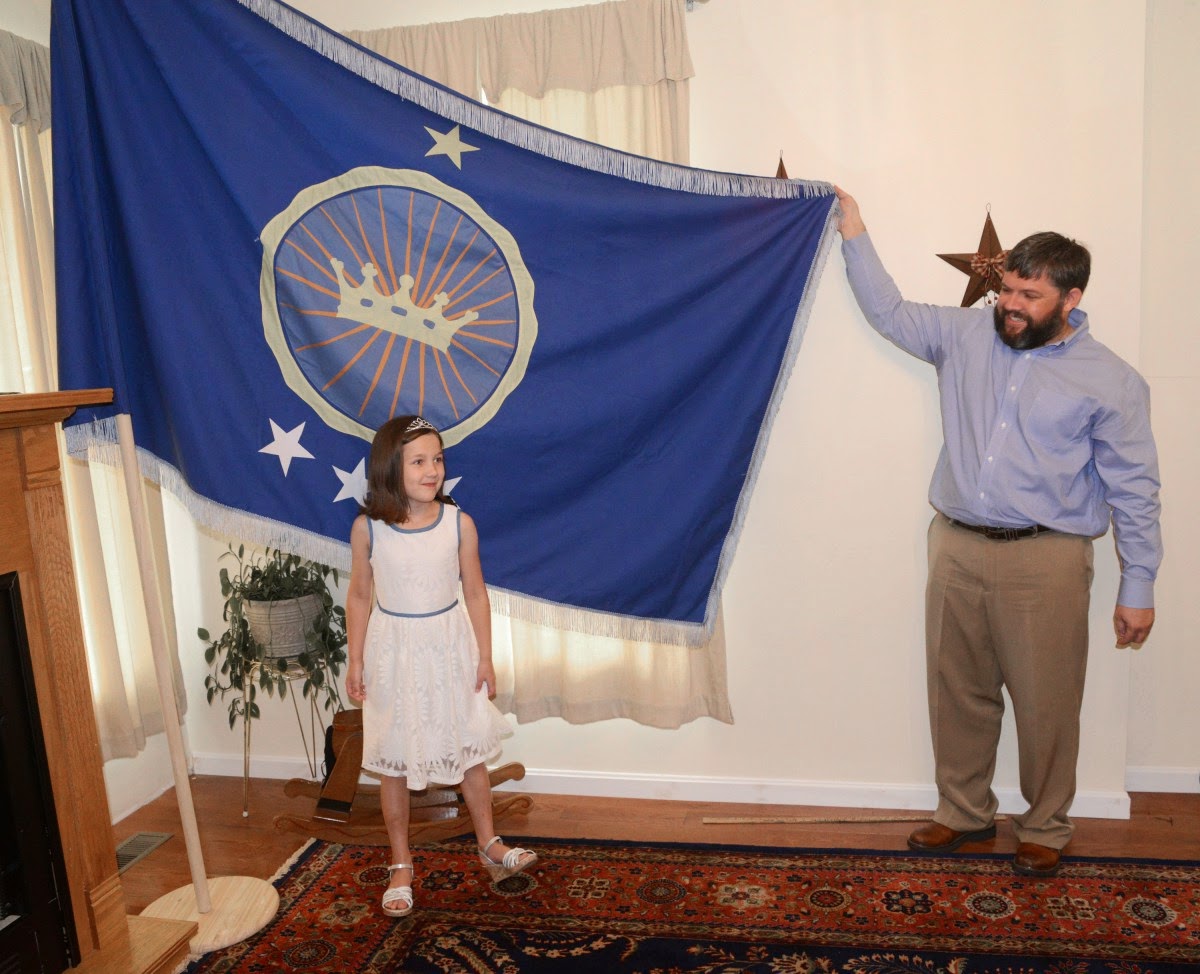
Virginia Dad Crowns 7-Year-Old Daughter “Princess” of African No-Man’s-Land He Dubs “Kingdom of North Sudan”


This Bastille Day, the world awoke to news that a new independent nation had been declared.  No, not Kurdistan or Catalonia or Scotland, but something called, in what is one of the more bizarre “micronations” to be founded in recent years, the Kingdom of North Sudan.  Nor was it founded by any of the numerous rebel groups—Nubians, Darfuris, etc.—who are battling the genocidal regime that runs the Republic of Sudan.

Bir Tawil is now the “Kingdom of North Sudan.”
The declaration was made by one Jeremiah Heaton, a former Democratic Party Congressional hopeful from Abingdon (pop. ca. 8,000), in the Appalachian western reaches of Virginia, who last month made a 14-hour overland trek via desert caravan to a remote, disputed shard of territory between Sudan and Egypt, planted a flag, and declared it, provisionally, “the Heaton Kingdom” and later, officially, on a suggestion from his children, the Kingdom of North Sudan.


His children?  Yes, well, this is sort of all about his children.  The reason Heaton has made himself king of North Sudan is to fulfill a promise to his seven-year-old daughter, Emily Heaton. As the self-styled monarch told the press, “Over the winter, Emily and I were playing, and she has a fixation on princesses.  She asked me, in all seriousness, if she’d be a real princess someday.  And I said she would.”

“Someday, princess, all this will be yours.”
The piece of land in question is Bir Tawil, an 800-square-mile lozenge of desert.  Its special status is due to it having fallen between the cracks of two border agreements: first, the Anglo-Egyptian Condominium Agreement of 1899—which made the 22nd parallel the frontier between the United Kingdom’s newly conquered “Anglo-Egyptian Sudan” (with an emphasis on the Anglo) and what was then an Ottoman Empire puppet state called the Khedivate of Egypt—and, second, a British modification of the boundary in 1902, taking tribal territories into slight account.  For a time, Egypt ruled Bir Tawil while the British in Sudan ruled the larger, coastal wedge of land falling between the two borders, the so-called Hala’ib Triangle.  Today, the independent states of Egypt and Sudan both claim the far larger and more strategic and valuable Hala’ib Triangle.  But the Egyptians, as part of their insistence on using the 22nd parallel as the boundary (thus granting themselves the Hala’ib Triangle), have relinquished their claims on Bir Tawil, and the Sudanese have done the same as part of their position that only the 1902 line is valid.  Thus, today, Egypt de facto administers the Hala’ib Triangle, and no one administers Bir Tawil.

Bir Tawil has attracted the attention of micronation hobbyists before,
as in this image from a 2010 cybernation blog—but only King Jeremiah
has actually planted a flag there.
This is what made Heaton figure that no one would mind if he, you know, just took the territory.  As Heaton himself put it this week, “It’s beautiful there.  It’s an arid desert in northeastern Africa.  Bedouins roam the area; the population is actually zero.”  Whoa, wait, wait—what did he say again?  “Bedouins roam the area; the population is actually zero.”  Yes, that’s what he said.  So, let me get this straight: Bedouins don’t exist? or they aren’t people? or is it just that Bedouins, being nomadic, are presumed to have no rights in any territory whatsoever?  The same callous, dehumanizing logic that has been used to legitimize European colonialism not just in Africa but in the Americas, Australia, and elsewhere is on full display here: “You’re not doing anything with the land that I recognize as ‘ownership’ or ‘permanent residence.’  Thus, white people can take it.”  Oh, but, wait, no—it’s all about Daddy’s Little Princess!  Sorry, sorry, I forgot; didn’t mean to make it sound colonialist or anything.


Africans, sadly, are used to white monarchs—most often, admittedly, legitimate ones—using their land to hand out as party favors to ease family relationships.  One example is the Heligoland Treaty of 1890, in which Germany’s emperor, Kaiser Wilhelm II, swapped Zanzibar to Queen Victoria in exchange for the North Sea island of Heligoland and the Caprivi Strip territory (which, as discussed in an article on this blog, Germans could could use as a supply route between German South-West Africa, today’s Namibia, and German East Africa, today’s mainland Tanzania).  That treaty included a special clause which threw a dogleg into German East Africa’s otherwise ruler-straight border with British Kenya, leaving Mt. Kilimanjaro on the Tanganyika side.  This was done because Wilhelm, who was also Victoria’s grandson (yes, that eventually made things kind of awkward, oh, ’round about 1914), had been pouting about the fact that he didn’t own as many African mountains as his English cousins.  Plus ça change, plus c’est la même chose.


But Jeremiah Heaton is hardly Kaiser Wilhelm II.  In fact, even though the Kaiser’s facial hair is considered much more hip in 2014 than Heaton’s evenly trimmed full beard, Heaton nonetheless very commendably refrained from using mustard gas as a campaign tactic when he sought the Democratic nomination to represent Virginia’s 9th District in 2012.

Kaiser Wilhelm’s facial hair:
hip in 1914, and in 2014
King Jeremiah’s facial hair:
so 1990s

As for Princess Emily, she seems determined to become a benevolent dictator (though with two brothers, she may never accede to the throne, at least under Salic Law).  True, she is as pampered as any well-off little American girl and sleeps in a princess-themed canopy bed.  But she has expressed concern that the people in and around her new realm have enough to eat.  “That’s definitely a concern in that part of the world,” King Jeremiah told an interviewer.  “We discussed what we could do as a nation to help.  If we can turn North Sudan into an agricultural hub for the area—a lot of technology has gone into agriculture and water.  These are the things [Emily and her brothers Prince Justin and Prince Caleb] are concerned with.”

“And next, I want an Oompa Loompa, Daddy—and I want one right now!”
Such magnanimity, unfortunately, may not mollify the brutal Islamist regime in the Republic of Sudan.  The country’s military dictator, Omar al-Bashir, rules through shari’a (Islamic law), something made easier after Western powers sheared off the predominantly-Christian, oil-rich southern half of his country away as an independent state, the Republic of South Sudan, in 2011.  Since then, Bashir has also faced Arab Spring uprisings challenging his rule, insurgencies in the southern regions of Nubia and Darfur, and a 2009 International Criminal Court (I.C.C.) arrest warrant on charges of crimes against humanity, including genocide, for his pitiless proxy war—using the dreaded Janjaweed militia—against the civilian population of Darfur.  Because of these international criminal charges, he is barely able to leave his country, and Sudan is excluded from participating as a full member of the international community.  Sudan was (as discussed at the time in this blog) also one of only 11 states—alongside pariah nations like Syria, Iran, and North Korea—to vote with Russia against a United Nations resolution recognizing Ukraine’s territorial integrity following the Russian invasion and annexation of Crimea.  To sum things up, Omar al-Bashir is a very, very grumpy man indeed.
The supposed “Kingdom of North Sudan” is highlighted in blue.
Nor does the official absence of a territorial interest in Bir Tawil mean that this piece of land is not an ideological and political flashpoint.  Sudan’s narrow Red Sea coastline is now its most important economic asset, that being the only route by which Bashir’s former captive nation and current arch-enemy, South Sudan, can bring its oil to market, via pipelines through Sudan proper to Port Sudan.  That interdependence between the two Sudans is probably the only thing keeping Sudan and South Sudan from destroying each other in all-out war (that and the fact that South Sudan is busily destroying itself in a civil war).  But South Sudan’s military, the Sudanese People’s Liberation Army (S.P.L.A.), a former rebel army, is, by most accounts, at least indirectly in league with rebel groups within the predominantly-Arab rump Sudan—not just the Justice and Equality Movement (J.E.M.) rebels in Darfur (a formerly quasi-independent region on border with Libya) but also something called the Eastern Front.

Flag of coastal Sudan’s
“Eastern Front” rebels
The Eastern Front, which draws support from the coastal area’s Cushitic-speaking Beja ethnic group and the Saudi-derived Rashaida Bedouin Arabs—and perhaps from the dictatorship in neighboring Eritrea—routinely demands more autonomy and is well aware of the strategic importance of the coastline.  In 2005, the Sudanese military killed 17 Beja rioters in Port Sudan, stoking anti-government feeling.  And one of their key demands is wresting the Hala’ib Triangle from Egyptian control—a demand which has become shriller as the new Egyptian dictatorship has cracked down harder on Islamists.  In short, the Eastern Front, with its preoccupation with the unsettled Egyptian border, is a potential mortal threat to the Bashir regime.  The question of who runs Bir Tawil and Hala’ib could conceivably be reopened at any time.

Omar al-Bashir, Princess Emily’s new enemy
King Jeremiah’s naïveté in the face of such realities is stunning.  As he told reporters this week regarding the question of diplomatic recognition, “I feel confident in the claim we’ve made. That’s the exact same process that has been done for thousands of years.  The exception is this nation was claimed for love.”  That’s right: he loves his little princess so much that he’s giving her the gift of a coveted spot on the target list of a terrorist Islamist régime.

Sudan’s pro-government Janjaweed militia
doesn’t like it when people get in their way.
Welcome to Africa, Emily!
[You can read more about separatist and new-nation movements, both famous and obscure, in my new book, a sort of encyclopedic atlas just published by Litwin Books under the title Let’s Split! A Complete Guide to Separatist Movements and Aspirant Nations, from Abkhazia to Zanzibar.  The book, which contains 46 maps and 554 flags (or, more accurately, 554 flag images), is available for order now on Amazon.  Meanwhile, please “like” the book (even if you haven’t read it yet) on Facebook and see this special announcement for more information on the book.]


As one might imagine, sometimes my friends and colleagues let me know about a news development before Google Alerts has a chance to.  In this case, thanks are due to Susan Abe, Tea Krulos (author of Heroes in the Night), and Emperor George II (Empire of Atlantium; like it on Facebook) for calling this story to my attention.
Sunday, April 27, 2014

Signs of Kurdish Spring: Syrian Border Trench, Barzani Statements, U.S. Push to Delist P.K.K. All Point to Eventual Independence


The “Kurdish Spring” in Turkey two years ago never gathered the same momentum toward change at the top as its namesake, the “Arab Spring” launched the previous year (still playing out bloodily in Egypt, Yemen, and partially-Kurdish Syria).  But shifting dynamics in Syria, along with other developments, point to a gradually settling consensus that Iraq’s northern Kurdistan Region is quietly humming along the road toward full independence.


The president of the Kurdistan Regional Government (K.R.G.) in northern Iraq, Massoud Barzani (pictured above), used his strongest language yet on April 8th regarding Kurdish independence.  Referring to the secret World War I–era Franco-British pact which undermined Woodrow Wilson’s later promise of an independent Kurdistan by allowing the new Turkish Republic to consume their homeland, Barzani told a Kurdish television audience, “The mistakes of the Sykes–Picot Agreement should be corrected.  The agreement itself has failed and the region should go back to its original nature, since some of the nations have been linked to each other by force.  No one can stop us from announcing the state of Kurdistan, but we want this to happen through dialogue and mutual understanding rather than war and bloodshed.”


Most surprising, perhaps, has been not only a recently introduced bill in the United States Senate to remove southeastern Turkey’s now more-or-less pacified Kurdistan Workers’ Party (P.K.K.) rebel group from the “terrorism” black list, but also an indication that President Barack Obama supports the move as well.  The Senate bill is backed by none other than Obama’s hawkish gadfly and former election opponent Senator John McCain, of Arizona, who also now says, “It is time we stop treating the K.D.P. and P.U.K. as terrorists” (referring to Iraq’s Patriotic Union of Kurdistan, headed by Iraq’s largely-ceremonial and now exiled president, Jalal Talabani, and Iraq’s Kurdistan Democratic Party), adding that their designation as “Tier III” terrorist groups “betrays our Kurdish friends and allies who have served as a stabilizing force in the region and displayed consistent loyalty to the United States throughout the years.”  It was largely a U.S.-imposed “northern no-fly zone” over northern Iraq after the 1991 Gulf War which allowed Iraqi Kurdistan to build sovereign institutions outside of Saddam Hussein’s reach, with Erbil as its capital.  The designation of Kurdish autonomists as “terrorists,” in both the U.S. and western Europe, is a vestige of the Cold War days when Turkey’s role as a front-line state within the North Atlantic Treaty Organization (NATO) against the Soviet Union made it a far more reliable asset to Western security than it is now.  And, if you want to strict about the definition of “terrorism,” the P.K.K., before its recent cease-fire with Ankara, attacked military targets almost exclusively, not civilian ones.

P.K.K. flags on display at a demonstration in Berlin
But Barzani, in his statements, also referred to the plight of Kurds outside Iraq. “In Turkey and Iran,” he said, “the rights of the Kurds have not yet been officially recognized while Kurds have been attached to these countries forcefully.”  He trod a little more lightly on the question of Kurds in Syria, whom he called more divided, making that situation more complicated.


In fact, actions speak even louder than words—actions like ditch-digging, I mean.  The K.R.G. has been busily digging a massive trench between the Iraqi region it governs and the neighboring portion of northern Syria now called Rojava, or “West Kurdistan,” where retreating Syrian government forces in 2012 allowed the establishment of a fully autonomous de facto state.  Rojava has become a shaky state, with discontinuous territory, but a state nonetheless, with a commitment to multiculturalism: Sunni Arabs, Assyrian Christians, and even diaspora Chechens share power with the majority Kurds in its three self-governing “cantons.”  But one group is shut out of the governing of Rojava, and that is the Kurdish factions strongy allied with Barzani’s K.R.G.: the territory is run by a group closely allied with Turkey’s P.K.K., which alarms both Turkey and the K.R.G. government that is enjoying the pleasant surprise of an oil-lubricated thaw in Turkish–K.R.G. relations.

Building Kurdish unity—not.
Rojava is also fighting for its life to limit territorial gains by a new al-Qaeda-derived Sunni Arab terror group, the Islamic State of Iraq and al-Sham (ISIS, a.k.a. ISIL), which has made great strides in controlling much of the Euphrates valley, all the way from the Syrian–Turkish border region downriver across the Iraqi border to Fallujah, on the outskirts of Baghdad itself.  The K.R.G.’s greatest fear is opening a pathway through its territory for ISIS militants to move freely back and forth and consolidate those gains—especially now that ISIS has been parlaying its stranglehold on Fallujah into foraying northward into K.R.G.-administered lands just outside the official Kurdistan Region, in mixed Arab–Turkmen–Kurdish areas in dispute between Baghdad and Erbil.  The Iraqi central government, too, is is locked in battle with ISIS to preserve the very unity of the non-Kurdish parts of the Iraqi state; backchannel discussions between Baghdad and Erbil have perhaps made it quite explicit that Iraqi Kurdistan cannot get more self-rule of any kind unless it nails shut the doorway to explosive Rojava.  So, for better or worse, the reunification of “West” (Syrian) and “South” (Iraqi) Kurdistan may have to wait until Iraqi Kurdistan disentangles itself from Arab Iraq.

Syrian Kurdistan (Rojava) is in yellow, Iraqi Kurdistan in orange.
Even in Iran, the most effectively totalitarian of the four states with significant Kurdish populations, the two main Kurdish political factions moved toward reconciliation this week.  The Kurdistan Democratic Party of Iran (K.D.P.I.) and its splinter group the Kurdistan Democratic Party (K.D.P.) made moves to repair a split that occurred in 2007.

In Iran, Mustafa Hijri (left) of the K.D.P.
and Khalid Azizi of the K.D.P.I. make nice.
Why is all this happening now?  Perhaps it is because the Shiite-dominated government in Baghdad has realized that it must make its Kurdish problem go away before it can successfully solve its (Sunni) ISIS problem.  Not incidentally, taking the mostly Sunni Kurdish people out of Iraq will leave the remaining population with an overwhelming Shiite majority, instead of the current very slight one.  It is also possible that signals from the K.R.G.’s main allies, including the U.S. and, to an extent, Israel are encouraging the establishment of a new solidly Western-allied state in the Middle East to counter Russia’s new expansionism, especially as President Vladimir Putin contemplates a more and more seamless Russian-aligned front along the northern edge of the region that includes the (soon?) whole north Black Sea coast, the North Caucasus, Armenia, Nagorno-Karabakh, and Iran.

ISIS—not the good guys, and worth digging a trench to keep out
But Kurds have never been ones to look a gift horse in the mouth.  They have waited for centuries for the Western promises of “self-determination” at the close of the First World War to come to fruition.  They can almost taste it.

Waving the Kurdish flag in Erbil
[For those who are wondering, yes, this blog is tied in with a forthcoming book, a sort of encyclopedic atlas to be published by Auslander and Fox under the title Let’s Split! A Complete Guide to Separatist Movements, Independence Struggles, Breakaway Republics, Rebel Provinces, Pseudostates, Puppet States, Tribal Fiefdoms, Micronations, and Do-It-Yourself Countries, from Chiapas to Chechnya and Tibet to Texas.  Look for it some time in 2014.  I will be keeping readers posted of further publication news.]

Monday, February 17, 2014

Yemeni Interim Government’s 6-Region Federation Plan Is Too Little, Too Late for Southern, Houthi, and al-Qaeda Separatists


A six-way split is popular not only among Silicon Valley dreamers who (as discussed yesterday in this blog) would like to partition their state.  It is also the magic number that the government of Yemen is banking on as it decides how to allocate power to the regions in a way that will mollify those who want to split the country up for good.

Yemen’s president Abd-Rabbu Mansour Hadi.
Hm, this doesn’t look quite like a rally for an interim president.
On February 9th, the caretaker interim president of the Republic of Yemen, Abd-Rabbu Mansour Hadi, announced a plan to divide the formerly partitioned Arab country into six autonomous regions—two making up what used to be the People’s Democratic Republic of Yemen (a.k.a. South Yemen) and four making up the smaller, more mountainous Arab Republic of Yemen.  The country will, under the new Constitution if implemented, be called the Federal Republic of Yemen.  The two were pawns of opposite sides in the Cold War until the abrupt end of Soviet communism in 1990 brought about reunification.  But the old border mapped tribal and sectarian loyalties as well, and since then there has been an insurgency seeking to revive an independent South Yemen.  Things had calmed down somewhat after a failed Southern secessionist revolt in 1994, but the Arab Spring revolutions which started in 2011 turfed Yemen’s autocratic ruler, Ali Abdullah Saleh, out of office the following year, and since then the Southern Separatist Movement, also called al-Hirak, has been fighting tooth and nail to split away.

The partition until 1990
Like much else in the Arab Spring, the violence is often sectarian in basis, with Shiites more dominant in the old North Yemen and Sunnis more dominant in the South.  This has given the northern-dominated government the opportunity to cast Southern secessionism as Wahhabist and Islamist in origin, and indeed Ansar al-Shari’a, also known as al-Qaeda in the Arabian Peninsula (A.Q.A.P.) operates mostly in Yemen, and mostly in the south (but increasingly in the north).  But al-Hirak are hardly radical Islamists; they command wide and deep loyalty in the former South Yemen.


But it is not just Southerners who want to split away.  The Houthi minority in the mountainous north of the country, along the border with Saudi Arabia, also have militias and also control territory.  The Houthis are the group that ruled North Yemen when it was the Mutawakelite Kingdom of Yemen, an Arab Revolt successor to the Ottoman Empire.  The Mutawakelites were turfed out of power in an Egyptian-led coup d’état in 1962 in a wave of movements that brought Nasserists, Ba’athists and other Arab nationalists to power in the wake of the Suez Canal crisis.

Apparently some Yemenis wouldn’t mind too much if the South seceded.
To look at the new map of territories unveiled this week (see map at the top of this article), the Yemeni regime seems more worried about the Houthi insurgency, which is closer to the capital, Sana’a, than the Southern one.  The four current Yemeni provinces where Houthis have the strongest presence—’Amran, al-Jawf, Hajjah, and their heartland, Sa’ada—are allocated among three different regions in the new plan: Tahman, Azal, and Sheba.  The former South Yemen, on the other hand, would become two large regions, Aden, around their eponymous former capital, and Hadramaut.

The situation in Yemen early on in the Arab Spring, when the current conflict began ...
Indeed, Houthis have made great gains recently.  It was reported recently that scores were killed in fighting in the northern mountains as Houthis have been disloding rival tribes from their lands.  Houthis now the core territory of the Hashid tribe, in Amran province.  The deposed dictator, Saleh, was a Hashid.

... and the state of play a little later on.
(Both maps are from the excellent and worthwhile Political Geography Now website.)
In some ways, the plan seems to be an attempt to hand a large degree of united autonomy to the South, mainly to try to bring the major Southern secessionist players back to the negotiating table.  Most Southern leaders withdrew from the negotiations for the new Constitution late last year.  The United States has been working quietly behind the scenes to help ensure the South does not split away, though the semi-secret American drone-aircraft war on A.Q.A.P. has not so far been extended to al-Hirak.  As far as the West is concerned, two Yemens would mean double the chance that one of them—most likely the South—would fall under the sway of al-Qaeda.  We have already seen the disastrous effects of al-Qaeda-linked groups piggybacking their cause onto separatist movements in northern Mali and southern Somalia.  Northern Nigeria’s Islamist insurgency could be put in this category as well.  Al-Qaeda also takes advantage of power vacuums in secessionist regions like eastern Libya and Syria’s Kurdistan region.  And, indeed, in 2011 and 2012, Ansar al-Shari’a established two towns, Jaar and Zinjibar, as sovereign Islamist enclaves (Jaar was the “Emirate of Waqar”); those were shut down by the Yemeni military (as reported at the time in this blog), but al-Qaeda will try again if they can.  After all, makeshift city-states is the new al-Qaeda strategy in both Syria (Azaz) and Iraq (Fallujah).

The Emirate of Waqar was short-lived.
President Hadi is now in the unenviable position of proposing a plan to end the violence which does not even have the backing of the major insurgent group in the country.  (At least the Houthis were at the table, but al-Qaeda certainly isn’t—and Houthi rebels naturally reject the six-region proposal.)  Part of the new plan is that after five years the borders and divisions can be reexamined and, possibly, renegotiated.  But that is not necessarily welcome news to Southerners who want independence now.  If nothing else, this means the Southern insurgency will not end any time soon, and may even intensify.

Southern separatists with their flag


[You can read more about South Yemen and other separatist movements, from the well known to the bizarre and obscure, in my new book, a sort of encyclopedic atlas just published by Litwin Books under the title Let’s Split! A Complete Guide to Separatist Movements and Aspirant Nations, from Abkhazia to Zanzibar.  The book, which contains 46 maps and 554 flags (or, more accurately, 554 flag images), is available for order now on Amazon.  Meanwhile, please “like” the book (even if you haven’t read it yet) on Facebook and see this special announcement for more information on the book.]


Monday, January 6, 2014

Polisario Front a Bit More Isolated after Paraguay “Unfriends” Sahrawi Arab Democratic Republic


The Republic of Paraguay’s Ministry for Foreign Affairs announced on January 3rd that the country is withdrawing its diplomatic recognition of the Sahrawi Arab Democratic Republic (S.A.D.R.), also known as Western Sahara, a former Spanish colony now mostly living under the brutal occupation of the Kingdom of Morocco.  It was a further blow to the S.A.D.R.’s governing body, the Polisario Front, the rebel militia which controls the Sahrawi quasi-state behind the vast, Moroccan-constructed sand walls that bisect the territory.  Late last year, Panama and Haiti withdrew their recognition as well (as reported at the time in this blog), leaving the number of countries exchanging ambassadors with the S.A.D.R. at 48, now dipping just under a quarter of United Nations member-states.


Spain withdrew from the Spanish Sahara in 1976 through a negotiated deal that gave the northern two-thirds of the colony to Morocco and the rest to Mauritania.  But Morocco swept in and occupied the entire territory, leaving the indigenous Sahrawi people to organize militarily to defend their right to govern themselves; the S.A.D.R. declared independence that year.  Since then, the question of whether to recognize the S.A.D.R. has mostly been a diplomatic tussle between those countries that side with Morocco and those, led by Algeria and Libya, who regard Morocco as too Western-leaning and side with the (“black,” non-Arab) Sahrawi people.  Now that Libya’s Moammar al-Qaddafi has been toppled and replaced by a shaky, but distinctly Western-leaning regime, Algeria remains the biggest proponent of S.A.D.R. recognition.  Algeria also hosts the vast Sahrawi refugee camp at Tindouf.  Most of Africa, much of Latin America, and parts of Asia recognize the S.A.D.R., but no states in Europe or in the Anglophone world outside Africa do.  The African Union (A.U.) and Organization of African Unity (O.A.U.) have welcomed the S.A.D.R. as a member, but the Arab League sides with Morocco.  Indeed, the dispute has become a proxy battle between the Arab and sub-Saharan African worlds and on the concept of colonialism within Africa.  In past years, no fewer than 39 states have made the same move that Paraguay has just done, withdrawing recognition—among them India, Vietnam, Colombia, Sudan, and Kenya.

Countries that recognize the S.A.D.R. (in red) are shown in green;
those that used to, including as of this month Paraguay, are in dark grey.
Another factor in the decline of the S.A.D.R.’s clout has been the Arab Spring revolutions that began in 2011.  Not only did Morocco’s monarchy, unlike Qaddafi’s régime, deftly ride through the unrest unscathed, but the gradually entrenchment of a terrorist network in North Africa’s central Sahel region seems, in the eyes of Western analysts, to implicate the Polisario Front in a web of cooperation that also includes the Islamist militia Ansar al-Dine which occupied northern Mali for much of last year, their partners al-Qaeda in the Islamic Maghreb (A.Q.I.M.) and Algeria’s Movement for Unity and Jihad in West Africa (MUJAO), the Ansar al-Sharia militia vying for control of the largely lawless interior of Libya, and northern Nigeria’s terrorist army Boko Haram.  Such ties do exist, but Sahrawi people would not be resorting to such alliances and assistance if the international community recognized their legitimate aspirations.


That leaves the Sahrawi people in an even weaker position in the ongoing, glacially-paced U.N. negotiations over Western Sahara’s status.  Perhaps if Western nations stepped up to the plate, set aside their cosy relationship with Morocco’s corrupt king, and recognized the S.A.D.R., then they could save the brutalized Sahrawi people, and help save Africa too.  But don’t count on it.


[For those who are wondering, yes, this blog is tied in with a forthcoming book, a sort of encyclopedic atlas to be published by Auslander and Fox under the title Let’s Split! A Complete Guide to Separatist Movements, Independence Struggles, Breakaway Republics, Rebel Provinces, Pseudostates, Puppet States, Tribal Fiefdoms, Micronations, and Do-It-Yourself Countries, from Chiapas to Chechnya and Tibet to Texas.  Look for it some time in 2014.  I will be keeping readers posted of further publication news.]

Saturday, January 4, 2014

Al-Qaeda-Affiliated ISIS Militia Declares Fallujah an Islamic State as Sunni-Shi’a War Spreads from Syria to Iraq


Only a few days old and 2014 is already starting to look like the year that Syria’s civil war bursts its seams and begins spilling over into neighboring countries.  To the west, a series of bombings in Lebanon include some targeting Hezbollah, the powerful Iranian-backed Shiite Arab militia which is allied with the regime in Syria and has long operated as a quasi-state entity in divided Lebanon.  For the first time since the Lebanese civil war wound down in 1990, Sunnis and Shiites are killing each other in serious numbers in a kind of mimickry of the sectarian battle lines in Syria.  But most dramatically this week in western Iraq, a Syrian-based militia called the Islamic State of Iraq and al-Sham (ISIS) has declared the Sunni-Arab-dominated city of Fallujah to be an independent state.


ISIS, which I flagged just a few days ago as one of “Ten Separatist Movements to Watch in 2014,” is an outgrowth of two groups.  First is the Al-Nusra Front (a.k.a. Al-Nusra Brigades), who have for a while now operated as increasingly well organized jihadist fighters ideologically opposed both to the “heretic” Alawite Shi’a regime of Syria’s embattled president, Bashar al-Assad, and to the more moderate Free Syrian Army (F.S.A.) half-heartedly and warily backed by the West and armed by Turkey and others.  (They hate the Kurds too.)  Along with Al-Nusra, ISIS is also formed out of elements from the Islamic State of Iraq (I.S.I.) (a.k.a. al-Qaeda in Iraq), a hard-line Sunni militia founded by Taliban and other jihadist fighters hardened by war in Afghanistan who set up shop in Iraq in the power vacuum created by the United States invasion in 2003.

Abu Waheeb (on phone), ISIS commander for Anbar province
and presumably de facto ruler of the Islamic State of Fallujah
I.S.I. had never really managed to secure enough territory in the chaos of Iraq’s mid-2000s civil war to advance its dream of a Sunni Arab state separate from the more numerous Arab Shiites who, now that Iraq was a fledgling democracy, were poised to run Iraq.  But by absorbing the Al-Nusra Brigades, they coalesced rapidly into a fighting force efficient enough to capture first Azaz, along Syria’s border with Turkey, which they declared an independent Islamic emirate in September 2013 (as reported on at the time in this blog).  By the middle of December, ISIS and its affiliates had captured a string of other towns in Syria, including Jarabulus, another border town; Al-Bab, near the fiercely contested city of Aleppo; Ar-Raqqah, a northern provincial capital; Shadadeh, in the Kurdish-dominated northeastern province of Al-Hasakah; the Al-Omar Oil Field, on the Euphrates River in Deir ez-Zor province abutting Iraq; Maaloula, far to the south on the outskirts of the national capital, Damascus; and, most daringly, western outposts such as Harem, in Idlib province, and Salma, deep in Alawite-dominated and Assad-friendly Latakia province by the Mediterranean coast.  In Azaz and other communities, ISIS was quick to set up international-border-style roadblocks, hang their ominous black flags, and open schools and other social services which were welcomed, naturally, by devastated, hungry communities pummeled to dust by years of civil war.

Syrian areas of control as of two weeks ago.
(The original map can be found at the highly recommended blog Political Geography Now.)
ISIS’s reference, in its name, to al-Sham uses an archaic Arabic term referring to, roughly, Syria and Lebanon—sometimes called in English the Levant (thus some call the group the Islamic State of Iraq and the Levant, or ISIL)—and by calling themselves the Islamic State of Iraq and al-Sham, ISIS implied a desire to create a theocracy embracing most or all of Syria–Lebanon and the Sunni-Arab-dominated parts of Iraq.  (Kurds, who rule northern Iraq, are Sunni but for the most part have no use for fundamentalist strains of Islam.)  Consequently, they announced last week that they intended to annex Iraq’s Anbar province after taking over Syria.  Anbar, which covers about a third of Iraq, was the scene of some of the worst fighting in the U.S.-led war in the 2000s, partly because it includes vast oil-rich areas with very little population—territories which could conceivably go to either side if Iraq were to be split into Sunni and Shiite entities.  Fallujah itself was the scene of battles in 2004 where U.S. and allied troops fought street to street battles against I.S.I. and other jihadist militias, with well over 1,000 dead.

Abu Waheeb
Those ambitions seemed quixotic a week ago, almost laughably so.  But Anbar, where Sunni unrest directed at the Shiite-dominated central government never really died down, has been boiling over the past several days, following the arrest of a prominent Sunni leader, Ahmed al-Alwani, in Ramadi on December 28th.  The central government and Sunni negotiators agreed on a partial withdrawal of government forces, but then on January 1st the Iraqi army moved in on Sunni rebel positions in Fallujah, just 40 miles or so west of Baghdad, and in Ramadi, which is Anbar’s capital.  By January 3rd, it was being reported that the Sunni-dominated al-Qaeda group ISIS had taken over all of Fallujah and militants were announcing over loudspeakers at Friday prayers, “We declare Fallujah as an Islamic state, and we call on you to be on our side!”  The complete takeover was confirmed by the governor of Anbar, speaking to reporters by phone from Ramadi, and he also confirmed that parts of Ramadi were al-Qaeda-controlled as well.  ISIS forces have helped themselves to Fallujah police weaponry originally contributed by the U.S. Marines.

Ramadi’s Army base on fire this week amid the fighting
Meanwhile, the U.S. State Department says that tribal groups in Iraq are organizing against ISIS and that, in the words of a U.S. spokeswoman, “ We are working with the Iraqi government to support those tribes in every possible way.”  These seem to include member of the Sunni but anti-Qaeda “Awakening Councils,” explicitly organized by the U.S. military during the insurgency and still wielding power.  Other sources say Awakening fighters are showing up on both sides in the fighting.  In any case, Baghdad is not waiting for help on the ground: today government airstrikes on Fallujah were reported.

Young Sunnis this week in Anbar resort to American pop culture to make their anti-Qaeda point.
Where is Sigourney Weaver when Iraq needs her?
In a way, this is more of the long-running deep historical rivalries between Sunni and Shi’a communities in the Arab world.  But the Arab Spring revolts have sharpened that conflict, and many of the civil wars and low-level insurgency and demonstrations in Arab countries have become proxy sectarian wars backed by the three regional superpowers: the theologically radical Sunni monarchy Saudi Arabia, the Sunni-majority secular state Turkey, and the Shiite theocracy Iran.  The Sunni–Shi’a conflict is everywhere.  Saudi Arabia’s Sunni royal families represses Shiite Arabs along the Persian Gulf; a Sunni minority monarchy barely prevented a majority-Shiite uprising in Bahrain in 2011; predominantly Sunni southern Yemenis are fighting a war of secession from formerly partitioned Yemen; the removal of Saddam Hussein shifted power from Sunnis to Shiites in Iraq in 2003, while Sunni Arabs in southwestern Iran wage a low-level insurgency against the government; in Turkey, official state secularism and weak democratic institutions lead to knuckling down on the activities of Shiite minorities like the Alawites and the Alevis, who include many Kurds; Lebanon is a powder-keg with a fragile constitutional power-sharing arrangement between Druze, Shiites, Christians, and Sunnis, with Shiites by far the best armed and organized; and the Syrian civil war is essentially a majority-Sunni revolt against a Shi’a minority dictatorship.


January 2014 may be looked back on as the tipping point, when the civil war in Syria could no longer be contained and became a more general regional war, embracing and weaving together numerous smaller wars in the Middle East.  In the middle of it all, al-Qaeda is building a network of “emirates” which it is using to found a theocratic, terrorist state, across borders, in the heart of the Arab world.  Unless the Iraqi government can somehow regain control.  The next few days will tell.


[For those who are wondering, yes, this blog is tied in with my forthcoming book, a sort of encyclopedic atlas to be published by Auslander and Fox under the title Let’s Split! A Complete Guide to Separatist Movements, Independence Struggles, Breakaway Republics, Rebel Provinces, Pseudostates, Puppet States, Tribal Fiefdoms, Micronations, and Do-It-Yourself Countries, from Chiapas to Chechnya and Tibet to Texas.  The book is now in the layout phase and should be on shelves, and available on Amazon, by early fall 2014.  I will be keeping readers posted of further publication news.  Meanwhile, please “like” the book (even though you haven’t read it yet) on Facebook.]

Subscribe Now: Feed Icon