Showing posts with label Assyrians. Show all posts

Sunday, April 27, 2014

Signs of Kurdish Spring: Syrian Border Trench, Barzani Statements, U.S. Push to Delist P.K.K. All Point to Eventual Independence


The “Kurdish Spring” in Turkey two years ago never gathered the same momentum toward change at the top as its namesake, the “Arab Spring” launched the previous year (still playing out bloodily in Egypt, Yemen, and partially-Kurdish Syria).  But shifting dynamics in Syria, along with other developments, point to a gradually settling consensus that Iraq’s northern Kurdistan Region is quietly humming along the road toward full independence.


The president of the Kurdistan Regional Government (K.R.G.) in northern Iraq, Massoud Barzani (pictured above), used his strongest language yet on April 8th regarding Kurdish independence.  Referring to the secret World War I–era Franco-British pact which undermined Woodrow Wilson’s later promise of an independent Kurdistan by allowing the new Turkish Republic to consume their homeland, Barzani told a Kurdish television audience, “The mistakes of the Sykes–Picot Agreement should be corrected.  The agreement itself has failed and the region should go back to its original nature, since some of the nations have been linked to each other by force.  No one can stop us from announcing the state of Kurdistan, but we want this to happen through dialogue and mutual understanding rather than war and bloodshed.”


Most surprising, perhaps, has been not only a recently introduced bill in the United States Senate to remove southeastern Turkey’s now more-or-less pacified Kurdistan Workers’ Party (P.K.K.) rebel group from the “terrorism” black list, but also an indication that President Barack Obama supports the move as well.  The Senate bill is backed by none other than Obama’s hawkish gadfly and former election opponent Senator John McCain, of Arizona, who also now says, “It is time we stop treating the K.D.P. and P.U.K. as terrorists” (referring to Iraq’s Patriotic Union of Kurdistan, headed by Iraq’s largely-ceremonial and now exiled president, Jalal Talabani, and Iraq’s Kurdistan Democratic Party), adding that their designation as “Tier III” terrorist groups “betrays our Kurdish friends and allies who have served as a stabilizing force in the region and displayed consistent loyalty to the United States throughout the years.”  It was largely a U.S.-imposed “northern no-fly zone” over northern Iraq after the 1991 Gulf War which allowed Iraqi Kurdistan to build sovereign institutions outside of Saddam Hussein’s reach, with Erbil as its capital.  The designation of Kurdish autonomists as “terrorists,” in both the U.S. and western Europe, is a vestige of the Cold War days when Turkey’s role as a front-line state within the North Atlantic Treaty Organization (NATO) against the Soviet Union made it a far more reliable asset to Western security than it is now.  And, if you want to strict about the definition of “terrorism,” the P.K.K., before its recent cease-fire with Ankara, attacked military targets almost exclusively, not civilian ones.

P.K.K. flags on display at a demonstration in Berlin
But Barzani, in his statements, also referred to the plight of Kurds outside Iraq. “In Turkey and Iran,” he said, “the rights of the Kurds have not yet been officially recognized while Kurds have been attached to these countries forcefully.”  He trod a little more lightly on the question of Kurds in Syria, whom he called more divided, making that situation more complicated.


In fact, actions speak even louder than words—actions like ditch-digging, I mean.  The K.R.G. has been busily digging a massive trench between the Iraqi region it governs and the neighboring portion of northern Syria now called Rojava, or “West Kurdistan,” where retreating Syrian government forces in 2012 allowed the establishment of a fully autonomous de facto state.  Rojava has become a shaky state, with discontinuous territory, but a state nonetheless, with a commitment to multiculturalism: Sunni Arabs, Assyrian Christians, and even diaspora Chechens share power with the majority Kurds in its three self-governing “cantons.”  But one group is shut out of the governing of Rojava, and that is the Kurdish factions strongy allied with Barzani’s K.R.G.: the territory is run by a group closely allied with Turkey’s P.K.K., which alarms both Turkey and the K.R.G. government that is enjoying the pleasant surprise of an oil-lubricated thaw in Turkish–K.R.G. relations.

Building Kurdish unity—not.
Rojava is also fighting for its life to limit territorial gains by a new al-Qaeda-derived Sunni Arab terror group, the Islamic State of Iraq and al-Sham (ISIS, a.k.a. ISIL), which has made great strides in controlling much of the Euphrates valley, all the way from the Syrian–Turkish border region downriver across the Iraqi border to Fallujah, on the outskirts of Baghdad itself.  The K.R.G.’s greatest fear is opening a pathway through its territory for ISIS militants to move freely back and forth and consolidate those gains—especially now that ISIS has been parlaying its stranglehold on Fallujah into foraying northward into K.R.G.-administered lands just outside the official Kurdistan Region, in mixed Arab–Turkmen–Kurdish areas in dispute between Baghdad and Erbil.  The Iraqi central government, too, is is locked in battle with ISIS to preserve the very unity of the non-Kurdish parts of the Iraqi state; backchannel discussions between Baghdad and Erbil have perhaps made it quite explicit that Iraqi Kurdistan cannot get more self-rule of any kind unless it nails shut the doorway to explosive Rojava.  So, for better or worse, the reunification of “West” (Syrian) and “South” (Iraqi) Kurdistan may have to wait until Iraqi Kurdistan disentangles itself from Arab Iraq.

Syrian Kurdistan (Rojava) is in yellow, Iraqi Kurdistan in orange.
Even in Iran, the most effectively totalitarian of the four states with significant Kurdish populations, the two main Kurdish political factions moved toward reconciliation this week.  The Kurdistan Democratic Party of Iran (K.D.P.I.) and its splinter group the Kurdistan Democratic Party (K.D.P.) made moves to repair a split that occurred in 2007.

In Iran, Mustafa Hijri (left) of the K.D.P.
and Khalid Azizi of the K.D.P.I. make nice.
Why is all this happening now?  Perhaps it is because the Shiite-dominated government in Baghdad has realized that it must make its Kurdish problem go away before it can successfully solve its (Sunni) ISIS problem.  Not incidentally, taking the mostly Sunni Kurdish people out of Iraq will leave the remaining population with an overwhelming Shiite majority, instead of the current very slight one.  It is also possible that signals from the K.R.G.’s main allies, including the U.S. and, to an extent, Israel are encouraging the establishment of a new solidly Western-allied state in the Middle East to counter Russia’s new expansionism, especially as President Vladimir Putin contemplates a more and more seamless Russian-aligned front along the northern edge of the region that includes the (soon?) whole north Black Sea coast, the North Caucasus, Armenia, Nagorno-Karabakh, and Iran.

ISIS—not the good guys, and worth digging a trench to keep out
But Kurds have never been ones to look a gift horse in the mouth.  They have waited for centuries for the Western promises of “self-determination” at the close of the First World War to come to fruition.  They can almost taste it.

Waving the Kurdish flag in Erbil
[For those who are wondering, yes, this blog is tied in with a forthcoming book, a sort of encyclopedic atlas to be published by Auslander and Fox under the title Let’s Split! A Complete Guide to Separatist Movements, Independence Struggles, Breakaway Republics, Rebel Provinces, Pseudostates, Puppet States, Tribal Fiefdoms, Micronations, and Do-It-Yourself Countries, from Chiapas to Chechnya and Tibet to Texas.  Look for it some time in 2014.  I will be keeping readers posted of further publication news.]

Sunday, February 9, 2014

Kurds Join Hands with Turkmens & Christians in Syria; Iraq Pits Ethnicities against Each Other in North


Things are getting complicated in Kurdistan.  In Rojava (“Western Kurdistan”), the newly declared autonomous region in northern Syria, a multi-ethnic spirit of cooperation is reigning, while in “South Kurdistan” (northern Iraq’s autonomous Kurdistan Region), the central government in Baghdad is using Turkmen and Assyrian autonomy as a bludgeon with which to beat back Kurdish national aspirations.  The leadership in these two parts of Kurdistan have never been farther apart.  Does the Turkish-Kurdistan rebel leader, Abdullah Öcalan, hold the key to greater cross-border unity?  Read on.


The “Geneva II” talks in Switzerland meant to bring Syrian government and rebel leaders together went, predictably, nowhere.  They were not supposed to go anywhere.  Everyone understands that unless Kurds are brought to the table—to say nothing of the radical Islamists of the al-Nusra Front and the Islamic State of Iraq and al-Sham (ISIS), which controls the upper Euphrates River valley—are brought to the table too, there is nothing really for President Bashar al-Assad and the Free Syrian Army (F.S.A.) to talk about.  What happened in Geneva was a pointless kabuki play which was more about providing a forum for the United States secretary of state, John Kerry, to put Iran in a corner and publicly dress down Assad than to do anything to end the bloodshed in Syria’s civil war.

ISIS likes to recruit them young.
Meanwhile, to hell with peace talks: the Kurds in northern Syria, along the border with Turkey, who make up 9 or 10% of the country’s population, declared an autonomous region in 2012 (as reported at the time in this blog) and since the late fall have been quietly building sovereign institutions there, brick by brick, the rest of the world be damned (see recent article).  And they are including other ethnic groups from the region, too, showing a spirit of cooperation seen almost nowhere else in the strife-torn Middle East.

A rough breakdown of ethnic territories in Syria and surrounding areas
Assad’s forces have mainly stayed out of the far north of the country, and it depends on whom you ask whether that is because of a Kurdish military rout of government forces in 2012, or because of a secret deal, with Assad deciding to concentrate his energies in the Syrian heartland while allowing the enemy Kurds to build a buffer state to protect him from a Turkish land invasion.  In any case, that government withdrawal allowed the emergence of autonomous Rojava, as the Syrian Kurdish region is known, but also opened the door for the radical Islamists of ISIS to (as reported at the time in this blog) take a string of towns along the border and disrupt Rojava’s geographic coherence.

A rather optimistic map of Rojava territory (see more realistic map below)
In June 2012, the president of Iraq’s autonomous Kurdistan Region, Massoud Barzani, had brokered a deal between rival Kurdish groups in Syria’s civil war, united under the umbrella of a pro-Barzani Kurdish Supreme Council (Desteya Bilind a Kurd, or D.B.K.).  But by late in 2013, one part of that coalition, the Democratic Union Party (Partiya Yekîtiya Demokrat, or P.Y.D.), which is more or less a local chapter of Turkey’s armed Kurdistan Workers’ Party (Partiya Karkerên Kurdistan, or P.K.K.), broke away and declared a new Rojava under its authority.  This has infuriated Barzani, who has been emerging as an ally of the United States, Azerbaijan, and Turkey.


The new Rojava declared in November 2013 is composed of three autonomous “cantons”: Efrîn (Afrin) in the west, Kobanê (Ayn al-Arab), and one covering the north of Syria’s al-Hasakah province, Cizîre (Jizira, or Jazeera), which includes the notional Syrian-Kurdish capital, Qamishli.  These are explicitly set up to be multi-ethnic and multi-sectarian.  Cizîre has a Kurd, Ekrem Heso, as its president, while the two vice-presidents are a Syriac (Assyrian) Christian named Elizabet Gewriye (a.k.a. Elisabeth Korean) and an Arab named Husen Ezem.  Cizîre has 22 government ministries, including its own foreign-affairs and defense ministries.  The prime minister of Efrîn is Hevi Ibrahim, a Kurdish woman.  Two Christian organizations, the Assyrian Unity Party (A.U.P.) and the Assyrian Women’s Union (A.W.U.) are formally included in the new Rojavan administrations.

A very approximate map of the current situation in Syria shows, at top,
the three autonomous cantons of Rojava (in yellow, from left to right): Efrîn, Kobanê, and Cizîre.
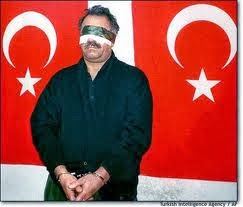
Last month, a special letter was delivered from the imprisoned leader and founder of the P.K.K., Abdullah Öcalan, to President Barzani in Erbil, Iraq, asking him to support Rojava’s sovereignty.  The letter was hand-delivered by Leyla Zana, a high-profile Kurdish member of the Turkish parliament from Diyarbakır, the notional capital of Turkish Kurdistan.  Öcalan also asked Barzani to support the peace process by which the P.K.K. is disarming and withdrawing from Turkey—and, Barzani fears, joining and strengthening the force in Rojava.  No word yet on whether this has softened Barzani’s feelings toward his Kurdish neighbors to the west, but the rivalry has complicated matters for him at home: the leadership of the opposition political party in Iraqi Kurdistan, the Movement for Change (Bzutinewey‌ Gorran), are supporting Rojava.  Gorran is angling for the vice-presidency in the Iraq’s Kurdistan Regional Government (K.R.G.).

Abdullah Öcalan, the imprisoned leader of Turkey’s Kurds
No one, of course, is more alarmed by these developments than the Shiite-Arab-dominated government in Iraq.  (Most Kurds are Sunni.)  Baghdad fears nothing more than that the spirit of cooperation between Kurds, Turkmens, and Christians in northern Syria would inspire similar alliances on the Iraqi side of the border—creating an even vaster area that would like to split away from Iraq, not just the Kurdistan Region.  Already, the K.R.G. has been itching to annex, and in some cases de facto administering, provinces outside of the official region where Turkmens and Christians live alongside Kurds, especially in Nineveh and Kirkuk provinces—provinces rich in oil.

Flag of the Assyrian people
With this in mind, the Iraqi central government declared last month intentions to create three new Iraqi provinces.  Two of these would be designed to be ethnic homelands for Iraq’s restive non-Kurdish minorities.  The Nineveh Plain, which is the heart of traditional Assyria, would be a new province dominated by Assyrian Christians, while Tuz Khormato province to its east (now part of Saladin province) would be set aside for Turkmens—who have long demanded their own autonomous region, or even independent state, to be called Türkmeneli, just to the south of, or overlapping with, the current Kurdistan Region.  Turkmens have also been pushing, so far without success, for a role in the K.R.G. administration.  (The third new province would have its capital at Fallujah, currently in Anbar province.  This is a rather pathetic attempt to minimize the damage to Iraqi unity done by ISIS, which last month took control of Fallujah and declared it a Sunni-Arab-ruled Islamic state.  The Sunni tribes in and around Fallujah are unlikely to be very impressed with the promise of their own province while (Shiite) Iraqi bombs rain down on the city.)


It rather looks as though Baghdad is trying to tie an ethnic noose around the Kurdistan Region, entrenching Turkmens and Christians in autonomous regions that would prevent Kurds from solidifying their control of Mosul and Kirkuk.  But Nineveh’s Sunni Arab governor in Mosul, Athil al-Nujaifi, sees an even more sinister motive.  “Reviewing the maps,” he said, “show that the two provinces proposed are located on the shortest route between Iran and Syria in Mosul.”  He said Iraq’s Shiite Arab president, Nuri al-Malaki, plans to sow sectarian division in the region, move Kurdish forces back over the border into official K.R.G. territory, and open a supply route through Iraq for weapons from Iran (a Shiite theocracy) to its allies in the (Shiite Arab) Syrian government.  Gov. Nujaifi, who fears that what he sees as the Shiite-on-Sunni war in Anbar will spread north to Nineveh, has even gone so far as to suggest that the current Nineveh province should declare autonomy from Baghdad as a Sunni Arab autonomous region.

Gov. Athil al-Nujaifi
And now there is an even further complication: it seems that ISIS and its affiliates in Syria have recruited at least 200 Iraqi Kurds into their ranks—even though Kurds on the whole tend to be socially progressive and politically moderate by Middle Eastern standards.  Their ultimate goal seems to be making Iraqi Kurdistan into an Islamic state separate from Iraq.


Despite all this, the Kurdish people have survived centuries of divide-and-rule tactics.  They are not about to be turned back now.  The momentum toward autonomy and independence, on the whole, seems unstoppable.  But there may be a lot of ethnic and sectarian bloodshed along the way.


[For those who are wondering, yes, this blog is tied in with my new book, a sort of encyclopedic atlas just published by Litwin Books under the title Let’s Split! A Complete Guide to Separatist Movements and Aspirant Nations, from Abkhazia to Zanzibar.  (That is shorter than the previous working title.)  The book, which contains 46 maps and 554 flags (or, more accurately, 554 flag images), is available for order now on Amazon.  Meanwhile, please “like” the book (even if you haven’t read it yet) on Facebook and see this special announcement for more information on the book.]


Related articles from this blog:
“And Now Civil War ... Could Syria Break Up?” (Nov. 2011)
“The Iraq War Is Over, but Is Iraq’s Partition Just Beginning?” (Dec. 2011)
“Get Ready for a Kurdish Spring” (March 2012)
“Shifting Alliances in the Kurdish Struggles” (April 2012)
“Syria’s Kurds Are Setting Up a Quasi-State—How Long Can It Last?” (July 2012)
“Liberation of Syrian Kurdistan Infuriates Turkey, Iraq, and the Free Syrian Army—in Fact, Everyone but Assad” (Aug. 2012)
“Turkish Kurdistan Ground War in Progress, Iraq Border Crisis Eases” (Aug. 2012)
“Kurdistan Update: Both Turks & PKK Claim to Control Şemdinli, Zaza MP Abducted, Donna D’Errico and Noah’s Ark” (Aug. 2012)
“Carnage Continues in Turkish Kurdistan” (Aug. 2012)
“Kurd Truce in Syria?, Plus: Turkmen and Kaka’i in Conflict with Iraqi Kurds” (Nov. 2012)
“Syrian Kurds Liberate 4 More Towns; Diyarbakır Mayor on Hunger Strike; More Carnage in Southeastern Turkey” (Nov. 2012)
“Kirkuk Car Bombing, Stand-Off in Iraq, Turkish Airstrikes: Kurdistan Update” (Dec. 2012)
“10 Separatist Movements to Watch in 2013” (Dec. 2012)
“Iraq’s Kurds and Arabs Debate Inclusion of Minorities in National Anthem” (July 2013)
“Syrian Regime Seeks Israeli Green-Light for Separate Alawite Republic” (Aug. 2013)
“The Caliphate Movement Comes to Syria: New Islamist Army Falters in Azaz but May Try to Carve Out Separate State” (Sept. 2013)
“Syrian Kurds’ Declaration of Autonomous ‘Rojava’ Scorned by Turkey, Assad—Even by Iraqi Kurds” (Nov. 2013)
“10 Separatist Movements to Watch in 2014” (Dec. 2013)
“Al-Qaeda-Affiliated ISIS Militia Declares Fallujah an Islamic State as Sunni–Shi’a War Spreads from Syria to Iraq” (Jan. 2014)
“Middle East Update: Al-Sham Islamic State Takes Form, West Kurdish Constitution, New Rights for Christians, Turkmens” (Jan. 2014)
“Yet Another Genocide Olympics: 10 Political Causes Sure to Disrupt the Sochi Games” (Feb. 2014)

Sunday, January 12, 2014

Middle East Update: Al-Sham Islamic State Takes Form, West Kurdish Constitution, New Rights for Christians, Turkmens


The redrawing of the map of the Middle East continued apace this past week, following the takeover of Fallujah and part of Ramadi in western Iraq’s Anbar province by a radical Islamist group affiliated with al-Qaeda.  Turkmens, Christians, and Kurds are all scrambling for pieces of the territorial pie as Syria and Iraq both spin out of control and into anarchy.

Anbar
First, the radical Sunnis.  The Islamic State of Iraq and al-Sham (ISIS), an outgrowth of last decade’s al-Qaeda in Iraq (a.k.a. Islamic State of Iraq, or I.S.I.) militia (which itself grew out of the al-Qaeda network in Afghanistan), had for months been building up its strength in the power vacuum of Syria’s civil war, mostly at the expense of the far more moderate, Western-backed, but utterly disorganized and fractious Sunni rebel network known as the Free Syrian Army (F.S.A.).  Then, on January 3rd (as reported at the time in this blog), ISIS fighters entirely took over Fallujah, a major city in Sunni-Arab-dominated Anbar province in western Iraq, about a half hour’s drive from the western outskirts of Baghdad.  ISIS fighters have held on there, but have been a bit less successful in taking over the smaller city of Ramadi, Anbar’s capital.  Fallujah was the scene of two of the fiercest battles in the United States’ war in Iraq, in 2004, with U.S. and Iraqi-government forces trying to quell a radical Sunni insurgency.  Things look similar now, except that the U.S. is gone, and the Islamists are winning (never mind that Sunni radicals would never have gained a foothold if the U.S. hadn’t invaded in the first place).  Fallujah is probably the city with the strongest anti-Shiite sentiment, and most of that anger is directed at the Shi’a Arabs who have run Iraq since the Sunni (but fiercely secularist) dictator Saddam Hussein was toppled in 2003 and the 65%-or-so Shi’a majority came to power in the ensuing elections.  Now, as Shiite bombs are feared soon to rain down on Fallujah, the prejudices of ordinary Sunni people in the city are hardening.  The Iraqi government is reportedly planning on keeping its assault—once it gets up the nerve to launch it in earnest—away from civilian areas for this very reason, but it won’t take much for any moves by Baghdad to feel like an anti-Sunni massacre to those in Fallujah.  The tribal Sunni militias in Anbar which the U.S. had tried to cultivate as partners to the new Shiite-led government—with partial success—seem now to be siding mostly with ISIS.

Ongoing chaos in Fallujah
ISIS has declared Fallujah to be an independent Islamic state.  Whether that state is something called the Islamic State of Fallujah, or whether it is presumed to be the kernel of an emerging Islamic State of Iraq and al-Sham is something which may slowly become apparent.  Perhaps the ISIS warlord in Fallujah, Abu Waheeb, is improvising as he goes along.  (Al-Sham means, roughly, the Levant, i.e. Syria and Lebanon; some news sources are calling ISIS “ISIL,” for Islamic State of Iraq and the Levant, and some are saying, inaccurately, that ISIS stands for Islamic State of Iraq and Syria—but they all refer to the same group.)  Much will depend on whether control of all or some of Anbar can be consolidated and whether that territory can be linked up with ISIS’s “liberated” territory in eastern Syria.  Which brings us to ...

Fallujah this week
North-central Syria’s heartland
Late last year, ISIS began capturing small towns in northern Iraq, mostly along the border with Turkey, in Syria’s Kurdish region.  The first of these was Azaz (as reported at the time in this blog), and others followed.  But by December ISIS was exceeding all expectations, capturing smaller towns in the far east along the Iraqi border and in the far west, in the Alawite (Shiite) Arab heartland of Latakia province.  Its biggest prize, however, has been ar-Raqqah, a provincial capital in north-central Syria.  Ar-Raqqah province borders Turkey and includes Kurdish areas, but its capital is on the Euphrates, which flows from ar-Raqqah to Ramadi and Fallujah in Iraq.

The B.B.C.’s most recent map of different areas of rebel control in Syria
But is ISIS going to capture the entire upper Euphrates and build a coherent territory in the way that the Kurds have?  Maybe not.  The al-Nusra Front, the loosely organized Syrian-based component of ISIS, is apparently seeing some defections, with individual militias deciding that the former I.S.I. units with whom they formed ISIS last year are foreigners who are too radical for them, and maybe even worse than the embattled Alawite dictatorship of Bashar al-Assad.  This is partly because of ISIS’s governing style, which involves sweeping into town, executing a few “infidels” and “traitors” in the town square, and then dispatching armed morality patrols to enforce shari’a (Islamic law).  What had become, by late last year, a three-way battle in Aleppo, ar-Raqqah, al-Hasakah, and Deir ez-Zor provinces among Assad’s government forces, the F.S.A., and al-Nusra may soon become a four-way battle among the government, the F.S.A., al-Nusra, and ISIS.  No, wait, five-way—since Kurdish militias (more on them below) are also vying for control of al-Hasakah city and parts of Aleppo.


These new twists put Western backers like Turkey and the U.S. in a quandary.  They know whom they want to win in Iraq, but in Syria it’s not so simple.  It was bad, and embarrassing, enough, when various forms of aid sent in the direction of the F.S.A. ended up in al-Nusra hands, but now the West may need to calculate that it’s worth backing al-Nusra for a little while—you know, just a little while—until ISIS is brought under control.  Sounds like a bad idea: help bad guys because they’re helping you fight worse guys depends a lot on fallible judgments as to who is bad or worse, and it can have an effect called “blowback.”  After all, that’s how the Taliban and al-Qaeda came to power in Afghanistan in the first place.  As for the Syrian opposition’s other “Western” backers, Saudi Arabia, well, for them strengthening al-Nusra might not even be a difficult choice.  Many of them are Saudis anyway, and have the tacit blessing of the royal family.  Look for a serious, perhaps permanent falling out between the U.S. and Saudi Arabia over how to handle Syria.

An image circulating in ISIS circles shows the nascent Islamic state
in Anbar and Syria as part of an eventual global Caliphate.
Hey, wait a minute—gulp!—is that Vienna?
Syrian Kurdistan
Things are a little bit more stable in the far north of Syria, along the border with Turkey, as the de facto self-governing Western Kurdistan Autonomous Region formed last year in liberated pockets along the border was in November 2013 rechristened Rojava (which simply means “western” in Kurdish) and was given specific contours and a formal (unrecognized) government (as reported at the time in this blog).  This past week, the Rojava government started filling in the details of its supposedly federal-style internal structure, with separate autonomous entities for Kurds, Christians, and Arab Muslims.  On January 6th, the Rojava’s governing Western Kurdistan Constituent Assembly unveiled a new constitution, which specifies the three autonomous subdivisions and confirms that the new state will be official multilingual, with state business conducted in Kurdish, Arabic, and Syriac (i.e. the variety of Aramaic—the language spoken by Jesus—which is in use today in the Syriac, Chaldean, and Assyrian communities of Middle Eastern Christians).  Other statements out of Rojava have also referred to equal rights for the Turkmen and even Chechen minorities.

The Western Kurdistan Constituent Assembly speaks to the public
This may have something to do with the fact that, to both Turkey’s consternation and that of the Kurdistan Regional Government (K.R.G.) in neighboring Iraq, Rojava is being run by the Democratic Union Party (Partiya Yekîtiya Demokrat, or P.Y.D.), a group linked to Turkey’s outlawed, traditionally-Marxist-Leninist Kurdistan Workers’ Party (Partiya Karkerên Kurdistan, or P.K.K.) and antagonistic to the K.R.G. government.  In Iraq’s Kurdistan Region, Kurds vie for control of the Kurdish-populated penumbra outside the official autonomous region, in places like Mosul, Kirkuk, and the Nineveh Plains that are also regarded as homelands for the Turkmen and Assyrian people, who naturally want their own autonomous regions.  Are the Rojava Kurds competing with the K.R.G. for the loyalties of the region’s smaller minorities?  If so, this could get much messier.


Northern Iraq
Meanwhile, perhaps as a direct response to the developments in Rojava, the Iraqi parliament in Baghdad voted on January 8th to make Turkmen, Syriac, and Assyrian national languages alongside the existing official languages, Arabic and Kurdish.  (There is a lot of variation in how to name the modern Aramaic languages; some use the terms Assyrian, Chaldean, and Syriac interchangeably, or use one term as including the other two, or name the same language differently depending on which self-identified ethnic or sectarian group is using it.)  Meanwhile, Turkmen leaders in areas hard-hit by terrorist violence said this week that they were forming popular defense committees along the lines of those formed by Kurds in Syria.

Some Turkmens’ rather optimistic vision
of an autonomous region or independent state to be called Türkmeneli
Things change in the region almost daily.  Springtime of Nations will do its best to stay on top of developments and keep you informed.


[For those who are wondering, yes, this blog is tied in with my forthcoming book, a sort of encyclopedic atlas to be published by Auslander and Fox under the title Let’s Split! A Complete Guide to Separatist Movements, Independence Struggles, Breakaway Republics, Rebel Provinces, Pseudostates, Puppet States, Tribal Fiefdoms, Micronations, and Do-It-Yourself Countries, from Chiapas to Chechnya and Tibet to Texas.  The book is now in the layout phase and should be on shelves, and available on Amazon, by early fall 2014.  I will be keeping readers posted of further publication news.  Meanwhile, please “like” the book (even though you haven’t read it yet) on Facebook.]

Monday, July 29, 2013

Iraq’s Kurds and Arabs Debate Inclusion of Minorities in National Anthem

In the Republic of Iraq, some Kurdish members of the parliament in Baghdad would like the Iraqi national anthem to be modified in order to represent their large minority, but they are getting pushback from representatives of the Arab majority—and even from some fellow Kurds.


Muayad Tayyib, M.P., from the Kurdistan Democratic Party (K.D.P.), is one Kurdish legislator who would like no fewer than three verses in the currently-under-revision national anthem devoted to Iraqi Kurds.  Proposed verses include excerpts from the works of poets, including the Iraqi Kurdish versifier Fayak Bekas (How sweet and fulfilling is the water of our homeland ...) and a non-Kurdish Iraqi poet and theologian from Najaf, Muhammad Mahdi al-Jawahri, who nonetheless composed verse about Kurdistan’s “high mountains and wide plains, ... your generous people and rich history.

Set your poems to music!
Muhammad Mahdi al-Jawahri in his later years
Since the Iraqi state was carved out of the remnants of the Ottoman Empire by the League of Nations in 1920 (the United Kingdom then oversaw its 12-year transition to independence), the Iraqi national anthem has changed each time there has been a regime change.  But Iraqis of all stripes are now wondering if Kurds (who are 17% of the population; nearly all the rest are Arab) should be included in the anthem if, as many expect, the northern Kurdistan Autonomous Region is on its way toward eventual independence.  Could three verses be enough to convince the Kurds to stay in a perhaps looser federal union?  Or should the anthem be an apologetically Arab-nationalist one, in preparation for a smaller and more ethnically homogeneous country?

Kurdistan’s flag
And then there is the the uncomfortable question of how many Kurds might still be in Iraq after the region secedes: after all, large Kurdish areas remain outside the reach of the Kurdistan Regional Government (K.R.G.), including vast oil resources and the ethnically mixed city of Kirkuk.  But the K.R.G. administers these areas, if loosely anyway.  Would they be taken along into an independent Kurdistan as well?  Such demographic and cartographic details (see maps above) as that will be a bigger headache down the road for the Iraqi parliament, and maybe for the Iraqi army too.


As could perhaps have been expected, Iraq’s Turkmens (3% of the population, including many in the disputed Kurdish area) and Christians (mostly Chaldeans and Assyrians, 1% of the population and shrinking) want verses too—and in their own languages.  So how about some brief mentions for the minuscule Yezidi and Zoroastrian populations?  That doesn’t seem too much to ask.

Turkmens want a piece of the pie too.
Perhaps the wisest suggestion is from Sardar Abullah, a member of parliament who thinks the national anthem should resemble that which was used under King Faisal I in the 1920s: it had no words at all.

Faisal I in 1919.
T. E. Lawrence (“of Arabia”) is to his immediate left behind him.

[Also, for those who are wondering, yes, this blog is tied in with a forthcoming book, a sort of encyclopedic atlas to be published by Auslander and Fox under the title Let’s Split! A Complete Guide to Separatist Movements, Independence Struggles, Breakaway Republics, Rebel Provinces, Pseudostates, Puppet States, Tribal Fiefdoms, Micronations, and Do-It-Yourself Countries, from Chiapas to Chechnya and Tibet to Texas.  Look for it some time in 2013.  I will be keeping readers posted of further publication news.]

Saturday, June 9, 2012

The Week in Separatist News, 3-9 June 2012: Clinton in Strife-Torn Caucasus, Plus Updates on Darfur, Kurdistan, Papua, Azawad, Cyrenaica, E. Turkestan, & Schleswig-Holstein

Photo of the week: Crowds at the Mae La refugee camp in Thailand, home to members of Burma’s Karen nationality, await, under heavy military presence, the arrival of Aung San Suu Kyi.  (See story below, under “East Asia.”)


TOP STORY:
SECRETARY OF STATE CLINTON VISITS
A CAUCASUS REGION SLIDING INTO WAR


9 Killed in Armenian-Azeri Border Violence Amid Clinton Visit.  A border clash between Armenia and Azerbaijan June 4th, on the eve of a visit to the region by the United States secretary of state, Hillary Rodham Clinton, has killed five Azeri troops and three Armenian ones, in the worst border violence in four years.  The incident took place in Qazakh district, near the point where Georgia, Armenia, and Azerbaijan meet, and north of the disputed Nagorno-Karabakh region.  Azerbaijan’s ministry of defense says an Armenian “saboteur squad” attacked over the border, killing five Azeris before being pushed back, while Armenia’s defense ministry claimed three Armenians killed by an invading Azeri battalion.  By the next day, news agencies were calling it eight dead, with another Armenian soldier killed (and two injured) along the Nagorno-Karabakh cease-fire line, and no clear indication of which side was to blame for starting the fighting.  Some Armenian sources said that Azerbaijani authorities were concealing the fact that up to 25 Azeri “saboteurs” had been killed in this week’s fighting, calling most of the deaths accidental.  Clinton warned that such violence could lead to a “much broader conflict.”  (See my recent article on the geopolitics of the South Caucasus and Asia Minor.)

Clinton Discusses “Status-Neutral” Passports for Abkhazia and South Ossetia.  Clinton reassured the Republic of Georgia while in Tbilisi June 5th that her government firmly opposed the independence of the Russian Federation–backed puppet states of Abkhazia and South Ossetia, which the U.S., like most of the world, regards as Georgian territory.  She added that the U.S. will recognize a planned “status-neutral” passport for residents of the two republics that will be recognized in the West.  Since the 2008 South Ossetia War between Russia and Georgia, residents of the two republics have had to choose between Russian passports or South Ossetian or Abkhazian passports which most of the world does not recognize.  The governments of Russia and the two republics condemned Clinton’s statements on the passports.  Clinton visited a total of four countries—Georgia, Armenia, Azerbaijan, and Turkey—during her visit.  (See my article on last year’s disputed presidential elections in South Ossetia.)

Hillary Rodham Clinton in Tbilisi this week, with ambassador John Bass and foreign minister Grigol Vashadze

Javakhk Armenians Petition Clinton on Political Prisoner.  Armenians from the Javakhk region in the Republic of Georgia sent a letter to Clinton before her visit, asking her to help seek the release of what they call a Javakhki political prisoner held by Georgia.  The prisoner, Vahagn Chakhalyan, is serving a ten-year prison sentence after agitating for the rights of Georgia’s Armenian minority.  There is no indication that Clinton did take up the issue when she visited Georgia.  (See my recent blog article discussing Armenia and the politics of memory.)


Abkhazia Blames Georgian “Saboteurs” for Murder of Police in Café.  The state security service of the Republic of Abkhazia are accusing the Georgian government of sending a “saboteur intelligence squad” into Abkhazia to carry out the May 28th machine-gunning of three people, including two policemen, at a café in the Abkhazian town of Gali.  The statement also said that Abkhaz police had back in March arrested one of the Georgian saboteurs and extracted from a confession that Georgia was targeting one of the policeman killed last week, one Devi Buava.  Georgia’s ministry of the interior rejected the accusations.

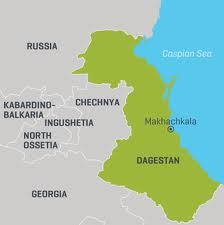
Killings of Police in Dagestan and Circassia Claim 3 in a Day; 6 Rebels Dead in Raid.  Meanwhile, in the ethnic republics along the Russian-controlled northern slope of the Caucasus ridge, violence raged before and during Clinton’s visit.  In the Russian Federation’s Republic of Dagestan, which is riven by Islamist separatism, a traffic police officer in Makhachkala, the capital, was shot and killed by unknown assailants on June 1st.  Earlier in the day, in the Kabardino-Balkar Republic in the Circassian region of Russia’s western North Caucasus, a 26-year-old traffic policeman was shot and killed while off duty in the capital city, Nalchik, and an hour later the body of a senior police investigator specializing in counter-insurgency was found shot dead in his car, also in Nalchik.  The following day, a federal investigator in Kabardino-Balkaria narrowly survived an attack on his car by unknown assailants with automatic weapons.  Later, on June 6th, one policeman was killed and another wounded after an unknown assailant unleashed automatic-weapon fire on a police car in Kizilyurt.  Six members of the militant Kyzlyar group were killed, according the Dagestani interior ministry on June 8th, in a special-operations police raid on an apartment in Dagestan.  And in the Republic of Ingushetia, unknown assailants launched grenades on June 8th into the home of the secretary of the republic’s security council, in Malgobek.  There were no injuries in that attack.

AFRICA


Islamists, Secular Tuaregs Turn Guns on Each Other in Azawad.  Relations between the two militias that have been co-ruling the northern two-thirds of the Republic of Mali as the Independent State of Azawad since early April may have finally snapped and broken.  Muslim but mostly-secular Tuareg separatists from the National Movement for the Liberation of Azawad (known by its French acronym M.N.L.A.) and the al-Qaeda-affiliated Islamist militia Ansar al-Dine, which would like to impose Islamic law (shari’a) throughout Mali, battled on the night of June 8th in Kidal, one of the largest cities in Azawad.  A local official told Agence France Presse, “Ansar al-Dine were to the north of Kidal, a group of M.N.L.A. to the south,” and heavy machine-gun fire was being exchanged.  The week began with talks reopening between the two groups on June 2nd, when a spokesman for Ansar al-Dine, which is an arm of the al-Qaeda Organization in the Islamic Maghreb (A.Q.I.M.), said there was new dialogue with the M.N.L.A.  Last week (as reported in this blog), splits had appeared in the coalition as Ansar al-Dine’s declaration of an Islamic republic was quickly followed by M.N.L.A. clarifications that it would be only a very mild form of shar’ia that would be implemented.  Soon after, on June 1st, the M.N.L.A. seemed to be actually disbanding the partnership.  But now the two groups are in what seems to be the beginning of a shooting war.  There have also been reports from the main Azawadi cities of Gao and Timbuktu that Ansar al-Dine militiamen are amputating the hands of thieves, removing all images of unveiled women from public places, and forcing schools to segregate classrooms by sex and ban subjects like biology and philosophy—a reign of terror that has prompted some quickly-scotched secular-Tuareg uprisings in the cities, including one in Kidal on June 5th.  Ansar al-Dine’s compromise in the May 26th coalition agreement had been to settle for shari’a in Azawad instead of trying to extend it to what remains of Mali to the south, but perhaps they are now reconsidering that.  The official quoted above said that M.N.L.A. flags were starting to disappear in locations around Kidal.  (See my blog article on Azawad’s declaration of independence, plus an article about Mali in the context of other north–south divides in the Sahel.)


Azawadi, Nearby Arabs Huddle in Mauritania to Mull Ridding Mali of Qaeda.  On June 5th tribal leaders of Azawad’s Arab minority—as well as Arab tribal leaders from neighboring areas of Algeria, Niger, Burkina Faso, and Mauritania—met in N’Beiket Lahouach in Mauritania to debate whether or not to take up arms to expel Ansar al-Dine from Azawad, which used to be northern Mali.  The summit was organized by the National Movement for the Liberation of Azawad (M.N.L.A.), the separatist but mostly secular Tuareg militia which has been co-ruling Azawad with the al-Qaeda-affiliated Ansar al-Dine militia since early April.   Malian Arab participants were divided as to whether or not Azawad should rejoin Mali.  The M.N.L.A. includes not only Tuaregs but also members of Azawad’s Arab (Moorish) and Songhai minorities.  Meanwhile, Mahamadou Issoufou, the president of Niger, which also has a Tuareg minority, warned on June 7th that jihadist warriors from Afghanistan and Pakistan had arrived in Azawad and were training fighters.  (See my blog article on Azawad’s declaration of independence, plus an article about the Mali in the context of other north–south divides in the Sahel.)


Cyrenaicans Threaten Libyan Capital with Blockade If Demands Not Met.  The Cyrenaica National Council, which unilaterally declared autonomy within the Republic of Libya earlier this year, announced that if its demand for a guaranteed 60 seats in the 200-seat Constituent Assembly is not met, it will block the transport of goods—perhaps even all road traffic—between Cyrenaica and the capital, Tripoli, it was reported June 5th.  Rallies and summits earlier in the week, on June 1st in Ajdabiya, marked the anniversary of the Emirate of Cyrenaica’s independence from United Kingdom rule in north Africa.  That event was organized under heavy security by the Council, which is pushing for Libya to revert to the loose federal system that prevailed after the emirate was absorbed into the United Libyan Kingdom in 1951.  Cyrenaica’s emir, Idris I, became King of Libya on that occasion, but he he abolished federalism in 1963 and declared a unitary state, which indirectly led to the rise of Moammar al-Qaddafi, who overthrew the king in 1969.  (See my article on Cyrenaica’s declaration of autonomy.)


Sudans Return to Talks in Addis Ababa under Threat of U.N. Sanctions.  Senior officials from the Republic of South Sudan and its former parent country, the Republic of Sudan, resumed talks in Addis Ababa, Ethiopia, June 4th, under the auspices of the African Union as their countries continue to slide toward all-out war over a border left undefined after South Sudan seceded nearly a year ago.  The Sudanese delegation denied that the unexpected arrival in Addis Ababa of a delegation from the Sudan People’s Liberation Movement’s northern branch (S.P.L.M.–N)—which the group said was at the invitation of the A.U.—is related to the talks, but it seems likely that they are included in the negotiations.  The S.P.L.M. was the rebel army that had fought for decades for southern independence.  After secession in July 2011, it became South Sudan’s formal military.  The northern branch, the S.P.L.M.–N, continues to fight in the northern-controlled South Kordofan and Blue Nile states, trying to throw off Khartoum’s rule there as well.  Sudan claims South Sudan is using the S.P.L.M.–N to fight a proxy war, but South Sudan denies this.  The return to the negotiating table came under threat of United Nations sanctions if they did not.  Both sides have recently pulled out of one of the most hotly disputed regions, the Abyei district.  (See my blog article listing the ongoing conflict over South Sudan as one of “Ten Separatist Movements to Watch in 2012.”)


Over 50 Killed in Darfur Clashes between Government and Rebels.  The Republic of Sudan’s military announced June 3rd that a clash between the government and members of the Justice and Equality Movement (J.E.M.), a faction of the anti-government forces in Darfur, left 45 rebels and an unstated number of Sudanese military dead.  The statement said that the J.E.M. initiated the violence by attacking a garrison in the village of Fataha, in North Darfur state.  In the J.E.M.’s version of events, the garrison was captured, 15 vehicles were commandeered, and only three J.E.M. fighters were lost.  Then, on June 6th, seven Sudanese soldiers were killed, with six still missing, after a convoy’s chance encounter in East Darfur with a rebel Sudan Revolutionary Front unit turned violent. 


International Legal Noose May Be Tightening on Omar Bashir.  The Republic of Malawi’s new president, Joyce Banda, announced that Sudan’s brutal Islamist dictator, Omar al-Bashir—who is wanted for war crimes, including genocide in Darfurfaced arrest if he tried to attend the African Union (A.U.) summit next month in Malawi’s capital, Lilongwe.  This prompted the Sudanese government to ask the A.U. for a change in venue, and shortly afterward Malawi withdrew its offer to host the summit—which will now probably be held in Addis Ababa, Ethiopia.  Meanwhile, the chief prosecutor for the International Criminal Court (I.C.C.) in the Netherlands, Luis Moreno Ocampo, asked the United Nations Security Council on June 5th to prompt individual nations to cooperate in arresting Bashir and three other Sudanese leaders wanted by the I.C.C.


Omar al-Bashir

Turkey Takes Small Step toward Recognizing Somaliland.  The ministry of foreign affairs of the de facto independent Republic of Somaliland has revealed that one happy result of last week’s conference in Istanbul on the future of Somalia is that the Republic of Turkey will open a liaison office in Hargeisa, Somaliland’s capital.  Moreover, Ankara has agreed to Somaliland’s request that the establishment of the office would enshrine the crucial “Article 6” of the “road map” agreed to at the London conference on Somalia earlier this year (see my blog article on that conference), which urges that “facilitation should be made for consultations between Somalia and Somaliland” as separate entities and that Somaliland and the Republic of Somalia’s internationally recognized Transitional Federal Government (T.F.G.) should be treated as separate entities.  Somaliland used the Istanbul conference as a platform for trying to garner diplomatic recognition.  Currently no state recognizes Somaliland, though plenty cooperate with it both politically and economically.  As reported in this blog last week, the non-secessionist but de facto self-governing states of Puntland and Galmudug—technically within the Republic of Somalia—boycotted the Istanbul conference over objections to the Turkish government’s opposition to maintaining the loose federalism of the T.F.G.  (See my blog article on the fragmentation of Somalia.)


Al-Shabaab Leaders Decamping from Jubaland to Somaliland and Galmudug.  Somali media are reporting that, as an African Union (A.U.) force led by Ethiopia and Kenya squeezes al-Shabaab’s area of control in southern Somalia, more and more members of the al-Qaeda-affiliated army are moving to self-governing statelets in the north of “Somalia,” in particular the de facto independent Republic of Somaliland and Galmudug State of Somalia.  Some senior al-Shabaab leaders, escaping the autonomous but now overrun Jubaland state in the south, have set up shop in Burao, in central Somaliland.  Some have also fled to Yemen.  In February (as reported in this blog), al-Shabaab began an expansion into the self-governing Puntland State of Somalia with the intention of disrupting that republic’s autonomy.  (See my blog article on the fragmentation of Somalia.)


Somaliland Attacks Puntland Port City, Orders Sultan’s Arrest for Hosting Islamists.  The navy of the de facto independent Republic of Somaliland attacked a team of civilian engineers working aboard a ship on June 1st in a part of the disputed Sanaag region which is in the control of the Puntland State of Somalia, a self-governing entity loosely tied to the Republic of Somalia.  The incident occurred in the ancient harbor town of Las Khorey, which is administered by Puntland but claimed by both states and also by the smaller self-proclaimed Khaatumo State.  The attack was repelled and there were no casualties, according to Puntland media.  Puntland’s deputy minister of security, Abdijamal Osman Mohamed, condemned the attack, saying, “This cowardly attack shows that the government in Somaliland wants to cause insecurity in Puntland and is opposing the progress of peace and reconciliation in Somalia.”  Somaliland denied any role in the incident.  Meanwhile, Somaliland’s minister of defense, Ahmed Adami, aroused indignation among the Sanaag region’s traditional leaders by putting out an arrest warrant for a sultan whom he blames for harboring al-Shabaab, the al-Qaeda-affiliated Islamist militia which has recently expanded from southern Somalia into Puntland.  (See my blog article on the fragmentation of Somalia.)


Puntland Launches Attacks on Pirate Bases.  Officials from the de facto independent Puntland State of Somalia reported June 6th that its paramilitary maritime police force attacked a pirate base in Bali Dhidid with helicopters in an attempt to capture or kill a notorious sea pirate.  Three vehicles were destroyed, but the pirate, Issa Yuluh, escaped, possibly with injuries sustained in the attack.  A day earlier, Puntland’s military had attacked a pirate base in Bargal.  (See my blog article on the fragmentation of Somalia.)


Nigerian Troops Raid Biafran Separatist Offices, Killing 16, Arresting Hundreds.  A military, intelligence, and police assault on offices of a Biafran separatist group in southeastern Nigeria on June 4th left 16 dead and 23 in critical condition.  Over 500 members of the organization, the Movement for the Actualisation of the Sovereign State of Biafra (MASSOB), were in State Security Office custody by the next morning.  The regional MASSOB administrator, Arize Igbani, an Igbo chieftain, said that over 50 troops and police took part in the unprovoked raid, and that the offices were also vandalized and a Baifran flag burned before they opened fire at a security meeting.  Igbani reiterated that MASSOB is a nonviolent organization.  However, a newspaper reported that the true cause of the raid was in response to an armed reign of terror by extortionists wearing MASSOB insignia.  Meanwhile, the United Kingdom on June 7th deported a Nigerian national, Joshua Odeke, who is both gay and a Biafran activist who had initially fled Nigeria for his own safety after the government killed his father and brother for their MASSOB activities.  (See my blog article reflecting on the Biafra War in an African context.)


31 Killed in Church Suicide-Bombing, Other Violence in Northern Nigeria.  The radical Islamist movement Boko Haram is suspected in a suicide car-bombing of a church in northern Nigeria on June 3rd, which killed 12 people and injured others.  The Harvest Field Pentecostal Church, in Yeruwa, is in the north, where the Muslim half of Nigeria’s population live and where shari’a (Islamic law) is in place.  Two days later, gun battles and bombings in Kano and Maiduguri, also in the north, left 19 people dead—all of them Boko Haram fighters, according to the military, though some sources said civilians died as well.  Boko Haram, suspected of links to the al-Qaeda Islamic Organization in the Maghreb (A.Q.I.M.), is using terrorism against Christians to advance its goal of spreading shari’a throughout Nigeria.  (See my blog article listing northern Nigeria as one of “Ten Separatist Movements to Watch in 2012.”)
One vision of Nigeria’s future

Caprivians Rally in Namibia to Demand Referendum, Release of Political Prisoners.  A large crowd rallied on June 3rd in Katima Mulilo, the main city in the Republic of Namibia’s Caprivi Strip region, to demand the release of what they called political prisoners, held since a 1999 attack by the Caprivi Liberation Army (C.L.A.) which killed 11.  A spokesman, Edwin Samati, also demanded political dialogue between the Namibian government and the C.L.A.’s leader, Mishake Muyongo (currently living in exile in Denmark), as well as a referendum on the status of the Strip, which many would like to see form its own independent state.  Samati said that if there was not a political solution, there would be street protests every Sunday.  Another Caprivian rally, on April 13th, was broken up by the police, but the police apparently approved the June 3rd gathering.  The Caprivi Strip, also called Itenge, is (as discussed earlier this year in this blog) a shard of Namibia jutting east between Botswana and Zambia.  It is dominated by the Lozi (or Barotse) ethnic group that also inhabits the Zambian secessionist region of Barotseland, just over the border.  The German Empire bought the territory from the United Kingdom in 1890 to form a supply route between its colonies of Südwest-Afrika (now Namibia) and Tanganyika (now part of Tanzania).  South Africa took over the territory as First World War booty and used it to run guns to white Rhodesian militants during Zimbabwe’s war for independence in the 1970s.  South Africa, as a reward, made the Strip a “Lozi” homeland (autonomous tribal reservation), but when Namibia became independent in 1990, the autonomy of the “traitor” region was revoked.


EUROPE


800 ETA Prisoners Unite to End Basque Separatist Violence.  800 imprisoned members of the Basque separatist group ETA (Euskadi Ta Askatasuna, “Basque Homeland and Freedom”)—650 in Spain and 150 in Francesigned a statement this week supporting the ETA leadership’s October 2011 promise to abandon violence.  The statement was read aloud at a Basque rally in Guernica, in Spain’s Basque region, on June 2nd.  Since laying down arms in October, the ETA leadership has said it is willing to start talks with France and Spain, but neither government is willing to negotiate and continue to call for the organization’s dissolution.  It is listed as a terrorist group by the European Union, the United States, and others.  (See my blog article featuring a profile of the Basque warrior Idoia López Riaño, a.k.a. la Tigresa.)


International Court Predicts Šešelj Sentencing within 9 Months.  The chairman of the United Nations’ International Criminal Tribunal for the Former Yugoslavia (I.C.T.Y.), Theodor Meron—a Polish-American jurist—said in New York on June 7th that he expected the court would pass sentence by March 2013 on the founder and president of the ultranationalist Serbian Radical PartyVojislav Šešelj, who is accused of crimes against humanity including illegal deportations, murder, torture, and the razing of villages in Bosnia and Herzegovina, Croatia, and Serbia’s autonomous Vojvodina province in the early 1990s.  Šešelj surrendered to the I.C.T.Y. in February 2003 and is currently imprisoned in the Hague, in the Netherlands, with serious health problems.  He is 57.


Vojislav Šešelj, in happier days

Schleswig-Holstein’s Danes (and Frisians, and Roma) Enter Politics.  A new government to be formed in the Federal Republic of Germany’s northernmost state, Schleswig-Holstein is to  feature, for the first time in modern German history, an ethnic-Danish party with a share in the governing Social Democrat–Green coalition.  The South Schleswig Voters’ Committee (S.S.W.)—which represents not only the state’s more than 50,000 self-identified Danes (out of a population of just under 3 million) but its 50,000 or so Frisians (an ethnic group that straddles the border with the Netherlands) and 5,000 Roma—will contribute a minister to the new Schleswig-Holstein premier’s cabinet.  Danes, Frisians, and Roma are—other than Sorbs (a.k.a. Wendish) and, of course, the remnant Jewish population—the only non-immigrant ethnic minorities in Germany.  Schleswig-Holstein’s Danish communities are residue from a German-Danish border that has shifted many times over the centuries and now sits rather farther north than makes sense in cultural geography.  The S.S.W. got 4.6% of the votes in last month’s election, below the 5% bar necessary for a role in government, but the rules were bent for them under a federal dispensation.


3 Dead in Apparent Suicide Bombing in Vojvodina.  A hand-grenade explosion at a crowded café in the Republic of Serbia’s Autonomous Province of Vojvodina on June 3rd killed at least three and injured eight.  One of the bombers was among those killed.  Police have still not determined a motive.  Vojvodina is home to a sometimes restive ethnic-Hungarian minority which gained ground in last month’s Serbian elections.  Vojvodina and much of Transylvania (the ethnic-Hungarian portion of Romania) were briefly united after the First World War in short-lived Banat Republic, recognized only by Hungary.

B.B.C. Instructs Journalists to Use Wording Inoffensive to Scottish Separatists.  After a meeting between Alex Salmond, First Minister of Scotland and leader of the separatist Scottish National Party (S.N.P.), and the chairman of the British Broadcasting Corporation (B.B.C.), Baron Patten of Barnes (formerly Chris Patten, governor of Hong Kong), the B.B.C. has instructed its journalists to avoid terms such as break-up and divorce, which are considered biased against those advocating Scotland’s independence from the United Kingdom in a 2014 referendum.  The word separatism is also on the blacklist, since it implies that an independent Scotland would be isolated, rather than still integrated with the U.K. within the European Union.  (See my blog article on legal aspects of Scottish secession, plus another article on possible economic implications.)


BITS OF ASIA THAT LIKE TO PRETEND THEY’RE PART OF EUROPE


Assyrians Lobby European Commission for Return of Turkish Citizenship.  A group representing the Assyrian ethnic group petitioned the European Commission in Brussels, Belgium, on June 4th to ask that Assyrians living in Europe be given back citizenship in the Republic of Turkey, as well as property confiscated by the Turkish government after their emigration.  “We are talking about thosands of acres here,” according to David Vergili, a spokesman for the group, the European Syriac Union.  Only a few tens of thousands of Assyrians (a predominantly Christian minority also known as Chaldeans and Syriacs) remained in Turkey after fleeing the civil war in Kurdistan in the 1980s.  Germany has about 90,000 Assyrians, while Sweden is home to more than 100,000 and the United States nearly half a million.

Kurdish Rebels Abduct and Release Briton, Kill 2 Turkish Soldiers with Landmine.  Members of the banned separatist Kurdistan Workers’ Party (P.K.K.) kidnapped a United Kingdom citizen on June 2nd in southeastern Turkey but was released two days later.  The man, in his mid-thirties, was snatched from a bus carrying tourists from Diyarbakir, the symbolic capital of Turkish Kurdistan to the resort city of Trabzon on the Black Sea, after about 15 P.K.K. rebels set up a roadblock with two burning vehicles, stopped the bus, and boarded it.  He was released into the care of Turkish officials, who said he was in good health.  Days later, on June 6th, another P.K.K. roadblock in the same area was used to kidnap three people, including a Turkish soldier.  Meanwhile, Turkish state media reported that three soldiers were killed by a landmine on June 4th while battling P.K.K. fighters in Diyarbakir province.  In Istanbul, a 23-year-old man suspected of being a P.K.K. rebel was found dead June 6th from a bomb explosion which police think he may have been in the process of transporting for purposes of terrorism when it accidentally detonated.  The same day, in Yüsekova, near the border with Iraq, a P.K.K. member’s funeral that turned into a P.K.K. rally came under gunfire, killing a 15-year-old boy and wounding one other person.  The next day, a Turkish security sweep of members of the banned Kurdistan Communities Union (K.C.K.) resulted in the arrest of the mayor of the town of Van, among others.  On June 9th, in Hakkari province, at least one Turkish soldier was killed in a battle with P.K.K. members.  And Turkish authorities are still investigating to determined if a May 30th explosion along a natural-gas pipeline, near the border with the Republic of Georgia, was an accident or the result of P.K.K. sabotage.  (See my blog article on this spring’s Kurdish uprisings and another article on shifting alliances in the Kurdish struggle, plus another article listing Kurdistan as one of “Ten Separatist Movements to Watch in 2012.”)


Aftermath of one of this week’s abductions by the Kurdistan Workers’ Party

ASIA—MIDDLE EAST

Hunger-Striking Kurdish Activists in Iranian Prison Hospitalized.  A Kurdish political prisoner in Iran, who has been refusing food since May 26th, is in critical condition, according to the Amsterdam-based Iranian exile news service Radio Zamaneh.  The activist, Mohammad Seddigh Kabboodvand, was given a 10-year prison sentence in 2007 for founding the Kurdistan Defense of Human Rights Organization of Kurdistan, plus an extra year for spreading anti-government “propaganda.”  He began his hunger strike to protest the refusal of family visits.  A prison doctor had already, because of prostate problems, determined that Kabboodvand was too ill to endure prison.  Also on hunger strike is Hossein Ronaghi Maleki, plagued by kidney troubles as a result of torture he has suffered in prison.  Maleki was given a 15-year prison term in 2009 for blogging in support of Kurdish rights.  He has been refusing food since May 19th and was transferred to the prison infirmary on June 4th.  (See my blog article on this spring’s Kurdish uprisings and another article on shifting alliances in the Kurdish struggle, plus another article listing Kurdistan as one of “Ten Separatist Movements to Watch in 2012.”)
Mohammad Seddigh Kabboodvand

Iraqi Turkmens Fear Arab–Kurd War over Kirkuk, Ask U.N. to Intervene.  The main group representing Iraq’s Turkmen minority demanded that the United Nations send peacekeepers to Kirkuk, in Iraq’s north, to prevent the city becoming a battlefield as relations deteriorate between the Arab Shiite–dominated central government in Baghdad and the autonomous Kurdistan Regional Government (K.R.G.), whose key demands include the absorption of Kirkuk into its territory.  Arshad Salhi, head of the group, the Turkmen Front in Iraq, expressed worries about a constitutional provision requiring a reversal of Saddam Hussein’s ethnic-cleansing policy of “Arabization” of the north before the status of Kirkuk can be revisited—which seems to be an invitation to conflict as the split between Kurds and Arabs deepens.  (See my blog article on prospects for the partition of Iraq.)

Iraq Delays Kurdish Elections Again over Restriction of Christians’ Voting Rights.  Northern Iraq’s Kurdistan Regional Government (K.R.G.) postponed on June 5th planned provincial elections scheduled for September.  The delay is the result of talks between the K.R.G. and the central Iraqi government’s Independent High Electoral Commission, which is concerned about rules in Iraq’s three officially Kurdish provinces that forbid Christian voters from voting for non-Christian candidates. This prolongs the delay from 2009, when the non-Kurdish portions of Iraq held their provincial elections.  (See my blog article on prospects for the partition of Iraq, plus another article listing Kurdistan as one of “Ten Separatist Movements to Watch in 2012.”)

Israel Defiant as Turks Set Murder Trial of Commanders in Gaza Flotilla Raid.  A court in Turkey has set November 6th as the trial date for the commanders of four branches of Israel’s military and intelligence structure.  The Turkish state is trying the four in absentia for the 2010 murders of nine Turkish citizens in the high-seas raid of a Turkish-flagged relief flotilla, the Mavi Marmara, intercepted as it tried to break Israel’s illegal economic blockade of the Gaza Strip.  The 144-page indictment seeks life in prison for all four.  Israel’s foreign minister, Avigdor Liberman, pointed out that since the United States rightly, in his opinion, refuses to apologize to Pakistan for an “accidental” assault on a Pakistani military post in November 2011 that killed two, nor should Israel apologize for killings it defines as “self-defense.”  Liberman, whom some call a moderate, has in the past called for Nuremberg-type trials for moderate Arab members of the Israeli Knesset, the bombing of Egypt’s Aswan Dam, and military attacks on Palestinian-owned businesses in Ramallah, in the West Bank.  (See my article listing Palestine as one of “Ten Separatist Movements to Watch in 2012.”)


Foreign minister Avigdor Liberman,
answering a question about the amount of respect he has for international law

23 al-Qaeda Dead as Yemeni Troops Try to Retake “Emirate of Waqar” Enclave.  Fighting flared again in and around Zinjibar, the capital of the former South Yemen’s Abyan province, where warriors allied with al-Qaeda in the Arabian Peninsula have for more than a year maintained an independent enclave dubbed the Emirate of Waqar, while pro-government forces also seem to have repelled an attempt by al-Qaeda to take control of the larger neighboring Shabwah province.  Some of the fighting was in Jaar, but most was in Zinjibar, a less securely held Waqar town, where the Republic of Yemen’s military attempted on June 3rd a new offensive to retake the town, prompting al-Qaeda to respond with a June 4th suicide-bombing of a nearby army barracks.  That incident killed four members of the pro-government Popular Resistance Committees—a militia which the government fears may eventually shift its goal to South Yemen’s secession from the republic.  Fighters from Pakistan and Somalia were among the 23 al-Qaeda troops killed, according to Yemen’s ministry of defense.  (See my article listing South Yemen as one of “Ten Separatist Movements to Watch in 2012.”)


ASIA—SOUTH ASIA


Tamil Leader’s Remarks Cast Doubt on Renunciation of Violence.  The stalled attempts at dialogue between the government of Sri Lanka and the Tamil National Alliance (T.N.A.) hit a snag June 3rd when the T.N.A.’s leader, Rajavarothiam Sampanthan, made comments suggesting that Tamil renunciation of violence after its defeat by the Sri Lankan military in 2009 after decades of civil war was reversible, or even a ploy.  Addressing a Tamil congress in Batticaloa, he said, “The softening of our stance concerning certain issues, and the compromise we show in other issues, are diplomatic strategies to ensure that we do not alienate the international community.  They are not indications that we have abandoned our fundamental objectives.”  The political fallout from this leaked quote is ongoing.  (See my recent article featuring a profile of the Tamil activist and musician Mathangi “Maya” Arulpragasam, a.k.a. “M.I.A.”)


Rajavarothiam Sampanthan

Pakistani Commander Blames Foreign Infiltrators for Balochistan Violence.  A high-ranking Pakistani military commander said June 2nd that fifty different foreign groups—some slipping in along the porous border with Afghanistan—had infiltrated the state of Balochistan to destabilize it and provoke secession from Pakistan.  But the commander, Obaidullah Khan Khaatak, Inspector General of the Frontier Corps, said that there must be a political, not military, solution to the problem.  Some suspected Baloch separatists for a June 8th bombing attack on a religious school in Quetta, in Balochistan, which killed at least 15.  (See my article listing Balochistan as one of “Ten Separatist Movements to Watch in 2012.”)


ASIA—EAST ASIA


Suu Kyi Visits Karen Refugee Camp in Thailand, Offers Hope.  Aung San Suu Kyi, the Nobel-Peace-Prize-winning former political prisoner whom a reforming Burmese junta has released this year and allowed to enter mainstream politics, ended on June 2nd her first trip abroad since her release by visiting a refugee camp in Thailand which is home to members of Burma’s Karen ethnic minority.  Most are refugees from the Karen’s decades-old war with the junta—which calls Burma the United Republic of Myanmar—for a separate state.  Her visit to the Mae La camp, in Mae Sot province, was controlled by a large Thai military presence, which did not permit her to give a public address or to meet with political leaders, as planned.  But she told a small group of residents, “I will never forget about you.  Don’t worry.  I will try my best to make sure you come home soon.”  (See my blog article on Burma’s ethnic minorities, plus another article listing the hoped-for Karen state, Kaawthooleias one of “Ten Separatist Movements to Watch in 2012.”)


Chinese Police Raid Uyghur Islamic School; 12 Children Hurt in Ensuing Fire.  State-run media in the People’s Republic of China reported June 6th a police raid on an Islamic religious school in the Xinjiang Uyghur Autonomous Region (which is not autonomous in reality but is under direct rule from Beijing), in China’s vast, arid far west, “rescuing,” in the government’s words, 54 children being “held” there.  Uyghur exile groups in Germany called the raid, in the town of Hotan, unprovoked, launched with the mere motivation of suppressing minority religious rights.  State media said three police were injured in the raid, three adults were arrested, and 12 children were injured when “the suspects ignited a flammable device to resist capture.”  A Uyghur exile spokesman, Dilxat Raxit, said teargas had been used against the children.


2 Killed in Separatist Violence in Southern Thailand.  Police in Thailand said June 7th that two people were killed in recent violence blamed on Muslim ethnic-Malay separatists in the south of the country.  In one incident, unidentified assailants fired assault rifles at men drinking tea at a house in Narathiwat province, killing two and injuring five.  Also, unknown persons torched a school in Pattani province.  There were no casualties.


OCEANIA


Australia Proposes Sweeping Reforms of Aboriginal Land-Claims Process.  The federal government in Australia has announced a proposed set of reforms to laws addressing aboriginal land title, including a streamlining of the land-claims process and a move away from the firm policy of extinguishing native title in parks and aboriginal reserves.  In announcing the reform process, Australia’s attorney general, Nicola Roxon, invoked the 20th anniversary of the supreme court’s decision in Mabo vs. Queensland, which recognized aboriginal title in Australia for the first time.  She said, “The government will consult closely with indigenous groups, state and territory governments, farmers, miners, and others on the terms of this legislative reform, but much work has already been done that must be acted upon.”


Papua Police Suspect Separatists in Wave of Drive-By Shootings.  Police in Indonesia said June 6th that they suspected members of the Free Papua Movement (O.P.M.) in a series four shootings in the far-eastern province of Papua.  Two motorcyclists were in critical condition after a third motorcyclist shot at them on June 5th in Jayapura, capital of Papua.  The same day, a 25-year-soldier riding a motorcyclist was shot in the chin by an unidentified gunman.  The previous day, a 16-year-old was shot and injured by another unknown assailant.  Then, on June 7th, a 20-year-old man and a woman were also fired upon—the woman in Kerom district near Jayapura.  One soldier was stabbed.  Papua’s deputy police chief, Paulus Waterpauw, said, “These attacks are intended to create an impression that there are violations of human rights in Papua by the T.N.I. and police”—referring to the Tentara Nasional Indonesia, the Indonesian National Armed Forces.  On June 7th, Indonesian police arrested two pro-independence activists in Abepura for holding “anarchic protests,” including Bukhtar Tabuni, head of the West Papua National Committee.  (See my article listing Papua as one of “Ten Separatist Movements to Watch in 2012.”)


Indonesia Cracks Down on West Papuan Separatists on Remote Island.  Dissident media in West Papua are reporting that Indonesia’s security forces, with the help of the Australian-trained “anti-terrorist” Detachment 88, have been cracking down on activists in the remote Yapen Island branch of the separatist National Liberation Army, including firing directly into houses and setting them ablaze.  Many Yapen tribespeople have fled into the forest to avoid military attacks.  There are reports that the raids, including a major one on May 29th, are being launched with the assistance of a detachment of security forces from Borneo known for their brutality and sadism.  On July 7th, Indonesian police were shot at, and one injured, by unknown assailants in Yapen’s Angkaisera district.  (See my article listing Papua as one of “Ten Separatist Movements to Watch in 2012.”)


Map showing the location of Yapen Island (red circle on the right)

NORTH AMERICA


B.C. Premier Won’t Meet with Musqueams Protesting Vancouver Condo Project.  In Canada, premier of British Columbia, Christy Clark, rejected demands by representatives of the Musqueam First Nation to meet with her about the controversy over a housing development on an ancient burial ground in Vancouver, saying that it is not on Crown land but on city land and so is outside provincial jurisdiction.  Construction has been halted on the project as a result of legal entanglements and a weeks-long protest encampment—along with rallies, sit-ins, marches, and roadblocks—by Musqueams and their supporters (as reported earlier in this blog).


Resort Island Near Victoria, B.C., Claimed by Tsawout Nation Up for Sale.  In British Columbia, Canada, James Island, an 845-acre property near the Victoria exurb of Sidney, will be going on the real-estate market for $75 million CDN, a move likely to revive claims on the island by the Tsawout First Nation.  Known to its original inhabitants as P’aqʷǝč, the island is currently owned by Craig McCaw, a United States telecom billionaire from Seattle, Washington, who has fitted out the island with a fake wild-west town, a fleet of electric cars, a golf course designed by Jack Nicklaus, and a heavily armed security perimeter.  Tsawout people owned a permanent settlement on the island when they were expelled in 1900 to make way for a dynamite factory.  After service in the Second World War, during which 800 workers lived in a company town on the island, the plant was shut down in 1972.  A spokesman for the Tsawout, Floyd Underwood, explained in 2001, “It was the understanding of our leadership of the day that upon dissolution of the factory we would have the island reinstated to us.”  The Tsawout—who are part of the Wsanec or Saanich (Straits Salish) ethnolinguistic group and are allied with neighboring Saanich communities in the Sencot’en Alliance—filed their first land claim on the island in 1995.  The island is home to an unmarked Wsanec burial ground.
P’aqʷǝč Island

CENTRAL AMERICA AND CARIBBEAN


Sim Daniel, Father of Nevisian Separatism, Dies at 77.  The first premier of the Nevis Island Administration, Dr. Simeon “Sim” Daniel, and an advocate of Nevisian independence from the Federation of Saint Kitts and Nevis, died May 27th and was laid to rest June 5th on his native island.  He was a London-trained barrister and a co-founder of the Nevis Reformation Party.  He served as premier from 1983—when the archipelago gained independence from the United Kingdom—to 1992.  He was 77.  Nevis is best known to North Americans as the birthplace of Alexander Hamilton, a framer of the United States Constitutiton and the first U.S. secretary of the treasury.  In Hamilton’s day, there was talk of the U.S. annexing the island for the sole purpose of making Hamilton eligible for the presidency.
Dr. Simeon “Sim” Daniel (1934-2012)

SOUTH AMERICA


Bolivian President Invokes Falklands in Territorial Dispute with Chile.  The president of the Plurinational State of Bolivia, Evo Morales, said June 3rd at the Organization of American States (O.A.S.) summit in Cochabamba, Bolivia, that the Republic of Chile must cede to Bolivia a scrap of northern coastland which it conquered from Bolivia in the War of the Pacific in 1879-1883.  Chile defeated both Bolivia and Peru in the war, fought over the Antofagasta region and its resources.  The annexation was ratified in a 1904 treaty, leaving Bolivia landlocked.  (Bolivia is today the fourth-largest independent state with no coastline, exceeded in size only by Kazakhstan, Mongolia, and Chad.)  Morales, who is a member of the indigenous Aymara ethnic group, compared the issue to Argentina’s claims over the Falkland Islands, which the O.A.S. supports.
PRACTICALLY BLOODY ANTARCTICA


Falklands Lawmaker Defies Latin American Foes at Quito Decolonization Summit.  A member of the Falkland Islands’ Legislative Assembly addressed on May 31st a regional summit of the Special Committee of 24—the United Nations’ “anti-colonialism” task force, which focuses exclusively on so-called colonialism by European nations (as discussed in detail in my recent blog article), to explain that the islands were part of the United Kingdom by choice.  The legislator, Roger Edwards, cited the right of self-determination enshrined in Article 1 of the U.N. charter and defied the Argentine Republic’s characterization of Falklanders as, as Edwards put it, “an implanted population ... held in the Islands against our will by our Colonial Masters back in the United Kingdom and” thus lacking “the right to self-determination.”  (See my recent article on the Quito summit on decolonization, plus an earlier article analyzing the Falklands dispute.)


Argentina Calls U.K. Firms’ Oil Exploration in Falklands Waters Illegal.  The Argentine Republic’s energy ministry declared June 4th that five companies’ oil and natural-gas explorations in the waters around the disputed Falkland Islands were “illegal” since they did not procure Argentine permits.  The Falklands are administered by the United Kingdom but claimed by Argentina.  It referred the matter to the foreign minister and the attorney general for legal action.  The firms, all with headquarters in the U.K., are Desire Petroleum, Rockhopper Exploration, Argos Resources, Borders and Southern Petroleum, and Falkland Oil and Gas.  (See my blog article on the dispute over the Falklands.)


[Also, for those who are wondering, yes, this blog is tied in with a forthcoming book, a sort of encyclopedic atlas to be published by Auslander and Fox under the title Let’s Split! A Complete Guide to Separatist Movements, Independence Struggles, Breakaway Republics, Rebel Provinces, Pseudostates, Puppet States, Tribal Fiefdoms, Micronations, and Do-It-Yourself Countries, from Chiapas to Chechnya and Tibet to Texas.  Look for it in spring 2013.  I will be keeping readers posted of further publication news.]

Subscribe Now: Feed Icon