Showing posts with label Free Syrian Army. Show all posts

Sunday, January 12, 2014

Middle East Update: Al-Sham Islamic State Takes Form, West Kurdish Constitution, New Rights for Christians, Turkmens


The redrawing of the map of the Middle East continued apace this past week, following the takeover of Fallujah and part of Ramadi in western Iraq’s Anbar province by a radical Islamist group affiliated with al-Qaeda.  Turkmens, Christians, and Kurds are all scrambling for pieces of the territorial pie as Syria and Iraq both spin out of control and into anarchy.

Anbar
First, the radical Sunnis.  The Islamic State of Iraq and al-Sham (ISIS), an outgrowth of last decade’s al-Qaeda in Iraq (a.k.a. Islamic State of Iraq, or I.S.I.) militia (which itself grew out of the al-Qaeda network in Afghanistan), had for months been building up its strength in the power vacuum of Syria’s civil war, mostly at the expense of the far more moderate, Western-backed, but utterly disorganized and fractious Sunni rebel network known as the Free Syrian Army (F.S.A.).  Then, on January 3rd (as reported at the time in this blog), ISIS fighters entirely took over Fallujah, a major city in Sunni-Arab-dominated Anbar province in western Iraq, about a half hour’s drive from the western outskirts of Baghdad.  ISIS fighters have held on there, but have been a bit less successful in taking over the smaller city of Ramadi, Anbar’s capital.  Fallujah was the scene of two of the fiercest battles in the United States’ war in Iraq, in 2004, with U.S. and Iraqi-government forces trying to quell a radical Sunni insurgency.  Things look similar now, except that the U.S. is gone, and the Islamists are winning (never mind that Sunni radicals would never have gained a foothold if the U.S. hadn’t invaded in the first place).  Fallujah is probably the city with the strongest anti-Shiite sentiment, and most of that anger is directed at the Shi’a Arabs who have run Iraq since the Sunni (but fiercely secularist) dictator Saddam Hussein was toppled in 2003 and the 65%-or-so Shi’a majority came to power in the ensuing elections.  Now, as Shiite bombs are feared soon to rain down on Fallujah, the prejudices of ordinary Sunni people in the city are hardening.  The Iraqi government is reportedly planning on keeping its assault—once it gets up the nerve to launch it in earnest—away from civilian areas for this very reason, but it won’t take much for any moves by Baghdad to feel like an anti-Sunni massacre to those in Fallujah.  The tribal Sunni militias in Anbar which the U.S. had tried to cultivate as partners to the new Shiite-led government—with partial success—seem now to be siding mostly with ISIS.

Ongoing chaos in Fallujah
ISIS has declared Fallujah to be an independent Islamic state.  Whether that state is something called the Islamic State of Fallujah, or whether it is presumed to be the kernel of an emerging Islamic State of Iraq and al-Sham is something which may slowly become apparent.  Perhaps the ISIS warlord in Fallujah, Abu Waheeb, is improvising as he goes along.  (Al-Sham means, roughly, the Levant, i.e. Syria and Lebanon; some news sources are calling ISIS “ISIL,” for Islamic State of Iraq and the Levant, and some are saying, inaccurately, that ISIS stands for Islamic State of Iraq and Syria—but they all refer to the same group.)  Much will depend on whether control of all or some of Anbar can be consolidated and whether that territory can be linked up with ISIS’s “liberated” territory in eastern Syria.  Which brings us to ...

Fallujah this week
North-central Syria’s heartland
Late last year, ISIS began capturing small towns in northern Iraq, mostly along the border with Turkey, in Syria’s Kurdish region.  The first of these was Azaz (as reported at the time in this blog), and others followed.  But by December ISIS was exceeding all expectations, capturing smaller towns in the far east along the Iraqi border and in the far west, in the Alawite (Shiite) Arab heartland of Latakia province.  Its biggest prize, however, has been ar-Raqqah, a provincial capital in north-central Syria.  Ar-Raqqah province borders Turkey and includes Kurdish areas, but its capital is on the Euphrates, which flows from ar-Raqqah to Ramadi and Fallujah in Iraq.

The B.B.C.’s most recent map of different areas of rebel control in Syria
But is ISIS going to capture the entire upper Euphrates and build a coherent territory in the way that the Kurds have?  Maybe not.  The al-Nusra Front, the loosely organized Syrian-based component of ISIS, is apparently seeing some defections, with individual militias deciding that the former I.S.I. units with whom they formed ISIS last year are foreigners who are too radical for them, and maybe even worse than the embattled Alawite dictatorship of Bashar al-Assad.  This is partly because of ISIS’s governing style, which involves sweeping into town, executing a few “infidels” and “traitors” in the town square, and then dispatching armed morality patrols to enforce shari’a (Islamic law).  What had become, by late last year, a three-way battle in Aleppo, ar-Raqqah, al-Hasakah, and Deir ez-Zor provinces among Assad’s government forces, the F.S.A., and al-Nusra may soon become a four-way battle among the government, the F.S.A., al-Nusra, and ISIS.  No, wait, five-way—since Kurdish militias (more on them below) are also vying for control of al-Hasakah city and parts of Aleppo.


These new twists put Western backers like Turkey and the U.S. in a quandary.  They know whom they want to win in Iraq, but in Syria it’s not so simple.  It was bad, and embarrassing, enough, when various forms of aid sent in the direction of the F.S.A. ended up in al-Nusra hands, but now the West may need to calculate that it’s worth backing al-Nusra for a little while—you know, just a little while—until ISIS is brought under control.  Sounds like a bad idea: help bad guys because they’re helping you fight worse guys depends a lot on fallible judgments as to who is bad or worse, and it can have an effect called “blowback.”  After all, that’s how the Taliban and al-Qaeda came to power in Afghanistan in the first place.  As for the Syrian opposition’s other “Western” backers, Saudi Arabia, well, for them strengthening al-Nusra might not even be a difficult choice.  Many of them are Saudis anyway, and have the tacit blessing of the royal family.  Look for a serious, perhaps permanent falling out between the U.S. and Saudi Arabia over how to handle Syria.

An image circulating in ISIS circles shows the nascent Islamic state
in Anbar and Syria as part of an eventual global Caliphate.
Hey, wait a minute—gulp!—is that Vienna?
Syrian Kurdistan
Things are a little bit more stable in the far north of Syria, along the border with Turkey, as the de facto self-governing Western Kurdistan Autonomous Region formed last year in liberated pockets along the border was in November 2013 rechristened Rojava (which simply means “western” in Kurdish) and was given specific contours and a formal (unrecognized) government (as reported at the time in this blog).  This past week, the Rojava government started filling in the details of its supposedly federal-style internal structure, with separate autonomous entities for Kurds, Christians, and Arab Muslims.  On January 6th, the Rojava’s governing Western Kurdistan Constituent Assembly unveiled a new constitution, which specifies the three autonomous subdivisions and confirms that the new state will be official multilingual, with state business conducted in Kurdish, Arabic, and Syriac (i.e. the variety of Aramaic—the language spoken by Jesus—which is in use today in the Syriac, Chaldean, and Assyrian communities of Middle Eastern Christians).  Other statements out of Rojava have also referred to equal rights for the Turkmen and even Chechen minorities.

The Western Kurdistan Constituent Assembly speaks to the public
This may have something to do with the fact that, to both Turkey’s consternation and that of the Kurdistan Regional Government (K.R.G.) in neighboring Iraq, Rojava is being run by the Democratic Union Party (Partiya Yekîtiya Demokrat, or P.Y.D.), a group linked to Turkey’s outlawed, traditionally-Marxist-Leninist Kurdistan Workers’ Party (Partiya Karkerên Kurdistan, or P.K.K.) and antagonistic to the K.R.G. government.  In Iraq’s Kurdistan Region, Kurds vie for control of the Kurdish-populated penumbra outside the official autonomous region, in places like Mosul, Kirkuk, and the Nineveh Plains that are also regarded as homelands for the Turkmen and Assyrian people, who naturally want their own autonomous regions.  Are the Rojava Kurds competing with the K.R.G. for the loyalties of the region’s smaller minorities?  If so, this could get much messier.


Northern Iraq
Meanwhile, perhaps as a direct response to the developments in Rojava, the Iraqi parliament in Baghdad voted on January 8th to make Turkmen, Syriac, and Assyrian national languages alongside the existing official languages, Arabic and Kurdish.  (There is a lot of variation in how to name the modern Aramaic languages; some use the terms Assyrian, Chaldean, and Syriac interchangeably, or use one term as including the other two, or name the same language differently depending on which self-identified ethnic or sectarian group is using it.)  Meanwhile, Turkmen leaders in areas hard-hit by terrorist violence said this week that they were forming popular defense committees along the lines of those formed by Kurds in Syria.

Some Turkmens’ rather optimistic vision
of an autonomous region or independent state to be called Türkmeneli
Things change in the region almost daily.  Springtime of Nations will do its best to stay on top of developments and keep you informed.


[For those who are wondering, yes, this blog is tied in with my forthcoming book, a sort of encyclopedic atlas to be published by Auslander and Fox under the title Let’s Split! A Complete Guide to Separatist Movements, Independence Struggles, Breakaway Republics, Rebel Provinces, Pseudostates, Puppet States, Tribal Fiefdoms, Micronations, and Do-It-Yourself Countries, from Chiapas to Chechnya and Tibet to Texas.  The book is now in the layout phase and should be on shelves, and available on Amazon, by early fall 2014.  I will be keeping readers posted of further publication news.  Meanwhile, please “like” the book (even though you haven’t read it yet) on Facebook.]

Saturday, January 4, 2014

Al-Qaeda-Affiliated ISIS Militia Declares Fallujah an Islamic State as Sunni-Shi’a War Spreads from Syria to Iraq


Only a few days old and 2014 is already starting to look like the year that Syria’s civil war bursts its seams and begins spilling over into neighboring countries.  To the west, a series of bombings in Lebanon include some targeting Hezbollah, the powerful Iranian-backed Shiite Arab militia which is allied with the regime in Syria and has long operated as a quasi-state entity in divided Lebanon.  For the first time since the Lebanese civil war wound down in 1990, Sunnis and Shiites are killing each other in serious numbers in a kind of mimickry of the sectarian battle lines in Syria.  But most dramatically this week in western Iraq, a Syrian-based militia called the Islamic State of Iraq and al-Sham (ISIS) has declared the Sunni-Arab-dominated city of Fallujah to be an independent state.


ISIS, which I flagged just a few days ago as one of “Ten Separatist Movements to Watch in 2014,” is an outgrowth of two groups.  First is the Al-Nusra Front (a.k.a. Al-Nusra Brigades), who have for a while now operated as increasingly well organized jihadist fighters ideologically opposed both to the “heretic” Alawite Shi’a regime of Syria’s embattled president, Bashar al-Assad, and to the more moderate Free Syrian Army (F.S.A.) half-heartedly and warily backed by the West and armed by Turkey and others.  (They hate the Kurds too.)  Along with Al-Nusra, ISIS is also formed out of elements from the Islamic State of Iraq (I.S.I.) (a.k.a. al-Qaeda in Iraq), a hard-line Sunni militia founded by Taliban and other jihadist fighters hardened by war in Afghanistan who set up shop in Iraq in the power vacuum created by the United States invasion in 2003.

Abu Waheeb (on phone), ISIS commander for Anbar province
and presumably de facto ruler of the Islamic State of Fallujah
I.S.I. had never really managed to secure enough territory in the chaos of Iraq’s mid-2000s civil war to advance its dream of a Sunni Arab state separate from the more numerous Arab Shiites who, now that Iraq was a fledgling democracy, were poised to run Iraq.  But by absorbing the Al-Nusra Brigades, they coalesced rapidly into a fighting force efficient enough to capture first Azaz, along Syria’s border with Turkey, which they declared an independent Islamic emirate in September 2013 (as reported on at the time in this blog).  By the middle of December, ISIS and its affiliates had captured a string of other towns in Syria, including Jarabulus, another border town; Al-Bab, near the fiercely contested city of Aleppo; Ar-Raqqah, a northern provincial capital; Shadadeh, in the Kurdish-dominated northeastern province of Al-Hasakah; the Al-Omar Oil Field, on the Euphrates River in Deir ez-Zor province abutting Iraq; Maaloula, far to the south on the outskirts of the national capital, Damascus; and, most daringly, western outposts such as Harem, in Idlib province, and Salma, deep in Alawite-dominated and Assad-friendly Latakia province by the Mediterranean coast.  In Azaz and other communities, ISIS was quick to set up international-border-style roadblocks, hang their ominous black flags, and open schools and other social services which were welcomed, naturally, by devastated, hungry communities pummeled to dust by years of civil war.

Syrian areas of control as of two weeks ago.
(The original map can be found at the highly recommended blog Political Geography Now.)
ISIS’s reference, in its name, to al-Sham uses an archaic Arabic term referring to, roughly, Syria and Lebanon—sometimes called in English the Levant (thus some call the group the Islamic State of Iraq and the Levant, or ISIL)—and by calling themselves the Islamic State of Iraq and al-Sham, ISIS implied a desire to create a theocracy embracing most or all of Syria–Lebanon and the Sunni-Arab-dominated parts of Iraq.  (Kurds, who rule northern Iraq, are Sunni but for the most part have no use for fundamentalist strains of Islam.)  Consequently, they announced last week that they intended to annex Iraq’s Anbar province after taking over Syria.  Anbar, which covers about a third of Iraq, was the scene of some of the worst fighting in the U.S.-led war in the 2000s, partly because it includes vast oil-rich areas with very little population—territories which could conceivably go to either side if Iraq were to be split into Sunni and Shiite entities.  Fallujah itself was the scene of battles in 2004 where U.S. and allied troops fought street to street battles against I.S.I. and other jihadist militias, with well over 1,000 dead.

Abu Waheeb
Those ambitions seemed quixotic a week ago, almost laughably so.  But Anbar, where Sunni unrest directed at the Shiite-dominated central government never really died down, has been boiling over the past several days, following the arrest of a prominent Sunni leader, Ahmed al-Alwani, in Ramadi on December 28th.  The central government and Sunni negotiators agreed on a partial withdrawal of government forces, but then on January 1st the Iraqi army moved in on Sunni rebel positions in Fallujah, just 40 miles or so west of Baghdad, and in Ramadi, which is Anbar’s capital.  By January 3rd, it was being reported that the Sunni-dominated al-Qaeda group ISIS had taken over all of Fallujah and militants were announcing over loudspeakers at Friday prayers, “We declare Fallujah as an Islamic state, and we call on you to be on our side!”  The complete takeover was confirmed by the governor of Anbar, speaking to reporters by phone from Ramadi, and he also confirmed that parts of Ramadi were al-Qaeda-controlled as well.  ISIS forces have helped themselves to Fallujah police weaponry originally contributed by the U.S. Marines.

Ramadi’s Army base on fire this week amid the fighting
Meanwhile, the U.S. State Department says that tribal groups in Iraq are organizing against ISIS and that, in the words of a U.S. spokeswoman, “ We are working with the Iraqi government to support those tribes in every possible way.”  These seem to include member of the Sunni but anti-Qaeda “Awakening Councils,” explicitly organized by the U.S. military during the insurgency and still wielding power.  Other sources say Awakening fighters are showing up on both sides in the fighting.  In any case, Baghdad is not waiting for help on the ground: today government airstrikes on Fallujah were reported.

Young Sunnis this week in Anbar resort to American pop culture to make their anti-Qaeda point.
Where is Sigourney Weaver when Iraq needs her?
In a way, this is more of the long-running deep historical rivalries between Sunni and Shi’a communities in the Arab world.  But the Arab Spring revolts have sharpened that conflict, and many of the civil wars and low-level insurgency and demonstrations in Arab countries have become proxy sectarian wars backed by the three regional superpowers: the theologically radical Sunni monarchy Saudi Arabia, the Sunni-majority secular state Turkey, and the Shiite theocracy Iran.  The Sunni–Shi’a conflict is everywhere.  Saudi Arabia’s Sunni royal families represses Shiite Arabs along the Persian Gulf; a Sunni minority monarchy barely prevented a majority-Shiite uprising in Bahrain in 2011; predominantly Sunni southern Yemenis are fighting a war of secession from formerly partitioned Yemen; the removal of Saddam Hussein shifted power from Sunnis to Shiites in Iraq in 2003, while Sunni Arabs in southwestern Iran wage a low-level insurgency against the government; in Turkey, official state secularism and weak democratic institutions lead to knuckling down on the activities of Shiite minorities like the Alawites and the Alevis, who include many Kurds; Lebanon is a powder-keg with a fragile constitutional power-sharing arrangement between Druze, Shiites, Christians, and Sunnis, with Shiites by far the best armed and organized; and the Syrian civil war is essentially a majority-Sunni revolt against a Shi’a minority dictatorship.


January 2014 may be looked back on as the tipping point, when the civil war in Syria could no longer be contained and became a more general regional war, embracing and weaving together numerous smaller wars in the Middle East.  In the middle of it all, al-Qaeda is building a network of “emirates” which it is using to found a theocratic, terrorist state, across borders, in the heart of the Arab world.  Unless the Iraqi government can somehow regain control.  The next few days will tell.


[For those who are wondering, yes, this blog is tied in with my forthcoming book, a sort of encyclopedic atlas to be published by Auslander and Fox under the title Let’s Split! A Complete Guide to Separatist Movements, Independence Struggles, Breakaway Republics, Rebel Provinces, Pseudostates, Puppet States, Tribal Fiefdoms, Micronations, and Do-It-Yourself Countries, from Chiapas to Chechnya and Tibet to Texas.  The book is now in the layout phase and should be on shelves, and available on Amazon, by early fall 2014.  I will be keeping readers posted of further publication news.  Meanwhile, please “like” the book (even though you haven’t read it yet) on Facebook.]

Thursday, November 21, 2013

Syrian Kurds’ Declaration of Autonomous “Rojava” Scorned by Turkey, Assad—Even by Iraqi Kurds


The Kurdish people of northern Syria, after declaring an autonomous region last year in liberated pockets and towns near the border with Turkey (as reported at the time in this blog), are finally trying to make their statelet official.  And the plan is meeting with hostility from all sides, even from fellow Kurds in northern Iraq.  But why are Kurds not all on the same page on this—autonomy is supposed to be good, right?—and, moreover, why is this all happening now?

P.Y.D. flags are more common in Syrian Kurdistan lately
than the usual sun-emblazoned Kurdish national ones.
Well, for one thing, the Syrian civil war has reached a strange impasse in recent months.  There has been little change lately in the general boundaries between areas administered by the embattled dictator, Bashar al-Assad, and those under rebel control.  But there have been dramatic changes in the make-up of the rebel opposition.  In particular, the Western-backed Free Syrian Army (F.S.A.), which is being armed by Turkey, Qatar, Saudi Arabia, and others, has lost ground since summer to a new organization called the Islamic State of Iraq and al-Sham (ISIS) (as reported recently in this blog).  ISIS seems to be an outgrowth of two pre-existing groups, the al-Qaeda-backed al-Nusra Brigades, who have for some time now been a player in the Syrian civil war, and the Islamic State in Iraq (I.S.I.), a radical Sunni Arab militia which featured prominently in the Iraqi civil war during the United States occupation and which in turn has roots in al-Qaeda in Afghanistan in the days of Taliban rule there.  The al-Sham of ISIS’s name is an archaic term for Syria plus Lebanon, i.e. the Levant.  ISIS hopes to link up adjoining Sunni Arab areas of Syria and Iraq—both of them Arab-Shiite-ruled nations currently—to create a new Islamic state.

One international idea of a partitioned Syria—
but nobody puts Kurdistan in a corner!
But one rebel area where ISIS is not gaining influence in the far north of Syria, where Kurds have in recent weeks been able to push back the battle lines of ISIS and other Islamist militias.  This has put the People’s Defense Units (Y.P.G.) of the Kurdish-dominated Democratic Union Party (Partiya Yekîtiya Demokrat, or P.Y.D.) in control of a large swath of the Syrian side of the Syrian–Turkish border.  Maybe even all of it, though reliable information is hard to come by.

Kurds celebrating the liberation of Derki, Syria, last year
When the P.Y.D. first started “liberating” parts of this area last summer, their “victories” were mocked by their detractors, like the Turkish government and the F.S.A., for being in reality a bloodless takeover of areas that had been handed to them by a voluntarily retreating Syrian military.  There was probably some truth to this.  Assad had already been courting and handing political favors to Kurdish, Christian, and Druze minorities in Syria in the months before the Syrian civil war really broke out, in an attempt (a vain one, it turned out) to prevent or forestall the kind of Arab Spring uprisings that were already rocking Egypt, Libya, and Yemen.  Assad last year may have withdrawn from the Kurdish areas in an attempt to see how the creation of an autonomous or independent area might turn out, as part of exploring a “Plan B” of partitioning Syria into an Assad-ruled Alawite (Shiite) coastal state and other ethnic fiefdoms inland.  Or perhaps, fearing a Turkish military intervention to aid the rebels, Assad wanted to create a de facto buffer state hostile to Ankara.  (The P.Y.D. is closely allied with southeastern Turkey’s partially-pacified Kurdish rebel army the Kurdistan Workers’ Party (Partiya Karkerên Kurdistan, or P.K.K.).  In any case, Assad’s forces have totally withdrawn from border areas since then, hesitant to risk a flare-up with Turkish forces and more interested in fighting for Damascus, Aleppo, and other towns in the heartland.

Protesters in Berlin display P.K.K. flags
The new declaration of autonomy by the P.Y.D. speaks not of a West Kurdistan Autonomous Region, which was the preferred phrase last summer (in Kurdish nationalist usage, West Kurdistan is northern Syria, North Kurdistan is southeastern Turkey, East Kurdistan is northwestern Iran, and South Kurdistan is northern Iraq).  Instead, it calls its new autonomous statelet Rojava (rojava being the Kurdish word for “west”), which looks much larger on maps being circulated now than last year’s sliver and which, it is claimed, will include three autonomous-regions-within-the-autonomous-region: one for Kurds, one for Christians, and one for Arabs.  This last part is odd, since Syria’s mostly mountainous Christian minority has tended to keep its head down in the civil war and not demand its own autonomous region the way some Christians in Iraq do.  Plus, Kurds and Arabs have quite famously not been getting along lately.  It could be that the P.Y.D. is trying to reassure the international community that Christians and Arabs in the enlarged autonomous territory will be allowed freedoms and also to signal to the world, perhaps especially Turkey, that this is not just a Kurdish state—i.e., not an extension of the national aspirations of the dreaded P.K.K. as many Turks fear.

As a reader notes below (see comments), this map may seriously underestimate
the number of Kurds in the border areas.
Well, and how is the idea of an autonomous or independent Rojava going over?  Like a lead balloon—in Ankara, predictably; in Damascus and among the F.S.A., almost as predictably; and, a little surprisingly, in Erbil (capital of Iraq’s northern Kurdistan Region).  We’ll take these in turn.  The Turkish government mostly fears that Kurdish separatism is a contagion that can spread to its own Kurds, even though it has decided to make peace with the idea of an autonomous, perhaps even eventually independent, Iraqi Kurdistan.  The implementation of this year’s historic peace deal between Ankara and the P.K.K. is proceeding relatively smoothly, but naturally Turkey worries that the still-armed P.K.K. rebels already retreating over the border into Iraqi Kurdistan—where the regional president, Massoud Barzani, can assure that they will be watched closely—might instead head to the more lawless Syrian Kurdistan, where they have natural allies in the P.Y.D.

Massoud Barzani, president of Iraq’s Kurds
Assad, for his part, may have liked the idea of a buffer area to keep Syrian and Turkish armies out of firing range of one another, but he is probably nervous about full-blown autonomy or independence.  If successful, the idea could spread rapidly to, say, the Druze.  ISIS already is drawing up its new borders.  And that would be the end of Syria.

(This map is ridiculously generous; Kurds don’t live as far west as the coast.)
President Barzani, the president of the quasi-independent Iraqi Kurdistan, condemns the Rojava declaration as being driven by the P.Y.D. with insufficient input from other Kurdish factions, which had been—nominally and precariously—united through painstaking multilateral diplomacy under Barzani’s auspices over the past couple years.  As Barzani put it, “We only support the steps that have the consensus of all Kurdish parties in Rojava.  We refuse to deal with unilateral actions.”  For the most part, Barzani refers to the Kurdish National Council (K.N.C.), which is closely allied to his own government and approved of by the West but seen by the more hardline P.K.K. and P.Y.D. as Western and Turkish stooges, while Barzani and the K.N.C. regard the P.Y.D. as unruly terrorists who have a working relationship, if not worse, with Assad.


We will be keeping readers informed of how the repercussions of the Rojava declaration play out.

[You can read more about these and many other separatist and new-nation movements, both famous and obscure, in my new book, a sort of encyclopedic atlas just published by Litwin Books under the title Let’s Split! A Complete Guide to Separatist Movements and Aspirant Nations, from Abkhazia to Zanzibar.  The book, which contains 46 maps and 554 flags (or, more accurately, 554 flag images), is available for order now on Amazon.  Meanwhile, please “like” the book (even if you haven’t read it yet) on Facebook and see this interview for more information on the book.]


Tuesday, September 24, 2013

The Caliphate Movement Comes to Syria: New Islamist Army Falters in Azaz but May Try to Carve Out Separate State

An ominous Islamic Emirate banners flying over a checkpoint in Azaz, Syria
It was bound to happen.  While the international community beyond the Middle East has debated and stalled on whether and when to offer overt aid to the rebel opposition in Syria—hoping that the conflict would sort itself out first and put a Western-friendly regime of some sort in charge—the ideological nature of the opposition has shifted.  And now the salafist Islamist component in the opposition seems to be gaining the upper hand, with territorial gains that may presage the formation of a de facto independent Islamist enclave.

The location of Azaz in Syria.  (Turkey is to the north.)

On September 18th, Azaz, a town in Syria’s Idlib province two miles from the boundary with Turkey and 20 miles from Aleppo, fell to Islamists associated with al-Qaeda.  Azaz is near a major Turkish–Syrian border crossing and was the scene of fighting between the regime and the more moderate rebel umbrella group, the Free Syrian Army (F.S.A.), last year.  Nine centuries or so earlier, during the Crusades, it was the site of a victory of Christian European forces over the town’s Turkish defenders—a resonance that is surely not lost on the deep-historical-grudge-bearing jihadists.

Near Azaz, a more official border crossing between Turkey and “Free Syria”
These particular jihadists, who—though the reports are inconclusive—seem to still hold the town, or part of it, are members of the Islamic State of Iraq and al-Sham (ISIS), a new player in the Syrian civil war.  Reports indicate that a cease-fire has had some success but that Islamic law seems to be in effect there, after a skirmish resulted in ISIS expelling an F.S.A. unit called Northern Storm from the town.  And the assassination of the self-declared emir of Azaz, Abu Abdullah Libi (nom de guerre: Junood), on September 23rd—his car was shot up by snipers while at a checkpoint—may only stoke the flames of conflict between the two groups.  But who is ISIS, and what do they want?


One finger means I have to go wee-wee, two fingers means behead the infidel:
students at a school in Aleppo run by the Islamic State of Iraq and al-Sham.
Al-Shām, or Sham, is an old Arabic term for the fertile lowlands between the Mediterranean and Iraq’s Euphrates River.  ISIS is thus sometimes called, in the media, the “Islamic State of Iraq and the Levant,” or, less accurately, “... and Syria.”  Some say that ISIS represents a merger between the al-Nusra Brigades—the most prominent Islamist force in the Syrian war and, some say, by far its best organized rebel group—and an older entity called the Islamic State in Iraq (I.S.I.).  I.S.I., under its original name Jama’at al-Tawhid wal-Jihad (Organization for Monotheism and Jihad), was founded in 2003 by a Jordan-born Mujahideen commander from the Afghan War named Abu Musab al-Zarqawi, during the period when al-Qaeda-linked groups were flooding into Iraq to fight the United States, which had invaded using as justification the lie that al-Qaeda was already there and cooperating with Saddam Hussein, which everyone knew it wasn’t.  Zarqawi folded his Afghanistan-based militia into Osama bin Laden’s al-Qaeda network in 2004 and renamed it al-Qaeda in Iraq (A.Q.I.).  Later, as I.S.I., it aimed to create an Islamic state in the Sunni-Arab-dominated parts of Iraq between Kurdistan and the Shiite-dominated south.  (See my article from this blog about a possible partition of Iraq.)  Zarqawi was dubbed al-Qaeda’s “Emir of Mesopotamia” (i.e., Iraq) before being killed in a U.S. bombing in 2006.

Abu Musab al-Zarqawi
For a group like ISIS to become a player in Syria is new, and dangerous.  Radical Islamist terrorists never had time to organize themselves as a major fighting force in Arab Spring revolutions such as those in Tunisia, Egypt, Libya, or Bahrain, though they were already a presence in Yemen and still are in the ongoing fighting there.  Zarqawi’s relocation from Afghanistan to Iraq in the early 2000s is part of a larger pattern of Islamist fighters from various points around the world converging on trouble spots that are perceived to be frontline struggles in a holy war to reclaim traditionally-Muslim-ruled areas and place them under shari’a (Islamic law).  This is what happened, for example, in southern Russia, in Chechnya between the First Chechen War in the mid-1990s, which was a secular nationalist movement, and, in 1999, the onset of the Second Chechen War, by now a salafist religious war with local rule often modeled on the harsh Saudi Arabian form of salafism known as Wahhabism.  It is also what has happened in Kashmir, where a war over the question of independence and self-determination in an area claimed by both India and Pakistan has been transformed into a holy war (for some, anyway).  It is also what happened last year in northern Mali, where the latest nationalist uprising by the Tuareg minority was coopted by jihadists as well as by Libyan Tuaregs displaced by civil war.  It is also the pattern in places such as northern Nigeria (Boko Haram), Zanzibar (Uamsho), and the southern Philippines (Abu Sayyaf), among other places.

The global caliphate some Muslim radicals envision
In each case, the aim has been to create an emirate (like Zarqawi’s Emirate of Mesopotamia) under shari’a, ruled by mullahs, or self-appointed doctrinal experts among the militant leadership.  These pseudo-states prominently feature the bureaucratic language of the political structure of the Ottoman Empire (emirates, vilayats, etc.), the closest thing there has been to the superstate ruling the entire Islamic world that these radicals envision.

A more Ottoman-centered vision for an Islamic caliphate
There have been some successes.  Under the Taliban’s rule, Afghanistan was known as the Islamic Emirate of Afghanistan—a term still used by radical Islamists who control pockets of the country.  The areas along the Afghan border which Pakistan’s government is unable or unwilling to govern is a de facto sovereign Taliban and al-Qaeda territory called the Islamic Emirate of Waziristan.  Al-Qaeda-linked radicals ran a so-called Emirate of Waqar in the towns of Jaar and Zinjibar in southern Yemen for more than a year until it was shut down (as reported at the time in this blog) by a Yemeni government offensive last summer.  Perhaps most prominently, as indicated above, the al-Qaeda-linked Ansar al-Dine militia and the Algerian-based Movement for Unity and Jihad in West Africa (MUJAO) ran an Islamic Republic of Azawad in the northern two-thirds of Mali until dislodged by France earlier this year.  (See my recent article with an update on Azawad.)  In all these places, shari’a means that music and beard-trimming are banned, women have to be completely covered and are denied education, adulterers are stoned to death, and anything deemed a non-Muslim or pre-Muslim religious structure can be demolished, including ancient architectural treasures.  These are not nice people.

Ansar al-Dine in Azawad
Some “emirates” are more imaginary.  A visit to the Kavkaz Center website reveals a fantasy world in which Russia’s North Caucasus region and surrounding areas are an Islamist-governed Caucasus Emirate, divided into renamed vilayats (provinces) where “Russian invaders” are always successfully resisted by the loyal mujahideen, in deadpan journalistic prose.  In the real world, this translates into a low-level but unending procession of suicide bombings, ambushes, assassinations of moderate clerics, and other terrorist acts in Russia’s North Caucasus republics.  The Caucasus Emirate has managed to send quite a few fighters to join the struggle in Syria, not incidentally, and they have their sights set on areas such as Tatarstan, in central Russia, as well.

The imaginary Caucasus Emirate of southwestern Russia
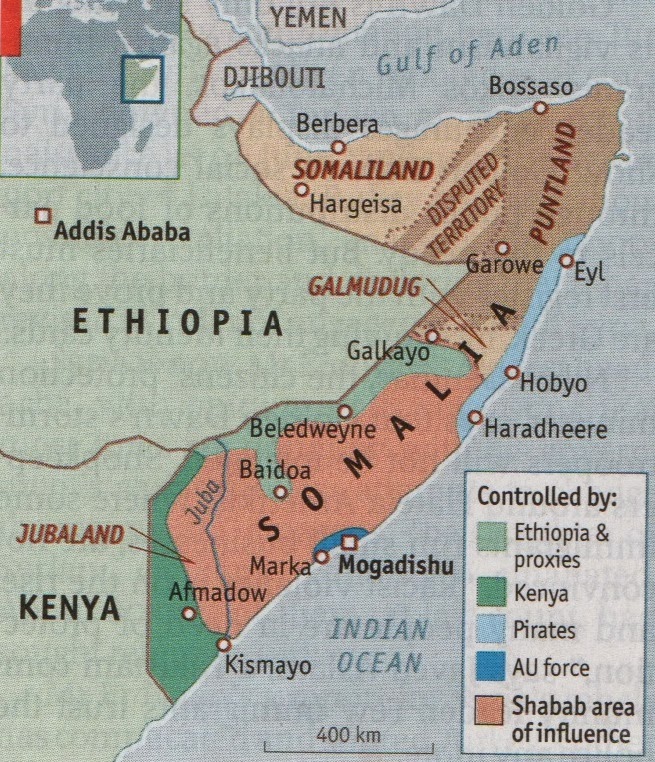
Starting in the late 2000s, an al-Qaeda-affiliated militia called al-Shabaab (literally, “the youth”) controlled nearly a third of Somalia—pretty much everything west and south of Mogadishu, the capital—until being dispersed by troops from Kenya and Ethiopia under the African Union (A.U.) banner last year.  Those events are the grievance behind al-Shabaab’s (as of this writing) ongoing Westgate shopping-mall massacre and siege in Nairobi, Kenya.  During its dominance of southern Somalia, al-Shabaab called its territory the Islamic Emirate of Somalia.  (See my recent article with an update on Somalia.)

How Somalia was divided up during the height of al-Shabaab’s influence
A version of this may be what is going on in Azaz.  In addition to the de facto West Kurdistan Autonomous Region in northern Syria along the Turkish border and a de facto division of much of the country into Bashir al-Assad’s Syria and “Free Syria,” we may now be seeing the beginnings of pockets of a so-called Islamic Emirate with plans to link the bulk of Syrian territory to adjoining Sunni-dominated parts of western and central Iraq.

One view of how Syria might be partitioned
One motivation for international salafist interest in Syria is that it is, like non-Kurdish Iraq, ruled by Shiites, whom Sunni salafists such as al-Qaeda and its partners regard as heretics.  In particular, this is true for the Arab Shiite minority that forms the political elite in Assad’s Syria, the Alawites, whose version of Islam is not particularly rigid and observant by most Muslim standards.  Some members of the Assad regime are interested in the possibility of forming an independent Alawite State in the coastal areas where the opposition is weakest and where Shiites predominate.  (See my recent article on the Alawite State idea, which I also called one of “10 Separatist Movements to Watch in 2013.”  See also an earlier, longer discussion in this blog of how Syria might be partitioned.)

The former flag of the “Alawite State” area in French-ruled Syria
may one day fly again over Tartous and Lattakia.
This sectarian division also intersects with the tussle over Syria between the local superpowers.  Iran, which is Shiite, is the Assad regime’s strongest backer, while Turkey funnels arms to moderate Sunnis (as long as they’re not Kurdish) and Saudi Arabia funnels arms to—well, we do have to worry that some of those arms at least are ending up in the hands of groups like al-Nusra and ISIS.


So now, if a resolution to the war in Syria is to involve some kind of partition, we would be looking at not only Kurdish, Alawite, and Sunni Arab (and maybe Druze) statelets or autonomous regions but also, perhaps, an attempt to establish an Islamic Emirate.  And the experience in Nigeria, Mali, and Somalia is that emirate movements are never content to revel in their safe enclaves but want to expand in order to bring shari’a to the rest of the benighted world.  These new developments make it much less likely that a peaceful partition can be achieved—and it also raises the prospect of a well-organized, Taliban-style faction jostling for the upper hand in any post-Assad regime.

It doesn’t look good.

An F.S.A. rebel defending Idlib province from the Assad regime and, now, al-Qaeda-linked Islamists as well

[Also, for those who are wondering, yes, this blog is tied in with a forthcoming book, a sort of encyclopedic atlas to be published by Auslander and Fox under the title Let’s Split! A Complete Guide to Separatist Movements, Independence Struggles, Breakaway Republics, Rebel Provinces, Pseudostates, Puppet States, Tribal Fiefdoms, Micronations, and Do-It-Yourself Countries, from Chiapas to Chechnya and Tibet to Texas.  Look for it some time in 2013 or 2014.  I will be keeping readers posted of further publication news.]

Saturday, November 24, 2012

Kurdistan Update, 18-24 November 2012


NORTH KURDISTAN (TURKISH KURDISTAN)

Turkish Military Reports 24 Kurdish Rebels Captured in 2-Day Operation.  The Turkish military announced on November 16th that operations in southeastern Turkey’s Kurdistan region over the previous two days had captured 24 fighters from the banned separatist Kurdistan Workers’ Party (P.K.K.).  Most of the operations took place in Tunceli province.  Then, on November 18th, Turkey’s military announced that five Turkish soldiers had been killed in a battle with the P.K.K. in Hakkari province.  It said one Turk was wounded.  Four P.K.K. rebels were killed, and four were taken prisoner.

Öcalan Calls End to Kurdish Prisoners’ Hunger Strike in Turkey.  A hunger strike by over 700 Kurds in Turkey’s prisons—joined by several prominent Kurdish politicians—ended on November 18th after Abdullah Öcalan, the long-imprisoned founder of the banned, separatist Kurdistan Workers’ Party (P.K.K.), held talks with Turkish intelligence officials and called an end to the action.  Öcalan’s announcement was released by his brother on November 17th.


SOUTH KURDISTAN (IRAQI KURDISTAN)

Soldiers, Kurds Skirmish in Turkmen Town in Northern Iraq.  In a Turkmen-dominated town in a disputed, Kurdish-dominated region of northern Iraq which lies just outside the Kurdistan Autonomous Regiona battle broke out between Iraqi soldiers and armed Kurds on November 16th, leaving two people dead and 10 injured.  The incident, in Tuz Khormato, near Kirkuk, began when troops attempted to search the home of a member of the Patriotic Union of Kurdistan (P.U.K.), the political party headed by Iraq’s president, Jalal Talabani.  One of the member’s bodyguards threw a grenade, leading to a short skirmish.  Within days, both the Iraqi military sent tanks and armored personnel carriers to reinforce their control over the area, and the Kurdish peshmerga were also mustering more forces for a possible showdown.

Turkmens in Tuz Khormato.  But Kurds and Shiites want to rule the town too.
WEST KURDISTAN (SYRIAN KURDISTAN)

Syrian Kurds Reject U.S. Urging to Join Rebel Umbrella Group as Killing Continues.  The spokeswoman for the United States’ Department of State, Victoria Nuland, said this week that Barack Obama’s administration is urging that Kurds be included in the newly coalesced armed opposition in Syria, called the National Coalition for Syrian Revolutionary and Opposition Forces.  “There are a number of reports from inside Syria of some of the liberated areas where Kurdish populations and Sunni populations are working well together,” she said (obviously meaning to say Sunni Arab populations, since most Kurds are Sunnis), adding, “That’s certainly the direction that we encourage.”  Meanwhile, though, violence between predominantly Sunni Arab rebels and the Kurdish-run People’s Defense Units (Y.P.G.) (reported on last week in this blogcontinued in the town of Ra’s al-’Ayn (called Serêkanî in Kurdish), in Syria’s now-mostly-Kurdish-controlled Hasakah province in the far northwest, where rebels from the militias Jabhat al-Nusra and Ghurba’ al-Sham attacked a Y.P.G. checkpoint, leaving at least 18 dead, possibly many more.  Some blame the violence on jihadist elements that have infiltrated the Syrian opposition.  There were also reports that the president of the Kurdish council in Ra’s al-’Ayn, Abed Khalil, had been assassinated by rebel snipers.  And on November 20th, Saleh Muslim, the head of the Syria’s Kurdish-run Democratic Union Party (P.Y.D.), which is suspected of links to Turkey’s banned Kurdistan Workers’ Party (P.K.K.), said that his group had not been invited to join the new group and would not join it.  He called the new Coalition a proxy group for the governments of Turkey and Qatar.  The Coalition has already been recognized by the French Republic, the United Kingdom, and others as the legitimate government of Syria.  Abdulbaset Sieda , the head of the Syrian National Council (S.N.C.), speaking to media in Erbil, the capital of Iraq’s Kurdistan Region, said that Jabhat al-Nusra, despite its claims, was not part of the Free Syrian Army (F.S.A.), and he disavowed S.N.C. responsibility for anti-Kurdish violence, but he said Kurds must choose sides in the Syrian civil war.

A P.Y.D. patrol in Syria
EAST KURDISTAN (IRANIAN KURDISTAN)

Rights Activists Call for General Strike over Plight of Kurds on Iran’s Death Row.  Human-rights activists in East Kurdistan, i.e. the portion of the Kurdish homeland which lies within Iranare calling for a public protest over death sentences passed on 27 Kurds being held in Iranian prisons.  A general strike and boycott of schools and other institutions is to start November 17th.  Most of the condemned prisoners are in the city of Saghez, in Iranian Kurdistan.  Meanwhile, exile rights groups announced this week that Zainab Bayazidi, a Kurdish political prisoner and women’s-rights activist, had been released on November 20th from a prison in Iran’s West Azerbaijan province.  Bayazidi was first arrested in 2008.


[Also, for those who are wondering, yes, this blog is tied in with a forthcoming book, a sort of encyclopedic atlas to be published by Auslander and Fox under the title Let’s Split! A Complete Guide to Separatist Movements, Independence Struggles, Breakaway Republics, Rebel Provinces, Pseudostates, Puppet States, Tribal Fiefdoms, Micronations, and Do-It-Yourself Countries, from Chiapas to Chechnya and Tibet to Texas.  Look for it in spring 2013.  I will be keeping readers posted of further publication news.]

Subscribe Now: Feed Icon