Showing posts with label Kurds. Show all posts

Saturday, May 10, 2014

California Assembly Passes Resolution Approving Ethnic Cleansing

The Armenian National Committee of America pushed
California’s joint resolution on N.K.R.

The California state assembly passed a resolution on May 8th to recognize the sovereignty of the Nagorno-Karabakh Republic (N.K.R.) (a.k.a. Artsakh Republic), an Armenian puppet state which the newly independent Armenia’s military, with the help of Russian forces, carved out of the newly independent Azerbaijan in the early 1990s in the wreckage of the imploded Soviet Union.

After the vote, California legislators posed with delegates from the N.K.R.
The N.K.R. is not recognized as independent by any recognized independent country, not even by its patron, the Republic of Armenia, but symbolic resolutions have been passed recognizing it in various local legislatures and city councils in the vast Armenian diaspora, including the legislatures of Louisiana, Maine, Massachusetts, and Rhode Island and of New South Wales in Australia, and, just last month, the city council of Los Angeles.  The California vote was expected.  The state has hundreds of thousands, some say almost a million, ethnic Armenians, mostly concentrated in greater Los Angeles.  There are, for example, only three cities in Armenia itself that have more Armenian residents than just one L.A. suburb, Glendale.  By contrast, there is only a negligible number of Azeri-Americans.


The California resolution passed with a vote of 70 to 1.  The only “no” vote was by Rocky Chávez, a Republican representing Oceanside, a San Diego suburb.  Armenian pressure groups play a huge role in pushing through symbolic pro-N.K.R. resolutions around the world, especially in the United States.  California’s Armenian diaspora also provides funding and support to the N.K.R.

Paid for in Moscow, planned in Yerevan,
carried out in Khojaly, applauded in Sacramento
Somewhere between 30,000 and 40,000 people died in the Nagorno-Karabakh War from 1991 to 1994, most of them killed by the Armenian military, which was aided by mercenaries from Russia and elsewhere and tacitly and covertly backed by Russia.  Thousands of Azeris were expelled from Azerbaijani territory to make room for Armenian settlement, and thousands of Kurds were cleansed from the Lachin corridor, which was not part of the Nagorno-Karabakh region but was conquered in order to provide a land bridge between Nagorno-Karabakh and Armenia and is now part of the N.K.R. Many see the Nagorno-Karabakh War as Armenian revenge for the genocide of Armenians by Anatolian Turks in the early 20th century (which the Turkish government still denies) and compensation for Armenian lands farther west lost to the Turkish Republic after the First World War.  Azeris speak a Turkic language and are often called “Turks.”

California is in lock-step with the Armenian army.
But, as discussed in a recent article in this blog, the overt and covert war against Ukraine by Russia, Armenia’s strongest ally, may be changing the dynamics of the N.K.R. issue.  Armenia was one of only 11 countries to back Russia’s annexation of Crimea earlier this year in a United Nations vote (as reported in this blog), alongside pariah nations like North Korea, Sudan, and Syria.  Azerbaijan, like Turkey, is a U.S. ally, and the Armenian government, which has signed onto President Vladimir Putin’s “Eurasian Union” trade bloc established as a rival to the European Union (E.U.), is openly hoping that the Kremlin will formally recognize the N.K.R. and possibly help Armenia expand its borders in other aggressive ways as a way of extending its own influence.

Assemblyman Mike Gatto spearheaded the N.K.R. resolution.
Last month, as reported in this blog, Azerbaijani lobbyists succeeded in defeating a similar N.K.R.-recognition bill in Vermont, and they have pushed anti-N.K.R. legislation in Hawaii, Mississippi, South Dakota, Tennessee, and Wyoming.

Armenians demonstrate in Los Angeles with the Nagorno-Karabakh flag
After the California vote, Assemblyman Adrin Nazarian, a Democrat from the L.A. suburb of Burbank, whose grandparents fled the Nagorno-Karabakh region in pre-Soviet days, told the chamber, “This is one of those issues, probably one of the hallmark issues, that’s led me to want to serve in public service and to be here. This has been the tormented history of a group of people who have been very determined to pursue their freedom.”

After the First World War, Armenia was supposed to be a large independent state;
the Young Turks killed that idea.
The Republic of Armenia’s expansionist aims are increasingly piggy-backed onto Putin’s quest to rebuild the Soviet Union and restart the Cold War, but apparently that news hasn’t yet reached Sacramento.  If the crisis in Ukraine continues to lurch toward war, more Californian assemblymen and assemblywomen may wish they had voted with Rocky Chávez.


[For those who are wondering, yes, this blog is tied in with my forthcoming book, a sort of encyclopedic atlas to be published by Auslander and Fox under the title Let’s Split! A Complete Guide to Separatist Movements, Independence Struggles, Breakaway Republics, Rebel Provinces, Pseudostates, Puppet States, Tribal Fiefdoms, Micronations, and Do-It-Yourself Countries, from Chiapas to Chechnya and Tibet to Texas.  The book is now in the layout phase and should be on shelves, and available on Amazon, by early fall 2014.  I will be keeping readers posted of further publication news.  Meanwhile, please “like” the book (even though you haven’t read it yet) on Facebook.]


Related articles from this blog:
“Vermont Snub on Karabakh May Signal Crimea Crisis Has Derailed Armenian-American Pressure-Politics Gravy Train” (April 2014)
“Rogues’ Gallery: Everyone Seems to Be against Crimea’s Annexation, but Who’s for It?; or, What Do Kim Jong-un and Ron Paul Have in Common?” (April 2014)
“The Power of Pressure Groups: 3 California Lawmakers Advocate Nagorno-Karabakh Independence” (Oct. 2012)
“Massachusetts Recognizes Nagorno-Karabakh Republic!” (Aug. 2012)
“The Armenian Genocide Debate: Turkey, Nagorno-Karabakh, and the Politics of Memory” (April 2012)

Sunday, April 27, 2014

Signs of Kurdish Spring: Syrian Border Trench, Barzani Statements, U.S. Push to Delist P.K.K. All Point to Eventual Independence


The “Kurdish Spring” in Turkey two years ago never gathered the same momentum toward change at the top as its namesake, the “Arab Spring” launched the previous year (still playing out bloodily in Egypt, Yemen, and partially-Kurdish Syria).  But shifting dynamics in Syria, along with other developments, point to a gradually settling consensus that Iraq’s northern Kurdistan Region is quietly humming along the road toward full independence.


The president of the Kurdistan Regional Government (K.R.G.) in northern Iraq, Massoud Barzani (pictured above), used his strongest language yet on April 8th regarding Kurdish independence.  Referring to the secret World War I–era Franco-British pact which undermined Woodrow Wilson’s later promise of an independent Kurdistan by allowing the new Turkish Republic to consume their homeland, Barzani told a Kurdish television audience, “The mistakes of the Sykes–Picot Agreement should be corrected.  The agreement itself has failed and the region should go back to its original nature, since some of the nations have been linked to each other by force.  No one can stop us from announcing the state of Kurdistan, but we want this to happen through dialogue and mutual understanding rather than war and bloodshed.”


Most surprising, perhaps, has been not only a recently introduced bill in the United States Senate to remove southeastern Turkey’s now more-or-less pacified Kurdistan Workers’ Party (P.K.K.) rebel group from the “terrorism” black list, but also an indication that President Barack Obama supports the move as well.  The Senate bill is backed by none other than Obama’s hawkish gadfly and former election opponent Senator John McCain, of Arizona, who also now says, “It is time we stop treating the K.D.P. and P.U.K. as terrorists” (referring to Iraq’s Patriotic Union of Kurdistan, headed by Iraq’s largely-ceremonial and now exiled president, Jalal Talabani, and Iraq’s Kurdistan Democratic Party), adding that their designation as “Tier III” terrorist groups “betrays our Kurdish friends and allies who have served as a stabilizing force in the region and displayed consistent loyalty to the United States throughout the years.”  It was largely a U.S.-imposed “northern no-fly zone” over northern Iraq after the 1991 Gulf War which allowed Iraqi Kurdistan to build sovereign institutions outside of Saddam Hussein’s reach, with Erbil as its capital.  The designation of Kurdish autonomists as “terrorists,” in both the U.S. and western Europe, is a vestige of the Cold War days when Turkey’s role as a front-line state within the North Atlantic Treaty Organization (NATO) against the Soviet Union made it a far more reliable asset to Western security than it is now.  And, if you want to strict about the definition of “terrorism,” the P.K.K., before its recent cease-fire with Ankara, attacked military targets almost exclusively, not civilian ones.

P.K.K. flags on display at a demonstration in Berlin
But Barzani, in his statements, also referred to the plight of Kurds outside Iraq. “In Turkey and Iran,” he said, “the rights of the Kurds have not yet been officially recognized while Kurds have been attached to these countries forcefully.”  He trod a little more lightly on the question of Kurds in Syria, whom he called more divided, making that situation more complicated.


In fact, actions speak even louder than words—actions like ditch-digging, I mean.  The K.R.G. has been busily digging a massive trench between the Iraqi region it governs and the neighboring portion of northern Syria now called Rojava, or “West Kurdistan,” where retreating Syrian government forces in 2012 allowed the establishment of a fully autonomous de facto state.  Rojava has become a shaky state, with discontinuous territory, but a state nonetheless, with a commitment to multiculturalism: Sunni Arabs, Assyrian Christians, and even diaspora Chechens share power with the majority Kurds in its three self-governing “cantons.”  But one group is shut out of the governing of Rojava, and that is the Kurdish factions strongy allied with Barzani’s K.R.G.: the territory is run by a group closely allied with Turkey’s P.K.K., which alarms both Turkey and the K.R.G. government that is enjoying the pleasant surprise of an oil-lubricated thaw in Turkish–K.R.G. relations.

Building Kurdish unity—not.
Rojava is also fighting for its life to limit territorial gains by a new al-Qaeda-derived Sunni Arab terror group, the Islamic State of Iraq and al-Sham (ISIS, a.k.a. ISIL), which has made great strides in controlling much of the Euphrates valley, all the way from the Syrian–Turkish border region downriver across the Iraqi border to Fallujah, on the outskirts of Baghdad itself.  The K.R.G.’s greatest fear is opening a pathway through its territory for ISIS militants to move freely back and forth and consolidate those gains—especially now that ISIS has been parlaying its stranglehold on Fallujah into foraying northward into K.R.G.-administered lands just outside the official Kurdistan Region, in mixed Arab–Turkmen–Kurdish areas in dispute between Baghdad and Erbil.  The Iraqi central government, too, is is locked in battle with ISIS to preserve the very unity of the non-Kurdish parts of the Iraqi state; backchannel discussions between Baghdad and Erbil have perhaps made it quite explicit that Iraqi Kurdistan cannot get more self-rule of any kind unless it nails shut the doorway to explosive Rojava.  So, for better or worse, the reunification of “West” (Syrian) and “South” (Iraqi) Kurdistan may have to wait until Iraqi Kurdistan disentangles itself from Arab Iraq.

Syrian Kurdistan (Rojava) is in yellow, Iraqi Kurdistan in orange.
Even in Iran, the most effectively totalitarian of the four states with significant Kurdish populations, the two main Kurdish political factions moved toward reconciliation this week.  The Kurdistan Democratic Party of Iran (K.D.P.I.) and its splinter group the Kurdistan Democratic Party (K.D.P.) made moves to repair a split that occurred in 2007.

In Iran, Mustafa Hijri (left) of the K.D.P.
and Khalid Azizi of the K.D.P.I. make nice.
Why is all this happening now?  Perhaps it is because the Shiite-dominated government in Baghdad has realized that it must make its Kurdish problem go away before it can successfully solve its (Sunni) ISIS problem.  Not incidentally, taking the mostly Sunni Kurdish people out of Iraq will leave the remaining population with an overwhelming Shiite majority, instead of the current very slight one.  It is also possible that signals from the K.R.G.’s main allies, including the U.S. and, to an extent, Israel are encouraging the establishment of a new solidly Western-allied state in the Middle East to counter Russia’s new expansionism, especially as President Vladimir Putin contemplates a more and more seamless Russian-aligned front along the northern edge of the region that includes the (soon?) whole north Black Sea coast, the North Caucasus, Armenia, Nagorno-Karabakh, and Iran.

ISIS—not the good guys, and worth digging a trench to keep out
But Kurds have never been ones to look a gift horse in the mouth.  They have waited for centuries for the Western promises of “self-determination” at the close of the First World War to come to fruition.  They can almost taste it.

Waving the Kurdish flag in Erbil
[For those who are wondering, yes, this blog is tied in with a forthcoming book, a sort of encyclopedic atlas to be published by Auslander and Fox under the title Let’s Split! A Complete Guide to Separatist Movements, Independence Struggles, Breakaway Republics, Rebel Provinces, Pseudostates, Puppet States, Tribal Fiefdoms, Micronations, and Do-It-Yourself Countries, from Chiapas to Chechnya and Tibet to Texas.  Look for it some time in 2014.  I will be keeping readers posted of further publication news.]

Sunday, January 12, 2014

Middle East Update: Al-Sham Islamic State Takes Form, West Kurdish Constitution, New Rights for Christians, Turkmens


The redrawing of the map of the Middle East continued apace this past week, following the takeover of Fallujah and part of Ramadi in western Iraq’s Anbar province by a radical Islamist group affiliated with al-Qaeda.  Turkmens, Christians, and Kurds are all scrambling for pieces of the territorial pie as Syria and Iraq both spin out of control and into anarchy.

Anbar
First, the radical Sunnis.  The Islamic State of Iraq and al-Sham (ISIS), an outgrowth of last decade’s al-Qaeda in Iraq (a.k.a. Islamic State of Iraq, or I.S.I.) militia (which itself grew out of the al-Qaeda network in Afghanistan), had for months been building up its strength in the power vacuum of Syria’s civil war, mostly at the expense of the far more moderate, Western-backed, but utterly disorganized and fractious Sunni rebel network known as the Free Syrian Army (F.S.A.).  Then, on January 3rd (as reported at the time in this blog), ISIS fighters entirely took over Fallujah, a major city in Sunni-Arab-dominated Anbar province in western Iraq, about a half hour’s drive from the western outskirts of Baghdad.  ISIS fighters have held on there, but have been a bit less successful in taking over the smaller city of Ramadi, Anbar’s capital.  Fallujah was the scene of two of the fiercest battles in the United States’ war in Iraq, in 2004, with U.S. and Iraqi-government forces trying to quell a radical Sunni insurgency.  Things look similar now, except that the U.S. is gone, and the Islamists are winning (never mind that Sunni radicals would never have gained a foothold if the U.S. hadn’t invaded in the first place).  Fallujah is probably the city with the strongest anti-Shiite sentiment, and most of that anger is directed at the Shi’a Arabs who have run Iraq since the Sunni (but fiercely secularist) dictator Saddam Hussein was toppled in 2003 and the 65%-or-so Shi’a majority came to power in the ensuing elections.  Now, as Shiite bombs are feared soon to rain down on Fallujah, the prejudices of ordinary Sunni people in the city are hardening.  The Iraqi government is reportedly planning on keeping its assault—once it gets up the nerve to launch it in earnest—away from civilian areas for this very reason, but it won’t take much for any moves by Baghdad to feel like an anti-Sunni massacre to those in Fallujah.  The tribal Sunni militias in Anbar which the U.S. had tried to cultivate as partners to the new Shiite-led government—with partial success—seem now to be siding mostly with ISIS.

Ongoing chaos in Fallujah
ISIS has declared Fallujah to be an independent Islamic state.  Whether that state is something called the Islamic State of Fallujah, or whether it is presumed to be the kernel of an emerging Islamic State of Iraq and al-Sham is something which may slowly become apparent.  Perhaps the ISIS warlord in Fallujah, Abu Waheeb, is improvising as he goes along.  (Al-Sham means, roughly, the Levant, i.e. Syria and Lebanon; some news sources are calling ISIS “ISIL,” for Islamic State of Iraq and the Levant, and some are saying, inaccurately, that ISIS stands for Islamic State of Iraq and Syria—but they all refer to the same group.)  Much will depend on whether control of all or some of Anbar can be consolidated and whether that territory can be linked up with ISIS’s “liberated” territory in eastern Syria.  Which brings us to ...

Fallujah this week
North-central Syria’s heartland
Late last year, ISIS began capturing small towns in northern Iraq, mostly along the border with Turkey, in Syria’s Kurdish region.  The first of these was Azaz (as reported at the time in this blog), and others followed.  But by December ISIS was exceeding all expectations, capturing smaller towns in the far east along the Iraqi border and in the far west, in the Alawite (Shiite) Arab heartland of Latakia province.  Its biggest prize, however, has been ar-Raqqah, a provincial capital in north-central Syria.  Ar-Raqqah province borders Turkey and includes Kurdish areas, but its capital is on the Euphrates, which flows from ar-Raqqah to Ramadi and Fallujah in Iraq.

The B.B.C.’s most recent map of different areas of rebel control in Syria
But is ISIS going to capture the entire upper Euphrates and build a coherent territory in the way that the Kurds have?  Maybe not.  The al-Nusra Front, the loosely organized Syrian-based component of ISIS, is apparently seeing some defections, with individual militias deciding that the former I.S.I. units with whom they formed ISIS last year are foreigners who are too radical for them, and maybe even worse than the embattled Alawite dictatorship of Bashar al-Assad.  This is partly because of ISIS’s governing style, which involves sweeping into town, executing a few “infidels” and “traitors” in the town square, and then dispatching armed morality patrols to enforce shari’a (Islamic law).  What had become, by late last year, a three-way battle in Aleppo, ar-Raqqah, al-Hasakah, and Deir ez-Zor provinces among Assad’s government forces, the F.S.A., and al-Nusra may soon become a four-way battle among the government, the F.S.A., al-Nusra, and ISIS.  No, wait, five-way—since Kurdish militias (more on them below) are also vying for control of al-Hasakah city and parts of Aleppo.


These new twists put Western backers like Turkey and the U.S. in a quandary.  They know whom they want to win in Iraq, but in Syria it’s not so simple.  It was bad, and embarrassing, enough, when various forms of aid sent in the direction of the F.S.A. ended up in al-Nusra hands, but now the West may need to calculate that it’s worth backing al-Nusra for a little while—you know, just a little while—until ISIS is brought under control.  Sounds like a bad idea: help bad guys because they’re helping you fight worse guys depends a lot on fallible judgments as to who is bad or worse, and it can have an effect called “blowback.”  After all, that’s how the Taliban and al-Qaeda came to power in Afghanistan in the first place.  As for the Syrian opposition’s other “Western” backers, Saudi Arabia, well, for them strengthening al-Nusra might not even be a difficult choice.  Many of them are Saudis anyway, and have the tacit blessing of the royal family.  Look for a serious, perhaps permanent falling out between the U.S. and Saudi Arabia over how to handle Syria.

An image circulating in ISIS circles shows the nascent Islamic state
in Anbar and Syria as part of an eventual global Caliphate.
Hey, wait a minute—gulp!—is that Vienna?
Syrian Kurdistan
Things are a little bit more stable in the far north of Syria, along the border with Turkey, as the de facto self-governing Western Kurdistan Autonomous Region formed last year in liberated pockets along the border was in November 2013 rechristened Rojava (which simply means “western” in Kurdish) and was given specific contours and a formal (unrecognized) government (as reported at the time in this blog).  This past week, the Rojava government started filling in the details of its supposedly federal-style internal structure, with separate autonomous entities for Kurds, Christians, and Arab Muslims.  On January 6th, the Rojava’s governing Western Kurdistan Constituent Assembly unveiled a new constitution, which specifies the three autonomous subdivisions and confirms that the new state will be official multilingual, with state business conducted in Kurdish, Arabic, and Syriac (i.e. the variety of Aramaic—the language spoken by Jesus—which is in use today in the Syriac, Chaldean, and Assyrian communities of Middle Eastern Christians).  Other statements out of Rojava have also referred to equal rights for the Turkmen and even Chechen minorities.

The Western Kurdistan Constituent Assembly speaks to the public
This may have something to do with the fact that, to both Turkey’s consternation and that of the Kurdistan Regional Government (K.R.G.) in neighboring Iraq, Rojava is being run by the Democratic Union Party (Partiya Yekîtiya Demokrat, or P.Y.D.), a group linked to Turkey’s outlawed, traditionally-Marxist-Leninist Kurdistan Workers’ Party (Partiya Karkerên Kurdistan, or P.K.K.) and antagonistic to the K.R.G. government.  In Iraq’s Kurdistan Region, Kurds vie for control of the Kurdish-populated penumbra outside the official autonomous region, in places like Mosul, Kirkuk, and the Nineveh Plains that are also regarded as homelands for the Turkmen and Assyrian people, who naturally want their own autonomous regions.  Are the Rojava Kurds competing with the K.R.G. for the loyalties of the region’s smaller minorities?  If so, this could get much messier.


Northern Iraq
Meanwhile, perhaps as a direct response to the developments in Rojava, the Iraqi parliament in Baghdad voted on January 8th to make Turkmen, Syriac, and Assyrian national languages alongside the existing official languages, Arabic and Kurdish.  (There is a lot of variation in how to name the modern Aramaic languages; some use the terms Assyrian, Chaldean, and Syriac interchangeably, or use one term as including the other two, or name the same language differently depending on which self-identified ethnic or sectarian group is using it.)  Meanwhile, Turkmen leaders in areas hard-hit by terrorist violence said this week that they were forming popular defense committees along the lines of those formed by Kurds in Syria.

Some Turkmens’ rather optimistic vision
of an autonomous region or independent state to be called Türkmeneli
Things change in the region almost daily.  Springtime of Nations will do its best to stay on top of developments and keep you informed.


[For those who are wondering, yes, this blog is tied in with my forthcoming book, a sort of encyclopedic atlas to be published by Auslander and Fox under the title Let’s Split! A Complete Guide to Separatist Movements, Independence Struggles, Breakaway Republics, Rebel Provinces, Pseudostates, Puppet States, Tribal Fiefdoms, Micronations, and Do-It-Yourself Countries, from Chiapas to Chechnya and Tibet to Texas.  The book is now in the layout phase and should be on shelves, and available on Amazon, by early fall 2014.  I will be keeping readers posted of further publication news.  Meanwhile, please “like” the book (even though you haven’t read it yet) on Facebook.]

Saturday, September 28, 2013

Talysh Rebel Leader, Former Political Prisoner, Resurfaces in Armenia, Challenging Azerbaijani Unity

Alikram Hummatov
Like a bad penny, we knew Alikram Hummatov would show up again, and it is reactivating a lot of the animosities of the regional animosities in the Caucasus region that swirled around the time of the fall of Leninism.  This week, the Azerbaijani former political prisoner and separatist leader has been greeted as a political celebrity in the Republic of Armenia and its puppet state carved out of Azerbaijan, the Nagorno-Karabakh Republic (N.K.R.).

In orange and brown is the Nagorno-Karabakh Republic,
on what the world considers Azerbaijani territory.
Hummatov, also known as Ali Akram Hemmatzadeh, was the separatist hero and self-proclaimed president of the brief-lived and tiny independent Talysh-Mughan Autonomous Republic (T.M.A.R.) (a.k.a. Talyshtan) in southeastern Azerbaijan, right along the border with Iran, in 1993.  This was in the midst of a coup d’état in Baku, Azerbaijan’s capital, in which the elected president of Azerbaijan, Abulfaz Elchibey, was overthrown by Heydar Aliyev, the ex-boss of the Azerbaijani Soviet Socialist Republic (S.S.R.).  The T.M.A.R. was quickly crushed by Azerbaijani forces.

Heydar Aliyev
This week, on September 24th, Hummatov, who is a member of the Talysh ethnic minority, appeared in Yerevan, Armenia’s capital, to help inaugurate a postgraduate Talysh Studies Program at Yerevan State University (Y.S.U.), under the Iranian Studies rubric.  (The Talysh language is related to Persian, unlike Armenian, which is an Indo-European isolate, and Azeri, which is Turkic.)  Then, two days later, he spoke before the N.K.R.’s parliament.  Hummatov and the legislature’s chairman, Ashot Ghulyan, praised the Talysh-Armenian brotherhood and their parallel oppression by stronger nations.  Hummatov still considers himself president of the T.M.A.R., which operates a government-in-exile in Iran, and reiterated that independence was still the goal of the Talysh people.


After the failed separatist rebellion in 1993, Hummatov fled to Russia but was extradited and sentenced, in 1995, to death, then commuted to a life sentence.  He was released in 2004, after he and other political prisoners in Azerbaijan became the focus of pressure by the Council of Europe and Amnesty International.  He was stripped of his citizenship and exiled to the Netherlands.

Many today suspect that the 1993 declaration of independence was orchestrated from Moscow, perhaps even by Aliyev himself (he was once the K.G.B. head for the republic) in order to create a distraction, including convincing the public that ethnic uprisings needed a strong leader.  Elchibey had, after all, failed to secure the southwestern chunk of Azerbaijan from being solidified as a de facto independent Nagorno-Karabakh, propped up by Armenia and, indirectly, by Moscow.  True or not, the Talysh struggle for self-determination clearly became a pawn in the larger game of the Caucasus’s polarized politics.


When the southern Caucasus was absorbed by Russia’s newly installed Bolshevik regime at the close of the First World War, a Mughan Soviet Republic was briefly set up, as a Communist bulwark against the rebellious Azeri nation-state which proved difficult to snuff out.  Ethnic national identities were suppressed during the Soviet period, in accordance with Marxist–Leninist “internationalism,” though some Caucasian nationalities suffered particular oppression, especially those historically antagonistic to Georgia, the nation into which Josef Stalin, the the Soviet Union’s first minister in charge of nationalities, was born.  Some groups were promised autonomy but then denied it.  Moscow also reneged on its promise to redraw borders to accommodate the ethnically Armenian population in southwestern Azerbaijan.  When Communism began to falter in the late 1980s, Armenians in this region, Nagorno-Karabakh, demanded to be transferred to the Armenian S.S.R.; the republics were moving toward more autonomy, and they feared direct rule by Azeris unmediated by Russia.  Mikhail Gorbachev initially sided with the Azeris, out of inertia and unwillingness to redraw borders, but Russian and Ukrainian mercenaries—and, covertly, some claim, official Russian forces—helped Armenia set up the N.K.R. as a de facto state.  By 1994, Boris Yeltsin, the born-again-nationalist president of post-Soviet Russia, brokered a deal which solidified the N.K.R. as a permanent “frozen conflict” with a tense cease-fire line, which is the situation, more or less today.

The fact that Gorbachev wasn’t sure whom to back in the Karabakh conflict illustrates just how ideologically neutral many of the nationalist struggles of the early post-Communist period were; they were all in it for themselves.  But the fact that Russia soon settled in to become Armenia and the N.K.R.’s most solid backer shows that the polarizations of the Cold War were, and are, still playing themselves out.

Shirali Muslimov, presumed to be 168 when he died in 1973
and thus often called the world’s oldest man, was Talysh.
Historically, the Russian Empire had always had more troubles with its Muslim minorities in the Caucasus—Chechens, Avars, Circassians—than the far fewer Christian ones, such as the Georgians, Armenians, and Ossetians.  The fact that not-yet-independent Azerbaijan was being helped in the Karabakh war by Chechen and even Afghan fighters with sectarian bones to pick doubtless helped Gorbachev choose sides eventually.  Today’s polarization of (a) the United States aligned with Turkey, Georgia, and Azerbaijan against (b) Moscow and its client states Iran, Armenia, and the N.K.R. has become one of the few areas in the world where a Washington-vs.-Moscow cold-war mentality still dictates regional alliances.  The early-20th-century Turkish genocide of Armenians was always soft-pedalled in the West (it still is) so as not to offend the strategically important Republic of Turkey, as the North Atlantic Treaty Organization’s only member-state bordering the U.S.S.R.—much to the (legitimate) fury of the U.S.’s huge Armenian-American lobby, which is estimated to be the third-most-influential immigrant lobby in American foreign policy, behind the Jewish and Cuban ones.  (California has more Armenians than Armenia, and this week when a legislative delegation from that state, under pressure from Armenian constituents, showed up in Stepanakert, the U.S. State Department scrambled to contain the damage.  See an article from this blog on the definition of genocide and its relation to the Nagorno-Karabakh conflict.)  Russia found it useful in the Soviet period to conflate Turkish crimes with Nazi ones and thus position itself as being a valiant foe of Germany in both world wars and of Turkey (the Ottoman Empire) in the first one as well (never mind that Stalin was just as bad).  After 1979, when a virulently anti-American Islamist government overthrew the U.K.- and U.S.-installed Shah of Iran, Moscow revived its decades-old project of seeking to bring Iran into its orbit as a way of inching toward the warm-water ports of the Indian Ocean—this time successfully, since even today Russia is almost Iran’s only ally.  The U.S., as a consequence, finds it useful to use Azerbaijan (as well as, now, the de facto independent and U.S.-liberated Kurdistan Autonomous Region in northern Iraq) as a staging ground for its espionage and sabotage campaign against Iran, and as oil-rich states that it is useful to have as allies.  Azeris and Kurds are happy for the patronage, even though neighboring Muslim states scorn them as stooges of America and Israel.

Yeah, it’s complicated.
This dynamic reverberates deep into the Caucasus region’s separatist politics as well.  The U.S. implicitly (and probably, in secret, concretely) backs a nascent movement to break Iran’s northwestern Azerbaijan region away so it can reunify with Azerbaijan proper.  Meanwhile, the loss of Karabakh has made Azeris nervous that the rest of their multi-ethnic republic could be whittled away too.  The Lezgin ethnic group over the northern border in the Russian Federation’s Republic of Dagestan would like to form a common territory with their Lezgin kin over the border in Azerbaijan, who have suffered serious repression.  Russian media celebrated gleefully when, in 1993, tens of thousands of Lezgins demonstrated in Azerbaijan against being drafted to fight the Karabakh war, and Moscow may even have been behind a Lezgin pro-unification march on the border from the Dagestani side.  Similar tensions prevail with respect to the Avar, Dagestan’s largest ethnic group, whose traditionally territory also extends into Azerbaijan.  How to count Azerbaijan’s minorities is highly politicized.  No one thinks they are as few in number as the government claims.  Officially, there are just over 100,000 Talysh in Azerbaijan, but some Talysh activists estimate they number more than 1 million of Azerbaijan’s population of just under 9 million.  After losing Karabakh, Azeri nationalists feel cooking the numbers is a matter of life and death.  Some Iranian nationalists, for their part, would rather see Talyshstan absorbed into Iran than become an independent state—a position that does not as yet make things as awkward as it should between the Talysh government-in-exile and its Iranian hosts.

Iranian nationalist propaganda sometimes portrays the non-Turkic Talysh people as “part of” Persia
This leaves Azerbaijan surrounded on three sides by powerful and to varying degrees anti-democratic states which are determined to chip away at it: Russia to the north, Armenia to the west, and Iran to the south.  Its only friendly neighbors are Georgia and Iraqi Kurdistan, and Azeris have already seen, during the 2008 South Ossetia War between Russia and Georgia, that the U.S. and the West are prepared to sit idly by while Russia bites large chunks (Abkhazia and South Ossetia) out of Western allies in the Caucasus.

The flag of Talyshstan (and of the Talysh-Mughan Autonomous Republic)
For Hummatov’s part, here is what he said at the Yerevan State University event, which among other things involved a commitment to preserving the endangered Talysh language: “In Azerbaijan, the Talysh are deprived of basic rights.  We are not respected; we are being extirpated, with a policy of assimilation being implemented against us.  They at the same time declare that we are brothers.  This is illogical.  We want to write and read in the mother tongue.  In response to our demands, they openly say, ‘You, the Talysh, have no future, you must be assimilated.’”  In the 1990s, he added, “We considered Azerbaijan our homeland and were even prepared to give up our lives for it, but the homeland should also defend us with might and main, and if it refuses to do it, then we have our homeland and we will build our homeland—Talyshstan.  Our youths already have self-consciousness.  No one can stop us anymore.  We will speak in Talysh and struggle for our independence.”

A repressed Talysh newspaper
Indeed, the day after Hummatov visited the parliament in Stepanakert, the Azerbaijani government sentenced the editor of a small Talysh-language newspaper to five years in a labor camp for “ethnic hatred” and “drug-trafficking.”  The editor, Hilal Mamedov, has reason to worry: his predecessor as editor was arrested in 2008 on similarly dubious-sounding charges and died in prison the following year after being denied medical care.

Does Azerbaijan think it can keep doing that forever?  That’s what they thought about their Armenian minority too.

[N.B.: This article was modified on Oct. 3, 2013, to correct wording which suggested that Talysh and Persian were not Indo-European.]

[Also, for those who are wondering, yes, this blog is tied in with a forthcoming book, a sort of encyclopedic atlas to be published by Auslander and Fox under the title Let’s Split! A Complete Guide to Separatist Movements, Independence Struggles, Breakaway Republics, Rebel Provinces, Pseudostates, Puppet States, Tribal Fiefdoms, Micronations, and Do-It-Yourself Countries, from Chiapas to Chechnya and Tibet to Texas.  Look for it some time in 2013 or 2014.  I will be keeping readers posted of further publication news.]

Tuesday, September 24, 2013

The Caliphate Movement Comes to Syria: New Islamist Army Falters in Azaz but May Try to Carve Out Separate State

An ominous Islamic Emirate banners flying over a checkpoint in Azaz, Syria
It was bound to happen.  While the international community beyond the Middle East has debated and stalled on whether and when to offer overt aid to the rebel opposition in Syria—hoping that the conflict would sort itself out first and put a Western-friendly regime of some sort in charge—the ideological nature of the opposition has shifted.  And now the salafist Islamist component in the opposition seems to be gaining the upper hand, with territorial gains that may presage the formation of a de facto independent Islamist enclave.

The location of Azaz in Syria.  (Turkey is to the north.)

On September 18th, Azaz, a town in Syria’s Idlib province two miles from the boundary with Turkey and 20 miles from Aleppo, fell to Islamists associated with al-Qaeda.  Azaz is near a major Turkish–Syrian border crossing and was the scene of fighting between the regime and the more moderate rebel umbrella group, the Free Syrian Army (F.S.A.), last year.  Nine centuries or so earlier, during the Crusades, it was the site of a victory of Christian European forces over the town’s Turkish defenders—a resonance that is surely not lost on the deep-historical-grudge-bearing jihadists.
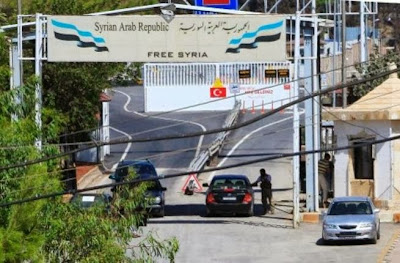
Near Azaz, a more official border crossing between Turkey and “Free Syria”
These particular jihadists, who—though the reports are inconclusive—seem to still hold the town, or part of it, are members of the Islamic State of Iraq and al-Sham (ISIS), a new player in the Syrian civil war.  Reports indicate that a cease-fire has had some success but that Islamic law seems to be in effect there, after a skirmish resulted in ISIS expelling an F.S.A. unit called Northern Storm from the town.  And the assassination of the self-declared emir of Azaz, Abu Abdullah Libi (nom de guerre: Junood), on September 23rd—his car was shot up by snipers while at a checkpoint—may only stoke the flames of conflict between the two groups.  But who is ISIS, and what do they want?


One finger means I have to go wee-wee, two fingers means behead the infidel:
students at a school in Aleppo run by the Islamic State of Iraq and al-Sham.
Al-Shām, or Sham, is an old Arabic term for the fertile lowlands between the Mediterranean and Iraq’s Euphrates River.  ISIS is thus sometimes called, in the media, the “Islamic State of Iraq and the Levant,” or, less accurately, “... and Syria.”  Some say that ISIS represents a merger between the al-Nusra Brigades—the most prominent Islamist force in the Syrian war and, some say, by far its best organized rebel group—and an older entity called the Islamic State in Iraq (I.S.I.).  I.S.I., under its original name Jama’at al-Tawhid wal-Jihad (Organization for Monotheism and Jihad), was founded in 2003 by a Jordan-born Mujahideen commander from the Afghan War named Abu Musab al-Zarqawi, during the period when al-Qaeda-linked groups were flooding into Iraq to fight the United States, which had invaded using as justification the lie that al-Qaeda was already there and cooperating with Saddam Hussein, which everyone knew it wasn’t.  Zarqawi folded his Afghanistan-based militia into Osama bin Laden’s al-Qaeda network in 2004 and renamed it al-Qaeda in Iraq (A.Q.I.).  Later, as I.S.I., it aimed to create an Islamic state in the Sunni-Arab-dominated parts of Iraq between Kurdistan and the Shiite-dominated south.  (See my article from this blog about a possible partition of Iraq.)  Zarqawi was dubbed al-Qaeda’s “Emir of Mesopotamia” (i.e., Iraq) before being killed in a U.S. bombing in 2006.

Abu Musab al-Zarqawi
For a group like ISIS to become a player in Syria is new, and dangerous.  Radical Islamist terrorists never had time to organize themselves as a major fighting force in Arab Spring revolutions such as those in Tunisia, Egypt, Libya, or Bahrain, though they were already a presence in Yemen and still are in the ongoing fighting there.  Zarqawi’s relocation from Afghanistan to Iraq in the early 2000s is part of a larger pattern of Islamist fighters from various points around the world converging on trouble spots that are perceived to be frontline struggles in a holy war to reclaim traditionally-Muslim-ruled areas and place them under shari’a (Islamic law).  This is what happened, for example, in southern Russia, in Chechnya between the First Chechen War in the mid-1990s, which was a secular nationalist movement, and, in 1999, the onset of the Second Chechen War, by now a salafist religious war with local rule often modeled on the harsh Saudi Arabian form of salafism known as Wahhabism.  It is also what has happened in Kashmir, where a war over the question of independence and self-determination in an area claimed by both India and Pakistan has been transformed into a holy war (for some, anyway).  It is also what happened last year in northern Mali, where the latest nationalist uprising by the Tuareg minority was coopted by jihadists as well as by Libyan Tuaregs displaced by civil war.  It is also the pattern in places such as northern Nigeria (Boko Haram), Zanzibar (Uamsho), and the southern Philippines (Abu Sayyaf), among other places.

The global caliphate some Muslim radicals envision
In each case, the aim has been to create an emirate (like Zarqawi’s Emirate of Mesopotamia) under shari’a, ruled by mullahs, or self-appointed doctrinal experts among the militant leadership.  These pseudo-states prominently feature the bureaucratic language of the political structure of the Ottoman Empire (emirates, vilayats, etc.), the closest thing there has been to the superstate ruling the entire Islamic world that these radicals envision.

A more Ottoman-centered vision for an Islamic caliphate
There have been some successes.  Under the Taliban’s rule, Afghanistan was known as the Islamic Emirate of Afghanistan—a term still used by radical Islamists who control pockets of the country.  The areas along the Afghan border which Pakistan’s government is unable or unwilling to govern is a de facto sovereign Taliban and al-Qaeda territory called the Islamic Emirate of Waziristan.  Al-Qaeda-linked radicals ran a so-called Emirate of Waqar in the towns of Jaar and Zinjibar in southern Yemen for more than a year until it was shut down (as reported at the time in this blog) by a Yemeni government offensive last summer.  Perhaps most prominently, as indicated above, the al-Qaeda-linked Ansar al-Dine militia and the Algerian-based Movement for Unity and Jihad in West Africa (MUJAO) ran an Islamic Republic of Azawad in the northern two-thirds of Mali until dislodged by France earlier this year.  (See my recent article with an update on Azawad.)  In all these places, shari’a means that music and beard-trimming are banned, women have to be completely covered and are denied education, adulterers are stoned to death, and anything deemed a non-Muslim or pre-Muslim religious structure can be demolished, including ancient architectural treasures.  These are not nice people.

Ansar al-Dine in Azawad
Some “emirates” are more imaginary.  A visit to the Kavkaz Center website reveals a fantasy world in which Russia’s North Caucasus region and surrounding areas are an Islamist-governed Caucasus Emirate, divided into renamed vilayats (provinces) where “Russian invaders” are always successfully resisted by the loyal mujahideen, in deadpan journalistic prose.  In the real world, this translates into a low-level but unending procession of suicide bombings, ambushes, assassinations of moderate clerics, and other terrorist acts in Russia’s North Caucasus republics.  The Caucasus Emirate has managed to send quite a few fighters to join the struggle in Syria, not incidentally, and they have their sights set on areas such as Tatarstan, in central Russia, as well.

The imaginary Caucasus Emirate of southwestern Russia
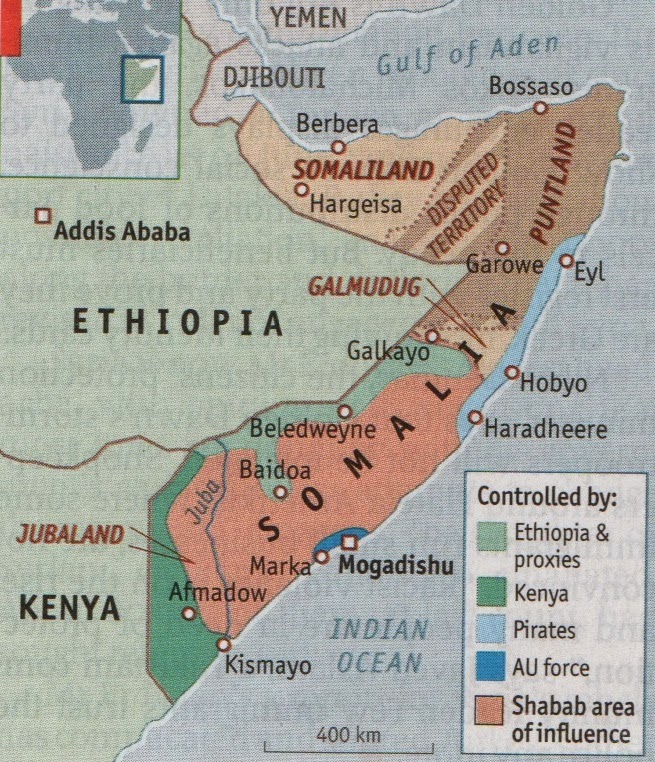
Starting in the late 2000s, an al-Qaeda-affiliated militia called al-Shabaab (literally, “the youth”) controlled nearly a third of Somalia—pretty much everything west and south of Mogadishu, the capital—until being dispersed by troops from Kenya and Ethiopia under the African Union (A.U.) banner last year.  Those events are the grievance behind al-Shabaab’s (as of this writing) ongoing Westgate shopping-mall massacre and siege in Nairobi, Kenya.  During its dominance of southern Somalia, al-Shabaab called its territory the Islamic Emirate of Somalia.  (See my recent article with an update on Somalia.)

How Somalia was divided up during the height of al-Shabaab’s influence
A version of this may be what is going on in Azaz.  In addition to the de facto West Kurdistan Autonomous Region in northern Syria along the Turkish border and a de facto division of much of the country into Bashir al-Assad’s Syria and “Free Syria,” we may now be seeing the beginnings of pockets of a so-called Islamic Emirate with plans to link the bulk of Syrian territory to adjoining Sunni-dominated parts of western and central Iraq.

One view of how Syria might be partitioned
One motivation for international salafist interest in Syria is that it is, like non-Kurdish Iraq, ruled by Shiites, whom Sunni salafists such as al-Qaeda and its partners regard as heretics.  In particular, this is true for the Arab Shiite minority that forms the political elite in Assad’s Syria, the Alawites, whose version of Islam is not particularly rigid and observant by most Muslim standards.  Some members of the Assad regime are interested in the possibility of forming an independent Alawite State in the coastal areas where the opposition is weakest and where Shiites predominate.  (See my recent article on the Alawite State idea, which I also called one of “10 Separatist Movements to Watch in 2013.”  See also an earlier, longer discussion in this blog of how Syria might be partitioned.)

The former flag of the “Alawite State” area in French-ruled Syria
may one day fly again over Tartous and Lattakia.
This sectarian division also intersects with the tussle over Syria between the local superpowers.  Iran, which is Shiite, is the Assad regime’s strongest backer, while Turkey funnels arms to moderate Sunnis (as long as they’re not Kurdish) and Saudi Arabia funnels arms to—well, we do have to worry that some of those arms at least are ending up in the hands of groups like al-Nusra and ISIS.


So now, if a resolution to the war in Syria is to involve some kind of partition, we would be looking at not only Kurdish, Alawite, and Sunni Arab (and maybe Druze) statelets or autonomous regions but also, perhaps, an attempt to establish an Islamic Emirate.  And the experience in Nigeria, Mali, and Somalia is that emirate movements are never content to revel in their safe enclaves but want to expand in order to bring shari’a to the rest of the benighted world.  These new developments make it much less likely that a peaceful partition can be achieved—and it also raises the prospect of a well-organized, Taliban-style faction jostling for the upper hand in any post-Assad regime.

It doesn’t look good.

An F.S.A. rebel defending Idlib province from the Assad regime and, now, al-Qaeda-linked Islamists as well

[Also, for those who are wondering, yes, this blog is tied in with a forthcoming book, a sort of encyclopedic atlas to be published by Auslander and Fox under the title Let’s Split! A Complete Guide to Separatist Movements, Independence Struggles, Breakaway Republics, Rebel Provinces, Pseudostates, Puppet States, Tribal Fiefdoms, Micronations, and Do-It-Yourself Countries, from Chiapas to Chechnya and Tibet to Texas.  Look for it some time in 2013 or 2014.  I will be keeping readers posted of further publication news.]

Subscribe Now: Feed Icon