Showing posts with label Saddam Hussein. Show all posts

Sunday, April 27, 2014

Signs of Kurdish Spring: Syrian Border Trench, Barzani Statements, U.S. Push to Delist P.K.K. All Point to Eventual Independence


The “Kurdish Spring” in Turkey two years ago never gathered the same momentum toward change at the top as its namesake, the “Arab Spring” launched the previous year (still playing out bloodily in Egypt, Yemen, and partially-Kurdish Syria).  But shifting dynamics in Syria, along with other developments, point to a gradually settling consensus that Iraq’s northern Kurdistan Region is quietly humming along the road toward full independence.


The president of the Kurdistan Regional Government (K.R.G.) in northern Iraq, Massoud Barzani (pictured above), used his strongest language yet on April 8th regarding Kurdish independence.  Referring to the secret World War I–era Franco-British pact which undermined Woodrow Wilson’s later promise of an independent Kurdistan by allowing the new Turkish Republic to consume their homeland, Barzani told a Kurdish television audience, “The mistakes of the Sykes–Picot Agreement should be corrected.  The agreement itself has failed and the region should go back to its original nature, since some of the nations have been linked to each other by force.  No one can stop us from announcing the state of Kurdistan, but we want this to happen through dialogue and mutual understanding rather than war and bloodshed.”


Most surprising, perhaps, has been not only a recently introduced bill in the United States Senate to remove southeastern Turkey’s now more-or-less pacified Kurdistan Workers’ Party (P.K.K.) rebel group from the “terrorism” black list, but also an indication that President Barack Obama supports the move as well.  The Senate bill is backed by none other than Obama’s hawkish gadfly and former election opponent Senator John McCain, of Arizona, who also now says, “It is time we stop treating the K.D.P. and P.U.K. as terrorists” (referring to Iraq’s Patriotic Union of Kurdistan, headed by Iraq’s largely-ceremonial and now exiled president, Jalal Talabani, and Iraq’s Kurdistan Democratic Party), adding that their designation as “Tier III” terrorist groups “betrays our Kurdish friends and allies who have served as a stabilizing force in the region and displayed consistent loyalty to the United States throughout the years.”  It was largely a U.S.-imposed “northern no-fly zone” over northern Iraq after the 1991 Gulf War which allowed Iraqi Kurdistan to build sovereign institutions outside of Saddam Hussein’s reach, with Erbil as its capital.  The designation of Kurdish autonomists as “terrorists,” in both the U.S. and western Europe, is a vestige of the Cold War days when Turkey’s role as a front-line state within the North Atlantic Treaty Organization (NATO) against the Soviet Union made it a far more reliable asset to Western security than it is now.  And, if you want to strict about the definition of “terrorism,” the P.K.K., before its recent cease-fire with Ankara, attacked military targets almost exclusively, not civilian ones.

P.K.K. flags on display at a demonstration in Berlin
But Barzani, in his statements, also referred to the plight of Kurds outside Iraq. “In Turkey and Iran,” he said, “the rights of the Kurds have not yet been officially recognized while Kurds have been attached to these countries forcefully.”  He trod a little more lightly on the question of Kurds in Syria, whom he called more divided, making that situation more complicated.


In fact, actions speak even louder than words—actions like ditch-digging, I mean.  The K.R.G. has been busily digging a massive trench between the Iraqi region it governs and the neighboring portion of northern Syria now called Rojava, or “West Kurdistan,” where retreating Syrian government forces in 2012 allowed the establishment of a fully autonomous de facto state.  Rojava has become a shaky state, with discontinuous territory, but a state nonetheless, with a commitment to multiculturalism: Sunni Arabs, Assyrian Christians, and even diaspora Chechens share power with the majority Kurds in its three self-governing “cantons.”  But one group is shut out of the governing of Rojava, and that is the Kurdish factions strongy allied with Barzani’s K.R.G.: the territory is run by a group closely allied with Turkey’s P.K.K., which alarms both Turkey and the K.R.G. government that is enjoying the pleasant surprise of an oil-lubricated thaw in Turkish–K.R.G. relations.

Building Kurdish unity—not.
Rojava is also fighting for its life to limit territorial gains by a new al-Qaeda-derived Sunni Arab terror group, the Islamic State of Iraq and al-Sham (ISIS, a.k.a. ISIL), which has made great strides in controlling much of the Euphrates valley, all the way from the Syrian–Turkish border region downriver across the Iraqi border to Fallujah, on the outskirts of Baghdad itself.  The K.R.G.’s greatest fear is opening a pathway through its territory for ISIS militants to move freely back and forth and consolidate those gains—especially now that ISIS has been parlaying its stranglehold on Fallujah into foraying northward into K.R.G.-administered lands just outside the official Kurdistan Region, in mixed Arab–Turkmen–Kurdish areas in dispute between Baghdad and Erbil.  The Iraqi central government, too, is is locked in battle with ISIS to preserve the very unity of the non-Kurdish parts of the Iraqi state; backchannel discussions between Baghdad and Erbil have perhaps made it quite explicit that Iraqi Kurdistan cannot get more self-rule of any kind unless it nails shut the doorway to explosive Rojava.  So, for better or worse, the reunification of “West” (Syrian) and “South” (Iraqi) Kurdistan may have to wait until Iraqi Kurdistan disentangles itself from Arab Iraq.

Syrian Kurdistan (Rojava) is in yellow, Iraqi Kurdistan in orange.
Even in Iran, the most effectively totalitarian of the four states with significant Kurdish populations, the two main Kurdish political factions moved toward reconciliation this week.  The Kurdistan Democratic Party of Iran (K.D.P.I.) and its splinter group the Kurdistan Democratic Party (K.D.P.) made moves to repair a split that occurred in 2007.

In Iran, Mustafa Hijri (left) of the K.D.P.
and Khalid Azizi of the K.D.P.I. make nice.
Why is all this happening now?  Perhaps it is because the Shiite-dominated government in Baghdad has realized that it must make its Kurdish problem go away before it can successfully solve its (Sunni) ISIS problem.  Not incidentally, taking the mostly Sunni Kurdish people out of Iraq will leave the remaining population with an overwhelming Shiite majority, instead of the current very slight one.  It is also possible that signals from the K.R.G.’s main allies, including the U.S. and, to an extent, Israel are encouraging the establishment of a new solidly Western-allied state in the Middle East to counter Russia’s new expansionism, especially as President Vladimir Putin contemplates a more and more seamless Russian-aligned front along the northern edge of the region that includes the (soon?) whole north Black Sea coast, the North Caucasus, Armenia, Nagorno-Karabakh, and Iran.

ISIS—not the good guys, and worth digging a trench to keep out
But Kurds have never been ones to look a gift horse in the mouth.  They have waited for centuries for the Western promises of “self-determination” at the close of the First World War to come to fruition.  They can almost taste it.

Waving the Kurdish flag in Erbil
[For those who are wondering, yes, this blog is tied in with a forthcoming book, a sort of encyclopedic atlas to be published by Auslander and Fox under the title Let’s Split! A Complete Guide to Separatist Movements, Independence Struggles, Breakaway Republics, Rebel Provinces, Pseudostates, Puppet States, Tribal Fiefdoms, Micronations, and Do-It-Yourself Countries, from Chiapas to Chechnya and Tibet to Texas.  Look for it some time in 2014.  I will be keeping readers posted of further publication news.]

Saturday, October 6, 2012

Turkey and Syria Edge toward War, Baghdad Expels Turkish Bases from North: Kurdistan Update, 30 September - 6 October 2012

That red line runs right through Kurdistan
NORTH KURDISTAN (TURKISH KURDISTAN)

Land Mine in Turkish Kurdistan Kills 1 Soldier; 2 Rebels Dead in Battle in Siirt.  A land mine in Şırnak province, in the Kurdistan region of southeastern Turkeykilled a Turkish soldier and wounded a second on September 30th.  The incident occurred during a mine sweep, and the banned separatist Kurdistan Workers’ Party (P.K.K.) is suspected.  Also this week, two P.K.K. fighters were reported killed in Siirt province in a clash with the military.

Local Hakkari Party Chief Released after Month of Captivity by Kurdish Rebels.  A local politician with Turkey’s ruling Justice and Development Party (A.K.P.) in Hakkari province, in the southeast’s Kurdistan region, was released October 4th after more than a month in captivity at the hands of the banned separatist Kurdistan Workers’ Party (P.K.K.).  The captive, Abdülmecit Tarhan, was the Hakkari branch chief of the A.K.P.  He appeared to have been held in Iraq, just over the border from Hakkari.

Abdülmecit Tarhan (center)
WEST KURDISTAN (SYRIAN KURDISTAN)

Kurds Are (Of Course) First Casualties as Turkey Edges toward Open War with Syria.  In the first fatal cross-border violence between Turkey and Syria since the Syrian civil war began last year, Turkish forces fired weapons across the frontier between Syria’s Hasaka province and Turkey’s Mardin province on October 2nd, killing one border patrolman from a Kurdish civil-defense militia that the Turkish government fears is allied with its own armed separatist Kurdistan Workers’ Party (P.K.K.).  Three Kurds were wounded in the incident.  Later, and with more attention from international media, further cross-border reprisals by the Turkish military targeted forces loyal to the embattled dictatorship of Bashar al-Assad within Syria, prompting fears that Turkey would be drawn fully into the war.

SOUTH KURDISTAN (IRAQI KURDISTAN)

After New Bombings, Baghdad to Boot Turkish Bases Out of Iraqi Kurdistan.  This week saw a new round of Turkish bombings of supposed Kurdish rebel positions in northern Iraq’s Kurdistan region, followed a few days later by an Iraqi government decision to phase out Turkey’s military bases in the Kurdish region.  First, on September 28th, warplanes from Turkey crossed into Iraq and bombed what it claimed were targets connected to the banned separatist Kurdistan Workers’ Party (P.K.K.), which is waging a decades-long insurgency in the Kurdish region of southeastern Turkey.  A P.K.K. spokesman said that the bombing went on for two days, in the Qandil mountains.  There were no reports of casualties.  On October 1st, the Turkish government asked parliament for an extension of its mandate to conduct such cross-border sorties.  The next day, an Iraqi government spokesman in Baghdad announced a cabinet decision “to reject the presence of any foreign bases or forces on Iraqi land and to reject the entry of any foreign military forces into Iraqi land.”  The reference to “land” seems designed to prevent Iraq from feeling committed to respond to future air sorties from Turkey, but it certainly signals the beginning of the end of Turkey’s military bases in Dohuk, one of the northern Iraqi provinces governed by the autonomous Kurdistan Regional Government (K.R.G.)—bases that were first established at the invitation of the dictator Saddam Hussein.


Hamas Leader Mashal and Kurdish President Barzani Hold Informal Meeting in Ankara.  The head of Hamas, the Islamist terrorist militia that governs the Gaza Strip portion of the Palestinian Territoriesmet on October 1st with the president of northern Iraq’s autonomous Kurdistan Regional Government (K.R.G.), Massoud Barzani, on the sidelines of a summit in Ankara of the Justice and Development Party (A.K.P.), which governs Turkey.  A Hamas source said that its leader, Khaled Mashal, discussed Palestine, the Arab Spring, and other topics with Barzani.

[Also, for those who are wondering, yes, this blog is tied in with a forthcoming book, a sort of encyclopedic atlas to be published by Auslander and Fox under the title Let’s Split! A Complete Guide to Separatist Movements, Independence Struggles, Breakaway Republics, Rebel Provinces, Pseudostates, Puppet States, Tribal Fiefdoms, Micronations, and Do-It-Yourself Countries, from Chiapas to Chechnya and Tibet to Texas.  Look for it in spring 2013.  I will be keeping readers posted of further publication news.]

Wednesday, March 28, 2012

Get Ready for a Kurdish Spring

[N.B.: This is my long essay on the Kurdish question.  See also my more recent, shorter post, titled “Shifting Alliances in the Kurdish Struggles.”]


The “Arab Spring” revolutions which began in early 2011 have transformed the Middle East, toppling authoritarian regimes in Tunisia, Egypt, Yemen, Libya, and, probably soon, Syria—and sparking near civil war in Bahrain and demonstrations everywhere in the Arab world from Morocco to Saudi Arabia to Iraq, supporting pluralism, democracy, and liberalization.  In many of these countries, religion has been a positive force: organizations like the Muslim Brotherhood have taken the lead in pushing for liberal reforms, and a shared experience with Islam has allowed one country’s successes to inspire uprising in others.  But, from the beginning, the question for the world has been: how far will the Arab Spring spread?

So far, the revolutions seem, mostly, contained in the Arab world.  They have not spread to Sahelian or sub-Saharan authoritarian states in Africa—other than a messy, not very ideological brief civil war in Côte d’Ivoire, some quickly squelched stirrings in Zimbabwe, and a Tuareg rebellion in northern Mali’s Azawad region waged mainly by decommissioned mercenaries from Libya’s civil war (that one still a volatile situation, having led to a coup; see my blog article on Mali’s civil war—and another on separatist faultlines in Muslim Africa).  Muslim countries to the east, such as Pakistan, Uzbekistan, Malaysia, and Indonesia, which surely could do with a little bit of street politics if that’s what it takes to liberalize their governments, have not had anything remotely like an Arab Spring–style awakening of civil society.  And Iranians, remembering an invigorating but mostly failed uprising over a contested election in 2009, have not seemed eager to try such a thing again—at least not while they are waiting to see whether Israel bombs them or not.  Nor, in Russia, have the so-called “Russian Winter” protests of late 2011 materialized into anything substantive; Vladimir Putin has just swindled his way back into power without much fear of anyone standing in his way.

But this month (March 2012), as the Kurdish New Year approached, the Arab Spring seemed poised to spread to one other nation—in fact, measured by population (perhaps between 30 or 40 million), the largest stateless nation in the world: Kurdistan.  Turkey’s banned Kurdistan Workers’ Party (P.K.K.), a nominally Communist militia, and its legal political wing, the Peace and Democracy Party (B.D.P.), called for a series of uprisings modeled on the Arab Spring.  On March 18th, thousands of Kurds marched in rallies across Turkey, with the largest in Diyarbakir, Turkish Kurdistan’s symbolic capital, where 40,000 protesters faced down police riot hoses.  One Kurd was killed in the street violence.  A planned declaration of statehood by Turkey’s Kurds was planned for March 20th but is now postponed.  There were simultaneous flare-ups of civil war in the mountains of  southeastern Turkey, where a low level of warfare between federal and Kurdish fighters has been going on for decades, but which had been quiet recently.  Almost simultaneously, the president of Iraq’s Kurds made a pivotal address, already being called his Enough Is Enough Speech, which some observers say amounts to a secession from Iraq (all these developments reported last week in this blog).  In December, I wrote about Kurdistan as one of “Ten Separatist Movements to Watch in 2012.”  Will the Arab Spring finally be the catalyst that frees the Kurds from the Turkish yoke—and from the Syrian, Iraqi, and Iranian ones too?


First, some geography and history.  Kurdistan is the name for the areas where Kurds predominate: eastern, but mostly southeastern, Turkey (where Kurds form 20% of the population nationally), northwestern Iran (Kurds are 10% of Iran), northern Iraq (15-20%) and the fringes of northern Syria (9%).  All of this is mountainous, difficult terrain, where Kurdish fighters have persisted for generations, fighting against regime after regime.


Kurdish history
Kurds were not always stateless.  They enjoyed independence in a cluster of sovereign emirates flourishing briefly, in the nineteenth century, in what is now western Iran and northern Iraq, until the Turkish-run Ottoman Empire reasserted control.  When Ottoman possessions were distributed among western European victors at the end of the First World War, Kurds were made a minority in the newly created kingdoms of Syria and Iraq, their territory spilling over also into the newly created Turkish Republic, where the majority of the Kurdish nation still lives.  Originally, both Kurds and Armenians were to be given generous homelands (with Kurdistan under partial French stewardship) under the Treaty of Sèvres.  The treaty, crafted under League of Nations auspices, was vigorously supported by President Woodrow Wilson, but never implemented because of the establishment of the expansionist Turkish Republic (though in northern Iraq a Kingdom of Kurdistan was briefly established in the early 1920s).  Kurds were a poor match with Mustafa Kemal Atatürk’s fledgling republic.  Whereas the “young Turks” who governed from Istanbul were secular, modern, urban, and ultranationalistic, Turkey’s Kurds were pious, traditional, and rural and had fit better into Turkey’s earlier incarnation as a vigorously multiethnic empire united by faith.

What the Treaty of Sèvres envisioned

During and after a series of failed uprisings against Turkish rule in the 1920s and ’30s—including a brief-lived Republic of Ararat, near the border with Armenia, and a brief-lived Kingdom of Kurdistan (another one) under Sheikh Sayid—the Turkish government cracked down hard.  A quarter-million Kurds were murdered and displaced in that uprising, and perhaps as many as a million and a half killed between 1925 and 1938.  Starting in the 1930s, a sadistic policy was put in place which denied Kurds’ very existence.  It became illegal to publish books in Kurdish or to speak it publicly, the words Kurd and Kurdistan were banned, and those who used to bear those names were officially relabeled “Mountain Turks.”  Most famously, a former government minister as recently as the 1980s was sentenced to two and a half years in prison for uttering the words, “I am a Kurd.  There are Kurds in Turkey.”  (And, if you’ve seen Midnight Express, you know two and a half years is nothing to sneeze at.)

Flag of the Republic of Ararat (1927-1930)

Kurds in the Cold War
The Cold War kept Kurdish national ambitions submerged.  Turkey, as the North Atlantic Treaty Organization’s frontline state—at that time the only member state bordering the Soviet Union—was able to do what it felt necessary to keep Kurds in their place without fear of United States or western European complaint.  Its belligerence in places like Cyprus was treated gingerly by the West.

Iraq and Syria, during most of the Cold War, were both run by dictators belonging to the Arab-nationalist Ba’ath Party.  In Iran, Kurds were briefly independent as the Kurdish Republic of Mahabad, a Soviet puppet state set up by Josef Stalin as a way of staying in control of northern Iran after officially withdrawing at the Second World War’s end, but when Stalin abandoned the Kurds they were quickly reabsorbed by the Western-friendly dictator installed by the United Kingdom, Shah Reza Pahlavi.

Flag of the Kurdish Republic of Mahabad (1945-46), also a commonly used flag for Kurdistan in general

After the fall of the Mahabad Republic, its president, Mustafa Barzani, decamped in 1958 to Iraq and founded the Kurdistan Democratic Party.  At first, he was allied with Abd al-Karim Qasim, the pro-Soviet Sunni revolutionary who had overthrown the British-aligned Kingdom of Iraq and become the new republic’s first prime minister.  But when the Ba’athists removed Qasim in a coup in 1963, Barzani became an enemy of the state, and throughout the rest of the 1960s and 1970s, he and his peshmerga fighters waged continuous war for independence against the Ba’athists running Iraq, taking support from the K.G.B., the C.I.A., or whoever was willing as geopolitics shifted over the years.

Mustafa Barzani

The new Ba’athist dictator who took power in 1968, Saddam Hussein, was even more virulently Arab-nationalist and ruled both northern Iraqi Kurds and southern Iraqi Shiites with an iron fist.  In 1970, the multi-sectarian Ba’athists of Syria were replaced in a coup by the Assad dynasty which still runs the country today (but not for long).  Hafez al-Assad—father of the current dictator, Bashar al-Assad—was from the Alawite branch of Shi’a Islam, a minority in Syria but one sympathetic, ultimately, to Iran.  The Alawite takeover in Damascus left Syria’s Kurds, who were mostly Sunni and mostly recent (1920s) refugees from persecution in Turkey, fairly powerless and secluded in the northern mountains, most even officially stateless.


In Iran, the new Shiite revolutionary Islamist regime that overthrew the Shah in 1979 is more intolerant of Kurdish cultural rights than the Shah was: Ayatollah Ruhollah Khomeini declared a jihad against Kurdish separatism soon after taking power, and he regarded the mostly-Sunni Kurds as vulnerable to becoming tools of foreign Sunni governments hostile to the revolution.  But Iranian Kurds never had it as bad as their Iraqi brethren.  The Kurdish language is related to Persian, not to Arabic or Turkish, and, although Iran’s Kurds are Sunnis, they are mostly integrated into a society that is nominally pan-Islamist and theocratic, not ethnonationalistic.

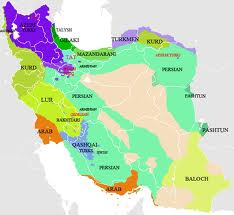
Iran’s ethnic groups

Kurdistan after the Cold War
In the 1980s, Kurds were caught between Iran and Iraq in their long, bloody war.  Khomeini continued the Shah’s practice of supporting Kurdish rebels in Iraq, even while keeping Iran’s own Kurds in their place when it came to autonomy—just as Hussein stepped up efforts to incite an insurgency by the majority Sunni Arabs in Iran’s southwestern Khuzestan region, which he coveted.  Hussein retaliated against northern Iraqi Kurds with a notorious massacre of civilians in 1988, using chemical weapons—illegal weapons that, ironically, had been clandestinely provided to Hussein by the U.S. in the hopes that they would be used against Iranian civilians, not Iraqi ones.  Hypocritically, the U.S. used this massacre as evidence of Hussein’s brutality as it waged, with western European allies, the First Gulf War, in 1991, to repel Hussein’s invasion of Kuwait.  The U.S. hoped that Kurds and Shiites would use the opportunity of the war to rise up against Hussein, but they were insufficiently organized and supplied.  Nor did President George H. W. Bush make any effort to help Iraqi Kurds secure independence—perhaps out of deference to Turkey, whose aid was crucial to Bush’s logistics.

Saddam Hussein’s Kurdish policy

As a half-measure, the U.S. imposed two “no-fly zones”—one covering the southern third of Iraq to protect Shiites from the Iraqi air force and another in the north to protect Kurds.  Meanwhile, Hussein’s military apparatus had been largely dismantled by the war and his industries crippled by sanctions, so the Kurds enjoyed a quasi-independence in their northern no-fly zone.  Iran’s influence in Iraqi Kurdistan was drastically reduced, and they became clients in a sense of the U.S.  Turkey, which had provided lots of support to the U.S. in the war effort, including the use of bases in Turkish Kurdistan, eyed the Kurdish quasi-state in northern Iraq warily, fearful of anything that might encourage its own Kurds.

Iraq’s no-fly zones (1991-2003)

After Hussein was toppled in the 2003 U.S. invasion of Iraq—a stated aim of which was to complete tasks left unfinished in the First Gulf War—a full-blown Kurdish Regional Government, with its own cabinet and parliament, was established in the north under U.S. sponsorship.  (The Kurdish Democratic Party now runs in it, with Barzani’s son, Massoud Barzani, as president.)  Turkey, having foreseen that the U.S. invasion might enhance Kurdish autonomy, did not help the U.S. this time around.


The Turkish military polices the border with Iraq aggressively and makes forays into Iraq to root out separatists whenever it deems it necessary.  The U.S. has tended to make sure Iraq’s Kurds never complain too much about this.  In fact, the greatest threat to Turkish control of its Kurdistan region in the modern period has come from Syria.  Hafez al-Assad began supplying and supporting Kurdish rebels in Turkey in the 1990s, and in 1998 this nearly brought Turkey and Syria to war.  Turkey massed tanks and troops along the border until Assad backed down and withdrew his support for the P.K.K.

P.K.K. fighters

This cold war between Turkey and Syria more than anything else set the stage for the double game the Kurds have had to play over the past year as the Syrian people rose up to try to remove Bashar al-Assad from power.  (See my recent blog article on the ethnic and regional dimensions of the Syrian uprising.)  Syria’s neighbors have tried to stand back as much as possible while the war rages.  Syria had long been a client state of Iran, both of them being Shiite regimes, and so Iran would like to keep Assad in power but has little influence on the ground there; its alliance was always with the Syrian regime, not with the populace or with what passes for civil society there.

Post-Hussein Iraq, no longer a Sunni-dominated Ba’athist regime but now a shaky Shiite-majority democratic republic, is in some senses a client state of the U.S. but also diverges from the U.S. in its efforts to stay on Iran’s good side, not making enemies where it does not need to, so it too has been rather weak in its denunciations of Assad.  Turkey, realizing that its cool but stable relationship with Damascus over the past decade had if nothing else kept its Kurdish problem from worsening, initially stood back too but has gradually come around to being one of the fiercest critics of Assad in the region.


Meanwhile, Kurds are strikingly absent from the Syrian opposition.  Assad bought them off early on in the uprising by granting long-overdue citizenship rights, and Kurds, from their mountain retreats, have seemed to see the civil war as more of an Arab-on-Arab squabble.  They would like their own autonomous region, like Iraq’s, but they seem to have no interest in joining any P.K.K.-envisioned independent Kurdistan.  As for the P.K.K., their fighters along the Turkish-Syrian frontier are now capturing any members of the rebel Free Syrian Army (F.S.A.) that cross the border and turning them in to the Assad regime.  Perhaps Turkey’s Kurds are doing this out of fear that a Sunni Arab majority regime in Damascus would be less Kurd-friendly than Assad’s, but mostly they seem to want to keep the border sealed and tidy so that Turkey will not feel the need to send troop reinforcements into Turkish Kurdistan to do that job itself.  In any case, the Turkish government is now claiming intelligence confirming that Syria is once again supporting the P.K.K., supposedly as retaliation for Turkey’s turning publicly against Assad, and that P.K.K. fighters now move freely throughout Syria—although why Assad would spend his energies on helping Turkey’s Kurds when his very survival is at stake closer to home is not explained.

Members of the Free Syrian Army

Kurdistan today: the shit hits the fan
Earlier this month, the Kurdish situation became more volatile on two fronts.  First, the P.K.K. and the B.D.P. called explicitly for Arab Spring–style street protests throughout Turkey for the weekend of March 17-18 (as reported in this blog).  The P.K.K.’s field commander, Murat Karayılan, announced, “From here on we must stop serving in the Turkish army, paying taxes, and using the Turkish language.  A new phase has begun.”  This rhetoric is not new, but for tens of thousands to heed it and take to the streets, as they did, was.  40,000 Kurds packed the streets of Diyarbakir alone.  Clearly, they are emboldened by the courage of common people just over the border in Syria.  The Turkish government responded with riot hoses, curfews (over 700 Kurds were arrested, and one killed), and, simultaneously, renewed attacks on rebel positions in the mountains, using cover from the Turkish air force.  On March 20th, a Turkish court convicted, and threatened with heavy sentences, two intellectuals—Büşra Ersanlı, an economics professor, and Ragıp Zarakolu, a publisher and a candidate for this year’s Nobel Peace Prize—for inciting Kurdish rebellion through their (actually rather mild) academic activities, which are linked to the B.D.P.  Ankara has also raided the offices of a major newspaper deemed too pro-Kurdish and shut it down.  Turkey has never really had freedom of speech; but right now it seems to be in the mood to remind Kurds of this.

Kurds are working up their courage

Meanwhile, in mid-March, Turkey’s prime minister, Recep Tayyip Erdoğan, openly contemplated establishing a security buffer to prevent the flood of refugees from Syria into Turkey; this would involve penetrating into Syria to secure the zone from all sides.  Most seriously, Ankara seemed to fear that F.S.A. gains might send some of Syria’s 2 million largely-Assad-aligned Kurds flooding into Turkey and inciting general rebellion.  This, in turn, might bring the P.K.K. into the civil war on the regime’s side, which would pull Turkey precipitately in as well.  In response to Erdoğan’s plan, the P.K.K.’s Karayılan said on March 22nd that if Turkey sent troops into “Western Kurdistan” (as Kurdish nationalists refer to the Kurdish areas of Syria) then “all of Kurdistan will turn into a war zone.”

The second front is in northern Iraq, where the Kurdish Regional Government has felt more and more isolated from Baghdad since elections placed the majority Shiite in power.  (Iraqi Kurds are mostly Sunni.)  Although, constitutionally, Kurds are part of Iraq’s power-sharing arrangement, the K.R.G.’s President Barzani is a leading critic of the authoritarian tendencies of Iraq’s Shiite prime minister, Nouri al-Maliki.  Iraq’s Shiites, now in power, are far less friendly to the idea of Kurdish autonomy than they were when both Shiites and Kurds were eager to get out from under the Sunni Arab Ba’athist thumb.  Late last year, Maliki accused his Sunni Arab vice-president, Tariq al-Hashemi, of running his own death squads and put out an arrest warrant for him.  Hashemi fled to Iraqi Kurdistan, where he is today, protected by Barzani, who refuses to extradite him, saying to do so would violate “Kurdish ethics.”  Also, Barzani is trying to close lucrative development deals with the Exxon Mobil Corporation, which it asserts it can do without approval from Baghdad; Maliki disagrees.  And Barzani has become more and more outspoken about the burden on K.R.G. social services of Arab refugees from Iraq’s sectarian fighting who have settled in Kurdistan, and about the too-small borders of his quasi-state, which he says should include the city of Kirkuk.  Iraqi Kurdistan has a large share of Iraq’s oil compared to its share of the population; this has enabled it to wrangle a lot of concessions out of Baghdad, but now even those are not enough.  On March 20th, Barzani threatened to pull out of the fragile coalition which rules Iraq, which, if he followed through, would plunge Shiite and Sunni Arabs back into political, maybe even violent, conflict.  Iraqi Arabs are regarding Barzani’s announcement as a veritable declaration of independence.

Massoud Barzani

So whither Kurdistan?  Right now, Syrian and Iranian Kurds are keeping their heads down, but Iraqi and Turkish Kurds are fed up and seem poised on a brink, trying to decide if it is worth taking the plunge into demanding partial or total independence.  A lot, here, will depend on how major players in the region would react—specifically, Turkey, Iran, Russia, Saudi Arabia, and “the West”—i.e., the U.S., the E.U., Israel, and NATO.  Let us take these in turn.

Iran.  As already mentioned, Iran’s Kurds are better integrated into the national society than those in Syria, Iraq, or Turkey.  Although the Shah had his own brand of nationalism, Iran was relatively unaffected by the muscular nationalism of either Atatürk or Nasser.  During the Hussein era in Iraq, Iran’s aid to Iraqi Kurdish rebels showed how unworried it was about its own Kurdish uprisings.  Hussein had much less luck trying to incite rebellion in Iranian Kurdistan.  Likewise, today, U.S. and Israeli intelligence agencies infiltrating Iran—using Azerbaijan and Iraqi Kurdistan as staging grounds—are focusing on inciting rebellion in Iran’s Balochistan and Khuzestan regions, knowing that they will not get very far trying to convince Kurds to rise up.

A Middle East divided between Sunnis and Shi’as

Today Iran’s primary geopolitical objective (other than not being bombed by Israel) is maintaining and, where possible, extending its domain of influence westward.  Iran has over the years supported the fellow Shiite regime in Syria and also supported the primarily-Shiite Hezbollah militia which wields so much influence in fragmented Lebanon.  The past year has driven Iran to try to manage its expectations of that sphere of influence.  The Syrian regime is crumbling, and Iran cannot do much about that, but it has also found Shiite uprisings to support in southern Iraq and in Yemen, where the Shi’a–Sunni split is one dimension in the state of general civil war.  Iran would like Assad’s fall to be delayed as much as possible, but it has probably written him off as a lost cause.  In Iraq, however, a partition (the possibility of which I discussed extensively in an article in this blog) would mean that the current pro-Shiite Maliki regime, which has a wary but mutually respectful working relationship with Iran, would be replaced by three states: an independent Kurdistan, a central Sunni republic (which would be virulently anti-Iranian but geopolitically weak), and a loyal Iranian client state in the form of a southern Shiite republic, which would allow Iran access to the Persian Gulf coastlines and southern oil fields near Kuwait and Saudi Arabia that it fought Iraq for eight years in the 1980s to get a larger piece of.  Iraq’s break-up would also solve one of Iran’s separatist problems by encircling Khuzestan’s Sunni Arabs with Shiites loyal to Tehran.  As for the Kurds of Syria and Iraq, Iran could work with them.  Iran has helped Iraq’s Kurds in the past, and it has been the last and only friend of the Assad regime to which Syrian Kurds are loyal now, so Iran would be able to encircle central Iraq with Iran-friendly states and gain considerable geopolitical advantage over its chief regional rival, Saudi Arabia.

Nouri al-Maliki

Saudi Arabia.  The main goal of Saudi regional foreign policy is containing the influence of Iran.  Today’s Shiite-dominated Iraq is not significantly less friendly to the Saudis than Hussein’s expansionist Iraq had been—hence Saudi cooperation with the U.S. in the First Gulf War and the political costs it entailed for them.  Saudi Arabia, which is authoritarian and overwhelmingly Sunni, is motivated to keep Iraq together for the same reasons that Iran would benefit from its partition.  Sunni Arabs at least nominally have a strong role in the current governing coalition in Iraq.  A partition would mean a pro-Tehran Shiite state in the south with a long, strategic border with Saudi Arabia.  This might, among other things, incite an uprising among the restive Shiite minority along Saudi Arabia’s Persian Gulf coast.  Iran and Saudi Arabia are the two outside forces trying to influence the direction Iraq will take.

Turkey.  Turkey’s primary domestic aim is to keep Kurds in line and within Turkey—something it may no longer, as of 2012, be able to be sure it can keep doing for long.  That having been said, Ankara has very specific goals in Syria, Iran, and Iraq with respect to the Kurdish question.  In Syria, it is finally exercising some payback to the Assad regime for supporting Turkey’s Kurds in the 1990s.  Syrian Kurds would like their own autonomous region, not a separate state, but that would not suit Turkey at all since that is precisely the part of Syria Turkey would like to put back under a Sunni Arab thumb if possible, or at least under the thumb of a not particularly Kurd-friendly Arab regime after Assad.  We have already seen that Turkey has no compunctions about militarizing the Syrian border and using force if necessary to hasten the end of what had been the only real Kurd-friendly foreign regime in the neighborhood.  But whether Syria’s Kurds manage to establish an autonomy area for themselves will largely depend on whether they pursue it before or after Assad’s fall.  If the opposition gains control before an autonomous region is in place, they may get nothing but violent payback for their having sided with Assad.  Turkey would be happy to help with that.

A Kurdish anti-Assad rally in Syria—though there haven’t been as many of those as you’d think

As for Iraq, Turkey was a primary sponsor of Baghdad’s current al-Iraqiya Sunni–Shi’a–Kurd coalition government—which was founded in the Turkish foreign minister’s office—and Ankara has reacted with alarm to the Shiite chauvinism and megalomania of the Maliki administration.  Turkish diplomats have been trying recently to convince Barzani to keep Kurdistan in Iraq, where Sunnis will keep Shiite power in check.  Recent comments to the press by an anonymous Turkish foreign-policy insider provide much detail on Ankara’s thinking.  As a Turkish newspaper columnist (read his article here) summed it up, “The resentment of [Iraq’s] Kurds towards Iran is such that they would rather see Turkish boots on the ground instead of Iranians meddling with their affairs.”  But that seems like wishful thinking.  Turkey seems to be in denial of the fact that a (perhaps inevitable) Iraqi Kurdistan would feel no particularly loyal to the Turkish government responsible for murdering one and a half million fellow Kurds.  But then pretending genocides never happened is a Turkish specialty.  This time around, their amnesia could be dangerous.

Map showing different Kurdish claims over the years

Russia.  Russia has always had a special place in the Kurdish imagination, as the one foreign power that ever went to the mat for them—first, by establishing in the 1920s an autonomous region within the Azerbaijani Soviet Socialist Republic called Red Kurdistan, which was dissolved by Stalin and its people deported to Kazakhstan (they never returned) out of deference to Turkey’s sensibilities, then in the failed Mahabad experiment after the Second World War.  (Woodrow Wilson went to the mat for the Kurds in the Treaty of Sèvres, but U.S. obeisance to Turkey’s Kurdish policy since then has erased that memory.)  Russia has mostly, since the end of the Cold War, seen Iran and Syria—especially Syria—as allies through whom it can project power into the Middle East.  But the West has bullied Russia to taking a more hands-off approach to Iran and has in the past few months watched fairly helplessly as Assad’s grip on Syria loosens.  Russia would likely try to build on its warm history with Kurds to befriend a nascent Kurdistan, though it will probably do quite a bit to avoid facing Turkey directly in the battlefield, since that would lead to all-out war with NATO.  Russia’s support for Armenia, against the Turkish- and U.S.-allied Azerbaijan, in the Nagorno-Karabakh conflict, places Russia already in a position hostile to Turkey in the region, but if Armenian noses are put out of joint by Kurdish claims on formerly Armenian areas in what is now Turkey—as happened around the time of the Treaty of Sèvres—then that might put Russia in an awkward position.  So Russia is more likely to support Kurdish ambitions outside Turkish borders than within them.

The West.  It is the West’s response to events that will be determinate.  The big question here is whether the U.S., the European Union, NATO, and Israel will have the nerve to say to Turkey, essentially, “What have you done for us lately?  Why should we continue to parrot your line on the evilness of all Kurds?”

In a sense, this divorce is already gradually occurring.  Turkey has been so stung both by Cyprus’s admission to the E.U. and by continuing stonewalling in its efforts to join the E.U. (even Serbia has been fast-tracked in front of it!) that it has clearly stopped even pretending to reform its human-rights situation.  NATO needs Turkey much less as a bulwark against Russia now that most of the Balkans are in NATO, with even Ukraine a likely eventual member.  The U.S. wasn’t able to count on Saudi Arabian and Turkish bases during the Second (2003) Gulf War as it had in the first, but it is now using Iraqi Kurdistan and Azerbaijan as a staging ground for any possible future confrontations with Iran.  So who really needs Turkey?

Recep Tayyip Erdoğan and Barack Obama

If Turkey weren’t in NATO, and if the P.K.K. weren’t inconveniently on the U.S.’s terrorists list (taking someone off the list right in the middle of their violent uprising doesn’t look too good), then helping Kurdistan win its independence—not just in the Iraqi area but everywhere—would be a possible goal.  Right now, however, President Barack Obama is extending Turkey’s prime minister, Recep Tayyip Erdoğan, lots of goodies, including some Predator drones, in its fight against the P.K.K.—it’s a fairly low-cost way to burnish anti-terrorist credentials in an election year—but what to do if Turkey’s anti-Kurdish atrocities make him more of a political liability internationally?  It could happen.

In many ways, the ball is in Turkey’s court.  The Middle East is transforming beyond recognition, but Ankara is reacting to events with a 1920s geopolitical mentality.  Kurdistan is rising.  The world had better make room for it.


[For those who are wondering, yes, this blog is tied in with my forthcoming book, a sort of encyclopedic atlas to be published by Auslander and Fox under the title Let’s Split! A Complete Guide to Separatist Movements, Independence Struggles, Breakaway Republics, Rebel Provinces, Pseudostates, Puppet States, Tribal Fiefdoms, Micronations, and Do-It-Yourself Countries, from Chiapas to Chechnya and Tibet to Texas.  The book is now in the layout phase and should be on shelves, and available on Amazon, by early fall 2014.  I will be keeping readers posted of further publication news.  Meanwhile, please “like” the book (even though you haven’t read it yet) on Facebook.]


Friday, December 23, 2011

The Iraq War Is Over, but Is Iraq’s Partition Just Beginning?

On December 15, 2011, President Barack Obama declared that the U.S. war in Iraq his predecessor George W. Bush had started was over, and the last troops began returning home.  But now that Iraq has been left to fend for itself, is the originally feared partition into separate Shiite and Sunni Arab and Kurdish—and perhaps other, smaller—states now inevitable?


One might think so to see the latest news of scores dead in coordinated attacks on Shiite targets that bear hallmarks of the Sunni-aligned terrorist organization Al-Qaeda in Iraq.  These attacks appear to be in retaliation for moves by Iraq’s Shiite prime minister, Nuri al-Maliki, who barely waited for the last U.S. helicopter to lift off before calling for the arrest of his vice president, Tarik al-Hashimi, a Sunni Arab, for running secret terror and assassination squads.  Hashimi is now hiding out in Iraqi Kurdistan, and Maliki has warned the Kurds against harboring him.


To understand the exact texture and consistency of the shit now hitting the Iraqi fan, however, it is necessary to review some tangled history.

Iraq is one of the more infamous examples of an “artificial” country—riven by internal strife largely because its borders were drawn by imperial powers without regard to where actual cultural and ethnic boundaries lay.  It was part of the Ottoman Empire until the 1920 Treaty of Sèvres (a subcommittee of sorts of the Treaty of Versailles), when, as among the losers of the First World War, Ottomans saw their possessions outside Asia Minor parceled out to European victors under League of Nations auspices.  Under that dispensation, the British ended up with Iraq, Trans-Jordan, Palestine, and Kuwait, and the French got Syria and Lebanon, while the Ottomans were left with a rump Turkish Republic.  (Saudi Arabia gradually established itself as an independent kingdom to the south of Iraq in a more complicated process.)


Of all these territories, with the exception of the much smaller Lebanon, the boundaries of the British Mandate of Mesopotamia (as Iraq was then called) corresponded the least well to any “naturally” bounded cultural area.  Northern Iraq was populated by Kurds, whose homeland also extended into neighboring areas of Iran, Syria, Armenia/Azerbaijan, and, of course, Turkey.  In the 1920s two separate attempts to establish a Kingdom of Kurdistan were put down by Turkish troops in southeastern Turkey and by the British in the Mesopotamia mandate.


The rest of Iraq, to the south, was mostly divided, with significantly less geographic clarity, between Arabs who followed Sunni Islam and those following Shi’a Islam—Islam’s deepest sectarian divide, as fundamental as the Catholic–Protestant divide in Christendom.  (Kurds, too, are predominantly Sunni.)  There are also smaller minorities, such as Turcomans, but they dominate only small areas.  Here is a rough map of the three major ethnic areas of 20th-century Iraq:


(The areas colored white are areas where almost no one lives; we’ll get to that oddity of geography later.)

In 1932, the U.K. granted independence to the Kingdom of Iraq, installing Faisal I as king.  Faisal, a Sunni Arab, had fought alongside T. E. Lawrence (Lawrence of Arabia) in the Arab Revolt during the First World War and had been king of the short-lived British puppet state in Syria immediately after the war.  Faisal’s dream was to unite Sunnis and Shiites in either a confederation of sovereign Arab states or an Arab superstate including much of the former Ottoman empire.  Faisal remained, however, a close ally of the British forces that had installed him.  Part of the agreement under which Iraq became independent was that the British would remain a military presence and play a role in shaping Iraqi politics.  Resentment of close ties to the British was a source of constant internal tension in the new country.  After the Second World War, as Western powers scrambled to preserve commercial interests in former colonies and in the oil-rich Middle East in particular, the Iraqi monarchy was an eager member of the U.K.-led Central Treaty Organization, or Baghdad Pact, which also included Iran, Pakistan, and Turkey—an organization designed to preserve Western oil interests along a swath running the length of the Near East.


In 1958, the Iraqi army staged a coup d’état, executing Faisal II and his family, declaring a republic, withdrawing from the Baghdad Pact, and aligning itself with the Soviet Union.  In a subsequent coup, in 1968, the Arab Socialist Ba’ath Party installed as president Saddam Hussein, a megalomaniacal but incredibly shrewd tyrant who stayed in power for decades mainly by playing superpowers against one another.  Hussein’s rule consolidated Sunni rule over a country where a majority of Arabs are Shiite (Shiites making up 60-65% of the population), and Hussein made sectarianism a point of conflict where it had not been before.  Hussein was mostly socialist and secular, but the Iranian revolution of 1979, which installed a Shiite theocracy next door in an unaligned country with a powerful military, made him paranoid about the possibility of an uprising among the mostly poor and disenfranchised Shiites in southern Iraq, including the so-called Marsh Arabs of the Tigris and Euphrates delta lowlands by Iraq’s narrow coastline, wedged between Iran and Kuwait.  This fear more than anything else prompted Hussein in 1980 to provoke a war with Iran, with the avowed goals of expanding its coastline by annexing areas that included Khuzestan, the only Sunni-Arab-dominated province in Shi’a-dominated Iran, just east of Iraq’s coast.


By this point, Iraq and Iran had both isolated themselves from most of the international community (Iran through the hostage crisis and other atrocities).  Western and Eastern powers in the Cold War supplied arms to both sides in the long Iran–Iraq War, and to some extent probably hoped both would lose; certainly, no outside powers were making as much money out of the region’s oil as they would like.  Iran’s alliance with Kurdish peshmerga rebels in northern Iraq led to Hussein’s campaign against the Kurds, often called genocidal, including the 1988 Halabja poison-gas attack, which killed thousands—using, it needs to be remembered, internationally banned chemical weapons provided clandestinely by the U.S. government, in the mistaken hope that they might be used against Iranian civilians instead of Iraqi ones.


The Iran–Iraq War ended in 1988 with no clear winners, gigantic death tolls on both sides, and the border pretty much where it had been at the beginning.

Frustrated in these attempts to expand power abroad, even as he consolidated it brutally at home, Hussein chose as his next target Kuwait, the oil-rich coastal city-state to the south.  Sunni-dominated Kuwait had been a much more autonomous member of the Ottoman Empire than Iraq, although at times it had come under the jurisdiction of Basra, now Iraq’s southernmost (and incidentally Shi’a-dominated) province.  In 1899, Kuwait aligned itself with the U.K., further loosening its ties to Constantinople.  Britain’s motivation here had been an economic rivalry with the German Empire, which, in the decades before the First World War, had been consolidating its ties with the Ottomans.  During the period of Faisal’s rule, Iraq had eyed Kuwait hungrily but never wanted to risk antagonizing the British.  The Ba’athists, with their anti-Western Arab nationalism, saw Kuwait’s independence from Britain in 1961, and its subsequent close ties to Saudi Arabia and the West, as a further affront to its national pride.  In 1990, after Kuwait amped up its oil production, thus depressing Iraqi oil revenue, Hussein invaded Kuwait, using mostly misty-eyed nationalistic rhetoric, claiming that Kuwait was historically part of Iraq.  It is perhaps significant, too, that, as with the attempted annexation of Khuzestan, the annexation of Kuwait would have tipped Iraq’s population toward a Sunni majority, and would have encircled the Shiite region with Sunni areas.  (Never mind that Kuwaitis, to a man, resisted and rejected Iraqi sovereignty; Hussein had no allies on the ground there.)  In the Iraq–Kuwait War (a.k.a. the Persian Gulf War—a.k.a. the Second Persian Gulf War, if you count the Iran–Iraq War as the first one), President George H. W. Bush Sr. led a coalition of the U.S., the U.K., and other Western allies, under United Nations auspices, to liberate Kuwait from Iraqi occupation, doing significant damage to Iraq’s infrastructure in the process, though not going to so far as to remove Hussein.


One of the results of that February 1991 Blitzkrieg was an even more severe economic stranglehold on Iraq by the international community.  The Iraqi military, one of the region’s strongest, was all but dismantled, and the war’s victors established two “no-fly zones” over northern and southern Iraq—policed on a daily basis for more than a decade by U.S. and other air forces—to prevent Ba’athist reprisals against those populations.  These no-fly zones were also a sort of guilty consolation prize offered to populations who had falsely hoped, in 1991, that Bush Sr. might either remove Hussein or assist them in their own uprisings.


For Iraq’s Kurds, the northern no-fly zone became the closest thing to autonomy that they had experienced in their lifetimes, even though the latitudinally drawn southern border corresponded only roughly to any boundary between Kurdish and Arab areas.  The whole enterprise irked the government of Turkey, which quite reasonably feared that a quasi-independent Kurdistan could emboldened the brutally repressed Kurds in neighboring southeastern Turkey.  Turkey also saw this pseudo-state as an affront because of their loan of air bases to the U.S. and its allies in the war (a favor Turkey did not repeat when the next gulf war came around).

Kurdistan’s flag

The allies were less keen to allow similar autonomy to the southern Shiites in and around Basra, not only because the Shiites’ nationalist feelings were more vague and less historically grounded than the Kurds’, but also because the southern no-fly zone included many large Sunni areas; in fact, it practically rubbed up against Baghdad’s southern suburbs.  Also, the West shared what had been Hussein’s initial fears—that Iraqi Shiites could become dangerous allies of Iran.  Saudi Arabia, which had also lent its military bases to the allies, felt (and today still feels) itself to be in a Sunni-vs.-Shi’a mini-superpower struggle with Teheran.  Saudi Arabia, Iraq, and Kuwait together held in those days what was thought to be a huge portion of the world’s known oil reserves—perhaps as much as a quarter of them.  Turkey, already squarely in NATO, was an ally the U.S. could afford to alienate a bit, but Saudi Arabia was not.  So, although the southern Shiites were protected somewhat from Ba’athist retaliation, they were, unlike the Kurds during this period (1991-2003), not allowed a regional government of any sort.

In 2003, as part of the War on Terror inaugurated by President George W. Bush in retaliation for al-Qaeda’s September 11, 2001, terrorist attacks, the U.S. led an unprovoked and globally reviled invasion of Iraq.  This became one of America’s longest wars, with famously shifting objectives.  First, in 2003, Bush and the U.K. prime minister Tony Blair disingenuously (to put it mildly) portrayed Saddam Hussein’s regime as on the brink of attacking the West with weapons of mass destruction.  By the time those lies had been definitively exposed, the goal was refocused to removing Hussein from power.  When that was achieved, the rationale for remaining there (despite Bush’s initially avowed aversion to “nation-building”) was to stabilize and democratize Iraq and keep it unified—thus, the U.S., the U.K., and their allies found themselves presiding, sometimes helplessly, over a bloody civil war among Iraq’s ethnic and sectarian militias.

A convincing argument can be made that all along the West’s goal had been to clear aside obstacles to Western economic exploitation in what had been in 2001 one of the only three countries strategic to oil interests with which Western oil companies could not do business—the others being Afghanistan (strategic as an avenue to the sea for central Asia’s inland oil fields) and Iran.  The war in Afghanistan that the U.S. waged just after the September 11th attacks and then Bush’s second-term ramp-up to a possible war against Iran (a plan permanently shelved when John McCain failed to succeed Bush) could be held up as further evidence for that interpretation.  In that respect, the war has been, from a Western perspective, a qualified success—unless one is so rude as to bring up the fact that, despite Bush’s statements to the contrary, al-Qaeda did not operate in Iraq before the Iraq War but now does.


One of the immediate and inevitable effects of the democratization of Iraq under U.S. auspices—and one thing one cannot take away from Bush is that Iraq does indeed now have elections—was that the slight majority of Shiites in the country now held majority power and that it was the Sunni minority, including former Ba’athists, who feared marginalization and disenfranchisement.  With the predominantly-Sunni Kurds withdrawing more and more from mainstream Iraqi political life and refusing to side decisively with either Sunni or Shi’a Arabs, the Shiites’ hold on power is even more secure.  Much of the U.S. and other occupiers’ energy over the last eight years have involved keeping Sunnis’ and Shiites’ fingers away from each other’s throats, with varying degrees of success.  There was a certain balance provided by the occupiers’ ambivalent interests in Iraq’s internal dynamics: while the West made a good show of dismantling the Ba’athists’ political, military, and secret-police institutions, the West was also not eager to see that power vacuum filled by Shiite radicals potentially sympathetic to Iran.


In 2006, Senator Joseph Biden (now Obama’s Vice-President), who had played an active role in NATO’s successful intervention in—and mediation to conclude—the Bosnian War in the 1990s, co-authored and pushed through the U.S. Senate a non-binding resolution in favor of partitioning Iraq into three quasi-independent entities, very similar to the internal partition of Bosnia and Herzegovina in the Dayton Accords.  Some versions of this plan called for an independent Kurdistan, a southern “Shiastan,” and a Sunni rump Iraq abutting Syria and Jordan.  But that proposal was anathema to the U.S. and Iraqi governments and got no traction.  The fear was that, unlike the situation in Bosnia, the veneer of confederation would quickly shatter, resulting in an Iranian client state with a capital in Basra and an independent Kurdistan on the brink of a war with Turkey that would divide NATO far more fatally than the Bosnian War ever had.


In any case, at that point in the Bush administration, occupation of Iraq seemed as though it might go on forever, so why not just keep U.S. troops there to stabilize the situation?  Moreover, the Iraqi civil war between Sunni and Shi’a militias did eventually calm down, not least because (again, echoes of the Wars of Yugoslav Succession, for which the term ethnic cleansing was coined) civil strife had forced Shiites and Sunnis into more sharply defined segregation—urban neighborhood by urban neighborhood, village by village.  If nothing else, this makes for an unhappy peace.

But with this month’s rather precipitous withdrawal of U.S. troops—and thus the just-under-the-wire fulfillment of one of Obama’s most urgent and popular campaign promises—Sunnis no longer feel like a protected minority, nor do Shiites any longer feel immune from a resurgent Ba’athist coup d’état or some other such sectarian calamity.  Kurds also fear being drawn into Sunni–Shi’a conflict and feel more vulnerable than ever to the occasional Turkish foray over the border to hunt down rebels in Iraqi Kurdistan.  The U.S. was even nice enough to let Turkey use some of its lethal drone aircraft as a parting gift on their way out of the region.  So is it now time for Iraq to split apart?

Iraq’s Kurds mostly hope so.  This moment may be the best if not only true chance to establish an independent Kurdistan, and if Shi’a and Sunni Arabs in the rest of Iraq start killing each other in even greater numbers, all the more reason to leave.  (For those drawing Yugoslavian parallels, think of Slovenia separating off with such alacrity partly so as to stay out of the crossfire of the impending Croat–Serb showdown.)  Kurds understand that NATO countries have been wary of supporting an independent Kurdistan mainly out of deference to Turkey’s meshuggeneh form of hypernationalism.  But with Turkey having sat out this most recent Iraq War and western Europe unwilling to budge on letting a country with Turkey’s abominable human-rights record even be considered for European Union membership, Kurds have reason to hope that Turkey may no longer be a factor and that, like Palestine or Kosovo or Taiwan, they may eventually be able to assemble a motley but slowly expanding coterie of Western countries that recognize it.  All it would take is a small number of E.U. or NATO allies to support a Kurdish state, and Turkey would back off.  Even more so if Iran (which showed in the Iran–Iraq War that it has no concrete fears of its own internal Kurdish uprisings) decides to support a Kurdish state.  Turkey has no problem shitting all over its own minority citizens, but it doesn’t have any stomach for fighting outside its borders, or for a showdown with Iran’s vast and sophisticated military.  Before Iraqi Kurdistan can declare independence, though, it need well defined borders, which it does not currently have.  There are large areas where Kurds and Sunni Arabs live in mixed communities (see the map below), and some of those areas have oil and are likely to be fought over.


Turkmens, too, hanker after the autonomy Kurds have enjoyed and would be perfectly willing to disrupt any attempts at Kurdish secession as a way of securing their own autonomy.  Turkmens have slivers of territory that would never make a viable state, but they have their pipe dream of an independent homeland named Türkmeneli covering much of Kurdistan.  The Assyrians, too, may make some trouble if a Kurdish state starts to gel in earnest.


But if Kurdistan can expect to hit some bumps on the road to statehood, it will be nothing compared to the bloodbath of a Sunni–Shi’a partition.  There, we could see a descent into civil war which could begin very soon and would differ significantly from the sectarian strife during the U.S. occupation.  For one thing, there would be no one to restrain Shiites from seeking direct or indirect help from Iran in fighting Sunnis, and here Iran would feel it had a greater stake than in the Kurdish question.  Iranian intervention would in turn prompt the Saudis to feel that they needed to step in to help contain Iran’s influence on their northern neighbor.  Iran, with its support for the now embattled minority Shiite regime in Syria and the Hezbollah militia in Lebanon, has long been suspected of angling to consolidate the various links in a Shiite belt that would stretch from Persia to the Levant.  (See my earlier blog post on how this dynamic may play out within Syria’s current civil war.)  And Saudi Arabia has long seen itself as a bulwark against such a spectre.  With so many of the conflicts of the 2011 Arab Spring—in Syria, in Bahrain, in Yemen, to say nothing of Lebanon’s decades-long conflicts—revolving around Sunni-vs.-Shi’a sectarianism, the Saudis and Iranians at times seem to be gearing up for a showdown for influence in the region.  Iraq is sadly positioned to be the front line in such a battle should it come to pass.


Moreover, refer to some of the maps above showing the distribution of groups within Iraq, and note the empty, white areas, or some of the southern areas marked as “Shia Arab / Sunni Arab.”  Those are parts of Iraq where virtually no one lives.  Like much of Saudi Arabia, these are uninhabitable wastes of sandy desert where communities cannot thrive, criss-crossed only by lonely highways, nomads, and oil workers.  That’s right, oil workers—for these no-man’s-lands are precisely the most potentially oil-rich areas of Iraq.  It is one thing to draw boundaries based on where Shiites and Sunnis live; it is another to decide which groups gets which chunks of oil-rich desert.  If the American war in Iraq and the recent sectarian strife have been chiefly in cities like Baghdad, Najaf, and Fallujah, a decisive war to divide Iraq into Shiite and Sunni states would be fought in the deserts, and the vast untapped oil reserves beneath would be the prize.  Saudi Arabia, with its sophisticated U.S.-equipped military and its familiarity with this type of terrain, would find it irresistible to push for an oil-rich Sunni state on its northern border—especially if a hostile Shiastan controlling all of current Iraq’s coastline would make a Sunni separatist state dependent on Saudi Arabia for bringing its oil to market via the sea.  One can imagine fierce battles for every mile of the currently undefinable border.

One of the saddest aspects of this is that there is currently no significant national identity among the populace as “Sunnistanis” or “Shiastanis.”  If Iraq is broken up this way, it would not be like Yugoslavia, where ancient fully-formed national and historical identities merely needed to be dusted off after the brief Communist interregnum.  If post-Iraq Arab sectarian national identities come into being, they will be fragile concoctions of European, Iranian, and Saudi power plays in the region.  Nor will they even have the stable identities of tiny post-Ottoman invented city-states like Kuwait, Bahrain, and Dubaii.  These will be quasi-nation-states, and their borders will be bloodily contested forever—or at least till the oil runs out.

But at this early stage, can we say that a secessionist civil war like this is where Iraq is actually headed?  Well, one ingredient of civil war—full-fledged sectarian militias—is well in place.  The U.S. had tried only half-heartedly before war’s end to dismantle a Ba’athist successor organization called the Sunni Awakening.  Part of the problem is that the Awakening’s leader, Sheikh Abu Ahmed Risha, had helped turn the tide in the civil war in 2006 by rallying ordinary Sunnis against al-Qaeda, eroding the influence of a pro-Qaeda Sunni separatist movement known as the Islamic State of Iraq.

A charming image from the Islamic State of Iraq’s website

The Awakening also provided a bulwark against Iranian influence.  This wouldn’t be the first time the U.S. had betrayed and abandoned an ally, but in fact the Awakening has been left largely active and in place, simply feeling more encircled and embittered.  Also, Shiite militias such as the Badr Brigades and the fanatical millennialist Mahdi Army have now become largely peaceful political organizations since the Shiites now run the country, but they never disbanded and if the Sunni Awakening and other Sunni militias reassert themselves, then these militias may take up arms again, and Maliki will surely not be able to control them.

The Mahdi Army always lends a festive air to Basra’s community events

The weeks and months ahead could take Iraq in any number of directions.  One thing is certain, however: the farther Iraq descends into chaos, the harder Obama will find it to portray the withdrawal from Iraq as a success as he runs for reelection, and a depressingly small number of American voters will be able to recall that it was the Republicans who started the mess in the first place.

Subscribe Now: Feed Icon