Showing posts with label Assad. Show all posts

Thursday, November 21, 2013

Syrian Kurds’ Declaration of Autonomous “Rojava” Scorned by Turkey, Assad—Even by Iraqi Kurds


The Kurdish people of northern Syria, after declaring an autonomous region last year in liberated pockets and towns near the border with Turkey (as reported at the time in this blog), are finally trying to make their statelet official.  And the plan is meeting with hostility from all sides, even from fellow Kurds in northern Iraq.  But why are Kurds not all on the same page on this—autonomy is supposed to be good, right?—and, moreover, why is this all happening now?

P.Y.D. flags are more common in Syrian Kurdistan lately
than the usual sun-emblazoned Kurdish national ones.
Well, for one thing, the Syrian civil war has reached a strange impasse in recent months.  There has been little change lately in the general boundaries between areas administered by the embattled dictator, Bashar al-Assad, and those under rebel control.  But there have been dramatic changes in the make-up of the rebel opposition.  In particular, the Western-backed Free Syrian Army (F.S.A.), which is being armed by Turkey, Qatar, Saudi Arabia, and others, has lost ground since summer to a new organization called the Islamic State of Iraq and al-Sham (ISIS) (as reported recently in this blog).  ISIS seems to be an outgrowth of two pre-existing groups, the al-Qaeda-backed al-Nusra Brigades, who have for some time now been a player in the Syrian civil war, and the Islamic State in Iraq (I.S.I.), a radical Sunni Arab militia which featured prominently in the Iraqi civil war during the United States occupation and which in turn has roots in al-Qaeda in Afghanistan in the days of Taliban rule there.  The al-Sham of ISIS’s name is an archaic term for Syria plus Lebanon, i.e. the Levant.  ISIS hopes to link up adjoining Sunni Arab areas of Syria and Iraq—both of them Arab-Shiite-ruled nations currently—to create a new Islamic state.

One international idea of a partitioned Syria—
but nobody puts Kurdistan in a corner!
But one rebel area where ISIS is not gaining influence in the far north of Syria, where Kurds have in recent weeks been able to push back the battle lines of ISIS and other Islamist militias.  This has put the People’s Defense Units (Y.P.G.) of the Kurdish-dominated Democratic Union Party (Partiya Yekîtiya Demokrat, or P.Y.D.) in control of a large swath of the Syrian side of the Syrian–Turkish border.  Maybe even all of it, though reliable information is hard to come by.

Kurds celebrating the liberation of Derki, Syria, last year
When the P.Y.D. first started “liberating” parts of this area last summer, their “victories” were mocked by their detractors, like the Turkish government and the F.S.A., for being in reality a bloodless takeover of areas that had been handed to them by a voluntarily retreating Syrian military.  There was probably some truth to this.  Assad had already been courting and handing political favors to Kurdish, Christian, and Druze minorities in Syria in the months before the Syrian civil war really broke out, in an attempt (a vain one, it turned out) to prevent or forestall the kind of Arab Spring uprisings that were already rocking Egypt, Libya, and Yemen.  Assad last year may have withdrawn from the Kurdish areas in an attempt to see how the creation of an autonomous or independent area might turn out, as part of exploring a “Plan B” of partitioning Syria into an Assad-ruled Alawite (Shiite) coastal state and other ethnic fiefdoms inland.  Or perhaps, fearing a Turkish military intervention to aid the rebels, Assad wanted to create a de facto buffer state hostile to Ankara.  (The P.Y.D. is closely allied with southeastern Turkey’s partially-pacified Kurdish rebel army the Kurdistan Workers’ Party (Partiya Karkerên Kurdistan, or P.K.K.).  In any case, Assad’s forces have totally withdrawn from border areas since then, hesitant to risk a flare-up with Turkish forces and more interested in fighting for Damascus, Aleppo, and other towns in the heartland.

Protesters in Berlin display P.K.K. flags
The new declaration of autonomy by the P.Y.D. speaks not of a West Kurdistan Autonomous Region, which was the preferred phrase last summer (in Kurdish nationalist usage, West Kurdistan is northern Syria, North Kurdistan is southeastern Turkey, East Kurdistan is northwestern Iran, and South Kurdistan is northern Iraq).  Instead, it calls its new autonomous statelet Rojava (rojava being the Kurdish word for “west”), which looks much larger on maps being circulated now than last year’s sliver and which, it is claimed, will include three autonomous-regions-within-the-autonomous-region: one for Kurds, one for Christians, and one for Arabs.  This last part is odd, since Syria’s mostly mountainous Christian minority has tended to keep its head down in the civil war and not demand its own autonomous region the way some Christians in Iraq do.  Plus, Kurds and Arabs have quite famously not been getting along lately.  It could be that the P.Y.D. is trying to reassure the international community that Christians and Arabs in the enlarged autonomous territory will be allowed freedoms and also to signal to the world, perhaps especially Turkey, that this is not just a Kurdish state—i.e., not an extension of the national aspirations of the dreaded P.K.K. as many Turks fear.

As a reader notes below (see comments), this map may seriously underestimate
the number of Kurds in the border areas.
Well, and how is the idea of an autonomous or independent Rojava going over?  Like a lead balloon—in Ankara, predictably; in Damascus and among the F.S.A., almost as predictably; and, a little surprisingly, in Erbil (capital of Iraq’s northern Kurdistan Region).  We’ll take these in turn.  The Turkish government mostly fears that Kurdish separatism is a contagion that can spread to its own Kurds, even though it has decided to make peace with the idea of an autonomous, perhaps even eventually independent, Iraqi Kurdistan.  The implementation of this year’s historic peace deal between Ankara and the P.K.K. is proceeding relatively smoothly, but naturally Turkey worries that the still-armed P.K.K. rebels already retreating over the border into Iraqi Kurdistan—where the regional president, Massoud Barzani, can assure that they will be watched closely—might instead head to the more lawless Syrian Kurdistan, where they have natural allies in the P.Y.D.

Massoud Barzani, president of Iraq’s Kurds
Assad, for his part, may have liked the idea of a buffer area to keep Syrian and Turkish armies out of firing range of one another, but he is probably nervous about full-blown autonomy or independence.  If successful, the idea could spread rapidly to, say, the Druze.  ISIS already is drawing up its new borders.  And that would be the end of Syria.

(This map is ridiculously generous; Kurds don’t live as far west as the coast.)
President Barzani, the president of the quasi-independent Iraqi Kurdistan, condemns the Rojava declaration as being driven by the P.Y.D. with insufficient input from other Kurdish factions, which had been—nominally and precariously—united through painstaking multilateral diplomacy under Barzani’s auspices over the past couple years.  As Barzani put it, “We only support the steps that have the consensus of all Kurdish parties in Rojava.  We refuse to deal with unilateral actions.”  For the most part, Barzani refers to the Kurdish National Council (K.N.C.), which is closely allied to his own government and approved of by the West but seen by the more hardline P.K.K. and P.Y.D. as Western and Turkish stooges, while Barzani and the K.N.C. regard the P.Y.D. as unruly terrorists who have a working relationship, if not worse, with Assad.


We will be keeping readers informed of how the repercussions of the Rojava declaration play out.

[You can read more about these and many other separatist and new-nation movements, both famous and obscure, in my new book, a sort of encyclopedic atlas just published by Litwin Books under the title Let’s Split! A Complete Guide to Separatist Movements and Aspirant Nations, from Abkhazia to Zanzibar.  The book, which contains 46 maps and 554 flags (or, more accurately, 554 flag images), is available for order now on Amazon.  Meanwhile, please “like” the book (even if you haven’t read it yet) on Facebook and see this interview for more information on the book.]


Tuesday, September 24, 2013

The Caliphate Movement Comes to Syria: New Islamist Army Falters in Azaz but May Try to Carve Out Separate State

An ominous Islamic Emirate banners flying over a checkpoint in Azaz, Syria
It was bound to happen.  While the international community beyond the Middle East has debated and stalled on whether and when to offer overt aid to the rebel opposition in Syria—hoping that the conflict would sort itself out first and put a Western-friendly regime of some sort in charge—the ideological nature of the opposition has shifted.  And now the salafist Islamist component in the opposition seems to be gaining the upper hand, with territorial gains that may presage the formation of a de facto independent Islamist enclave.

The location of Azaz in Syria.  (Turkey is to the north.)

On September 18th, Azaz, a town in Syria’s Idlib province two miles from the boundary with Turkey and 20 miles from Aleppo, fell to Islamists associated with al-Qaeda.  Azaz is near a major Turkish–Syrian border crossing and was the scene of fighting between the regime and the more moderate rebel umbrella group, the Free Syrian Army (F.S.A.), last year.  Nine centuries or so earlier, during the Crusades, it was the site of a victory of Christian European forces over the town’s Turkish defenders—a resonance that is surely not lost on the deep-historical-grudge-bearing jihadists.
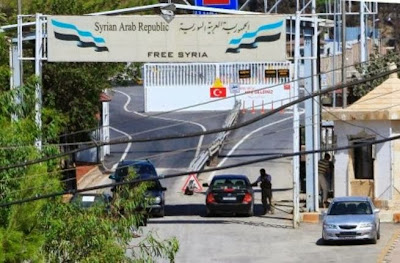
Near Azaz, a more official border crossing between Turkey and “Free Syria”
These particular jihadists, who—though the reports are inconclusive—seem to still hold the town, or part of it, are members of the Islamic State of Iraq and al-Sham (ISIS), a new player in the Syrian civil war.  Reports indicate that a cease-fire has had some success but that Islamic law seems to be in effect there, after a skirmish resulted in ISIS expelling an F.S.A. unit called Northern Storm from the town.  And the assassination of the self-declared emir of Azaz, Abu Abdullah Libi (nom de guerre: Junood), on September 23rd—his car was shot up by snipers while at a checkpoint—may only stoke the flames of conflict between the two groups.  But who is ISIS, and what do they want?


One finger means I have to go wee-wee, two fingers means behead the infidel:
students at a school in Aleppo run by the Islamic State of Iraq and al-Sham.
Al-Shām, or Sham, is an old Arabic term for the fertile lowlands between the Mediterranean and Iraq’s Euphrates River.  ISIS is thus sometimes called, in the media, the “Islamic State of Iraq and the Levant,” or, less accurately, “... and Syria.”  Some say that ISIS represents a merger between the al-Nusra Brigades—the most prominent Islamist force in the Syrian war and, some say, by far its best organized rebel group—and an older entity called the Islamic State in Iraq (I.S.I.).  I.S.I., under its original name Jama’at al-Tawhid wal-Jihad (Organization for Monotheism and Jihad), was founded in 2003 by a Jordan-born Mujahideen commander from the Afghan War named Abu Musab al-Zarqawi, during the period when al-Qaeda-linked groups were flooding into Iraq to fight the United States, which had invaded using as justification the lie that al-Qaeda was already there and cooperating with Saddam Hussein, which everyone knew it wasn’t.  Zarqawi folded his Afghanistan-based militia into Osama bin Laden’s al-Qaeda network in 2004 and renamed it al-Qaeda in Iraq (A.Q.I.).  Later, as I.S.I., it aimed to create an Islamic state in the Sunni-Arab-dominated parts of Iraq between Kurdistan and the Shiite-dominated south.  (See my article from this blog about a possible partition of Iraq.)  Zarqawi was dubbed al-Qaeda’s “Emir of Mesopotamia” (i.e., Iraq) before being killed in a U.S. bombing in 2006.

Abu Musab al-Zarqawi
For a group like ISIS to become a player in Syria is new, and dangerous.  Radical Islamist terrorists never had time to organize themselves as a major fighting force in Arab Spring revolutions such as those in Tunisia, Egypt, Libya, or Bahrain, though they were already a presence in Yemen and still are in the ongoing fighting there.  Zarqawi’s relocation from Afghanistan to Iraq in the early 2000s is part of a larger pattern of Islamist fighters from various points around the world converging on trouble spots that are perceived to be frontline struggles in a holy war to reclaim traditionally-Muslim-ruled areas and place them under shari’a (Islamic law).  This is what happened, for example, in southern Russia, in Chechnya between the First Chechen War in the mid-1990s, which was a secular nationalist movement, and, in 1999, the onset of the Second Chechen War, by now a salafist religious war with local rule often modeled on the harsh Saudi Arabian form of salafism known as Wahhabism.  It is also what has happened in Kashmir, where a war over the question of independence and self-determination in an area claimed by both India and Pakistan has been transformed into a holy war (for some, anyway).  It is also what happened last year in northern Mali, where the latest nationalist uprising by the Tuareg minority was coopted by jihadists as well as by Libyan Tuaregs displaced by civil war.  It is also the pattern in places such as northern Nigeria (Boko Haram), Zanzibar (Uamsho), and the southern Philippines (Abu Sayyaf), among other places.

The global caliphate some Muslim radicals envision
In each case, the aim has been to create an emirate (like Zarqawi’s Emirate of Mesopotamia) under shari’a, ruled by mullahs, or self-appointed doctrinal experts among the militant leadership.  These pseudo-states prominently feature the bureaucratic language of the political structure of the Ottoman Empire (emirates, vilayats, etc.), the closest thing there has been to the superstate ruling the entire Islamic world that these radicals envision.

A more Ottoman-centered vision for an Islamic caliphate
There have been some successes.  Under the Taliban’s rule, Afghanistan was known as the Islamic Emirate of Afghanistan—a term still used by radical Islamists who control pockets of the country.  The areas along the Afghan border which Pakistan’s government is unable or unwilling to govern is a de facto sovereign Taliban and al-Qaeda territory called the Islamic Emirate of Waziristan.  Al-Qaeda-linked radicals ran a so-called Emirate of Waqar in the towns of Jaar and Zinjibar in southern Yemen for more than a year until it was shut down (as reported at the time in this blog) by a Yemeni government offensive last summer.  Perhaps most prominently, as indicated above, the al-Qaeda-linked Ansar al-Dine militia and the Algerian-based Movement for Unity and Jihad in West Africa (MUJAO) ran an Islamic Republic of Azawad in the northern two-thirds of Mali until dislodged by France earlier this year.  (See my recent article with an update on Azawad.)  In all these places, shari’a means that music and beard-trimming are banned, women have to be completely covered and are denied education, adulterers are stoned to death, and anything deemed a non-Muslim or pre-Muslim religious structure can be demolished, including ancient architectural treasures.  These are not nice people.

Ansar al-Dine in Azawad
Some “emirates” are more imaginary.  A visit to the Kavkaz Center website reveals a fantasy world in which Russia’s North Caucasus region and surrounding areas are an Islamist-governed Caucasus Emirate, divided into renamed vilayats (provinces) where “Russian invaders” are always successfully resisted by the loyal mujahideen, in deadpan journalistic prose.  In the real world, this translates into a low-level but unending procession of suicide bombings, ambushes, assassinations of moderate clerics, and other terrorist acts in Russia’s North Caucasus republics.  The Caucasus Emirate has managed to send quite a few fighters to join the struggle in Syria, not incidentally, and they have their sights set on areas such as Tatarstan, in central Russia, as well.

The imaginary Caucasus Emirate of southwestern Russia
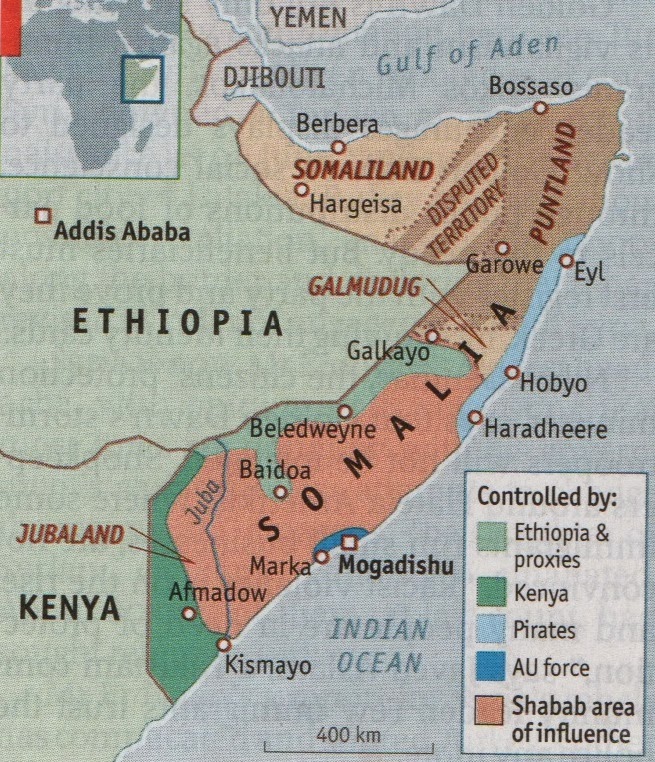
Starting in the late 2000s, an al-Qaeda-affiliated militia called al-Shabaab (literally, “the youth”) controlled nearly a third of Somalia—pretty much everything west and south of Mogadishu, the capital—until being dispersed by troops from Kenya and Ethiopia under the African Union (A.U.) banner last year.  Those events are the grievance behind al-Shabaab’s (as of this writing) ongoing Westgate shopping-mall massacre and siege in Nairobi, Kenya.  During its dominance of southern Somalia, al-Shabaab called its territory the Islamic Emirate of Somalia.  (See my recent article with an update on Somalia.)

How Somalia was divided up during the height of al-Shabaab’s influence
A version of this may be what is going on in Azaz.  In addition to the de facto West Kurdistan Autonomous Region in northern Syria along the Turkish border and a de facto division of much of the country into Bashir al-Assad’s Syria and “Free Syria,” we may now be seeing the beginnings of pockets of a so-called Islamic Emirate with plans to link the bulk of Syrian territory to adjoining Sunni-dominated parts of western and central Iraq.

One view of how Syria might be partitioned
One motivation for international salafist interest in Syria is that it is, like non-Kurdish Iraq, ruled by Shiites, whom Sunni salafists such as al-Qaeda and its partners regard as heretics.  In particular, this is true for the Arab Shiite minority that forms the political elite in Assad’s Syria, the Alawites, whose version of Islam is not particularly rigid and observant by most Muslim standards.  Some members of the Assad regime are interested in the possibility of forming an independent Alawite State in the coastal areas where the opposition is weakest and where Shiites predominate.  (See my recent article on the Alawite State idea, which I also called one of “10 Separatist Movements to Watch in 2013.”  See also an earlier, longer discussion in this blog of how Syria might be partitioned.)

The former flag of the “Alawite State” area in French-ruled Syria
may one day fly again over Tartous and Lattakia.
This sectarian division also intersects with the tussle over Syria between the local superpowers.  Iran, which is Shiite, is the Assad regime’s strongest backer, while Turkey funnels arms to moderate Sunnis (as long as they’re not Kurdish) and Saudi Arabia funnels arms to—well, we do have to worry that some of those arms at least are ending up in the hands of groups like al-Nusra and ISIS.


So now, if a resolution to the war in Syria is to involve some kind of partition, we would be looking at not only Kurdish, Alawite, and Sunni Arab (and maybe Druze) statelets or autonomous regions but also, perhaps, an attempt to establish an Islamic Emirate.  And the experience in Nigeria, Mali, and Somalia is that emirate movements are never content to revel in their safe enclaves but want to expand in order to bring shari’a to the rest of the benighted world.  These new developments make it much less likely that a peaceful partition can be achieved—and it also raises the prospect of a well-organized, Taliban-style faction jostling for the upper hand in any post-Assad regime.

It doesn’t look good.

An F.S.A. rebel defending Idlib province from the Assad regime and, now, al-Qaeda-linked Islamists as well

[Also, for those who are wondering, yes, this blog is tied in with a forthcoming book, a sort of encyclopedic atlas to be published by Auslander and Fox under the title Let’s Split! A Complete Guide to Separatist Movements, Independence Struggles, Breakaway Republics, Rebel Provinces, Pseudostates, Puppet States, Tribal Fiefdoms, Micronations, and Do-It-Yourself Countries, from Chiapas to Chechnya and Tibet to Texas.  Look for it some time in 2013 or 2014.  I will be keeping readers posted of further publication news.]

Thursday, August 1, 2013

Syrian Regime Seeks Israeli Green-Light for Separate Alawite Republic


In the “strange bedfellows” department, the embattled dictatorship in Syria—which in the past has rarely felt that it needed Israeli permission for anything, whether it was funding Hezbollah in Lebanon, harboring Palestinian militants, or continuing to claim the Golan Heights—has, it turned out, gone to the Israeli government hat in hand recently to ask its support for setting up a post-civil-war “rump state” in the coastal area of the country.


This was revealed earlier this week by the English newspaper the Guardian, which reported that Syria’s dictator, Bashar al-Assad, had asked an unnamed diplomat “to approach the former Israeli foreign minister, Avigdor Lieberman, late last year with a request that Israel not stand in the way of attempts to form an Alawite state, which could have meant moving some displaced communities into the Golan Heights area.”  (At the end of last year, I listed Syrian Alawites as one of “10 Separatist Movements to Watch in 2013.”)


Alawites, who are Arab, practice a form of Shi’a Islam and make up about 12% of Syria’s population, but after the humiliation of defeat by Israel in the Arab–Israeli War of 1967, Hafez al-Assad, the current dictator’s father, deposed the Ba’athist Arab-nationalist regime that represented the just-over-two-thirds of the country that is Sunni Arab and made his own Alawite community into the political élite.  The Alawite version of Islam, though secular and liberal by many standards, is Shiite nonetheless, thus putting Assad’s Syria in an axis of fiercely anti-Western Shiite régimes that include Iran and Lebanon’s Hezbollah, as well as radical Shiite Arabs in southern Iraq who have recently found themselves part of the political majority.  The Syrian civil war which began in 2011 began as largely political until it drew an influx of Salafist Sunni fighters.  Many of them sympathetic are foreign fighters sympathetic to al-Qaeda, they tend to regard Shiism in general and the Alawite in particular as heresy, and they have become a prominent part of the opposition.  That, more than anything else, has helped sectarianize the Syrian conflict.  It is now one of the fronts in the wider historical conflict between Shiites and Sunnis that has become a feature of the recent rise of Islamist politics—along with Lebanon, Yemen, Bahrain, and of course Iraq.  There seems no way that Muslim Brotherhood or Salafist elements would not demand, and probably get, a prominent role in a post-Assad régime.

Like father, like son
After the Ottoman Empire was dismantled at the close of the First World War, the League of Nations put France in charge of some of the empire’s Arab territories, including what are now Syria and Lebanon.  This was by far the most religiously and ethnically diverse part of the Arab world, and the French strove to avert conflict by dividing French Syria into, among other divisions, separate zones for Druze (Jabal Druze), Maronite Catholics (what is now Lebanon), and Alawites (the Alawite State).  (North of the Alawite area was the Sanjak of Alexandretta, with a mixed Arab and Armenian population, which was later snatched by Turkey.)  When Syria became independent in 1946 in its present borders, strong protections for minorities were in place as the formerly quasi-autonomous Alawite State became today’s provinces of Tartous and Latakia, which include all of Syria’s small coastline and are separated from the rest of Syria by high mountains.


It is no secret that Assad, for all his bluster, is making contingency plans for possible rebel victory in Damascus, other major cities, and the vast center and east of the country.  Observers have noted what appear to have been attempts to create a régime-controlled corridor between the Alawite region and centers of régime control in the interior.  And tensions in the Alawite region have risen dramatically.  This has been, for obvious reasons, the least rebellious part of the country, but there have been reports of attempted pogroms of Alawites by Salafist Sunnis.  Other Sunnis are fleeing the area for points east or abroad, despite the fact that is the area least affected by the war.

The flag of the French-era Alawite State.  Presumably if it were restored it would lose the tricoleur.
But why would Assad expect Israel to protect an Alawite redoubt or give a green light to an independent Alawite State?  The answer is probably because, although Israel and the Assad régime are historical enemies, Israel has even less affection for the radical Sunni Islamists that would be likely to replace Assad in Damascus.  They would, in their foreign policy, perhaps more resemble the Ba’athists that joined the alliance to destroy Israel in the 1960s.  Moreover, a post-Assad régime in Damascus would also have links to the Muslim Brotherhood, the broad Sunni movement whose brief rule in Egypt from 2011 until this summer seriously destabilized the Sinai Peninsula and Gaza Strip on Israel’s Western flank by turning away from the uneasy détente of the Mubarak years.  Salafists running Damascus might turn the Golan Heights—Syrian (actually, mostly Druze) territory which Israel has occupied since the 1967 war—into a new flashpoint.  No one wants that, except for the wackos who increasingly feature prominently in the armed Syrian opposition.

The state of play at the moment, according to the Economist
Assad is, as the saying goes, the devil Israel knows.  If Israel gives a blessing to an Alawite State, it would deny post-Assad Syria a coastline and would provide the Alawites with a place where they can rebuild, regroup, and perhaps one day take back the rest of the country.  (That seems especially possible after Egypt’s recent counter-revolution.)  But what of the fact that Western countries, including the United States, the United Kingdom, France, and the European Union generally, are dead against Assad, to the point where even radical Salafists seem like worthy allies of the moment?  Well, that is one of the biggest divides in foreign policy between Israel and its closest ally, the U.S., lately.  Israel wants Assad to stay, even if it is in a tiny breakaway state, and, though Washington is wary, when it comes to its immediate neighborhood Israel usually gets its way without much complaint from the White House.  Turkey can be expected to fight tooth and nail to prevent an Alawite State, so it could get interesting.

Strange bedfellows indeed: is the Israeli government about to join this cheering section?
The good news is that Israel may convince the U.S. to support and nurture the West Kurdistan Autonomous Region in northern Syria.  The bad news is that we might have Bashar al-Assad to kick around for quite a while yet.  But only maybe: no word yet on whether Israel is willing to go along with an Alawite State just yet.  Everyone’s still watching to see how the rest of the civil war plays out.

Syrian Kurds celebrating the establishment last year of a de facto West Kurdistan Autonomous Region.
Some call that moment simply the first crack in the break-up of Syria.
[Also, for those who are wondering, yes, this blog is tied in with a forthcoming book, a sort of encyclopedic atlas to be published by Auslander and Fox under the title Let’s Split! A Complete Guide to Separatist Movements, Independence Struggles, Breakaway Republics, Rebel Provinces, Pseudostates, Puppet States, Tribal Fiefdoms, Micronations, and Do-It-Yourself Countries, from Chiapas to Chechnya and Tibet to Texas.  Look for it some time in 2013.  I will be keeping readers posted of further publication news.]

Saturday, November 17, 2012

Syrian Kurds Liberate 4 More Towns; Diyarbakır Mayor on Hunger Strike; More Carnage in Southeastern Turkey: Kurdistan Update, 11-17 November 2012


The carnage in Ra’s al-’Ayn, in Syria
NORTH KURDISTAN (TURKISH KURDISTAN)

Death Toll in Hakkari Battles between Turks and Kurds Rises to 43.  The death toll from three days of Turkish airstrikes and ground operations against separatist Kurdistan Workers’ Party (P.K.K.) fighters in southeastern Turkey’s Hakkari province which began November 8th (as reported last week in this blogwere raised by the 10th from 13 to 42.  One Turkish soldier was killed, with much of the fighting concentrated in and around Şemdinli, site of a massive ground battle between Turkey and the P.K.K. earlier this year.  Meanwhile, the Turkish military reported on November 14th that two P.K.K. field commanders had been killed along with seven other P.K.K. militants.

Kurdish Mayor, 5 M.P.s Join 700 Hunger Strikers in Turkey.  Six prominent Kurdish politicians in Turkey this week joined the massive hunger strike calling for improved conditions and rights for founder of the Kurdistan Workers’ Party (P.K.K.), Abdullah Öcalan, among other demands.  The politicians include Osman Baydemir, the mayor of Diyarbakır, Turkish Kurdistan’s notional capital, who is the source of the information on the other five.  The others are members of Turkey’s parliament from the pro-Kurdish Peace and Democracy Party (B.D.P.): Sırrı Süreyya ÖnderGültan KışanakAysel TuğlukAdil Kurt, and Sabahat Tuncer.  About 700 Kurdish prisoners have been hunger-striking for about two months (as reported on last week in this blog).  Meanwhile, police say that a Kurd from Iran who was one of two P.K.K. members arrested in Hakkari province this week has confessed that he was part of a team that planned to set off bombs in case one of the hunger-strikers should die.

Osman Baydemir, now on hunger strike
SOUTH KURDISTAN (IRAQI KURDISTAN)

2 Kurdish Civilians Killed in Turkish Airstrike in Iraq Last Week Were Iranian.  The autonomous Kurdistan Regional Government (K.R.G.) in northern Iraq has released more information about the two civilians killed in a November 6th airstrike by Turkey over the border into Iraq, ostensibly to root out rebels from Turkey’s banned separatist Kurdistan Workers’ Party (P.K.K.).  The two were Kurds from Iran, aged 19 and 45, who were in Iraqi Kurdistan on a business trip.  A Kurd named Abubakir Khidr, of Besta village, described the scene: “We were sleeping during the strike and when we woke up we were covered in blood.  Two men died right away and we were injured.  The other man with me ended up losing a leg.”  The head of the village, Said Hussein Ali, added, “The Turkish planes targeted a small shop where Iranian and Iraqi Kurds have conducted business for years.”

Kurdish casualties of a Turkish airstrike on Iraq
Bombings at Iraqi Kurdish Party Offices in Kirkuk Kill 5, Hurt 4.  Five people were killed and four injured on November 14th by bombings outside the offices of a Kurdish political party in Kirkuk, a Kurdish-dominated area in northern Iraq that lies outside the autonomous Kurdistan Region.  The first bomb was planted in a car; the second was set up to detonate after police gathered in response to the first explosion.

WEST KURDISTAN (SYRIAN KURDISTAN)

Kurds Take 4 Towns; Syrian Province Now in 3-Way War with Kurds, Regime, F.S.A.  The London-based Syrian Observatory for Human Rights reported on November 10th that Kurds in northern Syria have taken over three more towns to add to what they are calling a West Kurdistan Autonomous Region which they hope, after the civil war’s end, to make into an at least quasi-independent entity along the lines of northern Iraq’s Kurdistan Regional Government (K.R.G.).  The towns—Derbassiye, Tall Tamr, and Amuda, all near the border with Turkey—were abandoned by regime forces after being surrounded by fighters from the Democratic Union Party (P.Y.D.), which is affiliated with Turkey’s banned separatist Kurdistan Workers’ Party (P.K.K.).  A fourth town, Derik, was liberated by Kurds on November 13th.  This leaves almost all of Syria’s Hasakah province outside the regime’s control.  But on November 12th fighter jets and helicopters loyal to Bashar al-Assad’s embattled dictatorship attacked the Hasakah town of Ra’s al-’Ayn (called Serêkanî in Kurdish), one controlled mostly by the opposition’s Sunni-Arab-dominated Free Syrian Army (F.S.A.), killing 18 people, including six Kurds, and injuring scores.  The other 12 included seven members of the Nusra Front, an opposition paramilitary linked to al-Qaeda.  Kurds in the area have accused the Turkish government of backing F.S.A. encroachment into Kurdish-controlled areas.


[Also, for those who are wondering, yes, this blog is tied in with a forthcoming book, a sort of encyclopedic atlas to be published by Auslander and Fox under the title Let’s Split! A Complete Guide to Separatist Movements, Independence Struggles, Breakaway Republics, Rebel Provinces, Pseudostates, Puppet States, Tribal Fiefdoms, Micronations, and Do-It-Yourself Countries, from Chiapas to Chechnya and Tibet to Texas.  Look for it in spring 2013.  I will be keeping readers posted of further publication news.]

Saturday, October 6, 2012

Turkey and Syria Edge toward War, Baghdad Expels Turkish Bases from North: Kurdistan Update, 30 September - 6 October 2012

That red line runs right through Kurdistan
NORTH KURDISTAN (TURKISH KURDISTAN)

Land Mine in Turkish Kurdistan Kills 1 Soldier; 2 Rebels Dead in Battle in Siirt.  A land mine in Şırnak province, in the Kurdistan region of southeastern Turkeykilled a Turkish soldier and wounded a second on September 30th.  The incident occurred during a mine sweep, and the banned separatist Kurdistan Workers’ Party (P.K.K.) is suspected.  Also this week, two P.K.K. fighters were reported killed in Siirt province in a clash with the military.

Local Hakkari Party Chief Released after Month of Captivity by Kurdish Rebels.  A local politician with Turkey’s ruling Justice and Development Party (A.K.P.) in Hakkari province, in the southeast’s Kurdistan region, was released October 4th after more than a month in captivity at the hands of the banned separatist Kurdistan Workers’ Party (P.K.K.).  The captive, Abdülmecit Tarhan, was the Hakkari branch chief of the A.K.P.  He appeared to have been held in Iraq, just over the border from Hakkari.

Abdülmecit Tarhan (center)
WEST KURDISTAN (SYRIAN KURDISTAN)

Kurds Are (Of Course) First Casualties as Turkey Edges toward Open War with Syria.  In the first fatal cross-border violence between Turkey and Syria since the Syrian civil war began last year, Turkish forces fired weapons across the frontier between Syria’s Hasaka province and Turkey’s Mardin province on October 2nd, killing one border patrolman from a Kurdish civil-defense militia that the Turkish government fears is allied with its own armed separatist Kurdistan Workers’ Party (P.K.K.).  Three Kurds were wounded in the incident.  Later, and with more attention from international media, further cross-border reprisals by the Turkish military targeted forces loyal to the embattled dictatorship of Bashar al-Assad within Syria, prompting fears that Turkey would be drawn fully into the war.

SOUTH KURDISTAN (IRAQI KURDISTAN)

After New Bombings, Baghdad to Boot Turkish Bases Out of Iraqi Kurdistan.  This week saw a new round of Turkish bombings of supposed Kurdish rebel positions in northern Iraq’s Kurdistan region, followed a few days later by an Iraqi government decision to phase out Turkey’s military bases in the Kurdish region.  First, on September 28th, warplanes from Turkey crossed into Iraq and bombed what it claimed were targets connected to the banned separatist Kurdistan Workers’ Party (P.K.K.), which is waging a decades-long insurgency in the Kurdish region of southeastern Turkey.  A P.K.K. spokesman said that the bombing went on for two days, in the Qandil mountains.  There were no reports of casualties.  On October 1st, the Turkish government asked parliament for an extension of its mandate to conduct such cross-border sorties.  The next day, an Iraqi government spokesman in Baghdad announced a cabinet decision “to reject the presence of any foreign bases or forces on Iraqi land and to reject the entry of any foreign military forces into Iraqi land.”  The reference to “land” seems designed to prevent Iraq from feeling committed to respond to future air sorties from Turkey, but it certainly signals the beginning of the end of Turkey’s military bases in Dohuk, one of the northern Iraqi provinces governed by the autonomous Kurdistan Regional Government (K.R.G.)—bases that were first established at the invitation of the dictator Saddam Hussein.


Hamas Leader Mashal and Kurdish President Barzani Hold Informal Meeting in Ankara.  The head of Hamas, the Islamist terrorist militia that governs the Gaza Strip portion of the Palestinian Territoriesmet on October 1st with the president of northern Iraq’s autonomous Kurdistan Regional Government (K.R.G.), Massoud Barzani, on the sidelines of a summit in Ankara of the Justice and Development Party (A.K.P.), which governs Turkey.  A Hamas source said that its leader, Khaled Mashal, discussed Palestine, the Arab Spring, and other topics with Barzani.

[Also, for those who are wondering, yes, this blog is tied in with a forthcoming book, a sort of encyclopedic atlas to be published by Auslander and Fox under the title Let’s Split! A Complete Guide to Separatist Movements, Independence Struggles, Breakaway Republics, Rebel Provinces, Pseudostates, Puppet States, Tribal Fiefdoms, Micronations, and Do-It-Yourself Countries, from Chiapas to Chechnya and Tibet to Texas.  Look for it in spring 2013.  I will be keeping readers posted of further publication news.]

Subscribe Now: Feed Icon