Showing posts with label PKK. Show all posts

Sunday, April 27, 2014

Signs of Kurdish Spring: Syrian Border Trench, Barzani Statements, U.S. Push to Delist P.K.K. All Point to Eventual Independence


The “Kurdish Spring” in Turkey two years ago never gathered the same momentum toward change at the top as its namesake, the “Arab Spring” launched the previous year (still playing out bloodily in Egypt, Yemen, and partially-Kurdish Syria).  But shifting dynamics in Syria, along with other developments, point to a gradually settling consensus that Iraq’s northern Kurdistan Region is quietly humming along the road toward full independence.


The president of the Kurdistan Regional Government (K.R.G.) in northern Iraq, Massoud Barzani (pictured above), used his strongest language yet on April 8th regarding Kurdish independence.  Referring to the secret World War I–era Franco-British pact which undermined Woodrow Wilson’s later promise of an independent Kurdistan by allowing the new Turkish Republic to consume their homeland, Barzani told a Kurdish television audience, “The mistakes of the Sykes–Picot Agreement should be corrected.  The agreement itself has failed and the region should go back to its original nature, since some of the nations have been linked to each other by force.  No one can stop us from announcing the state of Kurdistan, but we want this to happen through dialogue and mutual understanding rather than war and bloodshed.”


Most surprising, perhaps, has been not only a recently introduced bill in the United States Senate to remove southeastern Turkey’s now more-or-less pacified Kurdistan Workers’ Party (P.K.K.) rebel group from the “terrorism” black list, but also an indication that President Barack Obama supports the move as well.  The Senate bill is backed by none other than Obama’s hawkish gadfly and former election opponent Senator John McCain, of Arizona, who also now says, “It is time we stop treating the K.D.P. and P.U.K. as terrorists” (referring to Iraq’s Patriotic Union of Kurdistan, headed by Iraq’s largely-ceremonial and now exiled president, Jalal Talabani, and Iraq’s Kurdistan Democratic Party), adding that their designation as “Tier III” terrorist groups “betrays our Kurdish friends and allies who have served as a stabilizing force in the region and displayed consistent loyalty to the United States throughout the years.”  It was largely a U.S.-imposed “northern no-fly zone” over northern Iraq after the 1991 Gulf War which allowed Iraqi Kurdistan to build sovereign institutions outside of Saddam Hussein’s reach, with Erbil as its capital.  The designation of Kurdish autonomists as “terrorists,” in both the U.S. and western Europe, is a vestige of the Cold War days when Turkey’s role as a front-line state within the North Atlantic Treaty Organization (NATO) against the Soviet Union made it a far more reliable asset to Western security than it is now.  And, if you want to strict about the definition of “terrorism,” the P.K.K., before its recent cease-fire with Ankara, attacked military targets almost exclusively, not civilian ones.

P.K.K. flags on display at a demonstration in Berlin
But Barzani, in his statements, also referred to the plight of Kurds outside Iraq. “In Turkey and Iran,” he said, “the rights of the Kurds have not yet been officially recognized while Kurds have been attached to these countries forcefully.”  He trod a little more lightly on the question of Kurds in Syria, whom he called more divided, making that situation more complicated.


In fact, actions speak even louder than words—actions like ditch-digging, I mean.  The K.R.G. has been busily digging a massive trench between the Iraqi region it governs and the neighboring portion of northern Syria now called Rojava, or “West Kurdistan,” where retreating Syrian government forces in 2012 allowed the establishment of a fully autonomous de facto state.  Rojava has become a shaky state, with discontinuous territory, but a state nonetheless, with a commitment to multiculturalism: Sunni Arabs, Assyrian Christians, and even diaspora Chechens share power with the majority Kurds in its three self-governing “cantons.”  But one group is shut out of the governing of Rojava, and that is the Kurdish factions strongy allied with Barzani’s K.R.G.: the territory is run by a group closely allied with Turkey’s P.K.K., which alarms both Turkey and the K.R.G. government that is enjoying the pleasant surprise of an oil-lubricated thaw in Turkish–K.R.G. relations.

Building Kurdish unity—not.
Rojava is also fighting for its life to limit territorial gains by a new al-Qaeda-derived Sunni Arab terror group, the Islamic State of Iraq and al-Sham (ISIS, a.k.a. ISIL), which has made great strides in controlling much of the Euphrates valley, all the way from the Syrian–Turkish border region downriver across the Iraqi border to Fallujah, on the outskirts of Baghdad itself.  The K.R.G.’s greatest fear is opening a pathway through its territory for ISIS militants to move freely back and forth and consolidate those gains—especially now that ISIS has been parlaying its stranglehold on Fallujah into foraying northward into K.R.G.-administered lands just outside the official Kurdistan Region, in mixed Arab–Turkmen–Kurdish areas in dispute between Baghdad and Erbil.  The Iraqi central government, too, is is locked in battle with ISIS to preserve the very unity of the non-Kurdish parts of the Iraqi state; backchannel discussions between Baghdad and Erbil have perhaps made it quite explicit that Iraqi Kurdistan cannot get more self-rule of any kind unless it nails shut the doorway to explosive Rojava.  So, for better or worse, the reunification of “West” (Syrian) and “South” (Iraqi) Kurdistan may have to wait until Iraqi Kurdistan disentangles itself from Arab Iraq.

Syrian Kurdistan (Rojava) is in yellow, Iraqi Kurdistan in orange.
Even in Iran, the most effectively totalitarian of the four states with significant Kurdish populations, the two main Kurdish political factions moved toward reconciliation this week.  The Kurdistan Democratic Party of Iran (K.D.P.I.) and its splinter group the Kurdistan Democratic Party (K.D.P.) made moves to repair a split that occurred in 2007.

In Iran, Mustafa Hijri (left) of the K.D.P.
and Khalid Azizi of the K.D.P.I. make nice.
Why is all this happening now?  Perhaps it is because the Shiite-dominated government in Baghdad has realized that it must make its Kurdish problem go away before it can successfully solve its (Sunni) ISIS problem.  Not incidentally, taking the mostly Sunni Kurdish people out of Iraq will leave the remaining population with an overwhelming Shiite majority, instead of the current very slight one.  It is also possible that signals from the K.R.G.’s main allies, including the U.S. and, to an extent, Israel are encouraging the establishment of a new solidly Western-allied state in the Middle East to counter Russia’s new expansionism, especially as President Vladimir Putin contemplates a more and more seamless Russian-aligned front along the northern edge of the region that includes the (soon?) whole north Black Sea coast, the North Caucasus, Armenia, Nagorno-Karabakh, and Iran.

ISIS—not the good guys, and worth digging a trench to keep out
But Kurds have never been ones to look a gift horse in the mouth.  They have waited for centuries for the Western promises of “self-determination” at the close of the First World War to come to fruition.  They can almost taste it.

Waving the Kurdish flag in Erbil
[For those who are wondering, yes, this blog is tied in with a forthcoming book, a sort of encyclopedic atlas to be published by Auslander and Fox under the title Let’s Split! A Complete Guide to Separatist Movements, Independence Struggles, Breakaway Republics, Rebel Provinces, Pseudostates, Puppet States, Tribal Fiefdoms, Micronations, and Do-It-Yourself Countries, from Chiapas to Chechnya and Tibet to Texas.  Look for it some time in 2014.  I will be keeping readers posted of further publication news.]

Sunday, February 9, 2014

Kurds Join Hands with Turkmens & Christians in Syria; Iraq Pits Ethnicities against Each Other in North


Things are getting complicated in Kurdistan.  In Rojava (“Western Kurdistan”), the newly declared autonomous region in northern Syria, a multi-ethnic spirit of cooperation is reigning, while in “South Kurdistan” (northern Iraq’s autonomous Kurdistan Region), the central government in Baghdad is using Turkmen and Assyrian autonomy as a bludgeon with which to beat back Kurdish national aspirations.  The leadership in these two parts of Kurdistan have never been farther apart.  Does the Turkish-Kurdistan rebel leader, Abdullah Öcalan, hold the key to greater cross-border unity?  Read on.


The “Geneva II” talks in Switzerland meant to bring Syrian government and rebel leaders together went, predictably, nowhere.  They were not supposed to go anywhere.  Everyone understands that unless Kurds are brought to the table—to say nothing of the radical Islamists of the al-Nusra Front and the Islamic State of Iraq and al-Sham (ISIS), which controls the upper Euphrates River valley—are brought to the table too, there is nothing really for President Bashar al-Assad and the Free Syrian Army (F.S.A.) to talk about.  What happened in Geneva was a pointless kabuki play which was more about providing a forum for the United States secretary of state, John Kerry, to put Iran in a corner and publicly dress down Assad than to do anything to end the bloodshed in Syria’s civil war.

ISIS likes to recruit them young.
Meanwhile, to hell with peace talks: the Kurds in northern Syria, along the border with Turkey, who make up 9 or 10% of the country’s population, declared an autonomous region in 2012 (as reported at the time in this blog) and since the late fall have been quietly building sovereign institutions there, brick by brick, the rest of the world be damned (see recent article).  And they are including other ethnic groups from the region, too, showing a spirit of cooperation seen almost nowhere else in the strife-torn Middle East.

A rough breakdown of ethnic territories in Syria and surrounding areas
Assad’s forces have mainly stayed out of the far north of the country, and it depends on whom you ask whether that is because of a Kurdish military rout of government forces in 2012, or because of a secret deal, with Assad deciding to concentrate his energies in the Syrian heartland while allowing the enemy Kurds to build a buffer state to protect him from a Turkish land invasion.  In any case, that government withdrawal allowed the emergence of autonomous Rojava, as the Syrian Kurdish region is known, but also opened the door for the radical Islamists of ISIS to (as reported at the time in this blog) take a string of towns along the border and disrupt Rojava’s geographic coherence.

A rather optimistic map of Rojava territory (see more realistic map below)
In June 2012, the president of Iraq’s autonomous Kurdistan Region, Massoud Barzani, had brokered a deal between rival Kurdish groups in Syria’s civil war, united under the umbrella of a pro-Barzani Kurdish Supreme Council (Desteya Bilind a Kurd, or D.B.K.).  But by late in 2013, one part of that coalition, the Democratic Union Party (Partiya Yekîtiya Demokrat, or P.Y.D.), which is more or less a local chapter of Turkey’s armed Kurdistan Workers’ Party (Partiya Karkerên Kurdistan, or P.K.K.), broke away and declared a new Rojava under its authority.  This has infuriated Barzani, who has been emerging as an ally of the United States, Azerbaijan, and Turkey.


The new Rojava declared in November 2013 is composed of three autonomous “cantons”: Efrîn (Afrin) in the west, Kobanê (Ayn al-Arab), and one covering the north of Syria’s al-Hasakah province, Cizîre (Jizira, or Jazeera), which includes the notional Syrian-Kurdish capital, Qamishli.  These are explicitly set up to be multi-ethnic and multi-sectarian.  Cizîre has a Kurd, Ekrem Heso, as its president, while the two vice-presidents are a Syriac (Assyrian) Christian named Elizabet Gewriye (a.k.a. Elisabeth Korean) and an Arab named Husen Ezem.  Cizîre has 22 government ministries, including its own foreign-affairs and defense ministries.  The prime minister of Efrîn is Hevi Ibrahim, a Kurdish woman.  Two Christian organizations, the Assyrian Unity Party (A.U.P.) and the Assyrian Women’s Union (A.W.U.) are formally included in the new Rojavan administrations.

A very approximate map of the current situation in Syria shows, at top,
the three autonomous cantons of Rojava (in yellow, from left to right): Efrîn, Kobanê, and Cizîre.
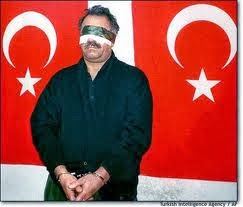
Last month, a special letter was delivered from the imprisoned leader and founder of the P.K.K., Abdullah Öcalan, to President Barzani in Erbil, Iraq, asking him to support Rojava’s sovereignty.  The letter was hand-delivered by Leyla Zana, a high-profile Kurdish member of the Turkish parliament from Diyarbakır, the notional capital of Turkish Kurdistan.  Öcalan also asked Barzani to support the peace process by which the P.K.K. is disarming and withdrawing from Turkey—and, Barzani fears, joining and strengthening the force in Rojava.  No word yet on whether this has softened Barzani’s feelings toward his Kurdish neighbors to the west, but the rivalry has complicated matters for him at home: the leadership of the opposition political party in Iraqi Kurdistan, the Movement for Change (Bzutinewey‌ Gorran), are supporting Rojava.  Gorran is angling for the vice-presidency in the Iraq’s Kurdistan Regional Government (K.R.G.).

Abdullah Öcalan, the imprisoned leader of Turkey’s Kurds
No one, of course, is more alarmed by these developments than the Shiite-Arab-dominated government in Iraq.  (Most Kurds are Sunni.)  Baghdad fears nothing more than that the spirit of cooperation between Kurds, Turkmens, and Christians in northern Syria would inspire similar alliances on the Iraqi side of the border—creating an even vaster area that would like to split away from Iraq, not just the Kurdistan Region.  Already, the K.R.G. has been itching to annex, and in some cases de facto administering, provinces outside of the official region where Turkmens and Christians live alongside Kurds, especially in Nineveh and Kirkuk provinces—provinces rich in oil.

Flag of the Assyrian people
With this in mind, the Iraqi central government declared last month intentions to create three new Iraqi provinces.  Two of these would be designed to be ethnic homelands for Iraq’s restive non-Kurdish minorities.  The Nineveh Plain, which is the heart of traditional Assyria, would be a new province dominated by Assyrian Christians, while Tuz Khormato province to its east (now part of Saladin province) would be set aside for Turkmens—who have long demanded their own autonomous region, or even independent state, to be called Türkmeneli, just to the south of, or overlapping with, the current Kurdistan Region.  Turkmens have also been pushing, so far without success, for a role in the K.R.G. administration.  (The third new province would have its capital at Fallujah, currently in Anbar province.  This is a rather pathetic attempt to minimize the damage to Iraqi unity done by ISIS, which last month took control of Fallujah and declared it a Sunni-Arab-ruled Islamic state.  The Sunni tribes in and around Fallujah are unlikely to be very impressed with the promise of their own province while (Shiite) Iraqi bombs rain down on the city.)


It rather looks as though Baghdad is trying to tie an ethnic noose around the Kurdistan Region, entrenching Turkmens and Christians in autonomous regions that would prevent Kurds from solidifying their control of Mosul and Kirkuk.  But Nineveh’s Sunni Arab governor in Mosul, Athil al-Nujaifi, sees an even more sinister motive.  “Reviewing the maps,” he said, “show that the two provinces proposed are located on the shortest route between Iran and Syria in Mosul.”  He said Iraq’s Shiite Arab president, Nuri al-Malaki, plans to sow sectarian division in the region, move Kurdish forces back over the border into official K.R.G. territory, and open a supply route through Iraq for weapons from Iran (a Shiite theocracy) to its allies in the (Shiite Arab) Syrian government.  Gov. Nujaifi, who fears that what he sees as the Shiite-on-Sunni war in Anbar will spread north to Nineveh, has even gone so far as to suggest that the current Nineveh province should declare autonomy from Baghdad as a Sunni Arab autonomous region.

Gov. Athil al-Nujaifi
And now there is an even further complication: it seems that ISIS and its affiliates in Syria have recruited at least 200 Iraqi Kurds into their ranks—even though Kurds on the whole tend to be socially progressive and politically moderate by Middle Eastern standards.  Their ultimate goal seems to be making Iraqi Kurdistan into an Islamic state separate from Iraq.


Despite all this, the Kurdish people have survived centuries of divide-and-rule tactics.  They are not about to be turned back now.  The momentum toward autonomy and independence, on the whole, seems unstoppable.  But there may be a lot of ethnic and sectarian bloodshed along the way.


[For those who are wondering, yes, this blog is tied in with my new book, a sort of encyclopedic atlas just published by Litwin Books under the title Let’s Split! A Complete Guide to Separatist Movements and Aspirant Nations, from Abkhazia to Zanzibar.  (That is shorter than the previous working title.)  The book, which contains 46 maps and 554 flags (or, more accurately, 554 flag images), is available for order now on Amazon.  Meanwhile, please “like” the book (even if you haven’t read it yet) on Facebook and see this special announcement for more information on the book.]


Related articles from this blog:
“And Now Civil War ... Could Syria Break Up?” (Nov. 2011)
“The Iraq War Is Over, but Is Iraq’s Partition Just Beginning?” (Dec. 2011)
“Get Ready for a Kurdish Spring” (March 2012)
“Shifting Alliances in the Kurdish Struggles” (April 2012)
“Syria’s Kurds Are Setting Up a Quasi-State—How Long Can It Last?” (July 2012)
“Liberation of Syrian Kurdistan Infuriates Turkey, Iraq, and the Free Syrian Army—in Fact, Everyone but Assad” (Aug. 2012)
“Turkish Kurdistan Ground War in Progress, Iraq Border Crisis Eases” (Aug. 2012)
“Kurdistan Update: Both Turks & PKK Claim to Control Şemdinli, Zaza MP Abducted, Donna D’Errico and Noah’s Ark” (Aug. 2012)
“Carnage Continues in Turkish Kurdistan” (Aug. 2012)
“Kurd Truce in Syria?, Plus: Turkmen and Kaka’i in Conflict with Iraqi Kurds” (Nov. 2012)
“Syrian Kurds Liberate 4 More Towns; Diyarbakır Mayor on Hunger Strike; More Carnage in Southeastern Turkey” (Nov. 2012)
“Kirkuk Car Bombing, Stand-Off in Iraq, Turkish Airstrikes: Kurdistan Update” (Dec. 2012)
“10 Separatist Movements to Watch in 2013” (Dec. 2012)
“Iraq’s Kurds and Arabs Debate Inclusion of Minorities in National Anthem” (July 2013)
“Syrian Regime Seeks Israeli Green-Light for Separate Alawite Republic” (Aug. 2013)
“The Caliphate Movement Comes to Syria: New Islamist Army Falters in Azaz but May Try to Carve Out Separate State” (Sept. 2013)
“Syrian Kurds’ Declaration of Autonomous ‘Rojava’ Scorned by Turkey, Assad—Even by Iraqi Kurds” (Nov. 2013)
“10 Separatist Movements to Watch in 2014” (Dec. 2013)
“Al-Qaeda-Affiliated ISIS Militia Declares Fallujah an Islamic State as Sunni–Shi’a War Spreads from Syria to Iraq” (Jan. 2014)
“Middle East Update: Al-Sham Islamic State Takes Form, West Kurdish Constitution, New Rights for Christians, Turkmens” (Jan. 2014)
“Yet Another Genocide Olympics: 10 Political Causes Sure to Disrupt the Sochi Games” (Feb. 2014)

Thursday, November 21, 2013

Syrian Kurds’ Declaration of Autonomous “Rojava” Scorned by Turkey, Assad—Even by Iraqi Kurds


The Kurdish people of northern Syria, after declaring an autonomous region last year in liberated pockets and towns near the border with Turkey (as reported at the time in this blog), are finally trying to make their statelet official.  And the plan is meeting with hostility from all sides, even from fellow Kurds in northern Iraq.  But why are Kurds not all on the same page on this—autonomy is supposed to be good, right?—and, moreover, why is this all happening now?

P.Y.D. flags are more common in Syrian Kurdistan lately
than the usual sun-emblazoned Kurdish national ones.
Well, for one thing, the Syrian civil war has reached a strange impasse in recent months.  There has been little change lately in the general boundaries between areas administered by the embattled dictator, Bashar al-Assad, and those under rebel control.  But there have been dramatic changes in the make-up of the rebel opposition.  In particular, the Western-backed Free Syrian Army (F.S.A.), which is being armed by Turkey, Qatar, Saudi Arabia, and others, has lost ground since summer to a new organization called the Islamic State of Iraq and al-Sham (ISIS) (as reported recently in this blog).  ISIS seems to be an outgrowth of two pre-existing groups, the al-Qaeda-backed al-Nusra Brigades, who have for some time now been a player in the Syrian civil war, and the Islamic State in Iraq (I.S.I.), a radical Sunni Arab militia which featured prominently in the Iraqi civil war during the United States occupation and which in turn has roots in al-Qaeda in Afghanistan in the days of Taliban rule there.  The al-Sham of ISIS’s name is an archaic term for Syria plus Lebanon, i.e. the Levant.  ISIS hopes to link up adjoining Sunni Arab areas of Syria and Iraq—both of them Arab-Shiite-ruled nations currently—to create a new Islamic state.

One international idea of a partitioned Syria—
but nobody puts Kurdistan in a corner!
But one rebel area where ISIS is not gaining influence in the far north of Syria, where Kurds have in recent weeks been able to push back the battle lines of ISIS and other Islamist militias.  This has put the People’s Defense Units (Y.P.G.) of the Kurdish-dominated Democratic Union Party (Partiya Yekîtiya Demokrat, or P.Y.D.) in control of a large swath of the Syrian side of the Syrian–Turkish border.  Maybe even all of it, though reliable information is hard to come by.

Kurds celebrating the liberation of Derki, Syria, last year
When the P.Y.D. first started “liberating” parts of this area last summer, their “victories” were mocked by their detractors, like the Turkish government and the F.S.A., for being in reality a bloodless takeover of areas that had been handed to them by a voluntarily retreating Syrian military.  There was probably some truth to this.  Assad had already been courting and handing political favors to Kurdish, Christian, and Druze minorities in Syria in the months before the Syrian civil war really broke out, in an attempt (a vain one, it turned out) to prevent or forestall the kind of Arab Spring uprisings that were already rocking Egypt, Libya, and Yemen.  Assad last year may have withdrawn from the Kurdish areas in an attempt to see how the creation of an autonomous or independent area might turn out, as part of exploring a “Plan B” of partitioning Syria into an Assad-ruled Alawite (Shiite) coastal state and other ethnic fiefdoms inland.  Or perhaps, fearing a Turkish military intervention to aid the rebels, Assad wanted to create a de facto buffer state hostile to Ankara.  (The P.Y.D. is closely allied with southeastern Turkey’s partially-pacified Kurdish rebel army the Kurdistan Workers’ Party (Partiya Karkerên Kurdistan, or P.K.K.).  In any case, Assad’s forces have totally withdrawn from border areas since then, hesitant to risk a flare-up with Turkish forces and more interested in fighting for Damascus, Aleppo, and other towns in the heartland.

Protesters in Berlin display P.K.K. flags
The new declaration of autonomy by the P.Y.D. speaks not of a West Kurdistan Autonomous Region, which was the preferred phrase last summer (in Kurdish nationalist usage, West Kurdistan is northern Syria, North Kurdistan is southeastern Turkey, East Kurdistan is northwestern Iran, and South Kurdistan is northern Iraq).  Instead, it calls its new autonomous statelet Rojava (rojava being the Kurdish word for “west”), which looks much larger on maps being circulated now than last year’s sliver and which, it is claimed, will include three autonomous-regions-within-the-autonomous-region: one for Kurds, one for Christians, and one for Arabs.  This last part is odd, since Syria’s mostly mountainous Christian minority has tended to keep its head down in the civil war and not demand its own autonomous region the way some Christians in Iraq do.  Plus, Kurds and Arabs have quite famously not been getting along lately.  It could be that the P.Y.D. is trying to reassure the international community that Christians and Arabs in the enlarged autonomous territory will be allowed freedoms and also to signal to the world, perhaps especially Turkey, that this is not just a Kurdish state—i.e., not an extension of the national aspirations of the dreaded P.K.K. as many Turks fear.

As a reader notes below (see comments), this map may seriously underestimate
the number of Kurds in the border areas.
Well, and how is the idea of an autonomous or independent Rojava going over?  Like a lead balloon—in Ankara, predictably; in Damascus and among the F.S.A., almost as predictably; and, a little surprisingly, in Erbil (capital of Iraq’s northern Kurdistan Region).  We’ll take these in turn.  The Turkish government mostly fears that Kurdish separatism is a contagion that can spread to its own Kurds, even though it has decided to make peace with the idea of an autonomous, perhaps even eventually independent, Iraqi Kurdistan.  The implementation of this year’s historic peace deal between Ankara and the P.K.K. is proceeding relatively smoothly, but naturally Turkey worries that the still-armed P.K.K. rebels already retreating over the border into Iraqi Kurdistan—where the regional president, Massoud Barzani, can assure that they will be watched closely—might instead head to the more lawless Syrian Kurdistan, where they have natural allies in the P.Y.D.

Massoud Barzani, president of Iraq’s Kurds
Assad, for his part, may have liked the idea of a buffer area to keep Syrian and Turkish armies out of firing range of one another, but he is probably nervous about full-blown autonomy or independence.  If successful, the idea could spread rapidly to, say, the Druze.  ISIS already is drawing up its new borders.  And that would be the end of Syria.

(This map is ridiculously generous; Kurds don’t live as far west as the coast.)
President Barzani, the president of the quasi-independent Iraqi Kurdistan, condemns the Rojava declaration as being driven by the P.Y.D. with insufficient input from other Kurdish factions, which had been—nominally and precariously—united through painstaking multilateral diplomacy under Barzani’s auspices over the past couple years.  As Barzani put it, “We only support the steps that have the consensus of all Kurdish parties in Rojava.  We refuse to deal with unilateral actions.”  For the most part, Barzani refers to the Kurdish National Council (K.N.C.), which is closely allied to his own government and approved of by the West but seen by the more hardline P.K.K. and P.Y.D. as Western and Turkish stooges, while Barzani and the K.N.C. regard the P.Y.D. as unruly terrorists who have a working relationship, if not worse, with Assad.


We will be keeping readers informed of how the repercussions of the Rojava declaration play out.

[You can read more about these and many other separatist and new-nation movements, both famous and obscure, in my new book, a sort of encyclopedic atlas just published by Litwin Books under the title Let’s Split! A Complete Guide to Separatist Movements and Aspirant Nations, from Abkhazia to Zanzibar.  The book, which contains 46 maps and 554 flags (or, more accurately, 554 flag images), is available for order now on Amazon.  Meanwhile, please “like” the book (even if you haven’t read it yet) on Facebook and see this interview for more information on the book.]


Saturday, December 1, 2012

Kirkuk Car Bombing, Standoff in Iraq, Turkish Airstrikes: Kurdistan Update, 25 November–1 December 2012


The scene in Kirkuk, which was hit by car bombs this week (see below)
NORTH KURDISTAN (TURKISH KURDISTAN)

Turkish Premier Proposes Lifting Immunity from Kurdish Parliamentarians.  The prime minister of the Republic of TurkeyRecep Tayyip Erdoğan, said on November 26th that he favored rescinding the immunity from punishment enjoyed by Kurdish members of parliament.  Kurdish M.P.s are already frequently investigated for real or supposed links to the banned, separatist Kurdistan Workers’ Party (P.K.K.), and some have been convicted, but are not required to serve their sentences while in office.  The following day, Erdoğan advanced plans to investigate 10 M.P.s, nine of them from the Peace and Democracy Party (B.D.P.), which some regard as the political wing of the P.K.K.

1 Turkish Soldier, 2 Rebels Killed in Mardin Province; Landmine Wounds 6 Troops.  After a lull in what this summer and fall have been almost continuing violence in Turkey’s civil war against its Kurdish minority, a Turkish soldier and two members of the banned separatist Kurdistan Workers’ Party (P.K.K.were killed in a battle in Mardin province, in southeastern Turkey’s Kurdistan region.  One soldier was injured, according to the military, which reported on the battle on November 27th.  The day before, six Turkish soldiers were hurt by an exploding landmine in Diyarbakır province.


Kurd Who Threw Shoe at Erdoğan in Spain Released from Prison Early.  A Kurd from Syria convicted in 2010 of pelting the prime minister of Turkey with a shoe—one of the gravest insults in Muslim culture—was pardoned on November 30th with several months left to go on his three-year sentence.  In the incident, in Seville, Spain, the Kurd, Hokman Joma,  had hurled a shoe at Prime Minister Recep Tayyip Erdoğan and shouted, “Long live Kurdistan!”

Hokman Joma and his weapon of choice
SOUTH KURDISTAN (IRAQI KURDISTAN)

More Turkish Airstrikes on Kurdish Positions in Northern Iraq.  The Republic of Turkey launched air raids this week against supposed structures and weapons caches of the banned, separatist Kurdistan Workers’ Party (P.K.K.) just over the border in northern Iraq’s autonomous Kurdistan Region.  No casualties were reported.

Military Standoff with Kurds near Kirkuk Ends as Baghdad, Erbil Sign Pact.  The autonomous Kurdistan Regional Government (K.R.G.) in northern Iraq sent more peshmerga reinforcements on November 24th to an area near Kirkuk where Kurds are standing off against the military of Iraq’s Shiite-Arab-dominated central government over the question of the Djila Operations Command.  The Djila brigades were established last year by Iraq’s authoritarian Shiite prime minister, Nouri al-Maliki, to police the provinces of Kirkuk and Diyala, which officially lie outside the Kurdistan Region but which the K.R.G. partly administers.  The two sides negotiated for over a week to defuse the crisis in the oil-rich and hotly contested province.  The K.R.G.’s deputy minister for peshmerga, Anwar Haji Osman, was saying, “If they overstep the line, we will strike them.”  But on November 26th, Maliki’s office announced that the K.R.G. and Baghdad had agreed to pull forces back to their original positions.  On November 28th, a 14-point hold-fire agreement was signed by both sides, including a pledge to form a joint committee to enhance cooperation between Baghdad and Erbil in disputed regions.

Anwar Haji Osman
4 Killed in Car Bombings at Kurdish Party Offices, Other Sites in Kirkuk.  Among the 29 people killed in car bombings throughout Iraq on November 27th were four casualties of three separate car-bomb attacks in the Kurdish section of Kirkuk, in the Kurdish-dominated north of the country.  One exploded near a public market, another near a gas station, and the third at the offices of the Kurdistan Democratic Party (K.D.P.).


[Also, for those who are wondering, yes, this blog is tied in with a forthcoming book, a sort of encyclopedic atlas to be published by Auslander and Fox under the title Let’s Split! A Complete Guide to Separatist Movements, Independence Struggles, Breakaway Republics, Rebel Provinces, Pseudostates, Puppet States, Tribal Fiefdoms, Micronations, and Do-It-Yourself Countries, from Chiapas to Chechnya and Tibet to Texas.  Look for it in spring 2013.  I will be keeping readers posted of further publication news.]


Saturday, November 24, 2012

Kurdistan Update, 18-24 November 2012


NORTH KURDISTAN (TURKISH KURDISTAN)

Turkish Military Reports 24 Kurdish Rebels Captured in 2-Day Operation.  The Turkish military announced on November 16th that operations in southeastern Turkey’s Kurdistan region over the previous two days had captured 24 fighters from the banned separatist Kurdistan Workers’ Party (P.K.K.).  Most of the operations took place in Tunceli province.  Then, on November 18th, Turkey’s military announced that five Turkish soldiers had been killed in a battle with the P.K.K. in Hakkari province.  It said one Turk was wounded.  Four P.K.K. rebels were killed, and four were taken prisoner.

Öcalan Calls End to Kurdish Prisoners’ Hunger Strike in Turkey.  A hunger strike by over 700 Kurds in Turkey’s prisons—joined by several prominent Kurdish politicians—ended on November 18th after Abdullah Öcalan, the long-imprisoned founder of the banned, separatist Kurdistan Workers’ Party (P.K.K.), held talks with Turkish intelligence officials and called an end to the action.  Öcalan’s announcement was released by his brother on November 17th.


SOUTH KURDISTAN (IRAQI KURDISTAN)

Soldiers, Kurds Skirmish in Turkmen Town in Northern Iraq.  In a Turkmen-dominated town in a disputed, Kurdish-dominated region of northern Iraq which lies just outside the Kurdistan Autonomous Regiona battle broke out between Iraqi soldiers and armed Kurds on November 16th, leaving two people dead and 10 injured.  The incident, in Tuz Khormato, near Kirkuk, began when troops attempted to search the home of a member of the Patriotic Union of Kurdistan (P.U.K.), the political party headed by Iraq’s president, Jalal Talabani.  One of the member’s bodyguards threw a grenade, leading to a short skirmish.  Within days, both the Iraqi military sent tanks and armored personnel carriers to reinforce their control over the area, and the Kurdish peshmerga were also mustering more forces for a possible showdown.

Turkmens in Tuz Khormato.  But Kurds and Shiites want to rule the town too.
WEST KURDISTAN (SYRIAN KURDISTAN)

Syrian Kurds Reject U.S. Urging to Join Rebel Umbrella Group as Killing Continues.  The spokeswoman for the United States’ Department of State, Victoria Nuland, said this week that Barack Obama’s administration is urging that Kurds be included in the newly coalesced armed opposition in Syria, called the National Coalition for Syrian Revolutionary and Opposition Forces.  “There are a number of reports from inside Syria of some of the liberated areas where Kurdish populations and Sunni populations are working well together,” she said (obviously meaning to say Sunni Arab populations, since most Kurds are Sunnis), adding, “That’s certainly the direction that we encourage.”  Meanwhile, though, violence between predominantly Sunni Arab rebels and the Kurdish-run People’s Defense Units (Y.P.G.) (reported on last week in this blogcontinued in the town of Ra’s al-’Ayn (called Serêkanî in Kurdish), in Syria’s now-mostly-Kurdish-controlled Hasakah province in the far northwest, where rebels from the militias Jabhat al-Nusra and Ghurba’ al-Sham attacked a Y.P.G. checkpoint, leaving at least 18 dead, possibly many more.  Some blame the violence on jihadist elements that have infiltrated the Syrian opposition.  There were also reports that the president of the Kurdish council in Ra’s al-’Ayn, Abed Khalil, had been assassinated by rebel snipers.  And on November 20th, Saleh Muslim, the head of the Syria’s Kurdish-run Democratic Union Party (P.Y.D.), which is suspected of links to Turkey’s banned Kurdistan Workers’ Party (P.K.K.), said that his group had not been invited to join the new group and would not join it.  He called the new Coalition a proxy group for the governments of Turkey and Qatar.  The Coalition has already been recognized by the French Republic, the United Kingdom, and others as the legitimate government of Syria.  Abdulbaset Sieda , the head of the Syrian National Council (S.N.C.), speaking to media in Erbil, the capital of Iraq’s Kurdistan Region, said that Jabhat al-Nusra, despite its claims, was not part of the Free Syrian Army (F.S.A.), and he disavowed S.N.C. responsibility for anti-Kurdish violence, but he said Kurds must choose sides in the Syrian civil war.

A P.Y.D. patrol in Syria
EAST KURDISTAN (IRANIAN KURDISTAN)

Rights Activists Call for General Strike over Plight of Kurds on Iran’s Death Row.  Human-rights activists in East Kurdistan, i.e. the portion of the Kurdish homeland which lies within Iranare calling for a public protest over death sentences passed on 27 Kurds being held in Iranian prisons.  A general strike and boycott of schools and other institutions is to start November 17th.  Most of the condemned prisoners are in the city of Saghez, in Iranian Kurdistan.  Meanwhile, exile rights groups announced this week that Zainab Bayazidi, a Kurdish political prisoner and women’s-rights activist, had been released on November 20th from a prison in Iran’s West Azerbaijan province.  Bayazidi was first arrested in 2008.


[Also, for those who are wondering, yes, this blog is tied in with a forthcoming book, a sort of encyclopedic atlas to be published by Auslander and Fox under the title Let’s Split! A Complete Guide to Separatist Movements, Independence Struggles, Breakaway Republics, Rebel Provinces, Pseudostates, Puppet States, Tribal Fiefdoms, Micronations, and Do-It-Yourself Countries, from Chiapas to Chechnya and Tibet to Texas.  Look for it in spring 2013.  I will be keeping readers posted of further publication news.]

Subscribe Now: Feed Icon