Showing posts with label MNLA. Show all posts

Friday, September 13, 2013

Mali Civil War May Be Reigniting; Tuaregs Suddenly No Longer Satisfied with Autonomy


Last month, I reported in this space that the Tuareg rebels of the northern Mali were prepared to set aside their demands for full independence (as some sort of “Republic of Azawad”) but promised that violence could be renewed if the incoming Malian president denied the region its autonomy.


But no sooner did a former prime minister, Ibrahim Boubacar Keïta, take office, with barely any time to articulate an Azawad policy, than violence has erupted again.  The main Tuareg rebel group, the National Movement for the Liberation of Azawad (M.N.L.A.), was calling, on September 4th, for pro-independence protests protests to coincide with the inauguration of “I.B.K.,” as Malians call their new leader.  He had promised to open negotiations with the M.N.L.A. within 60 days of taking office.

“I.B.K.”

On September 11th, it was reported that M.N.L.A. rebels clashed with Malian government soldiers near Léré, in the Niafunké district of Timbuktu province, near the border with Mauritania but also right near the former border between the three provinces that make up “Azawad” and the Mopti province that forms a buffer between Tuareg and non-Tuareg parts of Mali.  Each side blames the other for starting the violence, which violates a cease-fire agreed to in June.  Three Malian troops were injured.

Where Tuaregs live.
It is unclear what position the two other main rebel groups in the north—the generally more moderate High Unity Council of Azawad and the ethnic-“Moor”-dominated Arab Movement of the Azawad (M.A.A.)—are taking on the question of peace with the central government.  Nor is it clear how unified the M.N.L.A. is on the question, or whether the renewed fighting was an intentional restarting of hostilities—and, if so, by which side.

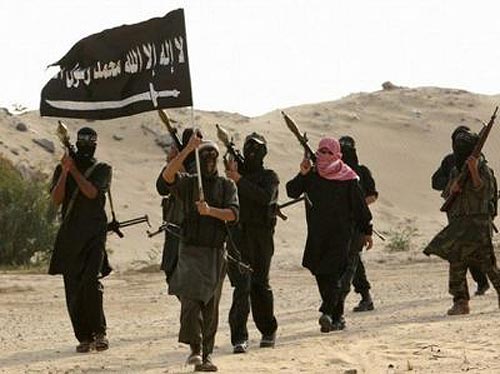
Ansar al-Dine on parade
The current troubles—which this blog has been reporting on in detail all along—began last year when displaced pro-regime Tuareg militias from the civil war in Libya fled, bristling with Moammar al-Qaddafi’s weapons, into northern Mali and reignited the latest in a series of Tuareg uprisings which date back to the early periods of colonial rule by France.  Tuaregs made a fatal alliance with Islamists affiliated with al-Qaeda and with radicals in Algeria, notably the Movement for Unity and Jihad in West Africa (MUJAO) and Ansar al-Dine.  Discontent in Mali’s capital, Bamako, over the government’s response to the Tuareg crisis sparked a coup d’état, which in turn created the power vacuum necessary for the M.N.L.A., MUJAO, and Ansar al-Dine to take over the northern two-thirds of the country with little opposition and declare an “Islamic Republic of Azawad.”  When, earlier this year, they attempted to spread their area of control into Mopti, with the avowed goal of placing all of Mali under shari’a (Islamic law), troops from France, Chad, and other countries intervened and put the north back into government control.  At least the cities.  Most of the hinterlands are still in rebel hands, though the Islamists have mostly melted away into the desert.

What happens next is anyone’s guess.  This, the Fifth Tuareg Rebellion (by many historians’ count), may not be over yet.  Or we may be ready for a sixth.  Without the Islamist factor, it remains to be seen how much the outside world will care this time.


[Also, for those who are wondering, yes, this blog is tied in with a forthcoming book, a sort of encyclopedic atlas to be published by Auslander and Fox under the title Let’s Split! A Complete Guide to Separatist Movements, Independence Struggles, Breakaway Republics, Rebel Provinces, Pseudostates, Puppet States, Tribal Fiefdoms, Micronations, and Do-It-Yourself Countries, from Chiapas to Chechnya and Tibet to Texas.  Look for it some time in 2013.  I will be keeping readers posted of further publication news.]

Monday, August 12, 2013

On Election Eve, Mali’s Tuaregs Vow: Autonomy or War

Not a single hanging chad in sight
Votes are still being counted from the Republic of Mali’s runoff election yesterday, with huge implications for the unity of the country.  Tuareg rebels, in league for a while with Islamists affiliated with al-Qaeda, controlled the northern three-fifths or so of the country for about a year until February of this year, when invading French troops put the Malian government in control of the region’s cities.  But the Tuareg-led National Movement for the Liberation of Azawad (known by its acronym in French, M.N.L.A.) says it will restart the war if any new government does not respect the autonomy of the large, sparsely-populated northern desert region called Azawad.

Map of Mali, showing the formerly de facto independent republic of Azawad in purple
The M.N.L.A. raised the stakes after the July 28th Malian elections it grudgingly recognized and yesterday’s runoff, the results from which are still inconclusive.  The group’s main European spokesman, Moussa Ag Assarid, said August 4th at a conference in Corsica organized by the local separatist Corsa Libera party that the Tuareg rebel group would take up arms against any new government in Bamako that did not guarantee autonomy to Azawad.  A peace deal reached in June stipulates that Bamako will open negotiations with the M.N.L.A. within 60 days of forming a cabinet following these elections.

Moussa Ag Assarid (right) speaking alongside a Berber separatist at a rally in Paris. 
If things do come to that, the M.N.L.A. may not be alone.  On August 9th, in neighboring Mauritania, the M.N.L.A. announced that they had patched things up with two rival Azawadi militias: the High Unity Council of Azawad and the anti-Islamist Arab Movement of the Azawad (M.A.A., formerly known as the National Liberation Front of Azawad, or F.L.N.A.).  This buries the hatchet following remote desert clashes between the groups in April.  Although French and Malian troops control Azawad’s cities, rebels still control areas of northern Mali’s vast deserts—it is not clear entirely how much.  Azawad’s “Arabs”—actually ethnic Berbers who have been speaking Arabic for centuries—are often also called “Moors”—in French Maures, hence the name Mauritania, where they are the largest ethnic group.  These Moors are the main inhabitants of most of Azawad’s territory but are only a small part of the population (perhaps 10-15%, though figures are unreliable), with little presence in the Tuareg-dominated cities of Timbuktu, Kidal, and Gao.  (The Tuareg language is somewhat close to Berber but only very distantly related to Arabic.)


Facing off for the presidency are the Rally for Mali party’s Ibrahim Boubacar Keïta, a former prime minister of Mali (1994-2000), who got 40% of the vote in the July 28th round, and a former finance minister, Soumaïla “Sumy” Cissé, current president of the West African Monetary Union, who got 20%.  Cissé, who faces an uphill battle, is a native of Niafunké, the town in the far south of Azawad’s Timbuktu province, which is also the home town of possibly the world’s most famous Malian, the late musician Ali Farka Touré.  Both Keïta and Cissé have campaigned on vows to end the Azawad conflict without partitioning the country.  If they are not prepared to allow the 10% of the Malian population who are Tuareg and Moor a quasi-state in the north, that may be an impossible promise to keep.

If Keïta wins, he will have the perhaps impossible task of keeping Mali together.
[Also, for those who are wondering, yes, this blog is tied in with a forthcoming book, a sort of encyclopedic atlas to be published by Auslander and Fox under the title Let’s Split! A Complete Guide to Separatist Movements, Independence Struggles, Breakaway Republics, Rebel Provinces, Pseudostates, Puppet States, Tribal Fiefdoms, Micronations, and Do-It-Yourself Countries, from Chiapas to Chechnya and Tibet to Texas.  Look for it some time in 2013.  I will be keeping readers posted of further publication news.]

Subscribe Now: Feed Icon