Hundreds of thousands of Catalans, perhaps more than a million according to some accounts,
linked arms in a dramatic human chain across their small nation on September 11th to notify the world that they crave independence from the
Kingdom of Spain. But the stunt proved to be less of a momentum-building event to carry the message through to a referendum next year on secession and more of an awkward backdrop to the newest statement by
Catalonia’s president and the ruling separatist party’s leader,
Artur Mas i Govarró, who seems suddenly to be climbing down from his previous confrontational stance toward Madrid.
 |
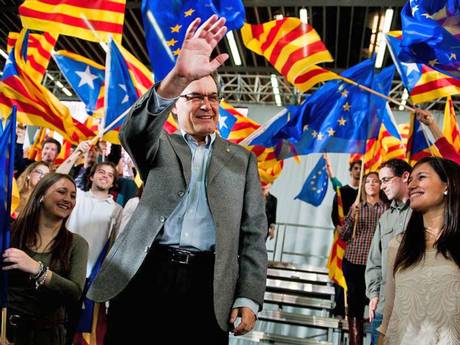
| Artur Mas, greeting a separatist rally last year. He might not get such a warm reception today. |
Initially, Mas’s
Democratic Convergence of Catalonia party (
Convergència Democràtica de Catalunya, or
C.D.C.) had defiantly said it would hold a referendum on independence whether the Spanish government approved or not, and it would be binding. But Madrid made it perfectly clear that any such referendum would be constitutionally impermissible. Now, on September 14th, Mas
came right out and said that no referendum would be held against the wishes of the central government. Since the central government’s implacable position is well known, this is tantamount to Mas canceling the referendum. He said that instead the 2016 elections would be interpreted as a symbolic plebiscite on the future direction of Catalonia’s status—a rather weak substitute indeed.
The human chain stretched over 400 kilometers, from the French border in the north to the internal border with Spain’s autonomous
Valencia region to the south. It ran mostly along the coast, including some of Catalonia’s nude beaches (see photo above). It took place on
la Diada, Catalonia’s national holiday, which commemorates this year the 299th anniversary of the reabsorption of Catalonia into Spain after Spain’s defeat by the
United Kingdom (whom the Catalans backed) in the Wars of Spanish Succession.
 |
| The route of last week’s human chain |
The stunt was directly modeled on the Baltic Way, a similar human chain in 1989 which snaked through
Estonia,
Latvia, and
Lithuania in a mass demand for independence from the
Soviet Union. (Recognizing this, a Catalan reporter asked Latvia’s prime minister,
Valdis Dombrovskis, whether he would recognize an independent Catalonia. “Provided there is legitimacy of the process, I would say, theoretically, why not?”
he replied, leading to a formal protest from Madrid and the recalling of Spain’s ambassador in Riga.)
Only a little over half of all Catalans support independence, actually, but more than 80% tell pollsters they want a referendum. This, one would think, is enough of a mandate for Mas to take a less conciliatory tone. But Mas’s climbdown is a political gamble in more immediate ways. The coalition that C.D.C. dominates,
Convergence and Union (
Convergència i Unió, or
CiU) coalition, does not have enough seats to rule on its own and relies on the support of the
Democratic Left of Catalonia (
Esquerra Republicana de Catalunya, or
E.R.C.), which typically takes more controversial hard-line stands, such as recognizing the legitimacy of British rule in the disputed colony of
Gibraltar (
as reported recently in this blog) and calling for unification with the much smaller Catalan region just over the border in southeastern
France. The E.R.C. has always been more committed to a referendum than C.D.C., so now the ruling coalition may collapse. That would put secession even farther out of reach.
The human chain across Catalonia might simply mark the end of the line for the small nation’s dream of independence.
[Also, for those who are wondering, yes, this blog is tied in with a forthcoming book, a sort of encyclopedic atlas to be published by Auslander and Fox under the title Let’s Split! A Complete Guide to Separatist Movements, Independence Struggles, Breakaway Republics, Rebel Provinces, Pseudostates, Puppet States, Tribal Fiefdoms, Micronations, and Do-It-Yourself Countries, from Chiapas to Chechnya and Tibet to Texas. Look for it some time in 2013. I will be keeping readers posted of further publication news.]