Showing posts with label Esquerra Republicana de Catalunya. Show all posts

Sunday, November 10, 2013

Black, White, and Red (and Yellow) All Over: Commie Nun Vows Revolution for Independent Catalonia


Separatist movements in the new Europe often have left and right wings to them.  Nowhere is this truer than in Spain, whose unusual political landscape of ideologically and regionally diverse splinter groups can be seen as part of the continuing aftermath of the Spanish Civil War, including a Fascist dictatorship which, almost uniquely in western Europe, yielded to pluralism only a generation ago.


It is true especially of Catalonia, whose widely popular independence movement (which this blog called one of “10 Separatist Movements to Watch in 2013”) is hurtling toward a referendum next year on separation from Spain.  (See recent articles on the movement here and here.)  There is the region’s ruling Convergence and Union (Convergència i Unió, or CiU), which, to the discomfort of some, includes many political conservatives in its broad pro-independence coalition.  Then there is the Republican Left of Catalonia (Esquerra Republicana de Catalunya, or ERC), which takes a more radical-socialist approach.  ERC disdains any attachment to mainstream Spanish politics—promoting unification with the small North Catalonia region over the border in southeastern France in an independent “Greater Catalonia” and (as reported on not too long ago in this blog) bucking the Spanish jingoistic consensus by defending the United Kingdom’s sovereignty in Gibraltar.  (After all, Catalans sided with Britain against Madrid in the Wars of Spanish Succession—and for a while during the Spanish Civil War, as readers of George Orwell know, Catalonia was, of all things, an independent “Anarchist” statelet.)

A Procès Constituent rally in Barcelona.
Good lord, they must be radicals.  Not a Catalan flag in sight.
But now even ERC has been outflanked on the left, by a new group called Constituent Process in Catalonia (Procès Constituent a Catalunya), a non-party movement founded in April 2013 with an agenda far more radical than any other independentist group in the region, Greens included.  One of its co-founders is Sister Teresa Forcades, a Benedictine nun who has now vowed that before or after separation Catalonia needs to undergo a revolution.  “We don’t shy away from the word revolution,” she says, adding, “We have democracy in name, but not in reality because the broad current of opinion, which is that the system must change, is not represented.”  Her co-founder, Arcadi Oliveres, a university economist in Barcelona, agrees: “Thousands of people are being evicted from their homes while thousands of homes lie empty.  This absurdity is based on the sacrosanct idea of private property.  All the property the banks have acquired should be made available as social housing.”


Sister Forcades considers CiU the party of the rich and calls instead for nationalization of banks, withdrawal from the North Atlantic Treaty Organization (NATO) (though it has yet to be agreed upon if an independent Catalonia could stay in NATO and the European Union if it wanted to), and even abolition of the military.

Sister Teresa says the CiU emperors have no clothes.
Procès Constituent has amassed over 45,000 members since it made its manifesto public earlier this year.  What remains to be seen is whether such expressions of discontent will help or hinder CiU’s larger push for independence.  Poll numbers are faltering, but is CiU’s accommodation to the Establishment and to political conservatives and nationalist xenophobes pushing those numbers down, or are they the only things keeping them up?  As in the rest of Spain, the solution on offer seems to be further fragmentation and factionalism (not that there’s anything necessarily wrong with that).

But Catalan independence is less important for Sister Forcades and her allies than the social changes they wish to see.  “A majority of people in Catalonia already want radical change,” she says, “so we are only trying articulate what already exists.  I don’t think these changes can only happen in an independent Catalonia, but I think it would be better.  However, there is a hunger for change across all of Spain and I think if it only happens in Catalonia it’s doomed to fail.”

Looking ahead to 2014 ...
[For those who are wondering, yes, this blog is tied in with a forthcoming book, a sort of encyclopedic atlas to be published by Auslander and Fox under the title Let’s Split! A Complete Guide to Separatist Movements, Independence Struggles, Breakaway Republics, Rebel Provinces, Pseudostates, Puppet States, Tribal Fiefdoms, Micronations, and Do-It-Yourself Countries, from Chiapas to Chechnya and Tibet to Texas.  Look for it some time in 2014.  I will be keeping readers posted of further publication news.]

Sunday, September 15, 2013

Catalans Link Arms for Independence While Their President Pulls Back from Separatist Precipice


Hundreds of thousands of Catalans, perhaps more than a million according to some accounts, linked arms in a dramatic human chain across their small nation on September 11th to notify the world that they crave independence from the Kingdom of Spain.  But the stunt proved to be less of a momentum-building event to carry the message through to a referendum next year on secession and more of an awkward backdrop to the newest statement by Catalonia’s president and the ruling separatist party’s leader, Artur Mas i Govarró, who seems suddenly to be climbing down from his previous confrontational stance toward Madrid.

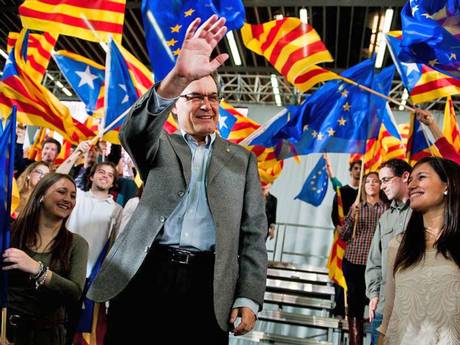
Artur Mas, greeting a separatist rally last year.  He might not get such a warm reception today.
Initially, Mas’s Democratic Convergence of Catalonia party (Convergència Democràtica de Catalunya, or C.D.C.) had defiantly said it would hold a referendum on independence whether the Spanish government approved or not, and it would be binding.  But Madrid made it perfectly clear that any such referendum would be constitutionally impermissible.  Now, on September 14th, Mas came right out and said that no referendum would be held against the wishes of the central government.  Since the central government’s implacable position is well known, this is tantamount to Mas canceling the referendum.  He said that instead the 2016 elections would be interpreted as a symbolic plebiscite on the future direction of Catalonia’s status—a rather weak substitute indeed.


The human chain stretched over 400 kilometers, from the French border in the north to the internal border with Spain’s autonomous Valencia region to the south.  It ran mostly along the coast, including some of Catalonia’s nude beaches (see photo above).  It took place on la Diada, Catalonia’s national holiday, which commemorates this year the 299th anniversary of the reabsorption of Catalonia into Spain after Spain’s defeat by the United Kingdom (whom the Catalans backed) in the Wars of Spanish Succession.

The route of last week’s human chain
The stunt was directly modeled on the Baltic Way, a similar human chain in 1989 which snaked through Estonia, Latvia, and Lithuania in a mass demand for independence from the Soviet Union.  (Recognizing this, a Catalan reporter asked Latvia’s prime minister, Valdis Dombrovskis, whether he would recognize an independent Catalonia.  “Provided there is legitimacy of the process, I would say, theoretically, why not?” he replied, leading to a formal protest from Madrid and the recalling of Spain’s ambassador in Riga.)

Only a little over half of all Catalans support independence, actually, but more than 80% tell pollsters they want a referendum.  This, one would think, is enough of a mandate for Mas to take a less conciliatory tone.  But Mas’s climbdown is a political gamble in more immediate ways.  The coalition that C.D.C. dominates, Convergence and Union (Convergència i Unió, or CiU) coalition, does not have enough seats to rule on its own and relies on the support of the Democratic Left of Catalonia (Esquerra Republicana de Catalunya, or E.R.C.), which typically takes more controversial hard-line stands, such as recognizing the legitimacy of British rule in the disputed colony of Gibraltar (as reported recently in this blog) and calling for unification with the much smaller Catalan region just over the border in southeastern France.  The E.R.C. has always been more committed to a referendum than C.D.C., so now the ruling coalition may collapse.  That would put secession even farther out of reach.


The human chain across Catalonia might simply mark the end of the line for the small nation’s dream of independence.

[Also, for those who are wondering, yes, this blog is tied in with a forthcoming book, a sort of encyclopedic atlas to be published by Auslander and Fox under the title Let’s Split! A Complete Guide to Separatist Movements, Independence Struggles, Breakaway Republics, Rebel Provinces, Pseudostates, Puppet States, Tribal Fiefdoms, Micronations, and Do-It-Yourself Countries, from Chiapas to Chechnya and Tibet to Texas.  Look for it some time in 2013.  I will be keeping readers posted of further publication news.]

Saturday, August 17, 2013

Catalan Nationalists Side with Britain on Gibraltar Question, Shocking Spaniards

Border delays are part of the new cold war over Gibraltar, and Catalan nationalists are siding with London.
Once again in the “strange bedfellows” department: the main leftist separatist party in Catalonia seems to be siding with the United Kingdom in the dispute with the Kingdom of Spain over Gibraltar, a tiny British colony abutting the Spanish mainland which the Spanish crown ceded to the British in 1713 after a nasty war.  The Chief Minister of Gibraltar, Fabian Picardo, received a letter August 12th from the Republican Left of Catalonia (Esquerra Republicana de Catalunya, or E.R.C.) party, written in English and Catalan (Spanish translation not enclosed).  It read, in part, “We most sincerely regret the improper bullying and harassment that the Spanish government is applying on the citizens you represent.”

The Esquerra Republicana leader, Oriol Junqueras i Vies,
drapes himself in the E.U. and Catalan flags.
(Union Jack not pictured.)
The “bullying and harassment” refers to Spain’s recent escalation of its quixotic saber-rattling over “the Rock,” as the colony is known, including naval cat-and-mouse games in Gibraltarian waters, a renewal of the diplomatic war of words, and a punitive slowdown of the border-crossing procedure.  (Though both Spain and the U.K. are in the European Union (E.U.), the U.K. is not part of the passport-free “Schengen Area,” and Gibraltar implements laws in many ways as though it were a separate E.U. member-state.)


Ongoing territorial claims on Gibraltar are popular in Spain, despite the fact that they violate the Treaty of Utrecht and despite the fact that in two referenda, in 1967 and 2002, Gibraltarians voted nearly unanimously (98.6% and 98.97%, respectively) to remain British.  And of the minuscule number of dissenters, most were opting only for some sort of shared condominium with Spain, not annexation.  But Spain’s political mainstream and even the royal family are adamant.  Queen Sofía even gave Queen Elizabeth’s Diamond Jubilee a miss last year in anger over Gibraltar (as reported at the time in this blog).

Gibraltar’s flag
The dispute over Gibraltar is somewhat analogous to that over the Falkland Islands, which are claimed by the Argentine Republic even though Falklanders have let it be known in a referendum this year that they overwhelmingly want to be part of the U.K.  (Only three people voted against the status quo—and they, too, were probably preferring independence to conquest by Argentina.)  Though the claims of the Argentine and Spanish governments have no legal basis and use geographical proximity as their only argument, they have nonetheless become pet causes of anti-establishment leftists in Britain, the United States, and elsewhere—extending to these situations familiar, and far better grounded, complaints about Anglophone meddling in the Spanish-speaking world during the colonial and Cold War periods.  The left-wing Guardian newspaper in England recently said that the continuing British rule in Gibraltar and the Falklands (which are, in fact, self-governing) “den[ies] the logic of history and geography.”  The Guardian seems to feel that history and geography carry their own logic which trumps democracy every time.  (For all its faults, the U.K. has a very clear policy that it will not attempt to hang onto territories where the majority reject British rule.)  Even the newly enthroned Pope Francis, an Argentine, calls the Falklands part of Argentina.  Then again, he also believes all that stuff about the virgin birth and turning water into wine, so his critical-thinking skills are not necessarily top-notch.

Pope Francis would like to dislodge Protestant infidels from Argentina’s near abroad.
The United Nations, though it is not taking sides, still keeps Gibraltar on its finger-wagging list of “non-self-governing territories,” even though Gibraltar is self-governing—one of many fictitious delusions on the U.N. list.  (This list was critiqued in detail in an article on this blog.)

Catalonia’s ruling nationalist party, the Convergence and Union (Convergència i Unió, or CiU) coalition, is also wisely staying out of the Gibraltar dispute while it heats up.  The E.R.C., keep in mind, is a far-left party.  It has only 21 of the Catalan parliament’s 135 seats.  It is also the one Catalan nationalist party which pushes for reunification with traditionally Catalan lands that lie within France (the so-called Northern Catalonia, in the Pyrenées-Orientales département).

The Catalan-speaking areas (shown in grey) extend into France.
But there is a history to these events.  The same Treaty of Utrecht that made Gibraltar British also abolished the autonomy of Catalonia and Valencia.  In fact, 350 Catalan troops participated in the 1704 conquest of Gibraltar by Britain, during the War of Spanish Succession.  Remembering this, one Catalan nationalist group has asked the autonomous region’s president, Artur Mas i Gavarró, to invite Picardo to a 2014 event marking the 300th anniversary of the Treaty of Utrecht.

Catalans also involved themselves in the first Anglo-Spanish tussle over the Rock, in 1704.
But there is also a modern political logic to the E.R.C.’s cozying to London, and it is a logic which may emerge into the political mainstream in Barcelona in the following months as Catalans prepare for a referendum on independence from Spain in 2014.  As reported at the time in this blog, the Spanish government said last year that it might veto any vote on Scotland becoming a member of the E.U., in case Scotland should secede from the U.K. following its own 2014 referendum (and once the question of whether it would need to reapply for membership is settled).  This raises the prospect of the governments in Madrid and London entering a mutual veto pact as a way of stoking Scottish and Catalan fears of ejection from the E.U., thus influencing their referenda.  Catalonia would be motivated to prevent that.  U.K.–Catalan trade is considerable, and there are cultural exchanges as well, if you can classify as cultural exchange the fact that there are whole resort towns in Catalonia full of fish-and-chips shops, English pubs, Daily Mail vending machines, and hamlets of vacation homes where only English can be heard—a new Mediterranean quasi-nation of sorts which it would be tempting to call Chavalonia.  Britain doesn’t really want Catalonia out of the E.U. any more than it wants Scotland out of it, so it makes sense for Catalan nationalists to emphasize and strengthen their ties to London, just as it makes sense for Scots to improve relations with Madrid.

Relations between England and Catalonia have not always been warm,
but they may be improving.
The question of Gibraltar will not be settled soon.  Most Spaniards still feel that it should be made part of Spain against the wishes of its residents, and mainstream Spanish politicians are always eager to cater to jingoistic bluster; hating the English is a national pastime.  But Catalans, starting with the fringe leftists, may be starting to realize that if they want Madrid to respect and recognize their people’s wishes, it would be hypocritical not to treat the wishes of Gibraltarians the same way.


[Also, for those who are wondering, yes, this blog is tied in with a forthcoming book, a sort of encyclopedic atlas to be published by Auslander and Fox under the title Let’s Split! A Complete Guide to Separatist Movements, Independence Struggles, Breakaway Republics, Rebel Provinces, Pseudostates, Puppet States, Tribal Fiefdoms, Micronations, and Do-It-Yourself Countries, from Chiapas to Chechnya and Tibet to Texas.  Look for it some time in 2013.  I will be keeping readers posted of further publication news.]

Monday, November 26, 2012

Breaking News: Separatists Triumph in Catalonia Election


Mas’s Coalition Slips in Catalan Vote, but Leftist Separatists Gain; Referendum Now Likely.

The landmark elections to Catalonia’s regional parliament on November 25th left the separatist ruling coalition, Convergència i Unió (CiU, or Convergence and Union), with 12 fewer seats—now only 50 out of 135—meaning its leader, Artur Mas i Gavarró, will now have to join with other parties to push through his promised referendum on independence from Spain.


A likely partner is the leftist pro-independence party, Esquerra Republicana de Catalunya (E.R.C., or Republican Left of Catalonia), which came in second with 21 seats, up from a previous 10.


That combination would give separatists a strong majority.  Spain’s ruling People’s Party (P.P.) gained only one seat and now has 19.

[Also, for those who are wondering, yes, this blog is tied in with a forthcoming book, a sort of encyclopedic atlas to be published by Auslander and Fox under the title Let’s Split! A Complete Guide to Separatist Movements, Independence Struggles, Breakaway Republics, Rebel Provinces, Pseudostates, Puppet States, Tribal Fiefdoms, Micronations, and Do-It-Yourself Countries, from Chiapas to Chechnya and Tibet to Texas.  Look for it in spring 2013.  I will be keeping readers posted of further publication news.]

Subscribe Now: Feed Icon