Showing posts with label Afghanistan. Show all posts

Tuesday, June 3, 2014

Is Gorno-Badakhshan Stirring Again?


Outsiders are still trying to sort out what happened on May 21st in the Gorno-Badakhshan Autonomous Oblast (G.B.A.O.), the sealed-off eastern half of the Republic of Tajikistan.


According to the Russian news agency ITAR–TASS, three people were killed and seven wounded in Khorog, the Badakhshani capital, in the wake of a drug raid in which police killed two local residents.  Other suspects escaped in a car and shot and wounded four police officers in the ensuing chase.

Khorog, Gorno-Badakhshan’s capital
In response to these deaths at police hands, mass protests were held, cars were overturned, and public buildings were subjected to grenade attacks and set on fire, including a court, a police station, and the public prosecutor’s office.  One policeman was killed in street confrontations associated with the protest violence.  This was followed by demonstrations in the days following, with the public demanding an investigation.


Though the situation seems to have calmed down since then, it may have had an ethnic and sectarian dimension.  Gorno-Badakhshan—along with the adjacent part of Afghanistan, the eastern “panhandle” province of Badakhshan—is home to the Pamiri minority.  Pamiris, who like Tajiks speak a language related to Persian (see map below), follow Shi’a Islam—and in particular are Ismailis, i.e. followers of the Aga Khan—unlike the Tajiks, Uzbeks, and other Sunni Muslims who make up the other 97% of Tajikistan’s population.  An estimated 100,000 Pamiris and members of a related ethnic group, the Gharmis, were slaughtered in the civil war that lasted from 1992 to 1997 after Tajikistan’s separation from the Soviet Union.

A scene from the violence in Gorno-Badakhshan in 2012
Since then, Gorno-Badakhshan, which covers nearly half of Tajikistan’s territory, has largely run its own affairs, without molestation by the central government.  The conflict was revived in 2012, when the government moved in to reoccupy the region for a while following the murder of a central-government security-chief, which Tajikistan blamed on Tolib Ayombekov, a Pamiri warlord from the 1990s who became a major drugs and weapons trafficking boss.


It is hard to know what goes on in Gorno-Badakhshan.  The area is sealed off from much of the world. But its fate has wider strategic implications.  The Russian government acted aggressively to snuff out the civil war in the late 1990s out of fears that the ascendant Taliban government in Afghanistan could take advantage of ethnic affinities across the Afghan–Tajik border to gain a foothold there.  Both Pamiris and Afghanistan’s ethnic mainstream, after all, had long-standing resentment of Soviet and Russian influence.  It is not as though the Taliban has particularly much influence in the Pamiri areas of Afghanistan; but the appearance or threat of it could be enough for authorities on either side to take overly precipitous action.  The area also borders the People’s Republic of China, in particular the vast and predominantly-Muslim Xinjiang Uyghur Autonomous Region, where the Beijing government is using separatist violence by the oppressed Uyghur people (some of which might even be staged, in “false flag” operations, as many Uyghur exiles believe) as the excuse for a crackdown—and for building cross-border alliances with Tajikistan, Pakistan, Russia, and other states to crack down on “separatist” and “terrorist” networks.

This map of Central Asian languages, seems to classify Pamiri (controversially) as Tajik.
It also shows, in pink, the presence of Kyrgyz people in eastern Gorno-Badakhshan.
One Central Asia expert, Omar Ashour, believes that the currently ongoing winding-down of the United States and NATO war in Afghanistan may be leading to instability (which of course is different from suggesting that those forces should stay). Some groups—the Taliban among them—are betting that the drawdown will leave power vacuums that they can fill. “I think what the NATO departure will do,” Ashour says, “is just make all the major players in Tajikistan think that they can expand their influence without having some big brother in the neighborhood intervene to empower one side or the other.”

Tajik soldiers display weapons captured in Gorno-Badakhshan raids, in 2010.
Surely, in a larger sense, China and especially Russia feel that way too. In particular, the new aggressive “Monroe Doctrine” approach to the former Soviet lands which President Vladimir Putin made public earlier this year with his annexation of Crimea lends extra significance to any unrest in Soviet successor states. The possibility, or even the fear, that events are the work of Kremlin-directed agents provocateurs creating a pretext for Russian intervention or annexation, will help determine the progress of any conflict.  We already see this happening with the ongoing coup d’état situation in the unrecognized Russian puppet state of Abkhazia, on Georgia’s territory.  Tajik instability also serves Russian interests by making Tajiks feel they would be safer inside the new “Eurasian Union” trade bloc of Russia, Kazakhstan, and Belarus inaugurated last week as a counterbalance to the European Union.  Putin has already baldly exploited territorial anxieties to arm-twist Armenia (a prospective Eurasian Union member) and Kazakhstan to pull closer to Russia.

Tajik-Americans angered by the lack of information coming out of the violence-torn
areas in their homeland demonstrate in front of the Tajik embassy in Washington, D.C.
Ashour added, “Tajikistan is really on the brink at the moment and I think without some kind of international pressure to start some serious reforms in the security sector, in the military sector, and the political system, I think this country may see another cycle of heavy violence.”

[You can read more about Gorno-Badakhshan and many other separatist and new-nation movements, both famous and obscure, in my new book, a sort of encyclopedic atlas just published by Litwin Books under the title Let’s Split! A Complete Guide to Separatist Movements and Aspirant Nations, from Abkhazia to Zanzibar.  The book, which contains 46 maps and 554 flags (or, more accurately, 554 flag images), is available for order now on Amazon.  Meanwhile, please “like” the book (even if you haven’t read it yet) on Facebook and see this interview for more information on the book.]


Tuesday, September 24, 2013

The Caliphate Movement Comes to Syria: New Islamist Army Falters in Azaz but May Try to Carve Out Separate State

An ominous Islamic Emirate banners flying over a checkpoint in Azaz, Syria
It was bound to happen.  While the international community beyond the Middle East has debated and stalled on whether and when to offer overt aid to the rebel opposition in Syria—hoping that the conflict would sort itself out first and put a Western-friendly regime of some sort in charge—the ideological nature of the opposition has shifted.  And now the salafist Islamist component in the opposition seems to be gaining the upper hand, with territorial gains that may presage the formation of a de facto independent Islamist enclave.

The location of Azaz in Syria.  (Turkey is to the north.)

On September 18th, Azaz, a town in Syria’s Idlib province two miles from the boundary with Turkey and 20 miles from Aleppo, fell to Islamists associated with al-Qaeda.  Azaz is near a major Turkish–Syrian border crossing and was the scene of fighting between the regime and the more moderate rebel umbrella group, the Free Syrian Army (F.S.A.), last year.  Nine centuries or so earlier, during the Crusades, it was the site of a victory of Christian European forces over the town’s Turkish defenders—a resonance that is surely not lost on the deep-historical-grudge-bearing jihadists.
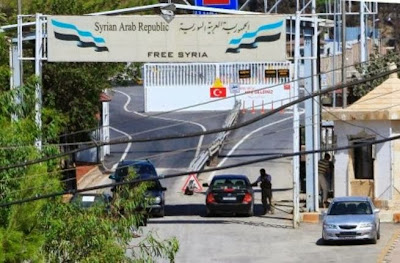
Near Azaz, a more official border crossing between Turkey and “Free Syria”
These particular jihadists, who—though the reports are inconclusive—seem to still hold the town, or part of it, are members of the Islamic State of Iraq and al-Sham (ISIS), a new player in the Syrian civil war.  Reports indicate that a cease-fire has had some success but that Islamic law seems to be in effect there, after a skirmish resulted in ISIS expelling an F.S.A. unit called Northern Storm from the town.  And the assassination of the self-declared emir of Azaz, Abu Abdullah Libi (nom de guerre: Junood), on September 23rd—his car was shot up by snipers while at a checkpoint—may only stoke the flames of conflict between the two groups.  But who is ISIS, and what do they want?


One finger means I have to go wee-wee, two fingers means behead the infidel:
students at a school in Aleppo run by the Islamic State of Iraq and al-Sham.
Al-Shām, or Sham, is an old Arabic term for the fertile lowlands between the Mediterranean and Iraq’s Euphrates River.  ISIS is thus sometimes called, in the media, the “Islamic State of Iraq and the Levant,” or, less accurately, “... and Syria.”  Some say that ISIS represents a merger between the al-Nusra Brigades—the most prominent Islamist force in the Syrian war and, some say, by far its best organized rebel group—and an older entity called the Islamic State in Iraq (I.S.I.).  I.S.I., under its original name Jama’at al-Tawhid wal-Jihad (Organization for Monotheism and Jihad), was founded in 2003 by a Jordan-born Mujahideen commander from the Afghan War named Abu Musab al-Zarqawi, during the period when al-Qaeda-linked groups were flooding into Iraq to fight the United States, which had invaded using as justification the lie that al-Qaeda was already there and cooperating with Saddam Hussein, which everyone knew it wasn’t.  Zarqawi folded his Afghanistan-based militia into Osama bin Laden’s al-Qaeda network in 2004 and renamed it al-Qaeda in Iraq (A.Q.I.).  Later, as I.S.I., it aimed to create an Islamic state in the Sunni-Arab-dominated parts of Iraq between Kurdistan and the Shiite-dominated south.  (See my article from this blog about a possible partition of Iraq.)  Zarqawi was dubbed al-Qaeda’s “Emir of Mesopotamia” (i.e., Iraq) before being killed in a U.S. bombing in 2006.

Abu Musab al-Zarqawi
For a group like ISIS to become a player in Syria is new, and dangerous.  Radical Islamist terrorists never had time to organize themselves as a major fighting force in Arab Spring revolutions such as those in Tunisia, Egypt, Libya, or Bahrain, though they were already a presence in Yemen and still are in the ongoing fighting there.  Zarqawi’s relocation from Afghanistan to Iraq in the early 2000s is part of a larger pattern of Islamist fighters from various points around the world converging on trouble spots that are perceived to be frontline struggles in a holy war to reclaim traditionally-Muslim-ruled areas and place them under shari’a (Islamic law).  This is what happened, for example, in southern Russia, in Chechnya between the First Chechen War in the mid-1990s, which was a secular nationalist movement, and, in 1999, the onset of the Second Chechen War, by now a salafist religious war with local rule often modeled on the harsh Saudi Arabian form of salafism known as Wahhabism.  It is also what has happened in Kashmir, where a war over the question of independence and self-determination in an area claimed by both India and Pakistan has been transformed into a holy war (for some, anyway).  It is also what happened last year in northern Mali, where the latest nationalist uprising by the Tuareg minority was coopted by jihadists as well as by Libyan Tuaregs displaced by civil war.  It is also the pattern in places such as northern Nigeria (Boko Haram), Zanzibar (Uamsho), and the southern Philippines (Abu Sayyaf), among other places.

The global caliphate some Muslim radicals envision
In each case, the aim has been to create an emirate (like Zarqawi’s Emirate of Mesopotamia) under shari’a, ruled by mullahs, or self-appointed doctrinal experts among the militant leadership.  These pseudo-states prominently feature the bureaucratic language of the political structure of the Ottoman Empire (emirates, vilayats, etc.), the closest thing there has been to the superstate ruling the entire Islamic world that these radicals envision.

A more Ottoman-centered vision for an Islamic caliphate
There have been some successes.  Under the Taliban’s rule, Afghanistan was known as the Islamic Emirate of Afghanistan—a term still used by radical Islamists who control pockets of the country.  The areas along the Afghan border which Pakistan’s government is unable or unwilling to govern is a de facto sovereign Taliban and al-Qaeda territory called the Islamic Emirate of Waziristan.  Al-Qaeda-linked radicals ran a so-called Emirate of Waqar in the towns of Jaar and Zinjibar in southern Yemen for more than a year until it was shut down (as reported at the time in this blog) by a Yemeni government offensive last summer.  Perhaps most prominently, as indicated above, the al-Qaeda-linked Ansar al-Dine militia and the Algerian-based Movement for Unity and Jihad in West Africa (MUJAO) ran an Islamic Republic of Azawad in the northern two-thirds of Mali until dislodged by France earlier this year.  (See my recent article with an update on Azawad.)  In all these places, shari’a means that music and beard-trimming are banned, women have to be completely covered and are denied education, adulterers are stoned to death, and anything deemed a non-Muslim or pre-Muslim religious structure can be demolished, including ancient architectural treasures.  These are not nice people.

Ansar al-Dine in Azawad
Some “emirates” are more imaginary.  A visit to the Kavkaz Center website reveals a fantasy world in which Russia’s North Caucasus region and surrounding areas are an Islamist-governed Caucasus Emirate, divided into renamed vilayats (provinces) where “Russian invaders” are always successfully resisted by the loyal mujahideen, in deadpan journalistic prose.  In the real world, this translates into a low-level but unending procession of suicide bombings, ambushes, assassinations of moderate clerics, and other terrorist acts in Russia’s North Caucasus republics.  The Caucasus Emirate has managed to send quite a few fighters to join the struggle in Syria, not incidentally, and they have their sights set on areas such as Tatarstan, in central Russia, as well.

The imaginary Caucasus Emirate of southwestern Russia
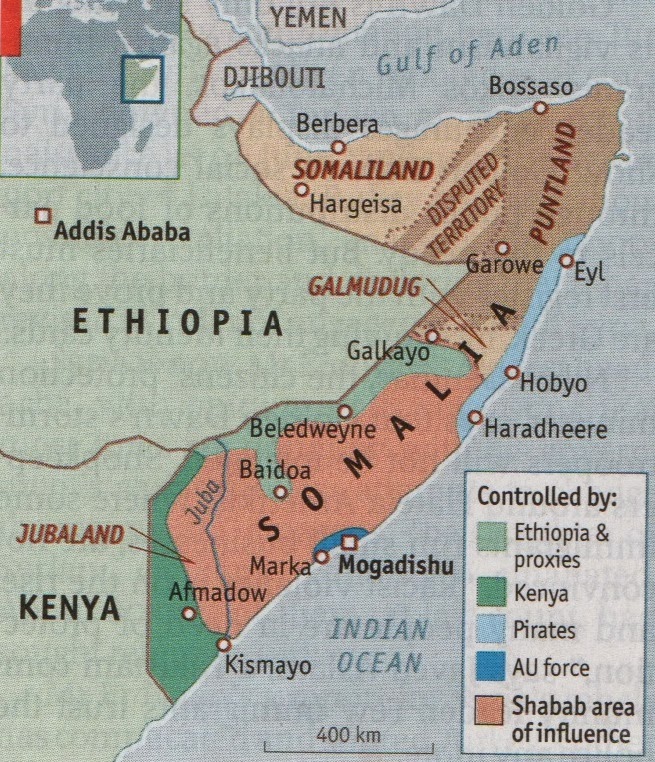
Starting in the late 2000s, an al-Qaeda-affiliated militia called al-Shabaab (literally, “the youth”) controlled nearly a third of Somalia—pretty much everything west and south of Mogadishu, the capital—until being dispersed by troops from Kenya and Ethiopia under the African Union (A.U.) banner last year.  Those events are the grievance behind al-Shabaab’s (as of this writing) ongoing Westgate shopping-mall massacre and siege in Nairobi, Kenya.  During its dominance of southern Somalia, al-Shabaab called its territory the Islamic Emirate of Somalia.  (See my recent article with an update on Somalia.)

How Somalia was divided up during the height of al-Shabaab’s influence
A version of this may be what is going on in Azaz.  In addition to the de facto West Kurdistan Autonomous Region in northern Syria along the Turkish border and a de facto division of much of the country into Bashir al-Assad’s Syria and “Free Syria,” we may now be seeing the beginnings of pockets of a so-called Islamic Emirate with plans to link the bulk of Syrian territory to adjoining Sunni-dominated parts of western and central Iraq.

One view of how Syria might be partitioned
One motivation for international salafist interest in Syria is that it is, like non-Kurdish Iraq, ruled by Shiites, whom Sunni salafists such as al-Qaeda and its partners regard as heretics.  In particular, this is true for the Arab Shiite minority that forms the political elite in Assad’s Syria, the Alawites, whose version of Islam is not particularly rigid and observant by most Muslim standards.  Some members of the Assad regime are interested in the possibility of forming an independent Alawite State in the coastal areas where the opposition is weakest and where Shiites predominate.  (See my recent article on the Alawite State idea, which I also called one of “10 Separatist Movements to Watch in 2013.”  See also an earlier, longer discussion in this blog of how Syria might be partitioned.)

The former flag of the “Alawite State” area in French-ruled Syria
may one day fly again over Tartous and Lattakia.
This sectarian division also intersects with the tussle over Syria between the local superpowers.  Iran, which is Shiite, is the Assad regime’s strongest backer, while Turkey funnels arms to moderate Sunnis (as long as they’re not Kurdish) and Saudi Arabia funnels arms to—well, we do have to worry that some of those arms at least are ending up in the hands of groups like al-Nusra and ISIS.


So now, if a resolution to the war in Syria is to involve some kind of partition, we would be looking at not only Kurdish, Alawite, and Sunni Arab (and maybe Druze) statelets or autonomous regions but also, perhaps, an attempt to establish an Islamic Emirate.  And the experience in Nigeria, Mali, and Somalia is that emirate movements are never content to revel in their safe enclaves but want to expand in order to bring shari’a to the rest of the benighted world.  These new developments make it much less likely that a peaceful partition can be achieved—and it also raises the prospect of a well-organized, Taliban-style faction jostling for the upper hand in any post-Assad regime.

It doesn’t look good.

An F.S.A. rebel defending Idlib province from the Assad regime and, now, al-Qaeda-linked Islamists as well

[Also, for those who are wondering, yes, this blog is tied in with a forthcoming book, a sort of encyclopedic atlas to be published by Auslander and Fox under the title Let’s Split! A Complete Guide to Separatist Movements, Independence Struggles, Breakaway Republics, Rebel Provinces, Pseudostates, Puppet States, Tribal Fiefdoms, Micronations, and Do-It-Yourself Countries, from Chiapas to Chechnya and Tibet to Texas.  Look for it some time in 2013 or 2014.  I will be keeping readers posted of further publication news.]

Thursday, September 27, 2012

Pavel Grachev, Russian Commander in First Chechen War, Dies at 64, Sparking Poisoning Rumors


The Russian Federation’s former minister of defense, Gen. Pavel Sergeyevich Grachevdied near Moscow on September 23rd at the age of 64.


Shouldn’t take more than an afternoon, eh?
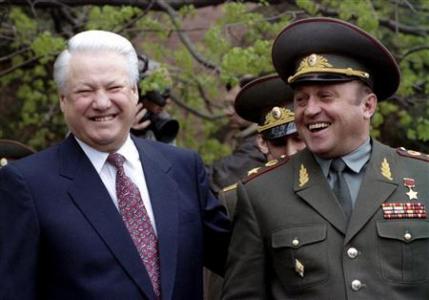
A veteran of the disastrous Soviet war in Afghanistan, Grachev had been deputy minister of defense under Mikhail Gorbachev in the waning months of the Union of Soviet Socialist Republics (U.S.S.R.), then the Russian Federation’s first minister of defense under President Boris Yeltsin, whom he backed during two failed coups d’état against him—one by pro-Soviet forces in 1991 and the second by the Russian parliament in 1993.


Pavel Grachev (1948-2012) (right) in (can you guess?) ... 1993, actually.
(Communist iconography dies hard.)
Most famously, Grachev was ridiculed for having claimed that the Russian military could reclaim the secessionist Chechen Republic of Ichkeria within a few hours.  The First Chechen War, which Grachev mostly commanded, ended up instead lasting nearly two years (1994-1996), costing tens of thousands of lives, and resulting in the de facto independence of Chechnya (which was brutally reclaimed in 2000 at the conclusion of the Second Chechen War, under Vladimir Putin).


“Okay, guys, off you go.  See you back here in a couple hours.”
Just for fun, we will note that the website of the radical Islamist separatist Caucasus Emirate movement, Kavkaz Center, has gleefully picked up on unfounded media speculation that Grachev was killed by poisonous mushrooms, eaten at a birthday party.  The official cause of death is acute meningoencephalitis, which can indeed be caused by some poisons.  The Emirate website theorizes that the ’shrooms were fed to him as part of a hit by Putin’s minions.  The website calls Grachev “a new victim in a long list of top Russian army generals, colonels and G.R.U. [Russian military intelligence] staff whom Putin suspected of plotting against his K.G.B. rule and preparing a military coup.”

Pavel and Boris share a tender moment.  Don’t make fun.
It’s a male Russian thing.  You might not understand.
Grachev was himself actually once involved in an assassination scandal, in 1994, when a journalist, Dmitry Kholodov, who had accused Grachev of corruption in connection with the Soviet military withdrawal from the German Democratic Republic (G.D.R.) was killed by an exploding briefcase.


I include this photo of Pavel Grachev because I have no idea what that flag in the background is.
Does anyone know?
[Also, for those who are wondering, yes, this blog is tied in with a forthcoming book, a sort of encyclopedic atlas to be published by Auslander and Fox under the title Let’s Split! A Complete Guide to Separatist Movements, Independence Struggles, Breakaway Republics, Rebel Provinces, Pseudostates, Puppet States, Tribal Fiefdoms, Micronations, and Do-It-Yourself Countries, from Chiapas to Chechnya and Tibet to Texas.  Look for it in spring 2013.  I will be keeping readers posted of further publication news.]

Saturday, September 8, 2012

Turkey Crosses Iraq Border Again: Kurdistan Update, 2-8 September 2012

Kurds demonstrating in Aleppo, Syria, this week
TOP STORY:
KURDISH CIVIL WAR IN TURKEY STILL RED HOT:
31 KILLED IN ONGOING INSURGENCY IN SOUTHEAST;
BOLD TURKISH CROSS-BORDER OPERATION ALONG IRAQI FRONTIER KILLS 26


26 Dead as Turkish Air Force Pounds Positions in Northern Iraq and Şirnak.  The Turkish air force and army pounded suspected Kurdish rebel positions along both sides of the border between Turkey and Iraq on September 5th, with about 2,000 ground troops, 10 F-16 fighter jets, and several Cobra helicopters involved in the battle, part of which focused on Kato mountain in Turkey’s Şirnak province.  By the next day, one soldier was reported killed and two injured.  The Dwele region in northern Iraq’s mountains was hit by bombers.  There were no indications that Turkish ground troops had crossed the border into Iraq, which would have represented a raising of stakes by Ankara.  On September 7th, Turkish authorities announced that 26 Kurdish rebels had been killed in the two-day offensive.


31 Killed in Ongoing Violence in Turkish Kurdistan.  Thirty-one people were killed this week in the ongoing civil war between Turks and Kurds in southeastern Turkey.  On August 31st, a bomb derailed a train in Van province, damaging four train cars but causing no injuries.  Soon after, six Turkish soldiers on their way to investigate the blast site were hurt when a remote-controlled roadside bomb hit their vehicle.  The same day, fighting that followed an attack by the banned separatist Kurdistan Workers’ Party (P.K.K.) on a police station in Beytüşşebap, in Şirnak province, killed 10 Turkish soldiers and 20 P.K.K. fighters.  Acting on a tip, police forces in Şanlıurfa province, in the southeastern Kurdistan region, intercepted what they reported to be an attempted suicide-bombing on September 2nd.  The tip was reportedly that a suicide bomber was attempting to cross into Turkey from Syria.  A black minivan approached and opened fire on a police checkpoint on the evening of the 2nd, injuring three police and a nearby civilian.  In the ensuing firefight, one militant from the P.K.K. was wounded and captured, while another another reportedly detonated his suicide vest and died while being pursued on foot.  The dead militant was later identified as the perpetrator of an August 9th landmine attack on a military bus in İzmir province (reported on at the time in this blog).  In further reverberations from the İzmir attack, authorities are suggesting that three villagers found shot and killed in a field on August 7th were witnesses killed by the planners of the İzmir attack to prevent it being foiled.  Meanwhile, it was reported that the P.K.K. had released a state official named Ubeydullah Sancar, who was kidnapped in Diyarbakir on August 17th, but on September 4th the P.K.K. announced it had the day before abducted the Hakkari provincial head of the ruling Justice and Development Party (A.K.P.), Majid Tarhan.  An explosion at an armory in Afyonkarahisar, in Afyon province, which killed 25 soldiers on September 5th, was ruled an accident and, according to authorities, “not a terrorist attack” (though, as a military target, it would not have fallen under the category of terrorism anyway).


NORTH KURDISTAN (TURKISH KURDISTAN)

B.D.P. Claims Kurdish Rebels Control 400 Square Km of Southeast Turkey.  The main pro-Kurdish party in mainstream Turkish politics is inciting controversy by claiming that the banned separatist P.K.K. controls 400 square kilometers of southeastern Turkey following a pitched battle in July and August for the city of Şemdinli, in Hakkari province.  Turkey’s deputy prime minister, Bekir Bozdağ, called the claim, by Serkan Demirtaş of the Peace and Democracy Party (B.D.P.), “not even a claim, but a lie.”  Adnan Keskin, deputy chair of another opposition party, the Republican People’s Party (C.H.P.), supported Ankara’s position, stating, “Demirtaş stated that the P.K.K. controls 400 square kilometers, and he invited any minister to see this situation with his own eyes,” and that “the P.K.K. has an ‘open land control strategy,’ meaning that the P.K.K. controls all the land,” but that “control of such a large area requires a minimum of 10,000 people [and] there [are] only 700 terrorists in the area.”  Presumably in response to the B.D.P. assertion, Turkish flags began showing up on mountaintops around Şemdinli.

C.I.A. Director Petraeus in Istanbul to Discuss Syria, Kurds.  The director of the United States’ Central Intelligence Agency (C.I.A.), David Petraeusarrived in Istanbul on September 3rd for unannounced, high-level talks with the Republic of Turkey on matters that include the civil war in Syria and the Kurdish rebellion there and in Turkey.  Sources say that another central topic of the talks were deteriorations in relations between Turkey and Israel, in part over last year’s incident on the high seas, in which Israeli troops stormed a passenger vessel bringing humanitarian relief to the Israeli-blockaded Gaza Strip and, according to a United Nations report, “summarily executed” nine Turkish activists on board.


David Petraeus
Taliban Calls for Kurdish Volunteers in Afghanistan Recruitment Video.  The Taliban, the radical Salafist terrorist group operating in Afghanistan and Pakistan, has begun specifically targeting Kurds, whom it asks to come to Afghanistan to “join the jihad.”  In a video released August 15th on a Turkish website, Maulvi Sangin Zadran, commander of the Haqqani Network, which is a branch of the Taliban, refers to seven members of Turkey’s military recently killed by jihadists in Afghanistan and asks not just Kurds but even ethnic Turks to join the battle against Afghanistan’s occupiers from the North Atlantic Treaty Organization (NATO), including the United States and Turkey.  A terrorism expert, Karen Hodgson, noted that the move was unusual, writing, “The few radical Islamic groups that are thought to include Kurds have been active mostly in Iraq and Iraqi Kurdistan, the main one being the Kurdistan Brigades—a group linked to the Salafi-Jihadi Ansar al-Islam movement, the insurgent group bombed by U.S. forces during the 2003 American invasion.”  A Turkey expert, Gareth Jenkins, said, however, that “there were certainly ethnic Kurds going to al-Qaeda training camps in Afghanistan prior to the U.S.-led military campaign in late 2001.  Most of the Turkish nationals responsible for the 2003 Istanbul bombings were ethnic Kurds who had travelled to Afghanistan for training, thought with al-Qaeda, not the Taliban.”

SOUTH KURDISTAN (IRAQI KURDISTAN)

Iraqi Kurdistan Extends Deadline for Disputed Payments by Baghdad.  The autonomous Kurdistan Regional Government (K.R.G.) in northern Iraq announced September 1st that it would continue pumping oil until September 15th, “as a goodwill gesture” extending the deadline for an ultimatum to the central Iraqi government in Baghdad to make payments the K.R.G. claims are owed firms working in Kurdistan.  The exports were halted in April but restarted in August pending negotiations.  In reply, Baghdad threatened to cut the K.R.G.’s federal budget allocations by $3 billion.

[Note: See these earlier articles from this blog on related topics, especially with respect to the Kurds and the Arab Spring: “And Now Civil War ... Could Syria Break Up?” (Nov. 2011), “The Iraq War Is Over, but Is Iraq’s Partition Just Beginning?” (Dec. 2011), “Ten Separatist Movements to Watch in 2012” (Dec. 2011); “Get Ready for a Kurdish Spring” (March 28, 2012); “Shifting Alliances in the Kurdish Struggles” (April 1, 2012); “Turkish Delights Hide Ugly History” (April 4, 2012);  “Syria’s Kurds Are Setting Up a Quasi-State—How Long Can It Last?” (July 2012), “Liberation of Syrian Kurdistan Infuriates Turkey, Iraq, and the Free Syrian Army—in Fact, Everyone but Assad” (Aug. 2012), “Turkish Kurdistan Ground War in Progress, Iraq Border Crisis Eases: Kurdistan and Syria Update” (Aug. 2012), “Kurdistan Update: Both Turks & PKK Claim to Control Şemdinli, Zaza MP Abducted, Donna D’Errico and Noah’s Ark” (Aug. 2012), “Carnage Continues in Turkish Kurdistan” (Aug. 2010), “Syria and Kurdistan Update, 26 August–1 September 2012.”]

[Also, for those who are wondering, yes, this blog is tied in with a forthcoming book, a sort of encyclopedic atlas to be published by Auslander and Fox under the title Let’s Split! A Complete Guide to Separatist Movements, Independence Struggles, Breakaway Republics, Rebel Provinces, Pseudostates, Puppet States, Tribal Fiefdoms, Micronations, and Do-It-Yourself Countries, from Chiapas to Chechnya and Tibet to Texas.  Look for it in spring 2013.  I will be keeping readers posted of further publication news.]

Subscribe Now: Feed Icon