Last year around this time, I wrote an article here titled “
Ten Separatist Movements to Watch in 2012.” As is always the case with such things, there were some successes and failures in my predictions.
 |
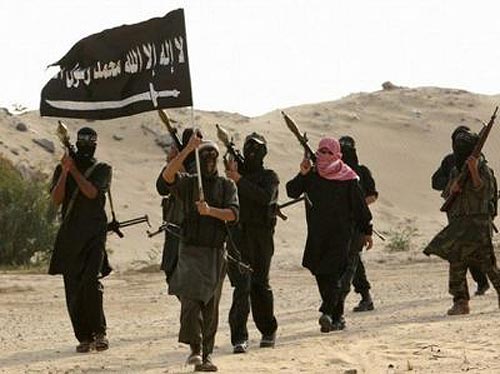
| The ominous black flag of Ansar al-Dine flew over a captured city in northern Mali in spring of 2012. |
The push to partition
Belgium into
Flanders and Wallonia (no. 10 on last year’s list) did indeed surge to the forefront as a movement, thanks to the election of a member of the Flemish nationalist party to the mayoralty of Antwerp in October (
as reported at the time in this blog), partly riding on the wave of separatism initiated by
Scotland and
Catalonia.
Kawthoolei (no. 6), as an independent homeland for the
Karen people of southeastern
Burma (a.k.a.
Myanmar) is to be called, is perhaps a bit closer to reality: the military
junta that rules the country began liberalizing at breakneck speed earlier this year, and peace accords with ethnic minorities are among the showpieces of Burma’s
détente with the West. Burma’s war against the Kachin minority has, if anything, intensified, and Buddhist pogroms against Muslim minorities in western Burma are putting the country and its reputation at risk, but the Karen, who have a strong lobby in the West, may just emerge from all of this unscathed; in fact, the
junta may cut them loose if only to show that they’re not complete fuckers (though it is quite possible that they are, in fact, deep down, complete fuckers after all; we’ll see).
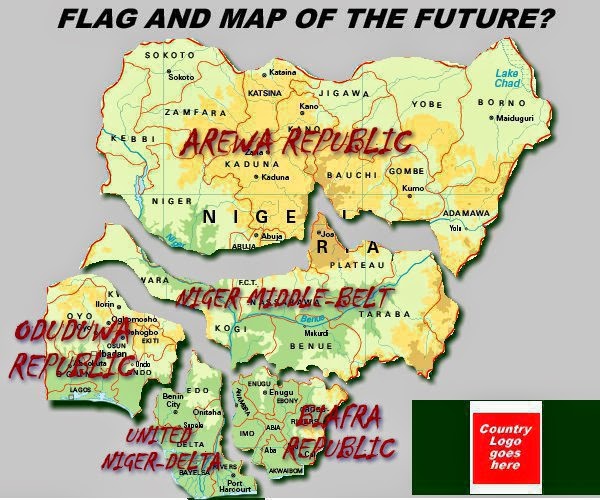
Northern Nigeria (no. 5), where the approximately 50% of the nation that is Muslim are concentrated, has indeed suffered an acceleration of terrorist agitation by the brutal Islamist militia
Boko Haram, with thousands now dead. This is the greatest threat to Nigeria’s unity since the
Biafra War, and calls for a separate state or some sort of partition are becoming a clearer voice in the hubbub.
South Sudan (no. 2), which is more properly speaking the
aftermath of a successful secessionist movement, did indeed see an explosion of violence along the still undefined border with its parent country,
Sudan, but it’s quite likely that this will die down and become one of the world’s many low-level, misery-inducing insurgencies, in the Nuba Mountains,
South Darfur, and other regions.
Kurdistan (no. 3 last year, no. 1 this year; see below) and
Palestine (no. 1 last year, no. 3 this year; see below) were indeed major stories of 2012, with, in Kurdistan, the establishment of a fragile
West Kurdistan Autonomous Region amid
Syria’s civil war and, at the
United Nations, the dramatic admission of the State of Palestine as a non-member observer state, despite a still-raging-at-that-point vest-pocket war between
Hamas and
Israel in the
Gaza Strip.
The conflicts in
Pakistan’s restive province of
Balochistan (no. 9 on last year’s list), in
Indonesia’s far-eastern
Papua and
West Papua provinces (no. 7), and in the parts of the
Republic of Yemen that would like to restore the independent
South Yemen (no. 4) ground on, but without coming any closer to resolutions. The campaign for northern
Italy to secede as
Padania (no. 8) collapsed completely, thanks to the Euro Zone crisis, which brought down
Silvio Berlusconi’s coalition government, in which the separatist
Northern League was an unlikely junior partner. And then, the League’s charismatic founder and leader,
Umberto Bossi, resigned amid a corruption scandal. Padania may rise again, but not any time soon.
 |
Umberto Bossi’s northern Italian separatist movement
was virtually obliterated by the Euro Zone crisis in 2012. |
My list also failed to include Scotland and its forward movement toward independence (no. 4 on this year’s list; see below), Catalonia’s rising separatist movement (no. 6 this time around; see below), the autonomy declaration in
Libya’s eastern
Cyrenaica region, the declarations of independence in the
Bakassi Peninsula portion of the disputed border area between Nigeria and
Cameroon, or the (unexpected by anyone) establishment of the
Independent State of Azawad (no. 2 this year; see below) in northern
Mali. I also had no idea that a reelection of
Barack Obama could inspire an upsurge of separatism in America’s red states (see no. 9 below).
Now, without further ado, are
Ten Separatist Movements to Watch in 2013:
10. Jubaland
Let’s start with one most people have never heard of. At the beginning of the year, southern
Somalia, which was at the time ruled by
al-Shabaab, a merciless Islamist army affiliated with
al-Qaeda, was being invaded by an
African Union (
A.U.) force led by
Kenya and
Ethiopia, with
United States aid, to try to dislodge the group and restore rule from Mogadishu. For Kenya, this meant setting aside for the moment plans for a possible buffer state in the region in order to settle a grudge: Kenya suffers more spillover of al-Qaeda terrorism than anywhere else in sub-Saharan Africa, and it has its own Muslim separatist movement around
Mombasa that it fears may become radicalized with militant Islam in the way that the
Zanzibar separatist movement in nearby
Tanzania has been. In the late summer, the A.U. coalition more or less succeeded—liberating the southern city of Kismayu and putting al-Shabaab on the run. However, the
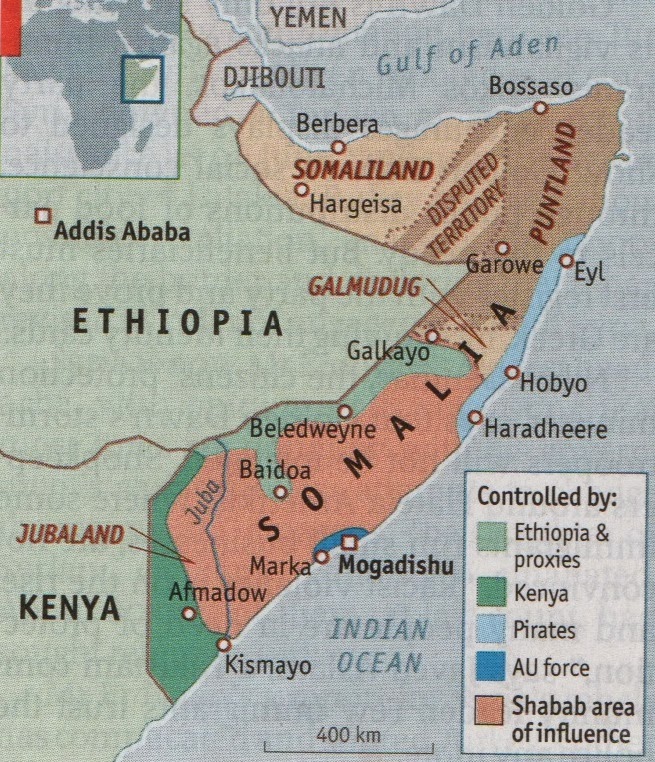
Federal Republic of Somalia in Mogadishu, although it this year ended its “transitional” period and is supposedly now “normalized,” is, disappointingly, not much closer to extending its actual administration of territory very far beyond the outskirts of the capital. So, local southern militias, some nearly as brutal and nearly as Islamist, are taking advantage of the power vacuum in the south to try to revive a regional government called, at various times,
Jubaland,
Azania, or even
Greenland (
sic), which has for brief periods enjoyed
de facto independence during Somalia’s long civil war. In the short term, many Jubalanders would like to establish a self-governing (
de facto independent) autonomous state—like
Galmudug and
Puntland, to the north (see map above)—but Mogadishu and the A.U. are resistant to this idea. They’ve seen how Galmudug and Puntland have, for all their relative stability, become havens for sea pirates. An autonomous Jubaland, especially one run by Islamists, may not solve much. But Jubalanders are tired of war and tired of instability and, it seems, they are tired of being part of Somalia.
 |
| Postage stamps from Jubaland’s brief quasi-independence in the 1920s as the Italian colony of Trans-Juba |
Two rival designs for the flag of Jubaland State
9. Texas
Texas is one of only four states that joined the
United States from the position of an independent state applying for admission (the others being
Vermont and, more ambiguously,
Hawaii and
California) and has always had a separatist streak. Lingering bitterness toward the North in this former slave state is perhaps stronger than anywhere else in the territory of the failed
Confederate States of America. Today, it is among the reddest of red states—the home not only of
George W. Bush but of
Lyndon B. Johnson, whose “betrayal” of fellow “Dixiecrats” by pushing through civil-rights legislation in the 1960s lay the groundwork for
Richard Nixon’s “Southern strategy”—in which the
Republican Party courted Southern white racists, which is why today’s electoral maps look the way they do. Texas is also home to extreme forms of political nuttiness, much of it swirling around issues of sovereignty. I have reported in this blog on the Texan separatists
getting their panties in a bunch over (actually rather routine and benign) monitoring of national-election polling places in Texas by “ferners” from the
Organization for Security and Cooperation in Europe (
O.S.C.E.), and on
some Texan politicians’ fears that President
Barack Obama is planning on allowing the
United Nations to institute direct rule in the Lone Star State. Local redneck folklore has it that Texas has the constitutionally ordained right to secede from the Union at any time—which is false, though it does have the right to devolve into as many as five separate states (which would have the effect of turning the U.S. Senate into a particularly bad episode of
Hee Haw). In the hours after Obama was reelected in November 2012, Texas was the second state (after
Louisiana) to be represented in
online petitions on the White House’s website calling for secession from the U.S. All 50 states, plus the
State of Jefferson and
Molossia,
had petitions in the days that followed, but of all these Texas got the most signatures—119,044—though, to be fair, some of those may have come from Northerners whose attitude toward Texan independence is “Don’t let the screen door hit you where the
Good Lord split you.” To be sure, this is mostly a rhetorical, symbolic reflection of fears of federal intrustion (“First Washington frees our slaves, then they make us take down the ‘No Coloreds Allowed’ signs, now they want everyone to have access to affordable health care—
what horrors are next??”). Even Governor
Rick Perry, whose warm comments about Texan independence may have contributed to his failed bid for the presidential nomination, continues to chime in on the subject. But serious or not, events in 2012 have put the word “secession” on everyone’s lips in Texas. The
Texas Nationalist Movement (
T.N.M.) says its membership has spiked as never before and has just formed its own political action committee (PAC). Don’t expect Texas to secede any time soon; that would require an act of Congress. But don’t expect the idea to die down any time soon either, at least not as long as there is a black man in the white House, especially one who, after the Newtown,
Connecticut, school massacre this month, really
is trying to take people’s assault weapons away.
8. Alawite State
 |
Lattakia and Tartous provinces, along Syria’s coast, formed the Alawite State in colonial times,
and may one day do so again. |
This time last year, everyone was predicting that by this point the civil war in
Syria would be over, that the dictator
Bashar al-Assad would be killed or in exile, and that Syria would be on a possibly rocky way towards something at least better and more democratic. But with thousands more dead, there is still no end in sight. This keeps open the possibility (
discussed in this blog in November 2011) that Assad and his inner circle may yet try to relocate from Damascus to the coastal areas that are the homeland of the minority to which they belong: the
Arabs of the
Alawite sect of Shi’a Islam. This region, comprising Syria’s only two coastal provinces,
Lattakia and
Tartus, are separated from the rest of Syria by a mountain range and in the 1920s and ’30s enjoyed quasi-independence under
France’s colonial mandate as the
Alawite State—an entity that some would like to revive as a sovereign state. Syria’s ethnic and religious minorities—including
Druze,
Christians, and
Kurds—have always been less fierce in their opposition to the Assad dynasty than the
Sunni Arab majority has been, but the Alawites have been his positive allies, and their coastal region has as a consequence seen far less violence than the rest of the country. If Assad is simply removed from power,
à la Moammar al-Qaddafi or
Saddam Hussein, then we can expect a horrific backlash against Alawite civilians by a new government in which radical Sunni Islamists who regard Alawism as heretical. (Alawites are relatively secular Muslims, with a mix of Christian practices and a tolerance and mysticism some compare to that of Bahai’ism or Sufism.) Thus, there might be pressure for the West, if it removes Assad, to create a protected zone for Alawite civilians. Or: Assad may be able to escape to the Alawite region and maintain a drastically shrunken version of his country as his own fief. The fact that Syrian rebels
are even now trying to cut off escape routes to the coast suggests that both sides are gearing for a battle premised on this contingency. Other civil wars in history have ended with the losing side allowed a smaller, truncated territory as a separate state:
North Korea,
Taiwan, and—for a while—
South Vietnam come to mind. Libya, too, in its civil war last year, was for a while partitioned along battle lines following old historic boundaries which threatened to become permanent. The recent decision to deploy
United States troops and Patriot missiles just over the border in south-central
Turkey perhaps makes an Alawite State less likely—and it would seem like a defeat to the Syrian majority if they end up with a country once an economically strategic oil route but now suddenly landlocked and at the mercy of their old enemies for coastal access—but many political observers over the past year have lost money betting against Assad’s tenacity. (
Kurdistan complicates the question of Syria’s fate, of course; see below.)
 |
| Flag of the Alawite State |
7. Tibet
Very little has changed in the brutal rule by the People’s Republic of China (P.R.C.) of Tibet in terms of actual policies, to say nothing of improvements, but the visibility of this movement has been raised considerably in 2012. The Summer Olympics in London were the occasion for many political protests, including those in favor of the Tibetan struggle for self-determination. More dramatically, self-immolations by Tibetans, many of them Buddhist monks, in desperate protest over the political situation, have spiked in late 2012, bringing to (as of this writing) 95 such incidents since the wave of self-immolations began in 2009. Beijing is stepping up its response to that situation, with a barrage of propaganda blaming the 14th Dalai Lama for the protesters’ deaths. Something is happening in the closed world of Chinese-ruled Tibet, and in the even more secret world of dissidents, whose ardor for independence has not dimmed the slightest in over six decades of domination. This may be the year everything blows up—with, as is always the case in the Chinese sphere of influence, unpredictable results.
6. Catalonia
This year saw
Catalonia, a small region in northeastern
Spain catapulted into international stardom for its sudden surge of separatist feeling, the triumph of separatists in regional parliamentary elections, and, just within the past couple weeks, the formation of a ruling separatist coalition and an agreement to hold a referendum on independence in 2014, the same year as
Scotland’s (see below). This development can be seen as one of the more profound political repercussions of the
Euro Zone crisis. Catalonia is Spain’s wealthiest region and thus has long chafed at the fact that it essentially subsidizes poorer areas. Add to this that it is also Spain’s most indebted region at the moment, and you have Catalans feeling that it is the profligacy of those poorer regions that has landed them in this pickle. Catalonia enjoyed
de facto independence during the Spanish Civil War and has long considered itself not really Spain, with closer cultural and linguistic affinities to France than other Spanish regions have. Hence their feeling that they are somehow a “northern European” success story that should not have to suffer for a financial crisis caused by the irresponsibility of “southern Europe” (the same dynamic, in the same rhetorical terms, that is at work among
Italy’s northern separatists and
Belgium’s
Flemish ones). Since
Francisco Franco’s death in 1975, Catalonia has become more and more independent, with their own devolved parliament, their own educational and language policies, etc. (The much smaller number of Catalans just over the border in
France have, like other French linguistic and ethnic minorities, almost no political recognition or rights.) But Catalonia is still wedded to Madrid when it comes to the collection of taxes and how the revenue is spent. Expect most of Spanish politics in 2013 to revolve around the tussle over whether Catalonia is even allowed to hold a referendum (Madrid says no), what happens if they do anyway (Catalonia has requested
NATO protection should Madrid send in the tanks), and whether an independent Catalonia could remain automatically, or even at all, within the
European Union (
E.U.)—a question faced also by Scotland (see below) and which is at the moment up in the air. (Separatist tendencies in
Galicia and, especially, the
Basque Country are also set to be debated this year.)
5. Barotseland
 |
| Greater Barotseland |
The
Barotse, or
Lozi, people formed an independent monarchy well into the period of British colonialism and dealt with
Cecil Rhodes’s
British South Africa Company as a sovereign entity until their absorption into British
North-Western Rhodesia in 1900. When North-Western and
North-Eastern Rhodesia merged to become the independent
Republic of Zambia, Lozis feared the loss of their special status under colonialism and negotiated the 1964 “Barotseland Agreement” with Zambia’s first president,
Kenneth Kaunda, which promised them greatly enhanced autonomy. But successive Zambian presidents have ignored the agreement and have even chipped away at Barotse rights and neglected the infrastructure of what was at first called
Barotseland province and then, in a further insult, renamed simply
Western Province. In the past year, the
Barotse Royal Establishment, whose king and prime minister are only ceremonial but command wide loyalty among the people, held a plebiscite of Lozi communities which came out overwhelmingly in favor of independence. Since then, rhetoric from Barotseland and from the Zambian central government in Lusaka has become increasingly bellicose and at various points seemed at risk of tipping into open conflict. Unlike other tribal separatist movements in Africa, the Lozi have a functioning government, headed by a charismatic king,
Libosi Imwiko II, who has a strong a public mandate. The Lozi are also well armed and make common cause with Lozi separatists just over the border in the
Republic of Namibia’s smaller
Caprivi Strip territory, which means any conflict there could become quickly internationalized. Boundaries are also messy: some Lozi live in neighboring Zambian provinces, and some minority ethnic groups in Barotseland prefer to stay Zambian. The international media have utterly ignored the lurch towards civil war in Zambian Barotseland. My guess is that in 2013 they will no longer be able to.
 |
| King Libosi Imwiko II |
 |
| The flag of Barotseland |
4. Scotland
In the British Isles, much of 2013 will be consumed by a debate over whether residents of
Scotland should vote, in their plebiscite the following year, to secede from the
United Kingdom. Much of the wrangling over the form of secession has been settled: an independent Scotland would be a non-nuclear state but within the
North Atlantic Treaty Organization (
NATO), it would keep the British pound but would be more open to joining the
Euro Zone than the U.K. is, and it would probably keep
Queen Elizabeth II as head of state and become a completely sovereign Crown dominion, like
Canada,
Australia, or
New Zealand. Still to be settled (as with
Catalonia; see above) is whether Scotland can stay in the E.U. after it splits from the U.K.—i.e., whether it would have to reapply for admission and whether the U.K. would block it. Legal scholars and political scientists are divided on this question; it has never come up before (but see
my article from this blog looking at precedents in other international arenas). This coming year, we will see the government in London pulling out the heavy guns, bringing
Tony Blair on board the “Better Together” campaign to try to convince Scots with threats, cajolery, and hyperbole that secession will be a disaster (will a drooling
Margaret Thatcher be wheeled out amid royal pomp to handbag a bagpiper?), while
Alex Salmond and his
Scottish National Party (
S.N.P.) and their “Scotland Yes” campaign will try to ride a rising wave of nationalist feeling. Right now, according to polls, there are not quite enough “yes” votes, but a year is an eternity in politics.
3. Palestine
This has been a banner year for the
State of Palestine, which declared independence in 1988 when it was a government-in-exile that controlled no territory, gradually accrued diplomatic recognition from most of the world, and in the 1993 Oslo Accords was given a quasi-governmental status as the
Palestinian National Authority (
P.A.), controlling the
Gaza Strip and scraps of the
West Bank. In November 2012, the
United Nations General Assembly voted in a landslide to admit Palestine as a non-member “observer state,” with only eight nations—the
United States,
Israel, and a rapidly shrinking rogue’s gallery of U.S. vassal states like
Canada and the
Marshall Islands—voting against. Until the U.S. sets aside its Security Council veto, Palestine cannot become a full member state, but now that it is recognized as a state its status is hugely enhanced. Most crucially, anything the State of Israel does to the West Bank and Gaza Strip is now an act of hostility by one state against another, which unleashes all sorts of legal and political consequences. Not that this deters Israel’s prime minister,
Benjamin Netanyahu, who is at the mercy of the small militant fundamentalist Orthodox Jewish political parties that hold the balance of power in Israeli politics. He has vowed to accelerate the building of illegal Jewish settlements, and he has mapped out a plan that uses settlements to break up the West Bank into ungovernable shards of territory, further locks down its Palestinian inhabitants into a vast razor-wired ghetto, and cordons off East Jerusalem, their hoped-for capital. International condemnation of the plans have been an avalanche. Meanwhile, on the Palestinian side, the West Bank and Gaza are further apart politically than ever. The West Bank is ruled by
Fatah, the actual Palestinian government, which is committed to statehood and peace with Israel, while the Gaza Strip is ruled by
Hamas, a radical Islamist terrorist organization, funded by
Iran, which is pledged to Israel’s destruction and will likely one day again initiate rocket attacks on civilians, like the ones last month that exploded into a stalemated but deadly vest-pocket war between Gaza and Israel. No one knows what will happen next, but 2013 will be interesting.
2. Azawad
At the beginning of 2012, the Republic of Mali—a massive, mostly politically stable nation in west Africa—was on nobody’s radar as any kind of international trouble spot. But the Tuareg ethnic group that dominates the arid, sparsely populated northern two-thirds of the country had staged rebellions before, seeking more autonomy for their vast landlocked Sahara homeland, which also spills over into Mauritania, Algeria, Niger, Burkina Faso, and Libya. Ah, Libya—that was the problem. In Libya’s civil war in 2011, Tuareg militias sided with Moammar al-Qaddafi and after his defeat, fearing retaliation, they fled in droves, with much of Qaddafi’s arsenal, to northern Mali. There, the local Tuaregs—a nomadic people, related to Berbers—seized the opportunity of increased numbers and arms to rise up and take control of the north. The feebleness of the central government’s response to the crisis inspired Malian troops to stage a military coup d’état in March, and the ensuing political chaos in the southern capital, Bamako, created even more of a vacuum for the Tuaregs in the north to fill. Despite some cosmetic handovers of power to civilian puppets, the disorganized military junta still controls the southern third of Mali. In the north meanwhile, the Tuareg-led National Movement for the Liberation of Azawad (M.N.L.A.) declared an Independent State of Azawad in early April, but its revolution was quickly hijacked by two radical Islamist armies: the Tuareg-dominated Ansar al-Dine and the Algerian-based Movement for Unity and Jihad in West Africa (MUJAO), which is a branch of the al-Qaeda Organization in the Islamic Maghreb (A.Q.I.M.). The Islamists have controlled Azawad since then, implementing a brutal form of shari’a (Islamic law): banning music, shutting down pubs, arresting unveiled women, amputating thieves’ hands, stoning adulterous couples to death, and, in a way most sickeningly, bulldozing into oblivion any ancient Sufi architectural treasures they deem heretical. The fate of the temples and libraries of Timbuktu, one of the centers of ancient civilization, is as yet not fully known, with the whole north—an area the size of France—mostly sealed off from the outside world. The world has taken notice—mostly because northern Mali now threatens to become a training ground and staging area for al-Qaeda terrorism, in the way that Sudan was in the early 1990s, Afghanistan was in the late 1990s, and southern Somalia threatened to become in more recent times (see no. 10, Jubaland, above). Observers already warn of a worrying increase in coordination and friendship between Ansar al-Dine and MUJAO and other radical Islamist groups such as Boko Haram in northern Nigeria and al-Shabaab in Somalia. Though it has taken a long time for the Economic Community of West African States (Ecowas), the African Union (A.U.), the European Union (E.U.), and the United Nations (U.N.) to agree on how and when to handle the situation, everyone predicts that some time in 2013 an international force, dominated by France but with U.S. participation as well, will invade to bring Azawad back into Mali—whether the junta in Bamako approves or not. Expect the fiercest fighting to take place in Mopti, a densely populated, ethnically diverse province in the borderlands between Azawad and Mali proper. Expect also, perhaps, that Mali will be the new Afghanistan—an open wound of interminable civil war.
 |
| Azawadi presidential motorcade |
1. Kurdistan
At times,
Kurdistan seems to be the center of the world—or at least of the world’s most high-profile crises. A stateless nation of 30 million or so non-
Arab Sunni Muslims, Kurds are spread over the edges of four separate countries, each of which is strategic, volatile, and riven by other conflicts as well:
Turkey,
Iran,
Iraq, and
Syria.
 |
| A “Kurdish Spring” spilled into the streets of Turkey’s cities in 2012. |
In
Turkey, the fifth or so of the population that is Kurdish has been granted, grudgingly, some measure of rights in what is the most repressive and intolerant of any “western” “democracy.” A bloody separatist insurgency, waged by the nominally-Communist
Kurdistan Workers’ Party (
P.K.K.), which is classed as a terrorist organization by most of the West, has dragged on since the 1980s, but the pace of conflict picked up mightily in 2012, with P.K.K. attacks starting to range far afield from the Kurdish areas, an unprecedented “Kurdish Spring” street protest movement modeled on the Arab Spring revolutions, and, most shockingly to the regime in Ankara, a full-scale ground battle in the Şemdinli district of
Hakkari province—right where Turkey meets
Iran and
Iraq—in which the P.K.K. for days or weeks controlled whole swathes of territory, though the government managed to cover this embarrassing fact up by sealing off the area. Meanwhile, Turkey has cracked down on peaceful civilian Kurdish groups as well, even rounding up members of parliament, while in Turkey’s medieval prison system, torture of Kurdish “rebels,” some of them children, is routine.
 |
| Kurdish flags in Turkey honor the P.K.K. (left) and its imprisoned founder, Abdullah Öcalan (right). |
The Turkish government blames this upsurge in conflict on the civil war across its southern border in
Syria, where a seemingly interminable civil war has sent thousands of refugees north. There, the dictator
Bashar al-Assad pulled his forces from much of the border region, allowing Syria’s 2 million Kurds, who make up 9% or so of the population, to establish this summer a
West Kurdistan Autonomous Region (
W.K.A.R.), with its own flags, military, and quasi-government. Kurds are wary of the increasingly jihadist-infiltrated
Sunni Arab majority in the
Free Syrian Army (
F.S.A.), which they fear would marginalize and brutalize them more than Assad ever did. The Turkish military is now threatening to cross the border into Syria, with
United States and
NATO backing, ostensibly to create a buffer zone between Turkish territory and the worst fighting, though this would smother the nascent Kurdish statelet there as a bonus. But things could go in any direction: if and when Assad falls, Syria may break up into
Alawite, Kurdish,
Druze, and Sunni Arab territories (see no. 8,
Alawite State, above), or Kurds may win an autonomous region as part of a coalition government, or the Kurds might end up squeezed between jingoistic Western-backed Turkish nationalists to the north and jihadist Sunni Arabs to the south. The last scenario is probably more in line with the Kurds’ sad history.
 |
Syrian Kurds celebrated the liberation of their territories from Assad.
How long will their autonomy last? |
For the moment, the W.K.A.R. is being supported heavily by the
Kurdistan Regional Government (
K.R.G.) in northern
Iraq, which became a
de facto autonomous fiefdom in the 1990s under the “no fly zone” the U.S. imposed on
Saddam Hussein and which became a full-blown nation-within-a-nation in the post-U.S.-invasion constitution. But the K.R.G. is being squeezed as well—by
Turkey, which regularly forays over the border to bomb alleged P.K.K. bases in the mountains, and by Iraq’s
Shiite-
Arab-dominated central government in Baghdad, which is trying to prevent the K.R.G. from positioning itself economically and politically as a nation-state. The Iraqi
Kurdistan Region is crucial to Iraq getting its oil to European markets, and already the K.R.G. is making unilateral energy deals with multinationals and pipeline deals with Turkey, cutting Baghdad out of the loop. Moreover, the K.R.G. would like to expand its territory to include oil-rich areas like Kirkuk—as it was once promised it could through referenda—and already there have been tense military standoffs between the K.R.G.’s well-armed
peshmerga, the Iraqi army, and paramilitaries loyal to Iraq’s other major ethnic minority, the
Turkmen, who also have a stake in the region and want an independent state. Add to this that the Kurdistan Region’s full secession from Iraq would probably prompt the breakup of what is left of Iraq into Shiite Arab,
Sunni Arab, and possibly Turkmen states.
 |
| Turkmens covet Kurdistan’s slice of the Iraqi pie as well. |
Things are quieter in
Iran’s chunk of Kurdistan, but perhaps only for the time being. If, as some expect,
Israel, with
U.S. backing, attacks Iran during 2013, then the already sophisticated covert
C.I.A. and
Mossad support of the Iranian Kurdish separatist movement (to say nothing of
Khuzestani,
Baloch,
Azeri, and
Turkmen separatists) means Kurds could be the pawns in that game as well. The whole world, then (
Russia, remember, is invested in the Syrian civil war), has its fingers in the increasingly complicated, multi-faceted Kurdish conflict. Kurds may finally gain the independent state they have hankered after for generations. Or they could get clobbered from all sides in an apocalyptic genocidal free-for-all.
[You can read more about these and many other separatist and new-nation movements, both famous and obscure, in my new book, a sort of encyclopedic atlas just published by Litwin Books under the title Let’s Split! A Complete Guide to Separatist Movements and Aspirant Nations, from Abkhazia to Zanzibar. The book, which contains 46 maps and 554 flags (or, more accurately, 554 flag images), is available for order now on Amazon. Meanwhile, please “like” the book (even if you haven’t read it yet) on Facebook and see this interview for more information on the book.]