Showing posts with label Nigeria. Show all posts

Tuesday, November 11, 2014

Boko Haram’s Nascent State in Nigeria Takes Shape, with Vast Parts of Borno, Adamawa under Islamist Control


As reported in August in this blog, Boko Haram, the extremist Islamist terrorist group in Nigeria which has been waging a lethal war against Christian (and other) civilians for years, took a page from the Islamic State (I.S.) and al-Qaeda playbook and declared a separate Islamic “caliphate” in northern Nigeria.  But now the contours of that nascent state are coming into sharper focus.  Last week, Boko Haram renamed Mubi, a city of over 100,000 people in Adamawa State, near the border with Cameroon, which the group had recently taken control of.  It is now, they say, “Madinatul Islam,” which means “City of Islam,” and presumably it is the capital of this kernel of a new Islamic nation.

The city of Mubi after Boko Haram paid it a visit about a year ago.  Now it controls it completely.
Boko Haram, according to news reports, controls four of Adamawa’s twelve local government areas (L.G.A.s)—as subdivisions of Nigerian states are called.  These L.G.A.s are all adjacent and bunched in the northern tip of Adamawa.  They are Madagali, Michika, Mubi North, and Mubi South—including, of course, the city of Mubi.  Boko Haram roadblocks and checkpoints have been set up along the borders of the quasi-statelet, and the Nigerian government and military have no presence there.  The group has announced its aim to take over all of Adamawa, a state of nearly 4 million people roughly the size of Maryland or Taiwan.

In this map, Borno State local government areas
controlled by Boko Haram are circled in red.
Already, Boko Haram was reported to control an astounding one-third of the twenty-four L.G.A.s in Borno State.  Borno is the much larger and more populous state to the north of Adamawa where Nigeria, Chad, Niger, and Cameroon meet at Lake Chad.  It is here, in late August, that Boko Haram declared the city of Gwoza, which it had captured, to be the kernel of the new caliphate.  It also at that time already controlled Gulak, in the current northern-Adamawa statelet, and a string of towns spilling across southern Borno into Yobe State as well.  Borno, with over 5 million people, is about the size of Ireland.  In addition to Gwoza, then, Boko Haram now also controls the Borno L.G.A.s of Gamboru-Ngala, Kala-Balge, Marte, Dikwa, Bama, and Askira-Uba, as well as part of Konduga (see map above).  Observers expect the group to make a grab soon for Maiduguri, the Borno capital, which has over 1 million people and which is already nearly surrounded by Boko Haram territories.

One map showing Boko Haram–controlled areas in northern Nigeria, from John Campbell’s excellent blog.
Other clear and informative maps of de facto Boko Haram territories
can be found at the useful Political Geography Now blog.
One wonders if that is the point at which Nigeria will bring the full force of its military to combat the Boko Haram threat, or the point at which the international community will regard what is happening in northern Nigeria as a crisis as serious as that in Iraq and Syria with Islamic State.

Every northern Nigerian’s nightmare is to wake up in the morning and see something like this roll into town.


[For those who are wondering, yes, this blog is tied in with my new book, a sort of encyclopedic atlas just published by Litwin Books under the title Let’s Split! A Complete Guide to Separatist Movements and Aspirant Nations, from Abkhazia to Zanzibar.  (That is shorter than the previous working title.)  The book, which contains 46 maps and 554 flags (or, more accurately, 554 flag images), is available for order now on Amazon.  Meanwhile, please “like” the book (even though you haven’t read it yet) on Facebook and see this special announcement for more information on the book.]


Thursday, August 28, 2014

Boko Haram, Inspired by Rise of ISIS, Declares Caliphate in Captured Nigerian Towns


Almost certainly inspired by the success of the Islamic State (I.S., also known as ISIS or ISIL) in capturing and holding a huge swathe of Iraq and Syria and declaring it the kernel of an eventual global caliphate, the Nigerian Islamist terrorist group Boko Haram has shifted from hit-and-run mass killings and is now concentrating on holding territory and declaring an Islamic state.  This is a game-changer for Nigeria, Africa’s most populous and most combustively ethnically diverse country, and ushers in a new phase of what is clearly now a full-on sectarian civil war.

Boko Haram’s dune-buggy battalion
In a nearly hour-long video made available on August 24th (see image at the top of this article), Boko Haram’s apparent leader, Abubakar Shekau, speaking both Arabic and Hausa, declared that the recently captured town of Gwoza was now “made ... part of the Islamic caliphate.”  Last month, in a similar communiqué, Shekau had openly supported the I.S., whose leader, Abu Bakr al-Baghdadi, had declared himself “caliph” and “leader of Muslims everywhere.”  But the new video did not explicitly call Gwoza part of a caliphate based in Mesopotamia.

Towns in Nigeria recently captured by Boko Haram are shown in red.
An unknown portion of rural areas between them is controlled by Boko Haram as well.
In addition to Gwoza, which is in the southern part of Borno State, in Nigeria’s predominantly-Muslim northern half, Boko Haram is also believed to hold territory elsewhere in Borno including the large town of Damboa; parts of Yobe State that include Buni Yadi; and, most recently captured, in the Madagali district of Adamawa State.  But getting accurate information is difficult; there had long been areas so consistently terrorized by Boko Haram that the Nigerian military had no effective presence there.

Abubakar Shekau
The 52-minute video also shows footage of the capture of a Nigerian military base, the seizure of a tank, and the mass execution of what appear to be about twenty civilians.

Nigeria’s president, Goodluck Jonathan: helpless
The following day, Boko Haram recaptured Gamboru–Ngala, a village cluster in Borno on the border with Cameroon—reportedly sending the local Nigerian military fleeing into Cameroon without even trying to put up a resistance—and within the past 24 hours (on August 27th), according to reports, the group was closing in on Gulak, the Madagali district capital, in the far north of Adamawa.  They are gradually building a cohesive territory, and the Nigerian state seems to lack either the resources or the political will to stop them.


Setting up an Islamic state has been tried before.  The Taliban called Afghanistan the Islamic Emirate of Afghanistan during the years it ruled there, a name still used in pockets of territory it controls.  The Islamic Emirate of Somalia and the Islamic Emirate of Waziristan, in Pakistan, are names designating areas of those countries controlled by, respectively, al-Shabaab and various al-Qaeda and Taliban groups.  An “Emirate of Waqar,” declared by al-Qaeda in a town in Yemen, was recaptured by the Yemeni government in 2012.  The terrorist group Caucasus Emirate claims a state consisting of the Muslim areas in and near Russia’s North Caucasus mountains, but it does not administer any territory.


Closer to Nigeria, the al-Qaeda-linked groups Ansar al-Dine and MUJAO (Movement for Unity and Jihad in West Africa) controlled the northern two-thirds of Mali as an Islamic Republic of Azawad for about a year ending in early 2013 (see map above), when it was ousted by troops from France, Chad, and other countries.  It still controls small territories, and, although it piggy-backed its agenda onto the back of a separatist uprising by the Tuareg minority, its avowed aim was to turn all of Mali into an Islamic state.  Turning all of Nigeria into an Islamic emirate had been Boko Haram’s aim as well, and it had seemed absurd, since the country, which is about evenly divided between Christians and Muslims, is nearly entirely Christian in its southern half.  But the new territorial claims are more pragmatic and are clearly inspired by I.S., which began by capturing towns in the west and north of Syria, expanded into Fallujah, Iraq, earlier this year, and has recently spread its territory northward up against the autonomous Kurdistan Region.  I.S. never aimed to take all of Syria or Iraq; they are just taking as much as they can and running it like a state, and that seems to be Boko Haram’s plan as well.


Already a coalition and an international consensus is building to stop I.S. in its tracks, with even deadly enemies like the United States and Iran finding common cause on the issue.  Syria and Iraq, of course, are a vitally strategic area, both geopolitically and economically.  This is less true of the arid north of Nigeria.  So who will stop Boko Haram?
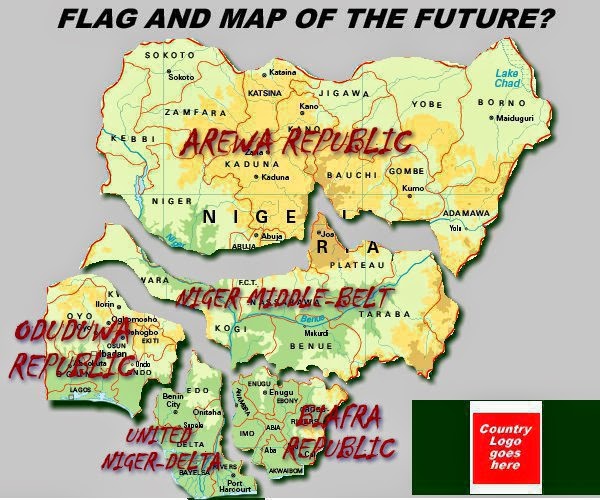
Worst-case scenario?
[You can read more about Boko Haram, Islamic State, and many other separatist and new-nation movements, both famous and obscure, in my new book, a sort of encyclopedic atlas just published by Litwin Books under the title Let’s Split! A Complete Guide to Separatist Movements and Aspirant Nations, from Abkhazia to Zanzibar.  The book, which contains 46 maps and 554 flags (or, more accurately, 554 flag images), is available for order now on Amazon.  Meanwhile, please “like” the book (even if you haven’t read it yet) on Facebook and see this interview for more information on the book.]


Sunday, July 27, 2014

Efik Monarch, Angry over Bakassi Cession, Seeks Independence from Nigeria


The Efik nation, a traditional monarchy in the southeastern corner of Nigeria which dates to pre-colonial times, has said that it intends to secede from Nigeria, mostly because of anger over last year’s cession of the Bakassi Peninsula to neighboring Cameroon, where Efiks also live.


High Chief Eyo Bassey Eyo-Cobham, chairman of the Eburutu Royal Fraternity Forum, made the announcement at a press conference in Calabar, Nigeria, on June 23rd.  He also cited “undue government interference in Efik kingship,” in the words of one press report, and suspicions that the central government in Abuja is planning on handing even more Efik land to Cameroon.  The current obong (prince or traditional ruler, sometimes translated king) of the Efik city-state at Akwa Akpa (“Old Calabar,” in Nigeria) is Basso Ekpo Bassey II (a.k.a. Ekpo Abasi Otu), who took the throne in 2008.  The larger Calabar (a.k.a. Kalabari) Kingdom, which includes Efiks but is dominated by the Ijaw ethnic group, is headed by Theophilus J. T. Princewill, who became King Amachree XI in 2002 (though Amachree’s rule has been in recent years troubled by competing claims).

Basso Ekpo Bassey II’s coronation in 2008
Nigeria’s Cross River State administered the disputed Bakassi Peninsula until the Nigerian and Cameroonian governments agreed in 2002 to abide by an eventual ruling on the overlap by the United Nations’ International Court of Justice (I.C.J.).  The I.C.J. decided in favor of Cameroon, and in 2006 Nigeria formally ceded the area, to the anger of Efiks who proceeded to declare a Democratic Republic of Bakassi.  In this, they had allies in both the Southern Cameroons National Council (SCAPO), a group fighting for the independence of the formerly British-administered parts of Cameroon—plus Bakassi—and an Ogoni autonomist group in Nigeria called the Movement for the Emancipation of the Niger Delta (MEND).  That declaration never got any traction, since the Cameroonian government cracks down much harder on separatist talk than Nigeria’s does.  In 2012, the Bakassi dispute was rekindled as the ten-year deadline for Nigeria to appeal the I.C.J. decision was allowed to lapse, prompting Efik activists to accuse Nigeria of abandoning their kinsmen in Bakassi to the Francophone-dominated Cameroonian regime.  In that same year (as reported at the time in this blog), the Efik obong openly advocated accepting an invitation to join Southern Cameroons separatists to push for an independent Ambazonia straddling the border.

This map shows the Efik ethnolinguistic group (included here with Ibibio)
in relation to the Igbo (here “Ibo”) and Ijaw peoples.
Regarding the Bakassi cession, High Chief Eyo-Cobham told reporters at the recent press conference, “With such developments and other oppressive acts and tendencies of the Nigerian State, we the Efik Eburutu people say, ‘Enough is Enough,’ and have decided to take our destinies in our hands peacefully by pulling out of Nigeria. Our peaceful aims and objectives of self-determination for full autonomy are in tandem with Articles 1, 3-21 of the United Nations Charter of which the Federal Republic of Nigeria is a signatory.”

Amachree XI, king of Calabar: is he as separatist as the Efik obong?
In an official statement, the monarchy said that the Nigeria has, in one way or another, “turned us [the Efik] into punching bags socially, economically, and politically.”


The Bakassi Peninsula, in the words of the statement, “was an integral part of Efik Eburutu Kingdom as shown in all available records” and “was secretly and heartlessly expunged from Nigerian map in October 1960, filed in United Nations and African Union (A.U.) secretariats and ceded in 1975 to Cameroun without the consent and knowledge of its owners—the kings and chiefs of Efiks of Calabar and Bakassi.  This action has demonstrated that our people are not wanted in Nigeria, and as a people, we do not want to belong to Cameroun.  The effect of this ceding has brought untold pain and sufferings to Efik Eburutu people.  With this, the spirit of our ancestors who were, as it were, buried in the now ceded territory are roaming, refusing to be appeased.”

Efik protesters angry about the Bakassi cession
It is not clear if King Amachree XI has taken a position on this latest statement—i.e., whether this latest move is an Efik initiative only or if it has the support of the larger Calabar Kingdom of which, in a sense, it is traditionally a part.  But it comes at a time of increasing fragility for Nigerian unity.  The Igbo-dominated Biafra separatist movement, which includes Cross River State and other traditional Calabar territories in its claim, has remained active in recent years, the Adamawa monarchy in east-central Nigeria—which also straddles today’s border with Cameroon, but farther north—agitated for separatism earlier this year (as reported at the time in this blog), and the radical Islamist terrorist group Boko Haram has been waging a brutal insurgency for years, killing thousands, in Nigeria’s north and has in recent weeks managed to control a large part of Borno State.

A proposed flag for “Bakassi Free State”
[For those who are wondering, yes, this blog is tied in with my forthcoming book, a sort of encyclopedic atlas to be published by Auslander and Fox under the title Let’s Split! A Complete Guide to Separatist Movements, Independence Struggles, Breakaway Republics, Rebel Provinces, Pseudostates, Puppet States, Tribal Fiefdoms, Micronations, and Do-It-Yourself Countries, from Chiapas to Chechnya and Tibet to Texas.  The book, which contains dozens of maps and over 500 flags, is now in the layout phase and should be on shelves, and available on Amazon, by early fall 2014.  I will be keeping readers posted of further publication news.  Meanwhile, please “like” the book (even though you haven’t read it yet) on Facebook.]

Related posts from this blog:

Sunday, March 30, 2014

Nigeria’s Adamawa Kingdom Invokes Sovereignty, Hints at Unification with Kindred in Cameroon


The king of Adamawa, one of the smaller ethnonational groups within Nigeria, added his voice to the strains pulling the country apart this week when he announced at a national conference that he had the right to take his kingdom out of Nigeria if he chose.  Muhammadu Barkindo Aliyu Musdaphar, the Lamido (king; also translated as “emir”) of Adamawa, said, in the midst of a debate over a procedural question, that he and the Adamawa kingdom had sovereignty that overrode Nigerian sovereignty, adding, “My people and the people of Adamawa have got somewhere to go.  I am the Lamido of Adamawa and my kingdom extends to Cameroon.  The larger part of my kingdom is in Cameroon.  Part of that kingdom is today called Adamawa State in Cameroon.  You see, if I run to that place, I will easily assimilate.”

The location of Adamawa state within Nigeria
Nigeria’s Adamawa state and Cameroon’s border one another.  The Adamawa are a mid-sized ethnic group by Nigerian standards, a predominantly-Muslim group in the eastern Middle Belt region who speak a language related to Fulani, one of the dominant languages of the separatist north of Nigeria.

Muhammadu Barkindo Aliyu Musdaphar, king of Adamawa
Condemnation of the king’s words came from many quarters.  Chief Gani Adams, national coordinator of the Oodua People’s Congress (O.P.C.), a Yoruba autonomist movement, said, “I was highly disappointed by his statement; an eminent royal father like the Lamido of Adamawa ought not to make such a statement.  He is one of the most respected emirs we have in Nigeria today.  ...  I seize this opportunity to appeal to the royal fathers, including the emir, to watch their statements.  Nobody should threaten the unity of Nigeria.  ...  We, the Yoruba people, want to remain in Nigeria, but we shouldn’t be threatened.”


But a spokesman for the Northern Elders Forum (N.E.F.) voiced support for the way the king expressed his frustration with the procedures at the annual National Conference.

The flag of the Kingdom of Adamawa.  If they declare independence,
they really might want to think about spicing this up a little bit.
Though Nigeria is riven by Biafran (Igbo), Ogoni, and other autonomy and independence movements, as well as a brutal Islamist insurgency in the north which threatens to divide the country permanently, it is rare for one of the scores of traditional kingdoms in the multiethnic country to claim sovereignty on a monarchical basis.  One exception today is the Calabar Kingdom, farther south along the Nigerian–Cameroonian border, where Efik separatism has been stoked by a border dispute between the two countries over the Bakassi Peninsula and an insurgency by the Ambazonian or Southern Cameroons peoples of the formerly Anglophone portions of Cameroon.

King Barkindo with throne and scepter

[For those who are wondering, yes, this blog is tied in with my forthcoming book, a sort of encyclopedic atlas to be published by Auslander and Fox under the title Let’s Split! A Complete Guide to Separatist Movements, Independence Struggles, Breakaway Republics, Rebel Provinces, Pseudostates, Puppet States, Tribal Fiefdoms, Micronations, and Do-It-Yourself Countries, from Chiapas to Chechnya and Tibet to Texas.  The book, which contains dozens of maps and over 500 flags, is now in the layout phase and should be on shelves, and available on Amazon, by early fall 2014.  I will be keeping readers posted of further publication news.  Meanwhile, please “like” the book (even though you haven’t read it yet) on Facebook.]


Wednesday, February 12, 2014

Biafra Bikers Rejoice: Igbo May Not Have Their Own Nation, but They Have License Plates


The slowly simmering separatist movement in southeastern Nigeria’s region of Biafra does not achieve very much that is concrete nowadays—not after a crushing, near-genocidal defeat of their briefly independent state in 1970 pushed Igbo nationalism underground.  But this week one Biafran pro-independence group scored a symbolic hit.  There is now such thing as a Biafra license plate.


Not for cars, just for motorcycles—oddly enough.   Over the weekend of February 8-9, the largest Biafran separatist group, the Movement for the Actualisation of the Sovereign State of Biafra (MASSOB) unveiled a license-plate for motorbikes, to be used in Nigeria’s Enugu state, in what some claim as Biafran territory.  Chief Larry Odimma, who represents MASSOB in Aba, in nearby Abia state, told the public in Nskukka, in Enugu, “I am here on the mandate of our [that is, MASSOB’s] leader, Chief Ralph Uwazuruike, to launch this plate number, which is aimed at identifying Biafrans and forestalling criminal activities among people who hide under our name to perpetrate evil.”

Chief Ralph Uwazuruike, head of MASSOB

He added, “the national leadership of MASSOB applauds the freedom being enjoyed here in Enugu State unlike what we witness in places like Aba, Ontisha, and Umuahia, where our members are constantly harassed by security agents.”

Igbos can never forget that the Nigerian military
killed hundreds of thousands with a starvation blockade in the late 1960s.
Odimma said the plates would only be issued to citizens with “unquestionable character.”  Perhaps this—and the whole scheme, too—is aimed partly at MASSOB’s newer rival, the Biafra Zionist Movement (B.Z.M.).  MASSOB is more inclusive than the B.Z.M.; the plates say “United States of Biafra,” suggesting a kinder envisioned policy toward minorities within Biafra like Ibibios, Efiks, and Ogonis.  It is also a little more level-headed: the B.Z.M. declared independence for Biafra on November 5, 2012, and seemed to sincerely expect swift diplomatic recognition by the United States and Israel.  The use of the term Zionist echoes an old, discredited theory that Igbos are descended from the Lost Tribes of Israel.  Often, MASSOB and the B.Z.M. seem to spend more time fighting each other, sometimes literally, than working against the Nigerian state.  So perhaps the license plates will announce to sympathetic Enugu constables that these particular motorcyclists are upstanding MASSOB patriots, not B.Z.M. riff-raff.

The Biafra Zionist Movement’s 2012 independence-day parade
Perhaps a bigger concern should be how the use of such license plates will be interpreted if a motorist takes a spin outside the confines of independence-friendly Enugu.  After all, the display of the Biafra flag is still a crime in Nigeria.  This may be as sure a way to invite trouble as to speed through Oklahoma with a Grateful Dead bumper sticker.

Lawbreakers

[For those who are wondering, yes, this blog is tied in with my forthcoming book, a sort of encyclopedic atlas to be published by Auslander and Fox under the title Let’s Split! A Complete Guide to Separatist Movements, Independence Struggles, Breakaway Republics, Rebel Provinces, Pseudostates, Puppet States, Tribal Fiefdoms, Micronations, and Do-It-Yourself Countries, from Chiapas to Chechnya and Tibet to Texas.  The book, which contains dozens of maps and over 500 flags, is now in the layout phase and should be on shelves, and available on Amazon, by early fall 2014.  I will be keeping readers posted of further publication news.  Meanwhile, please “like” the book (even though you haven’t read it yet) on Facebook.]


Friday, August 23, 2013

Cameroon Takes Over Bakassi, Dashing Ambazonian and Efik Nationalist Hopes

Up went the Cameroonian flag over the Bakassi Peninsula on Wednesday, to the dismay of separatists and irredentists.
After decades of controversy and conflict, the Republic of Cameroon on August 21st formally took control of the disputed Bakassi Peninsula on its border with the Federal Republic of Nigeria.  This closes the door on the hopes of Nigerian nationalist irredentists, separatists in the peninsula and in the wider “Southern Cameroons” region, and members of the Efik ethnic group whose communities are riven by the international border.


Nigeria had been administering the peninsula since independence when, in 2002, the United NationsInternational Court of Justice (I.C.J.) ruled that the territory would belong to Cameroon.  Both sides had agreed to abide by the I.C.J. decision, whatever it might be, and in 2006 Nigeria ceded the peninsula, angering nationalists.  The issue lay dormant until last year, when a 10-year period during which Nigeria could contest the decision came was nearing its close (developments which were covered extensively in this blog).  Nationalist critics of Nigeria’s president, Goodluck Jonathan, cried “capitulation,” members of the Efik ethnic group, which straddles the border, demanded that displaced Efiks in Nigeria be allowed to resettle in the peninsula, and Efik nationalists on both sides of the border called for an independent state which would revive the Efiks’ precolonial Calabar Kingdom.

The Calabar Kingdom is still a functioning ceremonial monarchy,
though the Nigerian–Cameroonian border bisects its traditional lands
On the Cameroonian side, this southwestern region of the country had for decades been home to a separatist movement in formerly British-ruled areas.  The original German colony of Kamerun had been divided between the United Kingdom and France after Germany lost the First World War.  At the time of decolonization, the southern part of the British chunk (“Southern Cameroons”) voted to join the newly independent French portion as the Republic of Cameroon, while the predominantly-Muslim chunk of the British sliver voted to join Nigeria.  But Southern Cameroonians, culturally distinct and used to using English rather than French as their lingua franca, chafed under a new 1972 constitution under which the Cameroonian dictatorship erased all regional autonomy.  Separatists declared an independent Republic of Ambazonia in the former Southern Cameroons in 1999 and in 2006 declared a Republic of Ambazania (note slight difference in spelling) which was to include the Bakassi Peninsula as well.  This declaration had the support of displaced Efik and other Bakassians on the Nigerian side, but it had little effect on the ground.  (To complicate matters, the areas on the Nigerian side of the border are part of a possibly future independent state envisioned by Igbo separatists—whose disastrously brief-lived Republic of Biafra in the 1960s included a restive Efik minority.)


But a 2012 declaration of independence by the Republic of Bakassi, though it involved only a radio-station tower on a tiny island off the peninsula’s coast, invited brutal reprisals by the Cameroonian military—not only against the Bakassian separatists but against Ambazonian/Ambazanian separatists more generally.

Separatists in Cameroon wave the flag of Ambazonia
But, declarations of independence aside, this is a time of reckoning for the estimated 90% of the peninsula’s 40,000-some residents who hold only Nigerian passports.  Instead of offering dual citizenship, as Bakassians demand, they are being told they must apply for foreign-resident permits, as though they were immigrants.  This is hardly a sporting attitude on the part of the Cameroonian victors in the dispute, and it is likely to inflame tensions.  While the rest of Nigeria is riven by separatism as well, many fear that the transition to Cameroonian rule might be the beginning, rather than the end, of the dispute over the Bakassi Peninsula.

[You can read more about Bakassi, Ambazonia, and many other separatist and new-nation movements, both famous and obscure, in my new book, a sort of encyclopedic atlas just published by Litwin Books under the title Let’s Split! A Complete Guide to Separatist Movements and Aspirant Nations, from Abkhazia to Zanzibar.  The book, which contains 46 maps and 554 flags (or, more accurately, 554 flag images), is available for order now on Amazon.  Meanwhile, please “like” the book (even if you haven’t read it yet) on Facebook and see this interview for more information on the book.]


Wednesday, August 21, 2013

Nigeria’s Boko Haram Warlord Abubakar Shekau Reported Dead from Gun Battle


The shadowy leader of what is perhaps the world’s busiest and deadliest terrorist army was reported killed this week.  Abubakar Shekau was—or, possibly, still is, since his death is not confirmed—the founder as well as the tactical and spiritual leader of Boko Haram, the Islamist terrorist group which has killed many hundreds of civilians, mostly Christians, in a reign of terror in northern Nigeria over the past few years.

A spokesman for the Nigerian military’s anti-terrorist Joint Task Force (J.T.F.) said August 19th that Shekau—whose full name is Imam Abu Muhammad Ibn Muhammad Abubakar Ash Shekawi—was wounded in a battle with soldiers on June 30th in the Sambisa Forest.  This area is in the Boko Haram stronghold of Nigeria’s arid northeast near where Lake Chad forms the point at which Cameroon, Chad, Nigeria, and Niger border one another.  According to the J.T.F. statement, he was spirited across the border into the Muslim-dominated far north of the otherwise-predominantly-Christian Republic of Cameroon, where he was given medical treatment but died of his wounds probably between July 25th and August 3rd.  None of this could be confirmed.


Boko Haram is a phrase in northern Nigeria’s Hausa language meaning “Western education is sinful”—it could even be translated as “literacy is sinful.”  The name reflects the fervent fundamentalist anti-intellectual Islamism of the group, which not only rejects the doctrine of evolution but also condemns “theories” such as rainfall being the result of clouds formed from evaporating water, since this contradicts wording in the Qur’an.  (This puts Boko Haram on the same level, intellectually, as most Republican lawmakers in the southern United States.)  The group’s full name is Jamā’a Ahl al-Sunnah li-Da’wa wa al-Jihād, which means, in Arabic, “Congregation and People of Tradition for Proselytism and Jihad.”  From their founding in 2001, but mostly over the years since 2009, they are responsible for the deaths of perhaps as many as 10,000 civilians.  Most have been Christians, with methods including truck-bombings of churches and government buildings and organized massacres of schoolchildren.  Recently moderate Muslims have been targeted as well.


Boko Haram’s ostensible aim is the imposition of shari’a (Islamic law) over all of Nigeria.  (It is already in force in Nigeria’s northern states, as the map above shows.)  Since Nigeria’s population is about evenly divided between a Christian south and a Muslim north, this is in terms of practical politics virtually impossible.  Some argue that Boko Haram’s real goal—or at least their most likely effect—is the partition of the country.  Ethnolinguistic and sectarian tensions have plagued Nigeria since its independence from the United Kingdom in 1960.  The departing British placed a northern, Muslim leader in charge of the new nation, which set off a tit-for-tat of coups d’état and counter-coups between Muslims and Christians, setting the stage for the devastating Biafra War of 1967-1970, in which more than a million died.  Southeastern Nigeria’s Igbos, whose nationalist ambitions were the immediate cause of that war, claim today that their people are still bearing the brunt of Muslim pogroms, especially in the religiously mixed “Middle Belt” region which Boko Haram finds so rich in targets.


Little is known about Shekau.  He may be in his thirties or forties.  He may be a native of Niger or of northeastern Nigeria, though he seems to be of the Kanuri ethnic group.  (The Kanuri declared an independent republic of Greater Kanowra on the site of the precolonial Bornu Kingdom in the four-way border region of the Lake Chad basin, but that movement was largely secular in orientation.)  He reportedly had, or has, a photographic memory.


Equally unclear is whether he is still alive.  If he is, then his quasi-supernatural talent for survival will increase his prestige among Boko Haram’s rank and file.  If he is not, then the movement now has a martyr.  There seems to be no good path forward, no best-case scenario.  The future looks bleak for Nigerians, and for Nigeria.

Expect many, many more scenes like this one.
[For those who are wondering, yes, this blog is tied in with my new book, a sort of encyclopedic atlas just published by Litwin Books under the title Let’s Split! A Complete Guide to Separatist Movements and Aspirant Nations, from Abkhazia to Zanzibar.  The book, which contains 46 maps and 554 flags (or, more accurately, 554 flag images), is available for order now on Amazon.  Meanwhile, please “like” the book (even if you haven’t read it yet) on Facebook.]


Subscribe Now: Feed Icon