Showing posts with label flags. Show all posts

Friday, May 30, 2014

Donetsk and Lugansk Republics Merge as “Novorossiya,” Claiming 6 Other Ukrainian Regions (Plus a “Confederate” Flag??)


International media coverage of the ongoing civil war in eastern Ukraine since the Ukrainian national elections on May 25th has been intensive and unrelenting—as it should be, for this important story.  But not every news source seems to have noticed that the self-declared “people’s republics” of Donetsk and Lugansk, in the ethnic-Russian stronghold along the border with Russia, have ratcheted up their claims to stake out a separate territory in Ukraine that is friendly to Moscow, not Kyiv or Brussels or Washington.  I present to you the Federal State of Novorossiya (Федеративное государство Новороссия)—Novorossiya being the Russian for “New Russia,” as the area that is today southern Ukraine was known in Czarist times.

Pavel Gubarev (center), during the first “Donetsk Republic” putsch, in March
Just days after his May 7th release by Ukrainian authorities in a prison exchange, Pavel Gubarev, the Donetsk republic’s “people’s governor,” said, in reference to the May 11th secession referenda in Donetsk and Luhansk oblasts (reported on in this blog at the time), “The referendum is everything for us.  It’s our declaration of independence.  It’s the formation of a new entity—the Donetsk People’s Republic.  However, this new entity is only the first step to our forming a bigger entity, Novorossiya, in all the former southeastern Ukraine.”  The Donetsk republic was declared on April 7th (as reported at the time in this blog) and the Lugansk one shortly afterward.


On May 13th, with the Donetsk People’s Republic (D.P.R.) already regarding itself as independent (though unrecognized, even by Moscow), Gubarev announced, “I, on my behalf, hereby proclaim the creation of a new political party, Novorossiya, whose head office will be in Donetsk.  The new party will be led only by those people who in this difficult time showed themselves as true patriots of their Motherland and proved themselves as true fighters and defenders of their Fatherland.”

Denis Pushilin formally announcing the creation of the Federal State of Novorossiya
Then, in Donetsk, on the eve of Ukrainian national elections, 145 delegates from Donetsk, Luhansk (as the oblast is known in Ukrainian), and six other oblasts voted to enact a “unification referendum” embracing not just Donetsk and Luhansk but also Dnipropetrovsk, Kharkov, Kherson, Nikolaev, Odessa, and Zaporizhiye.  The Republic of Crimea and the city of Sevastopol were not included because the delegates recognize them as now part of the Russian Federation.  Gubarev added that the new entity, Novorossiya, would recognize the new Ukrainian president only if Kyiv in turn recognized the D.P.R.’s independence.  The Lugansk republic has taken a similar position.

Novorossiya delegates voting on May 24th in Donetsk
To be clear: it is only in Luhansk and Donetsk that separatist rebels control territory on the ground—and even there, only in some districts.  Some argue that they really only control the array of government buildings that they have occupied, but in reality the police and other authorities have either refrained from asserting (Ukrainian) control or have switched sides.  The other six oblasts claimed are still fully governed by Kyiv.  An attempt to set up a Kharkov People’s Republic in Kharkiv (Kharkov, in Russian) in early April (reported at the time in this blog) was thwarted by the Ukrainian authorities, and the declaration on April 16th of an Odessa People’s Republic on April 16th (reported on at the time in this blog)—soon after renamed (as also reported here) the Odessa Republic of Novorossiya—has not been accompanied by any actual seizures, symbolic or otherwise, of reins of government (even though Odessa has been the site of some of the most serious street violence outside Donetsk and Luhansk oblasts).

This map (which is open to debate) purports to show areas of total (red)
and partial (pink) separatist control in Donetsk and Luhansk oblasts as of May 24th.
(Nor is it clear what the implications for Novorossiya unity are of the coup staged just within the past 24 hours by the Vostok Batallion, a militia heavily manned by well-trained Russian citizens.  This shadowy group has ejected the current D.P.R. “government” from their Donetsk headquarters.  Will there be a counter-coup? and, if not, is the Vostok faction in favor of unification with Lugansk as well?  At this point, it is unclear.)

The triumphant Vostok Batallion today in the Donetsk Republic headquarters (New York Times photo)
The idea of Novorossiya is not new.  In late 2012, Kremlin policy experts produced a paper (discussed recently in this blog) projecting a changed Europe in the year 2035 in which the Russian Federation has annexed not just Crimea, Belarus, and slices of the Baltic States and Georgia, but also Moldova’s separatist Transnistria region and the “Donbas” and “Novorossiya” territories in the southeast of the Ukrainian mainland.  Their map (see just below) shows Novorossiya’s contours much like the Donetsk and Lugansk rebels are presenting it today.

Russia’s president, Vladimir Putin, has used the imperialist term Novorossiya as well, mentioning in a speech that it was only a quirk of history that made the region, dominated by Russian-speakers, part of an independent Ukraine in the first place.  And as early as January of this year, this blog was reporting on ethnic-Russian nationalists in Crimea—which at that point had not yet seceded from Ukraine—calling for a similar territory to be called Malorossiya, or “Little Russia.”  That Czarist name more properly refers to the borderlands of the Donbass and north, including Kharkiv, rather than the plains just north of Crimea.  But a map circulated at the time showed Malorossiya swallowing up much more than the less-than-half of Ukrainian territory claimed by today’s Novorossiya separatists (see map below).


What is not clear is what form this new entity of Novorossiya will take.  Is it to be a loose federation, along the lines of the “Union State” that today links Russia and Belarus—or something closer to full independence, or closer to Russian Federation membership?  That has not been clarified.  Though perhaps, for a clue, we can look to a scrawled-upon map in the office of the chairman of the D.P.R.’s Supreme Soviet (yes, sadly, it is called that), Denis Pushilin, an image which has been widely circulated on the Internet.  It shows both Crimea and a large chunk of southeastern Ukraine (more like the above Malorossiya map than the current Novorossiya one) labeled simply, “Russia”:


However, Novorossiya does have a flag—or two, or three.  Earlier this year, Gubarev, on his Facebook page, solicited flag proposals from the public, resulting in an informal contest (see the web page http://novorossia.su/flag, which includes, disconcertingly, the almost-defunct “.su” domain suffix for the Soviet Union).  Here were the eleven finalists:


The last, no. 11, has circulated fairly widely on the Internet, including as the masthead image of a pro-Kremlin Facebook account with the risibly definite-article-free title “Truth about Situation in Ukraine”:


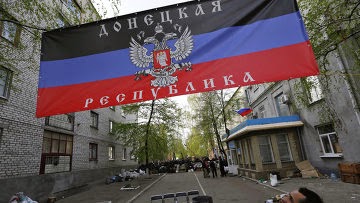
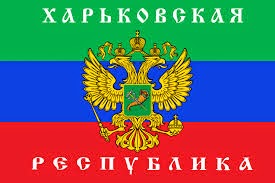
This proposal (above) is simply the Russian tricolor with a cross superimposed on it.  Chillingly, the cross in question is the Ehrenkreuz (“Honor Cross”) used by Nazi Germany.  Other submissions, in particular the tricolors, echo the flags of the already-declared “people’s republics” in the region (from left to right, Donetsk, Lugansk, Kharkov, and Odessa):


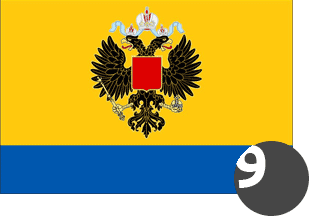
This is especially true of another Novorossiya flag which has been seen around lately, which seems to be a modification of the Russian tricolor with Ukraine’s blue and yellow and, like the “people’s republic” flags, features a double-headed eagle from the Russian Empire’s (and post-Soviet Russia’s) coat-of-arms:


A flag enthusiast and blogger named “Arcktick,” who opposes Ukraine’s disintegration, offers a deconstruction of this submission which is almost dizzyingly talmudic.  It involves taking the average of the most common colors in Ukrainian oblast flags and finding the most felicitous arrangement.  Interestingly, it resembles most closely a former flag of the Kingdom of the Netherlands


—(with orange of course corresponding to Protestantism and the House of Orange), which is ironic given one version of the origin of the Russian tricolor, which is that it modeled itself on the flag of the Netherlands, that being the nationality of an engineer aboard the first Russian naval vessel, in the 17th century.  The modern Dutch national flag is the same as Russia’s current one, with the stripes rearranged:


To no one’s surprise, the winning entry in the contest uses the Russian colors of red, white, and blue, which are also the colors, for example, of the post-Soviet (and also post-annexation) flag of Crimea—


—which merely transposes the top two stripes and expands the now-centered white one.  The first inkling of what this Novorossiya flag would look like was on Gubarev’s Facebook page in December 2013, though without a caption:


A photo of an apparent official unveiling of this flag (with slightly different tints) appeared in the online magazine Ukrainian Policy, though I have not been able to confirm the source of the photo:

The Novorossiya flag (with the Donetsk People’s Militia emblem below it)
However, it is the flag emblazoned, on the masthead and then again in the coat-of-arms, on the front page of the first page of the Novorossiya political party’s newspaper, also called Novorossiya:


As American readers may have noted, this is nearly identical to the frequently seen battle flag of the Confederate States of America from the period of the American Civil War (not the C.S.A.’s national “Stars and Bars” flag, incidentally—which is less commonly seen today—


—but the flag most commonly used today used to invoke Confederate heritage or sympathies—


—which is actually a variation on several C.S.A. member states’ battle flags).  The only difference, other than variations in proportions and shading, is the presence of stars in the Confederate version, which are lacking in the Novorossiya flag.  Could the Ukrainian separatists be invoking the rebelliousness, the David-and-Goliath courage, or the sheer anti–United States sentiment of the original Confederacy?  Indeed, the geographical contours of these two southerly separatist movements are surprisingly similar:


(A further parallel—depending on how far one wants to take this—is that the original Southern U.S. secessionist movement, along with its modern, fringe-politics remnant, emphasizes the supposedly more “English” and “Celtic” nature of Southern white culture, as opposed to the (immigrant-“contaminated”) “Yankee” culture.  The modern, white-supremacist League of the South (L.S.), which uses the Confederate battle flag (above) as its “national” flag, even uses British spellings such as colour and organisation, thus rejecting the American spelling reforms of the Connecticut-born Yankee traitor Noah Webster.  Like the Russian ultranationalists in eastern Ukraine, the L.S. rejects the central government (in Kyiv, rather than Washington) in light of perceived cultural and historical commonalities with the “mother country.”  The fact that the Confederate “Stars and Bars” and battle flags more closely resemble the Union Jack (see below for more discussion of the Union Jack) than they do the U.S. “Stars and Stripes” is a further reflection of this.)

Some Southern nationalists in the U.S. use a black-and-white version of the St. Andrew’s Cross,
(more on that below) with visual resonance of the flags of both Scotland and Alabama.
But back to the Novorossiya flag—despite a resemblance to the Confederate flag, a more immediate and likely origin for the design is that it is based on the Russian naval ensign, in use since 1712:


This uses the St. Andrew’s cross (saltire)—which is also the flag of Scotland—and St. George’s Cross—also the flag of England—which are also ingredients of the United Kingdom’s national flag, the Union Jack:


SS. George and Andrew were both prominent patron saints in the Russian Empire, as they have long been in the British Empire.  In fact, the St. George’s Cross shows up in the flag of the formerly-Soviet Republic of Georgia (the patron saint of Georgia being, naturally, George)—


(incidentally, those are Jerusalem crosses, not Nazi Ehrenkreuzen!)—and the flag of the Black Sea Fleet, which Russia captured, in violation of an earlier treaty, when it annexed Crimea, is merely that of Scotland with the colors reversed (see below, on the right, amid the Russian flags):


(In fact, in the contest entries shown above, St. Andrew’s–type saltires are almost as common as Czarist coats-of-arms.)  And of course the history of naval power in the Czarist empire has been an important historical, geopolitical, and symbolic rallying point in southeastern Ukraine’s pro-Russian rebellion.

The D.P.R. foreign minister, Yekaterina Gubareva, in front of Slovyansk municipal flags,
wears the Soviet-era “St. George’s Ribbon,” which has become a symbol
of pro-Russian separatism in Ukraine.
First we will have to see whether the next weeks and months will spell the demise of the Donetsk and Lugansk republics and their reabsorption into a Ukraine.  If they survive, in whatever form, they may likely do so as a new (and old) entity called Novorossiya.


[You can read more about Novorossiya and many other separatist and new-nation movements, both famous and obscure, in my new book, a sort of encyclopedic atlas just published by Litwin Books under the title Let’s Split! A Complete Guide to Separatist Movements and Aspirant Nations, from Abkhazia to Zanzibar.  The book, which contains 46 maps and 554 flags (or, more accurately, 554 flag images), is available for order now on Amazon.  Meanwhile, please “like” the book (even if you haven’t read it yet) on Facebook and see this interview for more information on the book.]


Thanks are due to Stanislav Zamyatin and Szymon Pawlas, of the Facebook group “Flags of the World,” for alerting me to some of the vexillological information.

Tuesday, May 20, 2014

Dragons, Doubts, and Devils Dog Welsh Identity as Scottish Referendum Looms


Opinion polls predict that the September 18th referendum on Scotland’s secession from the United Kingdom will fail, with polls giving somewhere between 46% and 47% intending to vote for continued union with England (and Wales and Northern Ireland) and only about 35% to 40% intending to opt for independence.  With just about four months to go before polling day, a lot could change.  But if the outcome is not 100% assured, one thing is: the truism that in the event of a “yes” result for Scottish independence, or even, as looks likely, a relatively close (non-landslide) “no,” the other constituent parts of the U.K.—England, Northern Ireland, and Wales are going to experience something of an identity crisis.


Wales, in particular, in the event of a Scottish split, would probably be carried along to independence itself like a rudderless ship in Scotland’s wake—much in the way that in the 1990s Serbia, the Czech Republic, and Belarus became independent states not from any desire to separate themselves but because of the dissolutions of their larger federations driven by centrifugal forces generated elsewhere.  After all, the U.K. is the United Kingdom because of the early-18th-century merger of the kingdoms of England and Scotland; without that constitutional basis, a rethinking of the rest of the union is in order.


Some of this anxiety is expressed as kerfuffles over flags.  Wales, were it to be independent, would suddenly become the European country with the most striking, remarkable, and dramatic national flag, featuring a rampant red dragon on a horizontal white-and-green bicolor (see above).  That prospect has attracted the superstitious nervousness of a fringe group called the Welsh Christian Party.  (Unlike more primitive backwaters like the United States, in Britain fundamentalist Christianity is a phenomenon of the fringes, not the political mainstream.)  As the Rev. George Hargreaves, speaking for the party, put it, “We will not allow this evil symbol of the devil to reign over Wales for another moment.  Wales is the only country in history to have a red dragon on its national flag.  This is the very symbol of the devil described in the Book of Revelation 12:3.  This is nothing less than the sign of Satan, the Devil, Lucifer, that ancient serpent who deceived Adam and Eve in the Garden of Eden” (he explains helpfully in case we haven’t heard of him).  Just for the record, Revelation 12:3 tells us, “And there appeared another wonder in heaven; and behold a great red dragon, having seven heads and ten horns, and seven crowns upon his heads.”  Far be it from me to contradict a man of the cloth, but I’ve been studying that Welsh flag and I’m afraid I see only one head and no crowns at all.

Now that’s the dragon of Revelation.  See?  Lots more heads.
But never mind that.  Hargreaves recommends that the Welsh dragon—which is of murky origins but has been in use on the flag only since 1959—be replaced by a black-and-yellow cruciform design called the Cross of St. David, which is the emblem of the patron saint of Wales (see the flag at right in the photo at the top of this article).  This flag is often flown on March 1st, which is the feast of St. David and the Welsh national holiday.  Adopting this flag would put Wales’s flag on the same footing as those of England, Northern Ireland, Scotland, and Cornwall, which feature the traditional crosses of those countries’ patron saints—St. George (yes, of dragon fame), St. Patrick (patron saint of all Ireland, actually), St. Andrew, and St. Piran, respectively.

This vessel in Queen Elizabeth II’s Diamond Jubilee flotilla in 2012 featured, atop the cabin,
the flags of England, Scotland, London (England’s flag but with sword in upper left), Northern Ireland
(not official, but the St. Patrick’s Cross), Cornwall, and Wales,with flags for the sponsoring Motability, Inc.,
mixed in, plus, aft, the U.K. civilian ensign.
(Hargreaves, given his feelings about the Welsh dragon, will be equally vexed to learn that archaeologists have recently discovered, in the ruins of Leiston Abbey in East Anglia, the remains of a seven-foot-tall canine who some feel might have been the origin of the 16th-century legend of the “Hell Hound of Suffolk.”)


It is not just conservative Christians who are unhappy with Wales’s flag.  The radical, militant Free Wales Army (F.W.A., or Byddin Rhyddid Cymru), uses a vaguely swastika-ish black-and-white emblem as its flag.  The F.W.A. are republicans and presumably would like to eschew anything heraldic as too posh.  Among other parties, the left-wing socialist Cymru Goch (“Red Wales”) independence party, though republican, wants to keep the dragon flag—it’s red, after all!—as does the equally republican Cymru Annibynnol, the Independent Wales Party, along with the former majority party in the Welsh Assembly, Plaid Cymru (“the Party of Wales”), which has republican and pro-Commonwealth (monarchist) tensions within it.  Nor are these minor distinctions: Plaid Cymru came under fire (as reported at the time in this blog) when a party leader appeared alongside F.W.A. radicals and their flags at a rally marking the 729th anniversary of the killing by English soldiers of Llywelyn ap Gruffudd (Llywelyn the Last), the last true Prince of Wales (before it became a title affixing to any English crown prince), thus ending Welsh independence.  By contrast, the Scottish National Party has prevailed over republican Greens and socialists in its coalition and plans on keeping Scotland in the Commonwealth, with Elizabeth II as its head of state.

No one respectable wants to be seen alongside the F.W.A. banner.
(A more benign St. David’s Cross flag is at right.)
The Scottish referendum campaign has raised vexillological vexations in other parts of the kingdom as well.  Northern Ireland’s identity crisis in a post-Scottish dis-United Kingdom would be even more severe than Wales’s, since the Scottish ancestry of the Protestant Scots-Irish majority in the region is the only rationale behind it being part of the U.K., rather than the Republic of Ireland, in the first place.  Northern Ireland currently has no flag, and uses only the Union Jack, but the traditional flag of Ulster is used by the small minority (soon to be taken more seriously, perhaps) who wish Northern Ireland to be independent.  (Ulster, rather awkwardly, includes not just the Northern Ireland counties but the majority-Catholic county of Donegal within the Republic, so there might be some words over that ...)

Unionist rallies in Belfast sometimes feature the “red hand” flag of Ulster.
And what of a rump U.K. minus only Scotland?  The current Union Jack is a blending of the crosses of SS. George, Andrew, and Patrick—


—and without the Scottish St. Andrew’s Cross it would look like this:


Clearly, a lot less colorful.  Thus, some favor incorporating Wales’s green into it somehow ...


... or in some other way taking the opportunity to give Wales a piece of the flag to call its own, if only to persuade them not to secede themselves:


Okay, well, maybe not that prominently.  It isn’t all just about Wales, you know.  Others favor solving the color problem in a more grandiose way:


If Scotland’s secession is followed by those of Wales and Northern Ireland, then England would find itself independent in spite of itself.  Indeed, the St. George’s Cross flag is the one preferred by the pro-independence party English Democrats (as reported on earlier in this blog):


... though some of independence-for-England activists prefer the “three lions” flag which is a modification of the personal royal standard Richard the Lion-Hearted (and which for complicated reasons—1066 and all that—is also a flag used by regional activists in the Normandy region of France):


Presumably, some of these suggestions are ones that the Welsh Christian Party can live with.  And if it’s Satanic symbols they’re worried about, just be glad they don’t have deal with Morocco’s national flag:


Oh, no, wait, sorry, I put it upside-down.  Here, let me fix that ...


Phew!  That was a close one.

Thanks to Jen Mayfield Shafer for alerting me to the report on the Leiston Abbey discovery.

[You can read more about Wales, Scotland, and many other separatist and new-nation movements, both famous and obscure, in my new book, a sort of encyclopedic atlas just published by Litwin Books under the title Let’s Split! A Complete Guide to Separatist Movements and Aspirant Nations, from Abkhazia to Zanzibar.  The book, which contains 46 maps and 554 flags (or, more accurately, 554 flag images), is available for order now on Amazon.  Meanwhile, please “like” the book (even if you haven’t read it yet) on Facebook and see this interview for more information on the book.]


Subscribe Now: Feed Icon