Showing posts with label Luhansk. Show all posts

Monday, November 3, 2014

Strange Bedfellows: “Republic of Venice” Libertarians Side with Putin in Ukraine, as Europe’s Regional Parties Tilt Eastward


Strange things are happening in Europe, as the West’s political landscape shifts in the wake of the war in Ukraine.  In the latest head-scratcher, a prominent academic historian and separatist libertarian activist in northern Italy is praising the Kremlin-backed rebels in eastern Ukraine, saying the “people’s republics” of Donetsk and Luhansk are legitimate states whose election results this week ought to be respected.


Paolo Bernardini, a Genoa-born professor of history at the University of Insubrica in Como, is known in academic circles for prolific work on the history of Jewry in Europe.  In politics, he is better known as co-founder of Veneto Independence (Indipendenza Veneta), a group seeking to separate the autonomous Veneto region—including its capital, Venice—from the Italian Republic and restore the historic Most Serene Republic of Venice, as outlined in Bernardini’s 2011 book Minima Libertaria.  For centuries, the republic was the premier naval power in the Mediterranean.  Many Venetian regionalists assert its absorption into the unified Kingdom of Italy in the mid nineteenth century was illegitimate.


Speaking a few days ago to Russia’s state-controlled news agency R.I.A. Novosti, Bernardini said, “The real and effective independence of the D.P.R. [Donetsk People’s Republic] and the L.P.R. [Luhansk People’s Republic] may create a new balance of power in the former [sic] Ukraine, and peaceful relations among the various parts of the region, including the D.P.R., L.P.R., Crimea, and what will be left of Ukraine.  A number of small states in fiscal competition one with the other would re-launch a region full of economic potential.”  Of course, this view ignores the fact that President Vladimir Putin’s not-very-covert military invasion of Ukraine has destabilized the entire world order and ushered in a new Cold War, with everyone wondering how far he will go in swallowing up his neighbor, which was ruled from Moscow for centuries until it gained independence with the implosion of the Soviet Union in 1991.  The D.P.R. and L.P.R. were declared independent states this spring by shady right-wing paramilitary rebel armies financed, supplied, and even staffed by the Russian military, with the overt desire for eventual annexation to the Russian Federation, along the lines of Crimea, which Russia had brutally invaded and annexed weeks earlier.  Western European countries and the United States have offered only token resistance to Putin’s expansion.  Ukraine is not in the North Atlantic Treaty Organization (NATO), so NATO member states are not obligated to defend it.

This week’s voting in Donetsk.
The peace signs do not seem to be intended ironically.
Another Veneto Independence leader, Alessio Morosin, told R.I.A. Novosti that the European Union (E.U.) “would be foolish to impose new sanctions against Russia for the sole reason that it [Russia] officially recognizes the November 2 elections,” as E.U. leaders have promised.   “There are no precedents in international practice,” Morosin added: “the threat of using sanctions against a state to change its political course, foreign and domestic policy is unacceptable.”  Morosin was silent on the question of  whether Russia is by the same token allowed to use military force to change Ukraine’s political course.  At the time of the Soviet collapse, Ukraine surrendered to Moscow the nuclear arsenal on its territory in exchange for recognition of its borders, including Crimea and the southeast, an agreement Putin now declares invalid because Ukraine’s government is now different—a highly eccentric reading of international law (which, if applied to Russia, would require the return of Sakhalin to Japan and Tuva to China).

Venetist demonstrators fly the Catalan flag as well to show
their—at times far too indiscriminate—support for separatists abroad.
The relationship between northern Italian separatism and Putin’s neo-Soviet imperialism is not new.  A strong theme in the European Parliament elections earlier this year, in which far-right separatist and xenophobic parties in western and central Europe made an unexpectedly strong showing (see recent article from this blog), was some parties’ infatuation with Putin’s style of muscular, aggressive, unapologetic nationalism.  Putin’s annexation of Crimea won praise from groups as disparate as Belgium’s Flemish-nationalist Vlaams Belang party, France’s Nazi-sympathizing National Front (Front nationale), and, yes, Italy’s xenophobic, anti-E.U. Northern League (Lega Nord) (see a recent discussion of them in this blog).  A reporter described a recent Lega Nord rally in Milan (pictured below) as oriented less toward an independent Padania (i.e. northern Italy) and more toward backing Putin, condemning the international sanctions against Russia, and praising Putin’s denigration of “invading” Muslims, a large theme of Lega Nord’s anti-immigrant rhetoric.  This shows what a dim memory the ideological divides of the Cold War have become.  Who would imagine that western Europe’s goose-stepping fascist fringe would be standing up for “people’s republics” in the Ukrainian rust belt?  But in true fascist style, it’s not about political economy: it’s about nationalism and aggression, two things the far right respects no matter what flavor they comes in.

A separatist rally in northern Italy morphs into a saint’s procession for
beloved fellow Muslim-basher Vladimir Putin.
For the most part, non–Lega Nord separatist parties in northern Italy had once occupied another part of the political spectrum (as discussed in an article in this blog; see also this article).  Those movements based in Venice, including the ideologies of “Venetism” and “Serenissimism” (the latter referring to Republic of Venice revanchists), defined themselves in opposition to the Lega Nord founder Umberto Bossi’s intolerance and jingoism, adding their own streak of American (or, in truth, Austrian) style classical-liberal libertarianism.  To make analogies with politics in the U.S., Lega Nord was Pat Buchanan while the Venetists were Ron Paul.  But Venetists are now shifting to the right, despite the fact that Lega Nord is still trying to relegitimize itself in the wake of the Euro crisis, which ejected the party from its role as Silvio Berlusconi’s junior coalition partner and ushered in a corruption scandal, and despite the fact that informal referenda in Veneto earlier this year showed that Venetist separatism could appeal to a majority of Venetians without the appeals to xenophobia and bigotry typical of Lega Nord.

Lega Nord, Republic of Venice, and Russian flags mingle at a League rally in Milan
(along with flags of the former Duchy of Milan, also used by the “eco-nationalist” Insubria movement).
Of course, the Kremlin and its state propaganda organs have been having a field day with the support they are receiving from western European third-, fourth-, and fifth-party politics.  The independence movements in Scotland and Catalonia have been touted by Russia as Exhibit A in its case for the West’s hypocrisy concerning “separatism.”  If Scots should be allowed to choose whether or not to secede, then why not Crimea’s ethnic-Russian majority? (or so the argument goes).  And the far-right xenophobic political party in Hungary, Jobbik, has openly backed the idea that ethnic Hungarians just over the border in Ukraine’s Transcarpathia (Zakarpattia) oblast should be offered “protection” from the “oppression” of the new Ukrainian government, just as the Kremlin is supposedly “protecting” ethnic Russians in the east and Crimea (as discussed in this blog; see also an article here).

Hungary’s Jobbik political party has all the trappings.
Even more bizarrely, in September the separatist parliament of Spain’s autonomous Basque Country region announced that it was recognizing the sovereignty of the Nagorno-Karabakh Republic (N.K.R.), the unrecognized puppet state which newly independent Armenia slashed out of Azerbaijan’s soft western flank when Communism collapsed, after a pitiless campaign of ethnic cleansing of Azeris and Kurds.  Armenia, a close Russian ally, had essentially been doing the same thing for decades in Azerbaijan that Russia started doing this year in Ukraine—and few outside Russia and its puppet states (and, to their shame, many in the U.S. Armenian-American community) backs the N.K.R.  But now the Basques, despite their legacy of leftism and resistance against Francisco Franco’s fascism, are jumping on Putin’s imperialist bandwagon as well.  Strange bedfellows indeed.

The Basque parliament now recognizes the Nagorno-Karabakh Republic.
Why is all this happening now?  Well, it’s easy to blame Putin’s propaganda machine, but some blame must be shared by the western European political establishment.  Though the U.K. showed itself to be an enlightened democratic nation by allowing the people of Scotland to choose independence, it still pushed strenuously—and, in the end, successfully—to convince Scots to stay in the U.K.  Spain, on the other hand, has drawn a line in the sand forbidding Catalonia, the Basques, or any other nation within its kingdom from holding similar referenda.  Nor do Germany, with respect to Bavaria; Belgium, with respect to Flanders; or Italy, with respect to Padania or Veneto, take anything like a British approach to regionalist movements.  In fact, the E.U. and NATO establishments are quite panicked at the idea that regions within European countries might be allowed to—horrors!—choose who governs them.  Well, who does allow such a thing?  In some very blinkered views, Russia does, with its support for eastern and southern regions’ secession from Ukraine.  Never mind that elections in Donetsk, Luhansk, and Crimea are messy and crooked, without international observers; never mind that the movements were spearheaded by provocateurs from Russia and are in fact a mere step on the road to absorption into the heavily centralized Russian Federation, which grants regions far less autonomy than Ukraine does.  And never mind that in Russia even openly voicing support for any kind of autonomy or separatism is illegal, as activists in Siberia and in the Steppes just east of Ukraine have been finding out in the form of prison terms (as discussed recently in this blog).  And never mind the city of Grozny, capital of Russia’s Chechen Republic, which Putin leveled, murdering tens of thousands of civilians, in a war to prevent the Chechen majority’s desire for independence.  Indeed, never mind any of that—and western European far-right separatists are not being reminded of it, either, as they go online and read glowing reports of their own movements in Russia’s slick and deceptive English-language media.

Grozny in 1995.  This is how Putin reacts to separatists when they’re not Russians.
Because western European governments have for the most part turned their backs on the legitimate aspirations of their own ethnic minorities, those groups are now seeking validation and succor, and perhaps even funding, elsewhere—the Kremlin of Vladimir Putin, the most anti-separatist tyrant of all.  For the E.U. and the leaders of Spain, the U.K., and Italy, this should be a wake-up call.  Western European governments who want to show the world that they are more democratic than Putin’s Russia (which they are), it’s time to put your money where your mouth is on the question of ethnic autonomy.  Spain, I’m looking at you.


[You can read more about Venice, Padania, and many other separatist and new-nation movements, both famous and obscure, in my new book, a sort of encyclopedic atlas just published by Litwin Books under the title Let’s Split! A Complete Guide to Separatist Movements and Aspirant Nations, from Abkhazia to Zanzibar.  The book, which contains 46 maps and 554 flags (or, more accurately, 554 flag images), is available for order now on Amazon.  Meanwhile, please “like” the book (even if you haven’t read it yet) on Facebook and see this interview for more information on the book.]


Sunday, October 26, 2014

“Lower Volga People’s Republic”—Internet Prank, or a New Autonomist Headache for the Kremlin?


Kremlin authorities are still baffled by an apparent Internet prank on October 7th which declared Astrakhan Oblast was declaring independence from the Russian Federation as the “Lower Volga People’s Republic.”

Astrakhan is thought of as the southernmost extent of ethnic-Russian settlement
and is in an historically and ethnically volatile neighborhood.
The announcement (pictured at the top of this article) appeared for about two hours on the website of the oblast’s legislature. It read, in part, “The short-sighted and criminal policies of the federal authorities have put the country on the brink of catastrophe.  The authorities have fully discredited themselves, having lost the huge amount of trust given to them.”  The declaration was purported to be co-signed by several oblast officials, including Governor Aleksandr A. Zhilkin, the Duma (parliament) chairman Aleksandr B. Klykanov, the local F.S.B. (state security, erstwhile K.G.B.) head Yuri V. Selyshev, and one Igor Ivanovich Strelkov, identified as “Commander of the People’s Militia.”  (This, coincidentally or not, is the name of a colonel and former F.S.B. agent who earlier this year became a prominent paramilitary leader in the Donetsk People’s Republic rebellion.)


The name of the Lower Volga People’s Republic republic echoes those of the two Kremlin-backed rebel governments which unilaterally seceded from Ukraine earlier this year after the Russian invasion and annexation of Crimea: the Donetsk People’s Republic and Lugansk People’s Republic.  (Three other declared republics, the Kharkov People’s Republic in Ukraine’s northeast and so-called people’s republics in Odessa and Transcarpathia oblasts in western Ukraine, were never backed by any “facts on the ground” in the form of physical secession.)  These “people’s republics” have less to do with actual state socialism or the rights of workers, as their names suggest, and more to do with recalling the symbols of a lost past when Ukraine was ruled from Moscow.  In fact, they are run by undemocratic paramilitary juntas, with strings probably pulled from the Kremlin.

Aleksandr Zhilkin, Astrakhan’s governor, was not amused.
Probably, the Lower Volga declaration evoked the Ukrainian rebel republics as a satirical observation of the fact that President Vladimir Putin advocates federalism and balkanization in Ukraine while tightening central control over regional governments at home in Russia.  But Astrakhan Oblast sits in a region with a separatist past.  Comprising the Volga River delta the oblast’s capital is Astrakhan, sometimes called the southernmost outpost of the Russian world.  To its east is the former Soviet republic of Kazakhstan.  (Kazakhs make up 16% of the oblast population, and Volga Tatars another 7%; nearly all the rest are ethnic Russians.)  To its southwest is the Republic of Kalmykia, a member of the Russian Federation populated by Asiatic people following Tibetan Buddhism who after the collapse of the Soviet Union nearly seceded under the leadership of their charismatic president, Kirsan Ilyumzhinov, a chess grandmaster and self-described U.F.O. contactee who boasted of psychic powers and chummed around with dictators like Moammar al-Qaddafi and Saddam Hussein.  Just past Kalmykia and the Terek steppes is the volatile Caucasus region, where nearly every one of the dozens of separate indigenous ethnic groups has some form of separatist rebellion brewing.  Across the Caspian Sea to the east are the Russian-populated Transcaspia region in Kazakhstan, where Cossacks have occasionally itched to secede from Kazakhstan and join Russia, and just beyond that the separatist Republic of Karakalpakstan within independent Uzbekistan.  Just upriver from Astrakhan is the former territory of the Volga German People’s Republic, which flourished before Soviet feelings toward its ethnic Germans soured with Adolf Hitler’s violation of his non-aggression pact with Josef Stalin.  (Both Leonid Brezhnev and Mikhail Gorbachev proposed restoring the republic until local Germanophobe Russians rose up against the idea.)

Coat-of-arms of the erstwhile Kuban People’s Republic
More to the point, perhaps, just to the southwest of Astrakhan is Krasnodar Krai, a mostly ethnic-Russian and ethnic-Ukrainian republic between Crimea and the Caucasus on the Black Sea, which includes Sochi, site of this year’s Winter Olympics.  It is here that Russian authorities last month jailed a leftist activist named Darya Polyudova for holding a rally asking for more autonomy for Krasnodar Krai.  Though she wasn’t asking for independence, she was arrested under a new law brought into force this year which makes the advocacy of separatism a crime.  This August (as reported on at the time in this blog) the Kremlin also cracked down on autonomy activists in Siberia, who, like Polyudova, were in fact asking for nothing more than the autonomy guaranteed regions in the Russian constitution—rights which Putin has systematically eroded into almost nothing.  Timed to coincide with the Siberian “day of action” that ended with police round-ups were autonomy rallies (reported on at the time in this blog) in Kaliningrad (Russia’s westernmost point, a formerly-German exclave wedged between Poland and Lithuania on the Baltic Sea), Yekaterinburg in Sverdlovsk Oblast (Boris Yeltsin’s home region, which attempted secession too after the Soviet collapse), and Krasnodar.  In Krasnodar, the August rally organizers were calling for the reestablishment of the Kuban Republic, a Menshevik (anti-Bolshevik) “people’s republic” which flourished briefly in the area during the Russian Civil War that followed the 1917 Communist revolution.

The autonomy activist Darya Polyudova is being held by the F.S.B. on separatism charges.
Police arrested Polyudova and other activists on “hooliganism” charges at that August rally, after alleged pro-Kremlin provocateurs incited a brawl.  Her family knew nothing of her whereabouts and waited in vain for her release when her one-month sentence ran out.  Then, the Public Monitoring Commission, a prisoners’ rights group in the area, located Polyudova a few days later in a Federal Security Service (F.S.B.—erstwhile K.G.B.) lock-up where she had been transferred.  Two other activists, Vyacheslav Martynov and Pyotr Lyubchenkov, have sought political asylum in Ukraine.  Polyudov’s group still advocates for “residents of Kuban whose rights are being violated, including the rights of ethnic Ukrainians.”  (Needless to say, this is not a very comfortable point in history to be an ethnic Ukrainian living in Russia proper.)

Some Cossack hosts formed brief-lived republics during the Russian Civil War
(shown here in relation to Astrakhan).
After the Soviet Union’s collapse in 1991, many thought it was ethnic minorities like Chechens and Tatars that might be the undoing of what was left of the Russian empire.  But with those populations mostly beaten down by war and repression, it is ordinary Russians in the provinces who are today challenging Putin to live up to the “Federation” part of “Russian Federation.”

Current flag of Astrakhan Oblast

[For those who are wondering, yes, this blog is tied in with my new book, a sort of encyclopedic atlas just published by Litwin Books under the title Let’s Split! A Complete Guide to Separatist Movements and Aspirant Nations, from Abkhazia to Zanzibar.  (That is shorter than the previous working title.)  The book, which contains 46 maps and 554 flags (or, more accurately, 554 flag images), is available for order now on Amazon.  Meanwhile, please “like” the book (even though you haven’t read it yet) on Facebook and see this special announcement for more information on the book.]


Friday, May 30, 2014

Donetsk and Lugansk Republics Merge as “Novorossiya,” Claiming 6 Other Ukrainian Regions (Plus a “Confederate” Flag??)


International media coverage of the ongoing civil war in eastern Ukraine since the Ukrainian national elections on May 25th has been intensive and unrelenting—as it should be, for this important story.  But not every news source seems to have noticed that the self-declared “people’s republics” of Donetsk and Lugansk, in the ethnic-Russian stronghold along the border with Russia, have ratcheted up their claims to stake out a separate territory in Ukraine that is friendly to Moscow, not Kyiv or Brussels or Washington.  I present to you the Federal State of Novorossiya (Федеративное государство Новороссия)—Novorossiya being the Russian for “New Russia,” as the area that is today southern Ukraine was known in Czarist times.

Pavel Gubarev (center), during the first “Donetsk Republic” putsch, in March
Just days after his May 7th release by Ukrainian authorities in a prison exchange, Pavel Gubarev, the Donetsk republic’s “people’s governor,” said, in reference to the May 11th secession referenda in Donetsk and Luhansk oblasts (reported on in this blog at the time), “The referendum is everything for us.  It’s our declaration of independence.  It’s the formation of a new entity—the Donetsk People’s Republic.  However, this new entity is only the first step to our forming a bigger entity, Novorossiya, in all the former southeastern Ukraine.”  The Donetsk republic was declared on April 7th (as reported at the time in this blog) and the Lugansk one shortly afterward.


On May 13th, with the Donetsk People’s Republic (D.P.R.) already regarding itself as independent (though unrecognized, even by Moscow), Gubarev announced, “I, on my behalf, hereby proclaim the creation of a new political party, Novorossiya, whose head office will be in Donetsk.  The new party will be led only by those people who in this difficult time showed themselves as true patriots of their Motherland and proved themselves as true fighters and defenders of their Fatherland.”

Denis Pushilin formally announcing the creation of the Federal State of Novorossiya
Then, in Donetsk, on the eve of Ukrainian national elections, 145 delegates from Donetsk, Luhansk (as the oblast is known in Ukrainian), and six other oblasts voted to enact a “unification referendum” embracing not just Donetsk and Luhansk but also Dnipropetrovsk, Kharkov, Kherson, Nikolaev, Odessa, and Zaporizhiye.  The Republic of Crimea and the city of Sevastopol were not included because the delegates recognize them as now part of the Russian Federation.  Gubarev added that the new entity, Novorossiya, would recognize the new Ukrainian president only if Kyiv in turn recognized the D.P.R.’s independence.  The Lugansk republic has taken a similar position.

Novorossiya delegates voting on May 24th in Donetsk
To be clear: it is only in Luhansk and Donetsk that separatist rebels control territory on the ground—and even there, only in some districts.  Some argue that they really only control the array of government buildings that they have occupied, but in reality the police and other authorities have either refrained from asserting (Ukrainian) control or have switched sides.  The other six oblasts claimed are still fully governed by Kyiv.  An attempt to set up a Kharkov People’s Republic in Kharkiv (Kharkov, in Russian) in early April (reported at the time in this blog) was thwarted by the Ukrainian authorities, and the declaration on April 16th of an Odessa People’s Republic on April 16th (reported on at the time in this blog)—soon after renamed (as also reported here) the Odessa Republic of Novorossiya—has not been accompanied by any actual seizures, symbolic or otherwise, of reins of government (even though Odessa has been the site of some of the most serious street violence outside Donetsk and Luhansk oblasts).

This map (which is open to debate) purports to show areas of total (red)
and partial (pink) separatist control in Donetsk and Luhansk oblasts as of May 24th.
(Nor is it clear what the implications for Novorossiya unity are of the coup staged just within the past 24 hours by the Vostok Batallion, a militia heavily manned by well-trained Russian citizens.  This shadowy group has ejected the current D.P.R. “government” from their Donetsk headquarters.  Will there be a counter-coup? and, if not, is the Vostok faction in favor of unification with Lugansk as well?  At this point, it is unclear.)

The triumphant Vostok Batallion today in the Donetsk Republic headquarters (New York Times photo)
The idea of Novorossiya is not new.  In late 2012, Kremlin policy experts produced a paper (discussed recently in this blog) projecting a changed Europe in the year 2035 in which the Russian Federation has annexed not just Crimea, Belarus, and slices of the Baltic States and Georgia, but also Moldova’s separatist Transnistria region and the “Donbas” and “Novorossiya” territories in the southeast of the Ukrainian mainland.  Their map (see just below) shows Novorossiya’s contours much like the Donetsk and Lugansk rebels are presenting it today.

Russia’s president, Vladimir Putin, has used the imperialist term Novorossiya as well, mentioning in a speech that it was only a quirk of history that made the region, dominated by Russian-speakers, part of an independent Ukraine in the first place.  And as early as January of this year, this blog was reporting on ethnic-Russian nationalists in Crimea—which at that point had not yet seceded from Ukraine—calling for a similar territory to be called Malorossiya, or “Little Russia.”  That Czarist name more properly refers to the borderlands of the Donbass and north, including Kharkiv, rather than the plains just north of Crimea.  But a map circulated at the time showed Malorossiya swallowing up much more than the less-than-half of Ukrainian territory claimed by today’s Novorossiya separatists (see map below).


What is not clear is what form this new entity of Novorossiya will take.  Is it to be a loose federation, along the lines of the “Union State” that today links Russia and Belarus—or something closer to full independence, or closer to Russian Federation membership?  That has not been clarified.  Though perhaps, for a clue, we can look to a scrawled-upon map in the office of the chairman of the D.P.R.’s Supreme Soviet (yes, sadly, it is called that), Denis Pushilin, an image which has been widely circulated on the Internet.  It shows both Crimea and a large chunk of southeastern Ukraine (more like the above Malorossiya map than the current Novorossiya one) labeled simply, “Russia”:


However, Novorossiya does have a flag—or two, or three.  Earlier this year, Gubarev, on his Facebook page, solicited flag proposals from the public, resulting in an informal contest (see the web page http://novorossia.su/flag, which includes, disconcertingly, the almost-defunct “.su” domain suffix for the Soviet Union).  Here were the eleven finalists:


The last, no. 11, has circulated fairly widely on the Internet, including as the masthead image of a pro-Kremlin Facebook account with the risibly definite-article-free title “Truth about Situation in Ukraine”:


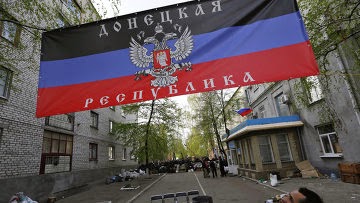
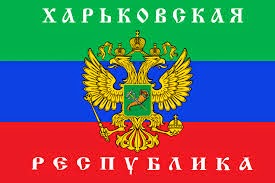
This proposal (above) is simply the Russian tricolor with a cross superimposed on it.  Chillingly, the cross in question is the Ehrenkreuz (“Honor Cross”) used by Nazi Germany.  Other submissions, in particular the tricolors, echo the flags of the already-declared “people’s republics” in the region (from left to right, Donetsk, Lugansk, Kharkov, and Odessa):


This is especially true of another Novorossiya flag which has been seen around lately, which seems to be a modification of the Russian tricolor with Ukraine’s blue and yellow and, like the “people’s republic” flags, features a double-headed eagle from the Russian Empire’s (and post-Soviet Russia’s) coat-of-arms:


A flag enthusiast and blogger named “Arcktick,” who opposes Ukraine’s disintegration, offers a deconstruction of this submission which is almost dizzyingly talmudic.  It involves taking the average of the most common colors in Ukrainian oblast flags and finding the most felicitous arrangement.  Interestingly, it resembles most closely a former flag of the Kingdom of the Netherlands—


—(with orange of course corresponding to Protestantism and the House of Orange), which is ironic given one version of the origin of the Russian tricolor, which is that it modeled itself on the flag of the Netherlands, that being the nationality of an engineer aboard the first Russian naval vessel, in the 17th century.  The modern Dutch national flag is the same as Russia’s current one, with the stripes rearranged:


To no one’s surprise, the winning entry in the contest uses the Russian colors of red, white, and blue, which are also the colors, for example, of the post-Soviet (and also post-annexation) flag of Crimea—


—which merely transposes the top two stripes and expands the now-centered white one.  The first inkling of what this Novorossiya flag would look like was on Gubarev’s Facebook page in December 2013, though without a caption:


A photo of an apparent official unveiling of this flag (with slightly different tints) appeared in the online magazine Ukrainian Policy, though I have not been able to confirm the source of the photo:

The Novorossiya flag (with the Donetsk People’s Militia emblem below it)
However, it is the flag emblazoned, on the masthead and then again in the coat-of-arms, on the front page of the first page of the Novorossiya political party’s newspaper, also called Novorossiya:


As American readers may have noted, this is nearly identical to the frequently seen battle flag of the Confederate States of America from the period of the American Civil War (not the C.S.A.’s national “Stars and Bars” flag, incidentally—which is less commonly seen today—


—but the flag most commonly used today used to invoke Confederate heritage or sympathies—


—which is actually a variation on several C.S.A. member states’ battle flags).  The only difference, other than variations in proportions and shading, is the presence of stars in the Confederate version, which are lacking in the Novorossiya flag.  Could the Ukrainian separatists be invoking the rebelliousness, the David-and-Goliath courage, or the sheer anti–United States sentiment of the original Confederacy?  Indeed, the geographical contours of these two southerly separatist movements are surprisingly similar:


(A further parallel—depending on how far one wants to take this—is that the original Southern U.S. secessionist movement, along with its modern, fringe-politics remnant, emphasizes the supposedly more “English” and “Celtic” nature of Southern white culture, as opposed to the (immigrant-“contaminated”) “Yankee” culture.  The modern, white-supremacist League of the South (L.S.), which uses the Confederate battle flag (above) as its “national” flag, even uses British spellings such as colour and organisation, thus rejecting the American spelling reforms of the Connecticut-born Yankee traitor Noah Webster.  Like the Russian ultranationalists in eastern Ukraine, the L.S. rejects the central government (in Kyiv, rather than Washington) in light of perceived cultural and historical commonalities with the “mother country.”  The fact that the Confederate “Stars and Bars” and battle flags more closely resemble the Union Jack (see below for more discussion of the Union Jack) than they do the U.S. “Stars and Stripes” is a further reflection of this.)

Some Southern nationalists in the U.S. use a black-and-white version of the St. Andrew’s Cross,
(more on that below) with visual resonance of the flags of both Scotland and Alabama.
But back to the Novorossiya flag—despite a resemblance to the Confederate flag, a more immediate and likely origin for the design is that it is based on the Russian naval ensign, in use since 1712:


This uses the St. Andrew’s cross (saltire)—which is also the flag of Scotland—and St. George’s Cross—also the flag of England—which are also ingredients of the United Kingdom’s national flag, the Union Jack:


SS. George and Andrew were both prominent patron saints in the Russian Empire, as they have long been in the British Empire.  In fact, the St. George’s Cross shows up in the flag of the formerly-Soviet Republic of Georgia (the patron saint of Georgia being, naturally, George)—


(incidentally, those are Jerusalem crosses, not Nazi Ehrenkreuzen!)—and the flag of the Black Sea Fleet, which Russia captured, in violation of an earlier treaty, when it annexed Crimea, is merely that of Scotland with the colors reversed (see below, on the right, amid the Russian flags):


(In fact, in the contest entries shown above, St. Andrew’s–type saltires are almost as common as Czarist coats-of-arms.)  And of course the history of naval power in the Czarist empire has been an important historical, geopolitical, and symbolic rallying point in southeastern Ukraine’s pro-Russian rebellion.

The D.P.R. foreign minister, Yekaterina Gubareva, in front of Slovyansk municipal flags,
wears the Soviet-era “St. George’s Ribbon,” which has become a symbol
of pro-Russian separatism in Ukraine.
First we will have to see whether the next weeks and months will spell the demise of the Donetsk and Lugansk republics and their reabsorption into a Ukraine.  If they survive, in whatever form, they may likely do so as a new (and old) entity called Novorossiya.


[You can read more about Novorossiya and many other separatist and new-nation movements, both famous and obscure, in my new book, a sort of encyclopedic atlas just published by Litwin Books under the title Let’s Split! A Complete Guide to Separatist Movements and Aspirant Nations, from Abkhazia to Zanzibar.  The book, which contains 46 maps and 554 flags (or, more accurately, 554 flag images), is available for order now on Amazon.  Meanwhile, please “like” the book (even if you haven’t read it yet) on Facebook and see this interview for more information on the book.]


Thanks are due to Stanislav Zamyatin and Szymon Pawlas, of the Facebook group “Flags of the World,” for alerting me to some of the vexillological information.

Subscribe Now: Feed Icon