Showing posts with label Venice. Show all posts

Monday, November 3, 2014

Strange Bedfellows: “Republic of Venice” Libertarians Side with Putin in Ukraine, as Europe’s Regional Parties Tilt Eastward


Strange things are happening in Europe, as the West’s political landscape shifts in the wake of the war in Ukraine.  In the latest head-scratcher, a prominent academic historian and separatist libertarian activist in northern Italy is praising the Kremlin-backed rebels in eastern Ukraine, saying the “people’s republics” of Donetsk and Luhansk are legitimate states whose election results this week ought to be respected.


Paolo Bernardini, a Genoa-born professor of history at the University of Insubrica in Como, is known in academic circles for prolific work on the history of Jewry in Europe.  In politics, he is better known as co-founder of Veneto Independence (Indipendenza Veneta), a group seeking to separate the autonomous Veneto region—including its capital, Venice—from the Italian Republic and restore the historic Most Serene Republic of Venice, as outlined in Bernardini’s 2011 book Minima Libertaria.  For centuries, the republic was the premier naval power in the Mediterranean.  Many Venetian regionalists assert its absorption into the unified Kingdom of Italy in the mid nineteenth century was illegitimate.


Speaking a few days ago to Russia’s state-controlled news agency R.I.A. Novosti, Bernardini said, “The real and effective independence of the D.P.R. [Donetsk People’s Republic] and the L.P.R. [Luhansk People’s Republic] may create a new balance of power in the former [sic] Ukraine, and peaceful relations among the various parts of the region, including the D.P.R., L.P.R., Crimea, and what will be left of Ukraine.  A number of small states in fiscal competition one with the other would re-launch a region full of economic potential.”  Of course, this view ignores the fact that President Vladimir Putin’s not-very-covert military invasion of Ukraine has destabilized the entire world order and ushered in a new Cold War, with everyone wondering how far he will go in swallowing up his neighbor, which was ruled from Moscow for centuries until it gained independence with the implosion of the Soviet Union in 1991.  The D.P.R. and L.P.R. were declared independent states this spring by shady right-wing paramilitary rebel armies financed, supplied, and even staffed by the Russian military, with the overt desire for eventual annexation to the Russian Federation, along the lines of Crimea, which Russia had brutally invaded and annexed weeks earlier.  Western European countries and the United States have offered only token resistance to Putin’s expansion.  Ukraine is not in the North Atlantic Treaty Organization (NATO), so NATO member states are not obligated to defend it.

This week’s voting in Donetsk.
The peace signs do not seem to be intended ironically.
Another Veneto Independence leader, Alessio Morosin, told R.I.A. Novosti that the European Union (E.U.) “would be foolish to impose new sanctions against Russia for the sole reason that it [Russia] officially recognizes the November 2 elections,” as E.U. leaders have promised.   “There are no precedents in international practice,” Morosin added: “the threat of using sanctions against a state to change its political course, foreign and domestic policy is unacceptable.”  Morosin was silent on the question of  whether Russia is by the same token allowed to use military force to change Ukraine’s political course.  At the time of the Soviet collapse, Ukraine surrendered to Moscow the nuclear arsenal on its territory in exchange for recognition of its borders, including Crimea and the southeast, an agreement Putin now declares invalid because Ukraine’s government is now different—a highly eccentric reading of international law (which, if applied to Russia, would require the return of Sakhalin to Japan and Tuva to China).

Venetist demonstrators fly the Catalan flag as well to show
their—at times far too indiscriminate—support for separatists abroad.
The relationship between northern Italian separatism and Putin’s neo-Soviet imperialism is not new.  A strong theme in the European Parliament elections earlier this year, in which far-right separatist and xenophobic parties in western and central Europe made an unexpectedly strong showing (see recent article from this blog), was some parties’ infatuation with Putin’s style of muscular, aggressive, unapologetic nationalism.  Putin’s annexation of Crimea won praise from groups as disparate as Belgium’s Flemish-nationalist Vlaams Belang party, France’s Nazi-sympathizing National Front (Front nationale), and, yes, Italy’s xenophobic, anti-E.U. Northern League (Lega Nord) (see a recent discussion of them in this blog).  A reporter described a recent Lega Nord rally in Milan (pictured below) as oriented less toward an independent Padania (i.e. northern Italy) and more toward backing Putin, condemning the international sanctions against Russia, and praising Putin’s denigration of “invading” Muslims, a large theme of Lega Nord’s anti-immigrant rhetoric.  This shows what a dim memory the ideological divides of the Cold War have become.  Who would imagine that western Europe’s goose-stepping fascist fringe would be standing up for “people’s republics” in the Ukrainian rust belt?  But in true fascist style, it’s not about political economy: it’s about nationalism and aggression, two things the far right respects no matter what flavor they comes in.

A separatist rally in northern Italy morphs into a saint’s procession for
beloved fellow Muslim-basher Vladimir Putin.
For the most part, non–Lega Nord separatist parties in northern Italy had once occupied another part of the political spectrum (as discussed in an article in this blog; see also this article).  Those movements based in Venice, including the ideologies of “Venetism” and “Serenissimism” (the latter referring to Republic of Venice revanchists), defined themselves in opposition to the Lega Nord founder Umberto Bossi’s intolerance and jingoism, adding their own streak of American (or, in truth, Austrian) style classical-liberal libertarianism.  To make analogies with politics in the U.S., Lega Nord was Pat Buchanan while the Venetists were Ron Paul.  But Venetists are now shifting to the right, despite the fact that Lega Nord is still trying to relegitimize itself in the wake of the Euro crisis, which ejected the party from its role as Silvio Berlusconi’s junior coalition partner and ushered in a corruption scandal, and despite the fact that informal referenda in Veneto earlier this year showed that Venetist separatism could appeal to a majority of Venetians without the appeals to xenophobia and bigotry typical of Lega Nord.

Lega Nord, Republic of Venice, and Russian flags mingle at a League rally in Milan
(along with flags of the former Duchy of Milan, also used by the “eco-nationalist” Insubria movement).
Of course, the Kremlin and its state propaganda organs have been having a field day with the support they are receiving from western European third-, fourth-, and fifth-party politics.  The independence movements in Scotland and Catalonia have been touted by Russia as Exhibit A in its case for the West’s hypocrisy concerning “separatism.”  If Scots should be allowed to choose whether or not to secede, then why not Crimea’s ethnic-Russian majority? (or so the argument goes).  And the far-right xenophobic political party in Hungary, Jobbik, has openly backed the idea that ethnic Hungarians just over the border in Ukraine’s Transcarpathia (Zakarpattia) oblast should be offered “protection” from the “oppression” of the new Ukrainian government, just as the Kremlin is supposedly “protecting” ethnic Russians in the east and Crimea (as discussed in this blog; see also an article here).

Hungary’s Jobbik political party has all the trappings.
Even more bizarrely, in September the separatist parliament of Spain’s autonomous Basque Country region announced that it was recognizing the sovereignty of the Nagorno-Karabakh Republic (N.K.R.), the unrecognized puppet state which newly independent Armenia slashed out of Azerbaijan’s soft western flank when Communism collapsed, after a pitiless campaign of ethnic cleansing of Azeris and Kurds.  Armenia, a close Russian ally, had essentially been doing the same thing for decades in Azerbaijan that Russia started doing this year in Ukraine—and few outside Russia and its puppet states (and, to their shame, many in the U.S. Armenian-American community) backs the N.K.R.  But now the Basques, despite their legacy of leftism and resistance against Francisco Franco’s fascism, are jumping on Putin’s imperialist bandwagon as well.  Strange bedfellows indeed.

The Basque parliament now recognizes the Nagorno-Karabakh Republic.
Why is all this happening now?  Well, it’s easy to blame Putin’s propaganda machine, but some blame must be shared by the western European political establishment.  Though the U.K. showed itself to be an enlightened democratic nation by allowing the people of Scotland to choose independence, it still pushed strenuously—and, in the end, successfully—to convince Scots to stay in the U.K.  Spain, on the other hand, has drawn a line in the sand forbidding Catalonia, the Basques, or any other nation within its kingdom from holding similar referenda.  Nor do Germany, with respect to Bavaria; Belgium, with respect to Flanders; or Italy, with respect to Padania or Veneto, take anything like a British approach to regionalist movements.  In fact, the E.U. and NATO establishments are quite panicked at the idea that regions within European countries might be allowed to—horrors!—choose who governs them.  Well, who does allow such a thing?  In some very blinkered views, Russia does, with its support for eastern and southern regions’ secession from Ukraine.  Never mind that elections in Donetsk, Luhansk, and Crimea are messy and crooked, without international observers; never mind that the movements were spearheaded by provocateurs from Russia and are in fact a mere step on the road to absorption into the heavily centralized Russian Federation, which grants regions far less autonomy than Ukraine does.  And never mind that in Russia even openly voicing support for any kind of autonomy or separatism is illegal, as activists in Siberia and in the Steppes just east of Ukraine have been finding out in the form of prison terms (as discussed recently in this blog).  And never mind the city of Grozny, capital of Russia’s Chechen Republic, which Putin leveled, murdering tens of thousands of civilians, in a war to prevent the Chechen majority’s desire for independence.  Indeed, never mind any of that—and western European far-right separatists are not being reminded of it, either, as they go online and read glowing reports of their own movements in Russia’s slick and deceptive English-language media.

Grozny in 1995.  This is how Putin reacts to separatists when they’re not Russians.
Because western European governments have for the most part turned their backs on the legitimate aspirations of their own ethnic minorities, those groups are now seeking validation and succor, and perhaps even funding, elsewhere—the Kremlin of Vladimir Putin, the most anti-separatist tyrant of all.  For the E.U. and the leaders of Spain, the U.K., and Italy, this should be a wake-up call.  Western European governments who want to show the world that they are more democratic than Putin’s Russia (which they are), it’s time to put your money where your mouth is on the question of ethnic autonomy.  Spain, I’m looking at you.


[You can read more about Venice, Padania, and many other separatist and new-nation movements, both famous and obscure, in my new book, a sort of encyclopedic atlas just published by Litwin Books under the title Let’s Split! A Complete Guide to Separatist Movements and Aspirant Nations, from Abkhazia to Zanzibar.  The book, which contains 46 maps and 554 flags (or, more accurately, 554 flag images), is available for order now on Amazon.  Meanwhile, please “like” the book (even if you haven’t read it yet) on Facebook and see this interview for more information on the book.]


Saturday, April 5, 2014

Venice Cops Nab 24 “Terrorists” with Jerry-Rigged Fiat “Tank” after 89% of Venetians Vote to Secede from Italy

“Fix it again, Tony”
Police in northern Italy on April 2nd arrested 24 separatist activists on “terrorism” charges, including for the construction of what the authorities are calling a home-made tank for use in a planned mock “invasion” of St. Mark’s Plaza in Venice.  This occurred only a little more than a week after an overwhelming majority of residents of Venice and its surrounding administrative region, Veneto, voted in an unofficial online referendum to secede from Italy.  The poll—reported on at the time in this blog—was organized by a group which would like to revive the Most Serene Republic of Venice, which ruled the Mediterranean until it was dismantled by Napoleon and the Hapsburgs in the late 18th century.


Other charges levied included “fabrication of weapons of war” and “subversion of the democratic order”—this last being a rather interesting way of viewing a group that organized a referendum on something that the central government refused to put to a vote.  Those arrested included Franco Rocchetta, a former parliamentary who founded the Veneto League (Ligo Veneta, or L.V.), which in the late 1980s split away from the more geographically broad Northern League (Lega Nord) to launch the movement for a revival of the old republic, a movement called “Serenissimism.”

Franco Rocchetta (right, holding a Venetian flag) was among those arrested.
Closer inspection of the released images, including police surveillance videos, show that the vehicle, though it was nicknamed “il Tanko” and allegedly was mounted with machine-gun turreted and stocked with dynamite, was in fact a rather amateurishly slapped together conglomeration of welded panels atop an ordinary Fiat earthmover (see photo at the top of this article).

Serenissimists are shown here pulling off a similar stunt in St. Mark’s Plaza
in 1997.  There were no injuries or violence.
Police also claim that wiretapped conversations among the plotters included a statement from one that “There’ll be 800 of us.  Well equipped, with gas masks.  Some of us with machine guns and there will be people from abroad too.”  Another allegedly said, “We’re going to install a real climate of fear.  It’s going to be fun.”


After the referendum held last month, organizers announced at a rally in Padua a turnout of 2.36 million voters out of Veneto’s 5 million residents and 73% of all registered voters.  89% of these voters ticked the “yes” box for independence.  Far more concretely, the ballot elected ten “delegates” designated to begin implementing moves toward secession.  In the same ballot, Venetians opted to retain membership in the European Union (E.U.), the Euro Zone, and the North Atlantic Treaty Organization (NATO) with majorities of 55%, 51%, and 65%, respectively.


Gianluca Busato, the referendum’s organizer, was ecstatic, telling reporters, “Rome treats us as the edge of the empire, good only to pay taxes,” and already discussing details for an independent Veneto’s tax system.


Veneto region’s separatist president, Luca Zaia, celebrated the results but said that there was still “some way to go” along the road to an official referendum whose results the Italian government and the international community would accept.


The arrested of the alleged terrorists may dampen enthusiasm for the movement and test its seriousness. On the other hand, it may just make Venetians—many of whom feel that their region pays in too much to prop up the currency-crisis-ravaged Italian state—only angrier.  That seems to be the case for at least one of those arrested, Luigi Faccia, who, in his arraignment in Vicenza on April 4th, would only give his citizenship as Venetian, and told the judge, “As head of the Venetian Liberation, servant of the Most Serene Republic of Venice, I declare myself a prisoner of war.”


[For those who are wondering, yes, this blog is tied in with a forthcoming book, a sort of encyclopedic atlas to be published by Auslander and Fox under the title Let’s Split! A Complete Guide to Separatist Movements, Independence Struggles, Breakaway Republics, Rebel Provinces, Pseudostates, Puppet States, Tribal Fiefdoms, Micronations, and Do-It-Yourself Countries, from Chiapas to Chechnya and Tibet to Texas.  Look for it some time in mid 2014.  I will be keeping readers posted of further publication news.]

Wednesday, March 19, 2014

Venice Votes on Independence from Italy This Week; Separatists Prepare Declaration, Transfer of Authority


It is a year for separatist referenda.  Scotland will hold its vote on separation from the United Kingdom on September 18th.  Catalonia, in Spain, will follow suit on December 18th—allowing the separatist government there a full three months to learn from any Scottish mistakes or successes.  Three days ago, on March 16th, the whole global order was called into question as the newly declared Republic of Crimea voted on cutting its ties to Ukraine and joining Russia.  Not to be outdone, the people of Veneto (in Italian, Veneta), the administrative region of which Venice is the capital, on the same day Crimeans went to the polls, began voting on whether to secede from the Italian Republic.

The seven provinces that form Veneto are in northeastern Italy.
An online referendum is now underway, by which Venetians can log in and answer the question, “Do you want Veneto to ­become an independent and sovereign federal republic?”  The vote is organized by Gianluca Busato, a member of the separatist party Venetian Independence (Indipendenza Veneta, or I.V.).  Busato claims that, even though it will be non-binding, it is supported by many local governments and will be “a call to arms.”  The results are to be announced on March 21st.

Gianluca Busato says, “Vote sì!
Claims of the popularity of independence in Veneto range from 65% to 80%.  Interestingly enough, the phenomenon of Venetian nationalism is distinct from the Northern League (Lega Nord) movement, which for decades has pushed vocally for all of northern Italy, including Venice, to secede as an independent country called Padania (named for the Po River).  The League’s high water mark was its junior membership in Silvio Berlusconi’s ruling coalition until the Euro Zone crisis brought down the Berlusconi and kicked the League out of government too.  In the late 1980s, members of the Veneto League (Ligo Veneta, or L.V.), a branch of Lega Nord, broke away and founded a separate movement to revive the Most Serene Republic of Venice (Serenissima Repubblica di Venezia), which for about a millennium was one of Europe’s most significant economic and naval powers and a major cultural center, until the Hapsburgs and Napoleon Bonaparte dismantled it in the late 18th century.  These L.V. members, in the jargon of Italian separatist politics, are a species of “Venetist” called “Serenissimists,” as distinct from the Northern League’s “Padanists.”  They went so far as to found a provisional Venetian government, calling into question the legality of the 1866 referendum which incorporated Veneto into the new Kingdom of Italy during the Risorgimento.  In a 1997 publicity stunt, a group of Serenissimists “invaded” the iconic St. Mark’s Plaza in Venice with an elaborately and patriotically decorated military tank.

The Northern League’s Umberto Bossi tried but failed
to coax Venetians toward Padanism.
The more serious and mainstream L.V. is much more popular and in fact is Veneto’s ruling party.  Veneto’s president, Luca Zaia, is the L.V. party leader.  Lega Nord, which is far more right-wing and has been buffeted lately by corruption scandals and outcries over racist, anti-immigrant comments by its politicians, has far fewer supporters in this part of the north; they got 10.5% of the vote in the 2013 regional elections, to L.V.’s 35%.  Ironically, it is Venice that Lega Nord envisions as the capital of a future Padania, rather than Turin or Milan, two more natural choices, which are Lega Nord strongholds.  The choice of Venice is probably a vain attempt to shore up support for Padanism in the northeast.

Veneto’s president, Luca Zaia, demonstrating what he’d like to do to Italy
However, the current referendum’s backers, I.V., are a far smaller splinter group which is very libertarian in its orientation.  I.V. got only 1.1% in the 2013 elections.  This despite the fact that they had organized a large independence rally in Venice the previous year (reported at the time in this blog), which culminated in the delivery to the regional government, by gondola, of a declaration of independence.


Fringe I.V. may be, and non-binding the referendum may be, but one I.V. spokesman, Lodovico Pizzati, sounds very serious when he discusses its implications. “If there is a majority yes vote,” he told a reporter, “we have scholars drawing up a declaration of independence and there are businesses in the region who say they will begin paying taxes to local authorities instead of to Rome.”  The new state is to be called the Republic of Veneto (Repubblica Veneta).  Pizzati is a World Bank economist who currently lives in California.  Another I.V. member, Raffaele Serafini, told media, “Venetians not only want out of Italy, but we also want out of the euro, the E.U. and NATO.”  This view is distinct from the pro-Brussels separatist sentiment found in Scotland or Catalonia, but it is not clear if most Venetans share Serafini’s views.  If so, then one of the obstacles to Scottish separatists reaching a majority—fear of ejection from the E.U.—is one which Venetists don’t need to worry about.

Lodovico Pizzati in St. Mark’s Plaza in 2012
Veneto’s nearly 5 million people are about a twelfth of Italy’s population.  Nonetheless, it constitutes about a tenth of Italy’s gross domestic product (G.D.P.), and separatists point out that a Republic of Veneto would be Europe’s seventh-strongest economy.  As in many of Italy’s administrative regions, Veneto’s dialect of Italian is increasingly referred to as a separate language.

Venetian flags mingle with Lombard and Padanian ones at a rally.
As Zaia put it, “The push for independence comes from the people.  It is a democratic request born of Rome’s indifference.  If Barcelona [i.e., Catalonia] gets independence, Veneto could adopt the same method and get it too.  We have knocked politely on the door of federalism, but it did not open.  Now we will break down the door.”


[For those who are wondering, yes, this blog is tied in with a forthcoming book, a sort of encyclopedic atlas to be published by Auslander and Fox under the title Let’s Split! A Complete Guide to Separatist Movements, Independence Struggles, Breakaway Republics, Rebel Provinces, Pseudostates, Puppet States, Tribal Fiefdoms, Micronations, and Do-It-Yourself Countries, from Chiapas to Chechnya and Tibet to Texas.  Look for it some time in mid 2014.  I will be keeping readers posted of further publication news.]


Lega Nord’s vision of the future is different from that of Venetists and Serenissimists.
Related articles from this blog:
“The World’s 21 Sexiest Separatists” (including Lega Nord’s Renzo Bossi) (April 2012)

Saturday, October 6, 2012

Venice Declares Independence—via Gondola; Gibraltar, Kosovo Jostle for Football Independence; Musqueam Win Vancouver Condo Battle; Nuwaubians in Georgia; Mauritius Rallies Africans to Take Chagos Isles Back from U.K.: The Week in Separatist News, 30 September - 6 October 2012


TOP STORY:
VENICE JOINS CATALONIA AND SCOTLAND IN PUSHING SECESSION,
TAKING ADVANTAGE OF LEGA NORD POWER VACUUM;
RALLY WILL DELIVER DECLARATION OF INDEPENDENCE, VIA GONDOLA


Civil engineers may say that Venice is sinking, but politically it seems to be rising.  A newly formed group, Indipendenza Veneta, has organized a rally for October 6th in Venice (just getting underway as this blog entry “goes to press”), with the aim of calling for the city and region to secede from the Italian Republic, including a declaration of independence to be delivered to the regional government offices—via gondola.  Recent polls put the share of Venetians hankering for independence at 70-80%.


The group’s aim is to found a Repubblica Veneta out of the region (i.e. autonomous macro-province) of Veneto and parts of the neighboring regions of LombardyTrentino–Alto Adige/Südtirol, and Friuli–Venezia Giulia.  This approximates the area ruled by the Most Serene Republic of Venice (whose striking embroidered red and gold lion flag is pictured at the top of this page), which was a major cultural, political, and naval power in the Mediterranean for nearly a millennium until it was divvied up between the French and the Hapsburgs in 1797 during France’s First Republic.  The territory was the focus of a Franco-Austrian tug of war until the mid 19th century, and many Venetian nationalists claim that the 1866 referendum which brought Venice and environs into the Kingdom of Italy was fishy.


A declaration of independence puts Venice on a collision course, however, with the Northern League (in Italian, Lega Nord, or Lega Nord per l’Indipendenza della Padania), a major political party which has taken a lot of hits lately (last year’s collapse of Silvio Berlusconi’s coalition government, in which it was junior partner, followed by a party corruption scandal) but which began in Lombardy, still the Padanian separatist heartland, in the 1980s and envisions Venice as the capital of a future Padania that would cover the northern third-or-so of Italy.  (See a separate article on the aims of the Padania movement.)  Venetism, as Venice-based separatism is known, is also anathema to the 35% of Trentino–Alto Adige/Südtirol residents who speak Austrian German and the one-fifth of the formerly independent city of Trieste, on the border with the old Yugoslavia, who speak Slovenian.  Though the movement was founded only a few months ago, in May, Lodovico Pizzati, Indipendenza Veneta’s founder, says, “We have gained a lot of momentum from what is happening in Scotland and Catalonia and things are moving fast.”  Fasten your seatbelts.  Scotland and Catalonia look rather straightforward compared to the can of vermicelli the Venetians are about to open up.

The regions of northern Italy.  In purple and green are the regions that the Lega Nord (Northern League) call Padania.
Some envision Tuscany, Umbria, and Marche in an independent Padania as well.
AFRICA

[For updates on separatism in Nigeria, including Boko Haram, the Middle Belt, Bakassi and Ambazonia, Biafra, and Ogoniland, see a separate update article here.]

U.S. Urges Malian Leaders to Allow Ecowas to Invade Azawad.  The United States assistant secretary for African affairs, Johnnie Carson (no relation), said this week that the Republic of Mali should allow the Economic Community of West African States (Ecowas) to send in the military intervention force it has readied in order to liberate the northern two-thirds, which has been run for much of this year as an Islamist-governed Independent State of Azawad.  Some Malian leaders object to the suggestion of bringing foreign troops in.  “We do not need to see a Mali,” Carson said, “which has a caliphate in the north.”  Meanwhile, the U.S. secretary of state, Hillary Rodham Clinton, blamed last month’s attack on the U.S. consulate in Benghazi, Libya, which killed the American ambassador, on the “powder keg” of terrorist-ruled northern Mali.  An ideologically similar but mostly unrelated group, Ansar al-Sharia, based in Benghazi, is generally considered responsible for the consulate attack.


Azawadi Islamists Demolish Another Sufi Tomb; More Whippings, Executions.  Members of one of the Islamist militias which co-govern the northern two-thirds of the Republic of Mali as the Independent State of Azawad on September 29th demolished another ancient Sufi tomb, according to witnesses.  The destroyed structure, the Tomb of Askia, burial place of the Songhai imperial ruler Almirou Mahamane Assidiki, in the town of Goundam, north of Timbuktu, was built in 1485.  In defiance of alarm bells from the United Nations Educational, Social, and Cultural Organization (UNESCO), the Islamists—Salafists who regard Sufism as heretical and the erection of structures atop burial sites sinful—have taken sledgehammers to numerous ancient structures in Azawad, especially around Timbuktu.  Then, on October 2nd in Timbuktu itself, an Islamist firing squad publicly executed a murder suspect in front of a municipal building and before a crowd of 100.  The suspect was a member of the National Movement for the Liberation of Azawad (M.N.L.A.), the Tuareg separatist army that inaugurated this spring’s secession before Islamists moved in and took over.  The same day, witnesses told media that officers from one of the two Islamist militias, the Movement for Unity and Jihad in West Africa (MUJAO), gave forty lashes to four local men in Douentza, in the partially Azawadi-controlled Mopti province, after they had been rounded up in a raid on a Christian-run underground tavern.


The Tomb of Askia, another cultural treasure fallen to the sledgehammers of religious fundamentalism
Turkish Development Officer Wounded in Shoot-Out at Checkpoint in Puntland.  A visiting official from Turkey was shot and wounded on October 2nd in the self-governing Puntland State of Somalia.  The official, Mustafa Hashimi Pulat, who is in charge of East Africa operations for the Turkish International Cooperation and Development Agency (TIKA), was injured when his security detail and unspecified armed men skirmished at a checkpoint near Galkayo, a town divided between zones controlled by Puntland and by a neighboring de facto independent republic, the Galmudug State.  Pulat was taken to Galkayo for treatment.

Puntland Electoral Commission Greeted with Bullets, Boycotts, Fury in Karkaar.  Ambitions for a tour of the Puntland State of Somalia by the de facto independent state’s electoral commission had to be scaled back this week after the commission’s chairman, Dr. Mohamed Hassan Barre, was met with a hail of gunfire from a local militia upon his delegation’s arrival in Rako in the Karkaar region.  The commission’s security detail returned fire but there were no injuries.  Later, at the Rako police station, the promised delegation of local officials did not show up to meet Barre.  Earlier, in  Bander Bayla, also in Karkaar, a group of elders had dressed Barre down for his government’s plan to unilaterally extend the president’s term of office.  Last week, the electoral commission had met with a full-on riot over the presidential-term issue, while visiting Qardho, the Karkaar capital (as reported last week in this blog).


South African Mercenary Firm Loses Contracts with Puntland Government.  The self-governing Puntland State of Somalia has cancelled its contract with a private “security” firm—i.e. a mercenary militia—based in South Africa called Sterling Corporate Services (S.C.S.) (formerly Saracen International) after international criticism of its human-rights abuses.  The United NationsMonitoring Group on Somalia and Eritrea (S.E.M.G.) had taken Puntland to task in August (as reported on at the time in this blog) for letting S.C.S. to function as the “private army” of President Abdirahman Mohamed Farole and referred to the C.I.A.-linked firm as the “most egregious threat” to peace and stability in the Horn of Africa, with offenses such as torture of recruits and violations of international sanctions.  Officially, S.C.S. had been aiding the Puntland Maritime Police Force in combatting sea piracy.  S.C.S. will be replaced by Bancroft Global Development, which already works with the U.N. in Somalia and which also employs a number of South Africans—a nationality which tends to dominate the mercenary profession.  (See an excellent article in the New York Times this week on mercenaries in Puntland.)

Somaliland Army Repels Militia Attack in Recently Pacified Buhoodle Region.  The military of the de facto independent Republic of Somaliland on September 29th successfully repelled an attack by a local militia during a peace conference in Kalshaale in Somaliland’s disputed Buhoodle region.  The meeting was to bring together different clan leaders and was sponsored by Suleiman Isse Ahmed Kara (nom de guerre: “Hagaltosie”), the former supreme warlord of the now-disbanded Khaatumo State (a.k.a. Sool, Sanaag, and Cayn (S.S.C.) State), which used to control the Buhoodle area, in a region claimed by both Somaliland and the Puntland State of Somalia.  No casualties were reported.  Meanwhile, the lower house of Somaliland’s parliament expelled four members on September 29th for dereliction of duty after they had missed too many sessions.

Ethiopian Police Beat 100 Oromo Celebrants at Cultural Festival; 1 Killed.  Police publicly beat over 100 members of the Oromo ethnic group in Bishoftu, in Ethiopia’s Oromia Region, and arrested hundreds during the annual celebration of the main Oromo annual cultural event, Irreecha, on September 30th, according to a statement released by the Oromo Liberation Front (O.L.F.).  At least 55 of those arrested were taken to a prison notorious for its use of torture, the O.L.F. said, and media reported that one person was killed.


Irreecha celebrants with Oromian flags
Kenyan Police Blame Mombasa Separatists for Machete Attack on Fisheries Minister.  Police in Kenya are blaming the Muslim separatist Mombasa Republican Council (M.R.C.) for an attack on a public meeting on October 4th by “youths brandishing machetes,” who attacked the country’s minister of fisheries, Amason Kingi—he was unharmed—and killed one of his bodyguards.  A crowd then beat three of the youths to death.  An M.R.C. spokesman denies involvement.  Meanwhile, a man arrested October 1st in Likoni is being charged with “incitement to violence” for passing out leaflets bearing the M.R.C.’s banned slogan, “Pwani Si Kenya,” meaning, “Coast Province is Not Kenya.”

Vast Majority of Kenyans Oppose Secession of Coast Province in New Poll.  A poll released September 30th indicates that 83.2% of Kenyans oppose the agenda of the Mombasa Republican Council (M.R.C.), which seeks to hive off Kenya’s Coast Province, and thus nearly all the country’s coast, as a separate, predominantly-Muslim country.  Supporters were 13.6% of the Kenyan population, according to the poll, but 19% of residents of Coast Province.  Only 11.6% of Kenyans support the recent court ruling which lifts the ban on the M.R.C., while 85.6% opposed the lifting of the ban.


Guyana Grants Sahrawi Arab Democratic Republic Diplomatic Recognition.  At the United Nations General Assembly meeting this past week in New York, the Co-operative Republic of Guyana, a Caribbean nation on the north coast of South America, joined 83 other independent states (and one quasi-independent one, the Republic of South Ossetia)—just under half the countries in the world—in extending diplomatic recognition to the Sahrawi Arab Democratic Republic (S.A.D.R.) (a.k.a. Western Sahara), a non-U.N.-member which controls only an eastern sliver of its territory in what is otherwise the former colony of Spanish Sahara, the rest of it illegally occupied by the Kingdom of Morocco.  Guyana also established formal diplomatic relations for the first time with Tuvalu, which is a fully recognized sovereign state.

17 Barotse Go on Trial in Zambia for Tearing Up Constitution Drafts.  In Lusaka, capital of the Republic of Zambia, 17 Barotse (Lozi) agitators for independence for Western Province as the Kingdom of Barotseland went on trial this week for their role in demonstrations last month (reported on at the time in this blog) in which copies of Zambia’s new draft constitution were ceremonially torn up.  They are being charged with threatening the peace and damaging government property.  They have pleaded not guilty.

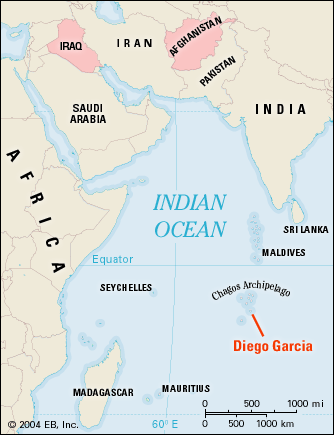
Mauritius Rails at U.N., Urges African Unity over Chagos Islands Sovereignty Issue.  The minister of foreign affairs for the tiny Indian Ocean island nation of the Republic of Mauritius told the United Nations General Assembly on October 1st that the United Kingdom’s squatting on the Chagos Islands, which rightfully belong to Mauritius, are an example of a cause in which small nations must push for the decolonization of the last remaining corners of Africa.  The U.K. unilaterally separated the Chagos Islands off of the colonial Dominion of Mauritius shortly before independence in 1968, but Mauritius still claims it as part of its territory under its understanding of the negotiations for independence.  The U.K. leases out the largest Chagos island, Diego Garcia, to the United States for a military base used heavily in the “War on Terror” (it is conveniently close to the Middle East) and claims it will consider other arrangements when the base is no longer needed militarily.  (That’s reassuring.  Because I’m sure things are going to calm down in the Middle East any day now.)


EUROPE


European Commission’s No. 2 Says Independent Scotland, Catalonia Would Stay in E.U.  The Luxembourger vice-president of the European Commission, Viviane Reding, chimed in this week on what many legal scholars say is the open question of whether regions that secede from European Union (E.U.) member states automatically become member states themselves by saying that there is no legal reason why Catalonia should have to leave the E.U. if it succeeds in seceding from Spain.  This brought an immediate reaction from one Scottish National Party (S.N.P.) parliamentarian, Roderick Campbell, who said, “Scotland is part of the territory of the European Union and the people of Scotland are citizens of the E.U.; there is no procedure for either of these circumstances to change upon independence” from the United Kingdom.  Meanwhile, Alfons López Tena, head of Catalan Solidarity for Independence, told media that he predicted Catalonia would be independent within two years.


Unionist Catalan M.E.P. Says Madrid Should Send in Civil Guard to Prevent Secession.  A Catalan but pro-unionist member of (and vice-president in) the European ParliamentAlejo Vidal-Quadras Roca, raised the stakes in the heated discussions of Catalonia’s promised upcoming referendum on independence from the Kingdom of Spain by saying that if Catalonia persisted in planning a referendum in the face of Madrid’s insistence on its illegality, then the Civil Guard should be sent in.  Vidal-Quadras, who is a member of Spain’s ruling People’s Party (P.P.), told a Spanish television interviewer, “They should be briefing a general of the Civil Guard.  The government should think of intervening in the rebellious region if they persist.”  A fellow M.E.P., Martina Anderson, who represents Londonderry, Northern Ireland, for Sinn Féin, the Irish nationalist party, responded, saying, “The ghost of General [Francisco] Franco haunts the European Parliament in the form of Vice President Alejo Vidal-Quadras.”


Arturo Mas, president of Catalonia
French Mob Drives Gypsies out of Marseilles, Torches Camp.  A mob of vigilantes in Marseille, in southern France, forced 35 Roma (Gypsy) people out of their encampment on September 27th and then burned it down.  The attack was motivated by suspicions of Roma responsibility for a string of burglaries in the area.

Papua New Guinea Becomes 93rd Nation to Recognize Kosovo.  On October 3rd the Independent State of Papua New Guinea became the 93rd nation to extend diplomatic recognition to the Republic of Kosovo.  See this blog’s separate article on this development.


[For the latest news from the North Caucasus (including DagestanChechnya, and Ingushetia), see this week’s Caucasus Update.]

BITS OF ASIA THAT LIKE TO PRETEND THEY’RE PART OF EUROPE


[For the latest news from the South Caucasus (Georgia, Armenia, Azerbaijan), see this week’s Caucasus Update.]

[For the latest news from Turkey and Turkish Kurdistan, see this week’s Kurdistan update.]

ASIA—MIDDLE EAST

[For the latest news from Syria, Iraq, and Kurdistan, see this week’s Kurdistan update.]


Former Yemen Vice-President, Now Separatist Leader, Boycotts Secession Conference.  A conference by Yemen’s secessionist Southern Movement began on September 30th in Aden, the former capital of South Yemen, but without a prominent separatist leader, Ali Salim al-Beidh, who was the first vice-president of the reunified Republic of Yemen in the early 1990s.  Beidh, who lives in Beirut, Lebanon, and plans (as reported recently in this blog) to return from exile, claims the conference was not well prepared.  The conference was hosted by Hassan Baoum, a leader who is less hard-line than Beidh and promotes a nonviolent struggle to secede.  During the conference, independence rallies were held in Aden, at one of which, on October 1st, five people were arrested.  A police station was also attacked with live fire and hand-tossed bombs in a drive-by incident.  At the conclusion of the conference, a joint announcement by the participant groups stated that the Southern Movement refused to take part in a planned summit on the separatist crisis proposed by the central government.

Yemeni President Accuses Iran of Backing Southern Separatists.  The president of the Republic of Yemen, Abd Rabbu Mansur Hadi, told media this week that the Islamic Republic of Iran was backing the Southern Movement, which aims to restore the separate South Yemen that was dissolved at reunification in 1990.  Hadi’s claim is more or less incoherent: although South Yemen, during the late Cold War period, was, like Iran, an enemy of the West, it is northern, not southern Yemen, that is predominantly Shiite, like Iran, and in fact it is the smaller Houthi autonomy movement in the north, with its militias, that has traditionally been backed by Iran.  It is Shiites of the Zaidi sect who broke free from the Ottoman Empire during the First World War’s Arab revolts and established the Mutawakelite Kingdom of Yemen, which became the Arab Republic of Yemen (i.e., North Yemen) in 1962.  Hadi himself is a former South Yemeni, from Abyan province.


2 Dead, 5 Injured in Clashes between Police and Separatists in Southern Yemen.  In Aden, the former capital of the formerly independent South Yemen, police fired tear gas and bullets on a separatist rally on September 28th, injuring at least three people.  Some of the injured were arrested and prevented from getting medical care.  About 300 people participated in the demonstration, which followed Friday prayers.  In 1990, the People’s Democratic Republic of Yemen (South Yemen) was absorbed into the Yemen Arab Republic (North Yemen), forming the Republic of Yemen.  Later in the week, on October 5th, a clash in Aden between police and separatists that attacked a checkpoint left two dead and two others injured, while another group of separatists attacked security officers with homemade bombs the same day, with no reported casualties. 

ASIA—SOUTH ASIA

Balochistan Rebels Take Credit for Assassinations of Politician, Paramilitary Leader.  Rebels fighting for an independent Balochistan in southwest Pakistan took credit for several attacks this week.  First, a district leader from a Pakistani opposition party was killed in a drive-by shooting in Hub, a town in Balochistan.  The victim, Qadir Zehri, belonged to P.M.L.–N, the faction of the Pakistan Muslim League, which forms Pakistan’s main opposition, headed by the former prime minister, Nawaz Sharif.  Two companions were killed in the incident and another was injured.  A spokesman of the Baloch Liberation Army (B.L.A.) accepted responsibility for the killing, citing Zehri’s close association with Shafeeq Mengal, head of the Musallah Deffa Tanzeem (“Armed Defense Organization”), an independent militia which targets Baloch political activists.  But the B.L.A. spokesman denied responsibility for another killing, the previous day, of a journalist in Khuzdar.  Later in the week, the Baloch Liberation Front (B.L.F.) said it was behind the killing of an official from Pakistan’s paramilitary Frontier Corps (F.C.) in Awaran and attacks on trucks carrying precious stones.  Also, the brother of the head of the Baloch Students Association (Pajjar) was gunned down and killed in Chamrok, in Balochistan.


Balochistan makes up 44% of Pakistan’s territory
Separatist Grenade Wounds 4 Indian Federal Police in Kashmir Hotel.  Four troopers from India’s federal Central Reserves Police Force (C.R.P.F.) were injured on October 4th in Sopore, in northern Jammu and Kashmir, when a grenade was thrown into a hotel.  Separatist guerillas are suspected.

President Zardari Invites Kashmiri Moderate Separatist to Visit Pakistan.  The president of Pakistan, Asif Ali Zardari, has invited a separatist leader from India’s main majority-Muslim state, Kashmir, to visit Pakistan.  The invitation was extended to Mirwaiz Umer Farooq, leader of moderates within the Kashmiri separatists’ umbrella group the Hurriyat Conference, while both were attending the United Nations General Assembly on September 28th. A Pakistani government spokesman said that in the brief meeting “Zardari reiterated his call to the international community to focus its attention toward the plight of the Kashmiri people who have been waging a legitimate struggle for their right to self-determination over six decades despite suffering huge losses and massive human-rights violations.”


In India, 2 Assamese Separatists Arrested, 1 Killed; 3 Karbi Rebels Also Nabbed.  In Guwahati, the largest city in India’s far-northeastern strife-torn tribal areas, security forces arrested five rebels on October 3rd, two from the United Liberation Front of Asom (ULFA)—which seeks independence for Assam state, where Guwahati is situated—and three from the Karbi People’s Liberation Tigers (K.P.L.T.).  The Karbi militants—who belong to an ethnic group from the hills of Assam—were intercepted by authorities when they were on their way to collect a ransom as part of an extortion plot.  The following day, security forces killed a member of ULFA’s hardline faction in a shootout in Assam’s Tinsukia district.

Retired Indian General, 78, Fights Off “Pro-Khalistan” Thugs in London Street.  A retired general in India’s military was attacked in the street in London on September 30th by four unknown assailants.  The victim, Lt.-Gen. Kuldeep Singh Brar, who is 78 years old, fought the attackers off but had his throat cut with a knife, requiring hospitalization.  Brar said later that it was an attempt on his life by “pro-Khalistan elements” because of his role in Operation Bluestar, the Indian Army’s brutal attack on the Golden Temple in Amritsar, Punjab, in 1984, as part of a crackdown on Sikh rebels who sought an independent state called Khalistan.  London police have arrested 15 suspects in the case but are unwilling to speculate on a motive.


Gen. K. S. Brar, after his attack
Indian Police Arrest 2 Sikh Terrorists, Including One Thought Killed in 1992.  A Sikh separatist militant in India who was once believed killed by police in 1992, was arrested last week in Rajasthan.  The militant, Sukhwinder Singh, aged 45, came to the notice of Delhi police during a drug-trade investigation.  Meanwhile, in Jalandhar, in Punjab state, the Sikh homeland, police arrested a suspected terrorist, Jaswant Singh Ajad, who has been linked to the Sikh separatist groups Babbar Khalsa International (B.K.I.), the Khalistan Zindabad Force (K.Z.F.), and the Khalistan Tiger Force (K.T.F.).

25 Police Hurt in Clash with Hyderabad Mob of 100,000 Demanding Telangana State.  In Hyderabad, India, police clashed with a mob of nearly 100,000 protesters on October 1st demanding a separate state for the Telugu-speaking Telangana region of Andhra Pradesh.  Demonstrators threw stones at police, and police responded with tear-gas and water-cannons.  At least 25 police were injured, and perhaps many more civilians, but apparently no casualties.  It should be clarified that these demonstrations, organized by the Telangana Joint Action Committee, are not demanding a separate nation but merely a separate state within India.


A proponent of a separate Telangana state in Andhra Pradesh this week
ASIA—EAST ASIA


Fighting Erupts Again between Burmese Troops and Kachin in Shan State.  There were reports on October 3rd of renewed combat between the Kachin Independence Army (K.I.A.) and the Burmese military in northern Burma’s Shan State.  The allied Taaung National Liberation Army also reported fighting in the area on October 1st.  No casualties were reported.

Wave of Muslim Attacks in Southern Thailand Kills 6, Injure 27.  Despite a recent high-profile cease-fire in the southern Thailand insurgency, six  people were killed and 27 injured in a series of attacks by ethnically-Malay Muslim separatists over the September 29-30 weekend.  In Pattani province, the dead included a Muslim police officer, a 74-year-old Buddhist, and a Muslim security volunteer.  A shooting in Yala province killed a Buddhist woman and injured her husband.  Another couple, on their way to a security-volunteer training session, were attacked in Narathiwat province, killing the wife and injuring her husband.  A grenade attack on a public market in Narathiwat injured 23 people.  On the morning of September 31st, a Muslim teenager was shot dead by unknown persons.


Taiwanese Separatist Presidential Aspirant Angers Party Members with Mainland Visit.  A former presidential candidate from the Republic of China (a.k.a. Taiwan), Frank Hsieh, who promotes formal independence from mainland China, arrived in the mainland this week for a five-day trip.  He will be meeting academicians but no government representatives during his trip.  Some Hsieh’s party, the Democratic Progressive Party (D.P.P.), on whose ticket he ran in the 2008 Taiwanese elections, have scorned the trip, which they see as an implicit sell-out to the People’s Republic of China (P.R.C.).  Both Taiwan and the P.R.C. claim the entirety of China.

Tibetan Writer Self-Immolates in Public Market near Lhasa.  Yet another Tibetan activist has died from self-immolation, this time a 43-year-old writer who set himself afire in a public market in Nagchu County, near Lhasa, capital of the People’s Republic of China’s misnamed Tibet Autonomous Region.  The writer, Driru Gudup, called out, as he died, “for the return of His Holiness the Dalai Lama to Tibet and freedom in Tibet and shouted that there was no freedom in Tibet,” according to an exiled Tibetan familiar with the events.  “Chinese authorities have not handed over his dead body to his family members.”


Driru Gudup
Hunger-Striking Tibetan Youth Congress Leader Hospitalized in India.  In Dharamsala, India, the seat of Tibet’s government-in-exile, the vice-president of the Tibetan Youth Congress (T.Y.C.), Dhundup Lhadar, was readmitted to a hospital because of complications from his ongoing hunger strike to protest the People’s Republic of China’s brutal occupation of Tibet.  He and two other activists, who are doing comparatively fine, have been fasting since early September.

OCEANIA

Rights Group Says 7 West Papuans Arrested for Bomb Plot Were Framed.  Police in Indonesia’s rebellious far-eastern province of West Papua arrested seven members of the West Papua National Committee (K.N.P.B.) on September 30th for a supposed bombing plot.  One of the arrested told police that he had been instructed to blow up a police station, a military station, a bridge, and other targets.  But the Institute for Human Rights Study and Advocacy (a.k.a. Elsham), an Indonesian rights-monitoring group, called the evidence and confessions fabricated.


Aboriginal Tent “Embassy” in Queensland Destroyed by Fire.  An Australian Aboriginal “embassy” tent encampment in Brisbane, Queensland, was found partially destroyed by fire on the morning of October 2nd.  Five tents were wiped out in the encampment in Musgrave Park, which has been the focus of lengthy demonstrations and stand-offs with police.  Police are treating the fire as “suspicious.”


Aboriginal Activist Asks U.N. to Bar Australia from Security Council.  An Aboriginal activist in Australia wrote to Ban Ki-Moon, secretary-general of the United Nations, on September 28th, urging him to reject, on human-rights grounds, Australia’s bid for a temporary seat on the U.N. Security Council, citing colonial policies toward the aboriginal population and treatment of refugees.  The gesture, by Michael Anderson, is merely symbolic, since brutal colonialism seems not to be a disqualifier for Security Council membership but seems at times even to be a prerequisite.  Permanent members of the council are the United States, the United Kingdom, the French Republic, the Russian Federation, and the People’s Republic of China.


NORTH AMERICA


Musqueam Hail Court Kibosh of Vancouver Condo Project on Burial Ground.  Members of the Musqueam First Nation in southwestern British Columbia, Canada, claimed victory this week after a court handed down two rulings on the Marpole Midden, a Musqueam burial site which was slated to be destroyed to make way for condominiums in the middle of downtown Vancouver—a cause which has been the focus of months of sit-ins, demonstrations, marches, and legal battles.  One of the new rulings finds that no further alterations to the site can occur; regarding another permit, more time is allowed to reinter remains that were recovered from the site during excavation.  The province has sided with the Musqueam in the case.  With a jaw-dropping lack of a sense of irony or history, a spokesman for the Century Group, the condominium developer involved, brayed that in effect the B.C. government “have expropriated the property without compensation and basically said you can’t do anything with that property and we are not doing anything to compensate you for that.”  Expropriation without compensation?!  I refuse to believe it!!  Who ever heard of stuff like that happening in North America?


Flag of the Musqueam nation
U.S. Judge Tosses Out Oglala Sioux Lawsuit against Liquor Stores.  A United States federal judge in Lincoln, Nebraska, threw out on October 1st a class-action lawsuit by the Oglala Sioux Tribe against four massive beer retail outlets in Whiteclay, Nebraska, on the edge of the Pine Ridge Indian Reservation, blaming them for alcoholism-related poverty and social problems on one of the poorest and most socially dysfunctional communities in North America.  The judge wrote, “There is, in fact, little question that alcohol sold in Whiteclay contributes significantly to tragic conditions on the reservations.  And it may well be that the defendants could, or should, do more to try to improve those conditions for members of the tribe.  But that is not the same as saying that a federal court has jurisdiction to order them to do so.”  But he dismissed the case without prejudice, rejecting its suitability for his court, not for its own merits, so the way is clear for further suits in different jurisdictions.


Sobering graffiti on the Pine Ridge reservation
“Nuwaupian Embassy” Spams Georgia Officials with Legal Notices.  County law-enforcers, court officers, and other public officials throughout central Georgia, in the United States, received more than two dozen certified letters October 1st from the so-called embassy of the “United Nuwaupian Nation,” but their full contents have not been disclosed.  All of the recipients were involved one way or another in the legal actions in the 2000s against the Nuwaubian (sic; the spelling with a p is new) Nation of Moors, a self-proclaimed African-American monarchy set up on a 500-acre compound called Tama Re in Putnam County, Georgia, in the 1990s.  Eventually, their leader, Dwight Malachi York (a.k.a. Dr. Malachi Z. York, a.k.a. Amar Utu, a.k.a. Rabboni Y’shua Bar El Haady, a.k.a. Bawaba Bassa Afriqa, a.k.a. Melki Sedec, a.k.a. Issa al-Haadi al-Mahdi, a.k.a. the Angel Michael, a.k.a. Paa Munzul Nazdur Amun Nub Reakh Ptah Shil Paa Hanutu (personally, I think he should have stuck with the last one—much more pithy)), was convicted, in 2004, to a 135-year sentence for child molestation and racketeering and in 2005 Tama Re was demolished.  One recipient, Georgia Smith, who had been a vocal opponent of the Nuwaubians during their struggle with authorities over land-use rules and other issues, said that the letters were titled “Citizen’s Notice of Violation of the Law and Intent to Act,” on Nuwaupian letterhead, and in content are, according to Putnam County’s sheriff, Howard Sills, “nonsensical.”  The Nation—classified as a racist hate-group by the Southern Poverty Law Center (S.P.L.C.)—has shifted its identity over time, at various times resembling a Black Muslim movement, once calling itself the Yamassee Native American Moors of the Creek Nation, and also espousing beliefs in extraterrestrials.  We will be keeping you posted of further developments and are happy to see the Nuwaubians back in the news.


The Nuwaubian (now, apparently Nuwaupian) Nation’s Dwight Malachi York
“President” of Parallel U.S. Appears in Alabama Court for Detention Hearing. The man who calls himself the “president” of the “Republic for the united States of America” (R.u.S.A.) (sic, including the lower-case u), James Timothy “Tim” Turner, appeared in a United States federal court in Montgomery, Alabama, October 1st for a detention hearing as part of multiple indictments against him for tax fraud (as reported earlier in this blog).  Turner, who was arrested September 18th, is the 56-year-old self-styled leader of the R.u.S.A., a “sovereign citizens” movement (see an earlier article from this blog on events in Iowa connected to the group) which borrows ideas from the pro-slavery, anti-women’s-suffrage “organic Constitutionalist” school of thought and is on the Southern Poverty Law Center’s hate-groups watch list.  The R.u.S.A. released a statement about the case, stating, “The unchartered Municipal Corporation (UNITED STATES) has taken a desperate action through their corporate policies which are clearly outside constitutional governance.  This dishonorable act will reveal to Americans that the United States must return to the Constitution and the rule of law.”


Aryan Nations Returns to Idaho with Recruitment Drive, Plans for Headquarters.  The white-supremacist group Aryan Nations has returned to Idaho, the heartland of militant white-supremacism in the United States, with plans to establish a world headquarters.  Aryan Nations and other racist hate groups declined in popularity, becoming mostly a prison-gang phenomenon, after a federal crackdown in the 1980s but have had a boom in recruitment, as they point out, after the election of Barack Obama to the presidency in 2008.  The new effort is headed by Jerald O’Brien, who has a swastika tattooed on his forehead and calls Obama “the greatest recruiting tool ever.”  The group started by distributing fliers to residents in Coeur d’Alene, ground zero of Idahoan white-supremacism, showing a girl asking her father, “Why did those dark men take mommy away?”

SPORT

Spain Fumes, Kosovo Bitter as Gibraltar Clears Hurdle for Entry to Football League.  The Union of European Football Associations (UEFA), in a meeting in St. Petersburg, Russia, on October 1st, has referred the Gibraltar Football Association’s application for the inhabited peninsular rock to become the football (soccer) governing body’s 54th competing member state to a final committee decision in London in May.  Reactions to the decision were varied and widespread, given the obscurity and minusculity of the territory.  (If admitted, Gibraltar, an overseas territory of the United Kingdom, will be the smallest UEFA member-state, overtaking the current smallest, the Most Serene Republic of San Marino.)  The Kingdom of Spain, which still occasionally presses spurious territorial claims on Gibraltar, told the media that it would fight Gibraltar’s admission to UEFA “with all legal means possible.”  The Bailiwick of Jersey, on the other hand, in the English Channel, was the site of raised hopes.  Jersey’s football association has been angling for full UEFA membership for years, and Gibraltar’s accession would make it harder to keep out.  Jersey, a Crown dependency of the U.K. rather than an overseas territory like Gibraltar, is in many ways more independent: for example, unlike Gibraltar, Jersey (along with Guernsey and the Isle of Man) is not in the European Union (E.U.).  The Faroe Islands, a self-governing overseas territory of the Kingdom of Denmark, is also a full UEFA member; Gibraltar’s success this week merely augments the precedent.  The head of the Football Federation of Kosovo (F.F.K.), however, said that, since it still awaited a promised decision on Kosovo’s eligibility, the UEFA is exhibiting a double standard, pointing out that Gibraltar doesn’t even pretend to be independent and that its football tradition is “embryonic.”  Later, the F.F.K. head, Fadil Vokrri, retracted some of his comments, clarifying, “UEFA has not broken its statutes to make Gibraltar a provisional member.  When this state made the request to join UEFA, its statues were different.  The statutes to not admit countries that are not members of the United Nations did not apply at that time.”


Gibraltar
[You can read more about Venice, Kosovo, and many other separatist and new-nation movements, both famous and obscure, in my new book, a sort of encyclopedic atlas just published by Litwin Books under the title Let’s Split! A Complete Guide to Separatist Movements and Aspirant Nations, from Abkhazia to Zanzibar.  The book, which contains 46 maps and 554 flags (or, more accurately, 554 flag images), is available for order now on Amazon.  Meanwhile, please “like” the book (even if you haven’t read it yet) on Facebook and see this interview for more information on the book.]


Subscribe Now: Feed Icon