Showing posts with label Barotseland. Show all posts

Tuesday, August 13, 2013

“Caprivi Strip” No More—but Does the De-Germanization of Namibia’s Map Have an Intertribal Agenda?


The international press is unanimous this week that the Republic of Namibia’s decision to rename the Caprivi Strip “the Zambezi Region” is a triumph of indigenous culture over colonialism.  A European name is erased from the map and replaced with the quintessentially African name Zambezi, for the noted river.  But the political subtext here is more complex, and it involves interethnic troubles in the strife-torn Caprivi region and in Namibia at large.

First, some history.

Count Leo von Caprivi
Though it sounds Italian, the name Caprivi is a legacy of colonialism by Germany, which ran Namibia (then known as South-West Africa) from 1890 until it lost it to the British as war booty after losing the First World War.  The Strip was named for Georg Leo Graf von Caprivi de Caprera de Montecuccoli, a Prussian count who succeeded Otto von Bismarck as German chancellor and whose curiously Italianate name derives from his father’s landed titles reaching back to the Italian-Slovenian borderlands on the Adriatic Sea.


When the Kaiser lost the Great War, he lost Namibia too.
The shard of land named for Count Caprivi is Namibia’s “panhandle,” as it would be called if it were an American state: jutting eastward from Namibia’s northeastern corner between Zambia, Angola, and Botswana.  It was originally part of the United Kingdom’s Bechuanaland Protectorate (i.e., Botswana).  However, in 1890, the year Caprivi succeeded Bismarck, the Crown traded it, along with the North Sea island of Heligoland, to the German Empire in exchange for Zanzibar.  The Germans wanted the strip to fill in a supply route between South-West Africa and German East Africa—i.e., Tanganyika, the mainland that later joined with Zanzibar to form today’s Tanzania.  This treaty was known as the Heligoland Treaty, indicating that its European border swaps were what were considered important about it in Berlin and London.  Later, it became notorious in the annals of the scramble for Africa because it also squiggled a small dogleg into the Kenya–Tanganyika border in order to put Mt. Kilamanjaro in German hands.   You see, Queen Victoria’s grandson Wilhelm II had been pouting because he didn’t own as many African mountains as his English cousins.


In any case, after the defeated empires of the Central Powers were hacked back by the League of Nations at the close of the First World War, the emasculated German Reich was stripped of its overseas colonies.  The newly independent Union of South Africa, then still a dominion of the British Crown, was put in charge of South-West Africa, including Caprivi.  By the 1970s, South Africa, still stewing under apartheid after nearly the whole rest of the continent had been liberated, was again using the Caprivi Strip as a supply route—this time to run guns to white Rhodesian militants in what is now Zimbabwe.  Some Caprivi natives also helped UNITA, the Angolan army backed by South Africa.  (The underground African National Congress also smuggled arms to leftist militias backed by Cuba in Angola’s civil war during the same period.)

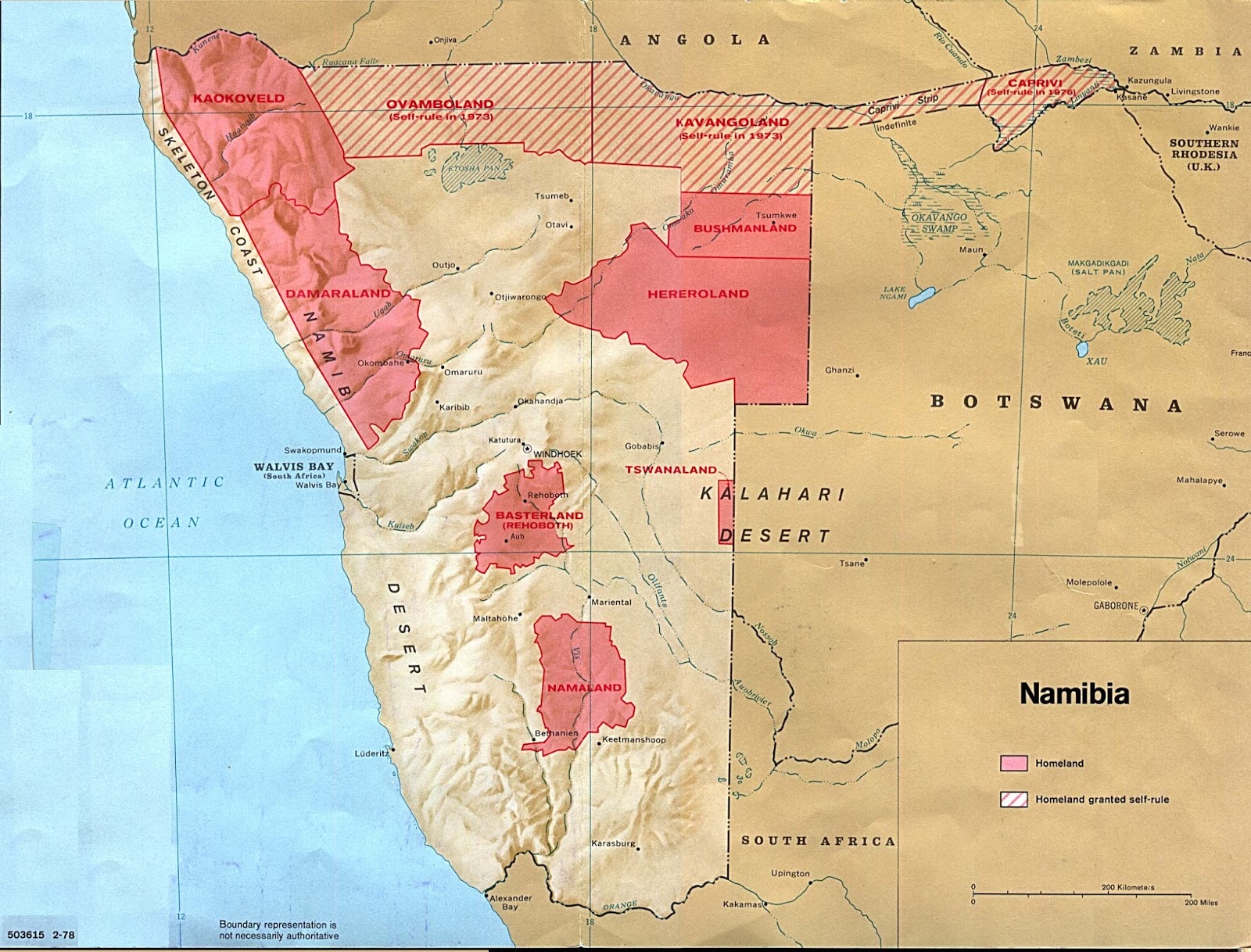
Namibia’s homelands during the apartheid era
By the time those conflicts had settled down, in the 1980s, Caprivi had become something else again: a “homeland.”  These glorified reservations, also called “Bantustans,” which the South African government tried to sell to the world as generous experiments in indigenous sovereignty, were scattered throughout South Africa and South-West Africa.  Bophuthatswana, in northern South Africa, site of the famous Sun City entertainment resort, was the most famous.  Most were barren patches of land onto which apartheid’s architects tried to expel Africans, hoping they would take the demographic and political “problems” they represented out of the South African body politic.  In South-West Africa, there was even a homeland called Rehoboth or Basterland, for the Baster people, a mix of Dutch and native Khoisian (“Bushman”) ancestry—the name baster being the Afrikaans equivalent of the English word bastard.  In some ways, these homelands had genuine autonomy, and the Lozi people of the Caprivi Strip were given their small degree of self-rule largely, many felt, as the apartheid regime’s reward for facilitating the white-supremacist gun-running during the Rhodesian business.  Whether that is a fair characterization or not, when South-West Africa finally did become independent, as the Republic of Namibia, in 1990, the homelands were abolished, and Caprivi Lozis found themselves feeling in some ways less autonomous than they did under apartheid.

The most excellent flag of the Caprivi separatists
In 1994, Lozis formed the Caprivi Liberation Army (C.L.A.), aiming to make the Strip a sovereign nation.  In 1999, a series of attacks on police stations and other targets prompted a government crackdown.  C.L.A. leaders were sent into exile, mostly to Denmark but also to Botswana, which was in the midst of a territorial dispute with Namibia.  In 2002, the C.L.A. unilaterally declared the independence of the Free State of Caprivi Strip/Itenge, but no state recognized it.

Zimbabwe’s Victoria Falls, just east of Caprivi
Today, the Strip is mostly calm, and it has natural wonders that Namibia would like tourists to flock to, being just upriver from the Zambezi River’s spectacular Victoria Falls, in Zimbabwe.  So the new name Zambezi Region is partly a rebranding, ditching a name that is mostly associated with civil war.  But why not rename the region Okavango, which some people have called it at times, after the river that runs through the western part of the Strip? or Itenge, a name preferred by Caprivian separatists? or Lozi, which was its name in the late pre-independence period?  After all, the Lozi are the people that live here.

Some nationalists’ vision of a “Greater Barotseland.”
No wonder Namibia is nervous.
Ah, but that is the rub.  The Lozi, also known as Barotse (it is the same name; ba- is a prefix in Bantu ethnonyms, and r and l are sometimes interchangeable), live not only in Caprivi but in a large area to the north called Barotseland, where a quiet revolt has been roiling for several years over the Barotse kingdom’s involuntary absorption into the Republic of Zambia at independence in 1964—a story this blog has been covering for quite a while.  (For example, I listed Barotseland as one of “10 Separatist Movements to Watch in 2013.”)   The last thing the Namibian government—run by the largest ethnic group, the Ovambo—wants is for a Barotse civil war to spill over into their territory.  So far, there has never been much coordination between Barotse/Lozi activists in Zambia and those in Namibia; Zambian Barotse are more focused on shoring up their constitutional monarchy and on challenging the legal basis of the Zambian state.  But that could change once the Barotse monarchy and its army begin to make strides and foment true unrest, as may happen any week now.  And the conservative monarchists on the Zambian side of the border are in no way natural allies of Namibia’s ruling party, the Southwest African People’s Organisation (SWAPO), a former leftist rebel army much in the A.N.C. mold.

The flag of the Barotse monarchy in Zambia
The town of Schuckmannsburg in the Caprivi Strip is also being renamed.  It is now Lohonono.  And Lüderitz, a harbor town at the other end of Namibia, in the southwest, has become !Nami=Nüs.  (Those punctuation marks represent clicks and other sounds unique to the Khoisian languages of the Kalahari Desert, which are perhaps the oldest languages in the world.)  But the renaming of the Caprivi Strip is not really about the European colonialism.  Germans have already been scrubbed from the Namibian political landscape—a neutered and cowed minority.  And the German government in 2004 made a formal apology to Namibia for massacres and concentration camps by which German soldiers killed tens of thousands of Hereros and other indigenous people in the colonial period.  If anything, the residual German-speaking population and their settlements are a tourist draw; one example is scenic Swapokmund, which played the part of the mysterious Brigadoon-like “Village” in the 2009 remake of the television series The Prisoner.  (Fun fact: Swapokmund is a linguistic blend of a name, which literally means Asshole-Mouth.  Mund is German for mouth, and the town is at the mouth of the Swapok River, derived from the indigenous Nama word tsoakhaub, which means anus—a reference to the large volumes of carcasses and reeking waste that wash out through the estuary during flood season.  You’d think that if the Namibian tourist board wanted to do some name changes to give tourism a bump, Asshole-Mouth should be top of the list.)

The Namibian flag flies over Swapokmund,
the colonial-German resort town where the remake of The Prisoner was filmed.
Rather, this rewriting of the map—which in itself is something very right and proper which nearly every formerly colonial state has undertaken—is designed to downplay the interethnic tensions within Namibia.  The Ovambo, whose territory in the north (a former homeland as well, Ovamboland) is only 6% of the country, are nearly half the population and by far the dominant group.  Many minority groups claim that Ovambos are forcing themselves on the rest of the population as the élite and are settling in areas formerly dominated by smaller groups, especially the hunter–gatherer tribes.  So the ruling Ovambos do not want names like Lozi showing up too prominently on maps.  They are trying to forestall the day when their hegemony is seriously challenged—which, to judge from events in Zambia, may happen first in the Caprivi Strip.


[You can read more about Caprivi/Itenge, Barotseland, and many other separatist and new-nation movements, both famous and obscure, in my new book, a sort of encyclopedic atlas just published by Litwin Books under the title Let’s Split! A Complete Guide to Separatist Movements and Aspirant Nations, from Abkhazia to Zanzibar.  The book, which contains 46 maps and 554 flags (or, more accurately, 554 flag images), is available for order now on Amazon.  Meanwhile, please “like” the book (even if you haven’t read it yet) on Facebook and see this interview for more information on the book.]

Thursday, December 20, 2012

10 Separatist Movements to Watch in 2013

Last year around this time, I wrote an article here titled “Ten Separatist Movements to Watch in 2012.” As is always the case with such things, there were some successes and failures in my predictions.

The ominous black flag of Ansar al-Dine flew over a captured city in northern Mali in spring of 2012.
The push to partition Belgium into Flanders and Wallonia (no. 10 on last year’s list) did indeed surge to the forefront as a movement, thanks to the election of a member of the Flemish nationalist party to the mayoralty of Antwerp in October (as reported at the time in this blog), partly riding on the wave of separatism initiated by Scotland and Catalonia.  Kawthoolei (no. 6), as an independent homeland for the Karen people of southeastern Burma (a.k.a. Myanmar) is to be called, is perhaps a bit closer to reality: the military junta that rules the country began liberalizing at breakneck speed earlier this year, and peace accords with ethnic minorities are among the showpieces of Burma’s détente with the West.  Burma’s war against the Kachin minority has, if anything, intensified, and Buddhist pogroms against Muslim minorities in western Burma are putting the country and its reputation at risk, but the Karen, who have a strong lobby in the West, may just emerge from all of this unscathed; in fact, the junta may cut them loose if only to show that they’re not complete fuckers (though it is quite possible that they are, in fact, deep down, complete fuckers after all; we’ll see).  Northern Nigeria (no. 5), where the approximately 50% of the nation that is Muslim are concentrated, has indeed suffered an acceleration of terrorist agitation by the brutal Islamist militia Boko Haram, with thousands now dead.  This is the greatest threat to Nigeria’s unity since the Biafra War, and calls for a separate state or some sort of partition are becoming a clearer voice in the hubbub.  South Sudan (no. 2), which is more properly speaking the aftermath of a successful secessionist movement, did indeed see an explosion of violence along the still undefined border with its parent country, Sudan, but it’s quite likely that this will die down and become one of the world’s many low-level, misery-inducing insurgencies, in the Nuba Mountains, South Darfur, and other regions.  Kurdistan (no. 3 last year, no. 1 this year; see below) and Palestine (no. 1 last year, no. 3 this year; see below) were indeed major stories of 2012, with, in Kurdistan, the establishment of a fragile West Kurdistan Autonomous Region amid Syria’s civil war and, at the United Nations, the dramatic admission of the State of Palestine as a non-member observer state, despite a still-raging-at-that-point vest-pocket war between Hamas and Israel in the Gaza Strip.


The conflicts in Pakistan’s restive province of Balochistan (no. 9 on last year’s list), in Indonesia’s far-eastern Papua and West Papua provinces (no. 7), and in the parts of the Republic of Yemen that would like to restore the independent South Yemen (no. 4) ground on, but without coming any closer to resolutions.  The campaign for northern Italy to secede as Padania (no. 8) collapsed completely, thanks to the Euro Zone crisis, which brought down Silvio Berlusconi’s coalition government, in which the separatist Northern League was an unlikely junior partner.  And then, the League’s charismatic founder and leader, Umberto Bossi, resigned amid a corruption scandal.  Padania may rise again, but not any time soon.

Umberto Bossi’s northern Italian separatist movement
was virtually obliterated by the Euro Zone crisis in 2012.

My list also failed to include Scotland and its forward movement toward independence (no. 4 on this year’s list; see below), Catalonia’s rising separatist movement (no. 6 this time around; see below), the autonomy declaration in Libya’s eastern Cyrenaica region, the declarations of independence in the Bakassi Peninsula portion of the disputed border area between Nigeria and Cameroon, or the (unexpected by anyone) establishment of the Independent State of Azawad (no. 2 this year; see below) in northern Mali.  I also had no idea that a reelection of Barack Obama could inspire an upsurge of separatism in America’s red states (see no. 9 below).


Now, without further ado, are Ten Separatist Movements to Watch in 2013:

10. Jubaland


Let’s start with one most people have never heard of.  At the beginning of the year, southern Somalia, which was at the time ruled by al-Shabaab, a merciless Islamist army affiliated with al-Qaeda, was being invaded by an African Union (A.U.) force led by Kenya and Ethiopia, with United States aid, to try to dislodge the group and restore rule from Mogadishu.  For Kenya, this meant setting aside for the moment plans for a possible buffer state in the region in order to settle a grudge: Kenya suffers more spillover of al-Qaeda terrorism than anywhere else in sub-Saharan Africa, and it has its own Muslim separatist movement around Mombasa that it fears may become radicalized with militant Islam in the way that the Zanzibar separatist movement in nearby Tanzania has been.  In the late summer, the A.U. coalition more or less succeeded—liberating the southern city of Kismayu and putting al-Shabaab on the run.  However, the Federal Republic of Somalia in Mogadishu, although it this year ended its “transitional” period and is supposedly now “normalized,” is, disappointingly, not much closer to extending its actual administration of territory very far beyond the outskirts of the capital.  So, local southern militias, some nearly as brutal and nearly as Islamist, are taking advantage of the power vacuum in the south to try to revive a regional government called, at various times, Jubaland, Azania, or even Greenland (sic), which has for brief periods enjoyed de facto independence during Somalia’s long civil war.  In the short term, many Jubalanders would like to establish a self-governing (de facto independent) autonomous state—like Galmudug and Puntland, to the north (see map above)—but Mogadishu and the A.U. are resistant to this idea.  They’ve seen how Galmudug and Puntland have, for all their relative stability, become havens for sea pirates.  An autonomous Jubaland, especially one run by Islamists, may not solve much.  But Jubalanders are tired of war and tired of instability and, it seems, they are tired of being part of Somalia.

Postage stamps from Jubaland’s brief quasi-independence in the 1920s as the Italian colony of Trans-Juba
Two rival designs for the flag of Jubaland State

9. Texas


Texas is one of only four states that joined the United States from the position of an independent state applying for admission (the others being Vermont and, more ambiguously, Hawaii and California) and has always had a separatist streak.  Lingering bitterness toward the North in this former slave state is perhaps stronger than anywhere else in the territory of the failed Confederate States of America.  Today, it is among the reddest of red states—the home not only of George W. Bush but of Lyndon B. Johnson, whose “betrayal” of fellow “Dixiecrats” by pushing through civil-rights legislation in the 1960s lay the groundwork for Richard Nixon’s “Southern strategy”—in which the Republican Party courted Southern white racists, which is why today’s electoral maps look the way they do.  Texas is also home to extreme forms of political nuttiness, much of it swirling around issues of sovereignty.  I have reported in this blog on the Texan separatists getting their panties in a bunch over (actually rather routine and benign) monitoring of national-election polling places in Texas by “ferners” from the Organization for Security and Cooperation in Europe (O.S.C.E.), and on some Texan politicians’ fears that President Barack Obama is planning on allowing the United Nations to institute direct rule in the Lone Star State.  Local redneck folklore has it that Texas has the constitutionally ordained right to secede from the Union at any time—which is false, though it does have the right to devolve into as many as five separate states (which would have the effect of turning the U.S. Senate into a particularly bad episode of Hee Haw).  In the hours after Obama was reelected in November 2012, Texas was the second state (after Louisiana) to be represented in online petitions on the White House’s website calling for secession from the U.S.  All 50 states, plus the State of Jefferson and Molossia, had petitions in the days that followed, but of all these Texas got the most signatures—119,044—though, to be fair, some of those may have come from Northerners whose attitude toward Texan independence is “Don’t let the screen door hit you where the Good Lord split you.”  To be sure, this is mostly a rhetorical, symbolic reflection of fears of federal intrustion (“First Washington frees our slaves, then they make us take down the ‘No Coloreds Allowed’ signs, now they want everyone to have access to affordable health care—what horrors are next??”).  Even Governor Rick Perry, whose warm comments about Texan independence may have contributed to his failed bid for the presidential nomination, continues to chime in on the subject.  But serious or not, events in 2012 have put the word “secession” on everyone’s lips in Texas.  The Texas Nationalist Movement (T.N.M.) says its membership has spiked as never before and has just formed its own political action committee (PAC).  Don’t expect Texas to secede any time soon; that would require an act of Congress.  But don’t expect the idea to die down any time soon either, at least not as long as there is a black man in the white House, especially one who, after the Newtown, Connecticut, school massacre this month, really is trying to take people’s assault weapons away.


8. Alawite State

Lattakia and Tartous provinces, along Syria’s coast, formed the Alawite State in colonial times,
and may one day do so again.
This time last year, everyone was predicting that by this point the civil war in Syria would be over, that the dictator Bashar al-Assad would be killed or in exile, and that Syria would be on a possibly rocky way towards something at least better and more democratic.  But with thousands more dead, there is still no end in sight.  This keeps open the possibility (discussed in this blog in November 2011) that Assad and his inner circle may yet try to relocate from Damascus to the coastal areas that are the homeland of the minority to which they belong: the Arabs of the Alawite sect of Shi’a Islam.  This region, comprising Syria’s only two coastal provinces, Lattakia and Tartus, are separated from the rest of Syria by a mountain range and in the 1920s and ’30s enjoyed quasi-independence under France’s colonial mandate as the Alawite State—an entity that some would like to revive as a sovereign state.  Syria’s ethnic and religious minorities—including Druze, Christians, and Kurds—have always been less fierce in their opposition to the Assad dynasty than the Sunni Arab majority has been, but the Alawites have been his positive allies, and their coastal region has as a consequence seen far less violence than the rest of the country.  If Assad is simply removed from power, à la Moammar al-Qaddafi or Saddam Hussein, then we can expect a horrific backlash against Alawite civilians by a new government in which radical Sunni Islamists who regard Alawism as heretical.  (Alawites are relatively secular Muslims, with a mix of Christian practices and a tolerance and mysticism some compare to that of Bahai’ism or Sufism.)  Thus, there might be pressure for the West, if it removes Assad, to create a protected zone for Alawite civilians.  Or: Assad may be able to escape to the Alawite region and maintain a drastically shrunken version of his country as his own fief.  The fact that Syrian rebels are even now trying to cut off escape routes to the coast suggests that both sides are gearing for a battle premised on this contingency.  Other civil wars in history have ended with the losing side allowed a smaller, truncated territory as a separate state: North Korea, Taiwan, and—for a while—South Vietnam come to mind.  Libya, too, in its civil war last year, was for a while partitioned along battle lines following old historic boundaries which threatened to become permanent.  The recent decision to deploy United States troops and Patriot missiles just over the border in south-central Turkey perhaps makes an Alawite State less likely—and it would seem like a defeat to the Syrian majority if they end up with a country once an economically strategic oil route but now suddenly landlocked and at the mercy of their old enemies for coastal access—but many political observers over the past year have lost money betting against Assad’s tenacity.  (Kurdistan complicates the question of Syria’s fate, of course; see below.)

Flag of the Alawite State
7. Tibet


Very little has changed in the brutal rule by the People’s Republic of China (P.R.C.) of Tibet in terms of actual policies, to say nothing of improvements, but the visibility of this movement has been raised considerably in 2012.  The Summer Olympics in London were the occasion for many political protests, including those in favor of the Tibetan struggle for self-determination.  More dramatically, self-immolations by Tibetans, many of them Buddhist monks, in desperate protest over the political situation, have spiked in late 2012, bringing to (as of this writing) 95 such incidents since the wave of self-immolations began in 2009.  Beijing is stepping up its response to that situation, with a barrage of propaganda blaming the 14th Dalai Lama for the protesters’ deaths.  Something is happening in the closed world of Chinese-ruled Tibet, and in the even more secret world of dissidents, whose ardor for independence has not dimmed the slightest in over six decades of domination.  This may be the year everything blows up—with, as is always the case in the Chinese sphere of influence, unpredictable results.


6. Catalonia


This year saw Catalonia, a small region in northeastern Spain catapulted into international stardom for its sudden surge of separatist feeling, the triumph of separatists in regional parliamentary elections, and, just within the past couple weeks, the formation of a ruling separatist coalition and an agreement to hold a referendum on independence in 2014, the same year as Scotland’s (see below).  This development can be seen as one of the more profound political repercussions of the Euro Zone crisis.  Catalonia is Spain’s wealthiest region and thus has long chafed at the fact that it essentially subsidizes poorer areas.  Add to this that it is also Spain’s most indebted region at the moment, and you have Catalans feeling that it is the profligacy of those poorer regions that has landed them in this pickle.  Catalonia enjoyed de facto independence during the Spanish Civil War and has long considered itself not really Spain, with closer cultural and linguistic affinities to France than other Spanish regions have.  Hence their feeling that they are somehow a “northern European” success story that should not have to suffer for a financial crisis caused by the irresponsibility of “southern Europe” (the same dynamic, in the same rhetorical terms, that is at work among Italy’s northern separatists and Belgium’s Flemish ones).  Since Francisco Franco’s death in 1975, Catalonia has become more and more independent, with their own devolved parliament, their own educational and language policies, etc.  (The much smaller number of Catalans just over the border in France have, like other French linguistic and ethnic minorities, almost no political recognition or rights.)  But Catalonia is still wedded to Madrid when it comes to the collection of taxes and how the revenue is spent.  Expect most of Spanish politics in 2013 to revolve around the tussle over whether Catalonia is even allowed to hold a referendum (Madrid says no), what happens if they do anyway (Catalonia has requested NATO protection should Madrid send in the tanks), and whether an independent Catalonia could remain automatically, or even at all, within the European Union (E.U.)—a question faced also by Scotland (see below) and which is at the moment up in the air.  (Separatist tendencies in Galicia and, especially, the Basque Country are also set to be debated this year.)


5. Barotseland

Greater Barotseland
The Barotse, or Lozi, people formed an independent monarchy well into the period of British colonialism and dealt with Cecil Rhodes’s British South Africa Company as a sovereign entity until their absorption into British North-Western Rhodesia in 1900.  When North-Western and North-Eastern Rhodesia merged to become the independent Republic of Zambia, Lozis feared the loss of their special status under colonialism and negotiated the 1964 “Barotseland Agreement” with Zambia’s first president, Kenneth Kaunda, which promised them greatly enhanced autonomy.  But successive Zambian presidents have ignored the agreement and have even chipped away at Barotse rights and neglected the infrastructure of what was at first called Barotseland province and then, in a further insult, renamed simply Western Province.  In the past year, the Barotse Royal Establishment, whose king and prime minister are only ceremonial but command wide loyalty among the people, held a plebiscite of Lozi communities which came out overwhelmingly in favor of independence.  Since then, rhetoric from Barotseland and from the Zambian central government in Lusaka has become increasingly bellicose and at various points seemed at risk of tipping into open conflict.  Unlike other tribal separatist movements in Africa, the Lozi have a functioning government, headed by a charismatic king, Libosi Imwiko II, who has a strong a public mandate.  The Lozi are also well armed and make common cause with Lozi separatists just over the border in the Republic of Namibia’s smaller Caprivi Strip territory, which means any conflict there could become quickly internationalized.  Boundaries are also messy: some Lozi live in neighboring Zambian provinces, and some minority ethnic groups in Barotseland prefer to stay Zambian.  The international media have utterly ignored the lurch towards civil war in Zambian Barotseland.  My guess is that in 2013 they will no longer be able to.
King Libosi Imwiko II
The flag of Barotseland
4. Scotland


In the British Isles, much of 2013 will be consumed by a debate over whether residents of Scotland should vote, in their plebiscite the following year, to secede from the United Kingdom.  Much of the wrangling over the form of secession has been settled: an independent Scotland would be a non-nuclear state but within the North Atlantic Treaty Organization (NATO), it would keep the British pound but would be more open to joining the Euro Zone than the U.K. is, and it would probably keep Queen Elizabeth II as head of state and become a completely sovereign Crown dominion, like Canada, Australia, or New Zealand.  Still to be settled (as with Catalonia; see above) is whether Scotland can stay in the E.U. after it splits from the U.K.—i.e., whether it would have to reapply for admission and whether the U.K. would block it.  Legal scholars and political scientists are divided on this question; it has never come up before (but see my article from this blog looking at precedents in other international arenas).  This coming year, we will see the government in London pulling out the heavy guns, bringing Tony Blair on board the “Better Together” campaign to try to convince Scots with threats, cajolery, and hyperbole that secession will be a disaster (will a drooling Margaret Thatcher be wheeled out amid royal pomp to handbag a bagpiper?), while Alex Salmond and his Scottish National Party (S.N.P.) and their “Scotland Yes” campaign will try to ride a rising wave of nationalist feeling.  Right now, according to polls, there are not quite enough “yes” votes, but a year is an eternity in politics.


3. Palestine


This has been a banner year for the State of Palestine, which declared independence in 1988 when it was a government-in-exile that controlled no territory, gradually accrued diplomatic recognition from most of the world, and in the 1993 Oslo Accords was given a quasi-governmental status as the Palestinian National Authority (P.A.), controlling the Gaza Strip and scraps of the West Bank.  In November 2012, the United Nations General Assembly voted in a landslide to admit Palestine as a non-member “observer state,” with only eight nations—the United States, Israel, and a rapidly shrinking rogue’s gallery of U.S. vassal states like Canada and the Marshall Islands—voting against.  Until the U.S. sets aside its Security Council veto, Palestine cannot become a full member state, but now that it is recognized as a state its status is hugely enhanced.  Most crucially, anything the State of Israel does to the West Bank and Gaza Strip is now an act of hostility by one state against another, which unleashes all sorts of legal and political consequences.  Not that this deters Israel’s prime minister, Benjamin Netanyahu, who is at the mercy of the small militant fundamentalist Orthodox Jewish political parties that hold the balance of power in Israeli politics.  He has vowed to accelerate the building of illegal Jewish settlements, and he has mapped out a plan that uses settlements to break up the West Bank into ungovernable shards of territory, further locks down its Palestinian inhabitants into a vast razor-wired ghetto, and cordons off East Jerusalem, their hoped-for capital.  International condemnation of the plans have been an avalanche.  Meanwhile, on the Palestinian side, the West Bank and Gaza are further apart politically than ever.  The West Bank is ruled by Fatah, the actual Palestinian government, which is committed to statehood and peace with Israel, while the Gaza Strip is ruled by Hamas, a radical Islamist terrorist organization, funded by Iran, which is pledged to Israel’s destruction and will likely one day again initiate rocket attacks on civilians, like the ones last month that exploded into a stalemated but deadly vest-pocket war between Gaza and Israel.  No one knows what will happen next, but 2013 will be interesting.


2. Azawad


At the beginning of 2012, the Republic of Mali—a massive, mostly politically stable nation in west Africa—was on nobody’s radar as any kind of international trouble spot.  But the Tuareg ethnic group that dominates the arid, sparsely populated northern two-thirds of the country had staged rebellions before, seeking more autonomy for their vast landlocked Sahara homeland, which also spills over into Mauritania, Algeria, Niger, Burkina Faso, and Libya.  Ah, Libya—that was the problem.  In Libya’s civil war in 2011, Tuareg militias sided with Moammar al-Qaddafi and after his defeat, fearing retaliation, they fled in droves, with much of Qaddafi’s arsenal, to northern Mali.  There, the local Tuaregs—a nomadic people, related to Berbers—seized the opportunity of increased numbers and arms to rise up and take control of the north.  The feebleness of the central government’s response to the crisis inspired Malian troops to stage a military coup d’état in March, and the ensuing political chaos in the southern capital, Bamako, created even more of a vacuum for the Tuaregs in the north to fill.  Despite some cosmetic handovers of power to civilian puppets, the disorganized military junta still controls the southern third of Mali.  In the north meanwhile, the Tuareg-led National Movement for the Liberation of Azawad (M.N.L.A.) declared an Independent State of Azawad in early April, but its revolution was quickly hijacked by two radical Islamist armies: the Tuareg-dominated Ansar al-Dine and the Algerian-based Movement for Unity and Jihad in West Africa (MUJAO), which is a branch of the al-Qaeda Organization in the Islamic Maghreb (A.Q.I.M.).  The Islamists have controlled Azawad since then, implementing a brutal form of shari’a (Islamic law): banning music, shutting down pubs, arresting unveiled women, amputating thieves’ hands, stoning adulterous couples to death, and, in a way most sickeningly, bulldozing into oblivion any ancient Sufi architectural treasures they deem heretical.  The fate of the temples and libraries of Timbuktu, one of the centers of ancient civilization, is as yet not fully known, with the whole north—an area the size of France—mostly sealed off from the outside world.  The world has taken notice—mostly because northern Mali now threatens to become a training ground and staging area for al-Qaeda terrorism, in the way that Sudan was in the early 1990s, Afghanistan was in the late 1990s, and southern Somalia threatened to become in more recent times (see no. 10, Jubaland, above).  Observers already warn of a worrying increase in coordination and friendship between Ansar al-Dine and MUJAO and other radical Islamist groups such as Boko Haram in northern Nigeria and al-Shabaab in Somalia.  Though it has taken a long time for the Economic Community of West African States (Ecowas), the African Union (A.U.), the European Union (E.U.), and the United Nations (U.N.) to agree on how and when to handle the situation, everyone predicts that some time in 2013 an international force, dominated by France but with U.S. participation as well, will invade to bring Azawad back into Mali—whether the junta in Bamako approves or not.  Expect the fiercest fighting to take place in Mopti, a densely populated, ethnically diverse province in the borderlands between Azawad and Mali proper.  Expect also, perhaps, that Mali will be the new Afghanistan—an open wound of interminable civil war.

Azawadi presidential motorcade
1. Kurdistan


At times, Kurdistan seems to be the center of the world—or at least of the world’s most high-profile crises.  A stateless nation of 30 million or so non-Arab Sunni Muslims, Kurds are spread over the edges of four separate countries, each of which is strategic, volatile, and riven by other conflicts as well: Turkey, Iran, Iraq, and Syria.

A “Kurdish Spring” spilled into the streets of Turkey’s cities in 2012.
In Turkey, the fifth or so of the population that is Kurdish has been granted, grudgingly, some measure of rights in what is the most repressive and intolerant of any “western” “democracy.”  A bloody separatist insurgency, waged by the nominally-Communist Kurdistan Workers’ Party (P.K.K.), which is classed as a terrorist organization by most of the West, has dragged on since the 1980s, but the pace of conflict picked up mightily in 2012, with P.K.K. attacks starting to range far afield from the Kurdish areas, an unprecedented “Kurdish Spring” street protest movement modeled on the Arab Spring revolutions, and, most shockingly to the regime in Ankara, a full-scale ground battle in the Şemdinli district of Hakkari province—right where Turkey meets Iran and Iraq—in which the P.K.K. for days or weeks controlled whole swathes of territory, though the government managed to cover this embarrassing fact up by sealing off the area.  Meanwhile, Turkey has cracked down on peaceful civilian Kurdish groups as well, even rounding up members of parliament, while in Turkey’s medieval prison system, torture of Kurdish “rebels,” some of them children, is routine.

Kurdish flags in Turkey honor the P.K.K. (left) and its imprisoned founder, Abdullah Öcalan (right).
The Turkish government blames this upsurge in conflict on the civil war across its southern border in Syria, where a seemingly interminable civil war has sent thousands of refugees north.  There, the dictator Bashar al-Assad pulled his forces from much of the border region, allowing Syria’s 2 million Kurds, who make up 9% or so of the population, to establish this summer a West Kurdistan Autonomous Region (W.K.A.R.), with its own flags, military, and quasi-government.  Kurds are wary of the increasingly jihadist-infiltrated Sunni Arab majority in the Free Syrian Army (F.S.A.), which they fear would marginalize and brutalize them more than Assad ever did.  The Turkish military is now threatening to cross the border into Syria, with United States and NATO backing, ostensibly to create a buffer zone between Turkish territory and the worst fighting, though this would smother the nascent Kurdish statelet there as a bonus.  But things could go in any direction: if and when Assad falls, Syria may break up into Alawite, Kurdish, Druze, and Sunni Arab territories (see no. 8, Alawite State, above), or Kurds may win an autonomous region as part of a coalition government, or the Kurds might end up squeezed between jingoistic Western-backed Turkish nationalists to the north and jihadist Sunni Arabs to the south.  The last scenario is probably more in line with the Kurds’ sad history.

Syrian Kurds celebrated the liberation of their territories from Assad.
How long will their autonomy last?
For the moment, the W.K.A.R. is being supported heavily by the Kurdistan Regional Government (K.R.G.) in northern Iraq, which became a de facto autonomous fiefdom in the 1990s under the “no fly zone” the U.S. imposed on Saddam Hussein and which became a full-blown nation-within-a-nation in the post-U.S.-invasion constitution.  But the K.R.G. is being squeezed as well—by Turkey, which regularly forays over the border to bomb alleged P.K.K. bases in the mountains, and by Iraq’s Shiite-Arab-dominated central government in Baghdad, which is trying to prevent the K.R.G. from positioning itself economically and politically as a nation-state.  The Iraqi Kurdistan Region is crucial to Iraq getting its oil to European markets, and already the K.R.G. is making unilateral energy deals with multinationals and pipeline deals with Turkey, cutting Baghdad out of the loop.  Moreover, the K.R.G. would like to expand its territory to include oil-rich areas like Kirkuk—as it was once promised it could through referenda—and already there have been tense military standoffs between the K.R.G.’s well-armed peshmerga, the Iraqi army, and paramilitaries loyal to Iraq’s other major ethnic minority, the Turkmen, who also have a stake in the region and want an independent state.  Add to this that the Kurdistan Region’s full secession from Iraq would probably prompt the breakup of what is left of Iraq into Shiite Arab, Sunni Arab, and possibly Turkmen states.

Turkmens covet Kurdistan’s slice of the Iraqi pie as well.
Things are quieter in Iran’s chunk of Kurdistan, but perhaps only for the time being.  If, as some expect, Israel, with U.S. backing, attacks Iran during 2013, then the already sophisticated covert C.I.A. and Mossad support of the Iranian Kurdish separatist movement (to say nothing of Khuzestani, Baloch, Azeri, and Turkmen separatists) means Kurds could be the pawns in that game as well.  The whole world, then (Russia, remember, is invested in the Syrian civil war), has its fingers in the increasingly complicated, multi-faceted Kurdish conflict.  Kurds may finally gain the independent state they have hankered after for generations.  Or they could get clobbered from all sides in an apocalyptic genocidal free-for-all.


[You can read more about these and many other separatist and new-nation movements, both famous and obscure, in my new book, a sort of encyclopedic atlas just published by Litwin Books under the title Let’s Split! A Complete Guide to Separatist Movements and Aspirant Nations, from Abkhazia to Zanzibar.  The book, which contains 46 maps and 554 flags (or, more accurately, 554 flag images), is available for order now on Amazon.  Meanwhile, please “like” the book (even if you haven’t read it yet) on Facebook and see this interview for more information on the book.]


Saturday, November 24, 2012

War in Gaza, Obama in Myanmar—Plus Bodoland, Kukiland, San Andrés y Providencia, Principality of Tartupaluk, and Forgottonia: The Week in Separatist News, 18-24 November 2012


TOP STORY
SCORES DEAD AS GAZA, ISRAEL PULL BACK FROM BRINK OF WAR;
APPLICATION FOR U.N. MEMBERSHIP STILL SET FOR NOVEMBER 29TH

The war of rockets and airstrikes between the State of Israel and the blockaded, half-starved Gaza Strip portion of the Palestinian Territories, which is ruled by the Islamist terrorist militia Hamas, escalated dramatically this week, but a cease-fire brokered by the United States and by Egypt’s new government pulled both sides back from the brink of all-out war, even as Israel was readying troops for a ground invasion.  In the end, Israel lost two soldiers, with 20 wounded, while four Israeli civilians were killed in rocket attacks and more than 200 wounded.  On the Palestinian side, Israel claims to have killed 120 Hamas and other Islamist militants in Gaza in what it was calling “Operation Pillar of Strength,” seriously damaging—but by no means erasing—their ability to launch rocket attacks on civilian areas.  Hamas claims that 105 civilians were killed, including many children, and United Nations estimates corroborate most of that.  Nearly 1,000 were injured, and numerous buildings were leveled.  Twelve rockets were fired after the November 21st cease-fire, but for the most part it is holding.  For the most part, after all that, no one is much better off.


France Pledges to Back Palestinian Membership in United Nations Vote.  The foreign minister of the French Republic, Laurent Fabius, indicated on November 22nd that his government’s delegation to the United Nations (U.N.) would support the State of Palestine’s planned November 29th application for “observer state” status in the General Assembly.  While not stating intentions outright, Fabius said, “As far as this government goes, I would like to remind you of the campaign pledge number 59 of the candidate, now President François Hollande, which said that there would be an international recognition of a Palestinian state.” 

AFRICA

[For updates from Nigeria, including Boko Haram violence and the Bakassi Peninsula dispute, see this week’s “Nigeria Update.”]

After Azawad Battle, Tuaregs Vow to Regroup while MUJAO Retakes Town.  In the Gao region of northern Mali, fighting that had already killed dozens was ongoing between the secular Tuareg separatist army called the National Movement for the Liberation of Azawad (M.N.L.A.) and one of the two al-Qaeda-affiliated Islamist militias that govern the northern two-thirds of the country.  The Islamist group, the Movement for Unity and Jihad in West Africa (MUJAO), on November 17th ordered about 300 fighters to head to Gao from Timbuktu in case the M.N.L.A. decided to regroup.  Within a few days, the town of Ménaka, near the border with Niger, had been retaken by MUJAO from the M.N.L.A., according to Ménaka’s mayor, Baay Ag Muhammed, speaking to media from exile in Bamako, Mali’s capital, to the south.  One M.N.L.A. fighter said, “Our goal remains to retake Azawad from the hands of A.Q.I.M. and its allies” (the acronym referring to the al-Qaeda Organization in the Islamic Maghreb), adding, “We can fall back, but it’s only to be able to better push forwards after.”  As of November 19th, however, there was still ongoing fighting for Ménaka, and by the next day there were reports of “a real massacre,” with dozens dead.  Among the dead was Bajan Ag Hamato, a local Tuareg legislator, and six of his staff.  In the surely-inflated partisan death tolls as of November 21st, the M.N.L.A. claimed 65 dead MUJAO and A.Q.I.M. fighters and only one M.N.L.A. death, plus 13 injuries, while MUJAO claims it killed more than 100 M.N.L.A. warriors and took 20 prisoner.


Mali Islamists Abduct 7th French Citizen, outside Azawad Territory.  A native of Portugal who is also a citizen of France was abducted on November 20th by one of the two Islamist militias that control the de facto independent Azawad republic in northern Mali, though the kidnapping occurred far from their area of control, in Diéma, in far-southwestern Mali, near the border with Mauritania.  (Other sources say he was grabbed in Nioro, to the north of Diéma, the following day.)  The victim, Gilberto Rodriguez Leal, who is 61, is the seventh French citizen to be abducted by in Mali.  The Movement for Unity and Jihad in West Africa (MUJAO) has claimed responsibility.


Barotse Rebel General Rejects Clement Sinyinda’s Resignation as Premier.  The commander of the Barotse Liberation Army (B.L.A.), in western Zambia, has rejected the resignation of the separatist Barotse kingdom’s ngambela (prime minister), Clement Wayinyae Sinyinda (reported on last week in this blog).  In an open letter to the Barotse (Lozi) king, Libosi Imwiko II, the commander, Gen. James Mwiya, states, “The Barotseland Army state that Hon. Sinyinda is still the Ngambela of Barotseland, he was chosen by the Citizen of Barotseland not by the Litunga or Indunas and represented Kingdom of Barotseland ....  Therefore the indunas who are chanting his resignation should resign themselves.”  Meanwhile, three organizations—the Barotse National Youth League (B.N.Y.L.), the Barotse Freedom Movement (B.F.M.), and the Movement for the Restoration of the Barotseland Agreement (MOREBA)—have written an open letter to King Liboso Imwiko, warning of the dangers of a power vacuum by writing, “It is a wise saying that ‘an idea whose time has come cannot be stopped.’  Like one of us once said: the Train taking Barotseland to its Freedom has taken off it is either you get on board, get out of the way or you risk being run over.”  Meanwhile, there are rumors and reports that Sinyinda’s disagreement with the king stemmed from the throne’s decision to accept a 42-billion-kwacha “bribe” from the federal government to soften its stand on secession.


Canadian Oil Firm Signs Offshore Deal with Cabinda Government-in-Exile.  An oil exploration firm based in Calgary, Alberta, Canada, Kilimanjaro Capital, Ltd., signed a deal on November 17th for rights to oil blocks off the coast of the Republic of Angola’s Cabinda exclave.  But Kilimanjaro signed the deal not with the Angolan government—which grants Agip, Total, and Chevron rights to operate those blocks—but with the Republic of Cabinda, a government-in-exile which aims to break Cabinda away from Angola.  During colonial rule by Portugal, Cabinda was a separate colony from the rest of Angola, the two being separated by the Democratic Republic of Congo’s narrow finger to the sea.  An attempt to set up an independent Cabinda when Portugal decolonized in 1975 was squashed by the Angolan rebel movement that became the new national government.  The Cabindan government-in-exile now operates offices in Paris and in Pointe-Noire, just over the border in the Republic of Congo.  Kilimanjaro Capital also has an offshore deal with the Government of Southern Cameroons, an unrecognized state which aims to secede from the Republic of Cameroon.


Puntland Nabs 2 al-Shabaab Rebels, Prompting Retaliatory Killing, Abductions.  Security forces in the de facto independent Puntland State of Somalia on November 17th captured two members of the al-Qaeda-affiliated al-Shabaab militia in Galkayo and recovered a cache of explosives.  One of the two was Mohamed Nuh Aden (nom de guerre: Abu Hafsa), a native of the neighboring unrecognized Republic of Somaliland who is head of the group’s “assassination division” and a former security chief for Ahmed Abdi Godane (a.k.a. Sheikh Moktar Ali Zubeyr), al-Shabaab’s top commander.  The second was Abdirizak Hussein Tahlil (nom de guerre: Ilk’ase), from the de facto independent Galmudug State, to Puntland’s south.  Puntland sources feel that those arrests were what prompted the abduction, two days later, of four Puntlanders and another Somali by a militia to the south of Galkayo in Galmudug-administered territory.  Also on November 19th, a Somali businessman was gunned down and killed outside a mosque in the Puntland-administered northern half of Galkayo.  That killing is also believed by Puntland authorities to be an “al-Shabaab response” to the arrests.

Puntland Militias Ambush, Kill 2 Pastoralists in Disputed Sool Region.  In the Sool region which is in dispute between the unrecognized Republic of Somaliland and the de facto independent Puntland State of Somalia, militias loyal to Puntland this week ambushed and killed two local pastoralists and injured several others.  The incident occurred in the Taleeh district.

EUROPE

[For updates on Serbia, Kosovo, and Vojvodina, including developments in Fatmir Limaj’s war-crimes trial, see this week’s “Kosovo and Serbia Update.”]

Polls Show Catalan Separatists Unlikely to Gain Majority in November 25th Vote.  Opinion polls being published in Spain are indicating that the elections to Catalonia’s parliament on November 25th may leave the separatist party of the Catalan president, Artur Mas, short of the majority needed to hold its planned referendum on independence.  Mas’s currently minority-ruling coalition, Convergència i Unió (CiU) is projected to end up with the same 62 seats, whereas 68 of the 135 seats in the chamber are needed to form a government without platform compromises.  However, should a vote on secession ever be put before the Catalan people, other polls indicate it would pass with 57%.


Russia, Irked by Energy Deal, Wants Moldova to Open Consulate in Transnistria.  The Republic of Moldova’s recently elected president, Nicolae Timofti, this week rejected a proposal from the Russian Federation to open a Moldovan consulate in the Pridnestrovian Moldavian Republic (better known as Transnistria), a wafer-thin sliver of territory along the border with Ukraine which Moldova still claims as its territory but which has been functioning as an unrecognized Russian puppet state since the end of the Cold War.  Timofti says there cannot be normalization with the region until Russia’s military withdraws from it.  The exchange came amid criticism from Vladimir Putin, Russia’s president, who has been railing against every move by Moldova, a former Soviet Socialist Republic, to become politically closer to the European Union (E.U.) and the North Atlantic Treaty Organization (NATO).  Most recently, Moldova has joined the E.U.’s “Third Energy Package” program, which would restrict Russian natural-gas firms’ control over pipelines running from Russia through Moldova to the rest of Europe.


Police Kill 2 Rebels in Shoot-Out in Kabardino-Balkaria.  Two militants were killed on November 17th in the Kabardino-Balkar Republic, in southwestern Russia’s North Caucasus region, in an exchange of fire with police in the village of Baksanyonok.  No police casualties were reported.


Bombings in Dagestan Village Kill 3, Wound 9.  A pair of terrorist bombings in the Republic of Dagestan, in southwestern Russia’s predominantly-Muslim North Caucasus region, left two policemen and one civilian dead this week.  The first blast was a car bomb outside a bank in the village of Shamilkala, and the second was timed to explode as police and others arrived to respond to the first.  It was the second that killed the three people.  Nine people were also injured.


Aftermath of this week’s car bomb in Dagestan
BITS OF ASIA THAT LIKE TO PRETEND THEY’RE PART OF EUROPE

Border Policeman Found Shot Dead in South Ossetia.  A border-security officer in the Republic of South Ossetia, a Russian puppet state whose partially recognized independence was secured in a 2008 war between Russia and Georgia, was found dead with a bullet in his head.  Police are investigating.  The officer, Maj. Vladimir Kozayev, was a veteran of the 2008 South Ossetia War.


[For updates on Turkey, including the Kurdish struggle, see this week’s “Kurdistan Update.”]

ASIA—MIDDLE EAST


[For updates on Syria, Iraq, and Iran, see this week’s “Kurdistan Update.”]

South Yemen Separatist Rebels Kidnap 3 Soldiers from Military Base.  Separatist fighters in the Republic of Yemen seeking to restore the formerly independent South Yemen on November 23rd kidnapped three members of the Yemeni military.  The abduction occurred in Ad Dali’ province, in south-central Yemen.  The masked rebels apparently broke into military installation and snatched the soldiers from their beds.  The Southern Movement claimed responsibility.

ASIA—SOUTH ASIA

Bodoland Leader Arrested in Assam in Wake of Hindu–Muslim Violence.  In the wake of last week’s resurgence of interethnic violence in India’s far-northeastern Assam state, which killed 11 people (as reported last week in this blog), police have cracked down on leaders of the Bodo ethnic group.  Mono Kumar Brahma, a member of the Bodoland Territorial Council (B.T.C.) was arrested November 17th, and police said they recovered weapons from his home.  His family says the police planted the weapons.  A few days later, on November 20th, the National Democratic Front of Bodoland (N.D.F.B.) split into rival factions over the crisis, which has derailed negotiations to release the imprisoned N.D.F.B. leader Ranjan Daimary, who was scheduled to participate in peace talks next month.  Daimary was arrested in Bangladesh in 2009 in connection with a series of terrorist bombings the year before.


Mono Kumar Brahma on his perp walk
2 ULFA Rebels Killed in Skirmishes in Assam Hill Country.  Meanwhile, in the village of Parabari, in Assam’s Kamrup district, a skirmish with security forces killed a militant from the United Liberation Front of Assam (ULFA), and another ULFA rebel was killed November 20th in the Thanti Hills area of the state’s Goalpara district, near the border with Meghalaya state.  Later, on November 22nd, a high-profile ULFA member named Muhim Gogoi (a.k.a. Muhim Asom) surrendered to the army in the Tinsukia district.  He had been the personal bodyguard of Paresh Baruah (a.k.a. Paresh Asom), ULFA’s commander-in-chief.


Police in Assam trying to keep the peace
Kuki Bandh Paralyzes Imphal, Brings India to Negotiating Table; Nagas Cite Intimidation.  In Manipur, in far-northeastern India, a bandh, or general strike or “blockade,” called by the Kuki State Demand Committee (K.S.D.C.), which wants a separate state within India for the Kuki ethnic group, paralyzed the state capital, Imphal, leading to panic buying.  The United Naga Council (U.N.C.) reported that members of Manipur’s Naga ethnic minority were being subjected to intimidation in order to bring about Naga support for the bandh.  On November 22nd, the K.S.D.C. suspended the bandh after the government agreed to a political dialogue.

12 Sikh Separatists Given Prison Terms for 1987 Bank Heist in Punjab.  A special terrorism court in India sentenced 12 Sikh bank robbers to 10 years in prison each on November 20th.  The 12 were members of the Khalistan Commando Force (K.C.F.) who robbed a branch of the Punjab National Bank in 1987 in one of the country’s heftiest bank heists ever.  The robbery was intended to help purchase weapons for what was then an active insurgency to create a separate Sikh republic, to be called Khalistan, in what is now India’s Punjab state.


Andhra Pradesh Congress M.P.s Mull No-Confidence Vote over Telangana Issue.  Members of Andhra Pradesh’s parliament, in southern India, who represent the Telugu-dominated region of the state, were threatening this week to abstain from votes and even initiate a no-confidence motion in the parliamentary session beginning November 22nd, in order to push for the creation of a separate Telugu state, to be called Telangana.  The M.P.s are from the Indian National Congress (I.N.C.), which is the ruling party of both Andhra Pradesh and India as a whole.


ASIA—EAST ASIA


Obama, on State Visit, Urges Burma to Enfranchise Rohingyas; Ethnic Rebels Freed.  During a state visit to Burma on November 20th, the United States president, Barack Obama, urged the authoritarian military junta that rules the country as the Republic of the Union of Myanmar to extend citizenship to the 800,000 predominantly-Muslim Rohingya people in the west of the country whose suffering at the hands of Buddhist mobs this summer and fall have turned opinion against the human-rights situation in the country.  On the day of his visit—on which he was accompanied by his secretary of state, Hillary Rodham Clinton—reports were emerging of another Rohingya village burned to the ground by Buddhists in Rakhine (a.k.a. Arakan) state.  Afterwards, an Obama aid told media that the junta had expressed a commitment to “addressing the issue of citizenship for the Rohingya.”  Meanwhile, the opposition leader Aung San Suu Kyi angered many, not least the government of Bangladesh, by labeling the Rohingya conflict “an international tragedy”—which implies that the Rohingya are not Burmese and therefore not Burma’s problem.  A couple days before Obama’s visit, the junta announced that 45 political prisoners would be released, including three members of the Kachin Independence Organization (K.I.O.) and two members of the Karen National Union (K.N.U.).

Okay, gals, get a room, willya.  There are photographers here.
5 More Pro-Tibetan Self-Immolations Include British Buddhist Monk in France.  Amid an acceleration of self-immolations by Tibetans in protest over Communist China’s brutal rule in Tibet, a taxi driver who was the mother of two children became the latest suicide in this wave of burnings on November 17th when she set herself on fire and died in Tongren County in a Tibetan region of China’s Qinghai province, which has become the epicenter of the recent self-immolations.  Her name was Chagmo Kyi, according to human-rights groups.  The same day, one Sangdag Tsering, aged 24, immolated himself in front of a government building in Qinghai’s Zeku County and later died.  Meanwhile, a citizen of the United Kingdom has become the first Westerner to choose self-immolation as a form of protest against Chinese rule in Tibet.  The Briton, who was born David Alain but became known as Tonden when he converted to Tibetan Buddhism, died from immolation on November 15th at a small Buddhist monastery near Labastide-St.-George, in south-central France.  He was 38 years old.  On November 19th, the burned body of a 25-year-old Tibetan herder was found in the home of his brother, a Tibetan Buddhist monk, in Qinghai province’s Xunhua County, and the following day Tsering Dongdri (also spelled Dhondup), a 35-year-old farmer, burned himself to death in Xiahe County, in Gansu province.

David Alain, a.k.a. Tonden, immolated himself for Tibetan freedom.
South Thailand Muslims Denounce Imam’s Assassination; 2 Dead in Train Ambush.  Three people were killed and at least 15 injured on November 18th as suspected Muslim separatists ambushed a train in southern Thailand’s Narathiwat province.  Meanwhile, Muslim spiritual leaders have been denouncing the assassination in Yala province on November 14th of a moderate ethnic-Malay imam (as reported last week in this blog).  A former member of Runda Kumpulan Kecil (R.K.K.) who had turned over a new leaf to embrace peace, he was killed, it is believed, by R.K.K. members angry at his betrayal of their cause and methods.  The imam, 50-year-old Abdullateh Todir, also may have been targeted, police suggested, because he collaborated with police in bringing unrepentant insurgents to justice.  R.K.K. has been fighting for decades to establish an ethnic-Malay Muslim state in the south of Thailand, an authoritarian Buddhist monarchy.


Aftermath of the train ambush in southern Thailand
OCEANIA

French Polynesian President Mulls Boycotting Elections over Sarkozy’s Unfair Reforms.  The separatist-minded president of French Polynesia, Oscar Temaru, said this week that he is not ruling out calling for a boycott of next year’s territorial elections.  Temaru claims that the new rules instituted by France’s president, Nicolas Sarkozy (since succeeded by François Hollande), are designed to keep Temaru’s party, Tavini Huiraatira—whose coalition in the deeply divided territorial assembly, is quite vulnerable—out of power.


Indonesia Up in Arms over Plans to Make Rebel Insignia New Aceh Flag.  The Republic of Indonesia’s military commander in Aceh, on the northwestern tip of Sumatra, lodged objections on November 22nd to proposals to make the flag of the now-disarmed separatist militia the province’s new flag.  The proposal, by the autonomous, Islamist government of the province, runs counter to a 2007 law which bans insignia from the Free Aceh Movement (GAM), or anything resembling them, from official seals or emblems, according to the commander, Maj.-Gen. Zahari Siregar.  The Acehnese legislature, however, is very near approving the new flag.


Free Aceh Movement rebels with their (now banned) flag
NORTH AMERICA

Danish–Canadian Dispute over Island near Greenland Complicated by Principality Claim.  The governments of the Kingdom of Denmark and Canada are set to sit down in the Canadian capital, Ottawa, next week to discuss the case of Hans Island, a half-square-mile large rock between Greenland (which is Danish territory) and Ellesmere Island, which is part of Canada’s Nunavut territory.  But the island is also claimed by the self-described Government of Tartupaluk (Tartupaluk being the Inuktitut/Greenlandic name for the island).  That self-proclaimed statelet is the brainchild of Calvan van Ulft, a student at Ottawa’s Carleton University who declared the islet free for the taking in 2006 since it was in dispute (demonstrating a deep misunderstanding of international law), and crowned himself prince.  Prince Calvan, who seems to have no connection to actual indigenous groups, is not invited to the nation-to-nation talks.  At that time, he proclaimed Tartupaluk the world’s 204th sovereign state—though at that point there were 193.


Hans Island, a.k.a. the Principality of Tartupaluk
British Columbia First Nations Activists Chase Oil-Pipeline Surveyors Off Territory.  See today’s full article on this development.

Quebec’s Parliament Will Keep Maple Leaf in Chamber, after Liberals Defy P.Q.  In Quebec’s legislature, the Liberal Party took a position against the separatist Parti Québécois (P.Q.) and its narrow coalition government, thus clinching the defeat on November 21st of a proposal that would have ordered the removal of Canada’s national Maple Leaf flag from the parliament.  Separatists point out that the flag, which was first designed in 1965, was only introduced into the chamber for the first time in 1985 and, moreover, was removed during the P.Q.’s dominance from 1994 to 2003.


Governor Brownback Says Kansas Will Remain in United States.  The Republican governor of Kansas, Sam Brownback, told a newspaper interviewer on November 15th that, despite a petition with thousands of signatures on the White House’s “We the People” petition website, Kansas would not be seceding from the United States.  “Kansas,” Brownback said, “is and will always remain a state in the United States of America.”


This boring, unimaginative flag is not likely to become a national flag any time soon.
White Supremacists Hop on State-Secession Bandwagon, Dream of “White Republic.”  The Southern Poverty Law Center (S.P.L.C.), a nonprofit organization which has been monitoring hate groups in the United States since the civil-rights era, reported this week that the wave of online petitions to secede from the U.S. (reported on earlier in this blog) has been embraced especially enthusiastically by the white-supremacist right-wing fringe.  Stormfront, a website run by a former Ku Klux Klan leader named Don (wait for it) Black, featured message threads on the petitions with comments such as this one from “MattwhiteAmerica”: “We would be better off using all of our strength to secede 80% white states.  A state like Texas, [Louisiana], [Mississippi], [Alabama], [California] etc. are going to need a good old fashion [sic] war to remove the non-whites.  ...  I’m saying this as most non-whites are socialists and takers.  We won’t get a good constitution without a solid white majority.  We need to form a white republic.”

Houston Joins El Paso, Austin in Seeking to Stay in U.S. If Texas Secedes.  While hundreds of thousands of Texans sign a petition on a White House website to allow Texas to secede from the United States, Houston has joined two other Texan cities—El Paso and Austin—in being the subject of a separate petition to remain in the union in the case of a Texan divorce from the U.S.  The Houston petition reads, “We, the city of Houston, think those asking for secession of the state of Texas are mentally deficient and do not want them representing us.  We would like more education in our state to eradicate their disease.  Thank you.  Please help us with these people.”  The El Paso petition is similarly caustic, reading, in part, “El Paso has little in common with the rest of Texas.  Its demographics are more similar to New Mexico.  El Paso is also proud to be part of the United States and wants no part of a state whom [sic] publicly contemplates secession from our great nation.”  Meanwhile, Josh Moon, a newspaper columnist in Alabama echoed the thoughts of many liberal Americans in supporting various secession movements, writing (in this case about the case of Texas), “We’ll start building a fence around that state (if we tell them it’s to protect them from us, we could probably get them to build the fence themselves), and we’ll give every person who signed one of these petitions free transportation.  That car/bus ride will be the last federal government resource devoted to any of them.  We put them all in there, call it something like Moronistan, slam the door behind them, and then live significantly less-stupid lives forever and ever.”  Meanwhile, a Republican politician from Arlington, Larry Scott Kilgore, is changing his name legally to Larry SECEDE Kilgore (sic; capitals are part of the new name) in preparation for his run for governor in 2014 with the platform, “Secession!  All other issues can be dealt with later.”


Larry Kilgore.  At least he spelled it right.
Neal Gamm, Self-Styled Governor of Western Illinois’s “Forgottonia,” Dies at 65.  Illinoisans this week are mourning Neal Gamm, an early participant in the movement to create a state out of 14 counties in western Illinois, to be called Forgottonia.  At the time, Gamm, who died November 16th in Ipava, Illinois, aged 65, was a theater student at Western Illinois University, in the Illinois–Iowa “Quad Cities” region.  Forgottonia was the brainchild of Frank “Pappy” Horn and his son Jack Horn, who in 1971 set up Gamm as Forgottonia’s “governor,” with a “governor’s mansion” in an empty storefront in the village of Fandon.  The publicity stunt was designed to call attention to the region’s neglected infrastucture.  But as Gamm told a reporter in 2010, the ultimate plans extended beyond mere statehood: “Secede from the Union, declare war and surrender—all a part of a political satire designed to draw desperately needed attention to a section of small-town America.”


CENTRAL AMERICA & CARIBBEAN


World Court Gives Colombia San Andrés Isles but Expands Nicaragua Sea Boundary.  The International Court of Justice (I.C.J.) in the Hague, in the Netherlands, ruled on November 19th on the Republic of Nicaragua’s territorial claims against the Republic of Colombia for the San Andrés, Providencia, and Santa Catalina island groups in the southwestern Caribbean.  The I.C.J. recognized and affirmed Colombia’s long-standing occupation and administration of the territory, but granted Nicaragua extended offshore rights in surrounding waters, including lucrative energy reserves.  But Colombia’s president, Juan Manuel Santos Calderón, “emphatically rejects,” in his words, the redrawing of the marine boundary and would not “rule out any recourse or mechanism provided by international law to defend our rights.”  The islands are the homeland of the Raizal, an Afro-Caribbean people culturally distinct from the mainstream Spanish-speaking populations of Colombia and Nicaragua, though the Colombian government has intentionally diluted that population through a program of settlement by Latinos.  There are several Raizal separatist organizations in the archipelago.


Key Defection Enables Curaçao Separatists to Scrape Together Coalition Government.  In the Country of Curaçao, the Partido Antiá Restrukturá (PAR, or Party for the Restructured Antilles) was not invited this week to join in an attempt to form a coalition government after the October 20th elections (reported on at the time in this blog) in which Pueblo Soberano (P.S., or Sovereign People’s Party), which supports secession from the Kingdom of the Netherlands, won with a scant 23% plurality, leaving it with the difficult task of forming a coalition out of the colony’s fragmented political landscape.  But one PAR member, Glenn Sulvaran, defected to the coalition-building effort, enabling the P.S. to form a government with the help of two other parties: the P.N.P. (Partido Nashonal di Pueblo, or National People’s Party) and PAIS (Partido pa Adelanto I Inovashon Soshal).

[Also, for those who are wondering, yes, this blog is tied in with a forthcoming book, a sort of encyclopedic atlas to be published by Auslander and Fox under the title Let’s Split! A Complete Guide to Separatist Movements, Independence Struggles, Breakaway Republics, Rebel Provinces, Pseudostates, Puppet States, Tribal Fiefdoms, Micronations, and Do-It-Yourself Countries, from Chiapas to Chechnya and Tibet to Texas.  Look for it in spring 2013.  I will be keeping readers posted of further publication news.]

Subscribe Now: Feed Icon