Showing posts with label al-Shabaab. Show all posts

Wednesday, September 23, 2015

Somalia’s New Autonomous Regions Hit Lethal Snags on Road to Federalism


The barely functioning Federal Somali Government (F.S.G.) is pushing forward this fall to replace its original system of small administrative regions with large autonomous “regional states,” officially enshrining a fragmentation that has been going on over a quarter-century of civil war.  But the plan is running into problems, notably with outbreaks of factionalism and fighting in the central Galmudug and Hiiraan regions.  Some say it is long past time to abandon the whole idea of Somali unity.

It’s only gotten more complicated since.
The most well known of these states, Puntland State of Somalia, has been de facto self-governing since 1991, when Somalia fragmented in civil war following the end of its sponsor state, the Soviet Union.  Today, Puntland is in most ways independent, though the government is nominally “unionist.”  Another region, the former British Somaliland, is the de facto independent Republic of Somaliland, which, unlike Puntland, does not pretend to be part of the Federal Republic of Somalia, though Somalia insists it is.  Somaliland is diplomatically unrecognized, but treated by the United Nations and many states as independent in every respect other than the exchange of ambassadors—mostly because of its oil wealth, exploited by firms from the United Kingdom, Canada, the United Arab Emirates, and elsewhere.

Puntlanders with their flag
The federal government gave its blessing last July to an officially autonomous “Central Regions State,” just south of Puntland.  (That’s the occasion for the flag display at the top of this article.)  That entity has now reverted to calling itself Galmudug Regional State (Galmudug being a portmanteau of the names of the smaller Mudug and Galduduud administrative regions), the name used when it first declared itself self-governing in 2004 amidst the chaos of the Somali civil war.  Galmudug’s formal establishment last year created tensions not only with Puntland—the two states’ shared border is in dispute—but with neighboring entities on its western and southern side which have long aspired, with less success, to formal autonomous status, notably Ximan and Xeeb (also spelled Himan and Heeb) State and Hiiraan State.  Puntland, jealous of threats to its preeminence as a stable, economically viable, and (not incidentally) territorially expansive pseudo-state, has (as discussed before in this blog) repeatedly threatened to withdraw from the Somali federation whenever another autonomous state begins establishing itself.

Mudug + Galgaduud = Galmudug
Internally, Galmudug is riven by factionalism within Ahlu Sunna, a moderate Islamist militia whose conservative faction controls some areas of Galmudug, including the town of Dhusamareb.  Twenty people were killed in a two-day battle for Abudwaak this month between the Interim Galmudug Administration (I.G.A.) and the traditionalist Ahlu Sunna Wajameeca faction, with the I.G.A. securing control of the town.

Warring Ahlu Sunna factions make a stable Galmudug difficult to achieve.
Just last week the newly elected president of Galmudug, Abdikarim Guled, said that Galmudug was in talks with Puntland to end their hostilities.  The Puntland–Galmudug conflict swirls mostly around rival claims on the Northern Mudug administrative district (in the terms of the old, vestigial map of Somalian regions and sub-regional districts), where Galmudug’s newly relocated capital, Adado, sits.  Local clans do most of the fighting in these disputes.  Formerly, Galmudug used the southern part of the city of Galkayo as its capital; Galkayo straddles, Berlin-like, the de facto border between Galmudug and Puntland.  Adado is farther south but is still claimed by Galmudug.  Awkwardly, it is also the capital of the aforementioned Ximan and Xeeb State, an intermittently self-governing landlocked pocket of desert which theoretically aspires to be a Mogadishu-recognized autonomous regional state.


To add to the mess, al-Shabaab (literally “the Youth”), a radical Islamist terror group which affiliates itself with al-Qaeda, is in a constant tug-of-war with these entities, the central government, and with the African Union (A.U.) Mission in Somalia (Amisom), a peacekeeping group dominated by Ethiopia and Kenya, for control of remote towns.  Just last week, federal troops, joined by some of the 2,000 Amisom troops there from Djibouti (a country which sponsors insurgent separatists in western Somaliland, incidentally), drove al-Shabaab out of two Hiiraan villages.  Hiiraan and Middle Shabelle (also called Hiiraan and Jawhar) Regional State was supposed to begin its implementation process on September 1st and complete it in December.  So there is a big push to stabilize that region so it can keep to its timetable.  There is also tension within Amisom, since Djibouti—which sponsors insurgent separatists in western Somaliland, incidentally—suspects Ethiopia of having an anti-Djiboutian agenda in the peacekeeping operations.  Djibouti is ruled by its Issa (Somali) minority, which is in perpetual conflict with its Afar majority, which is also a powerful minority in neighboring Ethiopia and Eritrea.

Somalian subdivisions—old style ...
The current parliamentary system is an arcane one involving unelected traditional clan elders as a sort of estate or upper chamber within the representative system.  But one of the plans being considered divides Somalia into seven large legislative districts: Puntland, the Interim Jubba Administration in the far south (also called, at various times, Jubaland, Jubbaland, Azania, or even Greenland), the Interim South West Administration (also called sometimes Asal, just to the north of Jubaland) (see article from this blog), Galmudug, Benadir, Somaliland, and the Hiiraan–Shabeelle entity (see above).  Jubaland, in particular, is supported by the A.U. and by the Kenyan military command which operates through the A.U. in southern Somalia; Kenya sees it as a useful buffer state between the Kenyan homeland and the al-Shabaab-ruled areas bent on exporting terrorism across the border into Kenya.  (See an article from this blog on Jubaland.)

... and old old style.
Somaliland, in the far northwest, will never accede to being part of the failed state of Somalia; it has done well on its own, and federal forces would never try to subdue Somaliland’s capable military.  But the Puntland, Galmudug, Hiiraan–Shabelle, South-West, Benadir, and Jubaland regional states are gradually trying to normalize themselves, in almost impossible circumstances.  Whether they can ever succeed is an open question.  In my opinion (as I have written as long ago as 2012), the problem is that the international community unanimously backs the failed idea of a central government based in Mogadishu.  The world’s leading nations should grant diplomatic recognition to Somaliland and showcase the country, imperfect though it is, as the island of stability it is in its horrifically dangerous neighborhood (near, among other places, South Sudan and Yemen).  This might encourage Puntland to declare independence as well (it is a quite viable state), or might convince Mogadishu to craft with local leaders a very loose confederation of four or five large regions.  The alternative is today’s dysfunction, with vast areas under no clear governance and becoming a breeding ground for al-Shabaab.  It would be good to get this in place before al-Shabaab, like Boko Haram in Nigeria, switches its allegiance to Islamic State.

The flag of Hiiraan State
[You can read more about Puntland, Galmudug, and many other separatist and new-nation movements, both famous and obscure, in my new book, a sort of encyclopedic atlas just published by Litwin Books under the title Let’s Split! A Complete Guide to Separatist Movements and Aspirant Nations, from Abkhazia to Zanzibar.  The book, which contains 46 maps and 554 flags (or, more accurately, 554 flag images), is available for order now on Amazon.  Meanwhile, please “like” the book (even if you haven’t read it yet) on Facebook and see this interview for more information on the book.]


Tuesday, August 12, 2014

Puntland, Its “Ego” “Injured” by Galmudug Recognition, Withdraws from Somalia; In Reply, Mogadishu Sends in Warlord

Recalled Puntland MPs returning to Galkayo after being recalled from Mogadishu


Abdiweli Mohamed Ali Gas, president of the Puntland State of Somalia, which governs itself like an independent state but has steadfastly called itself a part of the to-all-practical-purposes-nonexistent country of Somaliadeclared August 1st that his pirate-infested desert fief at the very tip of the Horn of Africa was withdrawing from the Federal Government of Somalia (F.G.S., also called S.F.G.)—such as it is—in Mogadishu.

Members of Puntland’s Council of Ministers
ratifying Pres. Gas’s withdrawal announcement earlier this month
A newspaper based in the neighboring unrecognized Republic of Somaliland, another fragment of the former Somalia, described the scene fairly dramatically: “This revelation was made by Gas during a post regional administration cabinet meeting press briefing in which he also ordered all legislators representing Puntland in the Mogadishu based parliament to decamp back to Garowe within 15 days.
The visibly incensed president Gas reported to have roughshod over his council of ministers during the hastily convened meeting on the night of 31st July at his Garowe residence.”

Somaliland is the area to the west of Puntland, though the border is in dispute.
Gas’s announcement of withdrawal was in reaction to a decision taken by the government in Mogadishu the day before to formally recognize as legitimately autonomous another de facto independent entity, the even-more-pirate-infested Galmudug State of Somalia, which lies just to the south of Puntland.  Galmudug, whose name is a portmanteau of two provinces of “Somalia”—Galgadud and Mudug—uses Galkayo, a city lying on the Puntland–Galmudug border, as its capital.  Puntland, which uses Garowe as its capital, governs only the northern half of Galkayo but claims all of Mudug, including all of Galkayo, its capital, as a constituent province.


It is not clear whether the Somaliland journalist or the Puntland administration itself is responsible for the awkward English version of Gas’s strident statement of protest, which states, “Puntland ego has been severely injured by the participation of the international community at the Mogadishu endorsement of the new regional administration.”

Somalian and Puntland flags flying side by side
But bruised Puntlandic egos may be the least of it.  Puntland’s withdrawal has led, among other things, to reports that a former president of Galmudug, the warlord Abdi Hassan Awale Qeybdiid (a.k.a. Abdi Qeybdiid), is launching plans to “invade” Puntland via the airport at Galkayo.  The same newspaper referred to above, the Somaliland Sun, stated that the office of the F.G.S.’s president, Hasan Sheikh Mahmudadmitted openly that it had hired Abdi Qeybdiid to “raise mayhem” and to “dislodge” Gas from power.

Abdi Qeybdiid (with microphone), pictured here in the days of his presidency,
is said to be gunning for Puntland’s current leadership—literally.
In what may or may not be a connected development, the chairman of Puntland’s military court, Abdirizak Haji Adan Ahmed, narrowly survived an assassination attempt on August 9th when gunmen said to be members of the al-Qaeda-affiliated Islamist terrorist network al-Shabaab riddled his car with bullets in Bosaso, the large harbor city on Puntland’s north coast.

Abdirizak Haji Adan Ahmed is the latest to be targeted.
This is not the first time Puntland has taken its ball and gone home.  Almost exactly a year ago (as reported at the time in this blog), Puntland’s president at the time, Abdirahman Farole, announced a similar withdrawal.  That time, Puntland’s grievances were over more general issues of sharing of resources and powers between itself and Mogadishu, as well as the status of another autonomous state within “Somalia,” Jubaland.  Mogadishu was at that point refusing to recognize Jubaland, which is in the al-Shabaab-infested far south of “Somalia,” while Puntland backed it.  That confrontation was quietly resolved in the weeks that followed.  (Jubaland is now run by an interim administration, while Mogadishu has taken over the running of its harbor, Kismayo.)  Through it all, Puntland never goes quite so far as to use the word independence, unlike its western neighbor, Somaliland, which announced a formal separation from Somalia in 1991 (discussed at length in an article from this blog).  That was the year that Mohamed Siad Barre, Somalia’s Communist dictator, was deposed in one of the many global reverberations of the implosion of the Soviet Union.  The former Somalia has been in a state of constant civil war ever since.

Jubaland has also at times been called Azania and Greenland.
As of yesterday (August 11th), Gas said that he and the central government in Mogadishu were negotiating how to proceed, but progress had not yet been made.  He hinted that the objections might mainly be territorial, stating, “Mudug is partially divided.  Puntland controls the north and the south is under other people’s control.  We will never retreat from our rights to administer the north of Mudug region.” This may be a shift, since Gas refers here only to the northern part of Mudug.  But whether an agreement can be reached is another matter.

President Gas, waiting for Mogadishu to blink
[For those who are wondering, yes, this blog is tied in with my forthcoming book, a sort of encyclopedic atlas to be published by Auslander and Fox under the title Let’s Split! A Complete Guide to Separatist Movements, Independence Struggles, Breakaway Republics, Rebel Provinces, Pseudostates, Puppet States, Tribal Fiefdoms, Micronations, and Do-It-Yourself Countries, from Chiapas to Chechnya and Tibet to Texas.  The book, which contains dozens of maps and over 500 flags, is now in the layout phase and should be on shelves, and available on Amazon, by early fall 2014.  I will be keeping readers posted of further publication news.  Meanwhile, please “like” the book (even though you haven’t read it yet) on Facebook.]


Wednesday, April 9, 2014

Puntland Now Backs Rival “South-Western State” in Somalia’s Jubaland Area


The government of the de facto independent but nominally unionist Puntland State of Somalia recently switched its support to a proposed South-Western State consisting of three regions in the mostly lawless far-south of the “Federal Republic of Somalia.”  Earlier, Puntland had supported the ambitions of another autonomous state, Jubaland, to win approval from the internationally recognized central government in Mogadishu for a legitimate autonomous territory—a status which Puntland enjoys.  (The proposed flag of South-Western State is pictured on the wall in the upper right of the above photograph.)


The March 31st statement read, “Puntland government conveys warm congratulations to Southwest State of Somalia’s people on their role in crowning an autonomous state,” and added that Puntland “fully supports the formation and the development of southwest state of Somalia.”  Jubaland has also been supported by the governments of Ethiopia and Kenya, two major foreign players in southern Somalia’s seemingly endless civil war against the al-Qaeda-affiliated Islamists of al-Shabaab.


Jubaland (which has at times also been called Azania and Greenland) claims Lower Juba, Middle Juba, and Gedo, three of Somalia’s 18 official regions.  South-Western State would include these as well as Bay, Bakool, and Lower Shebelle and would have a capital at the inland city of Baidoa, not the fiercely fought-over harbor city of Kismayo, which serves as Jubaland’s capital.  (The eight northernmost of the 18 regions are governed by two de facto independent “autonomous states”—Puntland and Galmudug—and by the fully independent but internationally unrecognized Republic of Somaliland.)  Somalia is currently in the beginning stages of a transition to a new system of federal states, but even their boundaries have not been agreed upon.

Madoobe Nunow Mohamed may one day take the reins
of power as president of South-West State of Somalia.
The administration of Jubaland bristles at South-Western’s aspirations, however.  A Jubaland government spokesman said last month that Jubaland officials “consider that administration illegal and its founders went beyond the constitution.” The spokesman accused Madoobe Nunow Mohamed, the recently elected “president” of South-West, of “fomenting violence since Jubaland enjoys wider recognition.”

Even true love doesn’t last forever.
[For those who are wondering, yes, this blog is tied in with a forthcoming book, a sort of encyclopedic atlas to be published by Auslander and Fox under the title Let’s Split! A Complete Guide to Separatist Movements, Independence Struggles, Breakaway Republics, Rebel Provinces, Pseudostates, Puppet States, Tribal Fiefdoms, Micronations, and Do-It-Yourself Countries, from Chiapas to Chechnya and Tibet to Texas.  Look for it some time in mid 2014.  I will be keeping readers posted of further publication news.]

Tuesday, September 24, 2013

The Caliphate Movement Comes to Syria: New Islamist Army Falters in Azaz but May Try to Carve Out Separate State

An ominous Islamic Emirate banners flying over a checkpoint in Azaz, Syria
It was bound to happen.  While the international community beyond the Middle East has debated and stalled on whether and when to offer overt aid to the rebel opposition in Syria—hoping that the conflict would sort itself out first and put a Western-friendly regime of some sort in charge—the ideological nature of the opposition has shifted.  And now the salafist Islamist component in the opposition seems to be gaining the upper hand, with territorial gains that may presage the formation of a de facto independent Islamist enclave.

The location of Azaz in Syria.  (Turkey is to the north.)

On September 18th, Azaz, a town in Syria’s Idlib province two miles from the boundary with Turkey and 20 miles from Aleppo, fell to Islamists associated with al-Qaeda.  Azaz is near a major Turkish–Syrian border crossing and was the scene of fighting between the regime and the more moderate rebel umbrella group, the Free Syrian Army (F.S.A.), last year.  Nine centuries or so earlier, during the Crusades, it was the site of a victory of Christian European forces over the town’s Turkish defenders—a resonance that is surely not lost on the deep-historical-grudge-bearing jihadists.
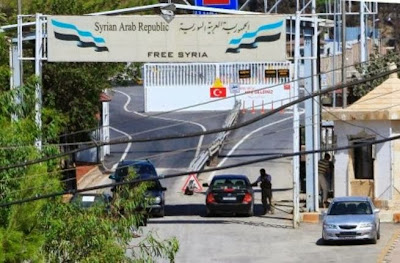
Near Azaz, a more official border crossing between Turkey and “Free Syria”
These particular jihadists, who—though the reports are inconclusive—seem to still hold the town, or part of it, are members of the Islamic State of Iraq and al-Sham (ISIS), a new player in the Syrian civil war.  Reports indicate that a cease-fire has had some success but that Islamic law seems to be in effect there, after a skirmish resulted in ISIS expelling an F.S.A. unit called Northern Storm from the town.  And the assassination of the self-declared emir of Azaz, Abu Abdullah Libi (nom de guerre: Junood), on September 23rd—his car was shot up by snipers while at a checkpoint—may only stoke the flames of conflict between the two groups.  But who is ISIS, and what do they want?


One finger means I have to go wee-wee, two fingers means behead the infidel:
students at a school in Aleppo run by the Islamic State of Iraq and al-Sham.
Al-Shām, or Sham, is an old Arabic term for the fertile lowlands between the Mediterranean and Iraq’s Euphrates River.  ISIS is thus sometimes called, in the media, the “Islamic State of Iraq and the Levant,” or, less accurately, “... and Syria.”  Some say that ISIS represents a merger between the al-Nusra Brigades—the most prominent Islamist force in the Syrian war and, some say, by far its best organized rebel group—and an older entity called the Islamic State in Iraq (I.S.I.).  I.S.I., under its original name Jama’at al-Tawhid wal-Jihad (Organization for Monotheism and Jihad), was founded in 2003 by a Jordan-born Mujahideen commander from the Afghan War named Abu Musab al-Zarqawi, during the period when al-Qaeda-linked groups were flooding into Iraq to fight the United States, which had invaded using as justification the lie that al-Qaeda was already there and cooperating with Saddam Hussein, which everyone knew it wasn’t.  Zarqawi folded his Afghanistan-based militia into Osama bin Laden’s al-Qaeda network in 2004 and renamed it al-Qaeda in Iraq (A.Q.I.).  Later, as I.S.I., it aimed to create an Islamic state in the Sunni-Arab-dominated parts of Iraq between Kurdistan and the Shiite-dominated south.  (See my article from this blog about a possible partition of Iraq.)  Zarqawi was dubbed al-Qaeda’s “Emir of Mesopotamia” (i.e., Iraq) before being killed in a U.S. bombing in 2006.

Abu Musab al-Zarqawi
For a group like ISIS to become a player in Syria is new, and dangerous.  Radical Islamist terrorists never had time to organize themselves as a major fighting force in Arab Spring revolutions such as those in Tunisia, Egypt, Libya, or Bahrain, though they were already a presence in Yemen and still are in the ongoing fighting there.  Zarqawi’s relocation from Afghanistan to Iraq in the early 2000s is part of a larger pattern of Islamist fighters from various points around the world converging on trouble spots that are perceived to be frontline struggles in a holy war to reclaim traditionally-Muslim-ruled areas and place them under shari’a (Islamic law).  This is what happened, for example, in southern Russia, in Chechnya between the First Chechen War in the mid-1990s, which was a secular nationalist movement, and, in 1999, the onset of the Second Chechen War, by now a salafist religious war with local rule often modeled on the harsh Saudi Arabian form of salafism known as Wahhabism.  It is also what has happened in Kashmir, where a war over the question of independence and self-determination in an area claimed by both India and Pakistan has been transformed into a holy war (for some, anyway).  It is also what happened last year in northern Mali, where the latest nationalist uprising by the Tuareg minority was coopted by jihadists as well as by Libyan Tuaregs displaced by civil war.  It is also the pattern in places such as northern Nigeria (Boko Haram), Zanzibar (Uamsho), and the southern Philippines (Abu Sayyaf), among other places.

The global caliphate some Muslim radicals envision
In each case, the aim has been to create an emirate (like Zarqawi’s Emirate of Mesopotamia) under shari’a, ruled by mullahs, or self-appointed doctrinal experts among the militant leadership.  These pseudo-states prominently feature the bureaucratic language of the political structure of the Ottoman Empire (emirates, vilayats, etc.), the closest thing there has been to the superstate ruling the entire Islamic world that these radicals envision.

A more Ottoman-centered vision for an Islamic caliphate
There have been some successes.  Under the Taliban’s rule, Afghanistan was known as the Islamic Emirate of Afghanistan—a term still used by radical Islamists who control pockets of the country.  The areas along the Afghan border which Pakistan’s government is unable or unwilling to govern is a de facto sovereign Taliban and al-Qaeda territory called the Islamic Emirate of Waziristan.  Al-Qaeda-linked radicals ran a so-called Emirate of Waqar in the towns of Jaar and Zinjibar in southern Yemen for more than a year until it was shut down (as reported at the time in this blog) by a Yemeni government offensive last summer.  Perhaps most prominently, as indicated above, the al-Qaeda-linked Ansar al-Dine militia and the Algerian-based Movement for Unity and Jihad in West Africa (MUJAO) ran an Islamic Republic of Azawad in the northern two-thirds of Mali until dislodged by France earlier this year.  (See my recent article with an update on Azawad.)  In all these places, shari’a means that music and beard-trimming are banned, women have to be completely covered and are denied education, adulterers are stoned to death, and anything deemed a non-Muslim or pre-Muslim religious structure can be demolished, including ancient architectural treasures.  These are not nice people.

Ansar al-Dine in Azawad
Some “emirates” are more imaginary.  A visit to the Kavkaz Center website reveals a fantasy world in which Russia’s North Caucasus region and surrounding areas are an Islamist-governed Caucasus Emirate, divided into renamed vilayats (provinces) where “Russian invaders” are always successfully resisted by the loyal mujahideen, in deadpan journalistic prose.  In the real world, this translates into a low-level but unending procession of suicide bombings, ambushes, assassinations of moderate clerics, and other terrorist acts in Russia’s North Caucasus republics.  The Caucasus Emirate has managed to send quite a few fighters to join the struggle in Syria, not incidentally, and they have their sights set on areas such as Tatarstan, in central Russia, as well.

The imaginary Caucasus Emirate of southwestern Russia
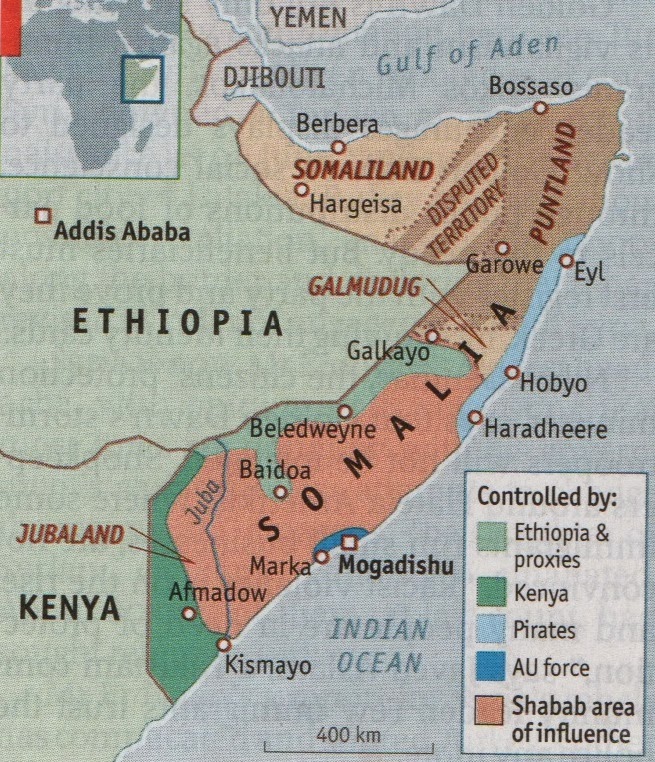
Starting in the late 2000s, an al-Qaeda-affiliated militia called al-Shabaab (literally, “the youth”) controlled nearly a third of Somalia—pretty much everything west and south of Mogadishu, the capital—until being dispersed by troops from Kenya and Ethiopia under the African Union (A.U.) banner last year.  Those events are the grievance behind al-Shabaab’s (as of this writing) ongoing Westgate shopping-mall massacre and siege in Nairobi, Kenya.  During its dominance of southern Somalia, al-Shabaab called its territory the Islamic Emirate of Somalia.  (See my recent article with an update on Somalia.)

How Somalia was divided up during the height of al-Shabaab’s influence
A version of this may be what is going on in Azaz.  In addition to the de facto West Kurdistan Autonomous Region in northern Syria along the Turkish border and a de facto division of much of the country into Bashir al-Assad’s Syria and “Free Syria,” we may now be seeing the beginnings of pockets of a so-called Islamic Emirate with plans to link the bulk of Syrian territory to adjoining Sunni-dominated parts of western and central Iraq.

One view of how Syria might be partitioned
One motivation for international salafist interest in Syria is that it is, like non-Kurdish Iraq, ruled by Shiites, whom Sunni salafists such as al-Qaeda and its partners regard as heretics.  In particular, this is true for the Arab Shiite minority that forms the political elite in Assad’s Syria, the Alawites, whose version of Islam is not particularly rigid and observant by most Muslim standards.  Some members of the Assad regime are interested in the possibility of forming an independent Alawite State in the coastal areas where the opposition is weakest and where Shiites predominate.  (See my recent article on the Alawite State idea, which I also called one of “10 Separatist Movements to Watch in 2013.”  See also an earlier, longer discussion in this blog of how Syria might be partitioned.)

The former flag of the “Alawite State” area in French-ruled Syria
may one day fly again over Tartous and Lattakia.
This sectarian division also intersects with the tussle over Syria between the local superpowers.  Iran, which is Shiite, is the Assad regime’s strongest backer, while Turkey funnels arms to moderate Sunnis (as long as they’re not Kurdish) and Saudi Arabia funnels arms to—well, we do have to worry that some of those arms at least are ending up in the hands of groups like al-Nusra and ISIS.


So now, if a resolution to the war in Syria is to involve some kind of partition, we would be looking at not only Kurdish, Alawite, and Sunni Arab (and maybe Druze) statelets or autonomous regions but also, perhaps, an attempt to establish an Islamic Emirate.  And the experience in Nigeria, Mali, and Somalia is that emirate movements are never content to revel in their safe enclaves but want to expand in order to bring shari’a to the rest of the benighted world.  These new developments make it much less likely that a peaceful partition can be achieved—and it also raises the prospect of a well-organized, Taliban-style faction jostling for the upper hand in any post-Assad regime.

It doesn’t look good.

An F.S.A. rebel defending Idlib province from the Assad regime and, now, al-Qaeda-linked Islamists as well

[Also, for those who are wondering, yes, this blog is tied in with a forthcoming book, a sort of encyclopedic atlas to be published by Auslander and Fox under the title Let’s Split! A Complete Guide to Separatist Movements, Independence Struggles, Breakaway Republics, Rebel Provinces, Pseudostates, Puppet States, Tribal Fiefdoms, Micronations, and Do-It-Yourself Countries, from Chiapas to Chechnya and Tibet to Texas.  Look for it some time in 2013 or 2014.  I will be keeping readers posted of further publication news.]

Monday, September 2, 2013

Jubaland and Puntland Deals May Help Reassemble Fragmented Somalia

 Farah Sheikh Abdukadir and Ahmed Madobe shake on it, and bring Jubaland back into “Somalia”
On August 28th, the Jubaland State of Somalia reached an agreement to cooperate with the Federal Republic of Somalia.  It was signed in Addis Ababa, Ethiopia, by the Somalian minister of state, Farah Sheikh Abdulkadir, and Sheikh Ahmed Mohamed Islam (better known as Ahmed Madobe), who only the most powerful and resilient of several warring self-proclaimed presidents of Jubaland, and not even the only one who claims to have been “elected.”  The deal allows Madobe to govern Jubaland during a two-year transition under a so-called Interim Jubba Administration (I.J.A.).  In exchange, the federal government will run the airport and harbor of Jubaland’s capital, Kismayo, and will absorb “all security elements” of what passes for government in Jubaland at the moment—i.e., Madobe’s powerful militia, the Ras Kamboni Brigades.  Though Jubaland is and will be to a great extent self-governing, this agreement makes nominally a part of a nominally federal “Somalia”—though true Somalian administration extends very little beyond the federal capital, Mogadishu.  The deal also represents a victory of sorts for Somalia’s prime minister, Abdi Farah Shirdon, who had been pushing Somalia’s skeptical president, Hassan Sheikh Mohamoud, to welcome the formation of Jubaland.


Jubaland consists, according to the new agreement, of the nominal Somalian gobols (regions, or provinces) of Gedo, Middle Jubba, and Lower Jubba.  Madobe’s Ras Kamboni fighters helped troops from Kenya and Ethiopia, under an African Union (A.U.) mandate, liberate the Jubaland area last year from an al-Qaeda-affiliated Islamist militia called al-Shabaab, which has since been dispersed into the hinterlands.  Madobe then tried to set up a Puntland-style (see below) federal autonomous region in the south called Jubaland (also spelled Jubbaland, and sometimes also known as Azania or Greenland) but met with initial resistance from Mogadishu.  (Jubaland was listed in this blog at the beginning of this year as one of “10 Separatist Movements to Watch in 2013.”)

A Somali political cartoon addresses the controversy over recognition of Jubaland.
(This is only one of several proposed Jubaland flags in circulation.)

Two days after the Jubaland deal, President Mohamoud said the federal administration was open to talks that would repair relations with the Puntland State of Somali, a de facto independent parliamentary republic at the tip of the Horn of Africa which announced last month it was formally severing all ties with the Mogadishu government (as reported at the time in this blog).


These two developments indicate the possibility of the northern and southern ends of “Somalia” being brought into the nominal federal fold—or perhaps even more than nominally.  (Puntland is considered the northern end of Somalia only because Mogadishu has, despite official protests, in reality long resigned itself to the de facto secession of the internationally-unrecognized Republic of Somaliland, to Puntland’s west.)  The Jubaland agreement, in particular, is being praised by the United Nations (U.N.), by the mostly pro-Mogadishu international community generally, and by the government of Puntland.  But there may be associated tensions emerging in the nation’s middle section . . .

Jubaland delegates at an annual Somalia conference in London.  (This is another proposed Jubaland flag.)
In response to the Jubaland accord, hundreds of residents of Baidoa, Somalia’s third-largest city, took to the streets on August 31st to protest Jubaland’s reabsorption into Somalia.  Baidoa is culturally and geographically part of the larger Jubaland region and in fact used to be the capital of Upper Jubba province before internal borders were reorganized.  It is now the capital of Baay (also spelled Bay) province (see map above).

Protesters ralied in Baidoa, Baay province, on August 31st.
Like most parts of Somalia, Baay province is only nominally under Somalian administration, at best.  Local control is in the hands of clan elders.  An elder’s-council spokesman, Malaq Ali Mumin, who also represents elders from the province of Bakool, told media during the protest, “We have withdrawn our support from the Somali federal government in Mogadishu.  We call on parliamentarians and other federal government officials hailing from this region to come back.”  Elders said that federal government officials were now banned from Baay.  Mumin, of the elder’s council, told reporters that his organization was declaring war in order to “liberate the regions of ‘Lower Jubba, Middle Jubba, and Gedo.’”
Somali troops celebrating the taking of Kismayo from al-Shabaab in 2012
Jubaland and Puntland may be on the brink of being tamed and brought in from the cold.  But do we now have to contend with a Republic of Baay?

[Also, for those who are wondering, yes, this blog is tied in with a forthcoming book, a sort of encyclopedic atlas to be published by Auslander and Fox under the title Let’s Split! A Complete Guide to Separatist Movements, Independence Struggles, Breakaway Republics, Rebel Provinces, Pseudostates, Puppet States, Tribal Fiefdoms, Micronations, and Do-It-Yourself Countries, from Chiapas to Chechnya and Tibet to Texas.  Look for it some time in 2013.  I will be keeping readers posted of further publication news.]

Subscribe Now: Feed Icon