|
| An ominous Islamic Emirate banners flying over a checkpoint in Azaz, Syria |
It was bound to happen. While the international community beyond the Middle East has debated and stalled on whether and when to offer overt aid to the rebel opposition in
Syria—hoping that the conflict would sort itself out first and put a Western-friendly regime of some sort in charge—the ideological nature of the opposition has shifted. And now the salafist Islamist component in the opposition seems to be gaining the upper hand, with territorial gains that may presage the formation of a
de facto independent Islamist enclave.
 |
| The location of Azaz in Syria. (Turkey is to the north.) |
On September 18th,
Azaz, a town in Syria’s Idlib province two miles from the boundary with
Turkey and 20 miles from Aleppo,
fell to Islamists associated with
al-Qaeda. Azaz is near a major Turkish–Syrian border crossing and was the scene of fighting between the regime and the more moderate rebel umbrella group, the
Free Syrian Army (
F.S.A.), last year. Nine centuries or so earlier, during the Crusades, it was the site of a victory of Christian European forces over the town’s Turkish defenders—a resonance that is surely not lost on the deep-historical-grudge-bearing jihadists.
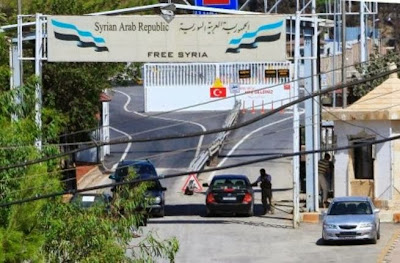 |
| Near Azaz, a more official border crossing between Turkey and “Free Syria” |
These particular jihadists, who—though the reports are inconclusive—seem to still hold the town, or part of it, are members of the
Islamic State of Iraq and al-Sham (
ISIS), a new player in the Syrian civil war.
Reports indicate that a cease-fire has had some success but that Islamic law seems to be in effect there, after a skirmish resulted in ISIS expelling an F.S.A. unit called
Northern Storm from the town. And the assassination of the self-declared emir of Azaz,
Abu Abdullah Libi (
nom de guerre:
Junood), on September 23rd—his car
was shot up by snipers while at a checkpoint—may only stoke the flames of conflict between the two groups. But who is ISIS, and what do they want?
 |
One finger means I have to go wee-wee, two fingers means behead the infidel:
students at a school in Aleppo run by the Islamic State of Iraq and al-Sham. |
Al-Shām, or
Sham, is an old Arabic term for the fertile lowlands between the Mediterranean and
Iraq’s Euphrates River. ISIS is thus sometimes called, in the media, the “
Islamic State of Iraq and the Levant,” or, less accurately, “
... and Syria.” Some say that ISIS represents a merger between the
al-Nusra Brigades—the most prominent Islamist force in the Syrian war and, some say, by far its best organized rebel group—and an older entity called the
Islamic State in Iraq (
I.S.I.). I.S.I., under its original name
Jama’at al-Tawhid wal-Jihad (
Organization for Monotheism and Jihad), was founded in 2003 by a
Jordan-born Mujahideen commander from the Afghan War named
Abu Musab al-Zarqawi, during the period when al-Qaeda-linked groups were flooding into Iraq to fight the
United States, which had invaded using as justification the lie that al-Qaeda was already there and cooperating with
Saddam Hussein, which everyone knew it wasn’t. Zarqawi folded his
Afghanistan-based militia into
Osama bin Laden’s al-Qaeda network in 2004 and renamed it
al-Qaeda in Iraq (
A.Q.I.). Later, as I.S.I., it aimed to create an Islamic state in the Sunni-Arab-dominated parts of Iraq between
Kurdistan and the Shiite-dominated south. (See
my article from this blog about a possible partition of Iraq.) Zarqawi was dubbed al-Qaeda’s “Emir of
Mesopotamia” (i.e., Iraq) before being killed in a U.S. bombing in 2006.
 |
| Abu Musab al-Zarqawi |
For a group like ISIS to become a player in Syria is new, and dangerous. Radical Islamist terrorists never had time to organize themselves as a major fighting force in Arab Spring revolutions such as those in
Tunisia,
Egypt,
Libya, or
Bahrain, though they were already a presence in
Yemen and still are in the ongoing fighting there. Zarqawi’s relocation from Afghanistan to Iraq in the early 2000s is part of a larger pattern of Islamist fighters from various points around the world converging on trouble spots that are perceived to be frontline struggles in a holy war to reclaim traditionally-Muslim-ruled areas and place them under
shari’a (Islamic law). This is what happened, for example, in southern
Russia, in
Chechnya between the First Chechen War in the mid-1990s, which was a secular nationalist movement, and, in 1999, the onset of the Second Chechen War, by now a salafist religious war with local rule often modeled on the harsh Saudi Arabian form of salafism known as Wahhabism. It is also what has happened in
Kashmir, where a war over the question of independence and self-determination in an area claimed by both
India and
Pakistan has been transformed into a holy war (for some, anyway). It is also what happened last year in northern
Mali, where the latest nationalist uprising by the
Tuareg minority
was coopted by jihadists as well as by Libyan Tuaregs displaced by civil war. It is also the pattern in places such as
northern Nigeria (
Boko Haram),
Zanzibar (
Uamsho), and the
southern Philippines (
Abu Sayyaf), among other places.
 |
| The global caliphate some Muslim radicals envision |
In each case, the aim has been to create an emirate (like Zarqawi’s Emirate of Mesopotamia) under
shari’a, ruled by mullahs, or self-appointed doctrinal experts among the militant leadership. These pseudo-states prominently feature the bureaucratic language of the political structure of the
Ottoman Empire (emirates, vilayats, etc.), the closest thing there has been to the superstate ruling the entire Islamic world that these radicals envision.
 |
| A more Ottoman-centered vision for an Islamic caliphate |
There have been some successes. Under the
Taliban’s rule, Afghanistan was known as the
Islamic Emirate of Afghanistan—a term still used by radical Islamists who control pockets of the country. The areas along the Afghan border which Pakistan’s government is unable or unwilling to govern is a
de facto sovereign Taliban and al-Qaeda territory called the
Islamic Emirate of Waziristan. Al-Qaeda-linked radicals ran a so-called
Emirate of Waqar in the towns of Jaar and Zinjibar in southern Yemen for more than a year until it was shut down (
as reported at the time in this blog) by a Yemeni government offensive last summer. Perhaps most prominently, as indicated above, the al-Qaeda-linked
Ansar al-Dine militia and the Algerian-based
Movement for Unity and Jihad in West Africa (
MUJAO) ran an
Islamic Republic of Azawad in the northern two-thirds of Mali until dislodged by
France earlier this year. (See
my recent article with an update on Azawad.) In all these places,
shari’a means that music and beard-trimming are banned, women have to be completely covered and are denied education, adulterers are stoned to death, and anything deemed a non-Muslim or pre-Muslim religious structure can be demolished, including ancient architectural treasures. These are not nice people.
 |
| Ansar al-Dine in Azawad |
Some “emirates” are more imaginary. A visit to
the Kavkaz Center website reveals a fantasy world in which Russia’s North Caucasus region and surrounding areas are an Islamist-governed
Caucasus Emirate, divided into renamed vilayats (provinces) where “Russian invaders” are always successfully resisted by the loyal
mujahideen, in deadpan journalistic prose. In the real world, this translates into a low-level but unending procession of suicide bombings, ambushes, assassinations of moderate clerics, and other terrorist acts in Russia’s North Caucasus republics. The Caucasus Emirate has managed to send quite a few fighters to join the struggle in Syria, not incidentally, and they have their sights set on areas such as
Tatarstan, in central Russia, as well.
 |
| The imaginary Caucasus Emirate of southwestern Russia |
Starting in the late 2000s, an al-Qaeda-affiliated militia called
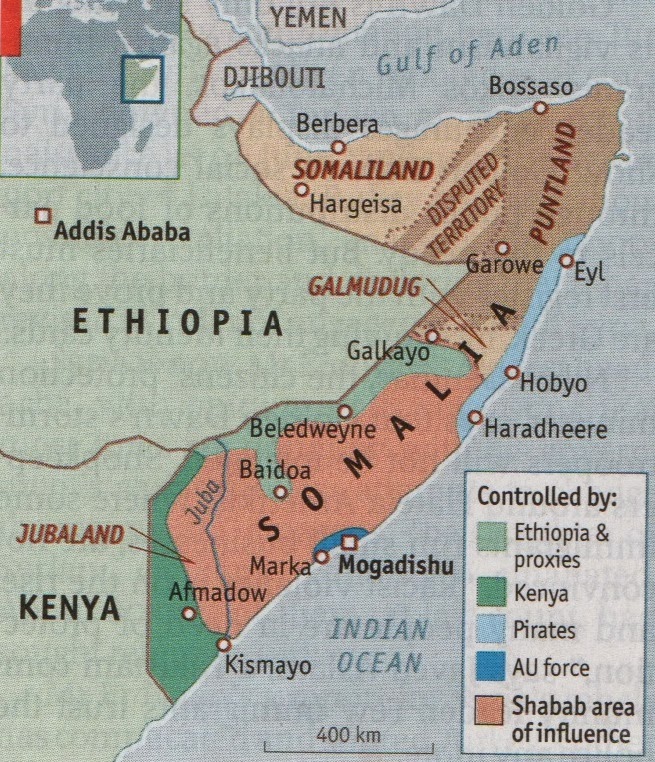
al-Shabaab (literally, “the youth”) controlled nearly a third of
Somalia—pretty much everything west and south of Mogadishu, the capital—until being dispersed by troops from
Kenya and
Ethiopia under the
African Union (
A.U.) banner last year. Those events are the grievance behind al-Shabaab’s (as of this writing) ongoing Westgate shopping-mall massacre and siege in Nairobi, Kenya. During its dominance of southern Somalia, al-Shabaab called its territory the
Islamic Emirate of Somalia. (See
my recent article with an update on Somalia.)
 |
| How Somalia was divided up during the height of al-Shabaab’s influence |
A version of this may be what is going on in Azaz. In addition to
the de facto West Kurdistan Autonomous Region in northern Syria along the Turkish border and a
de facto division of much of the country into
Bashir al-Assad’s Syria and
“Free Syria,” we may now be seeing the beginnings of pockets of a so-called Islamic Emirate with plans to link the bulk of Syrian territory to adjoining Sunni-dominated parts of western and central Iraq.
 |
| One view of how Syria might be partitioned |
One motivation for international salafist interest in Syria is that it is, like non-Kurdish Iraq, ruled by Shiites, whom Sunni salafists such as al-Qaeda and its partners regard as heretics. In particular, this is true for the Arab Shiite minority that forms the political elite in Assad’s Syria, the Alawites, whose version of Islam is not particularly rigid and observant by most Muslim standards. Some members of the Assad regime are interested in the possibility of forming an independent
Alawite State in the coastal areas where the opposition is weakest and where Shiites predominate. (See
my recent article on the Alawite State idea, which I also called one of
“10 Separatist Movements to Watch in 2013.” See also
an earlier, longer discussion in this blog of how Syria might be partitioned.)
 |
The former flag of the “Alawite State” area in French-ruled Syria
may one day fly again over Tartous and Lattakia. |
This sectarian division also intersects with the tussle over Syria between the local superpowers. Iran, which is Shiite, is the Assad regime’s strongest backer, while Turkey funnels arms to moderate Sunnis (as long as they’re not Kurdish) and
Saudi Arabia funnels arms to—well, we do have to worry that some of those arms at least are ending up in the hands of groups like al-Nusra and ISIS.
So now, if a resolution to the war in Syria is to involve some kind of partition, we would be looking at not only Kurdish, Alawite, and Sunni Arab (and maybe
Druze) statelets or autonomous regions but also, perhaps, an attempt to establish an Islamic Emirate. And the experience in Nigeria, Mali, and Somalia is that emirate movements are never content to revel in their safe enclaves but want to expand in order to bring
shari’a to the rest of the benighted world. These new developments make it much less likely that a peaceful partition can be achieved—and it also raises the prospect of a well-organized, Taliban-style faction jostling for the upper hand in any post-Assad regime.
It doesn’t look good.
 |
| An F.S.A. rebel defending Idlib province from the Assad regime and, now, al-Qaeda-linked Islamists as well |
[Also, for those who are wondering, yes, this blog is tied in with a forthcoming book, a sort of encyclopedic atlas to be published by Auslander and Fox under the title Let’s Split! A Complete Guide to Separatist Movements, Independence Struggles, Breakaway Republics, Rebel Provinces, Pseudostates, Puppet States, Tribal Fiefdoms, Micronations, and Do-It-Yourself Countries, from Chiapas to Chechnya and Tibet to Texas. Look for it some time in 2013 or 2014. I will be keeping readers posted of further publication news.]