|
| The Ingushetian and Chechnyan presidents Yunus-Bek Yevkurov and Ramzan Kadyrov |
NORTH CAUCASUS (CHECHNYA, DAGESTAN, INGUSHETIA, CIRCASSIA)
Chechen, Ingush Negotiators Meet to Resolve Border Dispute. In an attempt to iron out their newly flaring border dispute, leaders from two Russian republics met in Magas, Ingushetia, this week to lay out ground rules for negotiations on a border dispute. The two negotiators—the speaker of the Chechen Republic’s parliament, Dukvakha Abdurakhmanov, and the Republic of Ingushetia’s prime minister, Musa Chiliyev—vowed to resolve the issue without intermediaries, but they seem to be miles apart. Chechnya wants to drastically reduce the land area of Ingushetia, already the smallest constituent member of the Russian Federation, leaving it in two discontiguous chunks separated by Chechen territory. This would, Chechen negotiators say, restore the boundary to where it was before the Chechen and Ingush autonomous oblasts merged to form the Checheno-Ingush Autonomous Oblast (later Autonomous Soviet Socialist Republic) in 1934. But an Ingush historian claims that a map from the 1920s—when the territories were part of the Mountain Autonomous Soviet Socialist Republic—shows a Chechen–Ingush border closer to where it is today. Chechens point out that in those days the disputed regions were part of a Cossack district that was later absorbed, in 1929, into the Chechen Autonomous Oblast. Chechnya and Ingushetia separated as Communism fell, prompted by Chechnya’s war with Russia and Ingushetia’s smaller armed conflict with its neighbor on the other side, the Republic of North Ossetia–Alania. The new, de facto boundaries have never been formally demarcated.

4 Police, 9 Rebels Killed in Battles with Islamists in Chechnya, Dagestan. The Russian Federation’s ministry of the interior announced September 22nd that the previous two days in the Chechen Republic in the Vedeno region had seen the killings of four police officers and four rebels, with 11 officers also injured. This confirms earlier, sketchy figures for that period of time provided (as reported last week in this blog) on the website of the Caucasus Emirate, an Islamist militia which is fighting to establish a separate state in Russia’s predominantly-Muslim North Caucasus region. In the neighboring Republic of Dagestan’s Khasavyurt distrinct, four rebels were killed in a gun battle with security forces on September 23rd that resulted from a traffic stop. The next day, also in Khasavyurt, a college psychology professor who was vocal in his opposition to Islamist violence, was shot and killed near his home, killing him. A rebel was killed by police in Dagestan, it was reported September 28th, during a joint operation between local police and the Federal Security Service (F.S.B.).
 |
| One of several Chechen separatist flags. Is that, what?, a mink on a serving tray? I’m confused. |
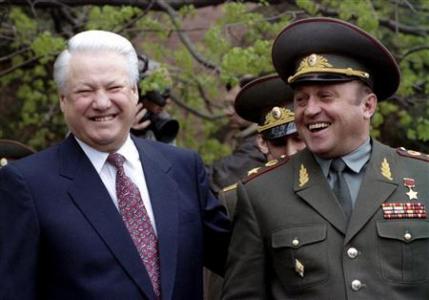
Pavel Grachev, Russian Commander in First Chechen War, Dies at 64. The Russian Federation’s former minister of defense, Gen. Pavel Sergeyevich Grachev, died near Moscow on September 23rd at the age of 64. See this blog’s full obituary for Grachev.
SOUTH CAUCASUS (GEORGIA, ARMENIA, AZERBAIJAN)
South Ossetia Diplomat Rejects Annexation by Russia, Touts “Integration” with Alania. The ambassador to the Russian Federation from the mostly unrecognized Russian puppet state of the Republic of South Ossetia said on the state-run Voice of Russia radio network this week that South Ossetia will not become part of Russia but intends “maximum integration” with the Republic of North Ossetia–Alania, which is an adjacent subdivision of the Russian Federation. It was unclear if this meant that North Ossetia would eventually split from Russia and join South Ossetia to form an independent “Greater Ossetia.” Speaking on Conversation with Konstantin Kosachev, the ambassador, Dmitry Medoyev, said that after the 2008 South Ossetia War between Russia and the Georgia, in which Russian troops fully severed South Ossetia’s last vestiges of ties to the Georgia, South Ossetia had become so well integrated with adjacent Russian republics that the question of unification is “somewhere far away” and “irrelevant.” Most of the world still regards South Ossetia, which declared independence immediately after the collapse of the Soviet Union in 1991, as part of the Republic of Georgia.
 |
| Dmitry Medoyev |

First Wave of Refugees from Syrian Civil War Settled in Abkhazia. According to authorities in the Republic of Abkhazia, a mostly-unrecognized Russian puppet state carved out of the northwestern tip of the Republic of Georgia, 73 refugees from Syria’s civil war have been resettled in Abkhazia. Fifty-three of them have been given Abkhazian citizenship, a status most of the world does not recognize. Another 30 settlers are expected next week. Some have been given housing and university spots, but three families returned to Syria after seeing what Abkhazia had to offer. In the past, Georgians have worried that Syrian refugees in Abkhazia would be moved into homes vacated by ethnic Georgians who were ethnically cleansed out of the republic in the early 1990s. The refugees in this case, though sources did not specify, tend to be ethnically Abkhaz. The Abkhaz is linguistically related to the Circassians—Muslim peoples of the northwest Caucasus area, between the mountains and the Black Sea—and some classify the Abkhaz as, very broadly, Circassian in language and culture. Circassians from Syria have had a notoriously difficult time returning to their homeland in southwestern Russia’s western North Caucasus region since the Syrian civil war began, due to obstruction by the Russian government. Abkhaz, who, unlike the Circassians, are mostly Eastern Orthodox Christians, are treated more preferentially by Moscow—unless they are, as some Abkhaz are, married to wives from the Russian-based and predominantly-Muslim Kabardian ethnic group, a branch of the Circassian nation proper.
Armenian Soldier Shot, Killed along Tense Border with Azerbaijan. The Republic of Armenia’s ministry of defense announced this week that a 19-year-old Armenian soldier had been shot and killed by Azerbaijani forces on September 25th along the Armenia–Azerbaijan border. Both sides accuse each other of cease-fire violations on an almost daily basis along the tense border that separates Azerbaijani-controlled territory from the unrecognized Armenian puppet state of the Nagorno-Karabakh Republic (N.K.R.).
[Note: This is a corrected version of this posting, which originally erroneously referred to Circassian and Abkhaz as Turkic languages. See reader comments below for the correction.]