Showing posts with label Yeltsin. Show all posts

Tuesday, August 5, 2014

Meanwhile, at the Other End of the Empire ... Putin Scrambles to Squash Siberian Autonomy Movement


While President Vladimir Putin seems committed to clawing back bits of territory on his western flank that used to be part of the former Soviet Union (Crimea, the Donbas, Abkhazia, etc.), a gigantic territory in the east is stirring to loosen, or even sever, its ties to Moscow.  The response has been swift and harsh.  But whether the Kremlin is nipping this movement in the bud or fanning its flames remains to be seen.


The region in question is Siberia, and even “gigantic” is an understatement.  Not a political entity at all in its own right at present, Siberia simply refers to all of the parts of the Russian Federation that are in Asia, i.e. east of the Ural Mountains.  This 13-million-square-kilometer territory makes up more than three-quarters of the Russian Federation as a whole and just shy of a whopping 10% of the land surface of the entire world—though its mostly frigid vastness contains only just over a quarter of Russia’s population.  If independent, Siberia would take over from Russia its centuries-long status as largest country in the world—Canada would still be a trailing second—and knock what’s left of Russia down to number seven, between Australia and India.  More to the point, Siberia contains most of Russia’s timber and mineral resources, plus the long Arctic Ocean coastline that could help Russia dominate the globe in the coming century as global warming frees unknowably vast energy resources from its ice cover (unless global warming kills us all first, of course (sorry to bring that up)).

This diagonal green-and-white flag is the most common Siberian regionalist flag in the modern period.
Although hundreds of indigenous ethnic groups call Siberia home, the population is over 90% ethnically Russian and over 70% urban.  (Then there’s the Jewish Autonomous Oblast, but that’s a long story.)  It is these descendants of late-Czarist-era pioneer settlers, plus more recent migrants and exiles, that are behind the current drive to give more autonomy to Siberia, not indigenous peoples, who have their own quiet drives for more autonomy and, in some cases, dormant secessionist movements (as in Tuva and Yakutia (Sakha)).

Yet another proposed Siberian flag
In just the past couple weeks, the Russian government has blocked a page on Vkontakte (the “Russian Facebook”) called “March to Federate Siberia” (Марш за федерализацию Сибири) which calls for devolution of powers from Moscow to the east—not actual secession.  The page was rallying for a march to be held August 17th in Novosibirsk, which is not just Siberia’s most populous city but the third-most-populous in Russia as a whole.  About 2,000 people had pledged to join the march, but now, according to a B.B.C. report, anyone surfing over to the page from a computer in Russia sees only a message reading, “Access is limited on the orders of the law-enforcement agencies.”

An image from online announcements for the August 17th march for federalism.
A white-and-green horizontal bicolor like this was used by the original independence movement
during the Russian civil war, but as far as I can tell the stylized black snowflake
(or are those Christian crosses? or gears?) is a fresh addition.
The march, which is being planned with the slogan, “Stop Feeding Russia!”, is designed to press for the establishment of a Republic of Siberia which would have considerably more autonomy than republics do now—especially when it comes to keeping in its own budget the wealth generated from Siberia’s natural resources.  (Russia’s first post-Communist president, Boris Yeltsin, lured separatist republics like Tatarstan and Kalmykia into the new Russian Federation with promises of more autonomy, but his successor, Putin, has reversed course and created a heavily centralized empire, where the more potentially restive regions are run not by elected leaders but by cronies directly appointed by the Kremlin.)

Glorious overall-wearing Siberian proletariat
smashes élitist oligarchs!
Siberian activists are quick to point out the Kremlin’s hypocrisy in making merely talking about separatism in Russia a crime against the state (see an article from this blog on that legislation) while actively supporting separatism in places like Crimea, eastern Ukraine, Transnistria, Abkhazia, South Ossetia, Nagorno-Karabakh—shall I go on?  (Putin’s baldly Orwellian doublethink on this question is one of the reasons that Siberia’s southern neighbor, the People’s Republic of China—where breathing the word “separatism” is also a way to get an all-expenses-paid thirty-year stay in a “re-education camp”—has been very, very quiet on the Crimea issue.)


The current movement, centered to all appearances quite closely on Novosibirsk, features artists as its central figures, including Artem Loskutov, who runs a blog on the topic.  The fact that Loskutov’s public rallies have often seemed more like satirical, culture-jamming “happenings” than serious political endeavors does not seem to make the Kremlin view the prospect of an August 17th march any more kindly.  But Loskutov makes clear that this is all hardly a prank, and that he is not alone.  He told an interviewer recently, “I’m not an ideologist.  Everything is very decentralized, as befits those advocating decentralization.  I will take part in this protest as on ordinary person who cares about the future of Siberia and Russia as a whole.”  Loskutov also seemed to carefully dodge questions about rumored plans to be appoint him “people’s mayor” of Novosibirsk, which would echo the terminology of the Donetsk People’s Republic and Lugansk People’s Republic rebels in eastern Ukraine, with whom the Siberian autonomy movement shares almost nothing ideologically.

Artem Loskutov
The movement, Loskutov said, is “not about separatism, it’s in full compliance with the law.  We are talking about creating a new region within Russia.  ...  Our [Russia’s] constitution provides for independence [“autonomy” is closer to his meaning here] of regions, the law just has to be put to work.  We must have as much autonomy as possible.  ...  Siberia gives away her resources and gets piles of dumb laws in return.”

A surfeit of flag proposals can be found in readers’ uploads
to the Siberian movement’s banned Vkontakte page.
Loskutov’s approach is not new.  Siberian autonomy has long been the domain of bohemians.  The anarchist philosopher Mikhail Bakunin advocated Siberian independence as long ago as the 1860s, and even tossed out the idea of letting Siberia link up with Alaska and become part of the United States, as a way of letting democracy into Eurasia from the east.  (See an article from this blog on the idea of Siberia as the 51st state.  See another article from this blog on the opposite scenario: Alaska joining Russia.)

Mikhail Bakunin: Siberia’s first separatist
During the Russian Civil War that followed the 1917 Leninist revolution, Mensheviks in Irkutsk declared an autonomous Siberia and maintained it for a while with the help of Czech and Slovak fighters, before Bolsheviks finally crushed the movement and absorbed it into the new Soviet Union.  And around the time of the 2010 census, artists kicked up dust in anger over census-takers’ refusal to accept “Siberian” as a self-declared “nationality.”  And the avant-garde novelist and conceptual artist Artur Solomonov is among the current drive’s most prominent backers.

Victorious Bolsheviks posing with the corpses
of Czech and Slovak pro-Siberian insurgents in 1917.
It seems unlikely that Novosibirsk on August 17th will turn into something as game-changing as the Euro-Maidan movement in Kyiv, Ukraine’s capital.  But, even in the face of Putin’s pitiless assault on Ukraine, Russian regional autonomists are showing that they are no longer cowed into silence.  In fact, in Kaliningrad Oblast (formerly Königsberg), Russia’s easternmost point, an exclave that Josef Stalin scooped up from Nazi Germany as war booty in 1945, autonomists are now planning their own “Stop Feeding Moscow” march timed to coincide with Novosibirsk’s.

Kaliningrad too?  (And, yes, those are Prussian flags.)
Some sort of giant may be stirring in its sleep.


[You can read more about Siberia and many other sovereignty and independence movements both famous and obscure in my new book, a sort of encyclopedic atlas just published by Litwin Books under the title Let’s Split! A Complete Guide to Separatist Movements and Aspirant Nations, from Abkhazia to Zanzibar.  The book, which contains 46 maps and 554 flags (or, more accurately, 554 flag images), is available for order now on Amazon.  Meanwhile, please “like” the book (even if you haven’t read it yet) on Facebook and see this interview for more information on the book.]


Copious thanks are due to Jeff Groton for directing me to many of these sources.

Thursday, February 27, 2014

Putin and Ukraine’s Ultranationalist Russians Light the Fuse: Second Crimean War Begins


In 1991, when ethnic Russians stranded in a newly independent Moldova (formerly Moldavian Soviet Socialist Republic) declared independence as Transnistria—a Kremlin-funded pseudo-state which survives to this day—that was just warming up.  Later, in the early 1990s, when an uprising by Cossacks around Ust’-Kamengorsk, in newly independent Kazakhstan, seemed almost surely encouraged by Russia’s government, that was just testing the waters.  In 1999, when Boris Yeltsin signed a treaty with the formerly-Soviet Republic of Belarus to create a “Union State” with Russia—without consulting any of the country’s citizens—that was mere practice.  When, in 2008, the Ukrainian region of Transcarpathia (formerly part of Czechoslovakia) declared an independent republic for its ethnic Russians and “Rusyns” (Ruthenians), Kiev called it a Kremlin plot; if it was, that was Vladimir Putin just sharpening his sword.  And when, also in 2008, Putin responded to the Republic of Georgia’s attempts to retake two rebel provinces with a Russian invasion and the “liberation” of Abkhazia and South Ossetia as “independent” Russian puppet states, that was a full-dress rehearsal.  But right now, as you are reading this, in Ukraine’s Crimean peninsula, this is the Main Event.  The second Crimean War has begun.

How things went in the 2010 election.  Crimea, in dark Yanukovych blue, is at the bottom.
Reports out of Ukraine this morning are sketchy, but it seems as if armed men have taken over the pro-Kremlin “soviet” (yes, its parliament calls itself that) of the ethnic-Russian-dominated Autonomous Region of Crimea in southern Ukraine.  Two people have been killed in related street battles.  The Russian flag is flying out front, and other government buildings in Simferopol, the Crimean capital, are also reportedly occupied by armed Russian-speaking men.  Two days ago, Putin ordered the Russian Federation’s armed forces into a state of readiness in the areas around Ukraine, and by now this includes ground exercises on the Crimean peninsula itself.  Already, Russia’s Black Sea Fleet—in a special deal made after Crimea’s Russians tried to declare independence the first time, in 1992—is permanently housed on the Crimean Peninsula.  There hardly even needs to be an invasion if the Russian military is already an honored guest.

The Black Sea fleet
A week ago ago, with the Winter Olympics in the nearby Russian city of Sochi still in full swing, the crisis in Ukraine was still a months-old, long, grinding street-politics uprising, the “Euro-Maidan” movement—escalating in violence but still a standoff between the corrupt authoritarian pro-Klemin president, Viktor Yanukovych, who squeaked into power mostly with the votes of his fellow ethnic Russians, and a vast “people politics” movement led by Ukrainian nationalists and others furious with Yanukovych for reorienting his country’s foreign relations away from the European Union (E.U.) and toward Russia.  The movement had escalated into a revolt against Yanukovych’s corruption and Putin-type authoritarianism in general.  Then, a wave of fatalities in a desperate violent government crackdown on the street protesters raised the stakes, and only steeled the resolve of those calling for Yanukovych’s resignation.  Despite what at first looked like a calming deal to hold elections this year, on February 22nd Yanukovych’s own parliament impeached him, and released from prison Yulia Tymoshenko, who had been jailed on possibly-trumped-up corruption charges after narrowly losing to Yanukovych in the 2010 election.  Two days later, the freshly installed interior minister, a member of the old opposition, issued a warrant for Yanukovych’s arrest, sending the toppled leader on a mysterious meandering flight, from Kiev to Kharkov (former capital of the old Bolshevik Ukrainian republic in the days of the Russian civil war, when ethnic Ukrainians had their own Menshevik republic in the west) to Donetsk, in Yanukovych’s home region known also as “Little Russia,” where Ukrainians are in a minority, and finally to Crimea, where it is believed he may be right now.  Maybe he is even directing some of these new events.  Other reports say he is already in Moscow; Putin has offered him protection and regards him as still the president.

“Heil Putin!”  Yanukovych in happier times.
It is not surprising that it has all come down to Crimea.  It was here, in the 1850s, that the Russian Empire was defeated by the British and French, as a way of beating the Czar back and keeping him from filling the political vacuum created by the weakening Ottoman Empire.  But Russia held onto the Crimea in the treaty that ended the war and later regrouped for a series of brutal wars pushing Czarist influence farther south in the Black Sea and Caucasus regions.  Crimea itself was Muslim, populated by Turkish-speaking Tatar people.  After the Second World War, Josef Stalin deported Tatars to Siberia and Central Asia, as punishment for supposed collaboration with the Nazis.  Crimean Tatars shared this fate with other Muslim groups like Meskhetian Turks, Kumyks, and Chechens.  But then when Nikita Khrushchev allowed many of the hundreds of thousand of deportees to return in the 1950s, the Tatars were not on the list.  By now, you see, Crimea was full of ethnic-Russians, even though on a whim, and supposedly while drunk, Khrushchev had with a stroke of the pen transferred the Crimean oblast from the Russian republic to the Ukrainian one in 1954.

Sergei Shuvainikov, a Crimean parliamentary deputy, feels more Russian than Ukrainian.
He is not alone.
Tatars have trickled back home in the post-Communist era but still make up only 12% of the population.  Russians are 58%, Ukrainians less than a quarter—and Russian nationalists with warm feelings toward Putin and Yanukovych dominate the regional parliament, which even said recently that it reserved the right to secede if Yanukovych was toppled.  And make no mistake, Russia and Russians regard what happened in Kiev on the 22nd as an unconstitutional coup d’état—which, very arguably, of course, it was, even if a majority of Ukrainian residents seem to back it.  The embattled Tatars, in their own toothless mini-parliament, are siding with the Euro-Maidan movement and the E.U.

Crimean Tatars, a minority in their own homeland, feel European, not Russian.
Russians in their hearts have never accepted the loss of Ukraine, which they see as part of Russia.  Kiev, after all, was the capital of Kievan Rus’, the medieval state which both Ukrainians and Russians regard as their ancestral polity.  And Putin, far more than his mostly pro-autonomy predecessor, Yeltsin, has itched to re-expand the old Russian Empire.

Vlad the Impaler plots from the sidelines.
And, in a sense, who can blame him?  He really does think that Crimea is a Russian territory which has been under foreign occupation—and this week suddenly unelected foreign occupation—since 1991.  For Putin, the main point is that Yanukovych, the elected leader, wanted Ukraine to join Russia, Belarus, Kazakhstan, Armenia, Abkhazia, and South Ossetia in a new “Eurasian Union” trading bloc to rival the E.U.  And Putin really believes that that would be better for Ukraine as well as for Russia.  (Ukraine is the most prosperous Soviet successor state, and it is across its territory that Russia delivers oil to western European consumers.)  Putin believes that, if the Crimean parliament declares an independent Crimea (as, in one way or another, it surely will), a Russian invasion will be a way to defend democracy; it wouldn’t even be “separatism” in his mind, only “repatriation,” the righting of an old wrong.  And the Russian electorate really does want ultranationalist “strong leaders” even if they are authoritarian and brutal; old habits die hard.

Pretty much the current scene outside the Crimean parliament.  Lots of Russian flags (center), some Crimean ones (the similar blue-white-red tricolor in back), and a smaller number of (blue and yellow) Ukrainian ones.
And, most importantly, Putin knows that the North Atlantic Treaty Organization (NATO) is terrified of the possibility, which has never yet occurred, of its troops facing Russian (or Soviet) troops on the battlefield.  For decades, that was thought to be the kind of thing that would lead to World War III, an exchange of nuclear missiles, and the end of civilization or even of all life on Earth.  Thus, when Russia invaded Georgia in 2008—Georgia, a strong ally of the United States and NATO but not in the alliance’s mutual-defense pact—Western leaders fretted, wagged their fingers in mock scorn, and shook their heads in disappointment, but lifted not a finger to intervene and save lives or defend their ally.  In Putin’s view, the dress rehearsal had gone very well.

Russian tanks rolling into Georgia in 2008.
In the case of Crimea, Russian tanks are already there.
Talking heads this week keep pointing out how better it will be for everyone if Ukraine tilts west—this is mostly true—and conclude that Putin must realize this also and in the long run will not light a fuse in Crimea.  But Putin’s reasoning is his own, and it exists in the tiny ultranationalist echo chamber inside his pointy little head.  Perhaps he has already decided that he will invade Crimea and it is merely a question of when, or perhaps he has not made his mind up.  But with a thousand paramilitary Cossacks out of a job in the greater region now that the Olympics are over—with armed ethnic Russians in Crimea believing that they are agents of Russian national will—and with ordinary Ukrainians, nationalist Ukrainians, and ultra-nationalist Ukrainians—some of these last confirming Russian prejudices by waving red-and-black fascist flags from the Second World War era—armed too and ready to defend their country, all it takes is a spark.


The Second Crimean War seems to have arrived.  Whether it will spread and become a new east–west war in Europe at large remains to be seen.

The Russian flag flying outside the occupied Crimean parliament building is not even the standard national flag:
it says “Russia” on it and features a Czarist heraldic device.  Not a good omen.
[For those who are wondering, yes, this blog is tied in with a forthcoming book, a sort of encyclopedic atlas to be published by Auslander and Fox under the title Let’s Split! A Complete Guide to Separatist Movements, Independence Struggles, Breakaway Republics, Rebel Provinces, Pseudostates, Puppet States, Tribal Fiefdoms, Micronations, and Do-It-Yourself Countries, from Chiapas to Chechnya and Tibet to Texas.  Look for it some time in 2014.  I will be keeping readers posted of further publication news.]


Members of the Ukrainian feminist political collective Femen give their opinion of Yanukovych.
Related articles from this blog:
“Minuscule Gagauzia Votes 99% to Declare Independence If Moldova Attempts Romanian Reunification” (Feb. 2014)
“Partition Lines in Ukraine Sharpen as Crimean Russians Call for Separate ‘Malorossiya’” (Jan. 2014)
“Will Ukraine Crisis Become Second Crimean War? Tatars and Russian Nationalists Take Sides” (Jan. 2014)

Tuesday, November 12, 2013

“Separatism” Added to List of Things Russians Aren’t Allowed to Talk about


Dead journalists.  The existence of homosexuality.  Anything which “offends” Eastern Orthodox Christianity.  And now Vladimir Putin’s political allies in Russia’s Duma (parliament) put forth a bill on November 8th which provides for prison terms of up to 20 years for “spreading separatist propaganda.”  The move comes on the heels of other assaults on free speech which have been damaging Russia’s already-precarious reputation as a new democracy: the jailing of members of the anti-clerical, anti-Putin dissident punk band Pussy Riot, the requirement that any charitable or nonprofit groups branching out into Russia have to register as “foreign agents,” and, most controversially in recent weeks, a new law criminalizing so-called homosexual propaganda.  This last has prompted calls at the popular level for boycotts of next year’s Winter Olympics in Sochi, Russia, or at least for protest actions to disrupt the Olympics themselves.  (Putin has promised that no athlete or spectator at the Games would be prosecuted under the new law, but that sort of misses the point.)


And what counts as “separatist propaganda”?  Well, the most likely answer—as with “homosexual propaganda”—is: anything that makes the authorities decide they want to arrest you and throw you into a hole for as long as they want.  This will doubtless include, along with violent insurgents who mean ill, many peaceful citizens with legitimate aspirations for autonomy for their ethnic and national communities.

It will also probably include much silliness as to what constitutes a separatist propaganda.  The ban on so-called gay propaganda, incidentally, has gotten so silly that last month a Kremlin vexillologist addressed a minor kerfuffle over Russia’s far-eastern Jewish Autonomous Oblast (J.A.O.)—which is, as discussed recently in this blog, a godforsaken patch of Siberia set up by Josef Stalin as a dumping ground for a troublesome minority, though today almost no Jews live there.  It seems the J.A.O. has a flag which some mistake for the “gay pride” flag.  But as the federal government official explained, the Jewish Autonomous Oblast flag ...


... was not in fact the same as the “gay pride” flag:


The designer of the J.A.O. flag, Alexandr Valyaev, even chimed in, explaining, “ On its flag the gay movement uses seven stripes, not six.  ...  The rainbow is a divine symbol, taken from the Bible.  God threw the rainbow from the sky into the wilderness of the desert as a symbol of hope.  Gays used this divine symbol, the rainbow, but removed from its spectrum the light blue color, so it’s already not a rainbow.”  In fact, the J.A.O. flag just has a lighter blue than the gay-pride flag; nothing is missing.  But, nonetheless, I notice that this Valyaev fellow seems suspiciously well versed in what the gay-pride flag looks like.  Check his papers.  (Also, the Kremlin will have a harder time explaining away the official protocols for the display of the J.A.O. flag, which call for the flag-bearer to hang the banner out of his back left jeans pocket, and then take it out and swing it above his head in a rotary motion when “Disco Inferno” comes on.)

Islamists’ proclaimed “Caucasus Emirate”
Seriously, though, Russia does have a separatism problem—most seriously in the predominantly-Muslim North Caucasus region.  Though Chechnya was pacified in two horrific wars of aggression by Russia, nationalism still persists there, awaiting a reawakening, while a Chechen government-in-exile still operates out of London.  More seriously, the Caucasus Emirate movement—a salafist, jihadist Islamist terror group which came into being after the Chechen wars lured floods of idealistic, battle-hardened young Muslim fighters from Afghanistan and the Middle East—claims that the Muslim regions of Russia’s southwestern rim are a separate Islamic state and that Russians are the interlopers.  They have killed hundreds over the last few years in a merciless campaign of ambushes, assassinations, massacre, and suicide attacks on government targets and “moderate” (mostly indigenous Sufi) clerics.  Ingushetia and Dagestan have been hit especially hard.  The Emirate has also shown signs of spreading into other restive Russian regions, such as the far-flung Republic of Tatarstan in central Russia, which was one of two republics to refuse initially to join the new Russian Federation after the Soviet Union dissolved in 1991.


Smaller, lesser known movements persist as well.  President Boris Yeltsin had told Russia’s constituent republics and other jurisdictions (oblasts, okrugs, krais, etc.) to “take as much autonomy as you can stand.”  But Putin has reversed that course—withdrawing de facto autonomous status from places like Tatarstan and Bashkortostan and even installing loyal Kremlin stooges to run places like Chechnya.  There is always the possibility that some of these other regions will get ideas and rise up—from the Finno-Ugrian-speaking Karelians along the border with Finland to the mostly-Buddhist Kalmyks and Tuvans, to the Sakha (Yakuts), Altai, Chukchi, and other peoples of the far east, to ethnic-Russian frontiersman who would like to see Siberia (all of Russia east of the Urals—i.e., 10% of the land surface of the world) become its own independent nation (some have even called for Siberia to join the United States), to “Volga Germans” who once had their own republic within Russia, to residents of the Kaliningrad Oblast exclave in former German territory who would like to split and join the independent Baltic States, and even to revived Cossack hosts along the border with Ukraine and Kazakhstan and the cis-Caucasian steppes who recall their days of glory when separate Cossack republics flicked in and out of existence during the Russian Civil War that followed the 1917 Bolshevik revolution.

Could it come to this?
The most delicate area right now, though, is the Circassians.  Inhabiting an area of the northeastern Black Sea area, including the northwestern Caucasus, the Circassians were dispersed and nearly exterminated in a series of brutal invasions by Russia in the mid 19th century.  The remnant Circassian subgroups are now spread out as mostly minorities in three different republics—all of which, to complicate things, are claimed as territory of the so-called Caucasus Emirate.  Circassians, already becoming more nationalistic in their diaspora in Turkey, Syria, and elsewhere, have become especially politicized by the choice of Sochi as a site for the 2014 Olympics.  Sochi was the site of one of the worst of the Russian massacres, in which the Ubykh subgroup of Circassians was wiped off the map exactly 150 years before the 2014 Games.  For Circassians, Sochi is hallowed ground and the choice of the site a provocation.  The Caucasus Emirate has vowed to cause trouble at at the Olympics, and Cossacks, hired by the government, have vowed to defend the Games from the trouble-makers.

Circassians remember their genocide.
But is this ideologically consistent?  Of course it isn’t.  This is Putin we’re talking about.  Although Putin cites Russia’s own internal insurgencies as it blocks the accession of the Republic of Kosovo (which split from Russia’s ally Serbia) to the United Nations, he has long played a double game.  Regular readers of this blog well know that Putin used the occasion of a 2008 war with the Georgia to grant diplomatic recognition to Abkhazia and South Ossetia, two regions that de facto seceded from Georgia (and cleansed their territories of ethnic Georgians) right after the fall of Communism.  (A month ago, as reported at the time in this blog, Moscow narrowly decided against allowing Abkhazia and South Ossetia to send their own Olympic teams so Sochi.)  More quietly, Russia props up the de facto independent Republic of Transnistria, which seceded (never formally recognized) from Moldova in the 1990s, and, even more quietly, backs the Nagorno-Karabakh Republic, which Armenia (which remains friendly to Moscow) carved out of the west flank of independent Azerbaijan in a nasty war.  Isn’t all this separatism too?  Well, yes, unless you classify those regions as “properly” part of Russia.  Putin hasn’t come right out and said that, but if he wants to have that conversation we can certainly have that conversation, and he won’t end up looking very good.

Russia’s newly empowered Cossacks.  Don’t worry, they’ll keep things nice and orderly
and peaceful—you know, like before.
In any case, will a new law criminalizing separatist propaganda make Russia’s separatist problems better or worse?  It will certainly allow Russian authorities to round up radical clerics, Muslim gang members, and anyone else suspicious with little provocation and lock them up for a long time.  In the past, though, in the Caucasus, that kind of thing only angers and emboldens the insurgency.  It is also likely to lend international sympathy to the cause of an autonomous or independent Circassia, something the movement, because of past association with jihadists, it does not enjoy.  If the Olympics were already going to be a headache for Putin, they certainly will be now.  Already, gay activists—and lots of just plain old visitors and participants who have a sense of equality and decency—are plotting ways to whip out and unfurl gay-pride flags at various times during the games, even the opening ceremonies.  Perhaps lots of other flags will start appearing as well.

Tatarstan’s flag.  Will it fly again?
Maybe even in Sochi?
Putin needs to realize that democracy means having the right to express whatever your views are on how you should be governed, including separatist sentiment.  And he will learn the hard way that suppressing national aspirations only stokes the fires.  But tyrants never learn.


[You can read more about Circassia, Siberia, Abkhazia, South Ossetia, Circassia, Chechnya, and many other sovereignty and independence movements both famous and obscure in my new book, a sort of encyclopedic atlas just published by Litwin Books under the title Let’s Split! A Complete Guide to Separatist Movements and Aspirant Nations, from Abkhazia to Zanzibar.  The book, which contains 46 maps and 554 flags (or, more accurately, 554 flag images), is available for order now on Amazon.  Meanwhile, please “like” the book (even if you haven’t read it yet) on Facebook and see this interview for more information on the book.]


Saturday, October 20, 2012

Update on the “Russian Democratic Republic” in Domodedovo


More information emerged this week about the declaration of independence in the Moscow suburb of Domodedovo, where opponents of a road project say they are seceding from Russia (as reported on in detail last week in this blog).

Despite earlier references to names like Domodedovo Republic and Democratic Republic of Rus, a Russian interview with the human-rights lawyer who is the public face of the movementYevgeni Arkhipov, just uses the name Russian Democratic Republic.  “There are fifty people in the leadership group,” Arkhipov says, “and we have already gathered around 500 signatures.  But when we started collecting signatures, it turned out that everyone supported us right away.  So we stopped, because there’s no sense in continuing.  Our activists have more important things to do.”  Arkhipov also said that the new state “will be an autonomous republic within the Russian Federation, but with a special status”—presumably even more autonomous than so-called autonomous republics like Tatarstan that have become steadily less autonomous under Vladimir Putin’s rule than under Boris Yeltsin’s, but the fact that Domodedovo also wants to join the European Union (E.U.) reflects a real misunderstanding of international politics.

The article also stressed that the original complaint is serious: “Forced demolitions and government land seizures have reached epidemic proportions both in Sochi”—site of the 2014 Winter Olympics, in the North Caucasus—“and in Eastern Russia near Vladivostok ahead of the Asian-Pacific Economic Cooperation summit that took place there recently,” and the Domodedovo road dispute in 2009 even led to human-rights concerns raised by Nicolas Sarkozy, then president of France.  Arkhipov also continued to blame an ethnic-Azeri mafia for enforcing the property seizures.

Finally, the article also describes the aspirant republic’s flag: “red and black, with a white symbol in the middle. The symbol was used by Russian princes during their wars against the Mongols.”  Well, yes.  This is indeed (see photo above, and discussion in my original article) the symbol of Kievan Rus’, a precursor to the Russian Empire with its capital at modern Kiev (Kyiv), Ukraine, which both Ukrainian and Russian nationalists regard as an ancestor state.  What the article fails to mention is that the red and black colors make it the exact flag used by the pro-Nazi fascist faction of the Ukrainian resistance during the Second World War.

[Also, for those who are wondering, yes, this blog is tied in with a forthcoming book, a sort of encyclopedic atlas to be published by Auslander and Fox under the title Let’s Split! A Complete Guide to Separatist Movements, Independence Struggles, Breakaway Republics, Rebel Provinces, Pseudostates, Puppet States, Tribal Fiefdoms, Micronations, and Do-It-Yourself Countries, from Chiapas to Chechnya and Tibet to Texas.  Look for it in spring 2013.  I will be keeping readers posted of further publication news.]

Thursday, September 27, 2012

Pavel Grachev, Russian Commander in First Chechen War, Dies at 64, Sparking Poisoning Rumors


The Russian Federation’s former minister of defense, Gen. Pavel Sergeyevich Grachevdied near Moscow on September 23rd at the age of 64.


Shouldn’t take more than an afternoon, eh?
A veteran of the disastrous Soviet war in Afghanistan, Grachev had been deputy minister of defense under Mikhail Gorbachev in the waning months of the Union of Soviet Socialist Republics (U.S.S.R.), then the Russian Federation’s first minister of defense under President Boris Yeltsin, whom he backed during two failed coups d’état against him—one by pro-Soviet forces in 1991 and the second by the Russian parliament in 1993.


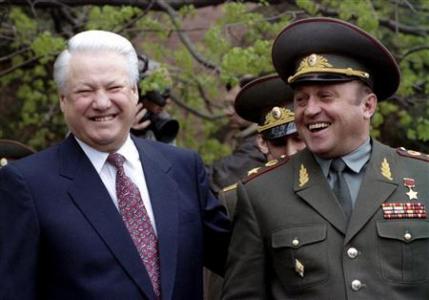
Pavel Grachev (1948-2012) (right) in (can you guess?) ... 1993, actually.
(Communist iconography dies hard.)
Most famously, Grachev was ridiculed for having claimed that the Russian military could reclaim the secessionist Chechen Republic of Ichkeria within a few hours.  The First Chechen War, which Grachev mostly commanded, ended up instead lasting nearly two years (1994-1996), costing tens of thousands of lives, and resulting in the de facto independence of Chechnya (which was brutally reclaimed in 2000 at the conclusion of the Second Chechen War, under Vladimir Putin).


“Okay, guys, off you go.  See you back here in a couple hours.”
Just for fun, we will note that the website of the radical Islamist separatist Caucasus Emirate movement, Kavkaz Center, has gleefully picked up on unfounded media speculation that Grachev was killed by poisonous mushrooms, eaten at a birthday party.  The official cause of death is acute meningoencephalitis, which can indeed be caused by some poisons.  The Emirate website theorizes that the ’shrooms were fed to him as part of a hit by Putin’s minions.  The website calls Grachev “a new victim in a long list of top Russian army generals, colonels and G.R.U. [Russian military intelligence] staff whom Putin suspected of plotting against his K.G.B. rule and preparing a military coup.”

Pavel and Boris share a tender moment.  Don’t make fun.
It’s a male Russian thing.  You might not understand.
Grachev was himself actually once involved in an assassination scandal, in 1994, when a journalist, Dmitry Kholodov, who had accused Grachev of corruption in connection with the Soviet military withdrawal from the German Democratic Republic (G.D.R.) was killed by an exploding briefcase.


I include this photo of Pavel Grachev because I have no idea what that flag in the background is.
Does anyone know?
[Also, for those who are wondering, yes, this blog is tied in with a forthcoming book, a sort of encyclopedic atlas to be published by Auslander and Fox under the title Let’s Split! A Complete Guide to Separatist Movements, Independence Struggles, Breakaway Republics, Rebel Provinces, Pseudostates, Puppet States, Tribal Fiefdoms, Micronations, and Do-It-Yourself Countries, from Chiapas to Chechnya and Tibet to Texas.  Look for it in spring 2013.  I will be keeping readers posted of further publication news.]

Subscribe Now: Feed Icon