Showing posts with label Tatarstan. Show all posts

Friday, March 14, 2014

Islam and the Second Crimean War: Russian Invasion a Calamity for Tatars but a Recruitment Windfall for Jihadists

Tatars rallying in Crimea in a plea for Turkish intervention
The Second Crimea War is about to burst forth, it seems.  The self-styled, Kremlin-installed government in Ukraine’s Autonomous Republic of Crimea declared on March 11th that it was now independent as simply the Republic of Crimea, and it will be holding a referendum on annexation to the Russian Federation in two days’ time (on March 16th).  But it can hardly be called a fair referendum: it will be held under occupation by the Russian military—something President Vladimir Putin, insanely, still denies is the case.  (The Kremlin says that the highly trained, Kalashnikov-toting soldiers in brand-new unmarked uniforms being transported around Crimea in Russian military vehicles are spontaneously organized “self-defense forces” of the local ethnic-Russian population.)  Meanwhile, the North Atlantic Treaty Organization (NATO) is massing its military forces on NATO states that border Ukraine—Poland, Romania—while Russia mobilizes troops along Ukraine’s rim in the Kremlin vassal state of Belarus and in the Russian plains along the Black Sea.  Whether this is just to intimidate Crimean voters, or whether it heralds in invasion and occupation of the Ukrainian mainland’s Russian-speaking regions as well is difficult to say.

Crimean Tatars feel more European than Russian.
The Western and Russian media are both portraying this conflict as a showdown between East and West, a settling of scores left over from the Cold War.  It is definitely that.  But the presence of the indigenous Crimean Tatar people in the Crimean peninsula complicates matters.  They are Muslim, and their history of ill treatment at Russian hands is extensive and bitter.  They will suffer the most if Russia’s plans succeed.  And it is the Tatar factor that could give the Second Crimean War a religious dimension as well and entwine it in a larger geopolitical battle with and among Muslim regional powers.


Tatars were the majority in Crimea and in what is now the south-central mainland of Ukraine until Czarist forces began pushing south in the modern period.  Tatars were decimated by deportation to Siberia and Central Asia by Josef Stalin as punishment for supposed colllaboration with Nazi Germany in the Second World War.  When Nikita Khrushchev, Stalin’s successor, allowed many deported peoples to return home in the 1950s, Crimean Tatars were not on the list.  But they have trickled backk nonetheless, especially in the post-Soviet period and now make up between 12% and 13% of the Crimean population.  Russians are about 58% and Ukrainians about 24%.  In the Soviet era, Crimea was part of the Russian republic until Khrushchev arbitrarily transferred it to the Ukrainian Soviet Socialist Republic in 1954.

It’s not a good time to be a Tatar.
The Tatar people have, by all accounts, been overwhelmingly against the annexation by Russia, and their leaders are calling for a boycott of the referendum, which the head of the Mejlis (Council) of the Crimean Tatar People, Refat Chubarov, insists will be fixed.  Within Ukraine over the past twenty years, they have enjoyed a privileged status even within Ukraine’s Autonomous Republic of Crimea—a kind of special dispensation toward indigenous peoples that is antithetical to Putin’s authoritarian and ethnic-chauvinist style.  Tatars have been forming their own “self-defense units,” according to many sources, including both Russian sources, which note it with alarm, and radical Islamist sources, which note it approvingly.  Mustafa Dzhemilev (also spelled Cemil), a revered former chairman of the Mejlis, has even made an explicit call to arms.

Refat Chubarov rails against the Kremlin.
Things could get ugly for the Tatars.  Last week, Radio Free Europe/Radio Liberty reported first-hand accounts that ethnic-Russian gangs were drawing up lists of Tatar residents and marking their homes with “X”es.  The right-wing Ukrainian nationalist firebrand Dmitry Yarosh, from the neo-fascist Rightist Sector party, claims that Russians are preparing for a massacre of Crimean Tatars.

Turkey
Moreover, Tatars are looking to Turkey as a possible savior.  It was from the penumbra of the increasingly rickety Ottoman Empire that the Czars seized control of Crimea in the mid 19th century.  Turkey and Russia have been on and off regional rivals—mostly on—since then.  While the United States and western European governments wisely remain wary of getting involved in a ground war with Russia, Tatars are banking that Turkey just might.  Never mind that the slightest retaliatory move by Russia against an interventionist Turkey would trigger Turkey’s mutual-defense agreement as a member of NATO and put Russia on a war footing with three nuclear powers.  That might be a reason for Turkey to shy away from intervening to aid the Tatars; on the other hand, it might embolden them to intervene with impunity: it would be suicidally for Russia to retaliate against Turkey itself.  Still, Crimean Tatars were heartened by the visit to Simferopol, the Crimean capital, on February 28th (reported on at the time in this blog) by Turkey’s foreign minister, Ahmet Davutoğlu.  After the meeting, Dzhemilev described the meeting to reporters, saying, “If a problem arises, Turkey will immediately get involved.”  The speaker of Turkey’s parliament, Cemil Çiçek, spoke in solidarity with Crimean Tatars on March 5th, saying, “Crimea is in our hearts and is a part of our spirit. Our brothers there have suffered more than anyone else in the past century. Our hearts are with our Crimean brothers.”  And Davutoğlu himself has said, “Don’t let it cross your mind that our prime minister and president will be indifferent to any issue affecting our kin in Crimea or anywhere in the world.  Wherever we have brothers in pain we are the first ones to go to help and do whatever we can do.”  Turkey’s 300,000-strong diaspora population of Crimean Tatars have also come out strongly in favor of intervention by Ankara.

A friend in need?  The Tatar leader Mustafa Dzhemilev meeting in Crimea
with Turkey’s foreign minister, Ahmet Davutoğlu.
Armenia and Azerbaijan
The current conflict is also playing into the cold war between two other former republics of the Soviet Union: the predominantly-Christian Republic of Armenia and the predominantly-Muslim Republic of Azerbaijan.  Armenia invaded Azerbaijan after Communism fell and set up the southwestern one-fifth of its territory as an Armenian-populated puppet state called the Nagorno-Karabakh Republic (N.K.R.), as part of a rivalry with its Turkic-speaking neighbors (including Azeris) dating back to the Anatolian Turks’ anti-Armenian genocide a hundred years ago.  Some Armenian nationalists are hoping that Russia’s new boldness on the Crimean question means Russia might step forward and formally recognize the N.K.R. as an independent state, the way it has done with its own puppet states within the Republic of Georgia, South Ossetia and Abkhazia.  Russian irregulars (and possibly regulars as well) fought on the Armenian side in the Nagorno-Karabakh War, and Armenia is strongly considering joining Putin’s Eurasian Union—his Eastern version of the European Union (E.U.)—the one which Putin tried and failed to bully Ukraine into joining, which is how the whole Crimea conflict began last month.  Azerbaijan, by contrast, is a strong ally of the U.S., which sees it as a crucial staging area for its own cold war against Iran, a Russian ally.  As with Crimea and Russia, the ultimate goal for Armenian nationalists is not so much recognition of N.K.R. sovereignty but annexation to Armenia.


The Azerbaijani government, for its part, is keeping a very low profile during the Crimea crisis, to an extent that has worried and terrified Crimean Tatars.  Dzhemilev appealed to the Azeri leadership last week, saying, “Do not leave your Crimean brothers and sisters at this difficult time.”  But two senior members of Azerbaijan’s opposition party Müsavat (“Equality”) were intercepted by Russian authorities in Makhachkala, the capital of Russia’s adjacent Republic of Dagestan, on March 9th and turned back.  They had been en route to Kiev (Kyiv), the Ukrainian capital, to offer solidarity.

Dzhemilev has also tried in vain to reach out to Kazakhstan as well.  Kazakhs, who are Muslim Turkic-speakers as well, are in a slightly different situation: they are already slated to join Putin’s Eurasian Union.

Where Turkic languages are spoken.  Crimea is in blue.
It’s a big family, but will they be there when needed?
Moldova
Elsewhere in the former Soviet Union, many in the Republic of Moldova (formerly the Moldavian S.S.R.), which is dominated by ethnic Romanians, are worried that what is happening in Ukraine may happen next in their country.  They, too, have an ethnic-Russian enclave, Transnistria, a sliver of land along the Ukrainian border, which declared itself independent of Moldova in 1991 and has functioned since then as a de facto independent Russian puppet state outside Moldovan control.  This unresolved territorial dispute has blocked Moldova’s aspirations to reunify with Romania and to join the E.U. and NATO.  If success in Crimea emboldens Putin to occupy, annex, or otherwise stir up trouble in ethnic-Russian parts of the Ukrainian mainland (as speculated upon in detail recently in this blog), then that would include Odessa oblast, to Crimea’s west, which borders Transnistria.  Ideally, Putin would like to link Transnistria by land with Russian territory.  And Moldova is currently gearing up to sign a cooperation agreement with the E.U. similar to the one that was at the root of the current Ukrainian crisis.


A further complication is Moldova’s own Turkic-speaking minority, the Gagauz, who have an autonomous region within Moldova.  Gagauzia’s parliament said last year (as reported at the time in this blog) that they would secede and form an independent state if Moldova made moves toward Romanian reunification.  And in that same February 2014 referendum, 98.4% of Gagauz said they would rather join Putin’s Eurasian Union than the E.U. Maybe they will feel differently if Russia actually invaded Moldova.  Romanians and Moldovans are hoping not to find out.

Does “Welcome to Gagauzia” go for Cossacks too?
Chechens
Probably no Muslim people in the Russian sphere of influence has suffered as much persecution in modern times as the Chechens.  They were on the front lines of Czarist southern expansion in the mid 19th century, their homeland in the Caucasus mountains was a battleground in the Second World War, and after the war Stalin deported hundreds of thousands of them as punishment for supposed collaboration with Nazi Germany.  Perhaps as much as a third of the Chechen nation perished in that wave of executions and deportations.  Caucasus peoples were second-class citizens in the Soviet Union, and after Communism collapsed in 1991 they declared independence.  As many as 50,000 Chechen civilians were killed and their capital leveled in the horrific asymmetrical wars that followed.  Boris Yeltsin and later Putin’s pitiless Chechen bombing campaigns constituted the most brutal in Europe since 1945.


Therefore, the Crimean Tatar people can rely on Chechen support in resisting the Russian invasion, right?  Wrong!  It is one of the oddities of recent Caucasus history that, after Chechnya’s “pacification” and reintegration in the 2000s, Putin appointed Ramzan Kadyrov as president of the Chechen Republic.  Though the son of the Chechen rebel leader and separatist president, Akhmed Kadyrov, who was assassinated in 2004, the younger Kadyrov had switched sides in the Second Chechen War and become a puppet of Putin.  While the larger Islamist insurgency in the North Caucasus has shifted to other republics (see below), Chechnya has become Putin’s loyal fief, where he allows to Kadyrov to run an Islamic-style state without much interference, in exchange for utter loyalty.  In the 2012 presidential elections, Putin won 99.89% of the vote in Chechnya—the highest numbers he got anywhere other than the equally corrupt Caucasus republics of Abkhazia and South Ossetia (nominally independent but populated mostly by Russian citizens).  If the numbers are true, it is the ugliest manifestation of the Stockholm Syndrome ever recorded.  If they are not, it shows how corrupt and loyal Kadyrov is.  The truth is probably a mixture.

Ramzan Kadyrov (center), current president of the Chechen Republic,
 is not on the side of his fellow Muslims in Crimea.
On February 26th, when Russians in Crimea were just beginning their agitation, Kadyrov announced that his people would be ready to come to the aid of the peninsula’s ethnic Russians.  “Ukraine and Russia are fraternal peoples,” Kadyrov said.  “I have many Ukrainian friends and like them all and regret what has recently been happening there.  The majority of people living today in Crimea are Russians, Cossacks.  We are always with them and if necessary are ready to come to the rescue.  We will stand up for Russians, Cossacks, and Chechens no matter where they live.”  Chechens, he said, were “part of multiethnic and multi-religious Russia” and “are called upon to protect our peoples.  If necessary, we are ready to go, to be observers.  If necessary, we are ready to be peacekeepers and soldiers and protect the people.”

The Chechen capital, Grozny, after Yeltsin and Putin got through with it.
And yet they seem to love Putin there.
Not satisfied with merely cozying to the Tatars’ enemies, Kadyrov threw Tatars under the bus even more explicitly, entreating Tatar deportees and their descendants in Crimea not to “heat up tensions” or “profit from the moment, gather in groups and shout various slogans.”

Ramzan Kadyrov
After the invasion, Kadyrov went further, offering to go there himself.  “If need be,” he said, “I can travel to Ukraine with volunteers who are ready to protect its population.  He added, “I spoke to Tatars, Russians, Cossacks, and Ukrainians, and all of them are saying that there are quite a few people walking in the streets of the Crimean cities, carrying black flags and acting aggressively.  A similar situation sparked the recent events in Kyiv when nationalists started gradually dictating their conditions.   This is why I think all of us need to unite and support Russian President Vladimir Putin in this uneasy situation.”  One wonders if Kadyrov really believes the Russian-media fairy tales of Ukrainian “neo-Nazi” oppression of Crimea’s Russians and Tatars, or whether he is just reading from a script prepared in the Kremlin.

An Orthodox priest demonstrating in Crimea
Caucasus Emirate
But although Chechnya is more or less pacified and under tight Kremlin control, the rest of the Russian-ruled North Caucasus is not.  The republics of Dagestan, Ingushetia, and Kabardino-Balkaria especially have been roiled for years by a separatist insurgency called the Caucasus Emirate, which is fueled by a jihadist brand of Sunni Islam that took root in the region—historically home to a more gentle, tolerant Sufist form of Islam—as one of the radicalizing effects of the Chechen Wars.  The “Vilayat Dagestan” cell of the Emirate was behind last year’s deadly bus bombings in Volgograd, which were touted at the time as a preview of the violence to come in the upcoming Winter Olympics in nearby Sochi.  Places like Dagestan are subjected to near-daily violence in the form of assassinations, suicide bombings, and ambushes.  Russian forces just barely govern the area, and the Emirate’s tendrils are intertwined with those of village warlords, organized-crime cartels, and smuggling networks.  The Rightist Sector’s Dmitry Yarosh (see above) recently called on the Caucasus Emirate to join Ukrainian nationalists in the battle against Russia (as reported at the time in this blog).  Whether he really said that and, if he did, whether it was a rhetorical flourish deployed for shock value, one thing is clear: Rightist Sector and the Emirate have almost nothing in common except for hatred of Putin.  But any kind of attack on Tatar rights will be a boon to the recruitment and propaganda efforts of the Emirate and may just drive them to expand their reach into Crimea.  (Crimean Tatars, for the most part, are very moderate in their Islam, with home-grown radicalism almost nonexistent there.)

Does Dmitry Yarosh (left) really want to open Pandora’s Box
by inviting the Caucasus Emirate to Ukraine?
Tatarstan
What of other Muslim peoples in the Russian Federation?  A natural place for beleaguered Tatars to look for help is the Republic of Tatarstan itself, in central Russia near the borderlands of Siberia and Asia.  Tatarstan’s Tatars, sometimes called Volga Tatars, are not the same as Crimean Tatars.  In fact, Tatar has often been a catch-all term for any Turkic-speaking Muslims of the Steppes or Central Asia, and Crimean Tatars are not more necessarily more closely related to the distant Volga Tatars than they are to the closer-by Turkic-speakers in the Caucasus like the Meskhetian Turks or the Karachays and Balkars.  But the Volga Tatars share their Crimean cousins’ history of oppression at Russian hands.  In the Russian civil war that followed the Communist revolution of 1917, Tatars founded the Idel–Ural State, a multinational Menshevik quasi-state which defied the Russian Bolsheviks but ultimately lost.  The Idel–Ural State was not merely Muslim.  Turkic-speaking Tatars and Bashkirs were allied with Christians such as the Turkic-speaking Chuvash and the Finno-Ugrian-speaking Udmurt, Komi, and Mari peoples.  Along with Chechnya, Tatarstan was one of the Russian republics which refused initially to sign on with Boris Yeltsin’s Federation Treaty in 1992; they later capitulated and joined, in exchange for a promise of greater autonomy on which Yeltsin’s successor, Putin, later reneged.


So one might expect Volga Tatars to hold a grudge against Putin.  Volga Tatars might, but their Putin-appointed president, Rustam Minnikhanov, sure doesn’t.  An ethnic Tatar in a republic which is only 53% Tatar, Minnikhanov went to Crimea on March 12th, after the crisis began, to sign a “cooperation agreement” with (wait for it) the self-appointed pro-Kremlin “president” of Crimea, Sergei Aksyonov (a former professional boxer with organized-crime links who goes by the nickname “Goblin”).  Minnikhanov also met with local Tatar leaders but spoke as if they were the ones who held the upper hand, lecturing them by saying that he was sure that “Crimean Tatars are smart people who will not let it all end in a bloodbath.”

Tatarstan’s president, Rustan Minnikhanov (right),
visits his kindred in Crimea—but not as an ally.
In recent years, the Caucasus Emirate movement has tried to spread its influence to Tatarstan in particular, even though there is far less home-grown Sunni radicalism there.  But a Putin-appointed president who openly sides against fellow Muslims in the Crimea might just tip the balance and make many Volga Tatars view radical Islam and the Emirate much more sympathetically.  That would be bad news for everyone.  I’m not sure Putin realizes what he’s fooling around with by alienating millions of Muslims living within the Russian Federation.

Serbs
If the Kosovo War has become a subtheme in the diplomatic wrangling over Crimea—with the Kremlin pointing to NATO’s 1999 bombing campaign which paved the way for an independent Kosovo which Russia, a Serbian ally, still opposes—then players in that war have also become a factor.  Among those who have come to Crimea to “defend” the ethnic-Russian population are “Chetnik” mercenaries from Serbia.  These ultranationalist irregulars, named for monarchist radicals from the Second World War era, played a role in the Yugoslav Wars of Succession in the 1990s, battling Muslim Bosniaks in Bosnia & Herzegovina and Muslim Albanians in Kosovo.  Now they are in Crimea to do battle opposite the Muslim Tatars who want to stay in Ukraine.  The head of the Chetnik contingent in Crimea, Milutin Mališić, told a press conference in Simferopol, “We represent ‘Chetnik Movement’ organization, you can compare them with the Cossacks in Russia.  Our goal—to provide support on behalf of the Serbian people to the Russian people.  He added, “We came at the invitation of the Cossacks.  During the civil war in Yugoslavia, many Russian volunteers came to support the Serbian people.  We are a small nation and we can not send a large number of people, but we have a great love for the Russian people.”

The Serb militia commander Milutin Mališić holds a press conference in Simferopol.
The Chetnik units in Crimea call themselves “the Wolves.”  They belong to the Chetnik faction headed by Bratislav Živković, which is sometimes called the “Prince Lazar” squadron, named for the Eastern Orthodox saint who battled for Serbia in the 1389 Battle of Kosovo and is a revered symbol of Serbian ultranationalism and Islamophobia.  It is not clear how many Chetniks are in Crimea, but Mališić is a veteran of the Kosovo conflict who was also accused in a plot to assassinate the Yugoslav (i.e., Serbian) president, Slobodan Milošević, in 2000.  They are certainly not sanctioned by the Serbian government, which is trying to ingratiate itself with the E.U. nowadays, but if Serbs are killed in Crimea it could complicate matters for Serbia both electorally and diplomatically.

Chetniks newly arrived in Crimea pose with the Chetnik and Serbian flags
and an icon of Prince Lazar.
And Cossacks, the legendary slayers of Muslim infidels in Russian frontier history, are in force in Crimea too—150 officers alone, and an unknown number of rank-and-file fighters.  As Nikolai Pervakov, first deputy commander of the Kuban host of Cossacks, told Time magazine, “Cossacks have no borders.  We are a united people, people of the same faith, traditions, customs.  Our lives are linked.  So we need to be like a clenched and monolithic fist.  Only then will we have victory.”

Cossacks guarding the parliament building in Crimea
But what about some kind of partition of Crimea itself?  If Crimea can secede from Ukraine, can’t a Tatar enclave secede from an independent or Russian Crimea?  The problem, here, is that Tatars live everywhere in the Crimean peninsula.  Plus, Tatars were forced out of their homeland in great numbers by Czarist forces in the 18th and 19th centuries, and deported by Stalin in the 20th.  They’ve been moved enough.  They won’t move again.  They are planning to stand their ground and fight.  What remains to be seen is whether they will have to do so alone.

Members of the Ukrainian feminist political collective Femen
were arrested in a demonstration in Simferopol, Crimea.
[For those who are wondering, yes, this blog is tied in with a forthcoming book, a sort of encyclopedic atlas to be published by Auslander and Fox under the title Let’s Split! A Complete Guide to Separatist Movements, Independence Struggles, Breakaway Republics, Rebel Provinces, Pseudostates, Puppet States, Tribal Fiefdoms, Micronations, and Do-It-Yourself Countries, from Chiapas to Chechnya and Tibet to Texas.  Look for it some time in mid 2014.  I will be keeping readers posted of further publication news.]

Related articles from this blog:
“Donetsk Putsch Nipped in Bud, but Could Odessa or Kharkiv Be Next as Russia Eyes Ukrainian Mainland?” (March 2014)

Saturday, February 8, 2014

Games Begin! Ukrainian Hijacking, Putin Rounds Up Dissidents


The Olympics are a symbol of peace and harmony among peoples.  So how does Vladimir Putin prepare for Russia’s hosting of the 2014 Winter games?  Why, by rounding up dissidents and ethnic minorities, of course.

(AP photo)

Circassian, gay-rights protestors rounded up
On the day of the opening ceremony in Sochi, on the Black Sea, at least 61 citizens were arrested in different parts of the Russian Federation for exercising free speech.  Among these were 19 gay-rights activists were arrested in Moscow and four in St. Petersburg.  The four in St. Petersburg did nothing more than unfurl a banner quoting the non-discrimination clause in the Olympic Charter, to which the Russian Federation is a signator.  Russia has come under harsh international criticism for recent legislation which makes any speech in favor of homosexuality of any kind punishable by law.  (The LGBT issue was listed as no. 3 in this blog’s recent article “Yet Another Genocide Olympics: 10 Political Causes Sure to Disrupt the Sochi Games.”)

Yevgeny Vitishko was arrested in Sochi on the very serious charge of “swearing in public.”
By complete and utter coincidence, he is also an environmental activist
who has criticized the government.
Also, a human-rights activist was arrested as he tried to board a plane in Kazan, capital of the sometimes-secessionist Republic of Tatarstan, in central Russia.  Environmentalist activists in Sochi have also been arbitrarily arrested.

The scene in Nalchik yesterday as Circassian protestors were arrested
In particular, near Sochi in the western part of the predominantly-Muslim North Caucasus region, 37 Circassians were arrested in Nalchik, capital of the Kabardino-Balkar Republic, for demonstrating to call attention to the Russian genocide of tens of thousands of Circassians right in the vicinity of Sochi exactly 150 years ago.  The republic is shared by two nationalities: the Kabardin branch of the Circassian nation and the Turkic-speaking Balkar people.  (The Circassian issue was listed as no. 2 in this blog’s recent article “Yet Another Genocide Olympics: 10 Political Causes Sure to Disrupt the Sochi Games.”)


Meanwhile, NoSochi2014.com, a website run by Circassian activists which encourages protests and boycotts of the Games, was hacked by unknown forces the day before the opening ceremonies and infected with malware.

Sochi is directly in the traditional region of Circassia.
Olympic-rings snafu
Snafus plagued the Olympic open ceremonies themselves.  As most people have now heard, one of the five rings that was supposed to blossom from a snowflake into a ring and erupt in fireworks failed to do so, leaving it as the anomalous shrunken snowflake next to four fully lit rings.  Naturally, this was doctored in the footage shown on Russian television, so it looked as though there had been no problem.  Was this sabotage as well?  If so, the ring selected was the one in the upper right, which is colored red on the Olympic flag and, according to some traditions meant to represent America (i.e., both North and South America, in the five-continent scheme used by much of the world (Antarctica omitted)).  Perhaps it was a jab at the United States?  Probably not.

Уууууууууууупс
Racist torch-bearer
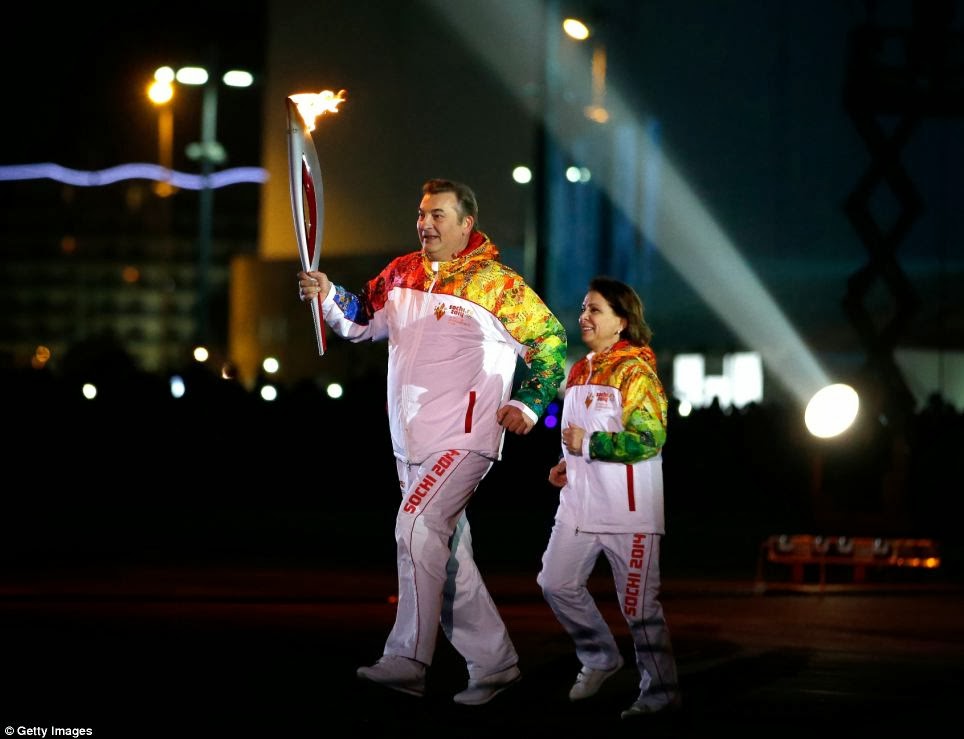
Other moments of uneasiness were perhaps less unintentional.  Eyebrows were raised when the Russian figure-skater Irina Rodnina accompanied the ceremony’s official torch-bearer.  Rodnina, who is also a member of Russia’s parliament in Putin’s ruling United Russia party, was at the center of a storm of controversy in September for posting a Photoshopped image on Twitter showing Barack Obama sitting next to Michelle with his mouth full while a banana is waved in front of him.  Initially, she cited free speech by refusing to take the image down.  The United States ambassador to Russia even called the tweet “outrageous behaviour” which “only brings shame to her parliament and country.”  Throwing bananas onto the field when foreign black athletes appear is a common form of hooliganism in European sporting events, and Russia, where anti-African racism is rampant and mostly unquestioned, this is especially the case.

The racist tweet defiantly posted in September
by one of the opening ceremonies’ final torchbearing athlete/politicians.
Putin’s secret lover among torch-bearers?
Another of the torchbearers was Alina Kabaeva, an Olympic gymnast who is an intimate of Putin’s and rumored to be his lover.  Media reported in 2008 a planned marriage between the two, but they were quashed.  More recently there have been rumors that they did marry secretly and are merely waiting for an official announcement.  Putin and his wife, Lyudmila Putina, divorced in June 2013 after 30 years of marriage.

Celebrity tabloids think Putin is romantically linked to a gymnast who carried
the torch at the opening ceremonies; they may even be secretly married.
(Or maybe they were lovers, but she still carries a torch for him?  Okay, sorry, sorry, I couldn’t resist.)

Putin’s torch-bearer and alleged mistress Alina Kabaeva.
As Lyudmila Putina put it, “Who is this bimbo, and what can she do that I can’t? Okay, never mind.”
Apologist for Syrian war crimes given key position in opening ceremony
A little more seriously, the Olympic flag was carried at the opening ceremony by a troupe of famous Russians, including a cosmonaut but also an obscurer but more controversial figure: the journalist Anastasia Popova.  A stooge of the Putin regime, Popova has appalled the international journalistic and human-rights communities by unapologetically cheerleading the embattled regime of Syria’s dictator, Bashar al-Assad. She visited Syria a few months after the civil war there began in 2011, writing, “Despite all our attempts, we didn’t manage to find the thousands-strong demonstrations against the government so often talked about by the Western media.”  More recently, she has claimed, without evidence, that it is Syrian rebels, rather than the government, that used chemical weapons against civilians.  A few days ago in an article in this blog I listed the Syrian issue as one of “10 Political Causes Sure to Disrupt the Sochi Games.”  But I didn’t think that it would be the Russian authorities themselves that would decide to flaunt their shameful support of the mass-murderer Assad and rub the international community’s nose in it.

Anastasia Popova, third from left, is Putin’s Syrian-war-crimes denier in chief.
Volgograd bombers neutralized just in time?
But security, of course, has been the biggest story of these Games, which, against all reason, decency, and common sense are being held just a few miles from the most active conflict zone in Europe, the insurgency-convulsed North Caucasus region.  Russian officials claim that on February 5th Russian police shot and killed one Zhamaldin Mirzayev, a 30-year-old alleged to be a mastermind of the recent lethal bus bombings in nearby Volgograd.  Responsibility for the attacks was claimed by a group called Vilayat Dagestan, which is not a “previously unknown group,” as the New York Times called it, but in fact a regional branch of an Islamist terrorist group called the Caucasus Emirate, which aims to break off the whole North Caucasus region (including Sochi) as an Islamic state independent of Russia.  The shootout occurred in Izberbash, in the Republic of Dagestan, a veritable war zone in the eastern North Caucasus which is so ethnically diverse that it has 30 official languages.  After the Volgograd attack, Vilayat Dagestan promised Putin they would send him “a present” for the Olympics.  Does this mean that that threat is now neutralized?  Who the hell knows.  The Kremlin controls all information about counterinsurgency operations, and Putin is highly motivated to make the Sochi Olympics seem safer than they actually are.  (The Caucasus Emirate was listed as no. 1 in this blog’s recent article “Yet Another Genocide Olympics: 10 Political Causes Sure to Disrupt the Sochi Games.”  I also listed the group as one of “10 Separatist Movements to Watch in 2014.”)

The Republic of Dagestan is “Vilayat Dagestan” in the Caucasus Emirate view of the world.
Sochi, meanwhile, is in “Vilayat Cherkessia” (Circassia).
Foiled Ukrainian hijacking
Some of the biggest headlines in the first 48 hours of these Olympics have come from the dramatic near-hijacking of a plane flying from Kharkov, in Ukraine, to Istanbul, Turkey, on February 7th, the day of the opening ceremonies.  The would-be hijacker, who was heavily intoxicated, said that a bomb was on the plane and demanded the plane, which was a Pegasus Airlines passenger jet, be taken to Sochi, for some unstated purpose.  The crew collaborated in deceiving him—and all the passengers—into thinking the plane was headed to Sochi.  But when it landed, “Sochi” was Istanbul, and the man was arrested.  Turkish police have released few details other than to say that he was a 45-year-old Ukrainian and that he was not cooperative.  It remains possible that he, like 30% of Ukrainian citizens, is ethnically Russian.  The point of origin of the flight, Kharkov, in northeastern Ukraine, is (as discussed recently in this blog) the proposed capital of a separate nation called Malorossiya or Malorussia (i.e., “Little Russia”) in the ethnic-Russian-dominated east of Ukraine.  (The Ukrainian crisis was listed as no. 4 in this blog’s recent article “Yet Another Genocide Olympics: 10 Political Causes Sure to Disrupt the Sochi Games.”)

An alleged image of the Ukrainian hijacker,
about whom as yet little is known
Watch this space for more updates on the attempted hijacking in particular, and, more generally, continuing updates on the geopolitics of the Sochi Olympics.

The defiantly racist Irina Rodnina (right)

[You can read more about Circassia, Dagestan, Tatarstan, and many other sovereignty and independence movements both famous and obscure in my new book, a sort of encyclopedic atlas just published by Litwin Books under the title Let’s Split! A Complete Guide to Separatist Movements and Aspirant Nations, from Abkhazia to Zanzibar.  The book, which contains 46 maps and 554 flags (or, more accurately, 554 flag images), is available for order now on Amazon.  Meanwhile, please “like” the book (even if you haven’t read it yet) on Facebook and see this interview for more information on the book.]


The British Virgin Islands team enters the arena

Related articles from this blog:

Tuesday, November 12, 2013

“Separatism” Added to List of Things Russians Aren’t Allowed to Talk about


Dead journalists.  The existence of homosexuality.  Anything which “offends” Eastern Orthodox Christianity.  And now Vladimir Putin’s political allies in Russia’s Duma (parliament) put forth a bill on November 8th which provides for prison terms of up to 20 years for “spreading separatist propaganda.”  The move comes on the heels of other assaults on free speech which have been damaging Russia’s already-precarious reputation as a new democracy: the jailing of members of the anti-clerical, anti-Putin dissident punk band Pussy Riot, the requirement that any charitable or nonprofit groups branching out into Russia have to register as “foreign agents,” and, most controversially in recent weeks, a new law criminalizing so-called homosexual propaganda.  This last has prompted calls at the popular level for boycotts of next year’s Winter Olympics in Sochi, Russia, or at least for protest actions to disrupt the Olympics themselves.  (Putin has promised that no athlete or spectator at the Games would be prosecuted under the new law, but that sort of misses the point.)


And what counts as “separatist propaganda”?  Well, the most likely answer—as with “homosexual propaganda”—is: anything that makes the authorities decide they want to arrest you and throw you into a hole for as long as they want.  This will doubtless include, along with violent insurgents who mean ill, many peaceful citizens with legitimate aspirations for autonomy for their ethnic and national communities.

It will also probably include much silliness as to what constitutes a separatist propaganda.  The ban on so-called gay propaganda, incidentally, has gotten so silly that last month a Kremlin vexillologist addressed a minor kerfuffle over Russia’s far-eastern Jewish Autonomous Oblast (J.A.O.)—which is, as discussed recently in this blog, a godforsaken patch of Siberia set up by Josef Stalin as a dumping ground for a troublesome minority, though today almost no Jews live there.  It seems the J.A.O. has a flag which some mistake for the “gay pride” flag.  But as the federal government official explained, the Jewish Autonomous Oblast flag ...


... was not in fact the same as the “gay pride” flag:


The designer of the J.A.O. flag, Alexandr Valyaev, even chimed in, explaining, “ On its flag the gay movement uses seven stripes, not six.  ...  The rainbow is a divine symbol, taken from the Bible.  God threw the rainbow from the sky into the wilderness of the desert as a symbol of hope.  Gays used this divine symbol, the rainbow, but removed from its spectrum the light blue color, so it’s already not a rainbow.”  In fact, the J.A.O. flag just has a lighter blue than the gay-pride flag; nothing is missing.  But, nonetheless, I notice that this Valyaev fellow seems suspiciously well versed in what the gay-pride flag looks like.  Check his papers.  (Also, the Kremlin will have a harder time explaining away the official protocols for the display of the J.A.O. flag, which call for the flag-bearer to hang the banner out of his back left jeans pocket, and then take it out and swing it above his head in a rotary motion when “Disco Inferno” comes on.)

Islamists’ proclaimed “Caucasus Emirate”
Seriously, though, Russia does have a separatism problem—most seriously in the predominantly-Muslim North Caucasus region.  Though Chechnya was pacified in two horrific wars of aggression by Russia, nationalism still persists there, awaiting a reawakening, while a Chechen government-in-exile still operates out of London.  More seriously, the Caucasus Emirate movement—a salafist, jihadist Islamist terror group which came into being after the Chechen wars lured floods of idealistic, battle-hardened young Muslim fighters from Afghanistan and the Middle East—claims that the Muslim regions of Russia’s southwestern rim are a separate Islamic state and that Russians are the interlopers.  They have killed hundreds over the last few years in a merciless campaign of ambushes, assassinations, massacre, and suicide attacks on government targets and “moderate” (mostly indigenous Sufi) clerics.  Ingushetia and Dagestan have been hit especially hard.  The Emirate has also shown signs of spreading into other restive Russian regions, such as the far-flung Republic of Tatarstan in central Russia, which was one of two republics to refuse initially to join the new Russian Federation after the Soviet Union dissolved in 1991.


Smaller, lesser known movements persist as well.  President Boris Yeltsin had told Russia’s constituent republics and other jurisdictions (oblasts, okrugs, krais, etc.) to “take as much autonomy as you can stand.”  But Putin has reversed that course—withdrawing de facto autonomous status from places like Tatarstan and Bashkortostan and even installing loyal Kremlin stooges to run places like Chechnya.  There is always the possibility that some of these other regions will get ideas and rise up—from the Finno-Ugrian-speaking Karelians along the border with Finland to the mostly-Buddhist Kalmyks and Tuvans, to the Sakha (Yakuts), Altai, Chukchi, and other peoples of the far east, to ethnic-Russian frontiersman who would like to see Siberia (all of Russia east of the Urals—i.e., 10% of the land surface of the world) become its own independent nation (some have even called for Siberia to join the United States), to “Volga Germans” who once had their own republic within Russia, to residents of the Kaliningrad Oblast exclave in former German territory who would like to split and join the independent Baltic States, and even to revived Cossack hosts along the border with Ukraine and Kazakhstan and the cis-Caucasian steppes who recall their days of glory when separate Cossack republics flicked in and out of existence during the Russian Civil War that followed the 1917 Bolshevik revolution.

Could it come to this?
The most delicate area right now, though, is the Circassians.  Inhabiting an area of the northeastern Black Sea area, including the northwestern Caucasus, the Circassians were dispersed and nearly exterminated in a series of brutal invasions by Russia in the mid 19th century.  The remnant Circassian subgroups are now spread out as mostly minorities in three different republics—all of which, to complicate things, are claimed as territory of the so-called Caucasus Emirate.  Circassians, already becoming more nationalistic in their diaspora in Turkey, Syria, and elsewhere, have become especially politicized by the choice of Sochi as a site for the 2014 Olympics.  Sochi was the site of one of the worst of the Russian massacres, in which the Ubykh subgroup of Circassians was wiped off the map exactly 150 years before the 2014 Games.  For Circassians, Sochi is hallowed ground and the choice of the site a provocation.  The Caucasus Emirate has vowed to cause trouble at at the Olympics, and Cossacks, hired by the government, have vowed to defend the Games from the trouble-makers.

Circassians remember their genocide.
But is this ideologically consistent?  Of course it isn’t.  This is Putin we’re talking about.  Although Putin cites Russia’s own internal insurgencies as it blocks the accession of the Republic of Kosovo (which split from Russia’s ally Serbia) to the United Nations, he has long played a double game.  Regular readers of this blog well know that Putin used the occasion of a 2008 war with the Georgia to grant diplomatic recognition to Abkhazia and South Ossetia, two regions that de facto seceded from Georgia (and cleansed their territories of ethnic Georgians) right after the fall of Communism.  (A month ago, as reported at the time in this blog, Moscow narrowly decided against allowing Abkhazia and South Ossetia to send their own Olympic teams so Sochi.)  More quietly, Russia props up the de facto independent Republic of Transnistria, which seceded (never formally recognized) from Moldova in the 1990s, and, even more quietly, backs the Nagorno-Karabakh Republic, which Armenia (which remains friendly to Moscow) carved out of the west flank of independent Azerbaijan in a nasty war.  Isn’t all this separatism too?  Well, yes, unless you classify those regions as “properly” part of Russia.  Putin hasn’t come right out and said that, but if he wants to have that conversation we can certainly have that conversation, and he won’t end up looking very good.

Russia’s newly empowered Cossacks.  Don’t worry, they’ll keep things nice and orderly
and peaceful—you know, like before.
In any case, will a new law criminalizing separatist propaganda make Russia’s separatist problems better or worse?  It will certainly allow Russian authorities to round up radical clerics, Muslim gang members, and anyone else suspicious with little provocation and lock them up for a long time.  In the past, though, in the Caucasus, that kind of thing only angers and emboldens the insurgency.  It is also likely to lend international sympathy to the cause of an autonomous or independent Circassia, something the movement, because of past association with jihadists, it does not enjoy.  If the Olympics were already going to be a headache for Putin, they certainly will be now.  Already, gay activists—and lots of just plain old visitors and participants who have a sense of equality and decency—are plotting ways to whip out and unfurl gay-pride flags at various times during the games, even the opening ceremonies.  Perhaps lots of other flags will start appearing as well.

Tatarstan’s flag.  Will it fly again?
Maybe even in Sochi?
Putin needs to realize that democracy means having the right to express whatever your views are on how you should be governed, including separatist sentiment.  And he will learn the hard way that suppressing national aspirations only stokes the fires.  But tyrants never learn.


[You can read more about Circassia, Siberia, Abkhazia, South Ossetia, Circassia, Chechnya, and many other sovereignty and independence movements both famous and obscure in my new book, a sort of encyclopedic atlas just published by Litwin Books under the title Let’s Split! A Complete Guide to Separatist Movements and Aspirant Nations, from Abkhazia to Zanzibar.  The book, which contains 46 maps and 554 flags (or, more accurately, 554 flag images), is available for order now on Amazon.  Meanwhile, please “like” the book (even if you haven’t read it yet) on Facebook and see this interview for more information on the book.]


Subscribe Now: Feed Icon