Showing posts with label Alina Kabaeva. Show all posts

Friday, May 23, 2014

The Babes of the New Russian Empire: Putin Serves Up Neo-Soviet Imperialism with a Slathering of Cheesecake


Russia’s president, Vladimir Putin, presents his newly muscular nationalism as an answer to Western decadence (very much taking a page from Germany’s 1930s propaganda playbook).  Wholesome Russian pop music, we are told, is being drowned out to be suggestive lyrics sung by bearded women from Austria.  Catalogues of Russian brides are slavered over by sexually frustrated Americans eager to abduct Russia’s young women into the Gomorrah of a cesspool that is the United States.  The West has embraced the shameless, sacrilegious, unpatriotic, ungrateful harlots of Pussy Riot as though they were some sort of brave dissident heroines.  The Russian Orthodox Church is laboring to give the Russian people a moral grounding of which decades of Soviet communism had robbed them.  On the other hand, of course, Putin tells us that the collapse of the Soviet Union in the early 1990s was a catastrophe for Russia.  He aims to fix all of this.

Putin contemplates some further modifications.
How embarrassing, then, when the newly appointed Minister of Culture for one of the newly established but still diplomatically unrecognized ethnic-Russian, pro-Kremlin puppet states, the Lugansk People’s Republic, turns out to have a semi-pornographic past.  No sooner was Irina Filatova (Ирина Филатова) appointed by the junta that has taken over Ukraine’s eastern border oblast of Luhansk than sultry photos of her were discovered the social-networking site VK (VKontakte) (which, with a quarter-billion users, is the Russian version of Facebook but, predictably, also shades a bit into being the Russian equivalent of AdultFriendFinder).  The photos were supposedly hurriedly removed, but can still be found anyway with not much effort [oops, this link now dead for the time being; apologies (June 2, 2014)].


More than anything else, the photos are a bit depressing.  Presumably shot in Luhansk city, the nearby sidewalks in these outdoor shots are strewn with gravel, the photos use drab, abandoned-looking post-Soviet backdrops like a gas station, and one photo (see below) even shows a bikini-clad Filatova sitting spread-eagled on a park bench clutching a champagne bottle, looking like nothing so much as one of the vodka-addled vagrants who people Russian cityscapes in the Western imagination.


Darn.  Well, I guess that’s the end of her political career, right?  That was certainly the gist of the exultant coverage of the Filatova revelations in the pro-Ukrainian press.  But, wait.  Not so fast.  In fact, not only might this be no problem at all, but it might have been actually planned.  By way of explanation, I’d like you to meet the newly appointed Minister of Culture in Lugansk’s unrecognized sister republic in Ukraine’s rebel-run Novorossiya (“New Russia”) region, the Donetsk People’s Republic (D.P.R.).

* * *

Natalia Voronina, minister of culture for the Donetsk People’s Republic
The new Donetsk minister, Natalia Voronina (Наталья Воронина), is a semi-celebrity fashion designer and, as with many female Russian celebrities, the line between sophisticated and tacky and between respectable and pornographic is ... well, let’s just say those lines are not drawn quite in the same place they are in other countries.


Voronina’s husband, the industrialist Aleksandr Kalyusskiy (Александр Калюсский), an habitué of the rebel capital’s hoity-toity “Donetsk Mafia Club,” happens to be the D.P.R.’s Deputy Prime Minister for Social Policy, but this red-headed bombshell also has a law degree and runs her own boutique and fashion line.  (Her boutique’s anti-Western, Anglophobic credentials may be in doubt however: Voronina’s spring line last year was called, in (sort of) English, “Lady Batterfly” (sic).)

Vorinina’s trophy husband: pro-Russian oligarch Alksandr Kalyusskiy
She is a positive asset to the popularity of the D.P.R.  Rebel-government handlers in her case were a bit more successful in scrubbing the Internet (in particular, VK) of some of her more erotic poses, apparently, but what remain are, while in the realm of high fashion, still fairly titillating.


If the culture ministries of the new “people’s republics” in eastern Ukraine are intended to provide their citizenry with “bread and circuses” while their rights are eroded and their once economically productive region is turned into a rubble-strewn war zone, then Filatova and Voronina are well cut out for the job—or, um, well, at least Voronina is.*

*[As of a couple weeks later, Voronina is no longer culture minister.  See my report in this blog on this development.]

Um ... whatever.
* * *

But this is nothing new in Putin’s new empire, and this is why this blog decided it was time for a Russo-specific follow-up to a popular previous blog post, “The World’s 21 Sexiest Separatists,” which included only two figures from the former-Soviet world (Emilia Plater, the 19th-century “Polish Joan of Arc,” and one of Chechnya’s presidents-in-exile, the actor and London playboy Akhmed Zakayev).


Though the pugnacious ultranationalist “new Russian” culture that Kremlin propaganda is erecting on the rubble of Ukrainian sovereignty is openly patriarchal, like much of Russian folk culture, there is a high proportion of female politicians in high positions in the zone of Russian expansion, but they feature a suspicious preponderance of visually pleasing ones.  Perhaps the most extreme example is Natalia Poklonskaya (Ната́лья Покло́нская) the new attorney general (chief prosecutor) of the Republic of Crimea, installed when it declared independence from Ukraine earlier this year and was subsequently annexed by the Russian Federation.


Poklonskaya, with her doe-eyed, innocent pretty looks, has unexpectedly become a global Internet meme and something of a cult figure in the mostly Japan-based world of the manga and animé subcultures.  A March 11th press conference by Poklonskaya posted on YouTube resulted in an explosion of fan art by Internet fans in Japan and China, who made her face into an animé icon in the pedophilia-tinged moé style—doubtless reinforced by her youthful appearance (though 34, she could pass for 14) and her office’s military-style uniform, with a jaunty tie that evokes the school uniforms popular in Japanese manga—and Japanese porn.

Natalia Poklonskaya’s many moods
But far be it from me, or this blog, to suggest that Poklonskaya is merely decorative or was chosen only for her looks.  As reported recently in this blog, her actions since taking office have included threatening the Mejlis (Council) of the Crimean Tatar Nation—which represents the 12% of Crimea who are Muslim Tatars and overwhelmingly opposed the annexation—with “liquidation.”  For a people that suffered ethnic engineered famine, ethnic cleansing, and mass deportation and death under Josef Stalin, the experience of suddenly finding themselves ruled from Moscow again and intimidated with words like “liquidation” is having the effect of terrifying many of them into silence.  So one could hardly say that Poklonskaya does not know how to do her job.


Poklonskaya’s unusual sort of fame has been welcomed by many Russian nationalists, and she famously wielded one press query about her private life by saying, “As the idiom goes, ‘Beauty saves the world.’”  But the velocity of the growth of Poklonskayamania has baffled and worried other Russian officials.  And the Kremlin has at times tried to contain the problem of floods of inquiries about her, as well as a fake Twitter account in her name.  (A Twitter tribute account remains.)

This is many Japanese middle-aged men’s fantasy, but Crimean minorities’
nightmare.  One way to put it is: the Tatars don’t have a safeword.
* * *

A little less polished and professional, so far, is Yekaterina Gubareva (Екатерина Губарева), wife of the founder of the Donetsk People’s Republic, Pavel Gubarev (Павел Губарев), who has, initially through the connection with her husband, become the D.P.R.’s Minister for Foreign Affairs.

Gubareva being interviewed at a separatist rally, with St. George’s Ribbon in buttonhole.
Gubarev first came to the attention of this blog in March when he led the first major rebellion in mainland Ukraine this year by declaring the “Donetsk Republic,” though he had already been arrested and jailed by Ukrainian authorities (as reported in this blog as well) by the time the D.P.R. was declared under its new name a month later.  (Flags still say simply, “Donetskiya Respublika.”)

Yekaterina Gubareva
Her husband’s imprisonment and, according to his supporters, his suffering torture at the Kyiv government’s hands (never substantiated) enhanced his status as “people’s governor” and lent Gubareva a kind of Yelena Bonner–like moral authority.  Her fashion-model good looks did not hurt the cause, either.

Gubareva became spokeswoman for her imprisoned husband.
(The D.P.R. does not seem to run a particularly tight ship when it comes to the protocol for cabinet appointments, however.  This week the leadership was embarrassed when a medical-school professor named Konstantin Scherbakov heard second-hand that he had been appointed the republic’s Ministry of Health.  No one had even asked him if he wanted the job, or even suggested his name was in the hopper.  As it turns out, he has no interest in the position.  “I never agreed to this, I never signed any papers, it was a complete surprise,” Scherbakov said, adding, “I work at a medical university.  I have things to do.”)

Yekaterina Gubareva
Though other leaders have come to the fore in the D.P.R., leaving Gubarev (who was released by Ukrainian authorities in a prisoner exchange this month) with a more symbolic “people’s governor” role, Gubareva’s influence has only grown, and she may prove in the long run to be even more of a shaker and mover in the separatist movement than her husband.


* * *

Already established in politics before the Ukraine crisis began last year was Nina Shtanski (Нина Штански), who is Minister for Foreign Affairs for the Pridnestrovian Moldavian Republic, a.k.a. Trans-Dniester Republic, a.k.a. Transnistria, a.k.a. Transdniestria.


This tiny sliver of eastern Moldova along the Ukrainian border, defended by the Russian military and propped up by infusions of rubles from the Kremlin, declared independence in 1991 but has existed in a kind of limbo, serving mainly as a way to prevent Moldova from being absorbed into the European Union (E.U.) or NATO.  After the annexation of Crimea, it was Shtanski who became the public face of Transnistria’s effort to get her small, diplomatically unrecognized pseudo-state admitted to the Russian Federation as well.


Shtanski, who is 37, is trained as a jurist and political scientist and has served diplomatic functions in her home republic since its foundation.  She was made foreign minister in 2012 and this year was given the added title of Deputy Prime Minister.  But she has also attracted attention for dressing in a manner that would not exactly be considered professional in other countries.  You’ve never seen Madeline Albright, Condoleezza Rice, or Hillary Rodham Clinton gussied up like this.


Many, including myself in this blog, have speculated that annexing Transnistria may be a goal of the Putin administration.  Though not at all far from Crimea’s western edge and though including the navigable estuary of the Dniester River, Transnistria is still landlocked, and linking it to Russia would probably mean the annexation or control of at least the predominantly-ethnic-Russian and fairly restive Odessa Oblast (activists have already declared it the “Odessa Republic of Novorossiya,” as reported in this blog), with its valuable Black Sea port.  Putin may even be contemplating the pros and cons of seizing all of Ukraine’s Black Sea coast.  That would make Transnistria Russia’s westernmost outpost other than the Baltic Sea exclave of Kaliningrad Oblast, at the location of Germany’s former East Prussia province.  A race for Transnistria across Ukraine’s soft underbelly might also spark a true Second Crimean War.  If so, Nina Shtanski will rise from obscurity to become a major player in global geopolitics.

It’s Christmas in Transnistria, and Nina Shtanski’s got the whole world in her hands.

* * *

Also in this category we could put Alina Kabaeva (Али́на Каба́ева), an Uzbekistan native of half-Russian, half-Tatar ancestry and since 2007 a member of Russia’s parliament for Putin’s United Russia party, whose long-term romantic relationship with the only-recently-divorced Putin is an open secret in Russia.  Kabaeva was recently listed by one business-news website as one of the “9 Most Attractive Politicians in the World” (a list with an admitted right-of-center bias; others included Sarah Palin and Mitt Romney of the United StatesRepublican Party; at no. 1, Silvio Berlusconi’s former Minister of Equal Opportunity in Italy’s cabinet, Mara Carfagna; Mexico’s establishment president, Enrique Peña Nieto; and Orly Levy, a Likud–Yisrael Beiteinu member of Israel’s Knesset who heavily courts the Russian-immigrant vote).


She is also an Olympic gymnast—a rhythmic gymnast, as the tabloids never tire of specifying—who won a bronze in Sydney in 2000 and a gold in Athens four years later.  Her presence as a torch-bearer at the opening ceremonies of the Winter Olympics in Sochi earlier this year was seen as in some sense a “coming out” and acknowledgement of her personal ties to Putin.


Though she serves in the Duma (parliament), her athletic past hardly qualified her for the position.  Like most United Russia deputies, she votes in lock step with Putin as he expands his quest for Eurasian domination.  This trophy wife—actually, trophy mistress—of one of the world’s most brutal authoritarian rulers is a decorative figurehead indeed.

Duma legislator Alina Kabaeva plunks down her designer attaché case
for another day of pretending to listen to long boring speeches.
* * *

On the other hand, it is hardly the pro-Russian faction in Ukrainian politics that has a lock on beauty and fashion.  The pro-E.U. but, most agree, quite corrupt former prime minister, Yulia Tymoshenko (Ю́лія Тимоше́нко)—who was later imprisoned by her pro-Kremlin successor Viktor Yanukovych and became a hero of the Euro-Maidan movement before running for president again in this weekend’s election (she is not favored to win)—has frequently been called “the world’s most beautiful politician.”


With her trademarked blonde braids, she has been a telegenic constant in coverage of Ukrainian politics.  Her stark beauty, while a political asset, has been used against her as well, both by pro-Ukrainian, anti-Moscow groups like the Ukrainian feminist culture-jammer guerilla-theater collective Femen, who have skewered her appearance in nude street demonstrations targeting her corruption—


—and perceived too-conciliatory approach to Putin—


—as well as by pro-Russian mobs and activists in places like Slavyansk in eastern Ukraine, whose loutish misogyny cannot separate their political opposition to her from her status as a sexual object:


* * *

Yet another Ukrainian beauty, Natalia Korolevska (Наталія Королевська), of Luhansk, was running for the presidency until withdrawing her candidacy on May 1st.

Natalia Korolevska
Korolevska, who turned 39 last week, was Yanukovych’s Minister for Social Justice until his ouster and then shifted her support to Tymoshenko.  The social-democratic “Ukraine—Forward!” party Korolevska runs focuses on anti-corruption.

Ukraine’s former social-justice minister Natalia Korolevska

* * *

But the real question remains: is Irina Filatova ready to take on the heady responsibilities of the Ministry of Culture portfolio in the Lugansk People’s Republic?  We believe she is.  We believe she is.  I mean, just look at her.


[You can read more about Transnistria, the Donetsk and Luhansk People’s Republics, and many other separatist and new-nation movements, both famous and obscure, in my new book, a sort of encyclopedic atlas just published by Litwin Books under the title Let’s Split! A Complete Guide to Separatist Movements and Aspirant Nations, from Abkhazia to Zanzibar.  The book, which contains 46 maps and 554 flags (or, more accurately, 554 flag images), is available for order now on Amazon.  Meanwhile, please “like” the book (even if you haven’t read it yet) on Facebook and see this interview for more information on the book.]


Thanks to William Abernathy, Olga Buchel, and Jeff Groton for alerting me to sources and information used in this article.


Saturday, February 8, 2014

Games Begin! Ukrainian Hijacking, Putin Rounds Up Dissidents


The Olympics are a symbol of peace and harmony among peoples.  So how does Vladimir Putin prepare for Russia’s hosting of the 2014 Winter games?  Why, by rounding up dissidents and ethnic minorities, of course.

(AP photo)

Circassian, gay-rights protestors rounded up
On the day of the opening ceremony in Sochi, on the Black Sea, at least 61 citizens were arrested in different parts of the Russian Federation for exercising free speech.  Among these were 19 gay-rights activists were arrested in Moscow and four in St. Petersburg.  The four in St. Petersburg did nothing more than unfurl a banner quoting the non-discrimination clause in the Olympic Charter, to which the Russian Federation is a signator.  Russia has come under harsh international criticism for recent legislation which makes any speech in favor of homosexuality of any kind punishable by law.  (The LGBT issue was listed as no. 3 in this blog’s recent article “Yet Another Genocide Olympics: 10 Political Causes Sure to Disrupt the Sochi Games.”)

Yevgeny Vitishko was arrested in Sochi on the very serious charge of “swearing in public.”
By complete and utter coincidence, he is also an environmental activist
who has criticized the government.
Also, a human-rights activist was arrested as he tried to board a plane in Kazan, capital of the sometimes-secessionist Republic of Tatarstan, in central Russia.  Environmentalist activists in Sochi have also been arbitrarily arrested.

The scene in Nalchik yesterday as Circassian protestors were arrested
In particular, near Sochi in the western part of the predominantly-Muslim North Caucasus region, 37 Circassians were arrested in Nalchik, capital of the Kabardino-Balkar Republic, for demonstrating to call attention to the Russian genocide of tens of thousands of Circassians right in the vicinity of Sochi exactly 150 years ago.  The republic is shared by two nationalities: the Kabardin branch of the Circassian nation and the Turkic-speaking Balkar people.  (The Circassian issue was listed as no. 2 in this blog’s recent article “Yet Another Genocide Olympics: 10 Political Causes Sure to Disrupt the Sochi Games.”)


Meanwhile, NoSochi2014.com, a website run by Circassian activists which encourages protests and boycotts of the Games, was hacked by unknown forces the day before the opening ceremonies and infected with malware.

Sochi is directly in the traditional region of Circassia.
Olympic-rings snafu
Snafus plagued the Olympic open ceremonies themselves.  As most people have now heard, one of the five rings that was supposed to blossom from a snowflake into a ring and erupt in fireworks failed to do so, leaving it as the anomalous shrunken snowflake next to four fully lit rings.  Naturally, this was doctored in the footage shown on Russian television, so it looked as though there had been no problem.  Was this sabotage as well?  If so, the ring selected was the one in the upper right, which is colored red on the Olympic flag and, according to some traditions meant to represent America (i.e., both North and South America, in the five-continent scheme used by much of the world (Antarctica omitted)).  Perhaps it was a jab at the United States?  Probably not.

Уууууууууууупс
Racist torch-bearer
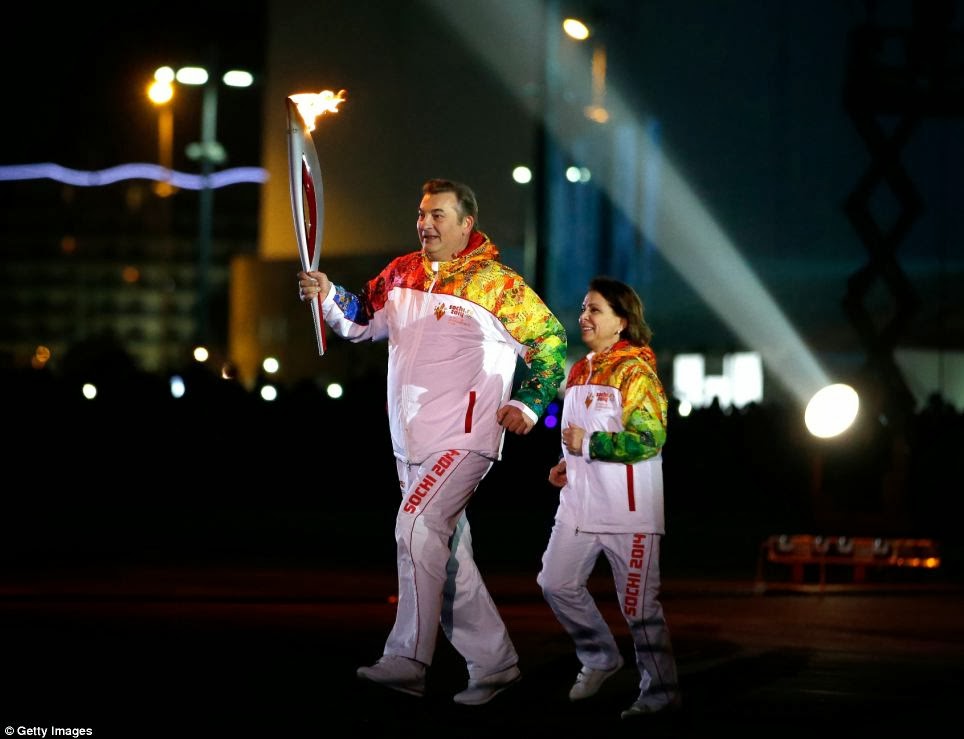
Other moments of uneasiness were perhaps less unintentional.  Eyebrows were raised when the Russian figure-skater Irina Rodnina accompanied the ceremony’s official torch-bearer.  Rodnina, who is also a member of Russia’s parliament in Putin’s ruling United Russia party, was at the center of a storm of controversy in September for posting a Photoshopped image on Twitter showing Barack Obama sitting next to Michelle with his mouth full while a banana is waved in front of him.  Initially, she cited free speech by refusing to take the image down.  The United States ambassador to Russia even called the tweet “outrageous behaviour” which “only brings shame to her parliament and country.”  Throwing bananas onto the field when foreign black athletes appear is a common form of hooliganism in European sporting events, and Russia, where anti-African racism is rampant and mostly unquestioned, this is especially the case.

The racist tweet defiantly posted in September
by one of the opening ceremonies’ final torchbearing athlete/politicians.
Putin’s secret lover among torch-bearers?
Another of the torchbearers was Alina Kabaeva, an Olympic gymnast who is an intimate of Putin’s and rumored to be his lover.  Media reported in 2008 a planned marriage between the two, but they were quashed.  More recently there have been rumors that they did marry secretly and are merely waiting for an official announcement.  Putin and his wife, Lyudmila Putina, divorced in June 2013 after 30 years of marriage.

Celebrity tabloids think Putin is romantically linked to a gymnast who carried
the torch at the opening ceremonies; they may even be secretly married.
(Or maybe they were lovers, but she still carries a torch for him?  Okay, sorry, sorry, I couldn’t resist.)

Putin’s torch-bearer and alleged mistress Alina Kabaeva.
As Lyudmila Putina put it, “Who is this bimbo, and what can she do that I can’t? Okay, never mind.”
Apologist for Syrian war crimes given key position in opening ceremony
A little more seriously, the Olympic flag was carried at the opening ceremony by a troupe of famous Russians, including a cosmonaut but also an obscurer but more controversial figure: the journalist Anastasia Popova.  A stooge of the Putin regime, Popova has appalled the international journalistic and human-rights communities by unapologetically cheerleading the embattled regime of Syria’s dictator, Bashar al-Assad. She visited Syria a few months after the civil war there began in 2011, writing, “Despite all our attempts, we didn’t manage to find the thousands-strong demonstrations against the government so often talked about by the Western media.”  More recently, she has claimed, without evidence, that it is Syrian rebels, rather than the government, that used chemical weapons against civilians.  A few days ago in an article in this blog I listed the Syrian issue as one of “10 Political Causes Sure to Disrupt the Sochi Games.”  But I didn’t think that it would be the Russian authorities themselves that would decide to flaunt their shameful support of the mass-murderer Assad and rub the international community’s nose in it.

Anastasia Popova, third from left, is Putin’s Syrian-war-crimes denier in chief.
Volgograd bombers neutralized just in time?
But security, of course, has been the biggest story of these Games, which, against all reason, decency, and common sense are being held just a few miles from the most active conflict zone in Europe, the insurgency-convulsed North Caucasus region.  Russian officials claim that on February 5th Russian police shot and killed one Zhamaldin Mirzayev, a 30-year-old alleged to be a mastermind of the recent lethal bus bombings in nearby Volgograd.  Responsibility for the attacks was claimed by a group called Vilayat Dagestan, which is not a “previously unknown group,” as the New York Times called it, but in fact a regional branch of an Islamist terrorist group called the Caucasus Emirate, which aims to break off the whole North Caucasus region (including Sochi) as an Islamic state independent of Russia.  The shootout occurred in Izberbash, in the Republic of Dagestan, a veritable war zone in the eastern North Caucasus which is so ethnically diverse that it has 30 official languages.  After the Volgograd attack, Vilayat Dagestan promised Putin they would send him “a present” for the Olympics.  Does this mean that that threat is now neutralized?  Who the hell knows.  The Kremlin controls all information about counterinsurgency operations, and Putin is highly motivated to make the Sochi Olympics seem safer than they actually are.  (The Caucasus Emirate was listed as no. 1 in this blog’s recent article “Yet Another Genocide Olympics: 10 Political Causes Sure to Disrupt the Sochi Games.”  I also listed the group as one of “10 Separatist Movements to Watch in 2014.”)

The Republic of Dagestan is “Vilayat Dagestan” in the Caucasus Emirate view of the world.
Sochi, meanwhile, is in “Vilayat Cherkessia” (Circassia).
Foiled Ukrainian hijacking
Some of the biggest headlines in the first 48 hours of these Olympics have come from the dramatic near-hijacking of a plane flying from Kharkov, in Ukraine, to Istanbul, Turkey, on February 7th, the day of the opening ceremonies.  The would-be hijacker, who was heavily intoxicated, said that a bomb was on the plane and demanded the plane, which was a Pegasus Airlines passenger jet, be taken to Sochi, for some unstated purpose.  The crew collaborated in deceiving him—and all the passengers—into thinking the plane was headed to Sochi.  But when it landed, “Sochi” was Istanbul, and the man was arrested.  Turkish police have released few details other than to say that he was a 45-year-old Ukrainian and that he was not cooperative.  It remains possible that he, like 30% of Ukrainian citizens, is ethnically Russian.  The point of origin of the flight, Kharkov, in northeastern Ukraine, is (as discussed recently in this blog) the proposed capital of a separate nation called Malorossiya or Malorussia (i.e., “Little Russia”) in the ethnic-Russian-dominated east of Ukraine.  (The Ukrainian crisis was listed as no. 4 in this blog’s recent article “Yet Another Genocide Olympics: 10 Political Causes Sure to Disrupt the Sochi Games.”)

An alleged image of the Ukrainian hijacker,
about whom as yet little is known
Watch this space for more updates on the attempted hijacking in particular, and, more generally, continuing updates on the geopolitics of the Sochi Olympics.

The defiantly racist Irina Rodnina (right)

[You can read more about Circassia, Dagestan, Tatarstan, and many other sovereignty and independence movements both famous and obscure in my new book, a sort of encyclopedic atlas just published by Litwin Books under the title Let’s Split! A Complete Guide to Separatist Movements and Aspirant Nations, from Abkhazia to Zanzibar.  The book, which contains 46 maps and 554 flags (or, more accurately, 554 flag images), is available for order now on Amazon.  Meanwhile, please “like” the book (even if you haven’t read it yet) on Facebook and see this interview for more information on the book.]


The British Virgin Islands team enters the arena

Related articles from this blog:

Subscribe Now: Feed Icon