Showing posts with label Lebanon. Show all posts

Thursday, August 1, 2013

Syrian Regime Seeks Israeli Green-Light for Separate Alawite Republic


In the “strange bedfellows” department, the embattled dictatorship in Syria—which in the past has rarely felt that it needed Israeli permission for anything, whether it was funding Hezbollah in Lebanon, harboring Palestinian militants, or continuing to claim the Golan Heights—has, it turned out, gone to the Israeli government hat in hand recently to ask its support for setting up a post-civil-war “rump state” in the coastal area of the country.


This was revealed earlier this week by the English newspaper the Guardian, which reported that Syria’s dictator, Bashar al-Assad, had asked an unnamed diplomat “to approach the former Israeli foreign minister, Avigdor Lieberman, late last year with a request that Israel not stand in the way of attempts to form an Alawite state, which could have meant moving some displaced communities into the Golan Heights area.”  (At the end of last year, I listed Syrian Alawites as one of “10 Separatist Movements to Watch in 2013.”)


Alawites, who are Arab, practice a form of Shi’a Islam and make up about 12% of Syria’s population, but after the humiliation of defeat by Israel in the Arab–Israeli War of 1967, Hafez al-Assad, the current dictator’s father, deposed the Ba’athist Arab-nationalist regime that represented the just-over-two-thirds of the country that is Sunni Arab and made his own Alawite community into the political élite.  The Alawite version of Islam, though secular and liberal by many standards, is Shiite nonetheless, thus putting Assad’s Syria in an axis of fiercely anti-Western Shiite régimes that include Iran and Lebanon’s Hezbollah, as well as radical Shiite Arabs in southern Iraq who have recently found themselves part of the political majority.  The Syrian civil war which began in 2011 began as largely political until it drew an influx of Salafist Sunni fighters.  Many of them sympathetic are foreign fighters sympathetic to al-Qaeda, they tend to regard Shiism in general and the Alawite in particular as heresy, and they have become a prominent part of the opposition.  That, more than anything else, has helped sectarianize the Syrian conflict.  It is now one of the fronts in the wider historical conflict between Shiites and Sunnis that has become a feature of the recent rise of Islamist politics—along with Lebanon, Yemen, Bahrain, and of course Iraq.  There seems no way that Muslim Brotherhood or Salafist elements would not demand, and probably get, a prominent role in a post-Assad régime.

Like father, like son
After the Ottoman Empire was dismantled at the close of the First World War, the League of Nations put France in charge of some of the empire’s Arab territories, including what are now Syria and Lebanon.  This was by far the most religiously and ethnically diverse part of the Arab world, and the French strove to avert conflict by dividing French Syria into, among other divisions, separate zones for Druze (Jabal Druze), Maronite Catholics (what is now Lebanon), and Alawites (the Alawite State).  (North of the Alawite area was the Sanjak of Alexandretta, with a mixed Arab and Armenian population, which was later snatched by Turkey.)  When Syria became independent in 1946 in its present borders, strong protections for minorities were in place as the formerly quasi-autonomous Alawite State became today’s provinces of Tartous and Latakia, which include all of Syria’s small coastline and are separated from the rest of Syria by high mountains.


It is no secret that Assad, for all his bluster, is making contingency plans for possible rebel victory in Damascus, other major cities, and the vast center and east of the country.  Observers have noted what appear to have been attempts to create a régime-controlled corridor between the Alawite region and centers of régime control in the interior.  And tensions in the Alawite region have risen dramatically.  This has been, for obvious reasons, the least rebellious part of the country, but there have been reports of attempted pogroms of Alawites by Salafist Sunnis.  Other Sunnis are fleeing the area for points east or abroad, despite the fact that is the area least affected by the war.

The flag of the French-era Alawite State.  Presumably if it were restored it would lose the tricoleur.
But why would Assad expect Israel to protect an Alawite redoubt or give a green light to an independent Alawite State?  The answer is probably because, although Israel and the Assad régime are historical enemies, Israel has even less affection for the radical Sunni Islamists that would be likely to replace Assad in Damascus.  They would, in their foreign policy, perhaps more resemble the Ba’athists that joined the alliance to destroy Israel in the 1960s.  Moreover, a post-Assad régime in Damascus would also have links to the Muslim Brotherhood, the broad Sunni movement whose brief rule in Egypt from 2011 until this summer seriously destabilized the Sinai Peninsula and Gaza Strip on Israel’s Western flank by turning away from the uneasy détente of the Mubarak years.  Salafists running Damascus might turn the Golan Heights—Syrian (actually, mostly Druze) territory which Israel has occupied since the 1967 war—into a new flashpoint.  No one wants that, except for the wackos who increasingly feature prominently in the armed Syrian opposition.

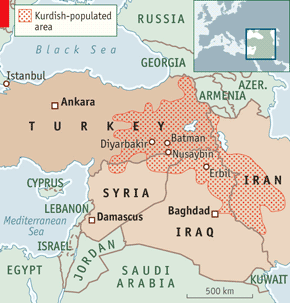
The state of play at the moment, according to the Economist
Assad is, as the saying goes, the devil Israel knows.  If Israel gives a blessing to an Alawite State, it would deny post-Assad Syria a coastline and would provide the Alawites with a place where they can rebuild, regroup, and perhaps one day take back the rest of the country.  (That seems especially possible after Egypt’s recent counter-revolution.)  But what of the fact that Western countries, including the United States, the United Kingdom, France, and the European Union generally, are dead against Assad, to the point where even radical Salafists seem like worthy allies of the moment?  Well, that is one of the biggest divides in foreign policy between Israel and its closest ally, the U.S., lately.  Israel wants Assad to stay, even if it is in a tiny breakaway state, and, though Washington is wary, when it comes to its immediate neighborhood Israel usually gets its way without much complaint from the White House.  Turkey can be expected to fight tooth and nail to prevent an Alawite State, so it could get interesting.

Strange bedfellows indeed: is the Israeli government about to join this cheering section?
The good news is that Israel may convince the U.S. to support and nurture the West Kurdistan Autonomous Region in northern Syria.  The bad news is that we might have Bashar al-Assad to kick around for quite a while yet.  But only maybe: no word yet on whether Israel is willing to go along with an Alawite State just yet.  Everyone’s still watching to see how the rest of the civil war plays out.

Syrian Kurds celebrating the establishment last year of a de facto West Kurdistan Autonomous Region.
Some call that moment simply the first crack in the break-up of Syria.
[Also, for those who are wondering, yes, this blog is tied in with a forthcoming book, a sort of encyclopedic atlas to be published by Auslander and Fox under the title Let’s Split! A Complete Guide to Separatist Movements, Independence Struggles, Breakaway Republics, Rebel Provinces, Pseudostates, Puppet States, Tribal Fiefdoms, Micronations, and Do-It-Yourself Countries, from Chiapas to Chechnya and Tibet to Texas.  Look for it some time in 2013.  I will be keeping readers posted of further publication news.]

Saturday, September 22, 2012

Angelina Jolie in Erbil and Baghdad, Rioting in Bingöl, Kurds Rounded Up in Denmark: Kurdistan Update, 16-22 September 2012


NORTH KURDISTAN (TURKISH KURDISTAN)

Killing of 18 Turkish Police, Military Prompts Anti-Kurdish Riot in Bingöl.  In southeastern Turkey’s Bingöl province, in the Kurdish region, eight police officers were killed by a landmine on September 16th, and nine were injured.  Also in Bingöl, on September 18th, a Turkish army convoy of over 200 soldiers was attacked by Kurdish rebels armed with rockets, killing 10 and injuring more than 70.  On September 21st, a non-Kurdish mob in Bingöl, angry over the violence, attacked the local offices of the pro-Kurdish but mainstream Peace and Democracy Party (B.D.P.).  The mob hurled stones, sticks, and furniture and had to be dispersed by riot police with water cannons.

The anti-Kurdish mob in Bingöl this week.
5 Killed in Other Kurdish Violence across Turkey.  Four Turkish soldiers were killed by remote-controlled bombs in Turkey’s southeastern Hakkari province, it was announced September 15th, in an area near the borders with Iran and Iraq where fighting with the separatist Kurdistan Workers’ Party (P.K.K.) has approximated civil war in recent weeks.  Five were wounded in the incident.  A regional public prosecutor in Tunceli province, Murat Uzunwas shot in the head as he entered his apartment building on September 19th and died the following day in the hospital.  The P.K.K. claimed responsibility for the killing.  Then, on September 20th, security forces near Diyarbakir, the notional Kurdish capital, in southeastern Turkey, defused a bomb found on a bridge near an airport, causing the cancellation of flights as the situation was investigated.  Police suspect the P.K.K.  The group is also suspected in the torching of a school in Hakkari province on September 21st.  There were no injuries in that incident.


SOUTH KURDISTAN (IRAQI KURDISTAN)

Angelina Jolie Visits Syrian Refugees, Urges Iraqi Kurds to Keep Borders Open.  The United States actress Angelina Jolie visited northern Iraq’s autonomous Kurdistan region this week, and on September 16th she visited refugee camps and urged the Kurdistan Regional Government’s prime minister, Nechirvan Barzani, as well as other officials, to keep borders open so that refugees from Syria’s civil war can seek refuge in the K.R.G. area.  Jolie is a Special Envoy for the United Nations High Commission for Refugees (U.N.H.C.R.).  Over a quarter-million Syrians have fled to neighboring countries since the civil war began.

Angelina Jolie visiting with Kurds in Baghdad
EAST KURDISTAN (IRANIAN KURDISTAN)

Iranian Kurdish Dissident Survives Assassination Attempt in Sweden.  The deputy head of Iran’s dissident Kurdistan Freedom PartyHossein Yazdanpanah, told Kurdish media this week survived an assassination attempt in Sweden last month, which he blames on Iranian agents.  But it wasn’t the first time.  “Since 1991,” he says, “the Iranian government has tried to kill me more than 10 times.”  During his stay in Sweden, visiting friends, three masked men tried to break into the house where he was staying, he said.  Despite the masks, Yazdanpanah conjectured from hair and skin tone that the men were from Lebanon and Somalia and had received paramilitary training in Iranian camps in Syria.  (That’s a lot of information to glean from merely, say, part of a wrist or an earlobe!)  Swedish police are apparently investigating the incident.


Hossein Yazanpanah, assassination survivor
KURDISH DIASPORA


Danes Bust 8 Kurds on Terrorism Fundraising Charges during Probe of T.V. Station.  In Denmark this week, authorities arrested eight people who are accused of raising and distributing money for a terrorist organization, in this case the Kurdistan Workers’ Party (P.K.K.).  Danish authorities made the discoveries during an investigation into Roj TV, a Kurdish television network based in Copenhagen.

Flag of the P.K.K.
[Also, for those who are wondering, yes, this blog is tied in with a forthcoming book, a sort of encyclopedic atlas to be published by Auslander and Fox under the title Let’s Split! A Complete Guide to Separatist Movements, Independence Struggles, Breakaway Republics, Rebel Provinces, Pseudostates, Puppet States, Tribal Fiefdoms, Micronations, and Do-It-Yourself Countries, from Chiapas to Chechnya and Tibet to Texas.  Look for it in spring 2013.  I will be keeping readers posted of further publication news.]

Saturday, August 4, 2012

Liberation of Syrian Kurdistan Infuriates Turkey, Iraq, and the Free Syrian Army—in Fact, Everyone but Assad

Celebrations in the liberated town of Derkli in Syrian Kurdistan

[Note: See these earlier articles from this blog on related topics, especially with respect to the Kurds and the Arab Spring: “And Now Civil War ... Could Syria Break Up?” (Nov. 2011), “The Iraq War Is Over, but Is Iraq’s Partition Just Beginning?” (Dec. 2011), “Ten Separatist Movements to Watch in 2012” (Dec. 2011); “Get Ready for a Kurdish Spring” (March 28, 2012); “Shifting Alliances in the Kurdish Struggles” (April 1, 2012); “Turkish Delights Hide Ugly History” (April 4, 2012);  “Syria’s Kurds Are Setting Up a Quasi-State—How Long Can It Last?” (July 2012), and, on a pretty much weekly basis, installments of my “Week in Separatist News” columns.]

The world’s media this week are focusing on what seem to be final battles for control of Syria in Damascus and Aleppo, what nearly everyone is predicting to be the dictator Bashar al-Assad’s last stand.  More quietly, Syria’s civil war is spilling over the borders into neighboring countries—not just into Lebanon, where Shiites and Sunnis have been killing each other for decades (see below), but across the borders that transect the stateless nation of Kurdistan—Syria’s borders with Turkey and Iraq.

This week saw some startling developments.  Last week in this blog, I described the liberation of the northern strip of mountainous land along the Turkish border, where Syria’s 2 to 3 million Kurds, who are 9% of the population, mostly live.  A makeshift Kurdish government called the Supreme Kurdish Council, which represents a rapprochement between long-feuding Kurdish factions, has declared this area the Western Kurdistan Autonomous Region, and it is running it as a de facto independent state.  (The notional capital of Syrian Kurdistan, Qamishli, right on the Turkish border, with 184,000 people, is an exception; Kurds seem to control it only partially, though news is sketchy.  Likewise Hasakah, which in the city is mostly Christian Assyrians anyway.)


How this came about is in dispute and points to some of the contradictions in Kurds’ relationship to the civil war.  Kurds, historically, have felt as sidelined as the Christians, the Druze, and the Sunni Arab majority under Assad’s Shiite Arab regime.  But as the rebellion against Assad picked up steam last year, the regime handed out some favors to the Kurds to keep them from rebelling as well: they were, for example, granted full citizenship rights for the first time.  (Previously, they had been regarded as spillover population from Turkey and not fully Syrian.)  And Assad spared the Kurdish region much of the violence he perpetrated elsewhere.  Kurds were strident about their identity but did little to antagonize the regime through most of the war, leading to suspicions by the Sunni Arab nationalists that were coming to dominate the Turkish-backed opposition’s Syrian National Council (S.N.C.) and Free Syrian Army (F.S.A.) that the Kurds were somehow Assad’s allies.  To be fair, the Kurds are a mountain people that are used to having no real allies, so they quite understandably were careful not to throw their lot in entirely with one side or another in the civil war until they could see how it would turn out.  Being geographically out of the way, they could afford this; the fight would have no reason to come to them.  So, when they took over a string of major towns, they themselves described it as the capturing or taking of those towns, whereas in fact they had to work harder to keep the F.S.A. out than they did the regime’s forces.  Why Assad relinquished the region so readily can only be guessed at.  Most likely, he has decided that he will only fight for the important, central, Arab-dominated parts of Syria at this point, now that he is on the ropes.  And if, as some suspect (discussed last week at length in this blog), Assad’s Alawite Shiite inner circle is contemplating surviving a Sunni takeover in Damascus by setting up an Alawite quasi-state west of the mountains by the Mediterranean, then pulling out of Kurdistan would begin the necessary dismemberment process.  Or, if the F.S.A. decided to insist on taking Kurdistan back from the Kurds too, then that, too, would suit Assad: there is nothing wrong with having one’s enemies exhaust themselves fighting each other.  If Assad’s regime survives in an Alawite redoubt, then conceivably the Kurds could benefit from whatever cease-fire guarantees the Alawites their own area by getting a similar deal.  If all of Syria gets ruled by Sunni nationalists, though, then the Kurds will already have their autonomous region and will be in a stronger position to demand to keep it, within a democratic Syria, much on the model of the autonomous Kurdistan Regional Government (K.R.G.) in northern Iraq.


Speaking of Iraq: it was the K.R.G. itself, under its president, Massoud Barzani, which brokered the formation of the Kurdish Supreme Council out of two warring factions in the so-called Arbil Agreement, named for the K.R.G. capital where it was signed.  (These two factions are the Democratic Union Party (P.Y.D.) and its local proxy the People’s Council of Western Kurdistan—which have ties to the militant Marxist separatists of the Kurdistan Workers’ Party (P.K.K.), which has been waging low-level civil war against the government in Turkey for decades—and the Kurdish National Council (K.N.C.), which the P.Y.D. tended, in earlier conflicts, to regard as too mainstream and conciliatory, too quick to cut deals with the regime.  Neither ever trusted the F.S.A. much.)  Barzani has taken a strong hand in aiding the Syrian Kurds, by helping unite them and by setting up training camps to train Kurdish refugees from Syria so they could go home and continue fighting.  This proactive approach is a gamble for Barzani: the Syrian civil war aside, Barzani had just been reaching the point where Turkey was warming to the existence of a K.R.G. quasi-state in northern Iraq and signing lucrative energy deals with it. With the K.R.G. as an ally, Turkey would never again have to rely on Iran or on Syrian or Iraqi Arabs for Middle Eastern oil and natural gas; plus, it could solidify its role as a conduit of those essentials to Europe.  Only such a geopolitical edge could ever convince a Turkish government to cosy up with Kurds of any country.  But by siding with Syrian Kurds so decisively, Barzani may have sacrificed warming ties with his Turkish neighbors.  More seriously, by exercising his own foreign policy, Barzani has upped the ante in his war of words with the central Iraqi government in Baghdad, which is already accusing him of setting up a quasi-state and has tried to punish the surprising number of western oil and natural-gas firms who are willing to go behind Baghdad’s back and sign deals with the K.R.G. directly.


But now Barzani has angered Baghdad as never before (read about it in detail below), by dispatching his own personal Kurdish army to Iraq’s Nineveh province (a Kurdish-controlled area outside K.R.G.’s technical jurisdiction) to side with Syrian Kurds in a border standoff at the Syrian-Iraqi border where the Iraqi army had tried to push its way into Syria this week.  The result is an armed standoff between thousands of soldiers in two armies: a Shiite-run Arab one and two Kurdish ones.  No one has yet blinked.  If Iraq is ever going to collapse into separate countries once and for all, it may start here, and any day now.  Perhaps Barzani is even dreaming of joining the two Kurdish autonomous regions, the Syrian and the Iraqi one, into a transnational Kurdish proto-state, even a fully independent one.  The whole map of the Middle East may get redrawn soon.

The current border standoff between Barzani, the Syrian Kurds, and Baghdad is occurring in the light green blob just north of the “I” in “IRAQ” in this map.

Turkey is also furious.  It has long regarded Kurds as its most serious enemy, internal or external, and it long ago used its leverage as the North Atlantic Treaty Organization’s front-line bulwark state in the cold war with the Soviet Union to coax NATO, the European Union (E.U.), the United States, and others to classify the P.K.K. as a terrorist organization (even though they restrict themselves almost entirely to military and quasi-military (civil defense) targets) and to overlook Turkey’s brutal genocidal policy towards the fifth of its population that is Kurdish.  And now it sees the P.K.K.’s allies in Syria setting up a quasi-state, and with the help of Turkey’s so-called friends in the K.R.G. as well.  Ankara is quite paranoid and irrational about the Kurdish issue.  Surely, Syrian Kurds have enough to do without trying to use their territory to launch fresh attacks against Turkish targets in Turkey, but that is just what Turkey says it has done, and the result is the ongoing battle of Şemdinli (described in more detail below).  The spring thaw always brings a renewal of violence—mostly hit-and-run attacks by the P.K.K. against Turkish military outposts—in mountainous southeast Turkey, but this spring’s attacks have been bolder and more numerous than usual, an outgrowth of the “Kurdish Spring” rebellions in Turkey earlier this year (reported on in this blog at the time) and of relentless legal and political pogroms against Kurdish leaders and Kurdish civil society by the Turkish government.  Now, according to Turkey, Kurdish forces streamed across the border from Syria and surrounded and attempted to take the town of Şemdinli, resulting in a pitched battle that is still ongoing.  Who knows what really happened.  This may be the cover story for what was in reality an unprovoked, Turkish-initiated offensive.  For one thing, Şemdinli is not that near the Syrian border and so would be an odd choice of a town to besiege with an offensive reaching in from Syria.  But one thing is clear: Turkey’s on-again-off-again war with its Kurds is now no longer the usual P.K.K. hit-and-runs, round-ups by security forces, or the occasional quick airstrike at a suspected mountain base.  It is now a ground war, and it will probably get better before it gets worse.


Now the details, from this week’s news reports from Syria and Kurdistan ...

Syria-Border Standoff Brings Iraqi Kurds, Iraq Army Face to Face, Arms Drawn.  As the civil war in Syria raged toward an apparent endgame, the central government of the Republic of Iraq sent 7,000 soldiers on July 27th to border crossings between Syria and the Iraqi province of Nineveh and tried to cross into adjacent Syrian areas controlled since last week by a new quasi-independent Kurdish government along Syria’s northern rim.  But 3,000 Kurdish peshmerga rebels blocked their way, leaving the two battalions at a standoff, which as of August 1st is without an end in sight.  The deputy minister of peshmerga, or soldiers (literally, “those who face death,” in Kurdish), for  Iraq’s northern autonomous Kurdistan Regional Government (K.R.G.) said that his ministry had sent an artillery unit to the area to protect the Syrian peshmerga—a move which Iraq’s increasingly authoritarian Shiite Arab prime minister, Nouri al-Maliki, called unconstitutional: Nineveh (ancient cradle of the Assyrian Empire), though it includes most of the Kurdish region that borders Syria, lies outside the K.R.G.’s technical jurisdiction.  In reply, the K.R.G. peshmerga deputy minister, Anwar Haji Osmanwarned that actions against them by Baghdad could lead to the K.R.G. forces attempting to bring non-K.R.G. Kurdish-dominated regions in Iraq under its control, including heavily contested areas like Kirkuk.  Maliki has sent more troop reinforcements to the site of the standoff.

Bashar al-Assad pictured on a border crossing between Iraq and Syria.
“Hey, guys, I’ll see you later.  If anyone needs me, I’ll be sipping piña coladas at poolside somewhere with Idi Amin.”

A K.R.G. military commander, Gen. Izzadin Saadosaid that, if the Iraqi military pushed forward as far as Zumar, Sinjar, and Mira, in Nineveh, then they would effectively retake areas that Kurdish have de facto autonomously governed since the United States invasion of 2003.  Nineveh is home to Kurds who are adherents of the Yazidi sect, a secretive religious minority who blend Sufism, Zoroastrianism, as well as other pre-Muslim local beliefs and are branded as heretical by most Muslims.  “The Ministry of Peshmerga prepared its forces to protect against any Iraqi army attacks and in any places,” Osman said, adding, “If the Iraqi army assaults peshmerga in Zumar area”—referring to a Nineveh border crossing in question—“we will extend the fight to all places.  We will not fight in one place.  We will protect our land in all places.”  Maliki himself issued a statement advising the K.R.G. that policing borders was Baghdad’s responsibility, adding, “Such action by the Kurdish regional forces could ignite a conflict with the Iraqi armed forces.”  By July 30th, Iraqi lawmakers were gathering signatures to compel the K.R.G.’s president, Massoud Barzani, to appear before the parliament in Baghdad and answer tough questions. Meanwhile, the Kurdistan Islamic Union (K.I.U.), the Kurdistan Islamic Group (Komal), and the Patriotic Union of Kurdistan (P.U.K.) have all condemned Maliki’s unilateral actions.

Anwar Hoji Osman

Turkish Foreign Minister, Syrian Rebel Leader Appeal to Barzani to Hold Back.  Both the foreign minister of Turkey and the leader of Syria’s opposition in the civil war traveled to Arbil, capital of Iraq’s northern autonomous Kurdish region this week to ask the Kurdistan Regional Government’s president, Massoud Barzani, to exercise restraint in his support for Kurdish separatism in northern Syria.  First, on July 29th, the president of the Syrian National Council (S.N.C.), the main armed opposition group in Syria, arrived in Arbil, capital of the K.R.G., to try to convince Barzani to try to convince Syria’s Kurdish rebels to join the S.N.C.  Currently, amid the chaos of Syria’s civil war, a coalition of Kurdish militias who united last month in an agreement in Arbil presided over by Barzani, are running most of the Kurdish towns in northern Syria as a de facto independent Western Kurdistan Autonomous Region, with logistical support from Barzani’s regional Kurdish military.  The S.N.C. president, Abdulbasid Seyda—who is himself a Kurd, though most S.N.C. members are Sunni Arabs—will also meet with the leadership of the Supreme Kurdish Council (also called Supreme Kurdish Committee), the newly minted governing body of the autonomous region in Syria, which is a coalition of the Kurdish National Council (K.N.C.) and the People’s Council of Western Kurdistan (P.C.W.K.) (an outgrowth of Syria’s main pro-Kurdish party, the Democratic Union Party, or P.Y.D., which is perceived as allied with the Kurdish separatist militia in Turkey, the Kurdistan Workers’ Party, or P.K.K.).  The S.N.C., which is heavily supported by Turkey’s government, is thus under pressure to neutralize the influence of the P.K.K., Ankara’s deadliest enemy, in Syria.  Then, on August 1st, the Turkish foreign minister, Ahmet Davutoğlu, arrived in K.R.G. territory to deliver the message that Turkey would not tolerate anything it regards as a threat to its territory from without and urge Barzani to withdraw his political and logistical support of the P.Y.D., which Ankara conflates with the P.K.K., via the Supreme Kurdish Council.  The Turkish government has been particularly focused on the relatively small issue of P.K.K. flags being raised in newly liberated areas in northern Syria.  (Predictably, the central Iraqi government in Baghdad had a hissie fit over Turkey sending Davutoğlu directly to the Kurdish regional capital rather than to Baghdad, but especially because they made a side trip to Kirkuk, an oil-rich Kurdish-ruled city which is not technically in the K.R.G.’s territory.)  This all comes as Turkey undertakes an enormous mobilization of its military forces along the Syrian border, with tanks maneuvering ostentatiously on August 2nd in Turkey’s Şanlıurfa province, within a kilometer of the Syrian border and within sight of Kurdish-controlled towns.  But Hussein Kochar, the P.Y.D.’s top representative in Iraq, insisted July 27th that Barzani is committed to Kurdish unity and would take no actions to undermine the coalition that formed the Supreme Kurdish Council, adding, “55% of the Syrian National Council is dominated by the Muslim Brotherhood.  Syrian people know this will fail because the Brotherhood cannot manage a multi-ethnic, multi-religious, and diverse country like Syria.”

Massoud Barzani and Ahmet Davutoğlu

Baghdad Claims Autonomous Kurdish Region Made Secret Arms Deal.  On July 29th, an anonymous high-ranking official in the Republic of Iraq’s Shiite-Arab-dominated government told media that intelligence agencies had discovered a secret deal between a foreign country and Massoud Barzani, president of the northern autonomous Kurdistan Regional Government (K.R.G.).  “The weapons,” the source said, “include anti-armor and anti-aircraft missiles, and a large number of heavy weapons.”  The source pointed out that the deal is unconstitutional because defense is handled only by the central government.

French Energy Firm Buys 35% Stake in 2 Blocks in Kurdish Region; Baghdad Fumes.  The French multinational oil and natural-gas firm Total, S.A., has joined Exxon Mobil Corporation and Chevron Corporation of the United States in engaging directly with Iraq’s northern autonomous Kurdistan Regional Government (K.R.G.) rather than with the Iraqi central government, in this case by buying a 35% share in two exploration blocks in K.R.G. territory currently owned by Marathon Oil Corporation, of Houston, Texas.  As with Chevron and Exxon, both of which were banned from further bids with the central government as a penalty, Baghdad threatened severe punishment in the form of “blacklisting” for Total or any other firms that sign unilateral deals with the K.R.G. without going through the central government.  Total is based in Courbevoie, France.


Amid Civil War, Kurds Kill 6 Syrian Soldiers in Tit-for-Tat.  In Syria, Kurdish fighters described as being from the Popular Protection Unitskilled six government troops on July 27th in retaliation for three Kurds killed in an earlier attack.  The fighters promised more reprisals if Kurds were not left alone.  The Units, also known as the Y.G.P., are governing the territory in northern Syria known now as the Western Kurdistan Autonomous Region.  On July 29th, celebrations were held in street parties in the major liberated towns in Syrian Kurdistan, including Qamishli, the declared capital of Western Kurdistan, which appears to have finally been ridden of the central government’s military.

7 Soldiers, 39 Rebels Die as Kurds and Army Battle for Turkish Border Town.  In addition to the usual grinding on of low-level civil war in Turkey’s southeastern Kurdistan region, the Turkish military is also in the midst this week of major offensives against Kurdish separatist rebels both in Diyarbakir province, which is not far from the Syrian border and which includes the unofficial Kurdish “capital,” Diyarbakir, and in Hakkari province, at the three-way conjunction of Iraq, Turkey, and Iran, where Turkish forces launched airstrikes August 2nd in response to what Ankara says is an attempt by Kurdistan Workers’ Party (P.K.K.) rebels to parlay what Ankara considers their new base of operations in northern Syria into an almost unprecedented attempted takeover a Turkish town, in this case Şemdinli.  Near the beginning of the week, in Diyarbakir province, a remote-controlled roadside bomb destroyed a military vehicle on July 27th, killing two soldiers and injuring one other and a civilian.  Separatist rebels from the banned P.K.K. were suspected.  On July 29th, in southeastern Turkey’s Şırnak  province, two Turkish soldiers died when their vehicle overturned in a non-combat-related incident.  On July 30th, the government announced that battles between the army and the P.K.K. in Şemdinli, in Hakkari province, had killed two Turkish soldiers and wounded 10.  The same day, two women the government called P.K.K. members were arrested in Istanbul and had ammunition confiscated.  Two Turkish soldiers died in a battle with the P.K.K. near Lice, in Diyarbakir province, on August 1st.  Around the same time a P.K.K. landmine destroyed part of a road near Diyarbakir.  The military reported via media on August 1st that 39 P.K.K. rebels had been killed in Hakkari, near the border with Iran, in operations ongoing since July 25th, which apparently intensified July 29th when nearly 100 P.K.K. fighters, according to the Turkish military at least, crossed into Turkey from northern Iraq and reached Şemdinli, where Turkish troops subsequently surrounded them, having been tipped off by two P.K.K. informants who had surrendered.  The battle of Şemdinli was still ongoing on August 3rd, and attempts by police, media, and Kurdish support groups to reach the area were hampered by a forest fire.  On August 3rd, meanwhile, in Siirt province, an armed attack by suspected P.K.K. fighters on a gendarmerie station killed one Turkish soldier and injured 13.  A second military position in Siirt was attacked as well, but without casualty.

Şemdinli this week

Ankara Grants Residency to Exiled Iraqi Vice-President.  At the expiration of his 90-day visa, Iraq’s exiled vice-president, Tareq al-Hashemi, who has been living in Turkey, was given a Turkish residence permit, it was announced July 30th.  A member of Iraq’s Sunni Arab minority and an opponent of the increasing authoritarianism of President Nouri al-Maliki (a Shiite Arab), Hashemi fled to Iraq’s northern autonomous Kurdistan region in December after Maliki issued a warrant for his arrest (as reported in this blog at the time) on charges of terrorism and running personal death squads.  After being sheltered by Massoud Barzani, president of the Kurdistan Regional Government (K.R.G.), Hashemi moved on Turkey, where he has been harbored by the ruling administration, to Maliki’s anger.

Tareq al-Hashemi


20 Hurt as Lebanon’s Sunnis, Shiites Battle in Streets—Spillover from Syria Strife.  The civil war between, in part, a Sunni Muslim majority and a Shiite minority in Syria has been echoed in the streets of neighboring Lebanon’s second-largest city, Tripoli, where 20 people, including three soldiers, were wounded July 27th in street clashes.  The fighting began between a neighborhood dominated by Sunnis and one home to members of the Alawite branch of Shi’a Islam (the same as that followed by the Syrian dictator Bashar al-Assad).  But it quickly spread to other Tripoli neighborhoods.  By the next day, the country’s army command was declaring itself in control of Tripoli and blamed the violence on “tensions that had been mounting since” the July 18th suicide-bomb in Damascus that gutted Syria’s defense cabinet.

Tripoli, Lebanon, this week

[Also, for those who are wondering, yes, this blog is tied in with a forthcoming book, a sort of encyclopedic atlas to be published by Auslander and Fox under the title Let’s Split! A Complete Guide to Separatist Movements, Independence Struggles, Breakaway Republics, Rebel Provinces, Pseudostates, Puppet States, Tribal Fiefdoms, Micronations, and Do-It-Yourself Countries, from Chiapas to Chechnya and Tibet to Texas.  Look for it in spring 2013.  I will be keeping readers posted of further publication news.]

Friday, August 3, 2012

Olympic Update: Femen Protest, Bigoted Judokas, Sudanese Defectors


UPDATE ON THE LATEST SEPARATIST, ETHNONATIONALIST, AND SILLY-NATIONALIST MOMENTS AT THE LONDON OLYMPICS


Olympic Rules Indulge Arab Refusal to Practice Next to, Let Alone Compete with, Israelis.  Olympics organizers continue to indulge some Muslim countries’ refusal to allow their teams to compete against athletes from Israel.  Iran is one such country, but the only Iranian athlete in a sport in which Israel is also competing, Javad Mahjoub, a judo competitor, stayed home with a stomach problem (a very convincing alibi).  Meanwhile, Lebanon’s judo team (what is it with the Middle East and judo?) even refused to practice on the same mat as Israelis, so organizers provided a screen—presumably so that the Lebanese would not have to look at any Jews.  (One Israeli official quipped, “What?  They can’t see us, but they will smell us.”)  You would think that having members of an ethnic group that one despises within one’s field of vision would help one chop cinder blocks or skulls or whatever it is they do in judo more aggressively and energetically—but then what do I know.  In this blogger’s opinion, the Lebanese team should have been sent home and then banned from the next Olympics.  This sort of thing goes part of the way toward explaining why no predominantly Muslim country has yet hosted an Olympics.  (Lebanon’s one of the more progressive ones!)  Though if Kurdistan becomes independent, it will probably be the most sexually egalitarian, comfortably secular, and Israel-friendly state in the Muslim world.  Istanbul, Madrid, and Tokyo are the three candidates for the 2020 Summer Games.  I say give it to Diyarbakir.

Israel’s judo team—honestly, they’re not that bad to look at.

Meanwhile, Fabien Gilot, a Jewish member of France’s gold-medal-winning swim team, offered a riposte to the I.O.C.’s controversial decision to disallow a moment of silence during the opening ceremonies for the Israeli athletes killed by Palestinian terrorists at the 1972 Munich games.  He showed his arm tattoo, which (Leviticus 19:28 notwithstanding) featured the words, “I am nothing without them”—a tribute, he explained, to his step-grandfather Max Goldschmidt, a survivor of Auschwitz.


Ukrainian Feminist Activists Protest Islamic Misogyny on Tower Bridge.  Members of Ukraine’s guerilla-activist feminist collective Femen—who made news July 26th when a member accosted Patriarch Kirill I, head of the Russian Orthodox Church, at Kyiv’s airport to call attention to Russia’s fem-punk-rockers turned political prisoners, Pussy Riot—have now invaded the Olympic Games in London.  The target of their protest August 2nd was the International Olympic Committee’s perceived coddling of misogynistic Islamist regimes such as those of Saudi Arabia (which, until the kingdom loosened up this year, the I.O.C. indulged in its ban on female athletes) and Iran.  (See above article for another example.)


Femen argues (for example, on its Facebook page) that regimes which oppress women should be banned from the Games.


At an earlier protest in France, Femen activists made a related point.

Femen activists marched along London’s Tower Bridge topless with words like “Shame” written on their bodies, until policemen, failing to cover them up with coats, hustled them into paddywagons and took them away.  And now we can breathe a sigh of relief because the United Kingdom is safe once again, the Queen is on her throne, and all’s right with the world.

Bobbies versus boobies.  No, it’s not an episode of The Benny Hill Show.

Nor is this Femen’s first foray into the Olympic arena.  Last year, nude Femen activists demonstrated in front of Kyiv’s Olympic Stadium during the Euro 2012 championships to protest the advocacy of the decriminalization of prostitution in Ukraine by the Union of European Football Associations (UEFA).


3 Sudanese Runners Defect in England after Failing to Qualify for Olympics.  The Republic of Sudan’s Olympic Mission in London announced July 31st that three of its athletes, all of them runners, have applied for political asylum in the United Kingdom.  The three traveled to the North Yorkshire town of Middlesbrough, England, on June 15th for training but did not qualify for the Games.  The athletes are Al-Nazeer Abdul GadirSadam Hussein, and Osman Yahya Omar.  (As he moves forward toward U.K. citizenship, someone might want to recommend a name change for Sadam Hussein.)  Elfatih Abelaal, head of the Sudanese Olympic mission, Darfuri rebels and “communists” for influencing the athletes’ decision.  It couldn’t possibly be the fact that their own government is currently mowing down protesters with sniper fire and sentencing adulteresses to death by stoning.  No, it must be communist brainwashing.

The Sudanese Olympic team is shrinking almost as fast as Sudanese territory.

Kashmiri Separatists Bring Message to London Games.  Members of the Jammu and Kashmir Liberation Front (J.K.L.F.), a group seeking independence for the Republic of India’s only predominantly-Muslim territory, on August 2nd launched a month-long “Torch of Peace” publicity campaign at the London Olympics, with banners and other demonstrations. The J.K.L.F.’s leader, Yasin Malik, said in Srinagar, Kashmir’s capital, “The statistics about the martyred and disappeared persons will travel throughout the Olympic valley highlighting the Kashmir issue and human rights violations being committed on the Kashmiri people by the Indian army and forces.”  Unlike some other Kashmiri separatists, which want to reattach Kashmir to Pakistan, the J.K.L.F. seeks independence for all of Jammu and Kashmir from its two occupying forces, India and Pakistan.  

Kashmiris bring their message to London.

[Also, for those who are wondering, yes, this blog is tied in with a forthcoming book, a sort of encyclopedic atlas to be published by Auslander and Fox under the title Let’s Split! A Complete Guide to Separatist Movements, Independence Struggles, Breakaway Republics, Rebel Provinces, Pseudostates, Puppet States, Tribal Fiefdoms, Micronations, and Do-It-Yourself Countries, from Chiapas to Chechnya and Tibet to Texas.  Look for it in spring 2013.  I will be keeping readers posted of further publication news.]

Subscribe Now: Feed Icon