Showing posts with label civil war. Show all posts

Sunday, July 27, 2014

Chorus Grows for Independence for Muslims in Central African Republic’s North


A few months ago in this blog, I reported on a nascent ambition among the Central African Republic’s beleaguered Muslims to split away as a separate independent country.

Governance of the C.A.R., since independence, has swung between different peoples,
in a country where no ethnicity has a majority.
The C.A.R. was not always on the list of countries straddling Africa’s Christian–Muslim divide plagued by militant separatism, a list that has included Nigeria, Kenya, Côte d’Ivoire (Ivory Coast), and the recently-partitioned Sudan.  But in 2012 a civil war broke out along the lines separating the 15% Muslim minority from the 80% Christian majority in France’s former landlocked colony.  (Since 35% are sometimes reported as “animist,” and since followers of tribal religions often belong to an organized religion as well, these figures are fairly approximate.)  Within months, Séléka, the Muslim umbrella coalition, deposed the Christian-dominated government in a coup d’état, but in just under a year, in January of this year, a Christian counter-coup turfed them out.  Reprisals have been particularly bloody, including massacres on a scale that has made some toy with the word genocide and even some fairly well documented instances of revenge cannibalism, including by a young “Muslim eater” nicknamed “Mad Dog.”

The notorious Islamophage “Mad Dog”
As in other civil wars, reprisals have forced the ethnic and religious boundaries on the ground to sharpen, as local minorities flee to areas where their own groups predominate.  For months now, Séléka has effectively sealed off the northern portion of the C.A.R. and is running it as a sort of de facto state, outside government control.  As one Muslim put it back in April, “The partition itself has already been done.  Now there only remains the declaration of independence.”


That may be coming.  General Mohamed Moussa Dhaffane, a Séléka delegate, said on July 22nd at a multi-party conference on the C.A.R. crisis in Brazzaville, Congo, that the only solution to the nation’s strife that can protect Muslims from pogroms is full independence.

Abakar Sabone wanted to bring a partition plan back
from Brazzaville, not another cease-fire
That view was echoed by Abakar Sabone, who heads the Movement of Central African Liberators for Justice (M.L.C.J.).  Sabone, a former Muslim cleric, said that Séléka “represent[s] the Muslim community in the north.  The partition is already effective because all Muslims are now in the north and the current government has no access to the north.  Séléka are voicing what that community in the north wants.”


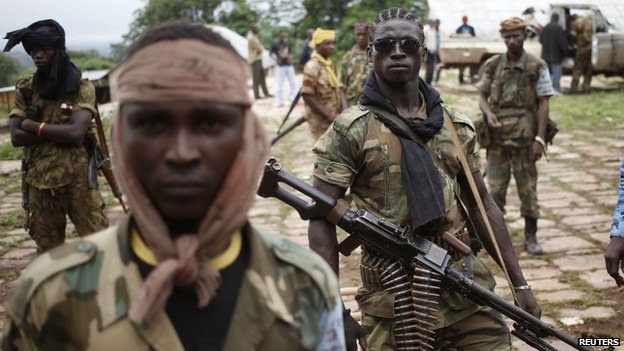
The Brazzaville summit had a more modest result, however.  All the participants went home with was a half-hearted cease-fire agreement between Séléka and the Christian–“animist” coalition called the “Anti-Balaka movement.”  Left unspecified was how such a cease-fire could be enforced in a country where no one is really in charge.  And shortly after the deal was announced, the Séléka leader Major-General Joseph Zoundeiko (pictured above), who had not attended the conference, told the B.B.C. that he rejected its terms and that his followers would not abide by it.  He demanded instead the immediate partition of the country.


Some C.A.R. Muslims are saying that a full half of the country should become their new state, reflecting not their share of the population so much as the vast areas Séléka held at the height of the civil war (see map above).  Still unresolved, too, is what the new country would be called.  The rather uninspiring Republic of Northern Central Africa has been proposed; I suppose Sélékastan is a possibility as well.  In April, supporters of the idea were circulating a proposed flag, but I have not yet been able to track down such an image.

When Séléka fighters do display a flag, it tends to be the C.A.R.’s national flag.
It is hard to imagine the international community ever sanctioning such a plan.  The Republic of South Sudan next door serving as an illustration of how dividing a country (in that case, the Republic of Sudan, partitioned with the United Nations’ blessing in 2011) between a Muslim north and Christian south can lead to previously unimaginable levels of misery and chaos.  Meanwhile, the United States and other Western countries fear that radical Islamist insurgencies in an arc stretching from northern Mali to northern Nigeria to Kenya and Somalia and Yemen are gradually making common cause with one another under what may eventually be an al-Qaeda banner.  And there is reason to fear that an “independent” state governed by an ill-disciplined rebel army in northern C.A.R. could allow that region to once again become a haven for Joseph Kony and his dreaded Lord’s Resistance Army (L.R.A.).

No one wants to give Joseph Kony a new lawless zone to move around in.
No, the international community, including even and especially the African Union (A.U.), remain steadfastly committed to making Africa’s European-drawn, colonial-era borders sacrosanct—no matter how much suffering ensues as a result.


[For those who are wondering, yes, this blog is tied in with my forthcoming book, a sort of encyclopedic atlas to be published by Auslander and Fox under the title Let’s Split! A Complete Guide to Separatist Movements, Independence Struggles, Breakaway Republics, Rebel Provinces, Pseudostates, Puppet States, Tribal Fiefdoms, Micronations, and Do-It-Yourself Countries, from Chiapas to Chechnya and Tibet to Texas.  The book, which contains dozens of maps and over 500 flags, is now in the layout phase and should be on shelves, and available on Amazon, by early fall 2014.  I will be keeping readers posted of further publication news.  Meanwhile, please “like” the book (even though you haven’t read it yet) on Facebook.]

Thursday, August 1, 2013

Syrian Regime Seeks Israeli Green-Light for Separate Alawite Republic


In the “strange bedfellows” department, the embattled dictatorship in Syria—which in the past has rarely felt that it needed Israeli permission for anything, whether it was funding Hezbollah in Lebanon, harboring Palestinian militants, or continuing to claim the Golan Heights—has, it turned out, gone to the Israeli government hat in hand recently to ask its support for setting up a post-civil-war “rump state” in the coastal area of the country.


This was revealed earlier this week by the English newspaper the Guardian, which reported that Syria’s dictator, Bashar al-Assad, had asked an unnamed diplomat “to approach the former Israeli foreign minister, Avigdor Lieberman, late last year with a request that Israel not stand in the way of attempts to form an Alawite state, which could have meant moving some displaced communities into the Golan Heights area.”  (At the end of last year, I listed Syrian Alawites as one of “10 Separatist Movements to Watch in 2013.”)


Alawites, who are Arab, practice a form of Shi’a Islam and make up about 12% of Syria’s population, but after the humiliation of defeat by Israel in the Arab–Israeli War of 1967, Hafez al-Assad, the current dictator’s father, deposed the Ba’athist Arab-nationalist regime that represented the just-over-two-thirds of the country that is Sunni Arab and made his own Alawite community into the political élite.  The Alawite version of Islam, though secular and liberal by many standards, is Shiite nonetheless, thus putting Assad’s Syria in an axis of fiercely anti-Western Shiite régimes that include Iran and Lebanon’s Hezbollah, as well as radical Shiite Arabs in southern Iraq who have recently found themselves part of the political majority.  The Syrian civil war which began in 2011 began as largely political until it drew an influx of Salafist Sunni fighters.  Many of them sympathetic are foreign fighters sympathetic to al-Qaeda, they tend to regard Shiism in general and the Alawite in particular as heresy, and they have become a prominent part of the opposition.  That, more than anything else, has helped sectarianize the Syrian conflict.  It is now one of the fronts in the wider historical conflict between Shiites and Sunnis that has become a feature of the recent rise of Islamist politics—along with Lebanon, Yemen, Bahrain, and of course Iraq.  There seems no way that Muslim Brotherhood or Salafist elements would not demand, and probably get, a prominent role in a post-Assad régime.

Like father, like son
After the Ottoman Empire was dismantled at the close of the First World War, the League of Nations put France in charge of some of the empire’s Arab territories, including what are now Syria and Lebanon.  This was by far the most religiously and ethnically diverse part of the Arab world, and the French strove to avert conflict by dividing French Syria into, among other divisions, separate zones for Druze (Jabal Druze), Maronite Catholics (what is now Lebanon), and Alawites (the Alawite State).  (North of the Alawite area was the Sanjak of Alexandretta, with a mixed Arab and Armenian population, which was later snatched by Turkey.)  When Syria became independent in 1946 in its present borders, strong protections for minorities were in place as the formerly quasi-autonomous Alawite State became today’s provinces of Tartous and Latakia, which include all of Syria’s small coastline and are separated from the rest of Syria by high mountains.


It is no secret that Assad, for all his bluster, is making contingency plans for possible rebel victory in Damascus, other major cities, and the vast center and east of the country.  Observers have noted what appear to have been attempts to create a régime-controlled corridor between the Alawite region and centers of régime control in the interior.  And tensions in the Alawite region have risen dramatically.  This has been, for obvious reasons, the least rebellious part of the country, but there have been reports of attempted pogroms of Alawites by Salafist Sunnis.  Other Sunnis are fleeing the area for points east or abroad, despite the fact that is the area least affected by the war.

The flag of the French-era Alawite State.  Presumably if it were restored it would lose the tricoleur.
But why would Assad expect Israel to protect an Alawite redoubt or give a green light to an independent Alawite State?  The answer is probably because, although Israel and the Assad régime are historical enemies, Israel has even less affection for the radical Sunni Islamists that would be likely to replace Assad in Damascus.  They would, in their foreign policy, perhaps more resemble the Ba’athists that joined the alliance to destroy Israel in the 1960s.  Moreover, a post-Assad régime in Damascus would also have links to the Muslim Brotherhood, the broad Sunni movement whose brief rule in Egypt from 2011 until this summer seriously destabilized the Sinai Peninsula and Gaza Strip on Israel’s Western flank by turning away from the uneasy détente of the Mubarak years.  Salafists running Damascus might turn the Golan Heights—Syrian (actually, mostly Druze) territory which Israel has occupied since the 1967 war—into a new flashpoint.  No one wants that, except for the wackos who increasingly feature prominently in the armed Syrian opposition.

The state of play at the moment, according to the Economist
Assad is, as the saying goes, the devil Israel knows.  If Israel gives a blessing to an Alawite State, it would deny post-Assad Syria a coastline and would provide the Alawites with a place where they can rebuild, regroup, and perhaps one day take back the rest of the country.  (That seems especially possible after Egypt’s recent counter-revolution.)  But what of the fact that Western countries, including the United States, the United Kingdom, France, and the European Union generally, are dead against Assad, to the point where even radical Salafists seem like worthy allies of the moment?  Well, that is one of the biggest divides in foreign policy between Israel and its closest ally, the U.S., lately.  Israel wants Assad to stay, even if it is in a tiny breakaway state, and, though Washington is wary, when it comes to its immediate neighborhood Israel usually gets its way without much complaint from the White House.  Turkey can be expected to fight tooth and nail to prevent an Alawite State, so it could get interesting.

Strange bedfellows indeed: is the Israeli government about to join this cheering section?
The good news is that Israel may convince the U.S. to support and nurture the West Kurdistan Autonomous Region in northern Syria.  The bad news is that we might have Bashar al-Assad to kick around for quite a while yet.  But only maybe: no word yet on whether Israel is willing to go along with an Alawite State just yet.  Everyone’s still watching to see how the rest of the civil war plays out.

Syrian Kurds celebrating the establishment last year of a de facto West Kurdistan Autonomous Region.
Some call that moment simply the first crack in the break-up of Syria.
[Also, for those who are wondering, yes, this blog is tied in with a forthcoming book, a sort of encyclopedic atlas to be published by Auslander and Fox under the title Let’s Split! A Complete Guide to Separatist Movements, Independence Struggles, Breakaway Republics, Rebel Provinces, Pseudostates, Puppet States, Tribal Fiefdoms, Micronations, and Do-It-Yourself Countries, from Chiapas to Chechnya and Tibet to Texas.  Look for it some time in 2013.  I will be keeping readers posted of further publication news.]

Saturday, August 25, 2012

Yee-Haw! Texas Judge Vows to Defend Lubbock County from Obama and the United Nations


Meanwhile, the jury is still out on the important question of whether there is something in the air or soil in Texas that makes people stupid, or whether stupid people just all move to Texas.

No clarification on this point can be had from the latest statement by Tom Head, a judge in Lubbock County, Texas.  Speaking to reporters from—you’ll never guess—Fox Television, he predicted civil war if Barack Obama is reelected as United States president, and vowed to stand alone if necessary against the United Nations.

Hizzoner, Tom Head
As Head put it, “He’s going to try and hand over the sovereignty of the United States to the U.N.  Okay.  What’s going to happen when that happens?  I am thinking worst case scenario—civil unrest, civil disobedience, civil war maybe.  And we’re not talking just a few riots here and demonstrations.  We’re talking Lexington, Concord, take up arms and get rid of the guy.  Now what’s going to happen if we do that, if the public decides to do that?  He’s going to send in U.N. troops.  I don’t want ’em in Lubbock County.  Okay.  So I’m going to stand in front of their armored personnel carrier and say, ‘You’re not coming in here.’  And the sheriff, I’ve already asked him, I said, ‘You gonna back me?’  He said, ‘Yeah, I’ll back you.’  Well, I don’t want a bunch of rookies back there.  I want trained, equipped, seasoned veteran officers to back me.”

Lubbock County, Texas.
As we speak, Ban-ki Moon is looking at this map in the U.N. war room, twirling his mustache,
and wondering how he could possibly conquer this last redoubt of freedom.
Later, when asked if the taxpayers would have to foot the bill for the civil war, Head said his statements had been taken out of context: “As emergency management director, I have to think of the worst-case scenario, and I used that as an example.”  Nothing like the mention of evil taxes to make a Texan Republican back-pedal from any statement.

Actually, come to think of it, my vote goes for something in the soil.


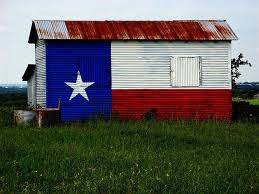
[You can read more about Texan sovereigntists and other separatist and new-nation movements, both famous and obscure, in my new book, a sort of encyclopedic atlas just published by Litwin Books under the title Let’s Split! A Complete Guide to Separatist Movements and Aspirant Nations, from Abkhazia to Zanzibar.  The book, which contains 46 maps and 554 flags (or, more accurately, 554 flag images), is available for order now on Amazon.  Meanwhile, please “like” the book (even if you haven’t read it yet) on Facebook and see this special announcement for more information on the book.]


Thursday, March 15, 2012

The Cyrenaica Crisis: Will Libya Stay United?

The long struggle for Libya—which ended in late 2011 with the ignominious execution of Moammar al-Qaddafi by rebels, after months of civil war—may not be finished.  With the world’s attention now on the Syrian chapter in the Arab Spring saga, it has been easy to assume that Libya was one of the Arab Spring countries that was out of the woods—the dictator dead, a newly installed government born from the pro-democratic rebel movement, promising elections and recognized and supported by the international community.  First, though, came the disturbing news reports about how most of the impromptu militias which formed around the vast desert nation to bring down Qaddafi were not quite giving up their arms.  Then came the bombshell last week, when an organization calling itself the Congress of the People of Cyrenaica declared, unilaterally, that the oil-rich eastern third of Libya was now “autonomous.”  This was not a declaration of independence; these Cyrenaicans merely want a return to the very loose federal system that prevailed before Qaddafi took power in 1969, under which the three regions—Cyrenaica (Barqah, in Arabic), Tripolitania (Tarabulus, in Arabic), and Fezzan—mostly ran their own affairs.  But the Transitional National Council which has run Libya from Tripoli, in Tripolitania, since Qaddafi’s defeat, is reacting as though it were a declaration of independence.  Its chairman, Mustafa Abdul Jalil, has said that Libya will remain united, by force if necessary.  A Cyrenaica–Tripolitania divide is not an utterly new wrinkle, however; these are old rifts in Libyan society, exacerbated by the oil boom and by an inevitable struggle over what a post-Qaddafi Libya will stand for.

Libya’s traditional regions

Cyrenaica has been independent before.  From 1949 until 1951 it was the sovereign Emirate of Cyrenaica, established through the United Nations and the United Kingdom as part of the plan to deliver Libya into post-colonial hands after it was taken by the victorious Allies as Second World War booty from Benito Mussolini’s defeated Italy.

Flag of the independent Emirate of Cyrenaica (1949-1951)

Italy had conquered all of what is now Libya from the Ottoman Empire immediately before the First World War, in the Italo-Turkish War (not counting a brief period during which a largely unrecognized Republic of Tripolitania existed from 1919 to 1923—one candidate for the first republic in the Muslim world, a distinction also claimed by Azerbaijan).  When the Ottoman Empire was dismembered under the Treaty of Versailles, Italian lordship over the country was made official.  The Italians originally worked deftly through local leaders—in Cyrenaica, for example, co-opting one Sayyid Muhammad Idris bin Muhammad al-Mahdi as-Senussi and placing him in charge of the colony as Emir.  Idris was the grandson of Muhammad ibn Ali as-Senussi, the founder of the Senussi order, a local Islamic revivalist political and religious order which had been fighting, and later continued to fight, against European colonizers, be they Italian, French, or British.

Flag of the Tripolitanian Republic, 1919-1923

But by Mussolini’s time that kind of indirect rule, verging on autonomy, was swept away in favor of Fascist authoritarianism.  When the Allies carved up Italy’s colonies, the U.K. got Tripolitania and Cyrenaica (both territories corresponding to Ottoman vilayats, or provinces), and France got the former vilayat of Fezzan in the south, a mostly uninhabitable desert region abutting what were already the French colonies of Algeria, Niger, and Chad.  The English were much better than the French at striking deals with local traditional rulers and were instrumental in propping up the Emirate of Cyrenaica, reinstalling Emir Idris—who had aided the British against Nazi Germany’s Erwin Rommel during the war—as head of state.

Idris, first and only king of the United Libyan Kingdom

But make no mistake: all of this back-and-forth was not motivated by European (or Turkish) altruism, not even when, in 1951, the U.N. was ushering in a United Libyan Kingdom under the old emir, now King Idris I.  (Tripoli was the nominal capital, but Idris’s palace was in Benghazi, Cyrenaica’s main city.)  The British, by 1951, were seeing in Algeria what a headache it could be to have a North African colony and were easily coaxed by the U.N. into allowing Tripolitania to become part of the new kingdom.  Under the Senussi dynasty, European powers (whichever ones were in charge at the moment) had access to Cyrenaica’s vital harbors and eventually access to Libya’s share of that twentieth-century gold rush, the oil boom.  With Idris on the throne as head of state, British corporations were still a presence—even after the Suez Crisis in 1956, to the chagrin of Arab nationalists everywhere, who were becoming more anti-British after that showdown over control of Mediterranean trade routes.  And the way the Libyan economy was structured—this was more the case in Libya than in post-French Algeria or post-Spanish Morocco or certainly in Egypt after the Suez Crisis—not too much of that oil wealth trickled down to Africans themselves.  Idris also raised some hackles of regional leaders when he abolished the three more or less autonomous regions in 1963 and recast Libya as a unitary state subdivided into small, weak provinces.  It is all this that explains the appeal of Colonel Moammar al-Qaddafi, who took power in a military coup in 1969, using the moment of weakness when Idris, who had failed to produce an heir and had become enfeebled, was handing the reins of state to his nephew Prince Hasan al-Senussi (see genealogy below).  Qaddafi declared the Libyan Arab Republic, on Islamic socialist principles and as an avowed enemy of all forms of European colonialism.

Flag of the former United Libyan Kingdom—
and of the new, post-Qaddafi Libya as well

This anti-Europeanism served Qaddafi and Libya well.  Foreign firms were chased out.  Libya followed a Saudi Arabian model of strict authoritarianism coupled with a deft manipulation of its oil production for maximum revenue.  Qaddafi made Libya that rarest of birds: a debt-free Third World nation.  And it wasn’t even Third World: Libya had the highest standard of living in Africa and a form of cradle-to-grave socialism, free education, and free everything that put it in the same league as super-rich countries like Saudi Arabia and Sweden.  And, unlike Saudi Arabia, they did it without entanglement with European and Western corporations.  However, like the pigs in Animal Farm, Qaddafi turned into a king himself—a self-styled “King of Africa,” with him and his family enjoying lavish lifestyles funded by the nation’s oil revenues.  Nor was there any such thing as regional government; Qaddafi was the government.  Himself a tribal Bedouin Arab born in a tent in Tripolitania, he manipulated public opinion against the large Berber minority in Libya, calling their very existence a myth (though he was enlightened when it came to the cultural rights of “black” (sub-Saharan) Africans in Libya’s south).  And he favored Tripolitania in his many flamboyant development projects, leaving Cyrenaica, by the time of the 2011 civil war, with a rotting infrastructure.

Moammar al-Qaddafi

When the Libyan people joined the Arab Spring, Cyrenaica joined first, and for much of the bloody civil war that followed Benghazi was the rebel capital.  Tripoli was the last redoubt of the Qaddafi government, and he also managed to find succor among local people near the end in Fezzan—where tribal Tuareg nomads had long been his personal Cossack-type mercenary shock force.  The Senussi dynasty was right there aiding the rebels as well.  In fact, the current head of the pro-autonomy Cyrenaica Transitional Council is Ahmed Al-Zubair al-Senussi, who is not only the most important Cyrenaican on the internationally recognized Transitional National Council currently ruling Libya (a former political prisoner himself, he has the political-prisoners portfolio) but is also a great-great-grandson of the Senussi order’s founder, Muhammad ibn Ali as-Senussi and thus second-cousin-twice-removed to King Idris I.  (He was also King Idris’s nephew, since Ahmed al-Senussi’s aunt Fatima married Idris—Fatima and Idris being first cousins once removed—but never mind all that; see the genealogy below if you’re interested).

Ahmed al-Senussi, leader of the Cyrenaican autonomy movement

The autonomy declaration was also supported by all the major tribes from Cyrenaica, including the al-Manfah tribe, represented by Muhammad al-Mukhtar, son of Omar al-Mukhtar, a Libyan national hero in the struggle against Fascism rule during the Mussolini era.

Cyrenaicans, and especially the Senussi dynasty, perhaps hated Qaddafi more than anyone else.  But why are they still discontent now that he’s gone?  Numbers tell part of the story.  Cyrenaica has about 20% of Libya’s population, but 80% of its oil reserves—plus (unlike poor South Sudan) pipelines, refineries, and harbors to get it to market.  (Fezzan’s population is negligible.)  The autonomy they envision would allow the wealth to be distributed locally.  This is a familiar pattern: relatively sparsely-populated, oil-rich areas seeking independence or autonomy so as not to share so much of their resources and wealth with the larger population.  Separatist movements in Scotland, Alaska, and Kurdistan come to mind.  (See my recent article on the Scottish and Iraqi situations.)


When Chairman Jalil, Libya’s current transitional ruler, responded to the Cyrenaica declaration last week, he not only exaggerated the declaration of autonomy into essentially separatism, but he blamed the autonomy movement on back-stabbing “sister Arab nations” (he must have meant Morocco or Algeria?; Egypt and Tunisia both condemned the autonomy declaration) and remnant Qaddafi loyalists.  That last accusation is not only laughable but outrageous.  Ahmed al-Senussi spent most of his adulthood in one of Qaddafi’s prisons after he led a failed monarchist uprising in 1970.  And Cyrenaica was so much the solid heartland of anti-Qaddafi sentiment that at various points in the civil war observers wondered whether a military stalemate would lead to an independent Cyrenaica, leaving Qaddafi in charge of Tripolitania and Fezzan—a sort of Korea situation.  The civil war would have been no more than a slightly messy coup d’état if it had not been for Tripolitanian Qaddafi loyalists.  And Jalil himself was Qaddafi’s Minister of Justice for years until the 2011.  And in Qaddafi’s Libya, believe you me, whoever claws his way to becoming the minister in charge of that dictatorship’s vast secret police network and kangaroo courts is not going to be a nice person.  Jalil is hardly in a position to accuse the Cyrenaican élite of being pro-Qaddafi.

Mustafa Abdul Jalil, Libya’s transitional ruler

Essentially, Jalil is trying to paper over some uncomfortable facts that the Cyrenaica declaration lays bare.  First, the revolution is not over.  Libyans who sacrificed everything to depose Qaddafi are noting that just next door in Egypt the new military transitional government is trying so hard to hold onto power that street protests have erupted all over again.  The leadership at the very top in Egypt has not really changed, and, so long as Jalil is still in charge, that is true in Libya as well.  Libyan elections have been scheduled, but Libya won’t be a democracy until they’re actually held.  Libya has never had a democratic government before; many Libyans worry that a former Qaddafi minister might not be the person to trust with that transition.

Second, related to the above, I will conjecture from what is happening in public that Ahmed al-Senussi and Jalil have butted heads in private on the T.N.C.—likely on the question of political prisoners and the reform of the justice system, an area of expertise for both of them, from different ends of the gun.

And, third, in this tumultuous time it is safe to say that whether Libya will be open for business and with whom is still an open question, debated within the T.N.C.  Certainly, the North Atlantic Treaty Organization, in helping the rebels win the war, hoped that Libya would reengage economically with the world, and also has been eager to ensure—as per usual in United States and western European military interventions—a transition to a Western-friendly government that is open for business.  During the later Qaddafi years, especially after his 2003 rapprochement with the international community, there was quite a lot of U.S. and U.K. investment in Libya’s oil business (Italian, Canadian, and French as well).  But Qaddafi’s oil industry (like Saddam Hussein’s) was nationalized; foreign firms cut deals with the Libyan state oil monopoly, but could not own any of it—and a huge amount of Libya’s oil profits was swept right back into the state’s socialist coffers.  How much of that will change? and who can make the transition?

Libyan rebels during the 2011 civil war

Keep in mind that, for all the U.S. demonization of him in the 1980s, Qaddafi had by the very end become a sort of ally of the West.  He gave up his nuclear program in 2003—wisely, after watching the U.S. bomb Iraq into the Stone Age as punishment for a nuclear program they didn’t have—and was finally playing ball with international courts on compensation for the 1988 terrorist bombing over Lockerbie, Scotland.  Qaddafi surely understood that the War on Terror was, among other things, a cover for taking down the small number of regimes that would not open up their oil wealth to U.S. interests—meaning, as of 2001, Iran, Afghanistan, Iraq, and Libya.  This was, as is well documented, the explicit policy of George W. Bush’s presidency, well before the September 11, 2001, attacks (though Libya, more in the European zone of economic influence, was at the bottom of the list).  So Qaddafi, protean desert fox that he is, turned himself into someone who was useful to the West in the battle against al-Qaeda in the Arab world.  Qaddafi and his Tuareg mercenaries worked closely with the U.S. Central Intelligence Agency (C.I.A.) in the late Bush and early Barack Obama administrations.  And we all remember how rebels sorting through Qaddafi’s presidential palace last year found documentation of Qaddafi’s creepy love-crush on the Bush’s Secretary of State, Condoleezza Rice.  No wonder U.S. participation in NATO’s Libya operation was so restrained and half-hearted; in U.S.-foreign-policy parlance, Qaddafi had become our son of a bitch.  Perhaps the U.S. even helped make sure that former Qaddafi loyalists like Jalil were on the N.T.C.—you know, just for continuity, if there has to be a revolution.


Qaddafi’s secret photo album.  He also reportedly spent a lot of time writing
“Mrs. Condoleezza al-Qaddafi” in flowing cursive all over his Pee-Chee folder.


So who will be the West’s son-of-a-bitch now?  Who will be the West’s man to run Libya?  Jalil, who surely, given his position, was privy to (if not deeply involved in) Qaddafi’s cooperation with the C.I.A., would be one candidate—and one with ready-made ties to the C.I.A. and to the U.S. corporations it serves.  Ahmed al-Senussi, with his family’s ties to the British intelligence network and the corporations it serves, would be another.  It remains to be seen just how convergent U.S. and U.K. interests in Libya are, and who their proxies are.

Obama and Qaddafi

There may be elements of a power struggle within the Senussi dynasty as well.  King Idris’s great-nephew and designated heir, son of Prince Hasan, is Muhammad al-Rida al-Senussi, who was born and raised in Tripoli and educated in the U.K. (see the genealogy below).  A rival claimant is Sayyid Idris bin Abdullah al-Senussi, who was born and raised in Benghazi, then exiled when Qaddafi came to power.  Now, in Arab culture, there is no rule of primogeniture as there is in European royal families.  That is to say, for example, Queen Elizabeth I is not allowed to decide that Prince Charles is a cad and a bounder and his ears stick out too much and therefore Edward or Andrew shall be the next king; the rule of the first-born is paramount.  In Arab dynasties, however, succession is flexible and highly politicized; it is all about whom the incumbent monarch designates.  This makes for dramatic and occasionally unpredictable transfers of power—and it also makes for a situation where brother princes compete with one another.  As it happens, Ahmed al-Senussi’s branch of the family is Sayyid Idris’s, not Muhammad al-Rida’s, though it’s unclear at this point where his sympathies lie in royal politics.  Presumably, as a Cyrenaican autonomist, he might favor the branch with the actual close cultural ties to Cyrenaica, i.e. Sayyid Idris’s (although here I am careful to frame my opinions of this opaque society as the sheer conjectures of an observer—however an educated observer, and one with extensive professional experience documenting and analyzing traditional forms of political succession in other parts of the world).  None of these Libyan royals is actively seeking a restoration of the Senussi or any monarchy.  But, even as a decommissioned royal class, their politics—which right now are Libya’s politics—are inflected by family dynamics.  The implications for Libya’s direction are possibly quite direct.


Granted, we will probably never know exactly what is going on behind the scenes in this new regional-based power struggle in Libya—and who knows, perhaps the Cyrenaican autonomy movement will go nowhere.  But it may just be that different foreign and internal powers have dogs in this fight.  And, sorry to point this out, but they still haven’t quite held those elections yet, have they?  No, the Libyan revolution is not quite over.  And it is in the hearts and minds of Cyrenaican nationalists that the next phase may be played out.

Cyrenaica’s coat of arms

(For more commentary on the Cyrenaica declaration, see this insightful Al-Jazeera opinion piece.)

[You can read more about these and many other separatist and new-nation movements, both famous and obscure, in my new book, a sort of encyclopedic atlas just published by Litwin Books under the title Let’s Split! A Complete Guide to Separatist Movements and Aspirant Nations, from Abkhazia to Zanzibar.  The book, which contains 46 maps and 554 flags (or, more accurately, 554 flag images), is available for order now on Amazon.  Meanwhile, please “like” the book (even if you haven’t read it yet) on Facebook and see this interview for more information on the book.]


Monday, January 23, 2012

The Moment Burma’s Separatist Minorities Have Been Waiting for

Burma, known by its ruling junta as the Republic of the Union of Myanmar, has reached an historical moment like that of Eastern Europe in 1989: change is so massive and so abrupt that it is impossible to tell what will happen next, not just in the next few years but in the next few weeks.  Last month in this blog, I flagged Burma’s Karen minority as one of “Ten Separatist Movements to Watch in 2012,” and that at least is proving prescient, though everything I write here may be outdated or proven wrong within a month.

Changes had been afoot in Burma for a few years.  In 2010, Aung San Suu Kyi, Burma’s Nobel laureate opposition leader, was released from house arrest, following largely fraudulent “elections” which retained the deeply unpopular junta in power.  In late 2011, Barack Obama’s secretary of state, Hillary Rodham Clinton, began going public with negotiations for a détente between the West and the isolated regime.  Then, this month (January 2012), over 600 political prisoners were released unconditionally, diplomatic relations with the U.S. were restored, and a cease-fire was agreed between the government and the separatist Karen fighters in the southeast of the country, near the Thai border, ending what had been the world’s longest-standing armed conflict.

Hillary Rodham Clinton and Aung San Suu Kyi

In terms of Realpolitik, this of course is part of the United States government’s overt agenda of going head to head with the People’s Republic of China for influence in East Asia, in military, political, and economic terms.  Most countries are happy to do business with China, but few can really be called its political allies.  During the first half of 2011, when I lived in China, there were only a handful of foreign governments which the Communist Party’s English-language newspaper China Daily unconditionally praised in editorials: Syria, Pakistan, Kazakhstan, Libya (then still under Moammar al-Qaddafi), North Korea, and Myanmar—all of them brutal authoritarian regimes and international pariah states (except for Pakistan, whose nukes are all that prevents it from being a pariah state).  I think Myanmar’s government has realized that this is not a foreign policy that is a way to tool itself for the new century.  It envies the rising prosperity, tourism, and serviceably warm Western relations enjoyed by neighboring countries like Thailand and even single-party (but capitalist) Vietnam.  As long as Burma has natural resources that Chinese corporations would like to plunder, China will never want to have it as an enemy, but being a close political ally of Beijing has few advantages for the regime in Rangoon.  The U.S., too, is eager to encircle China with countries that are more or less friendly to the U.S.  A stable, free-market, western-leaning Burma—or even a slightly less China-friendly one—would be a crucial link in a strategic chain that already includes Mongolia, South Korea, Japan, Taiwan, the Philippines, Thailand, and India.


Though the road may be rocky—after all, they haven’t tried free, open multi-party elections yet—it is clear the direction Burma will now drift, and it is undoubtedly good for Burma, for the region, for the West, and for the world.  But it is Burma’s internal politics that are now in unpredictable flux.

Myanmar’s president, Thein Sein

Burma is one of the more ethnically fractious countries in the world.  Before the British consolidated their control over what is now Burma in a series of wars leading up to full colonization in 1885, the area was home to several kingdoms with shifting borders over the centuries.  The Bamar or Burmese ethnic group, which accounts for two-thirds of the population, are descended from a migration from what is now Yunnan province in China about a thousand years ago.  Many of the minority groups in Burma have a longer history in the area and have never felt themselves to be “part of Burma.”  These include the Shan in east-central Burma (9% of the population), the Karen of Kayin state in southeastern Burma (7%), and the Kachin or Jingpo people, who make up only 1.5% of Burma’s population but whose eponymous state, in the far north of the country, is a vast region with agriculture, harvestable forests, jade production, and a massive Chinese-funded hydroelectric project which proceeds in fits and starts due to the ongoing civil war there between Kachin militias and the government.

When Burma became independent from the United Kingdom in 1948, it was supposed to be set up as a stable democracy, like neighboring India, but it proved difficult.  In the Panglong Agreement of 1948, the British and the new Burmese leader, Aung San (father of Aung San Suu Kyi), agreed to establish the Karen, Shan, Kachin, and others in autonomous regions where their nationhood would be recognized within a federated “Union of Burma.”  The Karenni or Red Karen (often considered distinct from other Karen) and Shan were offered eventual right of secession.  The small and impoverished Chin ethnic group of the northwest border area had no interest in going it alone and merely asked for their own autonomous region.   The Kachin, small in number, got not even that, and independence led to an ongoing separatist insurgency in the far north.  The Kachin’s many grievances include the establishment of Buddhism as the state religion while only a minority of Kachin are Buddhist (a slight majority are Christian, and most of the rest follow local religions).  The Karen, who felt slighted by the British, sat out of the negotiations and got nothing.  The Shan and Karenni never got their promised referenda, either.  Overall, they ended up only with administrative divisions named after their ethnic groups (the Karen in Kayin state, the Karenni in Kayah) in a uniformly authoritarian state with one central authority.


The Karen, of these groups, has a powerful public-relations presence in the West which had played a major role in the West’s continuing diplomatic isolation of the Myanmar junta.  Because of this, the Karen cease-fire has been big news, and is being used by the U.S. State Department to demonstrate a loosening of the junta’s grip and a general democratization and demilitarization of Burmese society (analogous in some ways to public representations of the Oromo cease-fire in Ethiopia, as I discussed here recently).

Protesters’ sign displaying the flag of the Karen National Union

But behind the handshakes and the warm words, the junta has been intensifying its brutal war against Shan and especially Kachin civilians in recent weeks, as reported in the New York Times and elsewhere.  My guess is that this is the Myanmar government sending a message to Beijing: “Don’t worry.  We may be warming to the West and devolving some rights to some minorities, but we’ll never let Shan and Kachin rebels impede your rape of their forests and your flooding of their valleys.”

The flag of Shan State

Meanwhile, there is suddenly more cooperation between Burma and India on separatists in their shared border region.  The Myanmar and Indian governments agreed this week to cooperate in rooting out Naga and Assamese separatist rebels hiding in Burma as well as Burmese Chin and other rebels hiding in India (though the former is a more common phenomenon).  And today (January 24, 2012), in India, a ceremonial cease-fire involving more than 700 rebels in India’s northeast seems to be the fruits of this agreement.  So the Indian government is clearly a party to the behind-the-scenes deals with Myanmar and the West over the minorities issue in the region.

It is not a stretch to observe the diplomatic machinations of the past couple weeks and conclude that the Karen are at the negotiating table with the U.S. and Burmese governments mainly because their making peace with a liberalizing government has to be a part of any international perception that Burma has turned a corner and deserves to be re-embraced as a good global citizen.  If the Karen are savvy (and they are) and if they still want independence (and that may well end up being decided after they see how liberal Burma is really becoming), then they may eventually get more autonomy and maybe even a separate state (which they would like to call Kawthoolei).  After all, also in recent months, the U.S.’s midwifing of a new Republic of South Sudan has been a successful power play that has further isolated (north) Sudan and may be pushing the Somalia war to a satisfying end-game.  If an independent Karen republic is what it takes to woo Burma away from China’s sphere of political influence, the U.S. will see that as a small price to pay.  A new Karen state would probably be a loyal U.S. ally.  But Burma’s rapprochement with the U.S. may prove to be at the cost of their long-suffering northern minorities and their lands.

The current flag of the Republic of the Union of Myanmar

Subscribe Now: Feed Icon