Showing posts with label genocide. Show all posts

Sunday, July 27, 2014

Chorus Grows for Independence for Muslims in Central African Republic’s North


A few months ago in this blog, I reported on a nascent ambition among the Central African Republic’s beleaguered Muslims to split away as a separate independent country.

Governance of the C.A.R., since independence, has swung between different peoples,
in a country where no ethnicity has a majority.
The C.A.R. was not always on the list of countries straddling Africa’s Christian–Muslim divide plagued by militant separatism, a list that has included Nigeria, Kenya, Côte d’Ivoire (Ivory Coast), and the recently-partitioned Sudan.  But in 2012 a civil war broke out along the lines separating the 15% Muslim minority from the 80% Christian majority in France’s former landlocked colony.  (Since 35% are sometimes reported as “animist,” and since followers of tribal religions often belong to an organized religion as well, these figures are fairly approximate.)  Within months, Séléka, the Muslim umbrella coalition, deposed the Christian-dominated government in a coup d’état, but in just under a year, in January of this year, a Christian counter-coup turfed them out.  Reprisals have been particularly bloody, including massacres on a scale that has made some toy with the word genocide and even some fairly well documented instances of revenge cannibalism, including by a young “Muslim eater” nicknamed “Mad Dog.”

The notorious Islamophage “Mad Dog”
As in other civil wars, reprisals have forced the ethnic and religious boundaries on the ground to sharpen, as local minorities flee to areas where their own groups predominate.  For months now, Séléka has effectively sealed off the northern portion of the C.A.R. and is running it as a sort of de facto state, outside government control.  As one Muslim put it back in April, “The partition itself has already been done.  Now there only remains the declaration of independence.”


That may be coming.  General Mohamed Moussa Dhaffane, a Séléka delegate, said on July 22nd at a multi-party conference on the C.A.R. crisis in Brazzaville, Congo, that the only solution to the nation’s strife that can protect Muslims from pogroms is full independence.

Abakar Sabone wanted to bring a partition plan back
from Brazzaville, not another cease-fire
That view was echoed by Abakar Sabone, who heads the Movement of Central African Liberators for Justice (M.L.C.J.).  Sabone, a former Muslim cleric, said that Séléka “represent[s] the Muslim community in the north.  The partition is already effective because all Muslims are now in the north and the current government has no access to the north.  Séléka are voicing what that community in the north wants.”


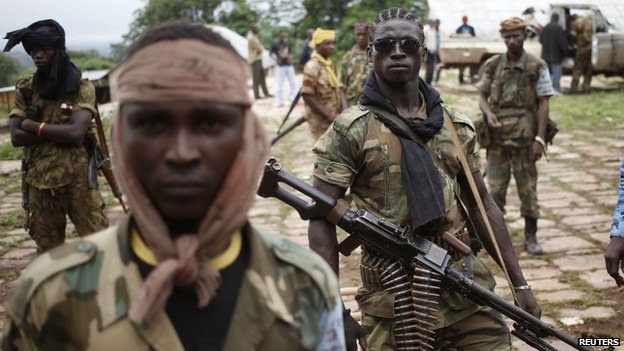
The Brazzaville summit had a more modest result, however.  All the participants went home with was a half-hearted cease-fire agreement between Séléka and the Christian–“animist” coalition called the “Anti-Balaka movement.”  Left unspecified was how such a cease-fire could be enforced in a country where no one is really in charge.  And shortly after the deal was announced, the Séléka leader Major-General Joseph Zoundeiko (pictured above), who had not attended the conference, told the B.B.C. that he rejected its terms and that his followers would not abide by it.  He demanded instead the immediate partition of the country.


Some C.A.R. Muslims are saying that a full half of the country should become their new state, reflecting not their share of the population so much as the vast areas Séléka held at the height of the civil war (see map above).  Still unresolved, too, is what the new country would be called.  The rather uninspiring Republic of Northern Central Africa has been proposed; I suppose Sélékastan is a possibility as well.  In April, supporters of the idea were circulating a proposed flag, but I have not yet been able to track down such an image.

When Séléka fighters do display a flag, it tends to be the C.A.R.’s national flag.
It is hard to imagine the international community ever sanctioning such a plan.  The Republic of South Sudan next door serving as an illustration of how dividing a country (in that case, the Republic of Sudan, partitioned with the United Nations’ blessing in 2011) between a Muslim north and Christian south can lead to previously unimaginable levels of misery and chaos.  Meanwhile, the United States and other Western countries fear that radical Islamist insurgencies in an arc stretching from northern Mali to northern Nigeria to Kenya and Somalia and Yemen are gradually making common cause with one another under what may eventually be an al-Qaeda banner.  And there is reason to fear that an “independent” state governed by an ill-disciplined rebel army in northern C.A.R. could allow that region to once again become a haven for Joseph Kony and his dreaded Lord’s Resistance Army (L.R.A.).

No one wants to give Joseph Kony a new lawless zone to move around in.
No, the international community, including even and especially the African Union (A.U.), remain steadfastly committed to making Africa’s European-drawn, colonial-era borders sacrosanct—no matter how much suffering ensues as a result.


[For those who are wondering, yes, this blog is tied in with my forthcoming book, a sort of encyclopedic atlas to be published by Auslander and Fox under the title Let’s Split! A Complete Guide to Separatist Movements, Independence Struggles, Breakaway Republics, Rebel Provinces, Pseudostates, Puppet States, Tribal Fiefdoms, Micronations, and Do-It-Yourself Countries, from Chiapas to Chechnya and Tibet to Texas.  The book, which contains dozens of maps and over 500 flags, is now in the layout phase and should be on shelves, and available on Amazon, by early fall 2014.  I will be keeping readers posted of further publication news.  Meanwhile, please “like” the book (even though you haven’t read it yet) on Facebook.]

Friday, July 25, 2014

Tazzies in a Tizzy over Missing Island on Commonwealth-Games Speedos, Reviving Independence Talk


Tasmanians have always been separated from the other Australian states by the waters of Bass Strait, but now a wider gulf has been opened by Australia’s new Commonwealth Games uniforms, which depict a map of the continent-nation without Tasmania.  The state’s premier is furious, and some regionalist activists are even saying the time has come for independence.


Speedo International, Ltd.—the New South Wales–based swimwear company synonymous with minuscule, painfully tight swimsuit bottoms that leave nothing to the imagination of appalled, eye-averting beach-goers worldwide—recently unveiled the design for the athletic swimwear to be worn by Team Australia at the 2018 games in Gold Coast Beach, Queensland.  The suits sport a jaunty tessellation of galloping kangaroos and emus alternating with Australia’s distinctive outline.  But missing is the large island of Tasmania just south of the mainland’s southeastern corner.  (That’s the uniform above, modelled by the Australian swimmer Kotuku Ngawati, displaying her hyper-mobile elbows.)

The flag of Tasmania (the real one; see below)
Nor is this the first such snub.  When the Commonwealth Games were held in Brisbane, Queensland, in 1982, opening-ceremony dancers formed a Busby Berkeley–style map of Australia, and Australia’s smallest state was missing there too.  Thus, Andrew Nikolic, a member of Australia’s parliament representing Bass, Tasmania, calls the new Speedos a “repetitive insult” and has written in pique to the federal minister of sport, Peter Dutton.  Nikolic says Commonwealth Games authorities “should have a good, hard look at themselves.”  Another Tasmanian legislator, Jacqui Lambie, is demanding compensation in the form of an extra $5 million (Australian) in tourism funding.

Brisbane in 1982.  Hmmm ... I don’t see the Cocos Islands either ...
The outspoken Tasmanian avocational historian Reg Watson* calls the latest omission “absolutely appalling,” adding, “This is typical of how mainlanders treat Tasmania and this is why I believe in secession for Tasmania.”   But Watson’s is not usually a voice of reason: the founder of Australia’s annual Anglo–Boer War Commemorative Day, Watson is also a ufologist, a Jack the Ripper aficionado, and an angry advocate of celebrating Tasmania’s British heritage, which he complains has been shouted down by “political correctness” and the rush to please racial minorities, a conspiracy of silence he compares to Nazism and Stalinism.  Watson is even part of a movement by amateur historians to downplay or outright deny the 1804 massacre of indigenous Tasmanians at Risdon Cove.  The last full-blooded Tasmanian Aboriginal died in the late 19th century after a campaign of extermination that was one of the most thorough and pitiless genocides in modern history.


Tasmania’s premier, Will Hodgman, is more sanguine: he calls the new uniforms “utterly un-Australian” and a “disgrace” and demands an apology, but he has also said, “I’m seriously annoyed, but this doesn’t mean we’ll move to secede.”

Tazzies, take heart!  Nothing could ever be worse than
Team Scotland’s uniforms at the 2014 Commonwealth Games in Glasgow.
Aside from genocide, Tasmania is known in the northern hemisphere mainly as the birthplace of the swashbuckling film star and libertine Errol Flynn and of another Hollywood celebrity with ravenous appetites, Warner Brothers cartoons’ “Tasmanian Devil,” who looks nothing like the ratlike, garbage-scavenging Sarcophilus harrisii found throughout the island.  But, within Australia, Tasmanians have a unique identity and have mulled a split before.  Though Tasmanians voted with the largest majority of any state, to join the Commonwealth of Australia in 1901, the Great Depression of the 1930s brought a surge of separatist anger by Tazzies (as islanders tend to be known) who blamed their economic woes on mainlanders.  Tasmanian secessionism has mostly been kept in check by a realization that Tasmania gets much more from the central government in the form of programs and services than it pays in.


Perhaps Speedo-gate will fan the faint coals of Tasmanian separatism again.  If so, those who take the idea seriously will have to wade through a barrage of inevitable randy jokes: because of the island’s vaguely triangular shape, the term map of Tasmania is a slang term for a woman’s pubic hair.  After all, isn’t that supposed to be invisible on a swimsuit?

Maybe this design would mollify would-be separatists:
you can see a little bit o’ map-o’-Tazzie on this one.
* Not to be confused with the other Australian writer named Reg Watson, creator and screenwriter of the squalid 1970s lesbians-behind-bars soap-opera Prisoner, who appears to be some sort of national treasure.
“Queen Bea” and Lizzie Birdsworth stare down
“Old Vinegar-Tits” in an episode of Prisoner

[For those who are wondering, yes, this blog is tied in with my forthcoming book, a sort of encyclopedic atlas to be published by Litwin Books under the title Let’s Split! A Complete Guide to Separatist Movements and Aspirant Nations, from Abkhazia to Zanzibar.  (That is shorter than the previous working title.)  The book, which contains 46 maps and 554 flags (or, more accurately, 554 flag images), will be on shelves and available on Amazon on March 1, 2015.  I will be keeping readers posted of further publication news.  Meanwhile, please “like” the book (even though you haven’t read it yet) on Facebook and see this special announcement for more information on the book.]


[Hear the author of this blog discuss the Cascadia independence movement in OregonWashington, and British Columbia in a recent interview for Seattle’s National Public Radio affiliate station KUOW-FM.  Click here to listen.]

Related articles from this blog:

“Wiradjuri Activists Raise Flag, Proclaim Newest Aboriginal Republic in Australia” (Jan. 2014)
“Lamb Island, off Australian Coast, to Vote on Becoming Republic of Nguduroodistan” (Oct. 2013)
“Hutt River’s Princess Shirley Had Irish Noble Blood, Mourners Learn” (Aug. 2013)
“Housing Estate Splits from New South Wales, Joins ‘Free State of Australia’” (July 2012)
“Founding of ‘Free State of Australia’ in New South Wales Stems from Zoning Dispute” (Nov. 2011)

[Special thanks are due to Alice Crawford and to Seaman Hornblower (not the one portrayed in film by Errol Flynn) for my education in Australian slang.]

Saturday, May 10, 2014

California Assembly Passes Resolution Approving Ethnic Cleansing

The Armenian National Committee of America pushed
California’s joint resolution on N.K.R.

The California state assembly passed a resolution on May 8th to recognize the sovereignty of the Nagorno-Karabakh Republic (N.K.R.) (a.k.a. Artsakh Republic), an Armenian puppet state which the newly independent Armenia’s military, with the help of Russian forces, carved out of the newly independent Azerbaijan in the early 1990s in the wreckage of the imploded Soviet Union.

After the vote, California legislators posed with delegates from the N.K.R.
The N.K.R. is not recognized as independent by any recognized independent country, not even by its patron, the Republic of Armenia, but symbolic resolutions have been passed recognizing it in various local legislatures and city councils in the vast Armenian diaspora, including the legislatures of Louisiana, Maine, Massachusetts, and Rhode Island and of New South Wales in Australia, and, just last month, the city council of Los Angeles.  The California vote was expected.  The state has hundreds of thousands, some say almost a million, ethnic Armenians, mostly concentrated in greater Los Angeles.  There are, for example, only three cities in Armenia itself that have more Armenian residents than just one L.A. suburb, Glendale.  By contrast, there is only a negligible number of Azeri-Americans.


The California resolution passed with a vote of 70 to 1.  The only “no” vote was by Rocky Chávez, a Republican representing Oceanside, a San Diego suburb.  Armenian pressure groups play a huge role in pushing through symbolic pro-N.K.R. resolutions around the world, especially in the United States.  California’s Armenian diaspora also provides funding and support to the N.K.R.

Paid for in Moscow, planned in Yerevan,
carried out in Khojaly, applauded in Sacramento
Somewhere between 30,000 and 40,000 people died in the Nagorno-Karabakh War from 1991 to 1994, most of them killed by the Armenian military, which was aided by mercenaries from Russia and elsewhere and tacitly and covertly backed by Russia.  Thousands of Azeris were expelled from Azerbaijani territory to make room for Armenian settlement, and thousands of Kurds were cleansed from the Lachin corridor, which was not part of the Nagorno-Karabakh region but was conquered in order to provide a land bridge between Nagorno-Karabakh and Armenia and is now part of the N.K.R. Many see the Nagorno-Karabakh War as Armenian revenge for the genocide of Armenians by Anatolian Turks in the early 20th century (which the Turkish government still denies) and compensation for Armenian lands farther west lost to the Turkish Republic after the First World War.  Azeris speak a Turkic language and are often called “Turks.”

California is in lock-step with the Armenian army.
But, as discussed in a recent article in this blog, the overt and covert war against Ukraine by Russia, Armenia’s strongest ally, may be changing the dynamics of the N.K.R. issue.  Armenia was one of only 11 countries to back Russia’s annexation of Crimea earlier this year in a United Nations vote (as reported in this blog), alongside pariah nations like North Korea, Sudan, and Syria.  Azerbaijan, like Turkey, is a U.S. ally, and the Armenian government, which has signed onto President Vladimir Putin’s “Eurasian Union” trade bloc established as a rival to the European Union (E.U.), is openly hoping that the Kremlin will formally recognize the N.K.R. and possibly help Armenia expand its borders in other aggressive ways as a way of extending its own influence.

Assemblyman Mike Gatto spearheaded the N.K.R. resolution.
Last month, as reported in this blog, Azerbaijani lobbyists succeeded in defeating a similar N.K.R.-recognition bill in Vermont, and they have pushed anti-N.K.R. legislation in Hawaii, Mississippi, South Dakota, Tennessee, and Wyoming.

Armenians demonstrate in Los Angeles with the Nagorno-Karabakh flag
After the California vote, Assemblyman Adrin Nazarian, a Democrat from the L.A. suburb of Burbank, whose grandparents fled the Nagorno-Karabakh region in pre-Soviet days, told the chamber, “This is one of those issues, probably one of the hallmark issues, that’s led me to want to serve in public service and to be here. This has been the tormented history of a group of people who have been very determined to pursue their freedom.”

After the First World War, Armenia was supposed to be a large independent state;
the Young Turks killed that idea.
The Republic of Armenia’s expansionist aims are increasingly piggy-backed onto Putin’s quest to rebuild the Soviet Union and restart the Cold War, but apparently that news hasn’t yet reached Sacramento.  If the crisis in Ukraine continues to lurch toward war, more Californian assemblymen and assemblywomen may wish they had voted with Rocky Chávez.


[For those who are wondering, yes, this blog is tied in with my forthcoming book, a sort of encyclopedic atlas to be published by Auslander and Fox under the title Let’s Split! A Complete Guide to Separatist Movements, Independence Struggles, Breakaway Republics, Rebel Provinces, Pseudostates, Puppet States, Tribal Fiefdoms, Micronations, and Do-It-Yourself Countries, from Chiapas to Chechnya and Tibet to Texas.  The book is now in the layout phase and should be on shelves, and available on Amazon, by early fall 2014.  I will be keeping readers posted of further publication news.  Meanwhile, please “like” the book (even though you haven’t read it yet) on Facebook.]


Related articles from this blog:
“Vermont Snub on Karabakh May Signal Crimea Crisis Has Derailed Armenian-American Pressure-Politics Gravy Train” (April 2014)
“Rogues’ Gallery: Everyone Seems to Be against Crimea’s Annexation, but Who’s for It?; or, What Do Kim Jong-un and Ron Paul Have in Common?” (April 2014)
“The Power of Pressure Groups: 3 California Lawmakers Advocate Nagorno-Karabakh Independence” (Oct. 2012)
“Massachusetts Recognizes Nagorno-Karabakh Republic!” (Aug. 2012)
“The Armenian Genocide Debate: Turkey, Nagorno-Karabakh, and the Politics of Memory” (April 2012)

Tuesday, April 15, 2014

Vermont Snub on Karabakh May Signal Crimea Crisis Has Derailed Armenian-American Pressure-Politics Gravy Train


For decades, the Armenian-American political lobby in the United States has pushed aggressively to chalk up symbolic victories by pressuring state and other legislative bodies into granting utterly-nonbinding “recognition” to the independence of the Nagorno-Karabakh Republic (N.K.R.), the Armenian puppet state which the newly independent Republic of Armenia, with the help of Russia, carved out of Azerbaijan’s western flank in a bloody campaign of ethnic cleansing in the late 1980s and ’90s.  The N.K.R. has essentially no recognition in the real world of international diplomacy, except from three puppet states of the Russian Federation: Abkhazia and South Ossetia (within Georgia) and Transnistria (within Moldova).  Not even Armenia or its close ally, Russia, recognizes the N.K.R.  But the Armenian National Committee of America (A.N.C.A.) and other groups have successfully cajoled the state legislatures of Louisiana, Maine, Massachusetts, and Rhode Island, as well as the Los Angeles city council, to “recognize” the N.K.R.  (Abroad, Australia’s state of New South Wales recognizes it too.)

Armenian-American demonstrators in Los Angeles display Nagorno-Karabakh flags.
Some reckon that the Armenian lobby is the third most powerful immigrant-minority lobbying group in U.S. politics, exceeded in influence only by the Jewish and Cuban-American lobbies.  They have also been pushing for recognition of the Armenian genocide at the hands of Anatolian Turks a century ago as a genocide, something the U.S. has over the decades resolutely refused to do, mostly to avoid offending Turkey, a North Atlantic Treaty Organization (NATO) ally.  There are perhaps as many as a million and a half Armenian-Americans in the U.S., mostly in southern California and New England.  There are, for example, only three cities in Armenia itself that have more Armenian residents than there are in Glendale, a suburb of Los Angeles.  For legislators confronted with an N.K.R.-recognition bill, the choice is between capitulating, passing the bill, and moving on, on the one hand, or, on the other, needlessly alienating and infuriating a powerful ethnic lobby.  There is, by contrast, almost no Azeri-American community of any size to exert pressure of the same kind.

Mammad Talibov tells the Vermont Senate the Azeri side of the story.
But the Armenian lobby’s winning streak, in New England at least, ended last week when Vermont’s state senate declined to wade into South Caucasus politics and recognize the N.K.R.  Vermont senators debating on the resolution were paid a visit by Yusif Babanly of the U.S. Azeris Network and a legal attaché from the Azerbaijani embassy in Washington, D.C., Mamma Talibov.  Babanly and Talibov gave the (in America, rarely heard) Azeri perspective on the Nagorno-Karabakh conflict and emphasized the strategic relationship between the U.S. and oil-rich Azerbaijan.  Azeris are closely related to the Anatolian Turks of Turkey proper, both culturally and linguistically, and Azerbaijan is a front-line state in the U.S.’s cold war with Iran.  (The Azeri lobby, which is closely linked to Turkey, is no stranger to manipulation and propaganda either.  See an article from this blog which touches on Azeri and Turkish efforts to build up the very minor 1992 “Khojaly Massacre” into a full-fledged “genocide” by Armenians.)  Mostly, the senate threw up its hands and decided the situation on the ground was too complex for the body to take a position on it.  As Norm McAllister, a Republican senator said, “We’re never going to know in this little committee who’s actually telling us the whole story.”


Earlier, in 2004, Vermont’s governor, James H. Douglas, officially recognized the Turkish genocide of Armenians during the First World War.  There are not a lot of Armenians in Vermont, but they include the novelist Chris Bohjalian, possibly the most prominent Armenian-American writer, who has written novels about the genocide and lives in Lincoln, Vermont.  It was Bohjalian who brought the N.K.R. recognition issue to Montpelier.

Chris Bohjalian poses before a statue in Yerevan, Armenia,
of William Saroyan, another Armenian-American writer.
Not only that, but Armenian-Americans are on the defensive elsewhere.  They only just barely managed to scotch Azeri-initiated bills this spring in Mississippi and Tennessee on recognizing Azerbaijan’s territorial integrity—i.e., declaring the N.K.R. illegitimate.  Hawaii, South Dakota, and Wyoming also rejected pro-Azerbaijani bills in February.  Similar Azeri lobbyists to those that swayed Vermont were involved in those states’ efforts as well.

Armenians with their national flag
Why did Azeris manage to keep Vermont in their column—or at least out of Armenia’s—after trying and failing to do so in those other five states?  The answer may have something to do with Crimea.  Armenia was one of only eleven countries which (as discussed recently in this blog) sided with Russia and against Ukraine in a recent United Nations General Assembly vote condemning Russia’s invasion and annexation of Ukraine’s Crimean peninsula.  Others in that small club included some of the most brutal dictatorships in the world, like North Korea, Syria, and Sudan.  It is possible, in fact, as an Armenian politician recently suggested (discussed recently in this blog), that Kremlin arm-twisting brought Armenia into Russia’s new “Eurasian Union” trade bloc with Belarus and Kazakhstan, using the threat of seeing to it that Armenia would lose its grip on the N.K.R. (which many Armenian nationalists hope, and most of the rest of the world fears, could be among the next territories President Vladimir Putin is eyeing for annexation).  We may never know whether the Armenian government was bullied by Putin into backing him at the U.N. or whether it found immoral and hypocritical reasons of its own for doing so.  But Armenia’s international standing has taken a hit.  Pre-Crimea, it was a mere detail of Caucasus geopolitics that Armenia was more aligned with Russia while Georgia and Azerbaijan were more aligned with NATO and the West.  But after Crimea, it matters quite a bit.  Supporting Armenia’s foreign-policy agenda is now, in a not so indirect way, support for Putin’s new cold-war project of aggressively expanding the territories in which Russians—and allied nationalities, like Armenians—are in charge.  “Recognizing” N.K.R. is, for state legislatures today, not just taking an irrelevant position on an obscure struggle.  It’s actually siding against U.S. interests.


The Armenian lobby in the U.S. should have just stuck with the genocide question.  Their moral stance on that issue is unassailable.  Instead, they opted for mimicking the fundraising model of Jewish-American groups raising money for Israel in the early days of Israeli settlement.  In fact, the N.K.R. was largely built with money from Armenian-American donors.  But Armenia has now squandered the moral authority it enjoyed as a nation victimized by genocide.  Armenian-Americans had better climb down from their support for the N.K.R. now.  Because if Nagorno-Karabakh does become the next Crimea-type battleground in Putin’s Russo-fascist expansionist schemes, it could get very uncomfortable for them in the U.S.

You won’t see this picture on the Armenian National Committee of America
website: Syria’s dictator Bashar al-Assad with Armenia’s president, Serzh Sargsyan
Oh, and one other thing.  The chair of the Vermont senate’s Government Operations Committee, Sen. Jeanette White, told a reporter while discussing the setting aside of the N.K.R. question, “I believe that countries should be able to determine their own destiny.  However it isn’t Vermont seceding from the U.S., which we have threatened to do.  It’s complicated.”  She is reminding us that Vermont has its own independence movement, a left-wing, environmentally-oriented movement called the Second Vermont Republic (S.V.R.).  (Vermont was an independent nation before joining the U.S. in 1791.)  So if Vermont ever does become an independent state, it can just forget about getting any diplomatic recognition from Armenia.  In the South Caucasus, people have long memories.  They never forget a slight.

Flag of the Second Vermont Republic

[For those who are wondering, yes, this blog is tied in with my forthcoming book, a sort of encyclopedic atlas to be published by Auslander and Fox under the title Let’s Split! A Complete Guide to Separatist Movements, Independence Struggles, Breakaway Republics, Rebel Provinces, Pseudostates, Puppet States, Tribal Fiefdoms, Micronations, and Do-It-Yourself Countries, from Chiapas to Chechnya and Tibet to Texas.  The book, which contains dozens of maps and over 500 flags, is now in the layout phase and should be on shelves, and available on Amazon, by early fall 2014.  I will be keeping readers posted of further publication news.  Meanwhile, please “like” the book (even though you haven’t read it yet) on Facebook.]

Wednesday, February 5, 2014

Yet Another Genocide Olympics: 10 Political Causes Sure to Disrupt the Sochi Games

Circassian nationalists (see below) protesting the Sochi Olympics
What, in God’s name, was Russia thinking?  If you’re going to host the Winter Olympics, there are only a few things to consider.  One, snow.  Russia covers between 10 and 15% of the land surface of the world, much of it perpetually blanketed in snow and ice (you’ve heard of Siberia, right?).  So where does Moscow choose, in all that territory, to have the winter games?  In Sochi, a Black Sea resort more famous for its beaches—practically the southernmost point in Russia—where, as of today, February 5th, there is no snow on the ground.  It sounds like the beginning of a Polish joke—except Poles would never be this stupid.

There’s no snow on the ground, but that’s okay, we bought some rolls of this kind of tarp stuff.
After a few vodkas, no one will care.
But that’s the least of it.  Snow can be created with machines.  Another thing needed for the Olympics is stability and security.  There’s a reason that places like Somalia and Afghanistan don’t host the Olympics.  There’s also a reason why countries at war don’t host the Olympics.  Five different Olympiads were cancelled during the world wars.  There’s also a reason why countries at the center of huge, divisive conflicts—or countries which are despised or not recognized by much of the world—don’t host the Olympics.  Having the Games in Israel or Palestine would be a disaster; it would be an invitation for boycotts.  Likewise apartheid-era South Africa, or Burma, or Taiwan.

Putin lights the fuse—um, I mean flame.
Russia, sadly, is pretty high in these “not fit for the Olympics” categories as well.  Through a series of draconian laws cracking down on dissent and free speech, Russia is gradually making itself a global pariah.  And it is also in the midst of failing to suppress a radical Islamist insurgency in the North Caucasus region, just a short drive from the Olympic village.  Not only that, but it chose, as the Olympic city, the site of a horrific Russian-engineered genocide of one of the ethnic groups involved in the insurgency, and this year is the 150th anniversary of those events.  What kind of rotgut moonshine vodka were Russian officials drinking when they stabbed their finger on a map and chose Sochi as an Olympic city?

Russia’s Olympic Organizing Committee at work
Here, then, is a rundown of the top ten political crises that are threatening to disrupt these Winter Olympics.  (See my similar article at the beginning of the Summer Olympics in London in 2012.)  There are others, but these are the top ten.  In reverse order, building up the biggie, the one that many experts are saying will—not might, but will—bring terrorism to the Olympics for the first time since Munich in 1972.


10. Syria
Your tax rubles at work in Syria
Russia has been doing so many things to infuriate the international community lately, that it’s hard to recall that for a while it was in the news mostly for being one of the very few nations to openly back the embattled dictator of Syria, Bashar al-Assad, who has been holding out against a massive popular revolution in the last two and a half years of civil war in the country.  And why does Russia cling to this?  Well, mostly because Iran is the other major country backing Assad, the Syrian regime being followers, like most Iranians, of the Shi’a branch of Islam.  Iran is trying to maintain regional influence through fellow Shiite government in places like Syria, Iraq, and southern Lebanon.  And Iran, dating back to the Cold War, has been a Russian ally mostly by virtue of its fierce antipathy, since the 1979 Islamic revolution, to the United States—and also because it such an alliance extends Russian influence to the Indian Ocean.  That is a key consideration for an oil-rich nation with few usable harbors to bring its commodities to market.  That was the whole rationale of Russia’s invasion of Afghanistan, after all, and the only reason the U.S. is so cosy with Pakistan.  Does that sound like a ridiculously convoluted reason for Putin to stand nearly alone against the world in backing a dictatorship that tortures thousands of dissidents and uses chemical weapons on its own citizens?  Yes, it is, and, even though Syria is not competing in these Olympics, those concerned for the country’s plight will be making their views known this year in Sochi.  Putin helped broker the deal last year by which Syria will destroy its chemical weapons, but in the minds of many that doesn’t erase the original sin of funding and backing the regime in the first place.

Vladimir Putin waiting for a presidential aide to bring a phone book to stand on
for a photo-op with fellow mass murderer Bashar al-Assad
9. Iran

An anti-Iran protest at the last Olympic games in Vancouver, in 2010
And speaking of Iran, which is sending five skiers to Sochi, this pariah nation is also likely to draw some attention this year.  Iran is an authoritarian theocracy, where women have few rights, dissidents are tossed into medieval prisons, and the legitimate aspirations of Kurdish, Azeri, Talysh, Turkmen, Baloch, and Khuzestani minorities, among others, are crushed mercilessly.  It is also a close ally of Russia’s, and Russia has a few of those minorities within its borders as well.  Expect some colorful protests.

All of Iran’s ethnic minorities are mistreated.
8. Kosovo

The head of Kosovo’s Olympic committee—
even though Kosovo is not in the Olympics
But Syria and Iran are not the only dastardly regimes that are allies of Russia.  We could also mention the Republic of Serbia, which, though it is rapidly liberalizing and angling for eventual European Union membership, was supported by the Kremlin through all the dark years of the 1990s when Serbs were waging a brutal, almost genocidal war against the captive nations trying to break free of the old Yugoslavia.  The last of these to secede, the Republic of Kosovo, is still claimed by Belgrade as Serbian territory, and Russia is one of the few nations in the world that actively sides with Serbia on this question.  The Security Council veto powers of Russia and the People’s Republic of China are the only remaining barriers to Kosovo’s membership in the United Nations General Assembly.  Kosovo is also not recognized as an Olympic nation; in London two years ago, the only Kosovar athlete competed under the flag of neighboring Albania.  (Kosovo is mostly ethnically Albanian.)  There is a lot of Kosovo hatred of the Kremlin.  Expect some protests when Serbia’s eight-person Olympic team shows up in Sochi.  Russia has recently outlawed public advocacy for “separatism” (as reported at the time in this blog), and Russian foreign policy classifies Kosovo’s right to exist under that rubric.  Putin has promised that no one will be arrested for exercising free speech at these Games.  We’ll see if he holds to that.

Kosovars wave Albanian flags at a protest
7. Palestine

Unlike these summer Olympics, Palestine won’t be sending athletes to Sochi,
but its cause will be heard there.
The Israeli–Palestinian conflict is one of the few foreign-policy questions on which Russia has been on the side consistent with human rights and self-determination.  But don’t think that that’s why Russia, as the Soviet Union did before it, supports the State of Palestine.  Mainly it was, and is, as a way of defying the United States and a way to counter U.S. influence in the Middle East via Israel.  In a sort of inversion of the situation with Kosovo (see above), it is mainly the U.S. that blocks membership in the U.N. General Assembly for Palestine, a nation which most of the world recognizes as sovereign.  If the Palestinian cause manifests itself at Sochi, the anger is more likely to be directed against the U.S. or the United Kingdom or Israel.  Palestinians are not sending a team to these Olympics, but they have rarely missed an opportunity to use the Olympic stage to make their views known.  Luckily, they are unlikely to do so in the way that they did in 1972, when Palestinian terrorists abducted and executed 11 members of the Israeli Olympic team in Munich, West Germany.

The unofficial Olympic sharpshooting team sent by Palestine to the Munich games in 1972
6. Pussy Riot


Sometimes when an authoritarian regime tries to suppress a dissident movement, it actually feeds it, giving it a bigger stage and a bigger audience and turning up the volume on its message.  Never was this done so ham-handedly and stupidly than when Russia responded to a provocative 2012 performance by the obscure, unknown feminist punk band Pussy Riot.  The band staged a deliberately sacrilegious guerrilla musical event in a Moscow cathedral, protesting the Kremlin’s cosiness with the Orthodox church.  Five Pussy Riot members were arrested, charged with hooliganism and inciting religious hatred.  Two remain in prison.  This has made Pussy Riot a household name around the world and has galvanized even more people against the ludicrous intolerance of dissent in Putin’s Russia.  The band’s now millions of fans and supporters around the world include the Ukrainian nudist feminist protest collective Femen, which can be expected to at least attempt to champion the Pussy Riot cause with some of its anti-clerical, anti-patriarchal, anti-Moscow publicity stunts.

We haven’t seen the last of Femen.
5. Abkhazia and South Ossetia


One of the more high-profile Olympic boycott movements has been by those in the Republic of Georgia who want to stay out of the Sochi games in anger over two rogue territories within Georgia, Abkhazia and South Ossetia, which Russia set up as “independent” puppet states after Georgia tried to reclaim the rebel regions in a 2008 war.  Only Russia and a handful of inconsequential small nations recognize the two republics as independent, so there was never really a question of whether they would compete themselves.  The International Olympic Committee (I.O.C.) shut down that idea quickly last year, and Moscow is not pushing the point (as I wrote about last year in this blog).  (Nearly all residents there are also, or only, Russian citizens, so Abkhazian and South Ossetian participation will be under the Russian flag.)  But Georgia is incensed at the Games being held so close to the conflict zone: the Abkhaz–Russian border is a mere 3 miles from Sochi.  And Russia recently upped the ante by declaring a “security zone” around Sochi which extends deep into Abkhazian—i.e., Georgian—territory.  Georgia said this week, with days to go, that it is keeping open the option to boycott the games.  That would hurt Georgia’s three slalom-racers, who are already in Sochi, more than anyone.  But Georgia is desperate to raise international awareness of what Russia did to their small country in 2008, so they may just play the boycott card.  Even if they don’t, there will be protests.  (Related recent article from this blog: “Is Ossetian Reunification Just Russian Irredentism by Another Name?”)

An anti-Russian protestor with a Georgian flag
4. Ukraine

Ukrainian protestor demolishing a Lenin statue recently
(but why was it still standing in the first place?)
The timing of the ongoing uprising in Ukraine could not be worse for Russia’s public image.  Since November, the streets of Ukraine’s cities have been filled with protestors, clogged with police barricades, shrouded in tear gas, and, occasionally, running with blood.  Ordinary Ukrainians have been rising up in the hundreds of thousands to protest President Viktor Yanukovych’s collusion with Vladimir Putin to place Ukraine into a neo-Soviet customs union with Moscow in lieu of, as most Ukrainians want, closer ties with the European Union (E.U.).  About 30% of Ukraine’s citizens are ethnically and linguistically Russian, especially in the east and south, so this has deeply divided this country, in what has turned into the most serious civil unrest in the European part of the former Soviet Union since that empire imploded in 1991.  As the protests drag on, opposing sides’ positions are hardening.  More and more of the red and black flags of Ukraine’s far-right nationalists are appearing at protests, while Russian-speakers are speaking now of partitioning the country by splitting off an independent Crimea (where Russians dominate) (as discussed recently in this blog) or creating a separate nation called Malorossiya (“Little Russia”—ouch, right?) in the east (see my recent article from this blog on that proposal, as well as my article listing Ukrainian partition as one of “10 Separatist Movements to Watch in 2014”).  Sochi is only about 150 miles from the Ukrainian (specifically, Crimean) border—in the other direction from the volatile Caucasus (see below), which means Sochi is squeezed directly between, essentially, two civil-war zones (see above in re: Russian Olympic planning committee, moonshine vodka, etc.).  Russian nationalists hate the Ukrainian protestors almost as much as Ukrainians hate Tymoshenko and Putin.  This will make things awkward for Ukraine’s 43 skiers, snowboarders, speed skaters, lugers, and figure skaters.  There will be demonstrations, believe me.

Members of the political collective Femen expressing their opinion of Ukraine’s President Yanukovych
3. Gay rights


Perhaps the cause of the most public vilification of Russia in the eyes of the world lately has been a result of recent legislation against gays, lesbians, bisexuals, and transgender people—and lots else too.  The law criminalizes “propaganda of non-traditional sexual relations” and is worded so that essentially publicly admitting that you are gay can put you right in prison.  This kind of bigotry is hugely popular in ultra-patriarchal Russian culture and is being used by the Kremlin as an issue to whip up resentment of the West, where gay rights have made gigantic strides just in the past decade.  In addition to boycotts of Russian products like vodka, the cause has created a giant worldwide movement to boycott the Sochi games.  (No country has quite taken that step—though the Gay and Lesbian Kingdom of the Coral Sea Islands is notoriously absent from the list of participating nations.)  Putin has said that no guests or athletes at the games will be prosecuted under this law, and that might open the door to all sorts of visible protests.


Activists in London in 2012 protesting Russia’s hosting of the 2014 games
There are lots of gay athletes (including biathletes—get it? biathlon? bi athletes?), and some of them, and their many allies and supporters, may unfurl gay-pride flags at key moments.  The LGBT movement is famous for wildly inventive and creative protests, so this could be good television—as long as Russian police can resist the temptation to crack some heads anyway (which is not out of the question, unfortunately).


2. The Circassians

This is how Russians treated Circassians in 1864,
and Circassians never forget.
Of all of the peoples and cultures shafted by Russian imperialism over the centuries, none has an emotional and symbolic stake in the Sochi Olympics quite like that of the Circassian people.  A predominantly-Muslim population speaking a language unrelated to any Slavic, Persian, or Turkic language of the region, the Circassians traditionally inhabited the plains along the Black Sea between the Crimea and the Caucasus.  These fiercely independent, warlike nation was more within the penumbra of the Ottoman Empire than under its actual thumb, but in the mid 19th century the Russian Empire pushed south to bring this region under its control, resulting in the mass extermination and expulsion of the entire Circassian population.  Many fled to places like Anatolia (Turkey) and the Levant (Syria), many were killed, and all were at least uprooted.  Some branches of the Circassian nation, like the Ubykh culture right around modern Sochi, were erased from the map.  The last speaker of the Ubykh language died in exile in Turkey in 1992.  The decisive massacre that sealed the fate of the Ubykh people occurred very near Sochi exactly 150 years ago.


For Circassians, this is no accident. It is the neo-Czarist Putin dancing like a Cossack on the mass grave of Circassian men, women, and children.  To them, this is like holding a celebration at Auschwitz.  There are just under a million Circassians (also called Adyghe people) remaining in Russia (compared to possibly as many as 3 million in Turkey), but unlike even many less numerous nationalities in the Russian Federation they do not rule their own republic.  They are divided among the Adyghe Republic just north of Sochi, where they are outnumbered by ethnic Russians three to one, and in two republics where branches of the Circassian nation share power with Turkic-speaking peoples: the Karachay-Cherkess Republic, which is only 11% Cherkess (Circassian), and the Kabardino-Balkar Republic, where Kabardins, who are Circassian, are 57% of the population.  (Some also classify the Abkhaz (see above) as Circassian.)  Circassian grievances are numerous: they want exiles to be allowed to return home, they want the international community to recognize what happened to them as a genocide, and they want a single autonmous republic that they can run themselves.  Some even want independence.  And these Olympics have set their tempers aflame.  There voices will be heard this month in Sochi.
Circassians marking the 1864 genocide (see also photo at top of article)
1. The Caucasus Emirate


The Circassians (see above) are traditionally warlike but for the most part have not used violent means to advance their goals in modern Russia.  That cannot be said of a network of terrorists mostly from other Caucasus ethnic groups, even some foreign ones, that have used Circassian and other grievances to mount a violent Islamist insurgency in Russia’s Caucasus mountains.  This group, known as the Caucasus Emirate movement, names itself for an imaginary Islamic state which they assert is the rightful government of the North Caucasus region, including the three Circassian and part-Circassian republics (see above), Chechnya, Ingushetia, North Ossetia (even though it is majority Christian), Dagestan, and even all of the nearby ethnic-Russian (i.e. Orthodox Christian) dominated regions, including Sochi itself in Krasnodar Krai.  The North Caucasus has been Muslim for centuries, but traditionally it is home to mystical strains of Sufism and other beliefs that were quite at odds with severer, harsher forms of Islam practiced farther south in places like the Arabian Peninsula and Iran—and were also liberally mixed with millennia-old indigenous traditions from these ethnically diverse mountains.  The picture changed drastically when the Soviet Union ended and Chechnya waged a war for independence.  To an extent, the Chechens won, and for a while in the 1990s Chechnya became de facto independent until Putin reabsorbed the republic in a Second Chechen War that was even more brutal than the first.  (See an article from this blog listing the Chechen exile government’s President Akhmed Zakayev as one of “The World’s 21 Sexiest Separatists.”)  Tens of thousands of Chechen civilians were killed as the capital city, Grozny, was reduced to rubble in what remains the worst violence of any kind in Europe since the Second World War.

Two Caucasus Emirate mujahideen with their flag
By this time the North Caucasus had become a magnet for jihadists fighters from all over—from Afghanistan, Saudi Arabia, Syria, Kashmir, the Philippines, everywhere, and soon the region came under the cloud of Wahhabism, a radical, puritanical strain of Sunni Islam that bans all music and art, approves the killing of infidels, and treats women like livestock.  Just a short drive east of the Olympic village in Sochi is a rugged mountain region ruled by traditional warlords, where Russian Interior Ministry troops can barely contain a violent insurgency that on an almost daily basis ambushes police patrols, levels government buildings with suicide bombs, and assassinates any moderate Muslim clerics that question the Wahhabist laws.  Alongside Afghanistan, Somalia, and the Democratic Republic of the Congo, the North Caucasus is among the most dangerous parts of the world.  Chechnya is more or less pacified now, but Kabardino-Balkaria, Ingushetia, and Dagestan in particular are veritable war zones.  Not only that, but Islamist insurgents are intertwined not only with local politicians and mullahs but with lawless drug and weapons smuggling cartels who together run the region with impunity.  It is barely Russia at all.

Volgograd after a visit from the Caucasus Emirate movement
The world was reminded of this late last year when two suicide bombings of buses in Volgograd, the largest Russian metropolis near the Caucasus region, killed more than 40 people and injured dozens.  Credit for the crimes was claimed by Vilayat Dagestan, the branch or “province” (vilayat, in Ottoman administrative terminology) of the Caucasus Emirate movement for the mostly lawless Republic of Dagestan (see map above, where you will also see Sochi included in the Emirate’s “Vilayat Cherkessia”).  Though the Emirate’s leader, Dokka Umarov, is quite reliably rumored to be dead, the Vilayat Dagestan’s claim of responsibility makes clear that the organization’s cells are quite capable of dealing out deadly violence.  They have promised to deliver “a large present” to the Sochi Olympics.  But don’t worry.  In case that makes athletes and spectators feel unsafe, be reassured that Putin has sent 400 Cossacks—yes, actual Cossacks—to Sochi to provide security.  They will, in the words of one local governor, “do things to preserve order that the police can’t.”  Of course, the Cossacks were the ones who committed all that genocide right around Sochi in the first place.  Something tells me their presence won’t exactly calm things down.

Cossacks arriving in Sochi last week
These Olympics are going to be a wild ride.  Fasten your seat belts—and keep watching this blog for regular updates on political stories and entanglements about these and other causes and movements during the Games.

Related articles from this blog:
“10 Ethnonationalist Causes That Might Disrupt the [London 2012] Olympics” (July 2012)
“Celts, Cypriots, Aborigines Raise Stink at Olympics: Ethnonationalist Protest Update” (July 2012)
“Olympic Update: Femen Protest, Bigoted Judokas, Sudanese Defectors” (August 2012)
“Somaliland’s Own Mo Farah Clinches Olympic Immortality” (August 2012)
“Separatist Football Update: Carnage at a Dagestan–Netherlands Match, Alderney vs. Sealand, Barotseland’s National Team” (August 2012)
“Abkhazia & South Ossetia Won’t Compete in Sochi Olympics, I.O.C. Declares” (October 2013)
“‘Separatism’ Added to List of Things Russians Aren’t Allowed to Talk about” (November 2013)
“10 Separatist Movements to Watch in 2014” (December 2013)
“Games Begin! Ukrainian Hijacking, Putin Rounds Up Dissidents” (Feb. 8, 2014)


[For those who are wondering, yes, this blog is tied in with my forthcoming book, a sort of encyclopedic atlas to be published by Auslander and Fox under the title Let’s Split! A Complete Guide to Separatist Movements, Independence Struggles, Breakaway Republics, Rebel Provinces, Pseudostates, Puppet States, Tribal Fiefdoms, Micronations, and Do-It-Yourself Countries, from Chiapas to Chechnya and Tibet to Texas.  The book, which contains dozens of maps and over 500 flags, is now in the layout phase and should be on shelves, and available on Amazon, by early fall 2014.  I will be keeping readers posted of further publication news.  Meanwhile, please “like” the book (even though you haven’t read it yet) on Facebook.]

Subscribe Now: Feed Icon