Showing posts with label Indonesia. Show all posts

Thursday, August 8, 2013

Indonesia’s Disarmed Aceh Rebels May Wave Different Flag Soon


The Republic of Indonesia and the rebellious Islamist province of Aceh at the westernmost tip of its westernmost island, Sumatra, may be close to reaching an agreement on what remains their most contentious issue after a 2005 peace agreement: their flag.
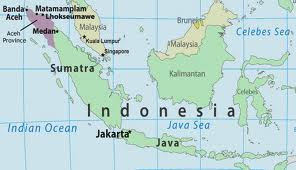
Aceh, Indonesia’s westernmost province, is shown in purple.
In March, the autonomous government of Aceh unveiled a new provincial flag (see photo at the top of this article), which just happened to the be the old flag of the supposedly-defanged separatist army, the Free Aceh Movement (Gerakan Aceh Merdeka), known by its initials GAM.  The government in Jakarta banned the flag and, although an Indonesian court supported the Acehnese position, nonetheless an agreement reached in the past week has now resulted in Indonesia’s home minister, Gamawan Fauzi, announcing that a new flag and new coat-of-arms will probably be designed for the province.  The crisis had come to a head when Indonesian troops forcibly took down hundreds of Acehnese flags on August 2nd, which prompted Aceh’s governor, Zaidi Abdullah, to put a moratorium on flying the banner while negotiations went ahead.
Aceh’s GAM rebels were proud of their flag.
Like other vast unitary states with large restive minorities, such as India and the People’s Republic of China, subnational flags are rare in Indonesia.  At the other end of Indonesia, the “Morning Star” flag of the Papuan people on the Indonesian, western half of the island of New Guinea is banned by law.  But Aceh is in a special category.
The rebel “Morning Star” flag of Papua and West Papua is even more strictly banned than the Acehnese flag.
Once a powerful independent sultanate, Aceh agitated to remain part of the Kingdom of the Netherlands when the Dutch granted Indonesia independence in 1945.  They joined the new nation only on condition that their autonomy be respected.  It wasn’t, and Aceh declared an Islamic state independent of the Javanese-dominated dictatorship in a 1953 uprising which was swiftly crushed.  Aceh then, through the 1950s, became a stronghold of the radical Darul Islam movement, which pushed for a more decentralized state.  An ensuing low-level insurgency was cooled in 1959 with the creation of a special autonomous status for Aceh.  Separatism emerged again in the 1970s, in anger over multinational corporations’ plundering of Acehnese natural resources.  An accelerating GAM rebellion, including another unilateral declaration of independence in 1976, eventually led, after decades of bloodshed, to a 2003 agreement giving Aceh enough autonomy to implement shari’a (Islamic law)—the only part of Indonesia where it is in force.  But hardline separatism was not fully set aside until after the devastating “Boxing Day tsunami” of 2004, which killed 170,000 Acehnese and left a half-million homeless.  Many saw the flood as divine punishment for separatist violence, and the relief efforts as an example of how it is occasionally useful to be part of a large, well-organized nation-state.  The GAM disarmed in 2005, with guarantees of a level of autonomy almost unprecedented in Southeast Asia, including far more control over resources.

Aceh after the tsunami in 2004
The Acehnese flag, with its crescent and star, is said to be the nearly-millennium-old symbol of the former sultanate.  It also happens to closely resemble the flag of the Republic of Turkey, with mostly just some stripes added.  Because of this, Acehnese nationalists have at times flown the Turkish flag—the flag of a friendly Muslim ally of Indonesia’s, after all—to get around the rules and make their point.
Aceh’s current coat-of-arms
It is not surprising that the Acehnese hanker for some vexillological spice in their lives.  Indonesia, in addition to having little tolerance for subnational flags, has itself one of the most boring national flags in the world.  Not only is it a mere red-over-white horizontal bicolor, but it is also identical in design, if not its proportions, to the national flag of the Principality of Monaco, to Austria’s two largest cities and one of its states, to one German state (Hesse), to France’s Alsace region, and to the Swiss canton of Solothurn.  Flip it vertically and you get the flag of Poland.  Yawn.

Try as folks might, there is just no way to make a boring flag like Indonesia’s interesting.
So now begins the long process of designing a new flag. A new coat-of-arms will also have to be designed, since that too is GAM insignia. More important than the flag’s design, however, will be the question of whether this or any flag is enough to appease the aspirations of Acehnese nationalists.

[Also, for those who are wondering, yes, this blog is tied in with a forthcoming book, a sort of encyclopedic atlas to be published by Auslander and Fox under the title Let’s Split! A Complete Guide to Separatist Movements, Independence Struggles, Breakaway Republics, Rebel Provinces, Pseudostates, Puppet States, Tribal Fiefdoms, Micronations, and Do-It-Yourself Countries, from Chiapas to Chechnya and Tibet to Texas.  Look for it some time in 2013.  I will be keeping readers posted of further publication news.]

Saturday, November 17, 2012

Kosovo Recognized by Timor-Leste, K.L.A. War-Crimes Arrests, an E.U. Ultimatum, and Hashim Thaçi’s Underground Sex Slaves: Kosovo Update, 11-17 November 2012


European Parliament Says Serbia Cannot Join without Recognizing Kosovo.  The European Parliament’s rapporteur for Kosovo, Ulrike Lunacek, said this week that the Republic of Serbia will not be allowed to join the European Union (E.U.) unless it grants diplomatic recognition to the Republic of Kosovo, the de facto independent state which most E.U. member states recognize but which Serbia still regards as part of its territory.  She did not express the ultimatum as a punishment for Serbia, saying, “The E.U. will not allow another Cyprus in the E.U.  The E.U. will not accept any country without defined borders.”  Lunacek, who represents Austria in the E.P. for the Green Party, also ruled out any partition of Kosovo.

Timor-Leste Becomes 94th Nation to Recognize Kosovo.  The partially recognized Republic of Kosovo received notice this week from one of the world’s youngest United Nations (U.N.) member states, the Democratic Republic of Timor-Leste, that it will be extending diplomatic recognition to Kosovo.  Timor-Leste (also known as East Timor), which became independent in 2002 after a U.N.-sponsored plebiscite end military occupation by Indonesia, is, at my count, the 94th nation, out of about 193 recognized sovereign states, to recognize Kosovo, following Papua New Guinea and the Republic of Burundi in October (as reported last month in this blog, at which point I also discussed some discrepancies over how to count Kosovo’s diplomatic partners).

Timor-Leste, a.k.a. East Timor, is Kosovo’s newest diplomatic partner.
E.U. Arrests 3 Former Kosovo Rebels on War-Crimes Charges.  Three former members of the Kosovo Liberation Army (K.L.A.), two of them currently serving in the North Atlantic Treaty Organization’s Kosovo Security Force (K.S.F.), were arrested this week by European Union (E.U.) police on war-crimes charges.  Reports indicate that the murder of two ethnic-Albanian supporters of the moderate politician Ibrahim Rugova in 1999.  The arrests were made by the E.U. Rule of Law Mission in Kosovo (Eulex).

E.U. Lays Corruption Charges against 7 Kosovars, Including Former Transport Minister.  The European Union Rule of Law Mission in Kosovo (Eulex) announced November 16th it had charged the Republic of Kosovo’s former minister of transport and communications and six other Kosovar Albanians with corruption.  The former minister, Fatmir Limaj, is the second-in-command in the Democratic Party (P.D.K.), Kosovo’s ruling party.  Charges against the seven include “manipulating tender procedures, giving and receiving bribes, and obstructing evidence.”

Fatmir Limaj
Slav Media Run Lurid Tales of Kosovo Prime Minister’s Underground Harem.  The organ-harvesting allegations (a hospital in the Netherlands was tapped by Interpol this week to investigate accusations of organ-trafficking by Kosovo rebels in the 1990s) don’t seem to be enough.  Several newspapers in the Balkans this week are running reports on interviews with a woman from Ukraine identified only as “N.M.” who describes escaping from what she calls an underground “hell hole” in which the prime minister of the Republic of KosovoHashim Thaçi, operates a “harem” with 52 sex slaves.  “None of the girls were from Kosovo,” N.M. said; “there were few from the Balkans, about ten from Russia, one from Cameroon, two Chinese women, etc.”  Many of the men who visit the harem for “orgies” “are foreign diplomats,” she said, “including officers from Eulex and KFOR.  The girls are not allowed to say, ‘No.’  One of the girls called Dolores from Colombia protested the conditions during our lunch time in the cafeteria.  She was shot dead by Thaci’s bodyguards.”  N.M. says she escaped with the assistance of a bodyguard from Chechnya, whom she had to bribe with sexual favors.  That’s all pretty good, but the lack of any reference to the ceremonial drinking of the blood of Serbian babies represents a disappointing decline in the literary quality of Serbian propaganda.


2 Serbs Ambushed in Kosovo; Grenade Attack on Serb Apartment Building.  Two Serbs were ambushed in their car in a village in western Kosovo’s Istok municipality on November 10th by an unknown gunman in a balaclava.  One of the two men, Momir Pantić, a former local police chief, was wounded in the arm and face.  Pantić owns land on Osojane, a Serb enclave in Istok, which is outside the Serb-governed North Kosovo territory along the republic’s border with the Republic of Serbia.  He said he had been followed all that day by unknown persons.  The mayor of Kosovoska Mitrovica, North Kosovo’s de facto capital, called Pantić an internally displaced person and said that the ambush was evidence that Serbs are not safe in Kosovo.  In the evening of the next day, November 11th, a hand grenade went off in front of a Serb-populated apartment building in Kosovska Mitrovica, which caused damage to the building and nearby vehicles but no injuries.


[Also, for those who are wondering, yes, this blog is tied in with a forthcoming book, a sort of encyclopedic atlas to be published by Auslander and Fox under the title Let’s Split! A Complete Guide to Separatist Movements, Independence Struggles, Breakaway Republics, Rebel Provinces, Pseudostates, Puppet States, Tribal Fiefdoms, Micronations, and Do-It-Yourself Countries, from Chiapas to Chechnya and Tibet to Texas.  Look for it in spring 2013.  I will be keeping readers posted of further publication news.]

Friday, August 31, 2012

Mombasa Riots, U.N. Won’t Mess with Texas, Rachel Corrie, Kachin Crisis, Ugandan Kings, Puerto Rico and Mitt Romney: The Week in Separatist News, 26 August - 1 September 2012

TOP STORY:
KENYAN MUSLIMS BLAME POLICE FOR MURDER OF RADICAL CLERIC,
SPARKING DEADLY RIOTING IN MOMBASA AND STOKING SEPARATISM


Aboud Rogo Mohammed, who Muslim separatists say was killed by Kenyan police
Kenyan Muslims Blame Cops for Murder of Radical Cleric, Burn Churches in Mombasa.  A Muslim cleric in Mombasa was killed in a hail of bullets on August 27th in what many in the separatist and predominantly Muslim region in southern Kenya say was a police killing, leading to deadly riots that killed one civilian and continued until the next day, including a grenade attack that killed two police officers and injured 16 others.  The cleric, Aboud Rogo Mohammed, had been accused by the United States and Kenyan governments of supporting al-Shabaab, the al-Qaeda-affiliated Islamist army fighting Kenyan and Ethiopian armies in southern Somalia, and had been facing terrorism charges for recruiting non-Somalis to join al-Shabaab.  Unidentified gunmen killed him as he sat in a private car.  In the ensuing riots, protesters also set fire to two churches and a government vehicle and vandalized four other churches, threw rocks at cars, set up a roadblock of burning tires, and looted stores throughout Mombasa.  Police responded with tear gas and rubber bullets, and one protester was killed by being hit in the head with a stone.  By the 28th, with riots still lingering, al-Shabaab announced that Kenyan Muslims should boycott the next presidential elections and “take all necessary measures to protect their religion, their honor, their property, and their lives from the enemies of Islam.”  Mombasa is Kenya’s second-largest city and tourist capital, on the southern Indian Ocean coast and is also the center for the country’s Muslim minority and the home of the separatist Mombasa Republican Council (M.R.C.), which would like Kenya’s Coast Province, including virtually its entire coastline, to secede as a separate country.


Rioting in Mombasa this week
AFRICA

Al-Qaeda Plotted to Kidnap Kennedy Heiress at Polisario Refugee Camp in Algeria.  Sources close to the United StatesCentral Intelligence Agency (C.I.A.) reported August 28th that the al-Qaeda Organization in the Islamic Maghreb (A.Q.I.M.) was plotting to abduct the human-rights activist Kerry Kennedy, a daughter of the late Sen. Robert F. Kennedy and ex-wife to New York’s governor Andrew Cuomo, during her visit this week to a Sahrawi refugee camp in Algeria.  The camp is run by the Polisario Front, a militia fighting for an independent Sahrawi Arab Democratic Republic (S.D.A.R.) in neighboring Western Sahara, which is mostly occupied by the Kingdom of Morocco.  Information about the plot was passed along to Algerian security forces.  Kennedy is president of the Robert F. Kennedy Center for Justice and Human Rights and is an outspoken supporter of Sahrawi independence.  The director of the R.F.K. Center, Santiago A. Canton, told reporters during the visit, on August 29th, that he had witnessed a Sahrawi woman beaten by police, requiring hospitalization, in Laayoune, a Western Sahara city under Moroccan rule.  “We were told by people there,” Canton said, “that the situation has been like that for some time.”  [Related article: “10 Ethnonationalist Causes That Might Disrupt the Olympics” (July 2012).]


Kerry Kennedy with the Sahrawi activist Aminatou Haidar,
holding a deformed lump of molten metal
that is someone’s idea of what her father Robert F. Kennedy looked like.
Moroccan Activists Attempt to Plant Flag on Disputed Spanish Fortress.  Four Moroccans were arrested on August 29th for a brief stunt during which they tried to symbolically occupy a small Spanish-ruled fortress atop Peñón de Vélez de la Gomera, a largish (19,000 square meters) rock which was a Mediterranean island until 1934, when a storm left behind a smear of silt that now forms an isthmus connecting it to the mainland of Morocco—and constitutes the world’s shortest land border (85 meters long).  A total of seven activists attempted to plant flags from their movement, the Committee to Free Ceuta and Melilla, but four were stopped by Spanish border police, who questioned and then released them.  Vélez de la Gomera, along with two municipalities attached to the Moroccan mainland, Ceuta and Melilla, and a scattering of tiny islands, constitute the Plazas de soberanía (literally, “Sovereign Territories”), a constituent territory of the Kingdom of Spain which is a source of repeated tensions in Spanish-Moroccan relations.  [Related articles: “Prince William Lands in the Middle of a New Cold War over the Falklands” (Feb. 2012), “What Is a Colony? The United Nations’ Definition Needs an Overhaul” (June 2012).]


Spain’s “Sovereign Territories” in the western Mediterranean, also claimed by Moroccan nationalists
Nigeria Confirms Indirect “Back-Channel” Negotiations with Boko Haram Factions.  The government of Nigeria confirmed August 26th that it is engaged in negotiations through “multi-level backroom channels” with Boko Haram, the Islamist militia that has been committing almost daily terrorist acts, mostly against Christians, in Nigeria’s predominantly-Muslim north and mixed-Muslim-and-Christian “Middle Belt” region since 2009, with over 1,000 deaths.  Reuben Abati, a government spokesman, said the talks were indirect and not face to face.  Abati also mentioned that Boko Haram had several factions.  Last week, the most hardline faction ruled out negotiations and also claimed that other factions were committing crimes in its name.  Boko Haram generally claims it wants to overthrow the federal government so that it can extend shari’a (Islamic law) beyond the 12 northern states where it is in force, but so far it does not claim to want a separate state.  [Related articles: “Remembering Odumegwu Ojukwu: On Biafra and on an African Continent Riven by European Borders” (Nov. 2011), “Ten Separatist Movements to Watch in 2012” (Dec. 2011)“Jihadists Imperil Nigerian Unity” (June 2012), “Ambazonian Separatists Focus on Bakassi Peninsula in New Push to Split Cameroon” (Aug. 2012), “Southern Nigeria Splitting Apart Too as the Muslim North Burns” (Aug. 2012).]

6 Die as Boko Haram Attacks Continue in Nigeria.  Militants presumed to be members of Boko Haram attacked a bank in Gashua, in northeastern Nigeria’s Yobe State on August 25th, resulting in one of the militants and one policemen dying.  The same day, in Taraba State, in the eastern Middle Belt region, “suspected armed bandits” killed a construction contractor from Ireland.  Then, on August 28th in Maiduguri, capital of Borno State in the northeast, one militant was killed by an apparently accidental explosion of a homemade bomb in a wheelbarrow.  The wheelbarrow’s owner was shot and killed when he tried to flee the explosion, and a baby was killed and his mother injured by stray bullets.  Elsewhere in Maiduguri on the same day, a homemade bomb was discovered and destroyed by anti-terrorism police in a controlled detonation, and an apparently separate bomb planted at a Maidiguri roundabout injured several members of the anti-terrorist Joint Task Force (J.T.F.).  [Related articles: “Remembering Odumegwu Ojukwu: On Biafra and on an African Continent Riven by European Borders” (Nov. 2011), “Ten Separatist Movements to Watch in 2012” (Dec. 2011), “Jihadists Imperil Nigerian Unity” (June 2012), “Ambazonian Separatists Focus on Bakassi Peninsula in New Push to Split Cameroon” (Aug. 2012), “Southern Nigeria Splitting Apart Too as the Muslim North Burns” (Aug. 2012).]


Malian Reports Flexibility on Shared Rule, Shari’a after Meeting Ansar al-Dine in Kidal.  The Islamist militia Ansar al-Dine, which controls the city of Kidal in the northern two-thirds of the Republic of Mali that since April has called itself the Independent State of Azawad, said August 29th that it was ready to discuss with the central Malian government the different possibilities for administration of the vast Kidal province.  Homeny Belco Maiga, the speaker of Kidal province’s (deposed, Malian) regional assembly, reported the development after meeting with Ansar al-Dine officials in a parley by the pro-unionist Coalition for Mali on August 17-24.  In Belco Maiga’s opinion, Ansar al-Dine were not separatists and were even flexible on the question of which parts of shari’a (Islamic law) to implement in the region.  He added, “Today, the health services are functional in Kidal.  The zone is well supplied but there’s no money.”


Map of the Republic of Mali’s eight regions (and capital, Bamako).
Timbuktu, Gao, and Kidal (and, in some versions of the situation, Mopti)
form the Independent State of Azawad.
Islamists Threaten More Amputations in Azawad; Population Cowed.  A minister in the non-functioning secular separatist Tuareg government in northern Mali said this week that civilians would continue to rise up against the Islamist militias who hijacked the Tuareg secession earlier this year.  The minister, Nina Walet Ntalo, of the Independent State of Azawad, was responding to new threats by the Movement for Unity and Jihad in West Africa (MUJAO) to amputate the hands of 60 thieves in Gao, in accordance with shari’a (Islamic law).  An accused thief, who was apparently stealing so he could feed his family but had his hand cut off by a MUJAO patrol, died from his amputation wound August 28th after a week of suffering.  His mother also died from a heart attack as a result of the trauma.  Almost no health-care was available to him, other than a crude splint, some painkillers, and left-over antibiotics, and MUJAO refused to help him seek better care elsewhere.  A journalist reported that the young man’s death led to nascent protests which were quickly squashed by the Salafist militias.  [Related articles: “Mali Becomes the Latest African Country to Split along North–South Lines” (Feb. 2012), “A New Country in Africa: Islamic Republic of Azawad” (April 2012), “Why It Matters What You Call Your Country: Cyprus vs. Northern Cyprus, Azawad vs. the Azawad” (April 2012), “Dream of a Tuareg State Fizzles: Is This the End of Azawad?” (July 2012), “Mali Becomes the 92nd Country to Formally Recognize Kosovo ... or Not” (Aug. 2012).]

Somaliland Claims Ethiopian Militia Incursions over Border in Wake of Zenawi Death.  The de facto independent but unrecognized Republic of Somaliland—which the rest of the world regards as part of the Somali Republic—this week accused police from across the border in Ethiopia of making repeated incursions into Somaliland territory.  The “Liyuu Police” are actually a militia under the control of regional leaders in Zone 5 of Ethiopia’s vast Afar Regional State.  Both countries built up military forces along their border (as reported last week in this blog) following the death on August 20th of Meles Zenawi, Ethiopia’s long-time authoritarian prime minister.  Liyuu Police are also said to be holding five abducted Somaliland customs officers and to have recently provided security services to the rogue separatist government of the formally disbanded Khaatumo State (a.k.a. Sool, Sanaag, and Cayn, or S.S.C., State) within Somaliland.  [Related articles: “Somalia the ‘Failed State’—So What Are Somaliland and Puntland? Chopped Liver?” (Feb. 2012), “Somaliland’s Own Mo Farah Clinches Olympic Immortality” (Aug. 2012).]


Oromo and Sidama Rebels Hope for Stability in Wake of Ethiopian Leader’s Death.  In statements released August 22nd, two rebel groups in Ethiopia, the Ogaden National Liberation Front (O.N.L.F.) and the Sidama Liberation Front (S.L.F.), hoped that the death of Meles Zenawi, Ethiopia’s authoritarian prime minister, two days earlier, would bring an opportunity for greater stability and freedom in the country.  The Sidama statement was stronger, stating, “Meles is gone, but the system he championed has continued preying on Sidama innocents.  ...  The army ... has continued intimidating and terrorizing Sidama people.”  The O.N.L.F. and the S.L.F., along with the Oromo Liberation Front (O.L.F.), form the People’s Alliance for Freedom and Democracy (A.F.D.), a national political party.  The Oromo occupy a large province called Oromia in southern Ethiopia, while the Sidama are one among several ethnic groups forming the Southern Nations, Nationalities, and People’s Region (the actual name of the province).  The Ogaden speak a Somali language and have a region covering much of the border with the Somali Republic.  Zenawi himself was a Tigray, from northern Ethiopia.


Map showing the ethnically defined regions into which Ethiopia is subdivided.
(“Southern” is the Southern Nations, Nationalities, and People’s Region, home to the Sidama.)
Shabaab Commander Surrenders to Puntland Forces in Galgala Region.  A platoon commander of a militia in northern Somalia’s Galgala Mountains, linked to al-Shabaab and al-Qaeda, surrendered on August 25th to the Dervish military of the self-governing state which controls the region, the Puntland State of Somalia.  The commander, Mowlid Adan Qalalan, had previously served in the Shabaab-controlled Kismayo and Kudhaa areas of southern Somalia proper before al-Shabaab’s expansion into Puntland earlier this year.  [Related articles: “Somalia the ‘Failed State’—So What Are Somaliland and Puntland? Chopped Liver?” (Feb. 2012), “Somaliland’s Own Mo Farah Clinches Olympic Immortality” (Aug. 2012).]

Clan Leaders Rally for Restoration of Uganda’s Ankole Kingdom.  More than 200 clan leaders from the Nkore and Hema (a.k.a. Hima) ethnic groups representing constituent groups of the old Ankole Kingdom met August 27th at a country club in Mbarara, in southwestern Uganda, to argue for the reinstatement of their monarchy.  In 1967, the dictator President Milton Obote abolished the purely ceremonial kingdoms entrenched in independent Uganda’s first constitution of 1962.  In the 1990s, five of the kingdoms—Toro, Bunyoro (a.k.a. Bunyoro-Kitara), Buganda, Busoga, and Rwenzururu—were restored, but Ankole was not.  George William Katatumba, prime minister of the Ankole kingdom, told the gathered youth and elders in Mbarara, “We lost out a lot of opportunities. We are now at the moment like bees without a queen, bees with a king.  They fly over the place without guidance.”  Earlier this month (as reported in this blog), supporters of the restoration of the Busongora Kingdom came into conflict with the reigning Rwenzururu monarch.


This map of Uganda’s ethnic groups shows the boundaries of some of the five recognized kingdoms—Toro, Bunyoro, Busoga, and Buganda—shown, as well as those of the aspirant kingdom of Ankole.  The Rwenzururu Kingdom and the overlapping claim of the Busongora Kingdom actually are in the western part of what is here shown as the Toro Kingdom.  (It is very difficult to find a good map of Uganda’s kingdoms.)
South African Boeremag Plotters Plea for Leniency, Time Served; 1 Let Off with Bail.  As sentencing begins for the 20 members of the South African white-supremacist Boeremag militia convicted of high treason this month (as reported, for example, last week in this blog), the judge in Pretoria this week granted one of the militiamen, Adriaan van Wyk, a 47-year-old accountant, R15,000 bail.  Van Wyk is considered one of the least complicit among the defendants and has already served 10 years behind bars awaiting trial.  Another convict, 44-year-old Jurie Vermeulen, apologized to the court for his actions—which included plotting to assassinate Nelson Mandela, overthrow the government of South Africa, and reinstitute apartheid—and also appealed for clemency.  He has already served more than seven years.

EUROPE


Independent Scotland May Lose Nuclear Subs but Will Keep EastEnders.  The leader of the separatist Scottish National Party (S.N.P.) and First Minister of Scotland, Alex Salmond, said August 24th that some British Broadcasting Corporation (B.B.C.) would be unavailable to Scottish viewers after independence as the country develops its own public broadcasting service.  Salmond did, however, reassure the public that EastEnders would continue to be available, and in so doing he may have removed the last remaining barrier to full Scottish independence.  [Related articles: “Succession or Accession—Could Scotland Leave Britain but Stay in Europe?” (Jan. 2012), “Orkney—the Next Dubai? Further Reflections on Scottish Independence” (Feb. 2012),  “Celts, Cypriots, Aborigines Raise Stink at Olympics: Ethnonationalist Protest Update” (July 2012).]


Wanted Basque Separatist Arrested in France for Police Attacks.  The Spanish ministry of the interior announced on August 27th that Spanish and French police arrested one Arturo Villanueva Arteaga, in Urrugne, in southwestern France, on terrorism charges.  Arteaga, who is 35, had been wanted since 2003 for attacks against police in Pamplona, Spain, on behalf of the now-disarmed Basque separatist group ETA (Euskadi Ta Askatusana, “Basque Homeland and Freedom”).  [Related article: “The World’s 21 Sexiest Separatists,” featuring a profile of the Basque warrior Idoia López Riaño, a.k.a. la Tigresa.]

[For the latest news from the North Caucasus (including Dagestan, Chechnya, and Ingushetia), see today’s article “Caucasus Update: Chechen-Ingush Border Conflict; Female Breakdancing Suicide-Bomber in Dagestan; South Azerbaijani Separatism; Is Georgia Supporting Islamism in Russia?”]

BITS OF ASIA THAT LIKE TO PRETEND THEY’RE PART OF EUROPE

[For the latest news from the South Caucasus, including Azerbaijan and Georgiasee today’s article “Caucasus Update: Chechen-Ingush Border Conflict; Female Breakdancing Suicide-Bomber in Dagestan; South Azerbaijani Separatism; Is Georgia Supporting Islamism in Russia?”]

[For the latest news from Turkey, including Turkish Kurdistan, see “Syria and Kurdistan Update, 26 August - 1 September 2012.”]

ASIA—MIDDLE EAST


[For the latest news from Syria, Iraq, and various parts of Kurdistan, see “Syria and Kurdistan Update, 26 August - 1 September 2012.”]

Israeli Court Clears Military in Bulldozing Death of American Activist in Gaza.
  A court in Israel has ruled for the military in a civil suit over the death of Rachel Corrie, a 23-year-old United States activist for Palestinian rights who was murdered when an Army bulldozer rolled over her and crushed her during a demonstration in the Gaza Strip in 2003.  The judge called the death a “regrettable accident”  and ruled that the army was not responsible since the killing occurred during a war-time situation.  The logic here is clear: Israel is surrounded by enemies, Israel is always at war, Israel can kill whoever it wants.  [Related article: “Ten Separatist Movements to Watch in 2012” (Dec. 2011).]


Rachel Corrie
France Opens Formal Assassination Inquiry into Yasir Arafat’s 2004 Death.  The government of France on August 28th formally opened an inquiry into the possible assassination of Yasir Arafat, following a formal complaint last month by Arafat’s widow, Suha, and daughter, Zawra, in the wake of an Al-Jazeera report in July (reported on at the time in this blog) indicating the possibility that his death in 2004 was due to radioactive poisoning.  Arafat, the long-time chairman of the Palestine Liberation Organization (P.L.O.) and the first president of the Palestinian National Authority, fell ill abruptly before his death, and traces of polonium, a rare lethal isotope, was found on his personal effects.  [Related article: “Ten Separatist Movements to Watch in 2012” (Dec. 2011).]

2 Rockets Fall on Israeli Town at Gaza Border.  Two rockets on August 31st struck the small city of Sderot, within Israel but on the edge of the Gaza Strip.  No one was injured but a house was damaged.  Presumably, like others before them, the rockets were fired from within the Gaza territory.  

U.N. Warns Gaza Strip Will Be Unlivable by 2020.  The United Nations’ humanitarian coordinator in the Gaza Strip portion of the Palestinian Territories, Matthew Gaylard, issued a scorching report August 27th, warning that by 2020 the enclave may become uninhabitable, due to water and power supplies, poor health-care, education, and sanitation, and other problems brought about by overcrowding and by Israel’s pitiless blockade. Since 2007, Gaza has been ruled by an elected local government run by Hamas, an Islamist terrorist organization, which has divided it politically and socially from the rest of the Palestinian Territories as well.  The Gaza Strip, surrounded by Israel, Egypt, and the Mediterranean, is only 141 square miles but with a population of 1.7 million that is predicted to increase by nearly a third over the next eight years.  If independent, the Gaza Strip would be the 3rd most densely populated country in the world, after Monaco and Singapore.  (Palestine as a whole already ranks 8th.)  Its population is one of the world’s youngest.  51% are under 18.  [Related article: “Ten Separatist Movements to Watch in 2012” (Dec. 2011).]


3 Jewish Children Arrested for West Bank Firebombing.  Three Jewish boys, ages 12 to 13, were arrested this week on suspicion of throwing a firebomb at a Palestinian vehicle in the Israeli-controlled West Bank early in the month.  Six people were injured in the incident, including two children.  [Related article: “Ten Separatist Movements to Watch in 2012” (Dec. 2011).]


Israel Turns Away 100 “Welcome to Palestine” Activists at West Bank Border.  About 100 pro-Palestinian activists from the “Welcome to Palestine” campaign were denied entrance to the West Bank on August 26th by Israeli customs officials.  The ministry of defense called the group “provocateurs and known troublemakers.”  Three from the United States were among those turned away.  The activists were delivering school supplies to Palestinian refugee camps in Bethlehem—which the Israeli government called a “failed publicity stunt,” saying that there was no shortage of school supplies in the West Bank.  [Related article: “Ten Separatist Movements to Watch in 2012” (Dec. 2011).]


South Yemeni Separatist Killed in Drive-By Shooting in Aden.  In Yemen, a protest camp run by the separatist South Yemen Movement in Aden, the former South Yemeni capital, was fired on by unknown gunmen in a drive-by shooting on August 26th, killing one separatist.  The northern Arab Republic of Yemen and southern People’s Democratic Republic of Yemen reunified as the Republic of Yemen in 1990, but sectarian and tribal divisions resurfaced in a 1994 civil war and, more recently, in the chaos of the Arab Spring revolution.  [Related article: “Ten Separatist Movements to Watch in 2012” (Dec. 2011).]


A flag of South Yemen on display in Aden
ASIA—SOUTH ASIA

Former Islamist Leader in Pakistan Warns of Separatism in Waziristan.  The former head of Pakistan’s main far-right-wing Islamist political party, Jamaat-e-Islami Pakistan, warned this week that continued assaults by Pakistan’s central government and the United States against Taliban-linked militants in the North Waziristan Agency of the lawless Federally Administered Tribal Areas (FATA) along the border with Afghanistan may lead to separatism in the region.  The leader, Qazi Hussain Ahmad, who is now retired, said that the aim of the U.S. in Pakistan was not to defeat militants but to weaken Pakistan, with the more global geopolitical aim of strengthening India as a counterweight to China.


Map showing the location of Waziristan in Pakistan
Indian Troops Exchange Gunfire with Separatists in Kashmir.  Kashmiri separatists and India’s military exchanged gunfire on August 29th in the Anantnag district in the western part of Jammu and Kashmir, India’s only predominantly-Muslim state.  No casualties were reported.

ASIA—EAST ASIA


500 Kachin Forced Back into Burma from China as Government Offensive Builds.  About 500 Kachin refugees returned home to northern Burma (a.k.a. Myanmar) over the August 25-26 weekend after being forced out of their refugee camps over the border in the People’s Republic of China’s Yunnan province.  They join another 1,000 that had already been returned.  One Chinese refugee camp still has over 500 residents, but many more Kachin refugees are living with relatives in Yunnan.  Meanwhile, the Burmese government escalated its war against the Kachin this week, causing an estimated 90,000 civilians to be displaced.  [Related article: “The Moment Burma’s Ethnic Minorities Have Been Waiting for” (Jan. 2012).]


2 Tibetan Teenagers Self-Immolate at Monastery in Sichuan Province.  The Tibetan exile group Free Tibet announced that two more young Tibetans had killed themselves by setting themselves on fire in Aba, a volatile county in a Tibetan-dominated portion of the People’s Republic of China’s Sichuan province.  The two were Lobsang Kalsang, an 18-year-old monk, and Damchoek, a 17-year-old former monk, who self-immolated in front of a monastery and both died later in a hospital.  As they died, they chanted slogans protesting P.R.C. rule in what China calls the Tibet Autonomous Region.  Free Tibet now counts 51 self-immolations since 2009.  [Related articles: “China, Tibet, and the Politics of Reincarnation” (March 2012), “10 Ethnonationalist Causes That Might Disrupt the Olympics” (July 2012).]


A vigil by Tibetan exiles
Malay Secessionists Suspected in Assassination of Thai Village Chief.  Separatist militants are being blamed in the assassination of an assistant village chief in the Muslim-dominated far south of the Kingdom of Thailand.  The headman, Abdulloh Awaeche, was shot and killed by two men on a motorcycle while eating a street vendor’s noodles on August 29th in Yala province.  Yala is one of three provinces by the border with Malaysia where ethnically Malay Muslims would like to secede from Thailand.

OCEANIA


Probe Urged into Papuan Separatist’s Assassination by Australian-Trained Élite Forces.  A report on August 28th that the assassination, in June, of a separatist leader in West Papua was carried out by an Indonesian anti-terrorism unit trained by Australia’s military has left Australian politicians scrambling to respond.  Australia’s prime minister, Julia Gillard, has asked Indonesia’s president, Susilo Bambang Yudhoyono, about it, and the two countries’ foreign ministers have also parleyed.  The separatist, Mako Tabuni, who was supposedly shot and killed while resisting arrest (as reported at the time in this blog), is now said to have been picked off by an élite anti-terrorism squad called Detachment 88.  The Australian foreign minister, Bob Carr, demanded a full inquiry, saying that providing anti-terrorism training to Indonesia’s military is “in Australia’s interests,” but “we don’t train them in counterinsurgency.”  The initial report, on Australia’s A.B.C. network, also suggests covert Australian links to torture of separatists by Indonesian forces.  [Related article: “Ten Separatist Movements to Watch in 2012” (Dec. 2011).]


Mako Tabuni, who was perhaps assassinated with Australian assistance
New Zealand Backs Paris in Keeping French Polynesia off U.N. List of “Colonies.”  The government of New Zealand reiterated this week that it stands with Australia and France in opposing the restoration of French Polynesia to the United Nations’ list of (currently 16) “non-self-governing territories”—all of which are traditional European-administered overseas colonies.  French Polynesia’s independence-minded president, Oscar Temaru, favors restoring it to the list (as reported recently in this blog).  New Zealand’s prime minister, John Key, says it is a matter for France and Polynesia to resolve between them, to which Temaru responds that he has allies in the Pacific on the matter and that Australia and New Zealand should stay out of it.  [Related article: “What Is a Colony? The United Nations’ Definition Needs an Overhaul” (June 2012).]

NORTH AMERICA


Separatist Parti Québécois Leads Tight 3-Way Race with Days Left before Vote.  In Canada, with only days left before Quebec’s general election on September 4th, the Parti Québécois (P.Q.) is leading the largely three-way race with 33% of votes, according to a poll conducted between August 22nd and 24th, with a margin of error of ±2.2%.  The center-right Coalition Avenir Québec (C.A.Q.) coalition, which favors a somewhat softer approach to autonomy than the pro-independence P.Q., has 28% support from eligible voters, while the scandal-plagued incumbent Quebec Liberal Party of Jean Charest has 27%.  Charest said August 28th that he would broaden the application of Quebec’s laws protecting and enhancing the French language, but would not alter the laws as his opponent, the P.Q.’s Pauline Marois, has promised to do (as reported recently in this blog).  [Related article: “Quebec Cracks Down on Crimes against the State—Like Playing Hopscotch in English” (Nov. 2012).]


Deadline Arrives for Atikamekw Cree Roadblocks of Quebec Logging Roads.  Leaders from the Atikamekw branch of the indigenous Cree Nation in Quebec, Canada, were facing a choice this week as the August 30th deadline they made to the federal and provincial governments in July drew near.  They asked that a land dispute be settled, or Atikamekw people would resume blockading logging roads, as they had done in June (as reported on in this blog).


United Nations Won’t Mess with Texas, Secretary-General’s Office Claims.  The United Nations has reassured Texans that the U.N. has no plans to invade Texas.  The statement came from Martin Nesirsky, spokesman for the U.N. secretary-general, Ban Ki-moon, in response to a judge in Lubbock County, Texas, who expressed his intention (as reported a few days ago in this blog) of banding together with some of his buddies to protect his county from U.N. black helicopters that he believes Barack Obama will send into Texas if reelected United States president in November.


But does the U.N. even want the place?
In Florida, North Miami Neighborhoods Mull Secession over Mayoral Scandals.  An irate group of residents in the well-heeled Sans Souci and Keystone Point neighborhoods of North Miami, Florida, are talking more and more about separating from the Miami suburb in northern Dade County.  Complaints of inept government have focused on the mayor’s nephew’s accepting bribes to sway City Council votes, as well as an extravagant security detail extended to the visiting president of Haiti last month using city funds.

CENTRAL AMERICA & CARIBBEAN

Fortuño Claims Romney’s Support for Puerto Rican Statehood.  The governor of the Commonwealth of Puerto Rico, a disenfranchised protectorate of the United States, said August 29th that he had gotten assurances from Mitt Romney, the Republican former Massachusetts governor running for president of the U.S., that he had the candidate’s support in the territory’s quest to become the 51st state.  Fortuño is a member of the New Progressive Party of Puerto Rico (P.N.P.), a pro-statehood party, but is registered nationally as a Republican.  A referendum on whether to seek independence, become a state, or keep the status quo will be on the November ballot.  [Related article: “What Is a Colony? The United Nations’ Definition Needs an Overhaul” (June 2012).]

SOUTH AMERICA


Up to 80 Yanomami Tribespeople Massacred by Gold Miners in Venezuela.  Perhaps as many as 80 members of the Yanomami (also spelled Yąnomamö) indigenous ethnic group near the border with Brazil in southern Venezuela’s portion of the Amazon basin have been murdered by gold miners, according to Survival International this week.  It took days for news of the massacre to reach the nearest town with links to the outside world.  A communal house was torched, with many burned bodies found inside.  Only three survivors from the Irotatheri community have been accounted for.


SPORT

Somali-British Gold Medalist Mo Farah Becomes Father of Twin Girls.  The Somali-British runner Mohammed “Mo” Farah, who won two Olympic gold medals for Team Britain in London this summer and is from the de facto independent Republic of Somaliland, became the father of twin baby girls on August 25th.  The girls have yet to be named, but Farah plans to have their names engraved on his two Olympic gold medals.  Farah was already stepfather to his wife Tania’s daughter Rihanna, from a previous relationship.  [Related article: “Somaliland’s Own Mo Farah Clinches Olympic Immortality” (Aug. 2012).]


Mo Farah’s step-daughter Rihanna, with her two (as yet unnamed) baby half-sisters.


[You can read more about these and many other separatist and new-nation movements, both famous and obscure, in my new book, a sort of encyclopedic atlas just published by Litwin Books under the title Let’s Split! A Complete Guide to Separatist Movements and Aspirant Nations, from Abkhazia to Zanzibar.  The book, which contains 46 maps and 554 flags (or, more accurately, 554 flag images), is available for order now on Amazon.  Meanwhile, please “like” the book (even if you haven’t read it yet) on Facebook and see this interview for more information on the book.]


Subscribe Now: Feed Icon