 |
| Georgian interior-ministry snipers being transported to the crisis in Lopota Gorge this week |
TOP STORY: ABDUCTION AND DEADLY SIEGE AT LOPOTA GORGE
SHINE LIGHT ON ABILITY OF ISLAMISTS TO OPERATE WITHIN GEORGIA
The Republic of Georgia’s ministry of the interior said August 29th that its forces had killed 11 militants in an attempt to free hostages in an anti-terrorist operation near the border with the Russian Federation’s Republic of Dagestan. The ministry would not give further information, such as the nationality of the gunmen or whether they had crossed into Georgia from Russia; an entire mountain gorge was closed off to reporters and other civilians. Two Georgian interior-ministry troops and a defense-ministry medic were killed and five other Georgians injured, the ministry said. The crisis had begun days earlier when five young people from the area had gone missing while hiking near the Russian border. Police discovered the kidnappers’ hideout and managed to free the five captives. Brief video footage on television showed suspects with the tell-tale beards of Islamist radicals. (Later, the Georgian interior ministry said that most of the militants were Dagestani but included some from Russia’s nearby Republic of North Ossetia–Alania.)
 |
| Map showing the location of Pankisi Gorge, site of an earlier 2003 battle with Islamists. Lopota Gorge is to its east, along the Dagestani border. |
Who were the culprits? Chechen nationalists operating within Georgia? This part of Georgia has at times been home to a cell of a Chechen separatist government-in-exile, a member of which, Khizri Aldamov, earlier this year said that the armed group operated in northern Georgia with the support of Georgia’s president, Mikhail Saakashvili, and that Georgia was used as a launching area for terrorist attacks within Russia’s Chechen Republic. Moreover, Aldamov alleged, the group, known as the Government of Ichkeria (this being an alternate name for Chechnya), whose leader, Akhyad Idigov, lives in France, sought to create a radical Islamist state in northern Georgia’s Pankisi Gorge region, by the Chechen border, to be called Pankisi Jamaat. Saakashvili, for his part, in a televised national address from his vineyard at his home, said, “We, the Georgian state, will not allow turmoil, instability, and violence on the territory of our neighboring country to spill over into Georgia in any form.”
 |
| Mikheil Saakashvili meeting a survivor of the Lopota Gorge hostilities |
Chechnya Accuses Ingushetia of Border Encroachment, Asks Moscow to Mediate. The Chechen Republic and the Republic of Ingushetia, two Russian republics in the war-torn North Caucasus region, are in a new conflict, over territory. The Chechen government announced August 26th that it was appealing to the Russian Federation to resolve a lingering border-demarcation conflict which the Chechen Republic claims is allowing Ingush encroachments on Chechen territory. Ramzan Kadyrov, the authoritarian Moscow-appointed president of Chechnya, said, “Whole villages and districts have been seized [by those] taking advantage of the Chechen people’s problems. ... These actions are provocative by nature. The boundary line, which we have never drawn and in which we took no interest, is being pushed inside the Chechen Republic.” Chechnya and Ingushetia used to be united, within the Russian Federative Soviet Socialist Republic, as the Chechen-Ingush Autonomous Soviet Socialist Republic, until Chechnya’s de facto secession from Russia in 1991 led to the establishment of Ingushetia as a separate republic.

Ingush Police-Funeral Bomber Got Wrong Victims, Emirate Admits; 4 More Rebels Killed. The Caucasus Emirate militants that attacked a funeral in the Russia’s Republic of Ingushetia August 19th (as reported last week in this blog) admitted August 24th that they’d gotten the wrong victims. Meanwhile, it was reported August 28th that four suspected militants were killed and two arrested in Malgobek, Ingushetia, in the ongoing attempt by security forces to sweep up those complicit in the attack. In a “clarification” posted on the Emirate website http://hunafa.com, the “Mujahideen Command” for the vilayet (as provinces in the old Ottoman Empire were known) of “Ghalghayche” (i.e. Ingushetia) says the attack, which killed seven, had targeted Mukhazhir Yevloyev, chief of police for Malgobek, whom the Command calls “one of the worst enemies of Allah.” Indeed, Ingush authorities had said that the policeman, killed the day before, whose funeral was attacked, Ilez Korigov, had been killed precisely in order to lure Yevloyev to the funeral. However, the entire Malgobek police department was during the funeral busy hunting for Korigov’s assassins’ getaway car, so all the police there were from another detachment. Meanwhile, the Emirate’s website announced August 28th that three civilians had been killed and at least two kidnapped in a “punitive raid” by Russian forces in Sagopshi, the village in the Malgobek region where the funeral massacre occurred.
 |
| Ingushetia’s Caucasus Emirate “Mujahideen Vilayat Command” |
DAGESTAN’S BLOODY TUESDAY: 17 DEAD IN SUICIDE-BOMBING, BORDER-POST RAMPAGE, AND ARMORY TAKEOVER
1. Female Suicide Bomber Blows Up Sufi Cleric in Dagestan, 6 Others. First, a female suicide bomber disguised as a pilgrim seeking conversion to Islam killed a Sufi leader and six of his followers, including an 11-year-old boy, as well as herself, on August 28th. The blast occurred in the village of Cherkei at the home of the leader, Said Atsayev, also known as Sheikh Said Afandi al-Chirkavi, who was 74 years old. The bomber, identified now as Aminat Saprykina, was an ethnically Russian actress and breakdancer (!) and wife of an Islamist militant who had also been widowed by two successive Islamist militant husbands. Sufism tends to be a politically moderate form of Islam, and is regarded as heretical by the Wahhabist brand of Sunni Islam followed by most Islamist militants in the North Caucasus. A member of parliament for the extremist-right-wing Liberal Democratic Party of Russia, Yaroslav Nilov, who chairs a committee on religious organizations, blamed foreign enemies of Russia for the attack.
 |
| Aminat Sapyrkin, the breakdancing suicide-bomber |
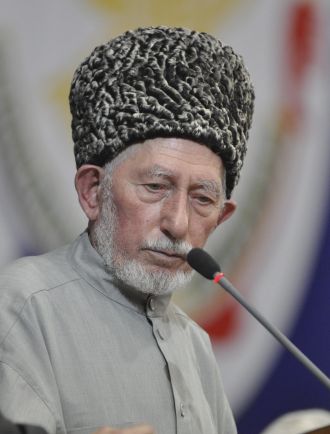 |
| Said Atsayev, assassinated this week |
2. Dagestan Border Guard Goes Berserk, Kills 7; Emirate Radicals Claim Responsibility. On the same day, a border guard in Dagestan shot and killed seven fellow servicemen at a border post “for no apparent reason” and was himself killed by others responding to the incident. The shooter, one Sgt. Ramzan Aliyev, fired at least 30 rounds at his comrades, who were a visiting unit from the Altai Republic. Six were injured in the incident. The Islamist separatist Caucasus Emirate movement claimed on its website that Aliyev, was in fact “a brave martyrdom-seeking infilitrator Mujahid of the Caucasus Emirate ... working as a puppet policeman.”
3. Islamist Rebels Seize Russian Armory in Dagestan, Killing 2 Soldiers. Then, again on the same day, a group of gunmen took over an Interior Ministry armory in Belidzhi village in Dagestan, killing two soldiers as they opened fire with automatic weapons and injuring three others. The Caucasus Emirate took credit for this as well, describing the incident thus on their website: “The Caucasian Mujahideen attacked from a forest a gang of Russian special police troops from Siberia which were stationed in the same village of Beliji. At least 1 Russian invader was killed and 5 others were seriously wounded.”
Caucasus Emirate Appoints New “Emir” for Dagestan Front. A new “emir” of the “Dagestan Front” was announced August 25th on a website of southwestern Russia’s Islamist separatist Caucasus Emirate movement. The Emirate uses the bureaucratic language of the old Ottoman Empire in its terrorist campaign to wrest the predominantly-Muslim fringes of the Russian Federation from Moscow’s control, with most of its activity being in the North Caucasus, including especially the Republic of Dagestan. The appointment, signed by Dokku Abu Usman (a.k.a. Dokku Umarov), so-called Emir of the Caucasus Emirate, designates Abu Muhammed to the post.
 |
| Abu Muhammad, new “emir” for Dagestan |
Azerbaijan Takes Over Investigation into Shiite Mosque Massacre in Dagestan. The Republic of Azerbaijan’s foreign ministry said on August 23rd that its embassy in Moscow is taking the lead in investigating an August 18th massacre at a Shiite mosque in Khasavyurt, in the Republic of Dagestan, in southwestern Russia’s North Caucasus region. In that incident (reported on last week in this blog), it is rumored, but not yet confirmed, that the one fatality and three of the eight injuries were of Azerbaijani citizens. The majority of Azeris are Shiite, while the radical Salafist terrorists whose violence has been plaguing the North Caucasus for years are mostly Sunni Muslims who view Shi’a Islam as heretical.
Kazakh Accused in Chechen, Russian Assassination Plots Switches Plea after Extradition. A citizen of Kazakhstan who was extradited on August 25th (after a brief delay reported on in this blog last week) from Ukraine to Russia to face charges of plotting to assassinate President Vladimir Putin has changed his testimony. Originally, the defendant, Ilya Pyanzin, had confessed, then changing his story and pleading innocence to Ukrainian authorities and shifting the blame onto his accomplice, Adam Osmayev, a Russian citizen from Chechnya. Now, Pyanzin is fingering Ruslan Madayev, a fellow militant who died in the explosion at the makeshift explosives factory in Odessa, Ukraine, which first led authorities to the plot in February. Osmayev is still in detention in Kyiv, Ukraine’s capital. Ukraine will not extradite him until the European Court of Human Rights hears his case. The two are also accused of plotting to kill Ramzan Kadyrov, the Moscow-appointed president of the Chechen Republic.
... AND FROM THE SOUTH CAUCASUS
... AND FROM THE SOUTH CAUCASUS
U.S., Azerbaijan Oppose Rohrabacher’s Plan to Split Azeri Region from Iran. The United States’ Department of State announced this week that it had received the July 26th letter (reported on last week in this blog) from California’s Rep. Dana Rohrabacher (a Republican legislator) recommending that the U.S. help the Azeri-dominated part of northwestern Iran secede and unify with the Republic of Azerbaijan, and that the department had responded. The spokesman would not elaborate on the reply except to state that “we support the principle of territorial integrity.” Azerbaijan’s foreign ministry, too, rejected the idea, with a foreign ministry spokesman, Elman Abdullayev, stating, “Despite the historical ties, similar cultural values, and family ties between Azerbaijan and Iran, we support the territorial integrity of Iran.” But support for Rohrabacher’s letter was voiced by Rahim Humbatov, head of the Azeri community in Ukraine’s Autonomous Republic of Crimea, and from
Donna D’Errico Updates from Noah’s Landing Spot. Meanwhile, there are updates from Donna D’Errico, the former nude model and Baywatch actress who has now famously left her fast-lane Hollywood lifestyle behind and committed herself to theological passions such as her expedition to the Turkish–Armenian–Iranian–Azerbaijani border region to investigate whatever might remain of Noah’s Ark (as reported on recently in this blog). On her blog site (http://www.donnaderrico.com/wordpress/), one can find numerous updates and details from her trip, including photos and video-blog entries.
 |
| Donna D’Errico interviewing a Kurdish elder and Noah’s Ark researcher in Yenidoğan, in Anatolia |
[Related articles: “The Armenian Genocide Debate: Turkey, Nagorno-Karabakh, and the Politics of Memory” (April 2012); “The World’s 21 Sexiest Separatists” (April 2012), featuring a profile of the Chechen rebel leader Akhmed Zakayev; “Massachusetts Recognizes Nagorno-Karabakh Republic!” (Aug. 2012); “Separatist Football Update: Carnage at a Dagestan–Netherlands Match ...” etc. (Aug. 2012); “That Creepy Underground Islamic Cult in Tatarstan? Turns Out It Was Just a Split-Level—and the Kids Were Fine” (Aug. 2012).]
[Also, for those who are wondering, yes, this blog is tied in with a forthcoming book, a sort of encyclopedic atlas to be published by Auslander and Fox under the title Let’s Split! A Complete Guide to Separatist Movements, Independence Struggles, Breakaway Republics, Rebel Provinces, Pseudostates, Puppet States, Tribal Fiefdoms, Micronations, and Do-It-Yourself Countries, from Chiapas to Chechnya and Tibet to Texas. Look for it in spring 2013. I will be keeping readers posted of further publication news.]


