Showing posts with label Lopota Gorge. Show all posts

Saturday, October 6, 2012

New Georgian President, South Ossetia Border Clash, Zhirinovsky on Dagestani Wedding Shootings: Caucasus Update, 30 September - 6 October 2012

The radicals’ envisioned Caucasus Emirate

NORTH CAUCASUS (CHECHNYA, INGUSHETIA, DAGESTAN)

13 Killed in Blasts, Sieges, Shoot-Outs in North Caucasus; Dagestan Synagogue Bombed.  In the Republic of Ingushetia, in southwestern Russia’s insurgency-ravaged North Caucasus region, four interior-ministry police were killed on October 3rd, in an incident that also wounded two others.  All of the attackers—suspected of belonging to the Caucasus Emirate movement, which aims to carve an independent state out of Russia’s predominantly-Muslim border regions, managed to flee.  Meanwhile, in neighboring Dagestan, also part of Russia and home to a Caucasus Emirate insurgency, a synagogue was damaged by a bomb planted on the night of October 3rd in Derbent, but there were no injuries.  The same day, in Buynaksk, a grenade attack on an interior-ministry facility killed two police officers.  Also in Dagestan, four rebels were killed by police on October 4th and the following morning, also in Buynaksk, police ended a siege of an apartment building where three rebels were barricaded by storming the entrances, killing all three.  The Caucasus Emirate’s not-always-reliable website claimed that a battalion of 10 to 30 Emirate mujahideen ambushed “a whole squad of Russian terrorists from military intelligence” near Dattykh, Chechnya, on October 3rd, prompting a day of Russian air attacks on Chechen rebel positions but, miraculously, without a single rebel casualty.  Curiously, no other news source has mentioned these events.

Zhirinovsky Demands Prison Terms for Trigger-Happy Dagestani Wedding Revelers.  Russian hostility toward ethnic minorities from the Caucasus resurfaced in Moscow this week as Russia’s ultranationalist firebrand Vladimir Zhirinovsky, a member of Russian parliament for the misnamed Liberal Democratic Party, called for the imprisonment of wedding-party revelers from southwestern Russia’s Republic of Dagestan who caused a stir on September 30th when they celebrated by firing weapons into the air just outside the Kremlin on September 30th.  The one Dagestani man charged was given the equivalent of a $60 fine.  Initial reports of the incident said that the partiers were aiming their live fire at passing cars, but that turned out to be inaccurate.  Nor was this among the more dramatic types of wedding celebration known in the predominantly-Muslim North Caucasus region, where elaborately staged and chillingly realistic “bride abduction” scenarios are sometimes acted out.  Zhirinovsky called the gunfire incident and other such incidents “signs of banditry” and called for prison terms.

Vladimir Zhirinovsky
SOUTH CAUCASUS (GEORGIA, ARMENIA, AZERBAIJAN)

Gunfire Exchanged at South Ossetia–Georgia Border on Eve of Tbilisi Power Shift.  Amid diplomatic tensions and back-and-forth accusations of military build-ups (reported on earlier in this blog) along the border between the Republic of South Ossetia and the country it unilaterally seceded from in 2008, with Russia’s military help, the Republic of Georgia, a South Ossetian border checkpoint came under live weapon fire on September 29th.  South Ossetia’s security forces claimed that they arrested a Georgian interior-ministry official, Mogol Tomiashvili, in connection with the incident.  A rifle and grenade launcher were seized from the official.  Later, after Georgia’s aggressively anti-separatist president, Mikheil Saakashvili, was defeated in an election this week, the deputy speaker of the South Ossetian parliament, Yuri Dzitstsoity, predicted that, “after the departure of Saakashvili into oblivion,” the new Georgian regime, under Bidzina Ivanishvili of the Georgian Dream–Democratic Georgia party, would recognize South Ossetia and Abkhazia as independent.

Bidzina Ivanishvili
Former Chechen Rebel Calls Lopota Gorge Siege Georgian “False-Flag Op.”  A former Chechen separatist now allied with the Moscow-appointed authoritarian government of Russia’s reconquered Republic of Chechnya claimed this week that the murky Lopota Gorge siege in late August in a Georgian canyon bordering Russia’s Islamist-infested Republic of Dagestan (reported on at the time in this blog) was in fact a Georgian “false-flag operation” in which Georgia’s government killed its own anti-Russian saboteurs.  The Georgian government’s position is that its interior-ministry forces ended a hostage crisis by killing eleven Islamists who had infiltrated Georgian territory from Dagestan.  The Chechen self-proclaimed whistleblower, Khizri Aldamov, however, claims, “Georgian president [Mikheil] Saakashvili’s plan was to send his own guys across the border into Russia, not the other way round, and then shoot them.  But there was no mission; this was a set-up.”  He says the operation was meant to paint Russia as harboring anti-Georgian terrorists while at the same time eliminate a rogue force that “knew too much” about Georgia’s supposed program of training jihadists to wreak havoc in Russia’s North Caucasus region.  (See another article from this blog looking at other allegations swirling around the Lopota Gorge events.)

[Also, for those who are wondering, yes, this blog is tied in with a forthcoming book, a sort of encyclopedic atlas to be published by Auslander and Fox under the title Let’s Split! A Complete Guide to Separatist Movements, Independence Struggles, Breakaway Republics, Rebel Provinces, Pseudostates, Puppet States, Tribal Fiefdoms, Micronations, and Do-It-Yourself Countries, from Chiapas to Chechnya and Tibet to Texas.  Look for it in spring 2013.  I will be keeping readers posted of further publication news.]

Saturday, September 15, 2012

Caucasus Update, 9-15 September 2012

NORTH CAUCASUS (CHECHNYA, INGUSHETIA, DAGESTAN)

Russian Army Accidentally Bombs Dagestani Boarding School in Snafu.  A Russian army unit on September 13th fired mortar rounds at a boarding school in Buinaksk, Dagestan, under the mistaken impression that it was a militant base.  No one was hurt, but the building was damaged.  A squad commander is considered responsible for giving the botched instructions.


The aftermath of last week’s bombing of a police funeral in Ingushetia
6 Dead, 4 Arrested in Week of North Caucasus Violence.  A helicopter gunship in the midst of a military operation crashed in the mountainous border region between the Chechen Republic and Republic of Dagestan, in southwestern Russia’s North Caucasus region, on September 8th.  At least four people were killed.  Also, in Dagestan, four men from the Khasavyurtovskaya criminal gang and one from the Novolaksky gang—both linked to Islamic insurgents—surrendered to police on September 9th, and in the Republic of Ingushetia the following day, investigators revealed that the suicide-bomber who killed eight police at a funeral last month (as reported at the time in this blog) was the son of a Chechen ex-policeman.  And on September 13th the federal National Anti-Terrorism Committee announced that Russian special forces had killed the head of the Kizlyar gang, an Islamist militia, in Dagestan.  The leader, Oki Nazhmudinov (nom de guerre: Bilal), was suspected of a 2010 terrorist attack that killed 12.  Another Kizlyar insurgent was also killed.


Oki Nazhmudinov
Chechen–Ingush Border Dispute Keeps Region on Edge.  On September 11th, according to the jihadist separatist Caucasus Emirate movement, the sound of mortar shells and gunfire could be heard September 11th in the Sunzha district of southwestern Russia’s Republic of Ingushetia, in the North Caucasus, but it could not be confirmed.  Sunzha, along with Malgobek, is one of two districts recently being claimed by the neighboring Chechen Republic, in a border dispute which is beginning to draw the attention of authorities in Moscow, who would like it tamped down.  Without Sunzha and Malgobek, Ingushetia would be split into two pieces and be without most of its current territory.

SOUTH CAUCASUS (GEORGIA, ARMENIA, AZERBAIJAN)

South Ossetian Deputy Defense Minister Survives Bomb Planted in Home.  The deputy minister of defense for the Republic of South Ossetia, an unrecognized puppet state of Russia carved out of the Republic of Georgia’s northwestern tip, survived an attempt on his life on September 13th when a bomb exploded in his apartment in Tskhinvali, the capital.  There were no injuries, though the target, Ibragim Gaseyev, was at home with his family.  The South Ossetian chief prosecutor, Merab Chigoev, speculated that the assassination attempt was “related to the fact that Gaseyev, who is a graduate of the military academy of the general staff of the Russian armed forces, is one of the well-trained South Ossetian military specialists.  We deem it possible that he was deliberately targeted with an assassination attempt by foreign special services.”

1 Russian Was Captured Alive in Lopota Gorge Operation, 5 Still at Large.  Scraps of information continued to leak out about last month’s murky special-forces operation against Islamists in the Republic of Georgia.  On September 8th, the Georgian ministry of the interior confirmed that one of the militants in the siege, in the Lopota Gorge near the border with Russia’s Republic of Dagestan, was captured alive but wounded and is recovering.  He is described as a Russian.  Five militants are still at large, and special forces are searching for them.

U.S. Lawmaker Pushes Draft Law on South Azerbaijan Secession.  Rep. Dana Rohrabacher, a United States congressman for California, has proposed a bill to the House Foreign Relations Committee advocating the secession of “South Azerbaijan,” the northwestern Azeri region of Iran, and its unification with the Republic of Azerbaijan to the north.  The information was provided to the public by Hüseyin Türkelli, chairman of the Center for Defense of Southern Azeri Turks.  (The Azeri speak a Turkic language and are sometimes called “Turks” or “Turcomans.”)

[Related articles: “South Ossetia Update: ‘Independent’ Elections in an ‘Independent’ State—Russian Style” (Dec. 2011), “The Armenian Genocide Debate: Turkey, Nagorno-Karabakh, and the Politics of Memory” (April 2012); “The World’s 21 Sexiest Separatists” (April 2012), featuring a profile of the Chechen rebel leader Akhmed Zakayev; “Massachusetts Recognizes Nagorno-Karabakh Republic!” (Aug. 2012); “Separatist Football Update: Carnage at a Dagestan–Netherlands Match ...” etc. (Aug. 2012); “That Creepy Underground Islamic Cult in Tatarstan? Turns Out It Was Just a Split-Level—and the Kids Were Fine” (Aug. 2012),  “Caucasus Update: Chechen-Ingush Border Conflict; Female Breakdancing Suicide-Bomber in Dagestan; South Azerbaijani Separatism; Is Georgia Supporting Islamism in Russia?” (Aug. 2012), “Lopota Gorge Questions, Azeri Axe-Murderer Pardoned, New N.K.R. Pres, Cossacks on Patrol: Caucasus Update, 2-8 September 2012” (Sept. 2012).]

[Also, for those who are wondering, yes, this blog is tied in with a forthcoming book, a sort of encyclopedic atlas to be published by Auslander and Fox under the title Let’s Split! A Complete Guide to Separatist Movements, Independence Struggles, Breakaway Republics, Rebel Provinces, Pseudostates, Puppet States, Tribal Fiefdoms, Micronations, and Do-It-Yourself Countries, from Chiapas to Chechnya and Tibet to Texas.  Look for it in spring 2013.  I will be keeping readers posted of further publication news.]

Saturday, September 8, 2012

Lopota Gorge Questions, Azeri Axe-Murderer Pardoned, New N.K.R. Pres, Cossacks on Patrol: Caucasus Update, 2-8 September 2012

A Georgian military checkpoint in the Lopota Gorge
TOP STORY:
QUESTIONS PERSIST OVER LAST WEEK’S MILITANT SIEGE
IN GEORGIA’S LOPOTA GORGE, NEAR DAGESTAN BORDER;
2 GEORGIANS, PLUS A BODYGUARD OF AKHMED ZAKAYEV’S, AMONG THE DEAD

Details continued to be sorted out in the murky militant siege last week (reported on in detail in this blog) in the Republic of Georgia’s Lopota Gorge, near the border with Dagestan.  Despite protestations to the contrary by the Georgian minister of the interior, Shota Khizanishivili, who spoke out this week to squelch rumors that Georgian citizens were among the 11 dead militants, a couple days later, identities of some of the 11 militants killed in the operation were being released.  Two—Aslan Margoshvili and Bakhaudin Kavtarashvili—were indeed Georgian citizens.  Another, Dukvakha Dushuyev, was a 44-year-old former bodyguard of the Chechen separatist leader Akhmed Zakayev.  Some witnesses have suggested that all of the dead may be Georgian.  From his exile in London, Zakayev vowed to get to the bottom of the incident.  A fourth was identified with a birthplace of Grozny, Chechnya, and three others were identified as from Chechnya and Ingushetia, which, like Dagestan, are Russian republics in the North Caucasus.  Pankisi Gorge, where the Georgian militants were from, is in Georgian territory—and was the site of an outbreak of violence in 2003—but home mainly to 5,000 Kists, who are a branch of the Chechen ethnic group, as well as to recent Chechen war refugees.  The original online rumors asserted that the Georgians were Wahhabis on their way to Syria to fight against Bashar al-Assad’s Shiite Alawite regime in the civil war there.  Wahhabis follow an extremist strain of Sunni Islam and dominate the Caucasus Emirate movement operating in Dagestan, in southwestern Russia.

NORTH CAUCASUS

Cossacks Patrolling Krasnodar to Defend Olympics Make 100 Arrests on First Day.  In southwestern Russia, the first of the promised Kuban Cossack detachments which are to protect Krasnodar Krai from Muslim ne’er-do-wells from the North Caucasus during the 2014 Olympics in Sochi were deployed September 1st in Krasnodar city, and they made more than 100 arrests on their first day.  The approximately 1,000 Cossacks are to aid police and defend the Olympic city against “non-Russians,” though they carry no firearms, only whips.  When the plan was announced last month by Krasnodar’s governor, Aleksandr Tkachev—who told a police gathering, “What you can’t do, the Cossacks can” (as reported at the time in this blog)—his overt racism and unilateral militarism drew fire from human-rights groups and even Russian Federation officials (also reported here).  And now there is talk of Cossacks performing police patrols in 18 other regions in Russia, including Moscow.  Krasnodar is a predominantly ethnically-Russian jurisdiction in an area where Muslim, Turkic-speaking Circassians were ethnically cleansed by successive czarist and Communist regimes over the past 150 years, and it is a focus of the Islamist separatist Caucasus Emirate movement.  It is also the site of an independent, Menshevik-allied Kuban People’s Republic, which existed for less than two years before being absorbed into the Union of Soviet Socialist Republics (U.S.S.R.) by Vladimir Lenin’s Red Army in 1920.

There’s never a Cossack around when you need one.
War of Words Continues in Chechen-Ingush Border Dispute.  The president of the Republic of Ingushetia in southwestern Russia’s North Caucasus region, Yunus-Bek Yevkurov, accused the president of the neighboring Chechen Republic, Ramzan Kadyrov, of provocation for calling Ingushetia’s Sunzha district and part of Malgobek district “indigenous Chechen territories.”  The two republics were joined together as the Chechen-Ingush Autonomous Soviet Socialist Republic during the Communist era, and their shared border in the new Russian Federation has never been fully demarcated.

3 Rebels, 6 Police Dead across South Caucasus in Muslim Insurgency.  Security forces in the Kabardino-Balkar Republic, in southwestern Russia’s North Caucasus region, on September 1st killed an insurgent who they claim was planning a major terrorist attack.  The man opened fire at a police checkpoint where he was being stopped for a vehicle inspection.  Bomb-making supplies, as well as a machine-gun and pistol, were later found in the car.  The following day, also at a police checkpoint, in the nearby Republic of Dagestan, two Islamist rebels opened fire rather than show their papers when their vehicle was stopped, but they were both killed by return fire.  Two Kalashnikovs were found in their car.  One of the men, Viktor Volkov, was wanted for attacks on police.  An attack by unidentified assailants on a police convoy near the village of Dattykh, in Ingushetia, on September 5th, killed six officers and injured several others.  A roadside bomb first struck, then the convoy came under fire from automatic weapons.  Other reports said it was a military convoy, with four soldiers killed, but it is probably the same incident.  Then, on September 6th, a policeman in Grozny, capital of the Chechen Republic, was killed by a bomb planted under his car.

Dagestani Interior Ministry Fills Out Portrait of New Caucasus Emirate Warlord.  The Republic of Dagestan’s pro-Moscow ministry of the interior this week released more information on the new “emir” for the Dagestan region named by the Islamist separatist Caucasus Emirate militia on August 25th (as reported last week in this blog).  Identified at the time as “Abu Muhammed”—which, we can now conclude, is only a nom de guerre—the ministry says he is, in fact, Rustam Aselderov, a 30-year-old from Russia’s predominantly-Buddhist Republic of Kalmykia.  Aselderov—who succeeds Ibragimhalil Daudov, who was killed on St. Valentine’s Day of this year at the age of 51—is already wanted on weapons charges and for racketeering, murder, and terrorist-related activities.  The ministry adds, “He is capable of any violence.”

Rustam Aselderov, a.k.a. Abu Muhammed
SOUTH CAUCASUS—GEORGIA

Dzhioyeva, Denied South Ossetian Presidency in 2011, Forms New Party.  The sidelined winner of the November 2011 presidential election in the de facto independent Republic of South Ossetia, Alla Dzhioyeva, this week registered a new political party, called Ossetia–Liberty Square.  Her victory in that vote was annulled in court, and her attempt to serve her term anyway resulted in her being savagely beaten by pro-Moscow thugs and forced to—at the time it appeared permanently—leave politics (discussed in detail at the time in this blog).

SOUTH CAUCASUS—ARMENIA & AZERBAIJAN

Armenia Cuts Ties to Hungary after Azeri Axe Murderer’s Pardon.  The Republic of Armenia on August 31st suspended diplomatic relations with the Republic of Hungary in anger over a Hungarian decision to allow a visit home by an Azerbaijani soldier who had murdered an Armenian military officer in 2004.  The murderer, Lt. Ramil Safarov, was immediately pardoned and released by Azerbaijan’s president, Ilham Aliyev, even after solemn Azerbaijani promises not to interfere with his life sentence.  Safarov had hacked the officer to death with an axe in Hungary during a NATO-sponsored language course over an alleged insult by the officer, Gurgen Markarian, to Azeri national feeling.  Safarov’s defense team pleaded emotional distress as a result of the still-simmering war between Armenia and Azerbaijan over the Nagorno-Karabakh region.  Safarov’s pardon and release were, however, praised by an exiled leader of the South Azerbaijan Liberation Party, which would like to unite Azerbaijan with the Azeri-populated region of northwestern Iran.

In California, which is home to more Armenians than Armenia itself,
Armenian-Americans marched the streets of Los Angeles to protest Ramil Safarov’s pardon.
These protesters carried Nagorno-Karabakh Republic flags.
New Nagorno-Karabakh President Sworn In.  The parliament of the unrecognized Nagorno-Karabakh Republic (N.K.R.) (a.k.a. Artsakh Republic) swore in Bako Sahakyan as the Armenian puppet state’s new president on September 7th in Stepanakert, the N.K.R. capital.  Diplomatic delegations from Abkhazia, South Ossetia, and Transniestria—all of them, like the N.K.R., unrecognized puppet states—were in attendance.

President Bako Sahakyan of the N.K.R.
Armenia Defers Recognition of Nagorno-Karabakh, Saying It’s “Ours Anyway.”  The deputy chair of the Republic of Armenia’s ruling party, the Republican Party of Armenia (R.P.A.), said this week that it was not yet time for Armenia to grant formal diplomatic recognition to the Nagorno-Karabakh Republic (N.K.R.), a.k.a. the Artsakh Republic—which Armenia and Russia brutally carved out of the Republic of Azerbaijan’s western flank after the collapse of the Union of Soviet Socialist Republics (U.S.S.R.) more than 20 years ago.  “We know that Nagorno-Karabakh is ours anyway,” the deputy, Galust Sahakyan, said, forgetting for the moment to pretend that the N.K.R. is not simply an Armenian puppet state.


[Related articles: “South Ossetia Update: ‘Independent’ Elections in an ‘Independent’ State—Russian Style” (Dec. 2011), “The Armenian Genocide Debate: Turkey, Nagorno-Karabakh, and the Politics of Memory” (April 2012); “The World’s 21 Sexiest Separatists” (April 2012), featuring a profile of the Chechen rebel leader Akhmed Zakayev; “Massachusetts Recognizes Nagorno-Karabakh Republic!” (Aug. 2012); “Separatist Football Update: Carnage at a Dagestan–Netherlands Match ...” etc. (Aug. 2012); “That Creepy Underground Islamic Cult in Tatarstan? Turns Out It Was Just a Split-Level—and the Kids Were Fine” (Aug. 2012),  “Caucasus Update: Chechen-Ingush Border Conflict; Female Breakdancing Suicide-Bomber in Dagestan; South Azerbaijani Separatism; Is Georgia Supporting Islamism in Russia?” (Aug. 2012).]

[Also, for those who are wondering, yes, this blog is tied in with a forthcoming book, a sort of encyclopedic atlas to be published by Auslander and Fox under the title Let’s Split! A Complete Guide to Separatist Movements, Independence Struggles, Breakaway Republics, Rebel Provinces, Pseudostates, Puppet States, Tribal Fiefdoms, Micronations, and Do-It-Yourself Countries, from Chiapas to Chechnya and Tibet to Texas.  Look for it in spring 2013.  I will be keeping readers posted of further publication news.]

Thursday, August 30, 2012

Caucasus Update: Chechen-Ingush Border Conflict; Female Breakdancing Suicide-Bomber in Dagestan; South Azerbaijani Separatism; Is Georgia Supporting Islamism in Russia?


Georgian interior-ministry snipers being transported to the crisis in Lopota Gorge this week
TOP STORY: ABDUCTION AND DEADLY SIEGE AT LOPOTA GORGE
SHINE LIGHT ON ABILITY OF ISLAMISTS TO OPERATE WITHIN GEORGIA

The Republic of Georgia’s ministry of the interior said August 29th that its forces had killed 11 militants in an attempt to free hostages in an anti-terrorist operation near the border with the Russian Federation’s Republic of Dagestan.  The ministry would not give further information, such as the nationality of the gunmen or whether they had crossed into Georgia from Russia; an entire mountain gorge was closed off to reporters and other civilians.  Two Georgian interior-ministry troops and a defense-ministry medic were killed and five other Georgians injured, the ministry said.  The crisis had begun days earlier when five young people from the area had gone missing while hiking near the Russian border.  Police discovered the kidnappers’ hideout and managed to free the five captives.  Brief video footage on television showed suspects with the tell-tale beards of Islamist radicals.  (Later, the Georgian interior ministry said that most of the militants were Dagestani but included some from Russia’s nearby Republic of North Ossetia–Alania.)

Map showing the location of Pankisi Gorge, site of an earlier 2003 battle with Islamists.
Lopota Gorge is to its east, along the Dagestani border.
Who were the culprits? Chechen nationalists operating within Georgia?  This part of Georgia has at times been home to a cell of a Chechen separatist government-in-exile, a member of which, Khizri Aldamov, earlier this year said that the armed group operated in northern Georgia with the support of Georgia’s president, Mikhail Saakashvili, and that Georgia was used as a launching area for terrorist attacks within Russia’s Chechen Republic.  Moreover, Aldamov alleged, the group, known as the Government of Ichkeria (this being an alternate name for Chechnya), whose leader, Akhyad Idigov, lives in France, sought to create a radical Islamist state in northern Georgia’s Pankisi Gorge region, by the Chechen border, to be called Pankisi Jamaat. Saakashvili, for his part, in a televised national address from his vineyard at his home, said, “We, the Georgian state, will not allow turmoil, instability, and violence on the territory of our neighboring country to spill over into Georgia in any form.”

... or Caucasus Emirate operatives who took a wrong turn?  Meanwhile, the Kavkaz Center website of the Caucasus Emirate movement, which seeks to establish a separate Islamic state out of the predominantly-Muslim areas of southwestern Russia and environs (though not out of predominantly-Christian Georgia), described “what really happened” at Pankisi Gorge as a Dagestani detachment of Emirate recruits passing through Georgian territory on their way to an operation within Dagestan, at which point Georgia dispatched troops, parleyed, and then refused to allow the Emirate recruits safe passage back into Dagestan.  The Emirate version of events also denies that hostages were taken.  The statement attributes Georgia’s overly aggressive response to a fear that the presence of Emirate operatives in Georgia will lead to a Russian pretext for another invasion of Georgia, as in the 2008 war over South Ossetia.


Mikheil Saakashvili meeting a survivor of the Lopota Gorge hostilities
NEWS FROM THE REST OF THE NORTH CAUCASUS ...

Chechnya Accuses Ingushetia of Border Encroachment, Asks Moscow to Mediate.  The Chechen Republic and the Republic of Ingushetia, two Russian republics in the war-torn North Caucasus region, are in a new conflict, over territory.  The Chechen government announced August 26th that it was appealing to the Russian Federation to resolve a lingering border-demarcation conflict which the Chechen Republic claims is allowing Ingush encroachments on Chechen territory.  Ramzan Kadyrov, the authoritarian Moscow-appointed president of Chechnya, said, “Whole villages and districts have been seized [by those] taking advantage of the Chechen people’s problems.  ...  These actions are provocative by nature.  The boundary line, which we have never drawn and in which we took no interest, is being pushed inside the Chechen Republic.”  Chechnya and Ingushetia used to be united, within the Russian Federative Soviet Socialist Republic, as the Chechen-Ingush Autonomous Soviet Socialist Republic, until Chechnya’s de facto secession from Russia in 1991 led to the establishment of Ingushetia as a separate republic.


Ingush Police-Funeral Bomber Got Wrong Victims, Emirate Admits; 4 More Rebels Killed.  The Caucasus Emirate militants that attacked a funeral in the Russia’s Republic of Ingushetia August 19th (as reported last week in this blog) admitted August 24th that they’d gotten the wrong victims.  Meanwhile, it was reported August 28th that four suspected militants were killed and two arrested in Malgobek, Ingushetia, in the ongoing attempt by security forces to sweep up those complicit in the attack.  In a “clarification” posted on the Emirate website http://hunafa.com, the “Mujahideen Command” for the vilayet (as provinces in the old Ottoman Empire were known) of “Ghalghayche” (i.e. Ingushetia) says the attack, which killed seven, had targeted Mukhazhir Yevloyev, chief of police for Malgobek, whom the Command calls “one of the worst enemies of Allah.”  Indeed, Ingush authorities had said that the policeman, killed the day before, whose funeral was attacked, Ilez Korigov, had been killed precisely in order to lure Yevloyev to the funeral.  However, the entire Malgobek police department was during the funeral busy hunting for Korigov’s assassins’ getaway car, so all the police there were from another detachment.  Meanwhile, the Emirate’s website announced August 28th that three civilians had been killed and at least two kidnapped in a “punitive raid” by Russian forces in Sagopshi, the village in the Malgobek region where the funeral massacre occurred.

Ingushetia’s Caucasus Emirate “Mujahideen Vilayat Command”
DAGESTAN’S BLOODY TUESDAY: 17 DEAD IN SUICIDE-BOMBING, BORDER-POST RAMPAGE, AND ARMORY TAKEOVER


Aminat Sapyrkin, the breakdancing suicide-bomber
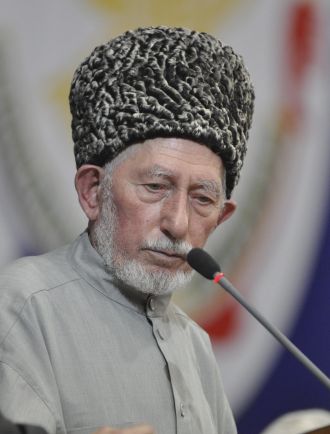
1. Female Suicide Bomber Blows Up Sufi Cleric in Dagestan, 6 Others.  First, a female suicide bomber disguised as a pilgrim seeking conversion to Islam killed a Sufi leader and six of his followers, including an 11-year-old boy, as well as herself, on August 28th.  The blast occurred in the village of Cherkei at the home of the leader, Said Atsayev, also known as Sheikh Said Afandi al-Chirkavi, who was 74 years old.  The bomber, identified now as Aminat Saprykina, was an ethnically Russian actress and breakdancer (!) and wife of an Islamist militant who had also been widowed by two successive Islamist militant husbands.  Sufism tends to be a politically moderate form of Islam, and is regarded as heretical by the Wahhabist brand of Sunni Islam followed by most Islamist militants in the North Caucasus.  A member of parliament for the extremist-right-wing Liberal Democratic Party of Russia, Yaroslav Nilov, who chairs a committee on religious organizations, blamed foreign enemies of Russia for the attack.

Said Atsayev, assassinated this week
2. Dagestan Border Guard Goes Berserk, Kills 7; Emirate Radicals Claim Responsibility.  On the same day, a border guard in Dagestan shot and killed seven fellow servicemen at a border post “for no apparent reason” and was himself killed by others responding to the incident.  The shooter, one Sgt. Ramzan Aliyev, fired at least 30 rounds at his comrades, who were a visiting unit from the Altai Republic.  Six were injured in the incident.  The Islamist separatist Caucasus Emirate movement claimed on its website that Aliyev, was in fact “a brave martyrdom-seeking infilitrator Mujahid of the Caucasus Emirate ... working as a puppet policeman.”

3. Islamist Rebels Seize Russian Armory in Dagestan, Killing 2 Soldiers.  Then, again on the same day, a group of gunmen took over an Interior Ministry armory in Belidzhi village in Dagestan, killing two soldiers as they opened fire with automatic weapons and injuring three others.  The Caucasus Emirate took credit for this as well, describing the incident thus on their website: “The Caucasian Mujahideen attacked from a forest a gang of Russian special police troops from Siberia which were stationed in the same village of Beliji.  At least 1 Russian invader was killed and 5 others were seriously wounded.”

Caucasus Emirate Appoints New “Emir” for Dagestan Front.  A new “emir” of the “Dagestan Front” was announced August 25th on a website of southwestern Russia’s Islamist separatist Caucasus Emirate movement.  The Emirate uses the bureaucratic language of the old Ottoman Empire in its terrorist campaign to wrest the predominantly-Muslim fringes of the Russian Federation from Moscow’s control, with most of its activity being in the North Caucasus, including especially the Republic of Dagestan.  The appointment, signed by Dokku Abu Usman (a.k.a. Dokku Umarov), so-called Emir of the Caucasus Emirate, designates Abu Muhammed to the post.

Abu Muhammad, new “emir” for Dagestan
Azerbaijan Takes Over Investigation into Shiite Mosque Massacre in Dagestan.  The Republic of Azerbaijan’s foreign ministry said on August 23rd that its embassy in Moscow is taking the lead in investigating an August 18th massacre at a Shiite mosque in Khasavyurt, in the Republic of Dagestan, in southwestern Russia’s North Caucasus region.  In that incident (reported on last week in this blog), it is rumored, but not yet confirmed, that the one fatality and three of the eight injuries were of Azerbaijani citizens.  The majority of Azeris are Shiite, while the radical Salafist terrorists whose violence has been plaguing the North Caucasus for years are mostly Sunni Muslims who view Shi’a Islam as heretical.

Kazakh Accused in Chechen, Russian Assassination Plots Switches Plea after Extradition.  A citizen of Kazakhstan who was extradited on August 25th (after a brief delay reported on in this blog last week) from Ukraine to Russia to face charges of plotting to assassinate President Vladimir Putin has changed his testimony.  Originally, the defendant, Ilya Pyanzin, had confessed, then changing his story and pleading innocence to Ukrainian authorities and shifting the blame onto his accomplice, Adam Osmayev, a Russian citizen from Chechnya.  Now, Pyanzin is fingering Ruslan Madayev, a fellow militant who died in the explosion at the makeshift explosives factory in Odessa, Ukraine, which first led authorities to the plot in February.  Osmayev is still in detention in Kyiv, Ukraine’s capital.  Ukraine will not extradite him until the European Court of Human Rights hears his case.  The two are also accused of plotting to kill Ramzan Kadyrov, the Moscow-appointed president of the Chechen Republic.

... AND FROM THE SOUTH CAUCASUS

U.S., Azerbaijan Oppose Rohrabacher’s Plan to Split Azeri Region from Iran.  The United States’ Department of State announced this week that it had received the July 26th letter (reported on last week in this blog) from California’s Rep. Dana Rohrabacher (a Republican legislator) recommending that the U.S. help the Azeri-dominated part of northwestern Iran secede and unify with the Republic of Azerbaijan, and that the department had responded.  The spokesman would not elaborate on the reply except to state that “we support the principle of territorial integrity.”  Azerbaijan’s foreign ministry, too, rejected the idea, with a foreign ministry spokesman, Elman Abdullayev, stating, “Despite the historical ties, similar cultural values, and family ties between Azerbaijan and Iran, we support the territorial integrity of Iran.”  But support for Rohrabacher’s letter was voiced by Rahim Humbatov, head of the Azeri community in Ukraine’s Autonomous Republic of Crimea, and from 

Donna D’Errico Updates from Noah’s Landing Spot.  Meanwhile, there are updates from Donna D’Errico, the former nude model and Baywatch actress who has now famously left her fast-lane Hollywood lifestyle behind and committed herself to theological passions such as her expedition to the Turkish–Armenian–Iranian–Azerbaijani border region to investigate whatever might remain of Noah’s Ark (as reported on recently in this blog).  On her blog site (http://www.donnaderrico.com/wordpress/), one can find numerous updates and details from her trip, including photos and video-blog entries.

Donna D’Errico interviewing a Kurdish elder and Noah’s Ark researcher in Yenidoğan, in Anatolia

[Also, for those who are wondering, yes, this blog is tied in with a forthcoming book, a sort of encyclopedic atlas to be published by Auslander and Fox under the title Let’s Split! A Complete Guide to Separatist Movements, Independence Struggles, Breakaway Republics, Rebel Provinces, Pseudostates, Puppet States, Tribal Fiefdoms, Micronations, and Do-It-Yourself Countries, from Chiapas to Chechnya and Tibet to Texas.  Look for it in spring 2013.  I will be keeping readers posted of further publication news.]

Subscribe Now: Feed Icon