Showing posts with label Ivanishvili. Show all posts

Thursday, October 3, 2013

Abkhazia & South Ossetia Won’t Compete in Sochi Olympics, I.O.C. Declares


It is now official: the International Olympic Committee (I.O.C.) has announced that it does not recognize the independence of two Russian puppet states in the South Caucasus region and that they therefore cannot participate in the 2014 Winter Olympics in Sochi, in the Russian Federation’s North Caucasus region.  A few days ago, the I.O.C. made known its decision on the two republics, the Republic of South Ossetia and the Republic of Abkhazia, in a letter to the government of the Republic of Georgia, which claims the two republics as its own territory.  But that does not mean that the controversy over the two territories—or related controversies exacerbated by an Olympics right in the Caucasus—are going away.


Abkhazia was an “autonomous republic,” and South Ossetia a lower-grade “autonomous oblast,” within the Georgian Soviet Socialist Republic during the years of Soviet rule.  After Georgia and Russia became independent states in 1991, Georgia descended into civil war.  In the midst of the fighting, South Ossetia and Abkhazia, with the help of Russian and Chechen mercenaries, ejected ethnic Georgians from their lands and achieved de facto independence—until August 2008, when Georgia’s president, Mikheil Saakashvili, decided to retake South Ossetia once and for all.  This prompted a Russian invasion, in the so-called South Ossetia War, or Five-Day War, which ended with a Georgian defeat and Russia’s elevation of both Abkhazia and South Ossetia to the status of fully recognized states.  Today, only a handful of nations recognize their sovereignty: Russia, along with two Latin American nations that do so only to piss off the United States—Venezuela and Nicaragua—and two Pacific mini-nations who do so only to secure lucrative aid deals with Moscow.  Those two, Tuvalu and Nauru, are also on the slightly longer list of nations that choose to recognize the Republic of China (Taiwan) instead of the People’s Republic of China, and for similar reasons.  (Nauru and Tuvalu are the third- and fourth-smallest countries in the world, respectively.)  The whole rest of the world considers Abkhazia and South Ossetia part of Georgia.
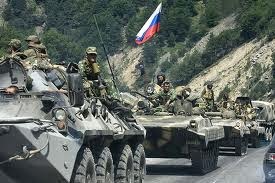
Russia invading South Ossetia in 2008
Georgian–Russian relations have been to some extent on the rocks ever since the fall of Communism, and Georgia has become the strongest U.S. and NATO ally in the Caucasus region, to Moscow’s consternation.  But when Sochi was chosen in 2007 as the site of the 2014 Olympics, Georgia was enthusiastic, seeing a Games in the Caucasus region as an avenue for improving relations with their giant neighbor to the north.  However, the South Ossetia War the following year changed all that, and Georgia responded with an all-but-complete severance of diplomatic ties and a decision to boycott the games.  Then, when an election last year (as reported at the time in this blog), brought a new coalition into power, the new prime minister, Bidzina Ivanishvili, quickly adopted a much more Kremlin-friendly foreign policy than the ferociously anti-Russian President Saakashvili.  Some even feared he might recognize Abkhazia and South Ossetia himself.  He didn’t do that—he still claims the republics—but he reversed course on the Olympics and decided that Georgia would attend.

Prime Minister Ivanishvili and President Saakashvili share a tender, candle-lit moment
During last year’s summer Olymics in London, Abkhaz and South Ossetian athletes competed under the Russian flag.  Both republics have a high proportion of ethnic Russians, and nearly all residents (ethnic Georgians, remember, were nearly all expelled) hold Russian passports as well as their own national passports, which are of very limited use abroad.  (There are not many direct flights from Sukhumi to Managua.)  But Georgia’s Olympic committee raised a stink (as reported at the time in this blog) when two wrestlers on the Russian team, an Abkhazian and a South Ossetian, were officially listed with birthplaces in their home republics as “Russia.”  (The Abkhazian and South Ossetian governments did not complain, funnily enough; those pseudostates are such Stockholm-Syndrome-addled barnacles on the ursine underbelly of the Russian empire that they must even themselves forget from time to time that they’re supposedly “independent.”)

Neither Abkhazia’s flag (with hand) nor South Ossetia’s (the white–red–yellow tricolor at center)
will fly at next year’s Winter Olympics.
Earlier this month, Georgian diplomats pounced when Russia tried to accredit Abkhaz and South Ossetian press teams for the Sochi games under their own republics’ rubrics.  So it was clear that Georgia would not put up with any attempt to give them their own Olympic teams, despite Ivanishvili’s conciliatory policy toward Moscow.


But the very location of the winter games remain a festering controversy.  Sochi is in the region of Circassia and is the site of one of the worst atrocities in the 19th-century Russian wars to conquer the predominantly-Muslim North Caucasus region.  The Ubykh subgroup of the Circassian nationality was dispersed and nearly eradicated; the last speaker of Ubykh died in Turkey in 1992.  Circassians, including a very vocal diaspora in Turkey, have agitated harder and harder to have this recognized as a genocide.  The Georgian government has already done so.  Many Circassians are pushing for their nation to be given a coherent territory as a constituent republic of the Russian Federation, rather than being split among three ethnically-mixed mini-republics, as they are now.  (Sochi is not within any of them; it is in Krasnodar Krai, which has an ethnic Russian majority.)  Other Circassians seek full independence.  And a hardened Islamist terrorist militia called the Caucasus Emirate has established a provisional government for all the northern Caucasus, including ethnic-Russian areas.  Emirate fighters have turned places like Dagestan, Kabardino-Balkaria, and Ingushetia into veritable war zones, with car-bombs, ambushes, and assassinations on an almost weekly basis.  (While blogging on the London Olympics last year, I listed the Circassian issue as no. 1 among “10 Ethnonationalist Causes That Might Disrupt the [London] Olympics.”  Abkhazia and South Ossetia were no. 7.)

Activists demanding recognition of the Russian Empire’s genocide of Circassians
To complicate matters, the Abkhaz ethnic group is considered a branch of the Circassian nation as well, and Circassian Kabardins were among the first and fiercest fighters for Abkhaz independence after the Soviet Union dissolved.  But relations are not perfect: Abkhaz in Abkhazia, who are predominantly Christian (Muslim Abkhaz were mostly expelled in the 19th century), are looked on with suspicion by many Circassian nationalists, especially in light of their recent attachment to Russia.

Some nationalist visions of Circassia include Abkhazia; increasingly, many don’t.
In addition to the Abkhazia and South Ossetia questions, Circassian nationalists and their jihadi advocates (from whom most Circassians distance themselves) are promising to disrupt the Sochi games, and Moscow is busily training Cossacks to defend the games from Muslims, by any legal or illegal means necessary.

One map of the imaginary Caucasus Emirate; other versions cover an even larger area.
There won’t be any Circassian, Abkhaz, or South Ossetian Olympic teams in Sochi next year.  But their causes will be on display—and may set the region aflame again.

Russia’s president, Vladimir Putin, basked last year in a gold-medal victory
by the Team Russia judoku Tagir Khaybulaev,
who is a member of the Avar nationality from the Republic of Dagestan.
[Also, for those who are wondering, yes, this blog is tied in with a forthcoming book, a sort of encyclopedic atlas to be published by Auslander and Fox under the title Let’s Split! A Complete Guide to Separatist Movements, Independence Struggles, Breakaway Republics, Rebel Provinces, Pseudostates, Puppet States, Tribal Fiefdoms, Micronations, and Do-It-Yourself Countries, from Chiapas to Chechnya and Tibet to Texas.  Look for it some time in 2013 or 2014.  I will be keeping readers posted of further publication news.]

[This article was modified on Oct. 4, 2013, to correct an error in which Ivanishvili was erroneously referred to as president instead of prime minister.]

Saturday, October 6, 2012

New Georgian President, South Ossetia Border Clash, Zhirinovsky on Dagestani Wedding Shootings: Caucasus Update, 30 September - 6 October 2012

The radicals’ envisioned Caucasus Emirate

NORTH CAUCASUS (CHECHNYA, INGUSHETIA, DAGESTAN)

13 Killed in Blasts, Sieges, Shoot-Outs in North Caucasus; Dagestan Synagogue Bombed.  In the Republic of Ingushetia, in southwestern Russia’s insurgency-ravaged North Caucasus region, four interior-ministry police were killed on October 3rd, in an incident that also wounded two others.  All of the attackers—suspected of belonging to the Caucasus Emirate movement, which aims to carve an independent state out of Russia’s predominantly-Muslim border regions, managed to flee.  Meanwhile, in neighboring Dagestan, also part of Russia and home to a Caucasus Emirate insurgency, a synagogue was damaged by a bomb planted on the night of October 3rd in Derbent, but there were no injuries.  The same day, in Buynaksk, a grenade attack on an interior-ministry facility killed two police officers.  Also in Dagestan, four rebels were killed by police on October 4th and the following morning, also in Buynaksk, police ended a siege of an apartment building where three rebels were barricaded by storming the entrances, killing all three.  The Caucasus Emirate’s not-always-reliable website claimed that a battalion of 10 to 30 Emirate mujahideen ambushed “a whole squad of Russian terrorists from military intelligence” near Dattykh, Chechnya, on October 3rd, prompting a day of Russian air attacks on Chechen rebel positions but, miraculously, without a single rebel casualty.  Curiously, no other news source has mentioned these events.

Zhirinovsky Demands Prison Terms for Trigger-Happy Dagestani Wedding Revelers.  Russian hostility toward ethnic minorities from the Caucasus resurfaced in Moscow this week as Russia’s ultranationalist firebrand Vladimir Zhirinovsky, a member of Russian parliament for the misnamed Liberal Democratic Party, called for the imprisonment of wedding-party revelers from southwestern Russia’s Republic of Dagestan who caused a stir on September 30th when they celebrated by firing weapons into the air just outside the Kremlin on September 30th.  The one Dagestani man charged was given the equivalent of a $60 fine.  Initial reports of the incident said that the partiers were aiming their live fire at passing cars, but that turned out to be inaccurate.  Nor was this among the more dramatic types of wedding celebration known in the predominantly-Muslim North Caucasus region, where elaborately staged and chillingly realistic “bride abduction” scenarios are sometimes acted out.  Zhirinovsky called the gunfire incident and other such incidents “signs of banditry” and called for prison terms.

Vladimir Zhirinovsky
SOUTH CAUCASUS (GEORGIA, ARMENIA, AZERBAIJAN)

Gunfire Exchanged at South Ossetia–Georgia Border on Eve of Tbilisi Power Shift.  Amid diplomatic tensions and back-and-forth accusations of military build-ups (reported on earlier in this blog) along the border between the Republic of South Ossetia and the country it unilaterally seceded from in 2008, with Russia’s military help, the Republic of Georgia, a South Ossetian border checkpoint came under live weapon fire on September 29th.  South Ossetia’s security forces claimed that they arrested a Georgian interior-ministry official, Mogol Tomiashvili, in connection with the incident.  A rifle and grenade launcher were seized from the official.  Later, after Georgia’s aggressively anti-separatist president, Mikheil Saakashvili, was defeated in an election this week, the deputy speaker of the South Ossetian parliament, Yuri Dzitstsoity, predicted that, “after the departure of Saakashvili into oblivion,” the new Georgian regime, under Bidzina Ivanishvili of the Georgian Dream–Democratic Georgia party, would recognize South Ossetia and Abkhazia as independent.

Bidzina Ivanishvili
Former Chechen Rebel Calls Lopota Gorge Siege Georgian “False-Flag Op.”  A former Chechen separatist now allied with the Moscow-appointed authoritarian government of Russia’s reconquered Republic of Chechnya claimed this week that the murky Lopota Gorge siege in late August in a Georgian canyon bordering Russia’s Islamist-infested Republic of Dagestan (reported on at the time in this blog) was in fact a Georgian “false-flag operation” in which Georgia’s government killed its own anti-Russian saboteurs.  The Georgian government’s position is that its interior-ministry forces ended a hostage crisis by killing eleven Islamists who had infiltrated Georgian territory from Dagestan.  The Chechen self-proclaimed whistleblower, Khizri Aldamov, however, claims, “Georgian president [Mikheil] Saakashvili’s plan was to send his own guys across the border into Russia, not the other way round, and then shoot them.  But there was no mission; this was a set-up.”  He says the operation was meant to paint Russia as harboring anti-Georgian terrorists while at the same time eliminate a rogue force that “knew too much” about Georgia’s supposed program of training jihadists to wreak havoc in Russia’s North Caucasus region.  (See another article from this blog looking at other allegations swirling around the Lopota Gorge events.)

[Also, for those who are wondering, yes, this blog is tied in with a forthcoming book, a sort of encyclopedic atlas to be published by Auslander and Fox under the title Let’s Split! A Complete Guide to Separatist Movements, Independence Struggles, Breakaway Republics, Rebel Provinces, Pseudostates, Puppet States, Tribal Fiefdoms, Micronations, and Do-It-Yourself Countries, from Chiapas to Chechnya and Tibet to Texas.  Look for it in spring 2013.  I will be keeping readers posted of further publication news.]

Subscribe Now: Feed Icon