Showing posts with label Baluchistan. Show all posts

Sunday, February 12, 2012

The Week in Separatist News, Feb. 12-18, 2012

AFRICA


100 Tuaregs Executed in Mali.  Media are quoting France’s Minister of French Cooperation, Henri de Raincourt, as reporting that over a hundred Tuareg separatists were executed by Mali’s military in Aguelhok, in the northern Azawad region, which is trying to establish a separate Tuareg republic.  “We’re talking about 100 people who were captured and executed in cold blood,” Raincourt said after returning from a fact-finding mission in Mali.  “The execution method was similar to those used by al-Qaeda.  Some had their throats cut, others were killed by shots to the head—barbaric methods.”  (See my recent blog post on the Tuareg rebellion.)


President Wade Campaigns in Casamance.  The octogenarian president of SenegalAbdoulaye Wade—who has been dogged by legal disputes and a popular uprising over his plans to run for a third term this year—took his re-election campaign to the secessionist Casamance region this week.  He offered the southern separatists a new three-point peace plan he calls DDP: “disarmament, demining, and projects.”  Casamance’s decades-old civil war erupted into violence again late last year, and four soldiers were killed by rebels there on Feb. 13.  Before his election in 2000, Wade promised to end the conflict within a hundred days.  (Casamance and other north–south splits in Africa’s larger Sahel region were discussed earlier this month in this blog.)


President Abdoulaye Wade with Paris Hilton

Kenyan Leader Reaches Out to Mombasa Rebels.  The president of KenyaRaila Odinga, visited Kwale in Coast province on Feb. 12th to try to reach out to the banned Mombasa Republican Council (MRC), which wants the province to secede from Kenya.  The MRC argues that the provincial capital, Mombasa—where Muslim and Arab influences are stronger than elsewhere in the country—was originally part of the Sultanate of Zanzibar and was attached to Kenya illegitimately.  (Zanzibar, to the south, was one of two colonies, the other being Tanganyika, that merged after independence as the United Republic of Tanzania, in 1964.)  Previously, the Kenyan government had tried to link the MRC to Al-Qaeda.

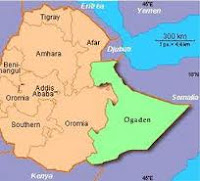
Ethopia’s Ogaden Turn to International Court.  The Ogaden Somali Community in Ethiopia filed a complaint against the Ethiopian government with the International Criminal Court (I.C.C.) at its offices in South Africa.  The complaint sites displacement of communities, confiscation of livestock, and unlawful imprisonment and torture of civilians.  The Somali-speaking Ogaden people inhabit a large desert area including part of the Somalia–Ethiopia border.  Somalia, which included Ogaden while it was a colony of Italy, tried to retake the territory in the late 1970s but lost to an Ethiopian military backed by the Soviet Union and Cuba.  Today the Ogaden National Liberation Front is trying to secure independence for the territory or attach it to the Republic of Somalia.  Ethiopia is not a signatory to the I.C.C., so the Ogaden complaint, even if taken up, may have little effect.  (See my recent blog post on Ethiopia’s separatist divisions.)

South Sudan Accuses North of Bombing Border Town.  The two Sudans seemed to inch closer to open war, with peace talks breaking down and, on Feb. 14th, the Republic of South Sudan accusing the Republic of Sudan of bombing Jau, a town in the disputed border region of South Kordofan and site of a massacre in December 2011.  The Republic of South Sudan seceded from the Republic of Sudan in July 2011, with international blessing, but with the status of several border provinces left undefined.

Bodies Wash Ashore in Somaliland.  Twenty-four badly decomposed corpses and seven miserable apparent shipwreck survivors washed ashore on a beach in the Sanaag region of Somaliland this week, apparently after trying to seek refuge in Yemen, across the Gulf of Aden.  The Republic of Somaliland is a de facto independent parliamentary democracy administering what the rest of the world calls the northwestern arm of the “failed state” of the Republic of Somalia.  The beach where the bodies washed ashore is in a self-governing but ideologically pro-Somalia-unionist clan fiefdom called the Sool, Sanaag, and Cyn State of Somalia, comprising parts of eastern Somaliland and parts of western Puntland, another de facto independent republic.  The discovery of the bodies came as Somaliland delegates began departing for a London conference on the decades-old Somalia crisis.  The delegates’ claim that their unrecognized state is a model of stability amidst the Horn of Africa’s chaos may be complicated by the apparent willingness of some of its citizens to flee in makeshift boats through pirate-infested, storm-tossed seas for better opportunities in a war-torn dictatorship.  Initial Somaliland reports say the dead were “Somali”—possibly meaning from Somalia proper rather than Somaliland—but this has not been clarified.


Puntland’s President Pledges Unity.  First reports of a meeting in Puntland of leaders from different parts of the formerly unified Republic of Somalia are quoting the president of the de facto independent Puntland State of Somalia, Abdirahman Mohamud Farole, as saying that Somalis need to set aside differences and work toward establishing a strong and democratic Somalia.  This represents a note of optimism, ahead of Thursday’s conference on Somalia in London, that Puntland may try to reenter the fold of a Mogadishu-based government.

Ghanaians Threaten Secession over Gas Project.  The Bonyere Citizens Association, representing a town in extreme southwestern Ghana, have reacted to news that a planned gas processing plant, Ghana’s first, may be built not in Bonyere but in a nearby town by threatening to secede from Ghana and join nearby Côte d’Ivoire (a.k.a. Ivory Coast).  Both Bonyere and the other town, Atuabo, are dominated by the Nzema ethnic group.

EUROPE


Cameron Pleads with Separatist Scots in Edinburgh.  The prime minister of the United Kingdom, David Cameron, visited Scotland this week to meet with Alex Salmond, head of the Scottish National Party and Scotland’s First Minister and call for unity.  A referendum for separation is planned for 2014, but Cameron would like for it to be held earlier, so that the S.N.P. has less time to try to raise the current level of support for secession, which is currently at about a third of the Scottish public.  Meanwhile, Scottish diplomats have taken up the issue of remaining in the European Union with bureaucrats in Brussels, but legal experts there have said that there is no precedent and no guarantee.

David Cameron and Alex Salmond this week

Minority Serbs Reject Kosovo’s Rule in Referendum.  Serbs in a border region of the partially recognized Republic of Kosovo voted overwhelmingly in a non-binding referendum held Feb. 14-15 to reject Kosovar rule.  The no votes were a stunning 99.7%.  Europe and much of the world are split over recognition of the 1999 United States– and NATO-sponsored secession of Serbia’s Kosovo region.  (Uganda this week became the 88th country to recognize Kosovo.)  The 35,000 Serbs, a minority in a nation dominated by ethnic Albanians, prefer to remain part of the Republic of Serbia.   The Serbian government opposed the referendum, since its hopes for eventual membership in the European Union depend on peaceful resolution of the Kosovo issue.  (See a recent blog post discussing this week’s Kosovar and Latvian referenda.)

The flags of Albania and Kosovo

Russian an E.U. language?  In Latvia, on the eve of a Feb. 18th referendum, underway as this blog is being written, on whether to make Russian—spoken by a third of Latvia’s population—an official language of the country, an ethnically-Russian member of European Parliament for Latvia has raised the possibility that, if the referendum passes, Russian could also become an official language of the European Union.  The legislator, Tatjana Zdanoka, of the Green Party, points out that in addition to Latvia’s more than a half million Russians, there are 9 million native Russian-speakers scattered throughout the E.U.  Currently the E.U. recognizes 23 official languages—into which all E.U. business must be translated—including some, like Irish Gaelic and Maltese, that have vanishingly few monolingual speakers.  Some languages which have significant numbers of monolingual speakers, like Welsh and Catalan, are only “semi-official languages,” and others, such as Flemish (the Germanic variety spoken by half of Belgium, which the E.U. classifies as a dialect of Dutch) and Romany (the language of millions of Roma or “Gypsy” people), have no official status at all.  (And of course any attempt to make Turkish an official language in Cyprus would send Greece into a screaming hissy-fit that would make its tantrum over Macedonia’s name look like a brief pout.)  Russian would be the first official E.U. language whose eponymous home nation is not an E.U. member-state.  But a European Commission spokesman said that no country’s request to make one of its official languages an E.U. language has ever been turned down.  However, Latvian nationalists and Russophobes can take heart: with the voting already underway, even the Latvian electoral commission predicts that the referendum, which requires more yes votes than there are even Russians in Latvia, was doomed to fail.  (See a recent blog post discussing this week’s Kosovar and Latvian referenda.)

The flag of Latvia

Chechens Ask Hilary Swank to Show Them the Money.  The U.S. actress Hilary Swank’s embarrassment over attending an event hosted by Chechnya’s authoritarian, anti-separatist, Moscow-appointed ruler surfaced again this week.  Swank had had to apologize to the world after Human Rights Watch and others criticized her attendance (and that of the Belgian actor Jean-Claude Van Damme), in October 2011, of a 35th-birthday celebration and concert in Grozny for Ramzan Kadyrov, who is accused of using torture, abductions, and executions to suppress Chechen aspirations for an independent homeland free from Russia.  After initially praising Kadyrov’s “passion to make peace and to make something beautiful,” she later said she “deeply regretted” attending and promised to compensate by donating to a charity that serves the Chechen people.  But now Chechnya’s separatist leader, Akhmed Zakayev, who lives in exile in London, has said that Swank never donated the money.  He says that he is in touch with the heads of the charities he recommended, and that they have persisted in asking him when the money will show up.  Swank’s spokeswoman said that Swank had fulfilled the pledge, but declined to specify the recipients or amount.  Zakayev also reiterated doubts that Swank could have been as ignorant as claimed about who Kadyrov was and what he had done.  Elsewhere in the Caucasus, Kadyrov reported that 20 members of a criminal had been killed by his forces in the mountains between Chechnya and the lawless, warlord-run Republic of Dagestan—Dagestani sources also said 11 police were killed—and three separatist militants were reported killed in the Kabardino-Balkar Republic in the northwestern Caucasus.


Ramzan Kadyrov (left) and Hilary Swank (right) in Grozny in October 2011

BITS OF ASIA THAT LIKE TO PRETEND THEY’RE PART OF EUROPE

Turks Round Up Kurds.  Police in Turkey arrested 100 activists hoping to establish an independent Kurdistan, in coordinated raids in six cities on Feb. 13th, including Istanbul and Ankara, as well as Diyarbakyr, the Kurdish capital.  The dragnet targeted both the militant separatist Kurdistan Workers Party (PKK) and its political wing, the Union of Communities in Kurdistan (KCK).  Meanwhile, Turkish bombers attacked alleged PKK positions in the mountains of northern Iraq.  This comes as Turkish political world continues to reel from revelations that the central government had been secretly negotiating with Kurdish separatists.

South Ossetian President Describes Police Raid, May Quit Politics.  The de facto president of the de-facto-independent Republic of South Ossetia, Alla Dzhioyeva, continued to recover from a “hypertensive episode”—apparently, a stroke—which she suffered during a police raid on her headquarters last week, and says she will soon decide whether to leave politics.  In her first interview since the incident, she told a Russian reporter, “People with guns and in masks barged in, destroying the doors, furniture, and tried to take me away by force.  One grabbed me by the hands, others by the feet.  They picked me up and dragged me like an old, overripe watermelon.”  She also said she was hit on the hid with a rifle butt, then lost consciousness.  The police dispute her version of events.  Dzhioyeva won a presidential election in November, but the South Ossetian supreme court invalidated the results.  She had been serving her term nonetheless, till the raid.  In other developments, the Russian forces occupying South Ossetia have for the first time begun forming army units that include Ossetian recruits.  Nearly all the world’s nations, except for Russia and a handful of others, regard South Ossetia as an autonomous region within the Republic of Georgia, but the Georgian government has not administered the territory since losing to Russia in the 2008 South Ossetia War.  (See my blog post on the South Ossetian election crisis.)

Allia Dzhioyeva

Kidnappers Release Georgian Cleric in Abkhazia.  The Republic of Georgia’s Ministry of the Interior announced on Feb. 11th that it had negotiated the release of Mamuka Maisuradze, a.k.a. Father Iona, a Georgian Orthodox “priest-monk” who had been kidnapped in Georgia’s de facto independent Abkhazia region while visiting holy sites 25 days earlier.  The Georgian government is keeping mum about further details of the mysterious case.  Abkhazia denies that he was arrested by Abkhaz authorities for political activities, though it also seems no ransom was paid.  Georgia has also confirmed Abkhaz assertions that Maisuradze had been expelled from Russia in 2009 on charges of spying for Georgia and that he joined the Georgian Orthodox Church only two years ago.  Abkhazia, like South Ossetia, is recognized by most of the world as part of Georgia but has been functioning as an independent state since Russia expelled Georgian forces from the region in a 2008 war.

Terror suspect arrested after Abkhazia visit.  Meanwhile, just days after a foiled Feb. 13th assassination plot in Tbilisi against Israel’s ambassador to Georgia, the Georgian interior ministry announced that it had arrested a suspected terrorist in an unrelated incident.  The man, Bezhan Shakia, was arrested in Zugdidi, in Georgia’s Mingrelia region, after returning from a visit to Abkhazia.  Police later said the man had been planning a terror attack against a market in Zugdidi and accused him of being a Russian agent.

Georgia Cuts Ties to Tuvalu.  The Republic of Georgia has severed diplomatic relations with the fourth-smallest country in the world, a handful of Polynesian atolls called Tuvalu.  The cause was Tuvalu late last year becoming the sixth United Nations member state—and the third South Pacific island mini-state—to formally recognize Abkhazia and South Ossetia.  The two republics are recognized only by Russia, Venezuela, Nicaragua, Vanuatu, Nauru, and, now, Tuvalu.  They are also recognized by each other and by the similarly unrecognized Pridnestrovian Moldavian Republic (a.k.a. Transnistria) and Nagorno-Karabakh Republic.  The two Caucasian republics’ relations with the South Pacific are similar to that of the Republic of China (a.k.a. Taiwan): Taiwan and the People’s Republic of China will each not recognize states that recognize the other, but Taiwan has wooed small, impoverished Pacific nations with development aid in exchange for recognition, just as Russia has been doing on behalf of its client states South Ossetia and Abkhazia.  Taiwan has diplomatic relations with just 23 countries, nearly all of them island mini-states, including six in the South Pacific (Tuvalu and Nauru among them), São Tomé and Príncipe off the coast of West Africa, and ten nations in the Caribbean region.

Tuvalu

ASIA


Iraqi Sunnis Funnel Arms to Syrian Rebels.  The New York Times reports on a new wrinkle in Syria’s civil war: rebels in this predominantly Sunni Muslim country, trying to depose an Alawite Shi’a ruling family, are receiving arms and other assistance from the Sunni minority just over the border in Iraq.  During the height of Iraq’s sectarian civil war several years ago, some of these same Sunnis were receiving weapons from their co-religionists in Syria.  Syria’s looming Sunni takeover after the eventual fall of Bashar al-Assad, whenever it comes, will be an odd reversal: the 2003 fall of Iraq’s Saddam Hussein after a United States–led invasion removed a Sunni dictator from a country with a Shiite majority.  All of this is part of a widening Sunni–Shi’a conflict that has driven Arab Spring conflicts in Saudi Arabia, Yemen, and Bahrain, to say nothing of the Sunni Arab uprising in Iran’s Khuzestan region, by the Iraq border.  As I discussed in an earlier blog post on sectarian and regional dimensions to the Syrian conflict, as well as a more recent one on Iraq’s separatist tensions, Iran initially regarded Iraq’s shift to Shi’a rule as the potential key link a chain of Shiite Iranian client states stretching from Iran to the Hezbollah-controlled parts of Lebanon.  Iran’s frustration at seeing its ally Syria falling to a Sunni-led uprising is one of the reasons, the Times points out, that the Iraqi government has been so slow to join the West and its American allies in criticizing the Syrian regime: Iraq doesn’t want to be an Iranian client state, or part of its Shi’a crescent stretching to the Mediterranean, but it cannot afford to alienate its powerful neighbor.  The Syrian conflict’s geopolitical implications are beginning to become apparent as the international community cracks down on the Assad regime.


U.N. Rejects Kashmiri N.G.O. as Pakistani Front.  The United Nations’ Committee on Non-Governmental Organizations has denied a long-in-the-works application for observer status from the Kashmir America Council, reportedly on the grounds that it was receiving money from Pakistan’s brutal Inter-Services Intelligence (I.S.I.) spy agency.  The organization, founded in 1990 by Ghulab Nabi Fai, is one of many organizations lobbying for more autonomy and respect for human rights in the parts of Kashmir administered by the Republic of India.  The application had long been contested by the Indian government, while the organization itself has been investigated by United States federal authorities for its ties to I.S.I.  Meanwhile, riots erupted in Kashmir itself after a young man was either “gunned down without provocation” by an Indian soldier or killed by an accidentally firing weapon.  Within Kashmir there are militant pro-independence movements as well as movements to attach the territory to Pakistan.  Kashmir has been a territory in dispute among Pakistan, India, and China since British India was partitioned in 1947.

Reporter Found Dead in Aceh.  The same week as a journalist from the Czech Republic was arrested for covering a pro-independence march in Indonesia’s sealed-off West Papua region (see last week), an Indonesian reporter has been found dead in another separatist region, Aceh, on the northwestern tip of the island of Sumatra.  He was found in a ditch with face wounds and signs of lethal blows with a blunt object.  The reporter’s wife believes he was murdered for his investigatory work.

Flag of Aceh

Pakistani bombing blamed on Baloch Separatists.  Three people, including boys aged about 12, were killed and eight injured by a remote-control bomb planted near a police vehicle in a crowded goat market on Feb. 13th in southwestern Pakistan.  The Baluch Republican Army, which is trying to establish independence for Balochistan province have claimed responsibility.  Two days earlier, Pakistan’s military had told media that arms for the Baloch separatist struggle were flowing not only from India but from Afghanistan.  (See a blog post in which I listed Balochistan as one of ten separatist movements to watch in 2012.)

South Yemen Separatists Set Fire to Protest Camp.  Activists in the Republic of Yemen hoping to re-establish South Yemen as an independent country set fire on February 12th to a tent housing anti-government protesters in Aden, the port city that was the Marxist state’s capital before the two Yemens reunified in 1990.  Meanwhile, also in Aden, a man killed by his bomb while trying to plant it in a polling station was suspected of being a Southern separatist.  Elections are to be held on February 21st to replace President Abdullah Ali Saleh, but many southerners feel they would be better off as a separate country.

The flag of South Yemen

Tibetan Exiles Hint at Mass Action; Hundreds Arrested upon Return.  At an open forum hosted by several Tibetan human-rights groups at the nation’s exile headquarters in Dharamsala, India, speakers aired frustration over an inability to help Tibetans within the People’s Republic of China, where a recent wave of self-immolations by monks, as well as other protests, have led to a new crackdown.  A pro-independence activist is quoted as saying, “Although I don’t know in specific details, ... a big and effective campaign is in the schedule, possibly this month.”  Another said, “I am tired of candlelight vigils.”  A few days later, Chinese authorities have rounded up hundreds of returning Tibetan P.R.C. citizens returning home from Dharamsala, where they had attended religious events hosted by the Dalai Lama, according to Human Rights Watch.

The Dalai Lama

China Appoints Top Cop to Rule Area of Tibetan Unrest.  The Chinese government has appointed Liu Zuoming, a career law-enforcement bureaucrat, as Communist Party secretary for Aba prefecture, an ethnically-Tibetan area in Sichuan province that has been the site of many of the recent self-immolations and other actions protesting Chinese rule of Tibet.

OCEANIA

Maori Militants Tried in New Zealand.  In Auckland, trial proceedings began on Feb. 13th against four Maoris arrested after police in 2007 raided a military-style training camp in the hilly Te Urewere region of New Zealand’s North Island, a separatist hotbed.  The four are accused of plotting a violent separatist campaign against the New Zealand government, using Molotov cocktails, AK-47s, and other weapons.  The defendants reject all charges.

Accused Maori separatist Tame Iti arriving in court

NORTH AMERICA


Trudeau’s Son Backtracks from Pro-Separatist Comments.  Justin Trudeau, a Liberal member of Canada’s parliament and son of the revered former prime minister Pierre Elliott Trudeau, had to backpedal after public reaction to an interview in which he seemed to support Quebec’s independence.  He had said, in a French-language interview that was not immediately reported in the English press, that if the current conservative government in Ottawa were to reverse national policy on social issues such as abortion and same-sex marriage, then “maybe I would consider wanting to make Quebec a separate country.”  In a subsequent interview, he clarified his position, saying he would fight for Canada to his “last breath” and that it was the current prime minister, Stephen Harper, that was sowing division.

Justin Trudeau

Southern Mayor Retracts Week Honoring Black Separatists.  The mayor of Fayetteville, North Carolina, is scrambling to retract his town’s declaration of the week of January 8th as “Moorish American Week in Fayetteville” after realizing that the “Moorish-American” cause was associated with Black nationalists who reject the legitimacy of the United States government and refuse to pay taxes.  The mayor, Tony Chavonne, apologized and said he’d never heard of the group when he signed the proclamation.  The Moorish Science Temple of America was founded in the early twentieth century—in the same milieu that generated the Nation of Islam and similar groups—by Noble Drew Ali, an African-American (born January 8, 1886, in North Carolina—hence the choice of date) who claimed that an Egyptian magician declared him the reincarnation of Buddha, Jesus, and Mohammed and who subsequently composed his own version of the Quran, heavily influenced by Freemasonry, Rosicrucianism, and crackpot anthropology.  The Moorish Science Temple believes that the Americas were originally inhabited by “paleo-Negroid” races that predated American Indians and that therefore African-Americans are the true owners of the continent.  The Southern Poverty Law Center, which tracks hate groups such as the Ku Klux Klan and the Aryan Nations, derides the Moorish American movement as “Sovereigns in Black”—a reference to the extremist right-wing, anarcho-libertarian, and nearly all-white “sovereign citizen” movement.  Many cities have proclaimed Moorish American Weeks, including Chicago.

A Moorish Science Temple conclave in Chicago, 1928.


PRACTICALLY BLOODY ANTARCTICA

Falklanders Ask for Special Passports; MPs Plan Visit.  The government of the Falkland Islands has requested from its parent government in London for special passports that state “Falkland Islands” on the front.  Prompted by the recent escalation of Argentina’s claims on the South Atlantic territory, the new passports would indicate pride in being Falklanders while still emphasizing their status as part of the United Kingdom.  The move is being treated by the government in Buenos Aires as a further provocation, as is the planned arrival in the islands next month of the British parliament’s defense committee and of the H.M.S. Dauntless, an air-defense destroyer, to replace an older vessel.  (See my recent blog article on the Falklands conflict.)

Chilean Falklanders March against Embargo.  Members of the Falkland Islands’ Chilean community, joined by some native British Falklanders, held a demonstration in Stanley, the capital, to protest plans by the government of Chile to cancel the archipelago’s last regular air service to the South American mainland.  Most other Latin American and Caribbean states fall in behind the Argentine air-travel embargo on the colony, but Britain’s relations with Chile have tended to be warmer than with other South American states—a relationship dating back to Margaret Thatcher’s close personal friendship with the mass-murderer dictator Augusto Pinochet.

Chileans demonstrate in Stanley

Argentine Dockworks to Boycott English “Pirates.”  In Buenos Aires, the Argentine Confederation of Transport Workers, a longshoremen’s union, announced that, in response to U.K. “militaristic pretensions,” it will “boycott any vessel with the English flag, with the invented Falklands flag, or registered under any of the convenience flags from the English pirates (Bermuda, Cayman Islands, Gibraltar, Panama, Malta, etc.).”  The reference to the Falklands flag as “invented” suggests that the transport union believes that other flags, such as the Argentine national flag, either are naturally occurring or were created by God, or were generated automatically during mediumistic trances.  (The first vessel to defy the ban was the British Ruby, a British Petroleum natural-gas tanker which docked in Bahía Blanca, Argentina, under a flag from the Isle of Man.)


Sean Penn Sides with Argentines.  The U.S. actor Sean Penn has spoken out against what he calls the U.K.’s “colonialist, ludicrous, and archaic” claims to the Falkland Islands, which he calls the Islas Malvinas.  He spoke Feb. 13th while meeting with Argentina’s president, Cristina Fernández de Kirchner, on a visit to Uruguay.  The television personality Ben Fogle, a friend of Prince William and his new wife the Duchess of Cambridge, suggested that Penn should be fed to crocodiles for his comments.  In 2010, Penn called Venezuela’s authoritarian president, Hugo Chávez, a “model democrat” and suggested that journalists who called him a dictator should be imprisoned.

Separated at birth?  Sean Penn meeting on Feb. 13th with Uruguay’s president José Mujica

Saturday, February 11, 2012

The Week in Separatist News, Feb. 4-11, 2012

ASIA


U.S. lawmakers urge Baloch freedom.  This week, Republican members of the United States Congress’s Foreign Affairs Committee, including Louie Gohmert of Texas and Dana Rohrbacher of California, criticized the human-rights crisis in Pakistan’s separatist Balochistan province and called for more respect for Balochistan’s right to self-determination.  In reply, the government in Islamabad blamed the U.S. for fomenting the break-up of their country.  Indeed, it is rare for the Balochistan crisis to show up on American foreign-policy radar, since usually the U.S. turns a blind eye to its “ally” Pakistan’s human-rights abuses, but remember there is also a Baloch separatist movement just over the border in neighboring Iran, so perhaps the Pakistani government’s interests are being temporarily shunted aside in favor a more pressing foreign-policy goal.  After all, the U.S. and Israel already encourage Iran’s southwestern Khuzestan militants to stir up separatism in the nation.  The Baloch rebellion was on this blog’s recent list of ten separatist movements to watch in 2012.

A protester waving the flag of the Baloch separatist movement.
(An earlier blog post here erroneously used the flag of Pakistan’s Balochistan province
for the Baloch people’s flag.)

South Ossetian president hospitalized.  Alla Dzhioyeva, the disputed acting president of the de facto independent Russian Federation client state the Republic of South Ossetia (which most of the world considers part of the Republic of Georgia) suffered a “hypertensive episode”—i.e., possible heart attack?—during a police raid on her headquarters.  She is reported to be in “grave” condition.

State seal of the Republic of South Ossetia


More Tibetan self-immolations.  Tibetan exile groups are reporting a growing number of Tibetan monks in the People’s Republic of China immolating themselves to protest the Han-dominated Communist government’s hegemony and the occupation of Tibet.  Most of these immolations are occurring in ethnic-Tibetan-dominated areas in neighboring provinces like Sichuan, rather than in the more closely policed Tibetan “autonomous region” itself.

Protesters with the Tibetan national flag and a portrait of the Dalai Lama

Bombing in southern Thailand.  A truck bomb killed one in new reports of unrest in southern Thailand related to Muslim, ethnically Malay separatist rebels fighting to secede from Thailand.  This is in a southern border region which used to be part of an independent Malay sultanate before the Kingdom of Siam annexed it in 1909—now a Thai region bordering Malaysia.


Saudi Shiite demonstration turns lethal.  Saudi Arabia, the heartland of Sunni Islam, is no stranger to the Sunni–Shi’a conflicts that have been dividing countries like IraqSyria, Yemen, and Bahrain during the Arab Spring unrest.  Two more unarmed protesters demanding more rights for the kingdom’s Shi’a Muslim minority were shot by security forces in the past couple days, bringing the total to seven for the past twelvemonth.  The royal family blames the unrest on Iranian provocateurs.


AFRICA

Sudans resume talks.  The fledgling Republic of South Sudan and its former rulers the Republic of Sudan returned to the negotiating table this week to address ongoing disagreements over oil revenues and over the still disputed regions of Abyei, Blue Nile, and South Kordofan.  But armies are massed at the border, and some still predict all-out war.


Insurgency in northern Mali intensifies.  Mali’s neighbor Mauritania and its former colonial ruler France are registering growing concern with the latest Tuareg rebellion in northern Mali’s Azawad region that is gradually turning into a full-blown separatist civil war.  Malian forces are responding with particular ferocity to the uprising, including government bombing of rebel positions in Kidal.  Tuareg separatist fighters are mostly mercenaries who were formerly partisans of Moammar al-Qaddafi in Libya’s 2011 civil war, using leftover Libyan arms.  Meanwhile, the U.S. has postponed anti-terrorist military exercises in the region.  Tens of thousands of refugees have been fleeing to Mauritania, and the Malian government claims it would like to settle the conflict by April.  (The Tuareg war was discussed at length here in a recent blog post.)

The Tuareg region in North Africa

Somaliland pursues more legitimacy.  Resulting from a new unanimity amid its internal factions, the unrecognized but fully functioning government of Somaliland, in the northwest of what the international community considers a Somalia ruled from Mogadishu, has ended a boycott of pro-Mogadishu international institutions by sending a delegate for the first time to the London Somalia Conference in England.  In the long term, Somaliland’s parliament hopes this will lead to international recognition.  Meanwhile, Somaliland’s war with its own pro-Mogadishu separatists in the Buhoodle region on its border with Ethiopia—the self-governing clan fiefdom known as the Sool, Sanaag, and Cyn State—has intensified, leading to Somaliland sacking its military commander for his failures.  Also, five Europeans—from Germany, Hungary, and Austria—were killed in an as-yet-ill-understood incident in the separatist Afar region just over the border in Ethiopia.

Somaliland’s flag superimposed upon a shape showing its boundaries

More Christian–Muslim separatist tensions in Nigeria.  Radical Muslim Boko Haram separatists in northern Nigeria (discussed in a recent blog post) may not have yet come right out yet and demanded a separate state, but a northern Hausa Muslim policeman in southeastern Nigeria sparked interethnic violence by killing a Christian Igbo bus driver who was displaying symbols of the Movement for the Actualisation of a Sovereign State of Biafra, a left-over from the brutally crushed Biafra War of the late 1960s and early ’70s (discussed recently in this blog).

Pro-Biafra rioters in southeast Nigeria this week


EUROPE

A court in Germany has handed down a life term to a citizen of the partially recognized Republic of Kosovo who killed two U.S. servicemen in Frankfurt last year.  The 22-year-old, Arid Uka, is being described as an ethnically-Albanian radical Muslim who had been whipped into an anti-American frenzy by jihadist propaganda.  The case highlights some of the tensions in U.S. foreign policy in the southern fringes of the former East Bloc: the 1999 secession of Kosovo and its Albanian majority from the Republic of Serbia (then known as the Federal Republic of [what was left of] Yugoslavia) was sponsored by the U.S. and western European powers, but—like Chechnya or Dagestan—the tiny region is a conduit for fundamentalist anti-Western ideology seeping into Europe.

Arid Uka, Kosovar jihadist assassin


Pseudo-state flat broke.  The Pridnestrovian Moldavian Republic, a.k.a. Transnistria, the unrecognized pro-Moscow sliver of the ethnically-Romanian-dominated post-Soviet Republic of Moldovahas revealed that it has only $49,000 remaining in its state coffers.  It is still unclear whether this is the result of mismanagement or of embezzlement or both.  Recent talks to resolve Transnistria’s status bogged down (as discussed in this blog), with no resolution in sight.


OCEANIA

Czech photojournalist arrested in West Papua.  Indonesian police have reportedly arrested and detained a reporter from the Czech Republic (initial reports called him a tourist; he probably used a tourist visa) for photographing a pro-independence march on the governor’s mansion in Manokwari in Indonesia’s separatist West Papua region (discussed recently in this blog).  The marchers were displaying the banned Morning Star Flag of an independent Papua.  Meanwhile, Papuan separatists shot and killed a policeman on patrol.

Demonstrators with the West Papua movement’s “Morning Star Flag”


NORTH AMERICA

Resurgence of white separatism in Pacific Northwest.  The Seattle Times reports that a foiled plot to bomb a Martin Luther King, Jr., Day parade in Spokane, Washington, is a symptom of a rise in white separatist activity in the Pacific Northwest states of Washington, Oregon, Idaho, and western Montana.  These states have been at times the (half-seriously?) hoped-for all-white “homeland” imagined by white-supremacist hate groups like the Aryan Nations, the Vanguard Kindred, and the Covenant Sword and Arm of the Lord, which were mostly dispersed and enfeebled by federal crackdowns in the 1980s and ’90s.

Aryan Nations members with their organization’s flag


PRACTICALLY BLOODY ANTARCTICA

Young prince unwittingly restokes Falklands conflict.  Prince William, second in line to the throne of the United Kingdom, arrived for a tour of military duty in the U.K.’s South Atlantic territory of the Falkland Islands, a move the president of Argentina, which also claims the islands, calls a provocation.  A war of words between the two countries has ensued, detailed in a recent discussion in this blog.  The British and Argentine navies fought a brief war over the archipelago, which the British won handily, in 1982.  The U.K.’s position continues to be that Falklanders are free to join Argentina or become independent if they wish it, but the islanders overwhelmingly prefer remaining British.

Saturday, December 31, 2011

Ten Separatist Movements to Watch in 2012

2011 was a busy year for independence, secession, and autonomy movements—Palestine’s application for United Nations membership, the independence of the Republic of South Sudan, all the tumult of the Arab Spring including Libya being divided between rebel- and loyalist-controlled territories for much of the year, a regionally divisive election in the Democratic Republic of the Congo, the Kenyan invasion of Somalia’s Jubaland region, the death of the former president of Biafra, Basques in Spain laying down their arms, the weakening of the European Union by a currency crisis, more and more Tibetan monks immolating themselves, and a U.S. presidential candidate mocked for statements in support of Texan secession.  Some of those stories will persist into 2012, some have crested, and there will be new ones as well.  Here is my list of separatist movements to keep an eye on in the new year, listed here in order of increasing significance.  (Please suggest others in the comments section if you like.)

10. Flanders and Wallonia


As I reported on this blog earlier this month, Belgium—perennially divided by political fault lines that map the boundary between French-speaking Walloons and Dutch-speaking Flemings—ended nearly two years without a working government a few weeks ago in an attempt to address the European currency crisis.  The new Socialist prime minister, Emilio Di Rupi, is neither a Fleming nor a Walloon—he is an Italian raised in a Belgian orphanage—and hopes to be a uniter.  But now that Belgium is actually starting to do things and implement policies, there have been street demonstrations against expected austerity policies just as there are in Greece and elsewhere.  If the Di Rupi government falls, it will likely be replaced by a more pro-Flemish one.  Flemings, who tend to be more right-wing and more separatist than Walloons, dislike the foppish Di Rupi (continental Europe’s first openly gay prime minister) and resent his poor mastery of their language.  This may be the year Belgium finally splits apart.


A Francophone view of Belgian politics (the lion is Flanders, the rooster is Wallonia)

9. Baluchistan


Some of Pakistan’s divisions are well aired in the Western media—the dispute with India over Kashmir, the government’s half-hearted (to put it generously) war with Islamists in their lawless Waziristan region, and the corrosive effects of their intelligence service, ISI, on Pakistani politics.  But the dispute that has been taking the largest toll in this most fractious of all hodgepodge nations is the brutal government war against separatists in Baluchistan (also spelled Balochistan), Pakistan’s largest province, which covers 44% of its territory.  Nearly all parts of Pakistan have secessionist movements or have had them, including Punjab, Kashmir, and Sindh, and Waziristan is in the de facto control of local warlords.  But it is in Baluchistan that separatist national feeling is strongest.  The Baluch people, who speak a language related to Persian and utterly distinct from Pakistan’s official Urdu, never wanted to be part of Pakistan and still feel that their king sold them out in 1947.  Pakistan has put down several pro-independence uprisings there over the years, sometimes assisted by Iran, which has its own Baluchistan province over the border.  The ISI is widely seen responsible for the thousands of reporters, activists, their families, and others “disappeared” in recent months.  Human-rights observers are not having much luck getting the West to notice this ongoing “dirty war.”  The international community seems so worried about Pakistan’s nuclear arms falling into the wrong hands that they are willing to turn a blind eye to any atrocities that help preserve unity.  But sometimes oppression merely fuels separatism all the more.  If Pakistan ever does split apart, it will happen in Baluchistan first, and it will be bloody.

The flag of Baluchistan

8. Padania


The Euro Zone crisis has exposed many cultural rifts in the European Union, reinforcing stereotypes of thrifty, responsible, hard-working Northerners and lazy, welfare-dependent spendthrifts and coddled civil servants along the Mediterranean rim.  See #10 above for how this dynamic plays itself out in microcosm in Belgium; but it is also the motivating psychological and cultural force behind Italy’s Lega Nord per l’Indipendenza della Padania (Northern League, in English), founded in 1991 with the idea of separating Italy’s more industrialized, prosperous north from its (as northerners characterize it) dysfunctional, Mafia-ridden, impoverished south, where the capital is.  Padania is a more-or-less invented name for a northern Italian homeland, and it consolidates several previous autonomist movements identified with individual regions like Tuscany, Lombardy, and the South Tyrol.  Europe is full of such small regional movements, in places like Cornwall and Savoy and Lapland where there is no real hope of secession.  But the Northern League crowds out national parties in northern regions and is the main political party in Veneto and the second-largest in Lombardy.  In 2008 it joined Silvio Berlusconi’s center-right coalition government as a clinching junior partner, and this put the push for greater devolved federalism in Italy squarely on the table.  But then came the 2011 currency crisis.  Many Northerners shared the general northern European view that it was a culture of laziness exemplified in places like Greece, Spain, and southern Italy that created the Euro mess, and this galvanized separatist feelings.  At the same time, disputes over how to confront the crisis brought about Berlusconi’s downfall.  The new, more left-leaning government of Mario Monti left the right-wing Northern League out in the cold.  So, now, with the currency crisis as a galvanizing emergency and exile from coalition politics as a grudge that can be nursed, the Northern League may see 2012 as the year in which they flex their muscles and push their agenda for independence like never before.

The flag of Padania

7. West Papua


Indonesia, the world’s most populous predominantly-Muslim country, has always been full of restive ethnic groups and has always cracked down on them with an iron fist.  It took decades for East Timor, which Indonesia had illegally invaded after its Portuguese colonizers departed, to break free, which it did in 2002.  Aceh, on the northwestern tip of Indonesia’s northwesternmost major island, Sumatra, agitated for independence for decades as well, but those ambitions were swept away in the Indian Ocean “Boxing Day Tsunami” of 2004, which left Acehnese more dependent than ever on federal largesse and perhaps skeptical that they had a viable state.  But in many ways Indonesia’s fiercest separatists have been those of West Papua, or Irian Jaya, comprising the western half of the island of New Guinea (the eastern half being Papua New Guinea).  Initially, the departing Dutch colonizers agreed with Australia, which was running Papua New Guinea, to eventually reunite both halves of New Guinea as one state.  But Indonesia moved in precipitously to annex it in 1962, with the connivance of both the United Nations and the Kennedy Administration, a supporter of Indonesia’s anti-Communist dictator, Sukarno.  The Netherlands succeeded in inserting into the U.N. resolution a promise of an eventual referendum on independence, but, as with a similar promise to East Timor, Sukarno had no intention of keeping it.  In 1971, rebels declared a Republic of West Papua and wrote a constitution, but Indonesia cracked down on the separatists and sealed the province off.  For decades, West Papua has been mostly closed to foreigners, so it is hard to know exactly what form the repression is taking, but during 2011 violence escalated and more Indonesian troops are being sent in.  To all appearances, West Papua’s national aspirations have reached a boiling point.  Here is West Papua’s “Morning Star Flag,” which is banned in Indonesia; many of the shooting incidents in the West Papua violence begin with illegal hoistings of this banner by separatists.  To me it looks a bit Americophilic, no?


6. Kawthoolei


When Burma became independent from the U.K. in 1947, many of its minority peoples, with their own long histories as independent states, were given deferred promises that their national aspirations would be met.  The Shan and Karenni states were told that after ten years they could secede, but the Karen (a.k.a. Kayin), angry at having been overlooked by the British earlier on, boycotted discussions of the subject and got nothing.  Nor did a succession of dictatorial regimes (the current one calls the country Myanmar) have any intention of fulfilling what promises had been made.  For these and other reasons, the Karen have been the most militant, the crackdown on them has been the most grievous, and the Karen struggle for an independent state called Kawthoolei is sometimes called the oldest ongoing armed struggle in the world.  In 2011, cracks appeared in the Myanmar junta’s repression of dissent, and the U.S. secretary of state, Hillary Rodham Clinton, traveled to Rangoon (Yangon) in December 2011 as part of a series of negotiations to end Myanmar’s international isolation in exchange for some democratization.  It seems natural that freedom for Myanmar’s subject peoples should be on the agenda, especially for a secretary of state who helped usher South Sudan to independence.  Expect that if Karen autonomy is not on the agenda, the insurgency may intensify, and that, if it is, Burma may start to unravel—in a good way, of course.

The Karen national flag

5. Northern Nigeria


Those mourning Chukuwuemeka Odumegwu-Ojukwu, the Biafran separatist hero, in November 2011, recalled his dream of a federalized Nigeria, if not necessarily a dismembered one.  With Igbos in the southeast (Biafra would have been their homeland), Yorubas in the southwest, Hausas in the north, and scores of smaller national and tribal groups, this most populous of African nations, with more than half as many people as the U.S., never made much sense as a unitary country.  After the federal government put a bloody end to Biafra’s aspirations in 1970, would-be Nigerian separatists have largely toed the line.  Exploited Ogoni people in the oil-soaked Niger delta seeking autonomy and a share of their homeland’s natural wealth have been an exception, though not a particularly well organized one.  But in 2011 that seemed to be changing with the rise of Boko Haram, a radical Islamist organization operating in the predominantly Muslim northern states of Nigeria.  The above map shows the twelve of Nigeria’s 36 states that have already imposed sharia, Islamic law, on their own.  A little less than half of Nigerians are Muslim, the same proportion, roughly, that are Christian.  Most Muslims are in the arid north.  They are emboldened by some of the events of 2011—sub-Saharan Muslims in neighboring Mali and Mauritania aiding (sometimes as mercenaries) Moammar Qaddafi’s last stand against European powers in Libya, and a Western-sponsored partition of Sudan into a Muslim Arab north and a Christian and tribal south.  The Islamist uprising in Nigeria has been haphazard—there is no flag, no borders of a proposed state, not even a name for a state, no constitution—and has been led by a radical extremist terrorist organization called Boko Haram, whose full name means People Committed to the Propagation of the Prophet’s Teachings and Jihad but whose leadership is utterly unknown.  Boko Haram not only call Christians infidels worthy of death, but they reject the notion of evolution, the notion of a spherical Earth, and the Satanic decadent notion that the formation of rainclouds is a byproduct of evaporation.  Their methods have mostly been random murder.  In 2011, they claimed responsibility for terrorist incidents which killed nearly 500 people, including bombings of Christian churches.  Not all Hausas or northerners are separatists or fundamentalists, not by a long shot, but Nigeria is a mess, and Boko Haram could spark the first true attempt to break up Nigeria since Biafra.

The flag of the Hausa people

4. South Yemen


From 1967 to 1991, Yemen was two countries: the Arab Republic of Yemen, a.k.a. North Yemen (succeeding a Kingdom of Yemen that rose from the ashes of the Ottoman Empire in 1916), and the People’s Democratic Republic of Yemen, a.k.a. South Yemen (comprising the territory of the former British-ruled Aden Protectorate).  (To look at a map, you’d think they should be called West and East Yemen, but North Yemen’s capital, Sanaa, is close to due north of Aden, the southern capital.)  This division was intensified by the two Yemens’ becoming client states of opposing sides of the Cold War.  After the fall of Communism, North Yemen absorbed the Communist south (almost simultaneous with the Federal Republic of Germany’s absorption of the Communist east), to create the Republic of Yemen.  But the old border also mapped tribal divisions, and those remained, resulting in a brief civil war in 1994.  (Among other differences, North Yemen tends to be more predominantly Shiite, while South Yemen has more Sunnis.)  With the Arab Spring of 2011 and the people-power movement that removed Yemen’s long-time dictator Ali Abdullah Saleh from power, those divisions, and some old grievances, have returned to the fore.  Separatists are becoming a more prominent part of Yemen’s ongoing violence, and it is common to see militias dusting off their old South Yemeni flags in demonstrations.  South Yemen is high on my list of possible next members of the U.N.

The flag of South Yemen

3. Kurdistan


As I discussed in a recent blog post following the official end of the United States’ war in Iraq, there are legitimate fears that this is the moment when Iraq will beginning splitting up in earnest.  Already, with U.S. troops barely gone, Shiite Arab and Sunni Arab factions within the government seem close to a shooting war.  The U.S. never really tried to dismantle the sectarian militias that turned Iraq into a bloodbath during the mid-2000s under U.S. occupation; some of them continued to be useful.  A division of the southern two-thirds of Iraq into a Sunni homeland centered on Baghdad and a far-southern “Shiastan” will be long and bloody if it happens at all, but Kurdistan, in the north, has a far better chance of escaping with some form of sovereignty.  Kurdistan-in-Iraq already has many of the trappings of an independent state, and the Obama administration is already sort of treating it as a separate diplomatic entity in the region.  Much of this grows out of the autonomy they enjoyed under the protection of the U.S. “northern no fly zone” in the years between the last two Gulf Wars (1991-2003).  But the areas where Kurdish people live also extends into northwestern Iran, a sliver of northern Syria (see my earlier discussion of sectarian and ethnic dimensions to Syria’s civil war), and, most famously, a huge chunk of southeastern Turkey.  The Turkish government has done a fine job of keeping itself well outside the European definition of a civilized country with its brutal, almost genocidal suppression of Kurdish language, culture, and identity.  Turks will complain the loudest about any moves toward a Kurdish state in northern Iraq, and Turkish troops and bombers routinely foray across the border to attack alleged rebel positions in the mountains of northern Iraq.  But Turkey is no longer as strategic a country as it once was.  It used to be NATO’s bulwark against the Soviet Union in the Middle East and the state to whose quirks and preferences other NATO countries were willing to defer as they operated in the region.  But the Cold War is over, and Turkey’s relations with the West continue to sour, especially after two U.S.-led Gulf Wars.  If Iraq goes up in flames in 2012, as many expect, and Kurds try to declare independence, we will see how important it really is to cater to the Turkish government’s paranoia and prejudices.  My guess is: at the end of the day, not that important at all.

The flag of Kurdistan

2. South Sudan


But wait, didn’t the Republic of South Sudan already gain independence from the Republic of Sudan in July 2011?  Well, yes, and it is now firmly a member of the United Nations, but in reality the south’s decades-long war for secession from the Arab Muslim north is far from over.  When plans for Sudan’s referendum on separation were drawn up (the vote was held in January, with more than 98% choosing to secede), three areas were deliberately left out, with the idea that separate referenda would be held there later (though it’s now clear that won’t happen).  These were South Kordofan and Blue Nile provinces, and the Abyei district, all of them areas where the presence of oil and recent migrations and population shifts make it difficult and contentious to draw a precise border.  Fighting and even ethnic cleansing started occurring in Abyei before independence was even declared, and it has now shifted rather intensively to South Kordofan and Blue Nile.  All are currently under the control of the north, with its much more powerful military.  Ideally, the Sudans should learn how to cooperate—the south has the oil, and the north has the resources and coastline to get it to market—but a badly drawn frontier and a referendum that deferred all the difficult questions for later have resulted in a civil war that some fear may never end.  Look for some bloody fighting over this border well into 2012.

The flag of the Republic of South Sudan, on independence day

And finally, at number one, ...

1. Palestine


The biggie.  The idea in 1949 was that there would be two states in what was the British protectorate in Palestine: one for Palestinian Arabs and one for Jewish settlers.  We all know what happened next: Palestinians rejected the idea of sharing their homeland, Israel was established, Palestinians were made refugees in neighboring Egypt and Jordan, Israel’s neighbors tried to wipe it off the map, Israel prevailed and conquered bits of three neighboring countries as a security buffer, and over long years of rebellion—and the withdrawal of Egypt’s claims on the Gaza Strip and Jordan’s on the West Bank—these areas became first a de facto, then a semi-official, and increasingly a recognized State—sort of—of Palestine.  Palestine, with its self-governing, U.N.-recognized Palestinian Authority, was already a sovereign state in all but name by 2011, when it took the step, against Barack Obama’s stern advice to be more patient (sic!), of applying for membership in the United Nations.  The application passed the General Assembly, where all states have an equal vote, but stalled at the Security Council, where the major nuclear-armed states wield vetoes—here, most relevantly, the United States, Israel’s closest (some would say only) ally.  This was predicted, and the whole move was largely symbolic.  It has not had much effect on the ongoing sporadically violent relations between Israel and Palestine.  And there was already a large number of countries, and not just Muslim ones, that recognized Palestine back in 1988, when the Palestine Liberation Organization declared independence from its exile in Tunisia.  Moreover, nearly all Arab countries still refuse to recognize Israel.  So this is merely a new dimension to a very old stalemate.  But U.N. membership would change a lot.  It would make any movements by Israel against Palestine not simply infractions against U.N. resolutions but an attack by one state upon another—the very sort of thing that could authorize a vast international response, as in the Iraq–Kuwait War.  Israel, which encircles Palestine like a prison camp and reserves the right to attack it at any time, obviously wants to avoid that.  But now that U.N. membership is on the table and one by one countries are supporting it (western military powers like the Czech Republic, Iceland, and Luxembourg have already done so), this originally symbolic move may gradually prove, in 2012, to have been the game-changer.

Map showing the 128 countries that recognize Palestinian independence (note that Somaliland, South Sudan, and Eritrea refuse to recognize Palestine, just to piss off the countries they seceded from)

Happy new year!

[For those who are wondering, yes, this blog is tied in with my new book, a sort of encyclopedic atlas just published by Litwin Books under the title Let’s Split! A Complete Guide to Separatist Movements and Aspirant Nations, from Abkhazia to Zanzibar.  The book, which contains 46 maps and 554 flags (or, more accurately, 554 flag images), is available for order now on Amazon.  Meanwhile, please “like” the book (even if you haven’t read it yet) on Facebook.]


Subscribe Now: Feed Icon